
Judge, 1930-05-31 · page 15 of 36
Judge — May 31, 1930 — page 15: what you’re looking at
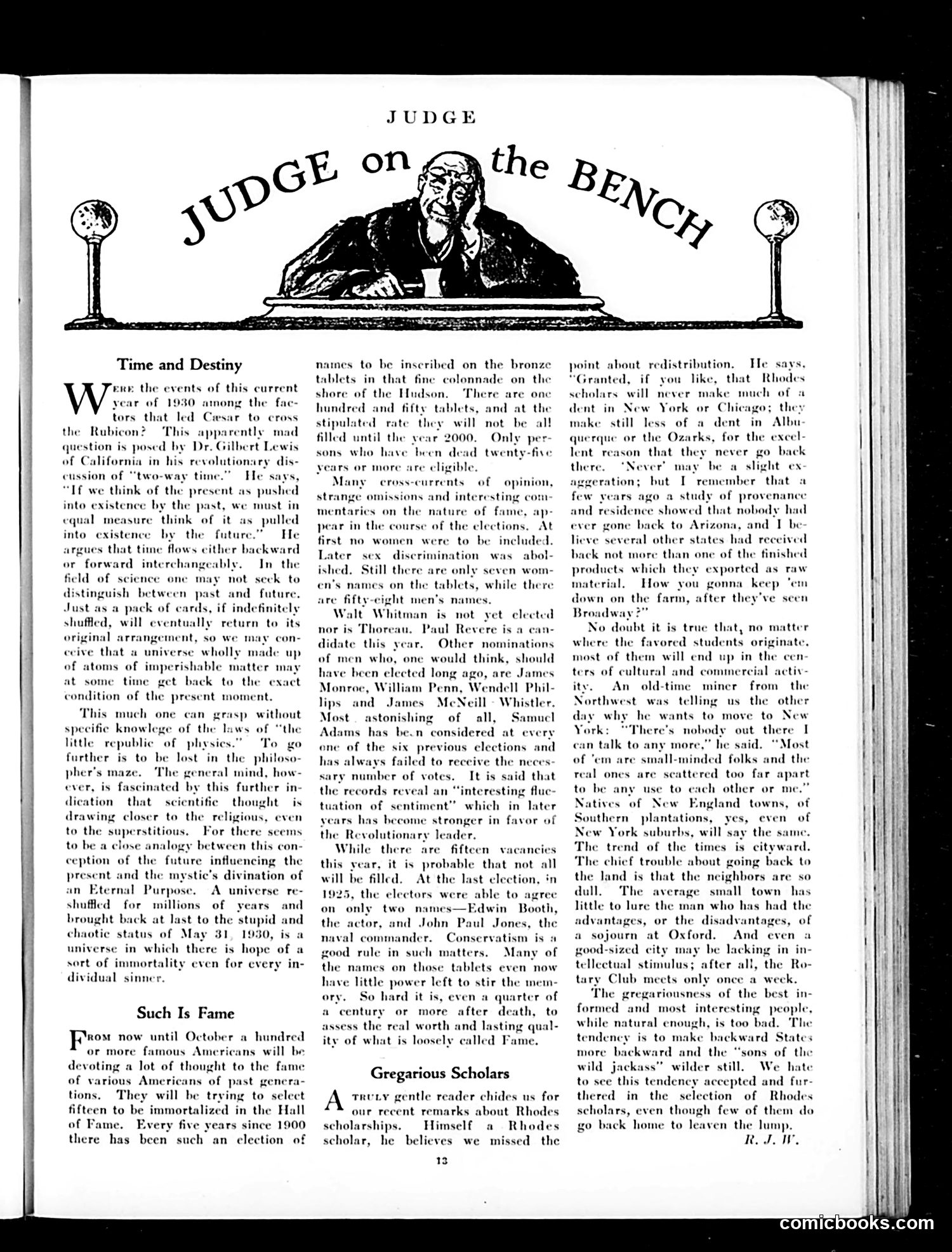
A restored page from Judge, 1930-05-31. Page through the whole issue in the reader above.
📄 Transcribed text from this page (OCR, searchable)
Machine-transcribed from the original scan — historical spelling and the odd misread are preserved.
Time and Destiny enk the events of this current Ws of 1930 among the fac- tors that led Cisar to cross the Rubicon? ‘This apparently mad question is posed by Dr. Gilbert Lewis of California in his revolutionary: dis- cussion of “two-way time.” He says, “If we think of the present as pushed into existence by the past, we must in equal measure think of it as pulled into existence by the future.” He argues that time flows cither backward or forward interchangeably. In the field of sciences y not seck to distinguish between past and future. Just az a pack of cards, if indefin shuffled, will ev ttually return to its rinent, so we may con- ceive that a universe wholly made up of atoms of imperishable matter m time get back to the ¢ condition of the present moment. at some This much one can grasp without knowlege of the laws of “the little republic of physics.” To go further is to be lost in the philoso- pher’s maze. The general mind, how- ever, is fascinated by this further in- dication that scientific thought — is drawing closer to the religious, even to the superstitious, For there seems to be a close analogy between this con ception of the future influencing the present and the mystic’s divination of an Eternal Purpose, A universe re- shuffcd for millions of years and brought back at last to the stupid and ic status of May 31. 1930, is a universe in which there is hope of a sort of immortality even for every in- dividual sinner. spec! Such Is Fame rom now until Octo yr more famous Am ing a lot of thought to the a hundred de of various Amer tions, ns of past generd They will be trying to sel ri ne: there has been such an election of cs to be inseribed on the bronze lets in that fine colonnade shore of the Hudson. There are one hundred and fifty tablets, and at the stipulated rate they will not be al! filled until the year 2000. Only per sons who have been dead twenty-five y on the rs or more are eligible. M stra cross-currents of opinion, we omissions and interesting com mentarics on the nature of far pear in the course of the elections, At first no women were to be included. Later sex discrimination was ished. Still there are only si en's abol- wom- ames on the tablets, while there are fifty-eight men’s names. Walt Whitman is not yet elected nor is Thoreau. Paul Revere is a didate this year. Other nomin of men who, one would think, should have been elected long ago, are James Monroe, William Penn, Wendell Phil- lips and James MeNeill - Whistler. Most. astonishing of all, Samucl Adams has be.n considered at every of the six previous elections and ways failed to receive the neces number of votes. It is said that the records reveal an “interesting fluc tuation of sentiment” which in later years has become stronger in favor of the Revolutionary leader. While there are fifteen vacancies this year, it is probable that not: will be filled. At the last ¢ 19: the elec on only two the actor, and John Paul Jones, the naval commander. Conservatism is good rule in such matters. Many of the names on those tablets even now have little power left to stir the mem- ory. So hard it is, even a quarter of a century or more after death, to ss the real worth and lasting qual- ity of what is loosel led Fame. Gregarious Scholars rrety gentle reader chides us for A our re arks about Rhod scholarships. nself a Rhodes scholar, he believes we missed the he about redistribution. He says, anted, if you like, that Rhodes scholars will never make much of a dent in New York or Chicago; thes make still less of a dent in’ Albu querque or the Ozarks, for the exeel- lent reason that they ne’ ‘ver’ may be a slight ex tion; but I remember that a xo a study of provenance and residence showed that nobody had ever gone back to Arizona, and I be lieve several other states had received hack not more than one of the finished products which they exported as material. How you gonna keep down on the farm, after they've scen Broadway?” o doubt it is trne that, no matter where the favored students originate, most of them will end up in the ecn ters of cultural and commercial activ- ity. An old-time miner from the Northwest. was telling us the other day why he wants to move to New York: “There's nobody out there I alk to any more,” he said. “Most of ‘em are small-minded folks and the real ones are scattered too far apart to be any use to cach other or me.” Natives of New England towns, of Southern + go back nh can plantations, yes, even of New York suburbs, will say the same. The trend of the times is yward, The chief trouble about going back to the land is that the neighbors are so dull. The avers small town has little to lure the man who has had the advantages, or the disadvantages, of a sojourn at Oxford. And ¢ good-sized city may be lacking in in- tellectual stimulus; after all, the Ro- tary Club meets only once a week. The gregariousness of the best in- formed and most interesting people, while natural enough, is too bad. The tendency is to make backward States more backward and the “sons of the wild jackass” wilder still. We hate to see this tendency accepted and fur- thered in the selection of Rhodes scholars, even though few of them do go back home to leaven the lump. RILW. comicbooks.com