
Judge, 1930-05-10 · page 26 of 36
Judge — May 10, 1930 — page 26: what you’re looking at
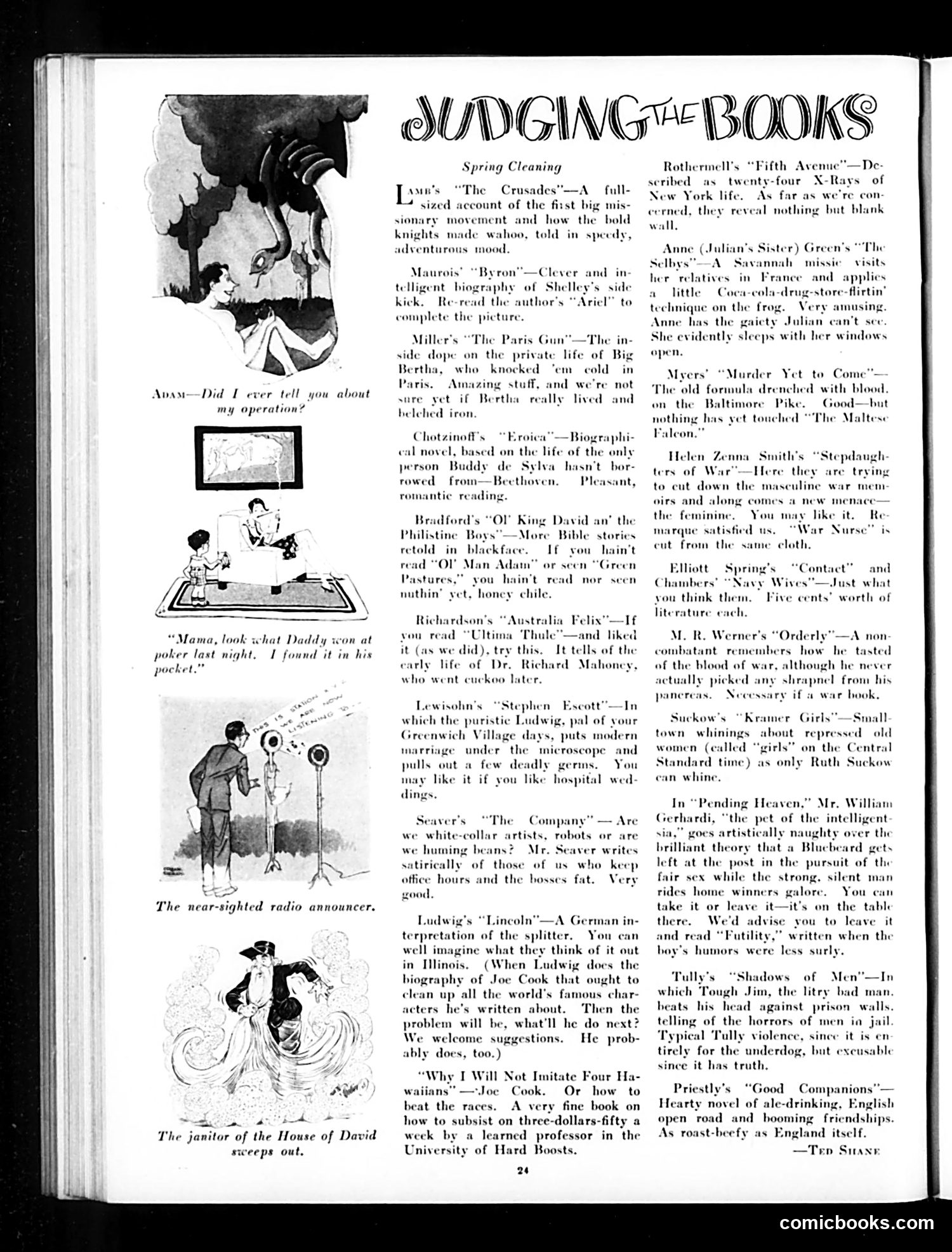
A restored page from Judge, 1930-05-10. Page through the whole issue in the reader above.
📄 Transcribed text from this page (OCR, searchable)
Machine-transcribed from the original scan — historical spelling and the odd misread are preserved.
= an Avam—Did I ever tell you about my operation? “Mama, poker last pocket.” The janito look what Daddy won at night. I found it in his r of the House of David sweeps out. AUDGING"§ BOOKS Spring Cleaning Lo “The Crusades”—A _ full- sized account of the first big mis- sionary movement and how the bold knights made wahoo, told in speedy, adventurous mood. Maurois’ “Byron” —Clever and in telligent biography of Shelley's side kick. Re-read the author's “Ariel” to complete the picture, Miller's “The Paris Gun"—The in- side dope on the private life of Big Bertha, who knocked ‘em cold in Paris. Amazing stuff, and we're not sure yet if Bertha really lived and belehed iron Chotzinoefts "EB “—Biographi- cal novel, based on the life of the only person Buddy de Sylva hasn't bor- rowed from—Becthoven. — Pleasant, romantic reading. Bradford’s “OV King David an’ the Philistine Boys"—More Bible stories retold in blackface. If you hain’t read “OV Man Adam” or scen “Green Pastures,” you hain’t read nor seen nuthin’ yet, honey chile. Richardson's “Australia Felix” —If you read “Ultima ‘Thule"—and liked it (as we did), try this. It tells of the carly life of Dr. Richard Mahoney, who went cuckoo later. Lewisohn’s “Stephen Eseott”—In which the puristic Ludwig, pal of your Greenwich Village days, puts modern marriage under the microscope and pulls out a few deadly germs. You may like it if you like hospital wed- dings. Seaver's “The Company” — Are we white-collar artists, robots or are we huming beans? Mr. Seaver writes atirically of those of us who keep office hours and the bosses fat. Very xood. Ludwig's “Lincoln"—A German in- terpretation of the splitter. You can well imagine what they think of it out in Mlinois. (When Ludwig docs the biography of Joe Cook that ought to yup all the world’s acters he’s written about. Then the problem will be, what'll he do next? We welcome suggestions. He prob- ably does, too.) “Why I Will Not Imitate Four Ha- ans” —Joc Cook. Or how to beat the races. A very fine book on how to subsist on three-dollars-fifty a “ck by a learned professor in the ersity of Hard Boosts. 2 Rothermell’s “Fifth Ave scribed as twenty-four X New York life. Av far as we're con cerned, they reveal nothing but blank *s Sister) Green's “The annah omissie visits her relatives in’ F ~ and applies a little Co -store-flirtin® technique on th i I > gaicty , She evidently sleeps with her windows open, Myers’ “Murder Yet te Come”- The old formula drenched with blood. on the Baltimore Pike od—but nothing has yet touched “The Maltese Falcon,” Helen Zenna Smith's “Stepda ters of War’—Here they to cut down the masculine oirs and along the feminin marque satisfied us. “War Nurse” cut from the same cloth, Elliott Spring’s “Contact and Chambers’ “Navy Wives” —Just what you think them. Five cents’ worth of literature each, M. R. Werner's “Orderly”—A non combatant remembers how he tasted of the blood of war, although he never actually picked any shrapnel from his pancreas. Necessary if a war hoe Suckow’s “Kramer Girls’ —Small town whinings about repressed old women (called “girls” on the Central Standard time) as only Ruth Suckow can whine. In “Pending Heaven,” Mr. William Gerhardi, “the pet of the intelligent sia,” goes artistically naughty over the brilliant theory that a Blucheard gets left at the post in the pursuit of the fair sex while the strong, silent man ides home winners You can take it or leave it—it’s on the table We'd advise you to leave it written when the y's humors were less surly. Tully's “Shadows of Men"—In which Tough Jim, the litry bad man, heats his head against: prison walls. telling of the horrors of men in jail Typical Tully violence, since it is en tirely for the underdog, but excusable since it has truth, Priestly’s “Good —Companions"— Hearty novel of ale-drinking, English open road and booming friendships. As roast-beefy as England itself. —Trp Suanxr comicbooks.com