
Judge, 1930-04-26 · page 15 of 36
Judge — April 26, 1930 — page 15: what you’re looking at
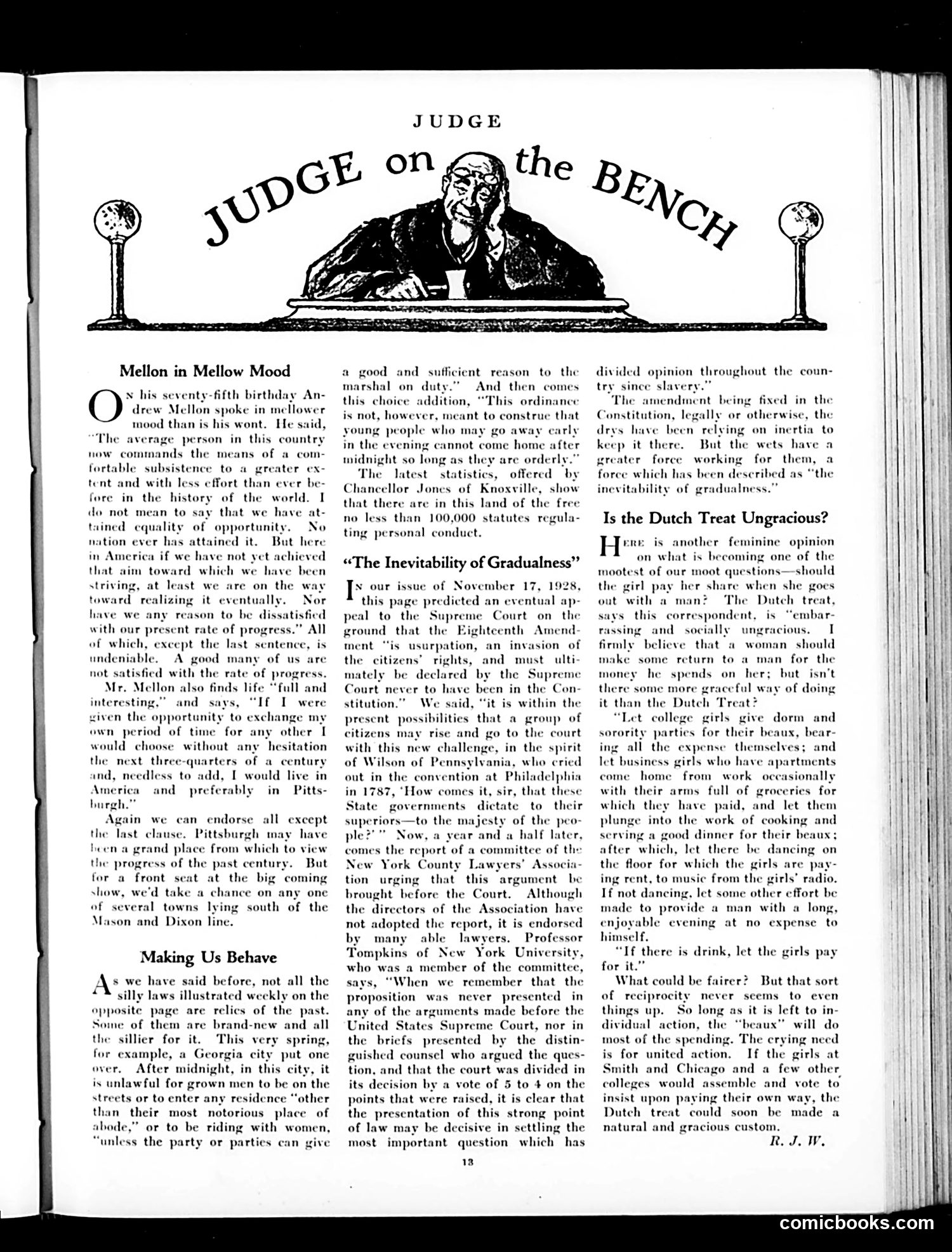
A restored page from Judge, 1930-04-26. Page through the whole issue in the reader above.
📄 Transcribed text from this page (OCR, searchable)
Machine-transcribed from the original scan — historical spelling and the odd misread are preserved.
Mellon in Mellow Mood S his seventy-fifth birthday An- drew Mellon spoke in meilow mood than is his wont. He The ave id, : person in this country now commands the m fortable subsistence to a greater ex- tent and with less effort than ever be- fore in the history of the world. I do not mean to say that we have at- tained equality of opportunity. No nation ever has attained it. But here in America if we have not yet achieved tim toward which we have been eon the eventually, have we any reason to be dissa with our present rate of progress.” All of which, except th undeniable. ans of a cor that toward A good many of us not satisfied with the rate of progress. Mr. Mellon also finds life “full and interesting,” and says, “If I were given the opportunity to exchs own period of time for would choose without any hesitation the next three-quarters of a century ind, needless to add, [ would live in America and preferably in Pitts- burgh.” Again we can endorse all except the last clause. Pittsburgh may have heen a grand place from which to view the progress of the past century. But for front seat the big coming we'd take a chance on any one of several towns lying south of the Mason and Dixon line. Making Us Behave As we have said before, not all the © Silly laws illust y opposite page are relics of th Some of them are brand-ne the sillier for it. This very spring, fore Georgia city put one After midnight, in this city, it is unlawful for grown men to be on the streets or to enter any residence “other than their most notorious place of abode,” or to be riding with women, less the party or parties can give over. a good and suff marshal on duty.” this choic ent reason to the And then comes addition, “This or is not, however, meant to construc that young people who may go away carly n the evening cannot come home after midnight so long as they are orderly The latest statistics, offered ‘by Chancellor Jones of Knoxville, show that there are in this land of the free no less than 100,000 statutes regula ting personal conduct. “The Inevitability of Gradualness” Is our issue of November 17, 1928, this page predicted an eventual peal to the Supreme Court on the ground that the Eighteenth Amend ment “is usurpation, the citizens’ rights, mately be declared by the Supreme Court never to have been in the Con- stitution.” We said, “it is within the resent possibilities that a group of y rise and go to the court with this new challenge, in the spirit of Wilson of Pennsylvania, who cried out in the convention at Philadelphis n invasion of and must. ulti in 1787, ‘How comes it, sir, that these State vernments dictate to their rs—to the majesty of the pco- rand a half la mes the report of a committee of the ew York County Lawyers’ Associ tion urgi that this argument be brought before the Court. Although the directors of the Association have not adopted the report, it is endorsed by many able lawyers. Professor Tompkins of New York University, who was a member of the committee, says, “When we remember that the proposition was never presented in any of the arguments made before the United States Supreme Court, nor in the briefs presented by the distin- guished counsel who argued the ques- tion, and that the court was divided in a vote of 5 to 4 on the points that were raised, it is clear that the presentation of this strong point of law may be decisive in settling the most important question which has 18 divided opinion throughout the coun- try since slavery.” The amendment being fixed in the Constitution Ily or otherwise, the drys have been relying on i p it there. But th : | force workin them, a | force which has been described as “the | inevitability of gradualness.” | | Is the Dutch Treat Ungracious? | } H"= is another feminine opinion on what is becoming one of the mootest of our moot questions—should rl pay her share when she goes out with a ma The Dutch treat, 's this correspondent, is “embs nd socially cious. T believe that a woman should return to a man for the | he spends on her; but. isn’t there some more graceful way of doing it than the Dutch Treat? “Let college girls give dorm and | sorority parties for their beaux, bear- | I the expense themselves; and | let business girls who ha rtments come home from work oc with their arms full of groe r- ung * some sionally ries for » into the work of cooking serving a good dinner for their be: after which, let there be dancing on the floor for which the girls are pay ing rent, to music from the girls’ radio. If not dancing, let some other effort be made to provide a man with a long, | enjoyable evening at no expense to himself. “If there is drink, let the girls pay could be of reciproci But that sort never seems to even 0 long as it is left to in- } dividual action, the “beaux” will do | most of the spending. The crying need is for united action. If the girls at Smith and Chicago and a few other colleges would assemble and vote to insist upon paying their own way, the rer? things up. Dutch treat could soon be made a \| natural and gracious custom. | RJLW. \| comicbooks.com