
Judge, 1930-04-05 · page 25 of 36
Judge — April 5, 1930 — page 25: what you’re looking at
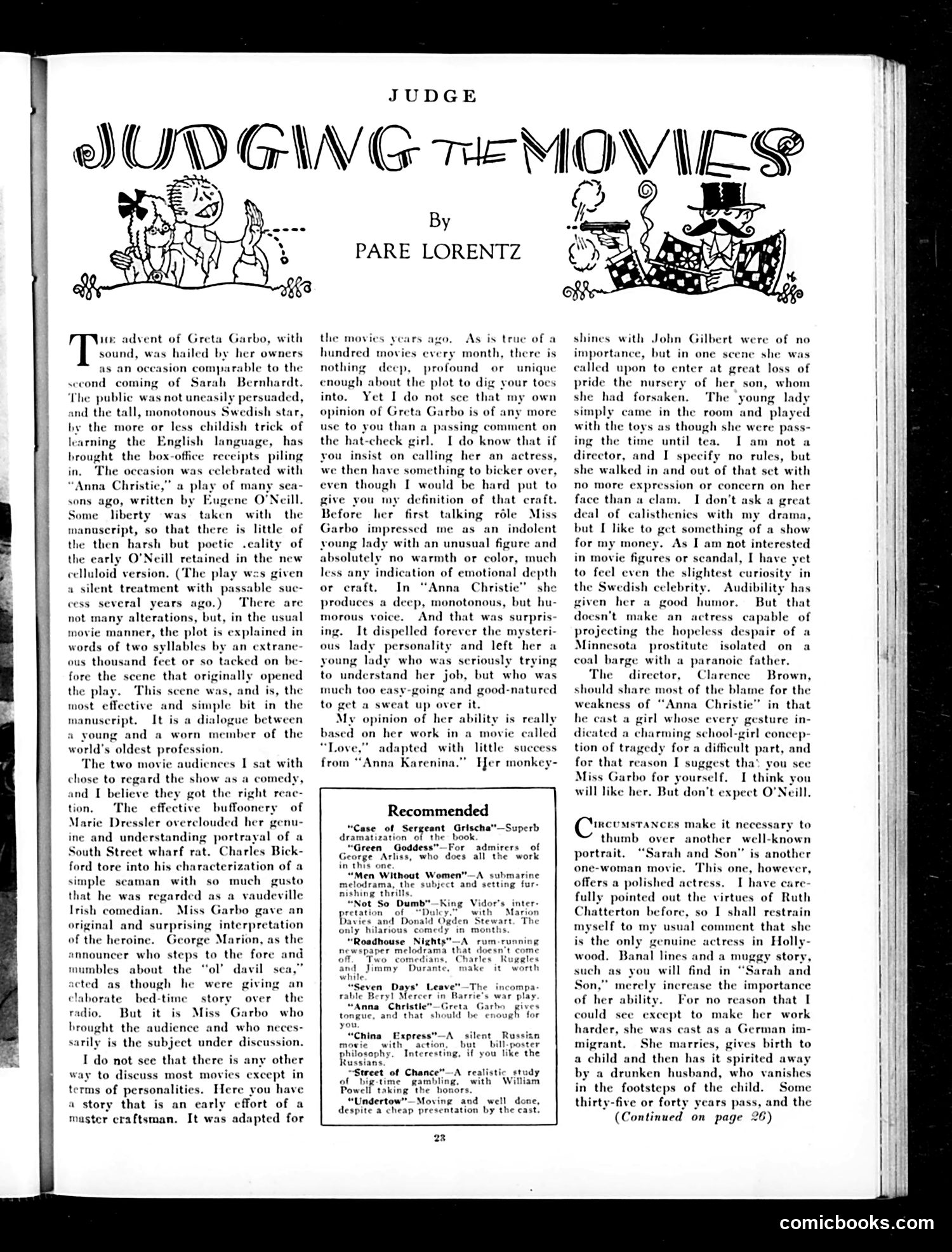
A restored page from Judge, 1930-04-05. Page through the whole issue in the reader above.
📄 Transcribed text from this page (OCR, searchable)
Machine-transcribed from the original scan — historical spelling and the odd misread are preserved.
JIUDGIVG TEM ) dvent of Greta Garbo, with ound, was hailed by her owners as an oceasion comparable to the second coming of Sarah Bernhardt. ‘The public was not uneasily persuaded, and the tall, monotonous Swedish star, by the more or less childish trick of earning the English language, has brought the box-office receipts piling in, The occasion was celebrated with “Anna Christi sons ago, written by E h Some liberty was taken with the manuscript, so that there is little of the then harsh but poctic .eality of the early O'Neill retained in the new 1 play of many sea- celluloid version. (The play wes given ple suc- 1 silent treatment with pass cess several years ago.) There ¢ not many alterations, but, in the us movie manner, the plot is explainec words of two syllables b. extrane- ous thousand feet or so tacked on be- fore the scene that originally opened the play. This scene was, and is, the most effective and simple bit in the manuscript. It is a dialogue between a young and a worn member of the world’s oldest profession. The two movie audiences I sat with chose to regard the show as a comedy, and I believe they got the right res tion. The effective buffoone Marie Dressler overclouded her genu- ine and understanding portrayal of a South Street wharf rat. Charles Bick- ford tore into his characterization of a simple seaman with so much gusto that he was regarded as a vaudeville Irish comedi Miss Garbo original and surprising interpretation of the heroine. George Marion, as the announcer who steps to the fore and mumbles about the “ol” ‘ cted as though he elaborate bed-time story over radio, But it is Miss Garbo who brought the audience and who nec sarily is the subject under discussion. were gi an I do not sce that there is any other to discuss most movies except in terms of personalities. Here you have a story that is an early effort of a master craftsman. It was adapted for JUDGE By PARE LORENTZ the movies As is true of a hundred movies every month, there is nothi deep, profound or unique enough about the plot to dig your toes into. Yet I do not sce that my own opinion of Greta Garbo is of any more use to you than a passing comment on the hat-check girl. I do know that if you insist on calling her an actress, we then have something to bicker over, even though I would be hard put to give you my definition of that craft. Before her first talking réle Miss Garbo impressed me as an indolent young lady with an unusual figure and absolutely no warmth or color, much less any indication of emotional depth or craft. In “Anna Christie’ she produces a deep, monotonous, but hu- morous voice. And that was surpris- It dispelled forever the mysteri- ous lady personality and left her a young lady who was seriously trying to understand her job, but who was much too eas, ood-natured to get a sweat up over it. My opinion of her ability is really based on her work in a movie called “Love,” adapted with little success from “Anna Karenina.” Her monkey- rs ago, oing and Recommended “Case of Sergeant Grischa”—Superb dramatization of the bool “Green Goddess”—For admirers of George Arliss, who does all the work this one. Men Without Women”—A submarine melodrama, the su and setting fur- nishing th “Not So Dumb"—King Vidor’s inter- pretation of “Duley with Marion Javies and Donald Ogden Stewart. The only hilarious comedy in months. “Roadhouse Nights"—A rom-running fama that doesn’ Ch “Seven Days’ Le a le Beryl Me Barrie’s war play. Anna Christie ta Garbo gives ngue, and that I be enough for “China Express"—A silent Russian movie with action, but bill-poster sophy. Interesting, if you like the ssians “Street of Chance”—A realistic study big-time gambling, with William well taking the honors. Indertow"—Moving and well done, despite a cheap presentation by the cast. OVIEe if shines with John Gilbert were of no importance, but in one scene she was led upon to enter at great loss of pride the nursery of her son, whom she had forsaken, The young 1s simply came in the room and playec with the toys as though she were pass- ing the time until tea. I am not a director, and I specify no rules, but she walked in and out of that set with no more expression or concern on her face than a clam. I don’t ask a gr deal of calisthenics with my dram. but I like to get something of a show for my money. As I am not interested in movie figures or scandal, I have yet to feel even the slightest curiosity the Swedish celebrity. Audibility given her a good humor. But’ th: doesn’t make an actress capable of projecting the hopeless despair of a Minnesota prostitute isolated on a coal barge with a paranoic father. The director, Clarence Brown, should share most of the blame for the nna Christ in that cast a girl whose every gesture in- ted a charming school-g tion of tragedy for a difficult part, and for that reason I suggest tha’ you see Miss Garbo for yourself. I think will like her. But don’t expect O') Cincesstances make it necessary to thumb over another well-known portrait. “Sarah and Son” is another one-woman movie, This one, ho offers a polished actress. I have care- fully pointed out the virtues of Ruth Chatterton before, so I shall restrain myself to my usual comment that she is the onl nuine actress in Holl; wood. Banal lines and a muggy story, such as you will find in “Sarah and Son,” merely increase the importance of her ability. For no reason that I could see except to make her work harder, she w tas a German im- migrant. She marries, gives birth to a child and then has it spirited ay by a drunken husband, who vanishes in the footsteps of the child. Some thirty-five or forty years pass, and the (Continued on page 26) ever, comicbooks.com