
Judge, 1930-04-05 · page 18 of 36
Judge — April 5, 1930 — page 18: what you’re looking at
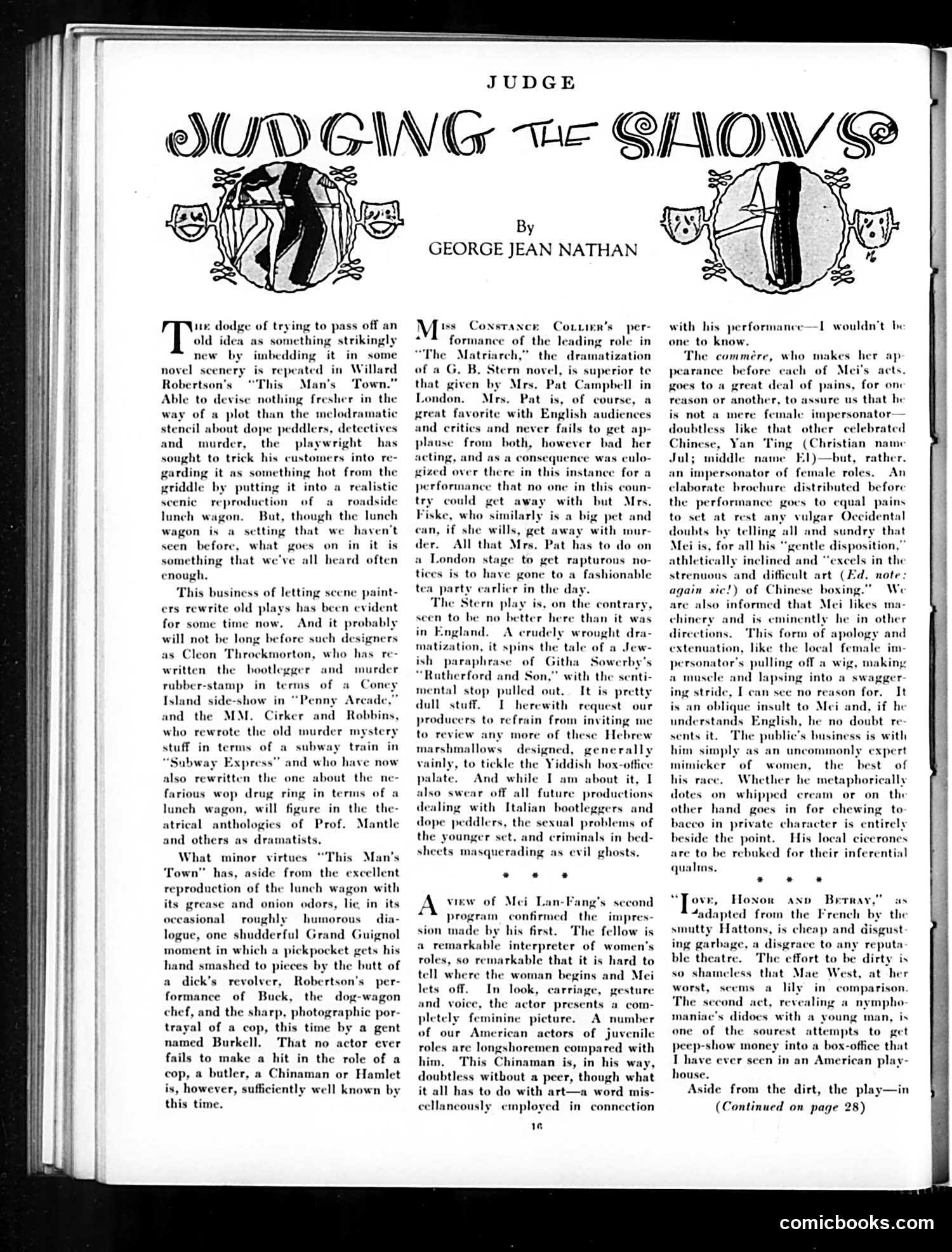
A restored page from Judge, 1930-04-05. Page through the whole issue in the reader above.
📄 Transcribed text from this page (OCR, searchable)
Machine-transcribed from the original scan — historical spelling and the odd misread are preserved.
ew ue dodge of trying to pass off an a as something striking new nbedding it in’ som novel scenery is repeated in Will Robertson's is Man's Town. Able to devise nothing fresher in the , of a plot than the melodram: stencil about dope peddlers, detectives and murder, the playwright — has sought to trick his customers into re- garding it as something hot from the griddle by putting it into a realistic production of a roadside on. But, though the lunch setting that we en't what goes on in it is all heard often seen before, something that we've enough, This business of letting scene paint- ers rewrite old plays has been evident for some time And it probably will not be long before such designers as Cleon Throckmorto: written the bootlegger and murder rubber-stamp in terms of a Coney Island side-show in “Penny Arcade,” and the MM. Cirker and Robbins, who rewrote the stuff in terms of “Subway Express now. who has re- old murder mystery 1 subway train in nd who have now also rewritten the about the farious wop drug ring in terms of a lunch wagon, will figure in the the- atrical anthologies of Prof. Mantle and others as dramatists. What minor “This Town” , aside from the reproduction of the lunch w its grease and onion odors, occasional roughly logue, one shudderful nd Guignol moment in which a pickpocket gets his hand smashed to pieces by the butt of ick’s revolver, Robertson's per- formance of Buck, the dog-wagon chef, and the sharp, photographie por- trayal of a cop, this time by a gent named Burkell. That no actor ever fails to make a hit in the role of a cop, a butler, a Chinaman or Hamlet is, however, sufficiently well known by this time. one ne- Man's xcellent gon with sin its humorous — dia- virtues JUDGE By GEORGE JEAN NATHAN iss Constance Coutirr’s formance of the le: “The Matriarch,” of a G. B. St per- ling role in the dramatization 1 novel, is superior te that given by Mrs. Pat Campbell in London. Mrs. Pat is, of course, a eat favorite with English audier and critics and never fails to plause from both, however r ing, and as a consequence was culo- gized over there in this instance for a performance that no one in this coun- try could get away with but Mrs. Fiske, who similarly is a big pet and can, if she wills, get away with mur- der. All that Mrs, Pat has to do on a London stage to get rapturous no- tices is to have gone to a fashionable tea party earlier in the da The Stern play is, on the ¢ seen to be no better here th and. A crudely wre on, it spins the tale of a Je araph of Githa Sowerby’s “Ruthe rford and Son,” with the senti- mental stop pulled out. It is pretty dull stuff. I herewith request our producers to refrain from inviting me to review any more of these He marshmallows designed, gen vainly, to tickle the Yiddish box-office palate. And while Iam about it, I also swear off all future productions dealing with Italian bootleggers. and dope peddlers, the sexual problems of the younger set. and criminals in bed- sheets masquerading as evil ghosts. ntrary, *- * * view of Mei Lan-Fang’s second program confirmed the sion made by his first. a remarkable impres- The fellow is interpreter of women’s roles, so remarkable that it is hard to tell where the woman begins and Mei lets off. In look, carriage, gesture and voice, the actor presents a com- pletely feminine picture. A number of our American actors of juvenile roles are longshoremen compared with him. This Chinaman is, in his way, doubtless without a peer, though what it all has to do with art—a word mis- cellaneously employed in connection 16 NG we GANOWS with his performance—I wouldn't bx one to know. The commére, who makes her ap pearance before each of Mei's acts. 1 great deal of pains, for one rason or another, to assure us that he is not a mere female impersonator— doubtless like that other celebrated Chinese, ng (Christian name Jul; middle name El)—but, rather. tor of female roles. An ture distributed befor the performance goes to equal to set at rest any vulgar Ocei Joubts by telling all and sundry that Mei is, for all his “gentle disposi athletically inclined and “excels in the strenuous and difficult art (Ed. note: again sic!) of Chinese boxing.” We Iso informed likes: ma- she in other This form of apology and n, like the local female im- personator’s pulling off a wig, making a muscle and lapying into a swagger ing stride, I can see no reason for. It is an oblique insult to Mei and, if he understands English, he no doubt re sents it. The public's business is with him simply as an uncommonly expert of women, the best of Whether he metaphorically dotes on whipped cream or on. the her hand goes in for chewing to > in private character is entirely beside the point. His local cicerones to be rebuked for their inferential qualins. an impersot elaborate b 7 8 «& ove, Honor anv Berray,” as 4adapted from the French by the smutty Hattons, is cheap and disgust ing garbage, a disgrace to any reputa ble theatre. The effort to be dirty is so shameless that Mae West, at her worst, seems a lily The second s maniac’s didoes with a young m one of the sourest attempts to get peep-show money into a box-office th I have ever seen in an American play- house. Aside from the dirt, the play—in (Continued on page 28) comicbooks.com