
Judge, 1930-04-05 · page 15 of 36
Judge — April 5, 1930 — page 15: what you’re looking at
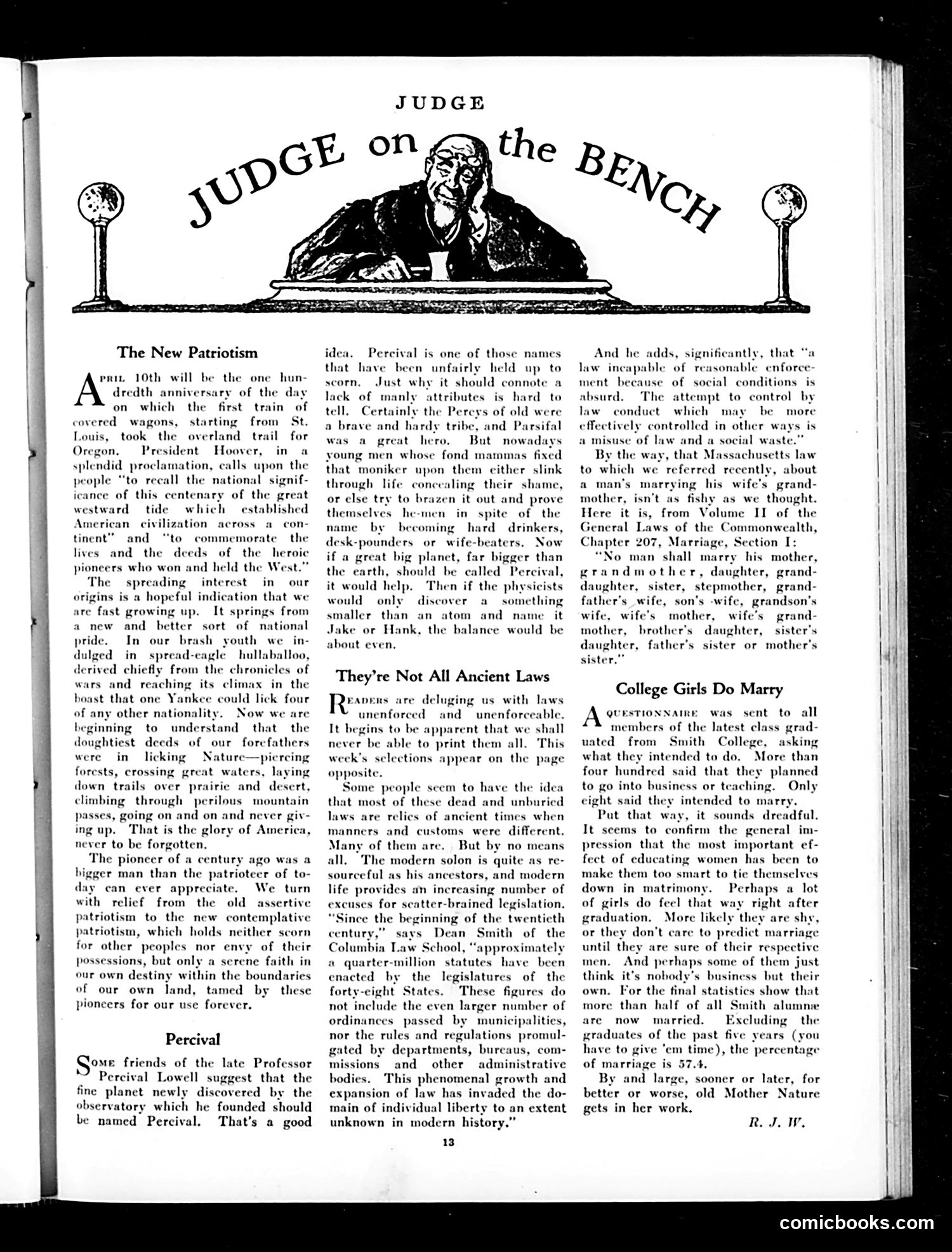
A restored page from Judge, 1930-04-05. Page through the whole issue in the reader above.
📄 Transcribed text from this page (OCR, searchable)
Machine-transcribed from the original scan — historical spelling and the odd misread are preserved.
The New Patriotism prit 10th dredth anniversary on which the ed wagons, starting from St. took the overland trail for President Hoover, in’ a splendid proclamation, calls upon the people “to recall the national signif- > of this centenary of the g westward tide which established American civilization OSS con- tinent” and “to commemorate — the and the deeds of the here pioneers who won and held the West.” The spreading interest in our origins is a hopeful indication that we are fast growing up. It springs from a new and better sort of national pride. In brash youth we in- dulged in’ spread-eagle hullaballoo, derived chiefly from the chronicles of wars and reaching its climax in the boast that one Yankee could lick four of any other nationality. Now we are beginning to understand that the doughtiest deeds of our forefathers were in” licking Nature—piereing forests, crossing great waters, | down trails over prairie and desert, climbing through perilous mountain passes, going on and on and never giv- ing up. s the glory of America, never to be tten, The pioncer of a century bigger man than the patrioteer of to- day can ever appreciate. We turn with relief from the old assertive patriotism to the new contemplative patriotism, which holds neither scorn for other peoples nor envy of their possessions, but only a serene faith i our own destiny within the boundaries of our own land, tamed by these pioncers for our use forever. hun- day train of will be the one of the first Louis, Oregon, ican lives our go was a Percival ome friends of the late Professor Percival Lowell suggest that the fine planet newly discovered by the observatory which he founded should be named Percival. That's a good Percival is one of those names t have unfairly held up to scorn, Just why it should connote a lack of manly attributes is hard to tell. Certainly the Pereys of old were a brave and hardy tribe, and Parsifal was a great hero. But nowadays young men whose fond matnmas fixed that moniker upon them either slink through life concealing their shame, or else try to brazen it out and prove themselves he-men in’ spite of the name by becoming hard drinkers, desk-pounders or wife-beaters. if a great big planet, far bigger than the th, should be called Percival, it would help. Then if the physicists would) only discover a something smaller than an atom and name it Jake or Hank, the balance would be about even. been They’re Not All Ancient Laws Reavers are deluging us with laws unenforced and unenforceable. It begins to be apparent that we shall never be able to print them all. This week's selections appear on the page opposite. Some people seem to have the idea that most of these dead and unburied relics of ancient times when manners and customs were different. of them are. But by no means The modern solon is quite as re- as his ancestors, and modern life provides an increasing number of excuses for scatter-brained legislation, “Since the beginning of the twenticth century,” says Dean Smith of the Columbia Law School, “approximately a quarter-million statutes have been the legislatures of the These figures do not include the even larger number of ordinances passed by municipalities, nor the rules and regulations promul- gated by departments, bureaus, com- missions and other administrative bodies. This phenomenal growth and expansion of law has invaded the do- main of individual liberty to an extent unknown in modern history.” 13 And he a law ment © of sor absurd. The » that “a nforce 1 conditions is attempt to control by w conduct which may be effectively controlled in other w a misuse of law and a soci: aste, By the way, that Massachusetts law to which we referred recently, about a man’s marrying his wife’s grand- mother, isn’t as fishy as we thought. Here it is, from Volume II of the General Laws of the Commonwealth, Chapter 207, Marriage, Section I: “No man shall marry his mother, grandmother, daughter, grand- ughter, sister, stepmother, grand- father’s wife, son's -wife, grandson's wife, wife's mother, wife's grand- mother, brother's daughter, sister's daughter, father’s sister or mother's sister,” more College Girls Do Marry QUESTIONNAIRE was sent to all members of the latest class grad- uated from Smith College, asking what they intended to do. More than four hundred said that they planned to go into busin ching. Only eight said they intended to marry. Put that way, it sounds dreadful. It seems to confirm the general im- pression that the most important ef- fect of educating women has been to make them too smart to tie themselves down in matrimony. Perhaps a lot of girls do feel that y right after graduation. More likely they are shy, or they don't care to predict marriage until they are sure of their respective men. And perhaps some of them just think it’s nobody's business but thei own. For the final statistics show t more than half of all Smith alumn: re now married. graduates of the past five ye have to give ‘em time), the percent: of marriage is 57.4. By ge, sooner or later, for better or worse, old Mother Nature gets in her work. Ss or ti R.JLW. comicbooks.com