
Judge, 1930-03-22 · page 15 of 36
Judge — March 22, 1930 — page 15: what you’re looking at
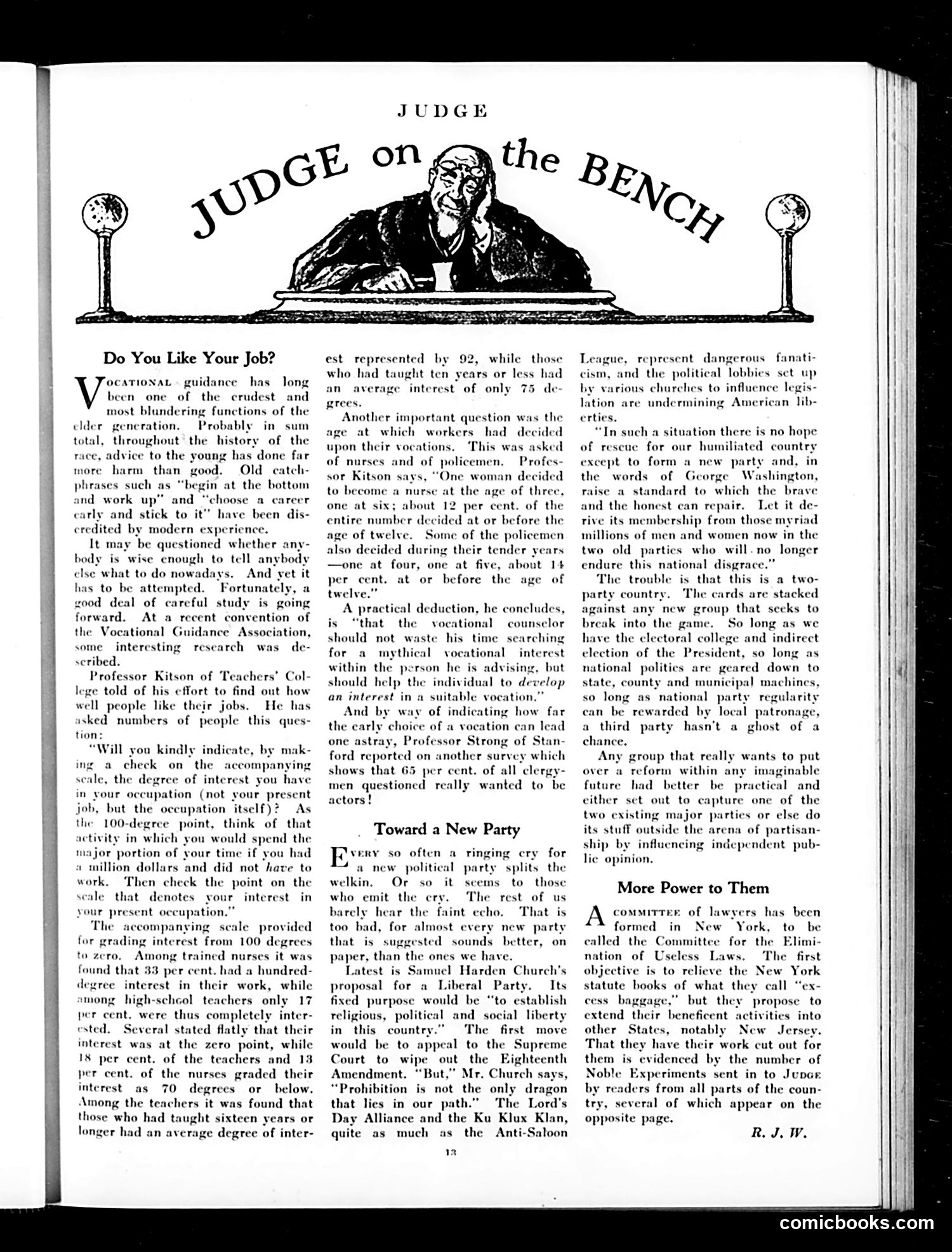
A restored page from Judge, 1930-03-22. Page through the whole issue in the reader above.
📄 Transcribed text from this page (OCR, searchable)
Machine-transcribed from the original scan — historical spelling and the odd misread are preserved.
Do You Like Your Job? ‘OCATIONAL guidance has long of the crudest and most blundering functions of the elder generation, Probably in. sum total, throughout the history of the race, advice to the young has done far more harm than good. Old catch- phrases such as “begin at the bottom and work up” and “choose a career tly and stick to ii been dis- credited by modern experience. It may be questioned whether any- body is wise enough to tell anybody clse what to do nowadays. And yet it has to be attempted. Fortunate a good deal of careful study is going forward. At a recent convention of the Vocational Guidance Association, some interesting research de- scribed. Professor Kitson of chers’ Col- lege told of his effort to find out how well people like their jobs. He has isked numbers of people this ques- tior Will you kindly indicate, by ing a check on the accompanying scale, the degree of interest you have in your occupation (not your present job, but the occupation itself)? As the 100-degree point, think of that uctivity in which you would spend the major portion of your time if you had « million dollars and did not have to work. Then check the point on the seale that denotes your interest’ in your present occupation.” The accompanying scale provided for grading interest from 100 degrees to zero, Among trained nurses it was found that 33 per cent. had a hundred- degree interest in their work, while smong high-schcol teachers only 17 per cent. were thus completely inter- ested. Several stated flatly that their interest was at the zero point, while 18 per cent. of the teachers and 13 per cent. of the nurses graded their interest’ as 70 degrees or below. Among the teachers it was found that those who had taught sixteen years or longer had an average degree of inter- been one was mak- JUDGE est represented by 92, while those who had taught ten years or less had an average interest of only 75 de grees. Another important question was the age at which workers had decided upon their vocations, This was asked of nurses and of policemen. Profes- sor Kitson says, “One woman decided to become a nurse at the of three, bout 12 per cent. of the entire number decided at or before the age of twelve. Some of the policemen also decided during their tender years —one at four, one at five, about 14 per cent. at or before the age of twelve.” A practical deduction, he concludes, is “that the vocational counselor should not waste his time searching for a mythical vocational interest within the person he is advising, but should help the individual to de an interest in ble vocation,” And by the early cho one astrs one at six ation can | y, Professor Strong of Stan- ford reported on another survey which shows that 65 per cent. of all clergy- men questioned really wanted to be actors! Toward a New Party Ee a, a new political party splits the so often welkin, Or so it who emit the cr The rest of us hear the faint echo. That is d, for almost every new party is suggested sounds better, on paper, than the ones we have. Latest nuel Harden Church's proposal for a Liberal Party. — Its d purpose would be “to establish religious, political and social liberty in this country The first’ move would be to al to the Supreme Court to wipe out the Eighteenth Amendment. “But,” Mr. Church says, “Prohibition is not the only dragon that lies in our path.” The Lord's Day Alliance and the Ku Klux Klan, quite as much as the Anti-Saloon seems to. those is § 1 League, represent dangerous fanati- ud the political lobbies set up by various churches to influence legis- lation are undermining American lib- erties. “In such a situation there is no hope of rescue for our humiliated country except to form a new party and, in the words of yrge Washington, raise a standard to which the brs and the honest can repair. Let it de rive its membership from those myriad millions of men and women now in the two old parties who will. no longer endure this national disgrace.” The trouble is that this is a two- party country. ‘The cards are stacked nst any new group that seeks to break into the game. So long as we have the clectoral college and indirect election of the President, so long as national polities are geared down to state, county and municipal machines, so long as national party regularity n be rewarded by loc third party hasn't chance. Any group that really wants to put over a reform within any it ble future had better be practical and either set out to capture one of the two existing major parties or else do its stuff outside the arena of partisan- ship by influcncing independent pub- lic opinion. cism, 1 patrona ghost of More Power to Them A committer of lav formed in) New called the Committee for the Elimi- nation of Useless Laws. The first objective is to relieve the N York statute books of what they call ‘“ex- cess baggage,” but they propose to extend their beneficent other tes, notably Jersey. That they have their work cut out for them is evidenced by the number of Noble Experiments sent in to Jupar by readers from all parts of the coun- try, several of which appear on the opposite page. ers has been York, to be ctivities into RJILW.