
Judge, 1930-03-15 · page 27 of 36
Judge — March 15, 1930 — page 27: what you’re looking at
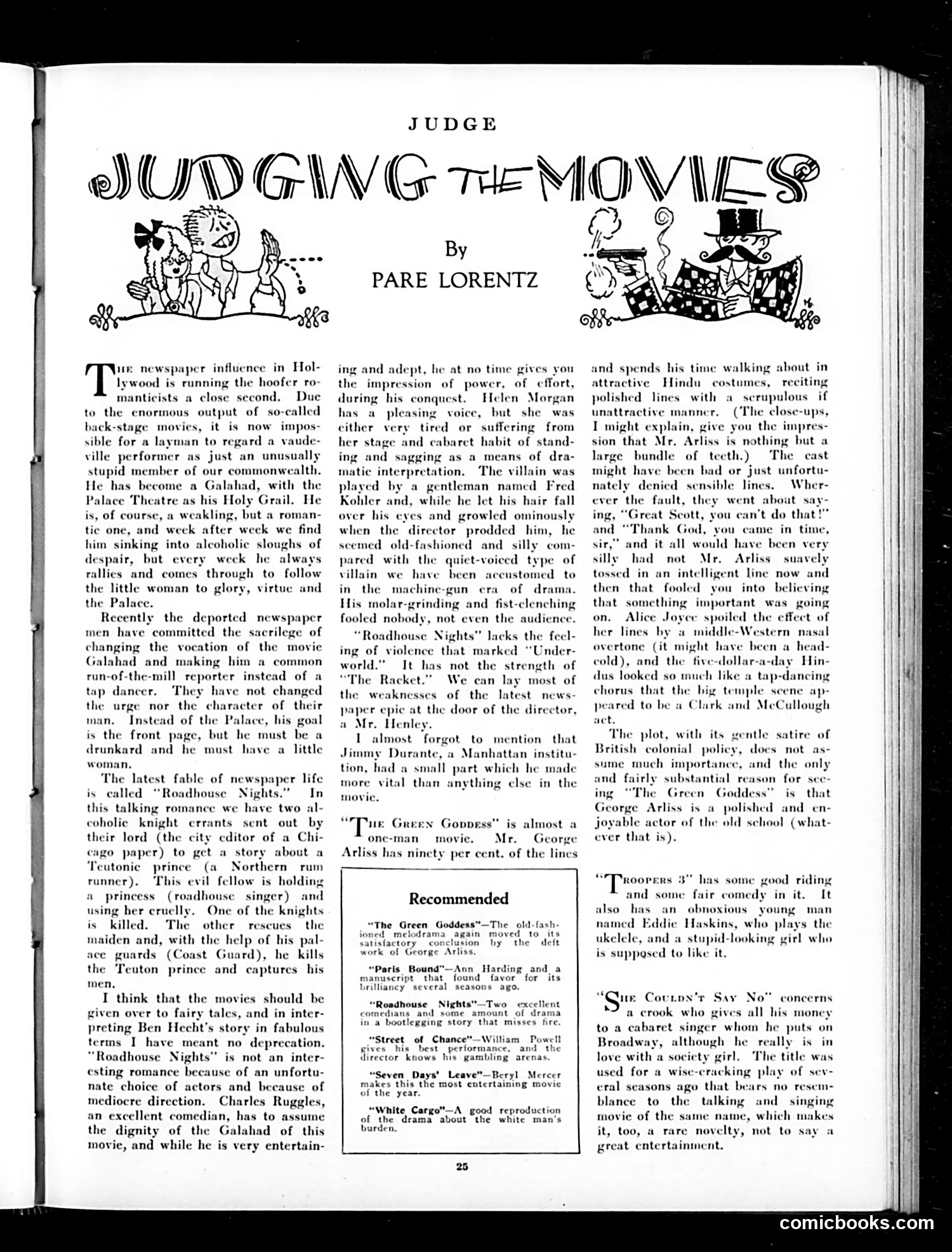
A restored page from Judge, 1930-03-15. Page through the whole issue in the reader above.
📄 Transcribed text from this page (OCR, searchable)
Machine-transcribed from the original scan — historical spelling and the odd misread are preserved.
4 j Bais rics seem JUDGE JIUVGING TEMOVIES? } yy) ie newspaper influence in Hol- | wood is running the hoofer ro manticists a close second. Due to the enormous output of so-called back-stage movies, it is now impos- sible for a layman to regard a vaude- ville performer as just an unusually stupid member of our commonwealth. He has become a Galahad, with the Palace Theatre as his Holy Grail. He is, of course, a weakling, but a roman- tic one, and week after week we find him sinking into alcoholic sloughs of despair, but every week he always rallies and comes through to follow the little woman to glory, virtue and the P. Recently the deported newspaper men have committed the sacrilege of changing the vocation of the movie Galahad and making him run-of-the-mill reporter i tap dancer. a common stead of a They have not changed the urge nor the character of their man. Instead of the Palace, his goal is the front page, but he must be a drunkard and he must have a little woman, The latest fable of newspaper life is called “Roadhouse Nights.” In this talking romance we have two al- coholic knight errants sent out by their lord (the city editor of a Chi- cago paper) to get a story about a ‘Teutonic prince (a Northern rum runner). This evil fellow is holding a princess (roadhouse singer) and using her cruelly. One of the knights is killed. The other rescues the maiden and, with the help of his pal- ds (Coast Guard), he kills the Teuton prince and men, I think that the movies should be given over to fairy tales, and in inter- preting Ben Hecht’s story in fabulous terms I have meant no deprecation. “Roadhouse Nights” is not an inter- esting romance because of an unfortu- nate choice of actors and because of mediocre direction. Charles Ruggles, an excellent comedian, has to assume the dignity of the Galahad of this movie, and while he is very entertain- ptures his By PARE LORENTZ he at no time gives you impr n of power, of effort, during his conquest. Helen Morgan has a pleasing voice, but she was cither very tired or suffering from her stage and cabaret habit of stand- ing and sagging as a means of dra- matic interpretation. The villain was played by a gentleman named Fred Kohler and, while he let his hair fall over his eyes and growled ominously when the director prodded him, he seemed old-fashioned and _ silly com- pared with the quiet-voiced type of villain we have been istomed to in the machine-gun of dr: His molar-grinding and _fist-clenching fooled nobody, not even the audience. Nights” lacks the feel- that marked “Under- “Roadhouse ing of violer world.” It has not the strength of “The Racket.” We can lay most of the weaknesses of the latest news paper epic at the door of the director, a Mr. Henley. I almost forgot to mention that Jimmy Durante, a Manhattan institu- tion, had a small part which he made more vital than anything else in the movie. “Cur Green Goppess” is almost a one-man movie. Mr. George Arliss has ninety per cent. of the lines Recommended “The Green Goddess"—The old-fa joned melodrama again moved satisfactory conclusion by the deft work of George Ar! ris Bound”—Ann Harding and a script that found favor for its iancy several seasons ago. “Roadhouse Nights"—Two excellent comedians and some amount of drama in a bootlegging story that misses fire. “Street of Chance"—William Powell es his best performance, and the director knows his gambling arenas. “Seven Days’ Leave"—Beryl Mercer makes this the most entertaining movie of the year. “White Cargo"—A good reproduction of the drama about the white man’s burden, 15 25 If ( 7 \ eS - and spends his time walking about in attractive Hindu costumes, reciting polished lines with a serupulous if unattractive manner. (‘The close-ups, I might explain, give you the impres- sion that Mr. Arliss is nothing but large bundle of teeth.) The cast might have been bad or just unfortu- Wher- put say- ing, pu can’t do that!" and “Thank God, you came in time, sir,” and it all would have been very silly had not Mr. Arliss suavely tossed in an intelligent line now and then that fooled you into believing that something important was going on. Alice Joyce spoiled the effect of her lines by 4 overtone cold), nately denied sensible lines. ever the fault, they went nah ay Hin- five-dollar-< dus looked so much like a tap-dancing chorus that the big temple se ap- peared to be a Clark and McCullough act. The plot, with its gentle satire of British colonial policy, does not as- sume much importance, and the only and fairly substantial reason for see ing “The Goddess” is that George Arliss is a polished and en- joyable actor of the old school (what- ever that is). Green ROOPERS and some "has some good riding air comedy in it, It also an obnoxious young man named Eddie Haskins, who plays the ukelele, and a stupid-looking gitl who is supposed to like it. ur Covnpy’r Say No” concerns 1 crook who gives all his money arct singer whom he puts on y, although her i love with a society girl. ‘The title used for a wise-cracking play of sev- cral seasons ago t blance to the movie of the it, too, a ra great cntert at bears no resem- talking and singing ne name, which makes novelty, not to say a ment. comicbooks.com