
Judge, 1930-03-15 · page 10 of 36
Judge — March 15, 1930 — page 10: what you’re looking at
What you’re looking at
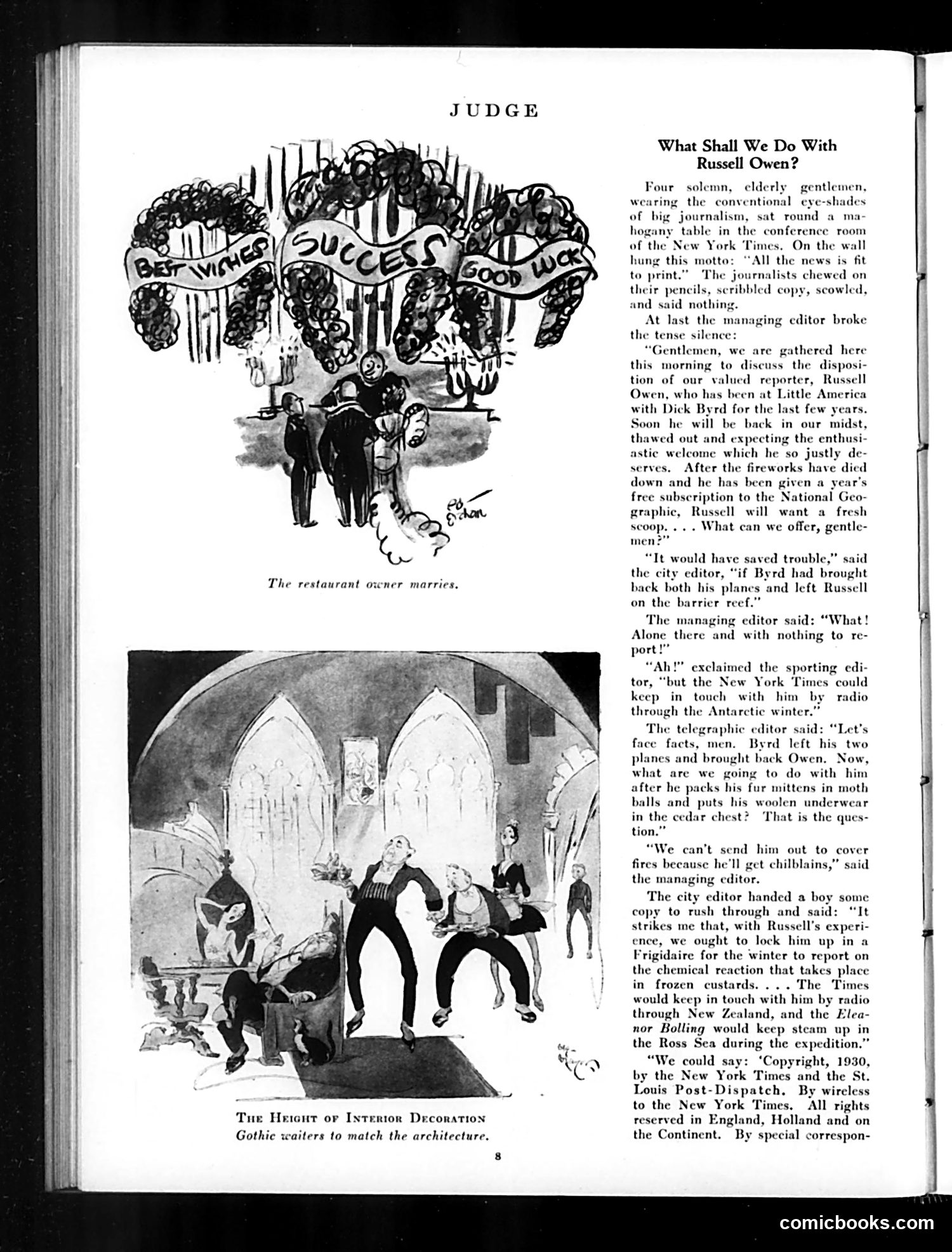
# What This Page Means This 1930 Judge satirical piece mocks the New York Times' obsession with sensationalizing reporter Russell Owen's return from Dick Byrd's Antarctic expedition. The cartoon depicts Times editors debating what assignment to give Owen after his famous polar expedition, joking that he's become a one-trick explorer unsuitable for normal reporting. The satire targets the era's yellow journalism: editors seriously propose locking Owen in a refrigerator to report on frozen custard reactions, or keeping him in constant radio contact with Antarctica—absurd ideas meant to squeeze more expedition-related content from him. The joke exposes how major newspapers exploited dramatic expeditions for circulation, and how little value they placed on actual investigative journalism once a reporter's exotic appeal faded. The motto "All the news is fit to print" hangs ironically overhead.
📄 Transcribed text from this page (OCR, searchable)
Machine-transcribed from the original scan — historical spelling and the odd misread are preserved.
Tue Heicut or Intertor Decoration Gothic waiters to match the architecture. What Shall We Do With Russell Owen? elderly gentlemen, the conventional eye-shades ig journalism, sat round a ma- hogany table in the conference room of the New York ‘Times. On the wall hung this motto: “All the news is fit to print.” The journalists chewed on solemn, their pencils, scribbled copy, scowled, and said nothi At last the m the tense silence “Gentlemen, we are gathered here this morning to discuss the disposi- tion of our valued reporter, Russell Owen, who has been at Little America with Dick Byrd for the last few years. Soon he will be back in our midst, thawed out and expecting the enthusi- stic welcome which he so justly de- serves. After the fireworks have died down and he has been given a year's free subscription to the National Geo- graphic, Russell will want a fresh scoop. ... What can we offer, gentle- mer ging editor broke It would have saved trouble,” said the city editor, “if Byrd had brought ack both his planes and left Russell arrier reef. ing editor said: “What! Alone there and with nothing to re- port!” “Ah!” exclaimed the sporting edi- tor, “but the New York Times could keep in touch with him by radio through the Antarctic winter. The telegraphic editor said: “Let's ce facts, men. Byrd left his two and brought back Owen, Now, are we going to do with him after he packs his fur mittens in moth balls and puts his woolen underwear in the cedar chest? That is the ques- tion.” “We can’t send him out to cover fires because he'll get chilblains,” the managing editor. The city editor handed a boy si copy to rush through and said strikes me that, with Russell's experi- ence, we ought to lock him up in a Frigidaire for the winter to report on the chemical reaction that takes place in frozen c ds. . The Times would keep in touch with him by radio through New Zealand, and the Elea- nor Bolling would keep s the Ross Sea during the expe “We could say: ‘Copyright, 1930, by the New York Times and the St. Louis Post-Dispatch. By wireless to the New York Times. All rights reserved in England, Holland and on the Continent. By special correspon- TES | SS a aren | Sena comicbooks.com