
Judge, 1930-03-08 · page 20 of 36
Judge — March 8, 1930 — page 20: what you’re looking at
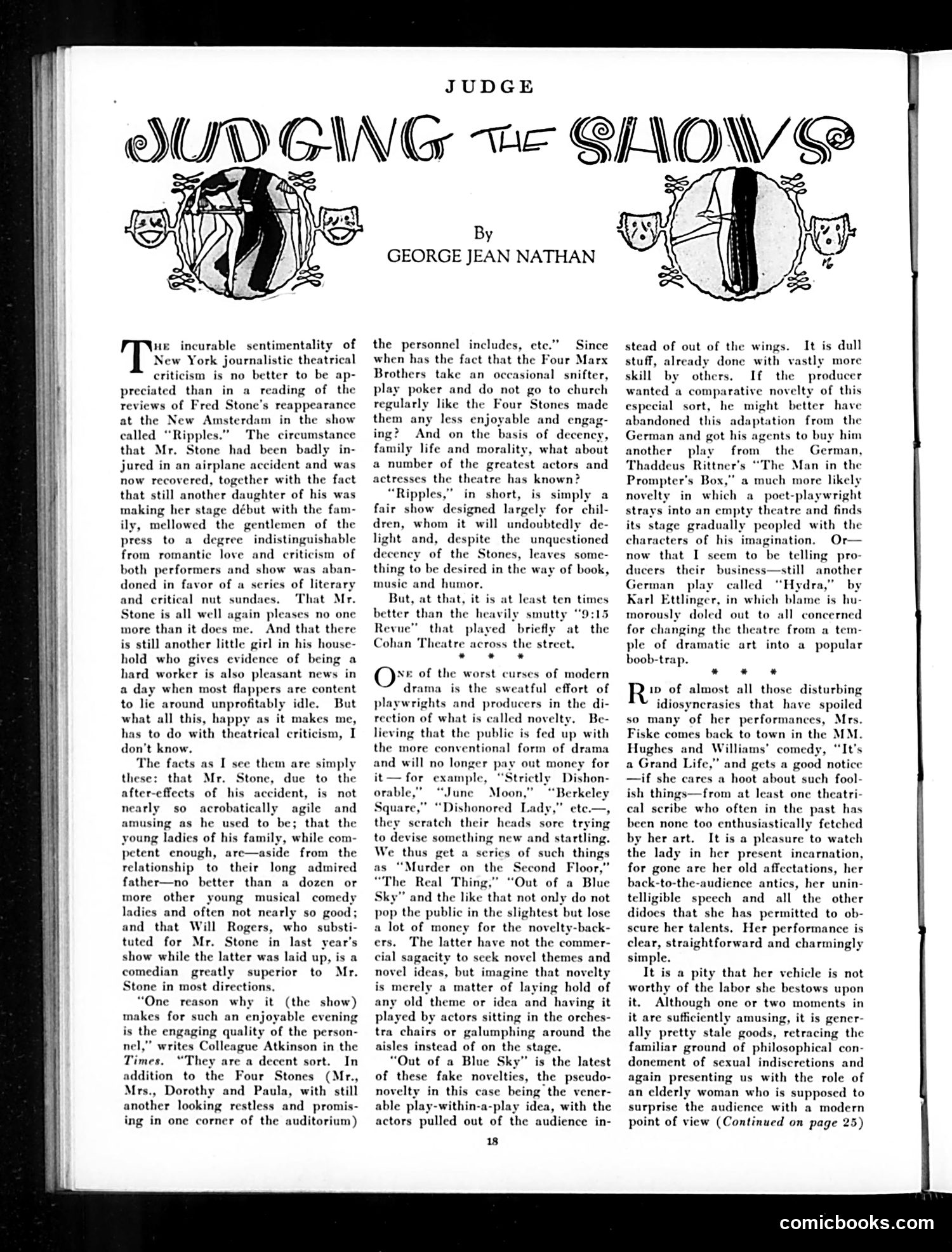
A restored page from Judge, 1930-03-08. Page through the whole issue in the reader above.
📄 Transcribed text from this page (OCR, searchable)
Machine-transcribed from the original scan — historical spelling and the odd misread are preserved.
> OA) incurable sentimentality of New York journalistic theatrical criticism is no better to be ap- iated than in a reading of the s of Fred Stone's reappearance at the New Amsterdam in the show called “Ripples.” The circumstance that Mr. Stone had been badly jured in an airplane accident and now recovered, together with the fact that still another daughter of his was making her stage début with the fam- ily, mellowed the gentlemen of the press to a degree indistinguishable from romantic love and criticism of both performers and show was aban- doned in favor of a series of literary and critical nut sundaes. That Mr. Stone is all well again pleases no one more than it does me. And that there is still another little girl in his house- hold who gives evidence of being a hard worker is also pleasant news in a day when most flappers are content to lie around unprofitably idle. But what all this, happy as it makes me, has to do with theatrical criticism, I don't know. The facts as I see them are simply these: that Mr. Stone, due to the after-effects of his accident, is not nearly so acrobatically agile and amusing as he used to be; that the young ladies of his family, while com- petent enough, are—aside from the relationship to their long admired father—no better than a dozen or more other young musical comedy ladies and often not nearly so good and that Will Rogers, who subs' tuted for Mr. Stone in last year’s show while the latter was laid up, is a comedian greatly superior to Mr. Stone in most directions. “One reason why it (the show) makes for such an enjoyable evening is the engaging quality of the person- nel,” writes Colleague Atkinson in the Times. “They are a decent sort. In addition to the Four Stones (Mr., Mrs., Dorothy and Paula, with still another looking restless and promis- ing in one corner of the auditorium) JUDGE ING we SHON GEORGE JEAN NATHAN the personnel includes, ete.” when has the Since t that the Four Marx Brothers take an occasional snifter, play poker and do not go to church regularly like the Four Stones made them any less enjoyable and engag- ing? And on the basis of decency, family life and morality, what about a number of the greatest actors and actresses the theatre has known? “Ripples,” in short, is simply a fair show designed largely for chil- dren, whom it will undoubtedly de- light and, despite the unquestioned decency of the Stones, leaves some- thing to be desired in the way of book, music and humor. But, at that, it at least ten times better than the heavily smutt Revue” that played briefly Cohan Theatre across the stre * 8 «* Ov: of the worst curses of modern drama is the sweatful effort of hts and producers in the di- rection of what is called novelty, Be- lieving that the public is fed up with the more conventional form of drama and will no longer pay out money for it — for example, “Strictly Dishon- orable,” “June Moon,” “Berkeley Square,” “Dishonored Lady,” ete they scratch their heads sore trying to devise something new and startling. We thus get a series of such things as “Murder on the Second Floor,” “The Real Thing,” “Out of a Blue Sky” and the like that not only do not pop the public in the slightest but lose a lot of money for the novelty-back- ers. The latter have not the commer- cial sagacity to seek novel themes and novel ideas, but imagine that novelty is merely a matter of laying hold of any old theme or idea and having it played by actors sitting in the orches- tra chairs or galumphing around the aisles instead of on the stage. “Out of a Blue Sky” is the latest of these fake novelties, the pscudo- novelty in this case being the vener- able play-within-a-play idea, with the actors pulled out of the audience in- 18 stead of out of the wings. It is dull stuff, already done with vastly skill by others. If the producer wanted a comparative novelty of this especial sort, he might better have abandoned this adaptation from the German and got his agents to buy him another play from the German, Thaddeus Rittner’s he Man in the Prompter’s Box,” a much more likely novelty in which a poet-playwright strays into an empty theatre and finds its stage gradually peopled with the characters of his imagination. Or— now that I seem to be telling pro- ducers their business—still another German play called “Hydra,” by Karl Ettlinger, in which blame is hu- morously doled out to all concerned for changing the theatre from a tem- ple of dramatic art into a popular boob-trap. more ~ *# R22,0f almost all those disturbing idiosyncrasies that have spoiled so many of her performances, Mrs. Fiske comes back to town in the MM. Hughes and Williams’ comedy, “It's a Grand Life,” and gets a good notice —if she cares a hoot about such fool- ish things—from at least one theatri- cal scribe who often in the past has been none too enthusiastically fetched by her art. It is a pleasure to watch the lady in her present incarnation, for gone are her old affectations, her back-to-the-audience antics, her unin- telligible speech and all the other didoes that she has permitted to ob- scure her talents. Her performance is clear, straightforward and charmingly simple. It is a pity that her vehicle is not worthy of the labor she bestows upon it. Although one or two moments in it are sufficiently amusing, it is gener- ally pretty stale goods, retracing the familiar ground of philosophical con- donement of sexual indiscretions and again presenting us with the role of an elderly woman who is supposed to surprise the audience with a modern point of view (Continued on page 25) comicbooks.com