
Judge, 1930-03-08 · page 15 of 36
Judge — March 8, 1930 — page 15: what you’re looking at
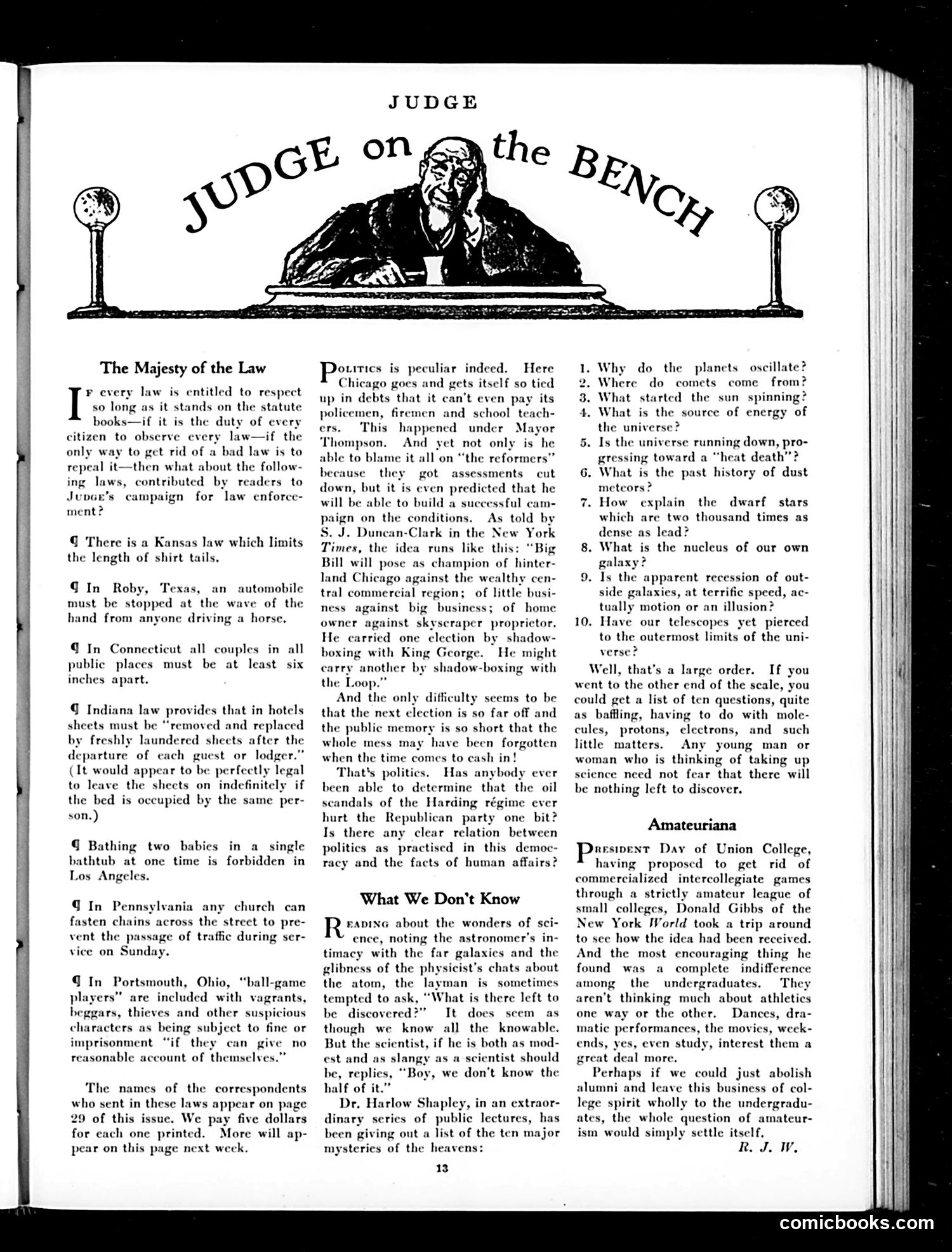
A restored page from Judge, 1930-03-08. Page through the whole issue in the reader above.
📄 Transcribed text from this page (OCR, searchable)
Machine-transcribed from the original scan — historical spelling and the odd misread are preserved.
The Majesty of the Law F every law is entitled to respect I so long as it stands on the statute books—if it is the duty of every citizen to observe every law—if the to get rid of a bad law is to about the follow- ’s, contributed by readers to campaign for law enforce- ment? @ There is a Kansas law which limits the length of shirt tails. G In Roby, Texas, an automobile must be stopped at the wave of the hand from anyone driving a horse. G In Connecticut all couples in all public places must be at least six inches apart. § Indiana law provides that in hotels sheets must be “removed and replaced by freshly laundered sheets after the departure of each guest or lodger.” (It would appear to be perfectly le to leave the shects on indefinitely i the bed is occupied by the same per- son.) G Bathing two babies in a single bathtub at one time is forbidden in Los Angeles. @ In Pennsylvania any church can fasten chains across the street to pre- vent the passage of traffic during ser- vice on Sunday. 4 In Portsmouth, Ohio, “ball-game players” are included with vagrants, gars, thieves and other suspicious characters as being subject to fine or imprisonment “if they can give no reasonable account of themselves.” The names of the correspondents who sent in these laws appear on page 29 of this issue. We pay five dollars for each one printed. More will ap- pear on this page next week. P itics is peculiar indeed. Here Chicago goes and gets itself so ticd up in debts that it can’t even pay its policemen, firemen and school teach- ers. This happened under Mayor Thompson. And yet not only is he able to blame it all on “the reformers” because they got assessments cut down, but it is even predicted that he will be able to build a successful cam- paign on the conditions. As told by S. J. Duncan-Clark in the New York Times, the idea runs like this: “Big Bill will pose as champion of hinter- land Chicago against the wealthy cen- tral commercial region; of little busi- inst big business; of home owner against skyscraper proprietor. He ried one clection by shadow- boxing with King George. He might carry another by shadow-boxing with the Loop.” And the only difficulty seems to be that the next election is so far off and the public memory is so short that the whole mess may have been forgotten when the time comes to cash in! That's politics. Has anybody ever been able to determine that the oil scandals of the Harding régime ever hurt the Republican party one bit? Is there any clear relation between politics as practised in this democ- racy and the facts of human affairs ness What We Don't Know R Avinc about the wonders of sci- ence, noting the astronomer’s in- timacy with the far galaxies and the glibness of the physicist’s chats about the atom, the layman is sometimes tempted to ask hat is there left to be discovered It does seem as though we know all the knowable. But the scientist, if he is both as mod- est and as slangy as a scientist should he, replies, “Boy, we don't know the half of it.” Dr. Harlow Shapley, in an extraor- dinary series of public lectures, been giving out a list of the ten major mysteries of the heavens: 13 1. Why do the planets oscillate? 2. Where do comets come from? 3. What started the sun spinning? 4. What is the source of energy of the universe? 5. Is the universe running down, pro- gressing toward a “heat death”? 6G. What is the past history of dust meteors? 7. How explain the dwarf. stars which are two thousand times as dense as lead? 8. What is the nucleus of our own 9. Is the pparent recession of out- ies, at terrific speed, ac- tually motion or an illusion? 10. Have our telescopes yet pierced to the outermost limits of the uni- verse? side Well, that’s a large order. If you went to the other end of the scale, you could get a list of ten questions, quite as baffling, having to do with mole- cules, protons, electrons, and such little matters. Any young man or woman who is thinking of taking up science need not fear that there will be nothing left to discover. Amateuriana P" sipENT Day of Union College, having proposed to get rid of commercialized intercollegiate games through a strictly amateur league of small colleges, Donald Gibbs of the New York World took a trip around to see how the idea had been received. And the most encouraging thing he found was a complete indiff among the undergraduates. aren't thinking much about athletics one way or the other. Dances, dra- matie performances, the movies, week- ends, yes, even study, interest them a great deal more. Perhaps if we could just abolish alumni and leave this business of col- lege spirit wholly to the undergradu- ates, the whole question of amateur- ism would simply settle itself, RJ. W, comicbooks.com