
Judge, 1930-03-01 · page 27 of 36
Judge — March 1, 1930 — page 27: what you’re looking at
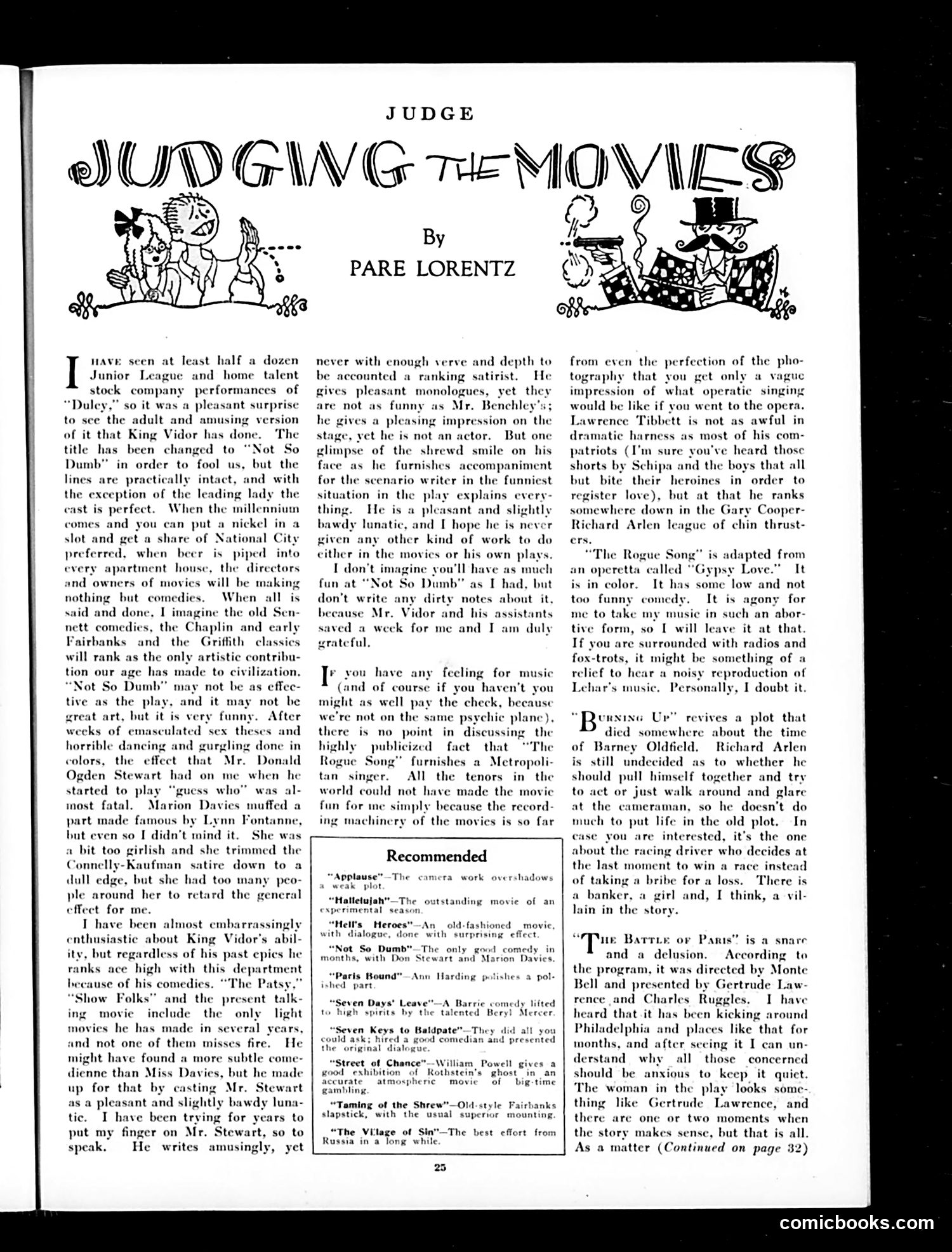
A restored page from Judge, 1930-03-01. Page through the whole issue in the reader above.
📄 Transcribed text from this page (OCR, searchable)
Machine-transcribed from the original scan — historical spelling and the odd misread are preserved.
UVUGIWG TEM HAvE seen at least half a dozen I Junior League and home talent stock company performances of “Duley,” so it was a pleasant surprise to see the adult and amusing version of it that King Vidor has done. The title has been changed to “Not So Dumb” in order to fool us, but the lines are practically intact, and with the exception of the leading cast is perfect. When the mill comes and you can put a nickel and get a share of National City erred, when beer is piped into y apartment house, the directors aking When all is said and done, I imagine the old Sen- nett comedies, the Chaplin and early Fairbanks and the iffith will rank as the only artistic contribu- tion our age | de to civilization, “Not So Dumb” may not be as effee- s the play, and it may not be at art, but it is very funny. After weeks of emasculated sex theses and horrible dancing and gurgling done in colors, the effect that) Mr. Donald Ogden Stewart had on me when he “guess who” 1 rs of movies will be nothing but comedies. classics was al- Marion Davies muffed a part made famous by Lynn Fontanne, but even so I didn’t mind it. She was a bit too girlish and she trimmed the Connelly-Kaufman satire down to a dull edge, but she had too many pco- ple around her to retard the general effect for me. I have been almost embarrassingly enthusiastic about King Vidor's abil- ity, but regardless of his past epics he ranks ace high with this department because of his comedies. “The Patsy Show Folks” and the present. talk- movie include the only light s he has made in several years, and not one of them misses fire. He might have found a more subtle come- dienne than Miss Davies, but he made up for that by casting as a pleasant and slightls tic. I have been try put my finger on Mr. Stewart, so to speak, ing mo} ewart y luna- JUDGE By PARE LORENTZ never with enough verve and depth to be accounted a ranking satirist. He s pleasant monologues, yet they ot as funny as Mr. Benchley's; he gives a pleasing impression on the yet he is not an actor. But one glimpse of the shrewd smile on his face as he furnishes accompaniment for the scenario writer in the funniest situation in the play explains every- thi He is a pleasant and slightly and I hope he is never other kind of work to do cither in the movies or his own plays. I don’t imagine you'll have as much fun at “Not So Dumb" as I had, but don't write any dirty notes about it, because Mr. Vidor and his assistants a week for me and Tam duly ateful. you have any feeling for music (and of course if you haven't you might as well pay the check, because we're not on the same psychic plane), there is no point in discussing the highly publicized fact that “The Rogue Song” furnishes a Metropoli- tan singer. All the tenors in’ the world could not have made the movie fun for nc simply because the record- ing machinery of the movies is so far : * R He writes amusingly, yet |" Recommended “Applause” —The came a weak’ plot Halletujah"—The outstanding experimental season “Hell's Meroes"*—An with dialogue, done ra work overshadows movie of an old-fashioned _ movie, with surprising effect ot So Dumb"—The only good comedy in months, with Don Stewart and Marion Davies. “Paris Bound” Ann Harding polishes ished part a pole “Seven Days’ Leave” nedy lifted to high spirits by the 1 “Seven Keys to Baldpate”—Th ired a good comedian ar dialogue Street of Chance nod exhibition accurate atmosy gambling William, Powell gives a Kothstein’s ghost in an eric movie of — big-time “Taming of the Shrew"—Old-style Fairbanks slapstick, with the usual superior mounting “The Vilage of Sin"—The best effort from ussia in a long while 25 me 2 from even the perfection of the pho- tography that you get only a vague impression of what operatic singing would be like if you went to the opera, wrence Tibbett is not awful in dramatic harness as most of his com- patriots (I’m sure you've heard those shorts by Schipa and the boys that all but bite their heroines in order to register love), but at that he ranks somewhere down in the Gary Cooper- Richard Arlen league of chin thrust- ers. “The Rogue Song an operetta called is in color. y Love.” It It has some low and not too funny comedy. It is agony for me to take my music in such an abor- tive form, so I will leave it at that. If you are surrounded with radios and fox-trots, it might be something of a relief to hear a noisy reproduction of Lehar’s music, Personally, I doubt it. © Perxixe Ur" revives a plot that died somewhere about the time of Barney Oldfield, Richard Arlen is still undecided as to whether he should pull himself together and try to act or just walk around and glare at the cameraman, so he doesn’t do much to put life in the old plot. In case you are interested, it's the one about the racing driver who decides at the last moment to win a race instead of taking a bribe for a loss. There is a banker, a girl and, I think, a vil- lain in the story. “Oe Barrie or Panis” is a snare and a delusion. According to the program, it was directed by Monte Bell and presented by Gertrude Law- rence and Charles Ruggles. I have heard that it has been kicking around Philadelphia and places like that for months, and after seeing it I can un- derstand why all those concerned should be anxious to keep it quiet. The woman in the play looks some- thi like Gertrude Lawrence, and there are one or two moments when the story makes sense, but that is all. As a matter (Continued on page 32) comicbooks.com