
Judge, 1930-03-01 · page 18 of 36
Judge — March 1, 1930 — page 18: what you’re looking at
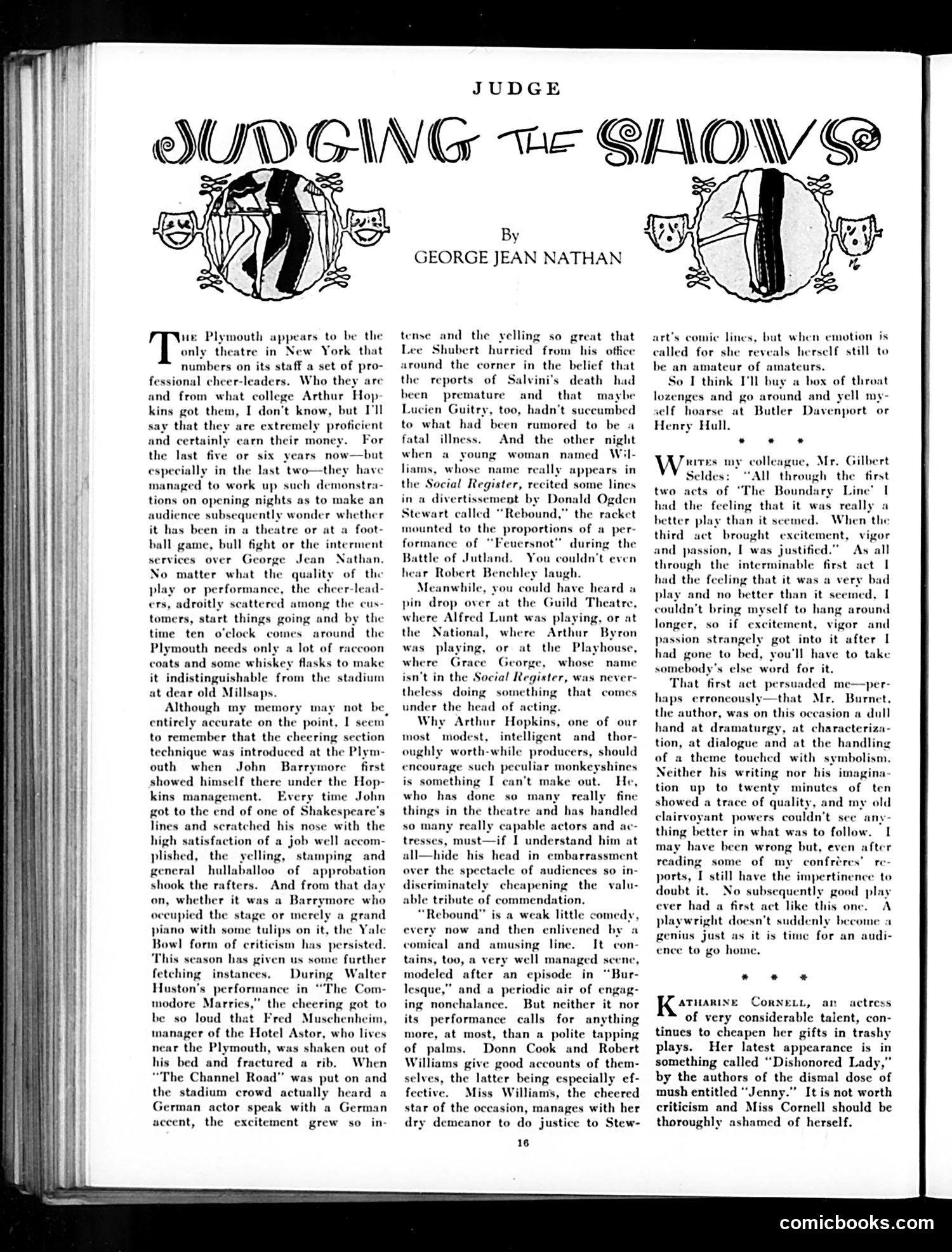
A restored page from Judge, 1930-03-01. Page through the whole issue in the reader above.
📄 Transcribed text from this page (OCR, searchable)
Machine-transcribed from the original scan — historical spelling and the odd misread are preserved.
ue Plymouth appears to be the only theatre in New York that numbers on its staff a set of pro- fessional cheer-leaders. Who they are and from what college Arthur Hop kins got them, I don't know, but I'll say that they are extremely proficient and certainly carn their money. For the last five or six years now—but lly in the last two—they have ed to work up such demonstra- tions on opening nights as to make an nce subsequently wonder whether it has been in a theatre or at a foot- ball game, bull fight or the interment services over George Jean Nath No matter what the quality of the nee, the cheer 1- y tered among th tomers, start things going and by the time ten o'clock comes around the Plymouth needs only a lot of raccoon oats and some whiskey flasks to ma it indistinguishable from the sta at dear old Millsaps. Although my memory may not be, entirely accurate on the point, I seem to remember that the cheering section technique was introduced at the Plym- outh when John Barrymore first showed himself there under the Hop- kins management. Every time John got to the end of one of Shakespeare's lines and scratched his nose with the high satisfaction of a job well accom- plished, the yelling, stamping and general hullabaloo of approbation shook the rafters. And from that day on, whether it was a Barrymore who reupied the stag erely a geri piano with some tulips on it, the Yale Bowl form of criticism has persisted. This season has given us some further fetching instances. During Walter Huston’s performance in ‘The Com- modore Marries,” the cheering got to be so loud that Fred Muschenheim, manager of the Hotel Astor, who lives near the Plymouth, was shaken out of his bed and fractured a rib. When “The Channel Road” was put on and the stadium crowd actually heard a German actor speak with a German accent, the excitement grew so in- cus- JUDGE NG we GAOWS tense and the yelling so great that Lee Shubert hurried from his office around the corner in the belief that the reports of Salvini's death had been premature and that = maybe Lucien Guitry, too, hadn't succumbed to what had been rumored to be a fatal illness. And the other night when a young woman named Wil- liams, whose name really appears in the Social Register, recited some lines in a divertissement by Donald Ogden Stewart called “Rebound,” the racket mounted to the proportions of a per- formance of “Feuersnot” during the Battle of Jutl uldn't even Meanwhile, you could have heard a pin drop over at the Guild Theatre, where Alfred Lunt was playing, or at the National, where Arthur) Byron was playing, or at the Playhouse, where Grace George, whose name isn’t in the Social Register, was never- theless doing something that come: under the head of acting. Why Arthur Hopkins, one of our most modest, intelligent and thor- oughly worth-while producers encourage such peculiar monk is something I can't make ov who has done so many really fine ratre and has handled »able actors and ac: I understand him at all—hide his head in embarrassment over the spectacle of audiences so in- discriminately cheapening the valu- able tribute of commendation. “Rebound” is a weak little comedy every now and then enlivened by comical and amusing line. It « tains, too, a very well managed scene, modeled after an episode in ‘Bur- lesque,” and a periodic air of engag- ing nonchalance. But neither it nor its performance calls for anything more, at most, than a polite tapping of palms. Donn Cook and Robert ve good accounts of them- selves, the latter being especially ef- fective. Miss Williams, the cheered star of the occasion, manages with her dry demeanor to do justice to Stew- 16 art's comic lines, but when emotion is called for she reveals herself still to be an amateur of amateurs. So I think I'll buy a box of throat lozenges and go around and yell my- velf hoarse at Butler Davenport or Henry Hull. Wares my colleague, Mr. Gilbert Seldes: “All through the first two acts of ‘The Boundary Line’ | had the feeling that it was really : better play than it seemed. When the third act brought excitement, vigor and passion, I was justified.” As all through the interminable first act 1 had the feeling that it was a very bad play and no better than it seemed, I couldn't bring myself to hang around longer, so if excitement, vigor and passion strangely got into it after I had gone to bed, you'll have to take somebody's else word for That first act persuaded me—per- haps erroneously—that Mr. Burnet. the author, was on this occasion a dull hand at dramaturgy, at characteriza- tion, at dialogue and at the handling of a theme touched with symbolism. Neither his writing nor his imag tion up to twenty minutes of ten showed a trace of quality, and my old clairvoyant powers couldn't see any- thing better in what was to folle ave been wrong but, even a some of my confi ports, I still have the imperti doubt it. No subsequently good p! ever had a first act this one. playwright doesn't suddenly become a genius just as it is time for an audi- ence to go home, * # « 7 * # Koateanne Cornet, an actress of very considerable talent, con- tinues to cheapen her gifts in trashy plays. Her latest appearance is in something called “Dishonored Lady,” by the authors of the dismal dose of mush entitled “Jenny.” It is not worth criticism and Miss Cornell should be thoroughly ashamed of herself. comicbooks.com