
Judge, 1930-03-01 · page 13 of 36
Judge — March 1, 1930 — page 13: what you’re looking at
What you’re looking at
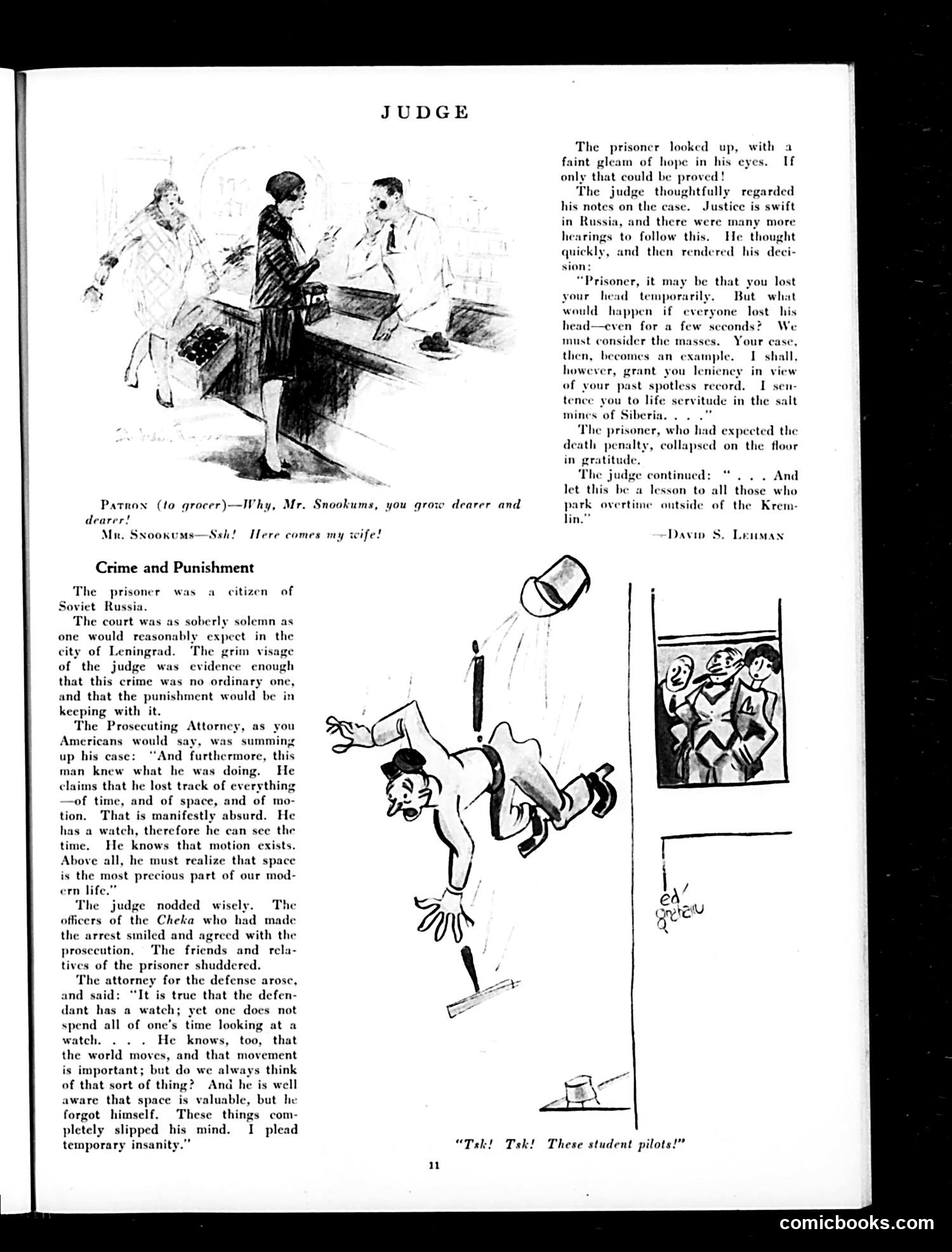
# Crime and Punishment in Soviet Russia This satirical story mocks Soviet (specifically Leningrad/Cheka) justice as absurd and severe. A prisoner's crime involves losing track of "time, space, and motion"—likely a euphemism for being late or absent from work. The prosecution argues this is inexcusable because the defendant owns a watch and should understand time's value. The defense pleads "temporary insanity." The judge, unmoved by either argument, sentences the man to life in Siberian salt mines anyway, then bizarrely lectures about how this should deter others from "park overtime outside of the Kremlin"—suggesting even minor infractions face draconian punishment in Soviet Russia. The cartoon below ("These student pilots!") appears unrelated satire about incompetent aviators. The piece satirizes Soviet authoritarianism: absurd laws, show trials with predetermined outcomes, and disproportionate punishments for minor offenses.
📄 Transcribed text from this page (OCR, searchable)
Machine-transcribed from the original scan — historical spelling and the odd misread are preserved.
The prisoner looked up, with a faint gleam of hope in his eyes. If only that could be proved! The judge thoughtfully regarded his notes on the case. Justice is swift in Russia, and there were many more hearings to follow this. He thought quickly, and then rendered his deci- risoner, it may be that you lost your head temporarily. But) what would happen if everyone lost his head—even for a few seconds? must consider the masses. Y. then, becomes an example. however, grant you lenieney in vi of your past spotless record. I sen- tence you to life servitude in the salt mines of Siberia... ." The prisoner, who had expected the death penalty, collapsed on the floor in gratitude, The judge continued: “. . . And let this be a lesson to all those who Patron (to grocer)—Why, Mr. Snookums, you grow dearer and park overtime outside of the Krem- dearer! lin.” Mn. Sxooxums—Ssh! Mere comes my wife! Daviv S. Lemay Crime and Punishment The prisoner was a citizen of Soviet Russia. The court was as soberly solemn as one would reasonably expect in the city of Leningrad. ‘The grim visage of the judge was evidence enough that this crime was no ordinary one, and that the punishment would be in keeping with it. The Prosecuting Attorney, as you Americans would say, was summing up his case: “And furthermore, this knew what he was doing. He ms that he lost track of everythin -of time, and of space, and of mo- tion. That is manifestly absurd. He has a watch, therefore he see the ime. He knows that motion exists. Above all, he must realize that space is the most precious part of our mod- ern life.” The judge nodded wisely. The officers of the Cheka who had made the arrest smiled and agreed with the prosecution, The friends and rela- tives of the prisoner shuddered. The attorney for the defense arose, and said: “It is true that the defen- dant has a watch; yet one does not spend all of one’s time looking at a vatch. . . . He knows, too, that the world moves, and that movement is important; but do we always think of that sort of thing? And he is well aware that space is valuable, but he forgot himself. These things com- pletely slipped his mind. I plead temporary insanity.” “Tek! Tsk! These student pilots!” comicbooks.com