
Judge, 1930-01-25 · page 20 of 36
Judge — January 25, 1930 — page 20: what you’re looking at
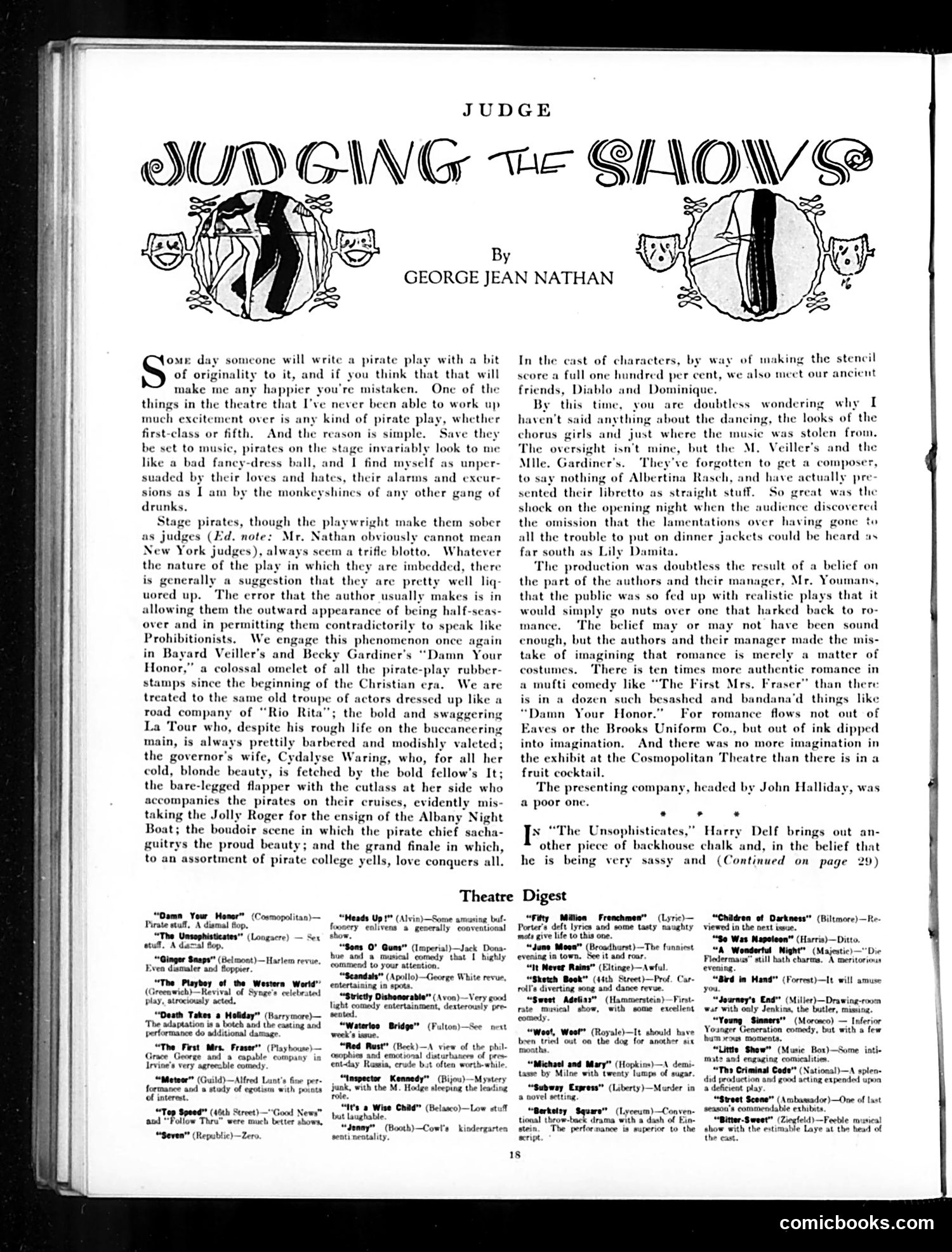
A restored page from Judge, 1930-01-25. Page through the whole issue in the reader above.
📄 Transcribed text from this page (OCR, searchable)
Machine-transcribed from the original scan — historical spelling and the odd misread are preserved.
someone will write a pirate play with a bit ty to it, and if you think that that will make me any happier you're mistaken. One of the things in the theatre that I've never been able to work up much excitement over is any kind of pirate play, whether first-class or fifth, And the reason is simple. “Save they be set to music, pirates on the stage invariably look to me like a bad faney-dress ball, and I find myself as unper- suaded by their loves and hates, their alarms and excur- sions as I am by the monkeyshines of any other gang of drunks. Stage pirates, though the pl as judges (Ed. note: Mr. Nz New York judges), alwa the nature of the play is generally a suggesti wright make them sober han obviously cannot mean na trifle blotto, Whatever ure imbedded, there re pretty well liq- n that they uored up. The error that the author usually makes is in allowing them the outward appearance of being half-seas- nd in permitting them contradictorily to speak like vitionists. We engage this phenomenon once again ard Veiller’s and Becky Gardiner’s “Damn Your Honor,” a colossal omelet of all the pirate-play rubber- stamps since the beginning of the Christian era. We treated to the same old troupe road company of “Rio Rita”; the bold and swagge La Tour who, despite his rough life on the buccaneerin: main, is always pret barbered and modishly valeted; the governor's wife, Cydalyse Waring, who, for all her cold, blonde beauty, is fetched by the bold fellow’s It; the bare-legged pper with the cutlass at her side who accompanies the pirates on their cruises, evidently mis- taking the Jolly Roger for the ensign of the Albany Night Boat; the boudoir scene in which the pirate chief sacha- guitrys the proud beauty; and the grand finale in which, to an assortment of pirate college yells, love conquers all. e of actors dressed up like a fi Theatre “Heads Up!" (Alvin) —Some amusing buf- frocery enlivens a generally conventional “Sens O' Guns” (Imperial) —Jack Dona- hue and a musical comedy that I highly “Oama Your Hener™ (Cosmopolitan) — Pirate stuff, A dismal flop. “The Unsophisticates” (Longacre) — Sex stuf. A damal flop, (Belmont)—Harlem revue. SAOWS stencil neient In the cast of characters, by way of making th t, we also meet our a score a full one hundred per ce friends, Diablo and Dominique. By this time, you are doubtless wondering why I haven't said anything about the dancing, the looks of the Is and just where the music was stolen from, t isn't mine, but the M, Veiller’s and the Mile. Gardiner’s. They've for, t a compose: to say nothing of Albertin: ctually pr sented their libretto as straight stuff. So great was the shock on the opening night when the audience discovered the omission that the lamentations over having g: all the trouble to put on dinner jackets could be hed far south as Lily Damita. The production was doubtless the result of a belief on the part of the authors and their manager, Mr. Youmans, that the public was so fed up with realistic plays that it would simply go nuts over one that harked back to ro- mance. The belief n or m not have been sound enough, but the authors and their manager made the mis- take of imagining that romance is merely a matter of costumes. There is ten times more authentic romance in a mufti comedy like he First Mrs, Fraser’ than there dozen such besashed and bandana’d things like Your Honor.” For romance flows not out of Brooks Uniform Co., but out of ink dipped ion. And there was no more imagination in xhibit at the Cosmopolitan Theatre than there is in a cocktail. The presenting company, headed by John Halliday, was a poor one. I “The Unsophisticates,” Harry Delf brings out an- other piece of backhouse chalk and, in the belief that he is being very sassy and (Continued on page 2 chorus The oversig rds . * * Digest “Fitty Million Frenchmen” —(Lyric)— Porter's deft lyrics and some tasty naughty mats give life to this one. “dune Move” (Broadthurst)—The funniest evening in town. See it and roar. “Children of Darkness” (Biltmore) —Re- viewed in the next issue, “$0 Was Napoleon” (Farris)—Ditto. “A Wondertul Might” (Majestic)—"'Die Fledermaus” still hath charms. A meritorious ‘Ginger Snaps” Even dusmaler and flopper. of the Western Wertd”” (Greenwich)—Revival of Synge's celebrated play, atrociously acted, “Death Takes a Holiday” (Barrymore)— ‘The adaptation is a boteh and the casting and performance do additional damage. “The First Mrs. Fraser’ (Playhouse) — Grace George and a capable company in Irvine's very agreeable comedy “Meteor” (Guild)—Alfred L formance and a study of egotis of interest. “Top Speed’ (46th Servet) — News” and “follow Thru” were muuch Uriter shows, “Seven” (Republic)—Zero. commend to your attention Apollo)—George White revue, entertaining in spots “Strictly Dishonorable” (Avon) —Very good light comedy entertainment, dexterously pre- sented. “Waterloo Bridge” (Pulton)—See nest week's inue. “Red Rust’ (Beck)—A view of the phil- csophies and emotional disturbances of pees ent-day Rusia, crude bit often worthwhile “lnspector Kennedy” (Bijou)—Mystery junk, with the M. Hodge sleeping the lending role. “It's a Wise Child” (Belasco)—Low stuf but Laughable “denay” (Booth)—Cowl's senti mentality, kindergarten “it Mever Rains” (Eltinge)—A wful “Sketch Book” (44th Street)—Prof. Car- roll’s diverting song and dance revue “Sweet Adeline” (Hammerstein) —First- rate musical show, with some excellent comely “Woot, West” (Royale)—It should have been tried out oa the dog for another six months “Michael and Mary” (Hopkins)—\ demi- tase by Milne with twenty lumps of sugar. “Subway Express” (Liberty) —M. a novel setting jarder in (Lyceum) —Con ver yw-back drama with a dash of evening. “Bird in Hand” (Forrest)—It will amuse you. “Journey's End” (Miller)—Drawing-roomn war with oaly Jenkins, the butler, missing. “Young Sinners” (Moronco) — Inferior Younger Generation comedy, but with a few bum sous moments. “Littte Show" (Music Bor)—Some inti- mate and engaging comicalities “Tho Criminal Code” (National)—A splen- did production and good acting expend a deficient play “Street Scene” (Ambawador)—One of last commendable exhibits weet” (Zicgfeld)—Feeble m the estimable Laye at the hea’ comicbooks.com