
Judge, 1930-01-11 · page 25 of 36
Judge — January 11, 1930 — page 25: what you’re looking at
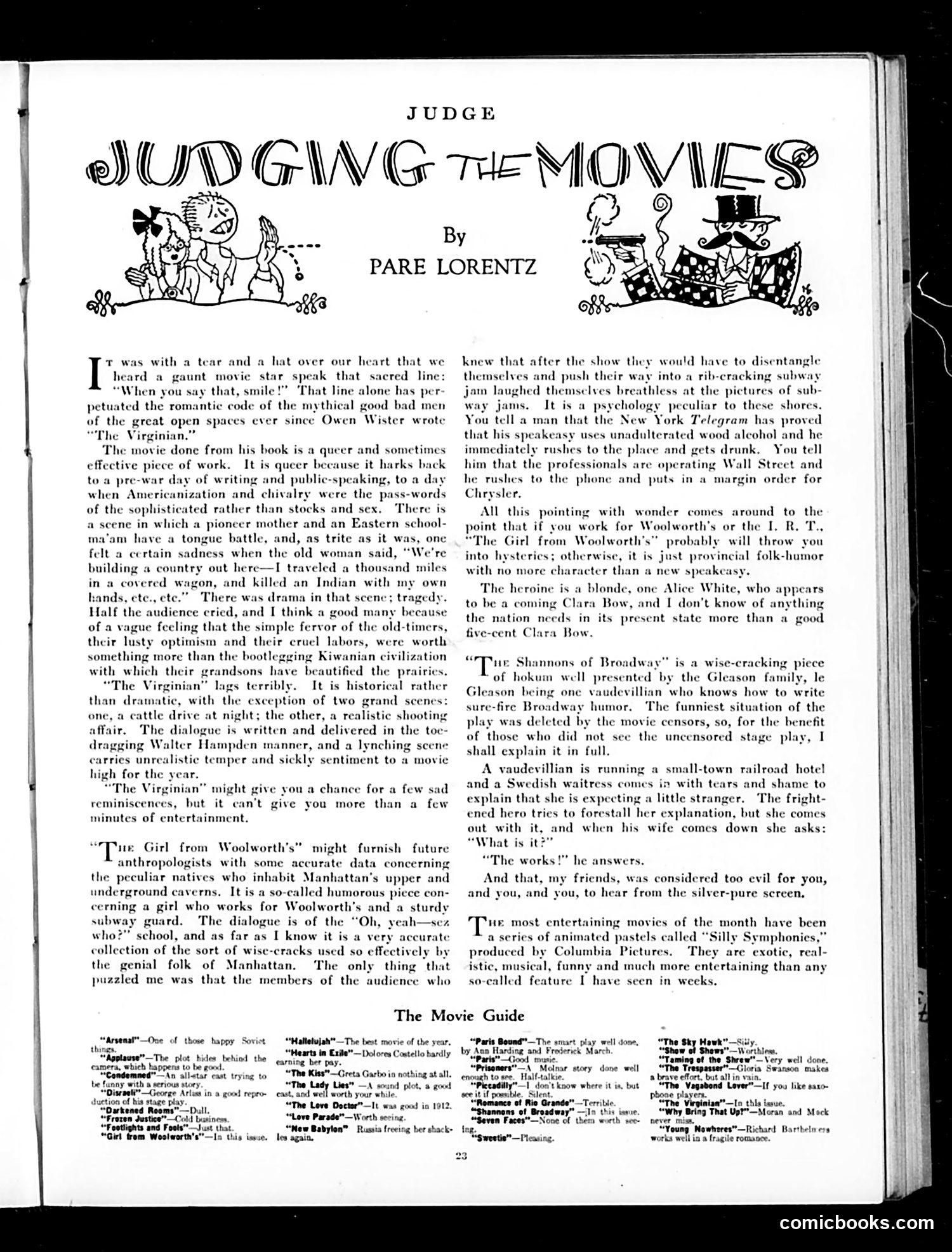
A restored page from Judge, 1930-01-11. Page through the whole issue in the reader above.
📄 Transcribed text from this page (OCR, searchable)
Machine-transcribed from the original scan — historical spelling and the odd misread are preserved.
IN. I movie star speak that sacred line: you say that, smile!” That line alone has per petuated the romantic code of the mythical good bad men of the great open spaces ever since Owen Wister wrote The Virginian.” The movie done from his book is a queer and sometimes effective piece of work. It is queer because it harks back to a pre-war day of writing and public-speaking, to a day when Americanization and chivalry were the pass-words of the sophisticated rather than stocks and sex. There is n Eastern school- m have a tongue battle, and, as trite as it was, one felt a certain sadness when the old woman said, “We're building a country out here—I traveled a thousand miles in a covered wagon, and killed an Indian with my own nds, ete., ete.” There was drama in that scene; tragedy. Half the audience cried, and I think a good many because of a vague feeling that the simple fervor of the old-timers, their lusty optimism and their cruel labors, were worth something more than the bootlegging Kiwanian with which their grandsons have beautified tl “The Virginian” lags terribly. It is historical rather matic, with the exception of two grand scenes: cattle drive at night; the other, a realistic shooting The dialogue is written and delivered in the to agging Walter Hampden manner, and a lynching scene carries unrealistic temper and sickly sentiment to a movie high for the year. “The Virginian” might give you a chance for a few sad reminiscences, but it can’t give you more than a few minutes of entertainment. jirl from Woolworth’s ets with some the peculiar natives who inhabit Manhattan's upper and underground caverns. It is a so-called humorous piece con- cerning a gitl who works for Woolworth’s and a sturdy a scene in which a pioncer mother and ation prairies. might furnish future accurate ¢ concerning subway guard. The dialogue is of the “Oh, yeah—sez who?” school, and as far as I know it is a very accurate collection of the sort of wise-cracks used so effectively by the genial folk of Manhattan. ‘The only thing ‘that puzzled me was that the members of the audience who By JUDGE JILUDGIVG HMO 6 themselves and push their w ing subwa jam laughed themselves br tures of sub- hless at the p » peculiar to these shores. 1 tell a man that the New York T'elegram has proved that his speakeasy uses unadulterated wood alcohol and he immediately rushes to the place and gets drunk. You tell him that the professionals are operating Wall Street and he rushes to the phone and puts in a margin order for Chrysler. All this pointing with wonder comes around to the point that if you work for Woolworth’s or the I, R. T., The Girl from Woolworth’s” probably will throw you into hysterics; otherwise, it is just provincial folk-humor with no more character than a new speakeasy. The heroine is a blonde, one Alice White, who a to be a coming Clara Bow, and I don’t know of the nation needs in its present state more than a good five-cent Clara Bow. « 7 “Tur Shannons of Broadway" is a wise-cracking piece of hokum well presented by the Gleason family, le Gleason being one vaudevillian who knows how to write y humor. The funniest situation of the play was deleted by the movie censors, so, for the benefit of those who did not see the uncensored stage play, I shall explain it in full. A vaudevillian is running a small-town railroad hotel and a Swedish waitress comes in with tears and shame to explain that she is expecting a little stranger. The fright- ened hero tries to forestall her explanation, but she comes out with it, and when his wife comes down she asks: “What is it? The works!” he answers. And that, my friends, was considered too evil for you, and you, and you, to hear from the silver-pure screen, He most entertaining movies of the month have been a series of animated pastels called “Silly Symphonies,” produced by Columbia Pictures. They are exotic, real- istic, musical, funny and much more entertaining than any so-called feature I have seen in weeks. The Movie Guide “Arsenal”—One of those happy Soviet “Hallelujah” —The best movie of the year. things, “Hearts in Exe” —Dolores Costello bardly earning ber pay. PFD allstar cast trying to. “The Kiss”—Greta Garbo in nothing at all. be fanny with a serious story “The Lady Lies” —\ 5 “Disrvel” “George Arius in a gon repeo- exst and well worth your while on of his stage play ” 4 good is 2. mo of bis age play “The Love Dector”—It. was good is 1912 ves Jeter ‘old business. “Love Parade” —\Worth serving. “Footlights and Foots™—Just that. ibyton™ =Russia freeing ber “Girt tr Weslworth’s”—In this ise. * ~The plot bides behind the camera, which happens to be gord “Condemned plot, a good “Paris Bound” —The sar by Ana Harding and Fred “Paris”—Good music ners—A Molnar story done well enough to are. Half-talkie. “Pieeadilly"—|_ don't koow where it is, but oce it if pomsble. Silent “Romance of Rio play well done, k March. “ ia Swansoa makes a brave effort, but all in vain. “The Vagabond Lever” —if you like saxo- phone players. “The Virginian” —In this issue. “why Bring That Up?”"—Moran snd Mock never msn. “Young Nowheres”—Richan! Barthe works well in a fragile romance. comicbooks.com