
Judge, 1930-01-11 · page 10 of 36
Judge — January 11, 1930 — page 10: what you’re looking at
What you’re looking at
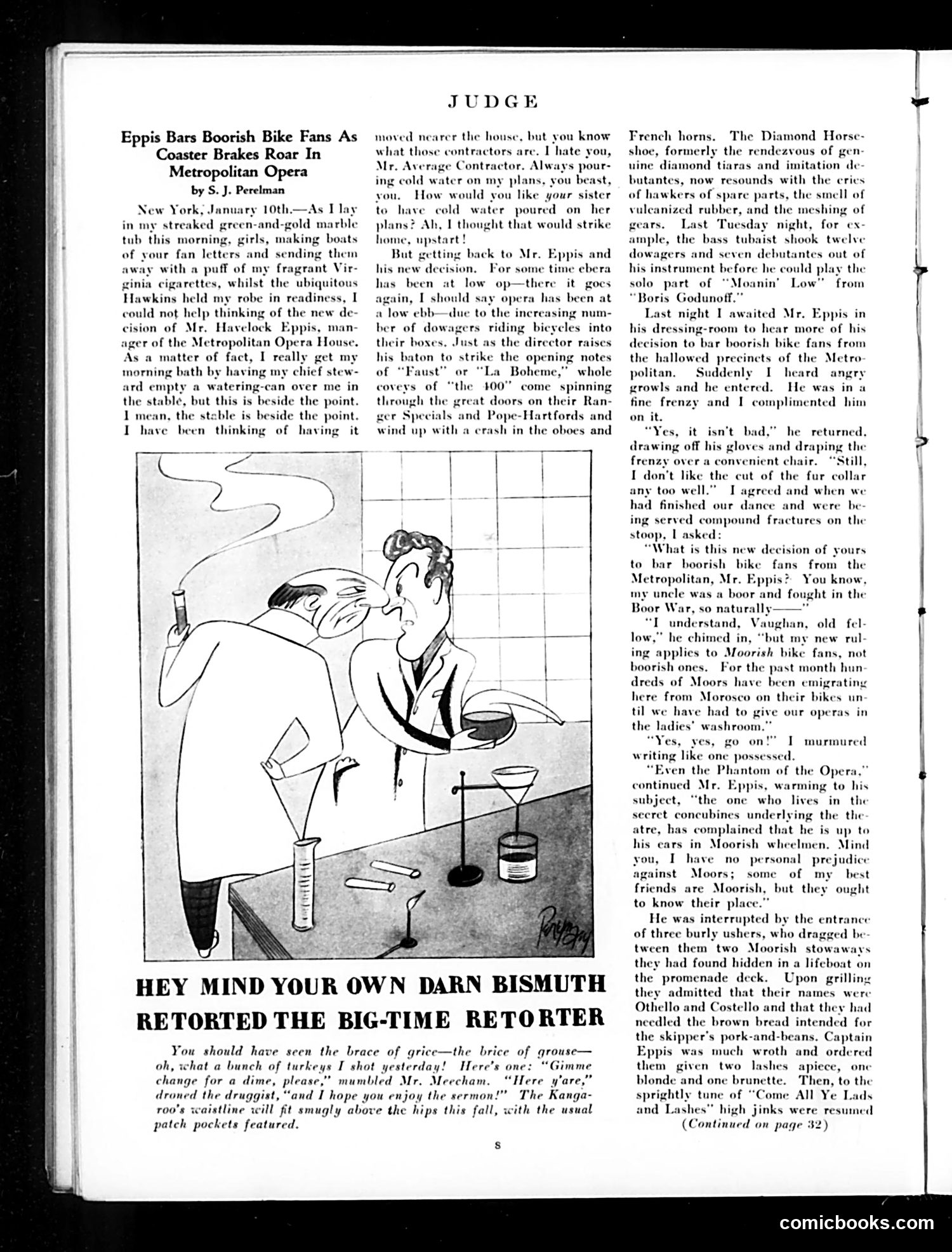
# Judge Magazine Satire Analysis This is a humorous piece by S.J. Perelman satirizing the Metropolitan Opera House and its manager (likely based on a real figure). The central joke concerns opera's declining prestige: wealthy socialites ("dowagers" and debutantes from "the 400"—old money society) have begun arriving to performances on bicycles rather than in carriages, creating literal chaos during performances—they crash their bikes into the orchestra pit. The cartoon shows a man (presumably the opera manager) gesticulating dramatically while bathing or dressing, illustrating his exasperated response. The satire mocks both the pretentiousness of high society and opera's fall from cultural dominance. The closing section adds a pun: Eppis has barred "Moorish" (not "boorish") bike fans—playing on the similar-sounding words while referencing immigrants from Morocco arriving by bicycle. The piece reflects 1920s-30s anxieties about social change, immigration, and the declining authority of traditional cultural institutions.
📄 Transcribed text from this page (OCR, searchable)
Machine-transcribed from the original scan — historical spelling and the odd misread are preserved.
JUDGE Eppis Bars Boorish Bike Fans As moved nearer the house, but you know Coaster Brakes Roar In what those cont -. Lhate you, F Mr. Average Contractor. Always pour- Metropolitan Opera ing cold water on my plans, you beast, by S. J. Perelman you. How would you like your sister New York, January 10th.—As Ilay te have cold water poured on her in my streaked green-and-gold marble — plans? Ah, I thought that would strike tub this morning, girls, making boats home, upstart! of your fan letters and sending them Bat getti with back to Mr. Eppis and a puff of my fragrant Vir- his new decision, For some time ebera ginia cigarettes, whilst the ubiquitous has been at low op—there it goes Hawkins held my robe in readiness, 1 in, I should say opera has been at could not help thinking of the new de- a low ebb—due to the increasing num- cision of Mr. Havelock Eppis, man- ber of dowagers riding bicycles into ager of the Metropolitan Opera House. — their boxes. Just as the director raises As a matter of fact, I really get my his baton to strike the opening notes morning bath by having my chief stew- of ist” or “La Boheme,” whole ard empty a wate an over me in coveys of “the 400" come spinning the stable, but this is beside the point. through the great doors on their Ran- 1 mean, the s' » is beside the point. ger Specials and Pope-Hartfords and I have been thinking of having it wind up with a erash in the oboes and HEY MIND YOUR OWN DARN BISMUTH RETORTED THE BIG-TIME RETORTER You should have seen the brace of grice—the brice of qrouse— oh, what a bunch of turkeys I shot yesterday! Here's one imme change for a dime, please,” mumbled Mr. Meecham. “Here y’are,” droned the druggist, “and I hope you enjoy the sermon!” The Kanga- roo's waistline will fit smugly above the hips this fall, with the usual patch pockets featured. French horns. The Diamond Horse- shoe, formerly the rendezvous of gen uine diamond tiaras and imitation de butantes, now resounds with the cries of hawkers of spare parts, the smell of vulcanized rubber, and the meshing of gears. Last Tuesday night, for ex- ample, the bass tubaist shook twelve dowagers and seven debutantes out of his instrument before he could play the solo part of “Moanin’ Low" from “Boris Godunoff.” Last night I aw his dressin ited Mr. Eppis in room to hear more of his ar boorish bike fans from the hallowed precincts of the Metro politan. Suddenly I heard angry growls and he entered. He was in a fine frenzy and I complimented him on decision to Yes, it isn’t bad,” he returned, drawing off his gloves and draping the frenzy over a convenient chair. “Still, I don’t like the cut of the fur collar any too well.” I agreed and when we had finished our dance and were be ing served compound fractures on the stoop, L asked: “What is this new decision of yours to bar boorish bike fans from the Metropolitan, Mr. Eppis? You know, my uncle was a boor and fought in the Boor War, so naturally——" “T understand, Vaughan, old fel- low,” he chimed in, “but my new rul- ing applies to Moorish bike fans, not boorish ones. For the past month hun dreds of Moors have been emigrating here from Morosco on their bikes un til we have had to give our operas in the ladies’ washroom,” "Yes, yes, go ¢ I murmured writing like one possessed. “Even the Phantom of the Opera,” continued Mr. Eppis, warming to his he one who lives in the secret concubines underlying the the atre, has complained that he is up to his cars in Moorish wheelmen, Mind you, I have no personal prejudice against Moors; some of my best friends are Moorish, but they ought to know their place. He was interrupted by the entrance of three burly ushers, who dragged be tween them two Moorish stowaways they had found hidden in a lifeboat on the promenade deck. Upon grilling they admitted that their names were Othello and Costello and that they had needled the brown bread intended for the skipper’s pork-and-beans. Captain Eppis was much wroth and ordered them given two lashes ap on blonde and one brunette. Then, to the sprightly tune of “Come All Ye Lads and Lashes” high jinks we (Continued on page resumed ) comicbooks.com