
Judge, 1929-12-14 · page 27 of 36
Judge — December 14, 1929 — page 27: what you’re looking at
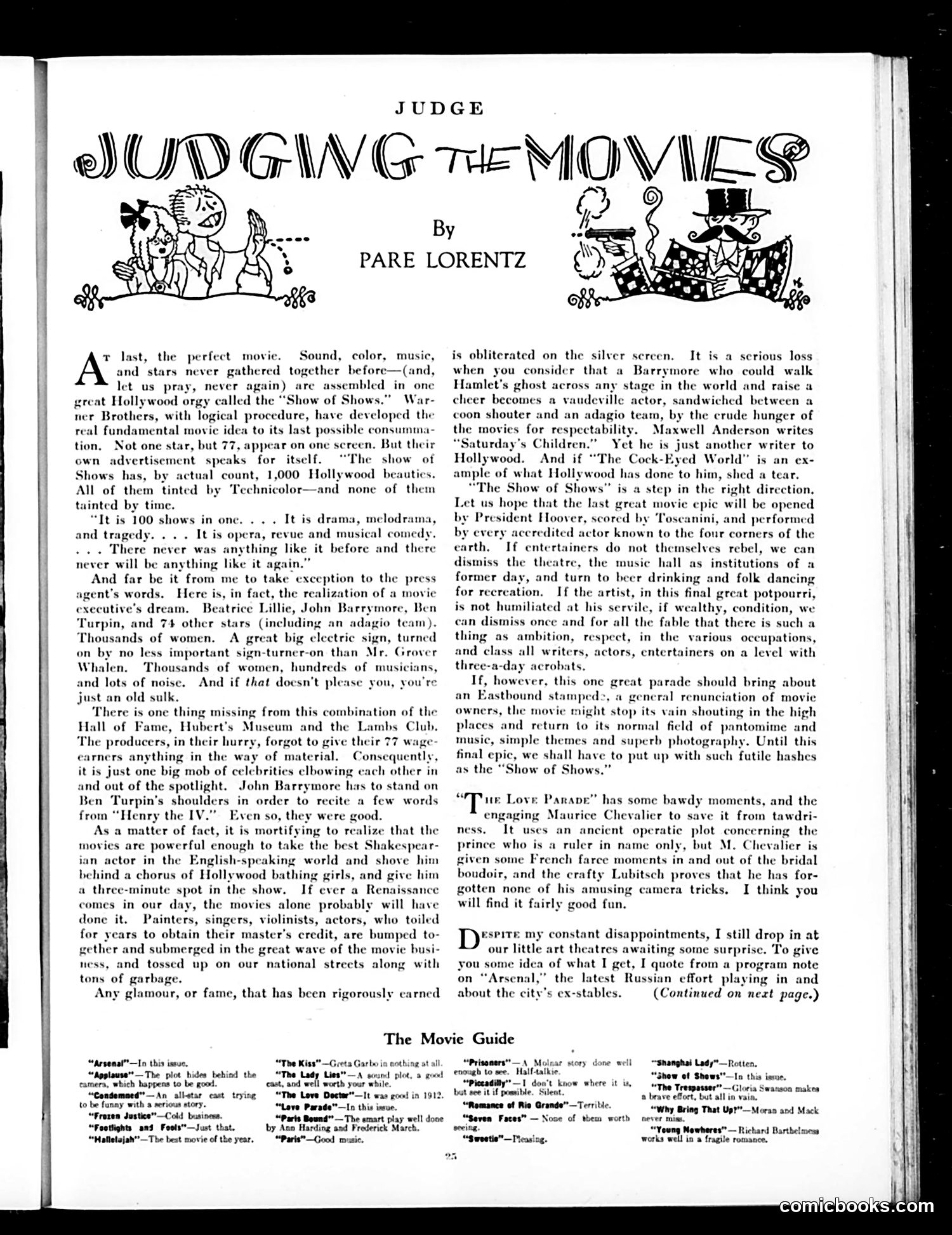
A restored page from Judge, 1929-12-14. Page through the whole issue in the reader above.
📄 Transcribed text from this page (OCR, searchable)
Machine-transcribed from the original scan — historical spelling and the odd misread are preserved.
JUDGE JUMVGIWN is TEMOV Ls + last, the perfect movie. Sound, color, music, A nd stars never gathered together before—(and, let us pray, never ) are assembled in one great Hollywood orgy called the “Show of Shows.” War- ner Brothers, with logical procedure, have developed the real fundamental movie idea to its last possible consumma- tion, Not one star, but 77, appear on one screen. But their own advertisement speaks for itself. “The show of Shows has, by actual count, 1,000 Hollywood beauties. All of them tinted by Technicolor—and none of them inted by time. “It is 100 shows in onc. and tragedy... . It is ope ... It is drama, melodrama, ver will be anything like it a And far be it from me to take exception to the press gent’s words. Here is, in fact, the re: tion of a movie cutive’s dream. Beatrice I n Barrymore, Ben urpin, and 74 other stars (including an « Thousands of women. A. greal big electric sign, turned on by no less important sign-turner-on than Mr. Grover Whalen, Thousands of women, hundreds of musicians, and lots of noise. And if that docsn’t ple: just an old sulk. There is one thing missing from this combination of the Hall of Fame, Hubert’s Museum and the Lambs Club. The producers, in their hurry, forgot to gi ners anything in the way of material. you, you're F Consequently, it is just one big mob of celebrities elbowing each other in and out of the spotlight. John Barrymore has to st: Ben Turpin’s shoulders in order to recite a few words from “Henry the IV." Even so, they were good. As a matter of fact, it is mortifying to realize that the movies are powerful enough to take the best Shakespear- ian actor in the English-speaking world and shove him behind a chorus of Hollywood bathing girls d give him a three-minute spot in the show. sance comes in our day, the movies alone probably will have done it. Painters, singers, violinists, act for years to obtain their master’s cred nd on , are bumped to- gether and submerged in the great wave of the movie busi- ness, and tossed up on our national streets along with tons of garbage. Any glamour, or fame, that has been rigorously earned By PARE LORENTZ is obliterated on the silver screen. It is a serious loss when you consider that a Barrymore who could walk Hamlet's ghost across any stage in the world and raise a cheer becomes a vaudeville actor, sandwiched between a coon shouter and an adagio team, by the crude hunger of the movies for respectability. Maxwell Anderson writes “Saturday's Children.” Yet he is just another writer to Hollywood. And if he Cock-Eyed World” is an ex- ample of what Hollywood has done to him, shed a tear. “The ow of Shows” is a step in the right direction, Let us hope that the last great movie epic will be opened by President Hoover, scored by ‘Toscanini, and performed by every accredited actor known to the four corners of the earth, If entertainers do not themselves rebel, we can dismiss the theatre, the music hall as institutions of a former day, and turn to beer drinking and folk dancing for recreation. If the artist, in this final great potpourri, is not humiliated at his servile, if wealthy, condition, we can dismiss once and for all the fable that there is such thing as ambition, respect, in the various occupations, and class all writers, actors, entertainers on a level with three-a- rrobats. If, however, this one great parade should bring about Zastbound stampede, « gencral renunciation of mo’ owners, the movie might stop its vain shouting in the high places and return to its normal field of pantomime and music, simple themes and superb photography. Until this final epic, we shall have to put up with such futile hashes as the “Show of Shows.” an “Ta Love Parape” has some bawdy moments, and the engaging Maurice Chevalier to save it from tawdri- ness. It uses an ancient operatic plot concerning the prince who is a ruler in name only, but M. Chevalier is some French farce moments in and out of the bridal ty Lubitsch proves that he has for- gotten none of his amusing camera tricks. I think you will find it fairly good fun, De my constant disappointments, I still drop in at our little art theatres awaiting some surprise. To give you some idea of what I get, I quote from a program note on “Arsenal,” the latest Russian effort playing in and about the city’s ex-stables. (Continued on next page.) The Movie Guide “Arsenal”—In this issue. “The Kiss" —Greta Garb in eothing at al “Applause” —The plot hides behind the “The Lady Lies”—A sound plot. a camera, which happens to be good. cast, and well worth your while. “Condemaed”—An allstar cast trying “The Love Doctor” —It was goo! in 1912. to be funay with a serious story. “Love Parade”—In this inve. “Frexen Justice” —Cold business. “Paris Bound” —The smart pla “Feottights and Fools —Just t! by Ann Harding and Frederick March, ““Halletajah”—The best movie of the year, “Paris” —Good muic. enough to see. Half: but see it if pomible. Silent. well done eveing. “Young Newheres” “Prisoners” —\ Molear story done kie. Rotten, "—In this issue, “The Trespasser” — Gloria Swanson makes 8 brave effort, but all in vain, “Why Bring That Up?"—Moras and Mack — Nove of sbem worth never mim, “Piceadity I doo't know where it is, “Romance of Rio Grande” —Terribic. “Seven Fac Richard Barthelmess “Sweetie” —Pieasing. works well in a fragile romance. Comicbooks.com