
Judge, 1929-12-07 · page 23 of 36
Judge — December 7, 1929 — page 23: what you’re looking at
A restored page from Judge, 1929-12-07. Page through the whole issue in the reader above.
📄 Transcribed text from this page (OCR, searchable)
Machine-transcribed from the original scan — historical spelling and the odd misread are preserved.
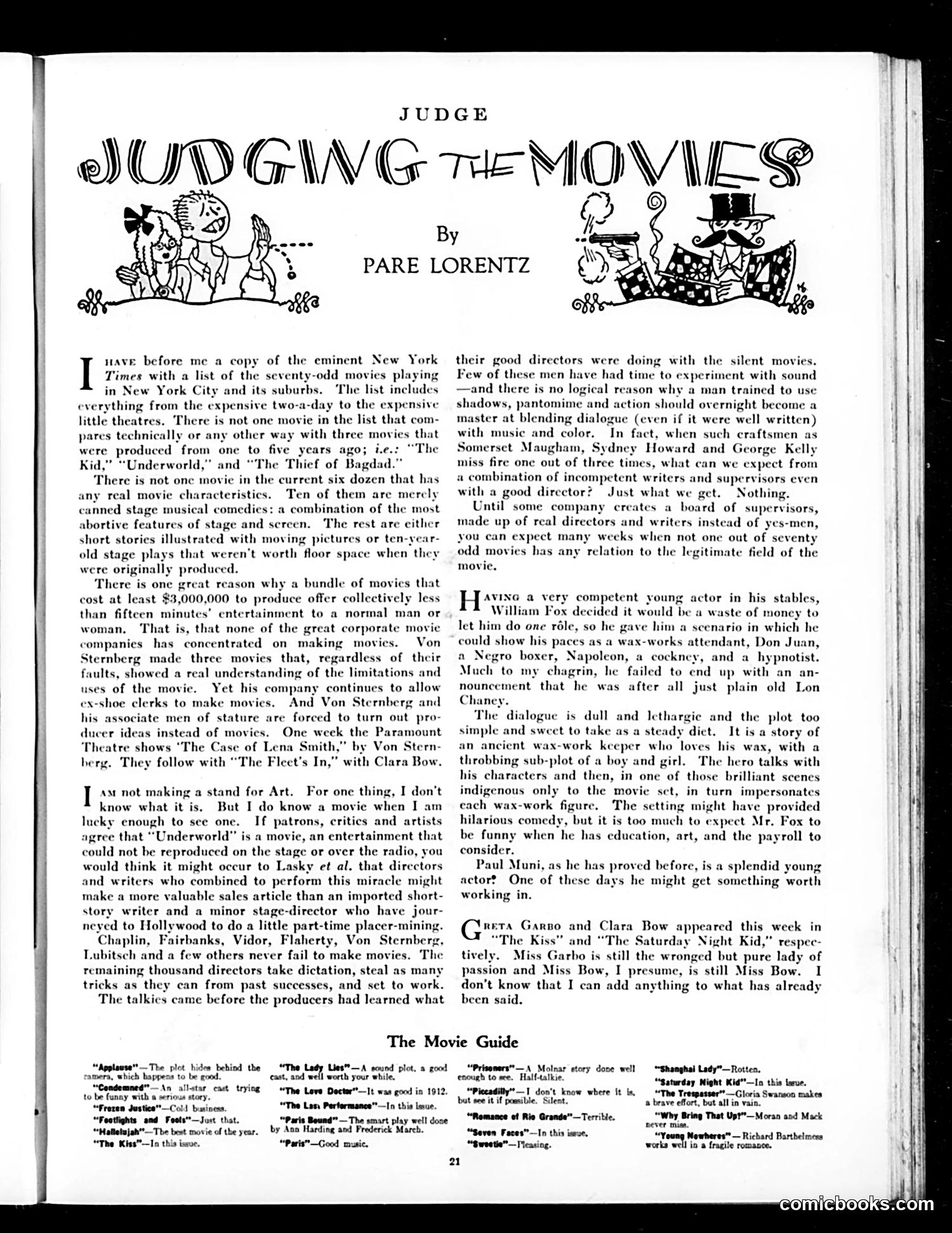
| JUDGE | S\UVGING THE MOV C$ Times with a list of the seventy-odd movies playing in New York y and its suburbs. ‘The everything from the expensive two-a-day to the expensive little theatres. There is not one movie in the list that com- pares technically or any other way with three movies that were produced from one to five years ago; ie.: “The Kid,” “Underworld,” and “The Thief of Bagdad.” There is not onc movie in the current six dozen that ha any real movie characteristics. Ten of them are merely canned stage musical comedies: a combination of the most abortive features of stage and sercen. The rest are either short stories illustrated with moving pictures or ten-year- old stage plays that weren't worth floor space when they were originally produced. There is one great reason why a bundle of movies that cost at least $3,000,000 to produce offer collectively less than fifteen minutes’ entertainment to a normal m woman, That is, t none of the great corporate movie companies has concentrated on making movies. Von Sternberg made three movies that, regardless of their faults, showed a real understanding of the limitations and uses of the movie. Yet his company continues to allow ex-shoe clerks to make movies. And Von Sternberg and his associate men of stature are forced to turn out pro- ducer ideas instead of movies. One week the Paramount Theatre shows ‘The Case of Lena Smith,” by Von Stern- herg. They follow with “The Fleet's In,” with Clara Bow, I wave before me a copy of the eminent New York cludes: an or I am not making a stand for Art. For one thing, I don’t know what it is. But I do know a movie when I am lucky enough to see one. If patrons, critics and artists agree that “Underworld” is a movie, an entertainment that could not be reproduced on the stage or over the radio, you would think it might occur to Lasky et al. that dire and writers who combined to perform this mirac' make a more valuable sales article than an imported short- story writer and a minor stage-director who have jour- neyed to Hollywood to do a little part-time placer-mining. ‘Chaplin, Fairbanks, Vidor, Flaherty, Von Sternberg, Lubitsch and a few others never fail to make movies. The remaining thousand directors take dictation, steal as many tricks as they can from past successes, and sct to work. The talkics came before the producers had learned what The Mo Ues"—A sound plot, » good cast, and well worth your while. “The Love Decter”—It was good in 1912. “Freten Jostice”—Cold business “The Lan Performance" —In this lmue. “Featiights and Fools—Just that. “Paris Bound” —The smart play well done “Mallelujah"—The best movie of the year. by Ana Harding and Frederick Mareh. “The Kiss"—In this issue. “Paris”—Good music. “Agplaese”'—The plot hides behind the “The mera, which happens to be ga “Condemned” —An all-star cast trying to be funny with s seri By their good directors were doi Few of these men have had time to experiment with sound —and there is no logical reason why a man trained to use shadows, pantomime and action should overnight become a master at blending dialogue (even if it were well written) with music and color. In fact, whe aftsmen as Somerset Maugham, Sydney Hows orge Kelly miss fire one out of three times, wl vect from a combination of incompetent writers and supervisors even with a good director? Just what we get. Nothing. Until some company cre board of supervisors, made up of real directors and writers instead of yes-men, you can expect many weeks when not x with the silent movies. one out of seventy timate field of the odd movies has any relation to the leg movie. a very competent young actor in his stables, n Fox decided it would be a waste of money to let him do one réle, so he gave him a scenario in which he could show his paces as a works attendant, Don Juan, a Negro boxer, Napoleon, a cockn and a hypnotist. Much to my chagrin, he failed to end up with an an- nouncement that he was after all just plain old Lon Chaney. The dialogue is dull and lethargic and the plot too simple and sweet to take as a steady diet. It is a story of an ancient wax-work keeper who loves his wax, with a throbbing sub-plot of a boy and girl. The hero talks with his characters and then, in one of those brilliant scenes indigenous only to the movie set, in turn impersonates each wax-work figure. The setting might have provided hilarious comedy, but it is too much to expect Mr. Fox to be funny when he has education, art, and the payroll to consider. Paul Muni, as he has proved before, is a splendid young actor? One of these days he might get something worth working in. A Garno and Clara Bow appeared this week in The Kiss” and “The Saturday Night Kid,” respec- Miss Garbo is still the wronged but pure lady of passion and Miss Bow, I presume, is still Miss Bow. I don’t know that I can add anything to what has already been said. vie Guide “Prisoners” —\ Molnar story done well ‘enough to sre. Half-talkie. “Shanghai Lady”—Rotten. Seca Tae “Saturday Night Kid"—In this lave. =I don't know where it i, = but see it if pomible. Silent. thinset aula “Romance of Rio Grande” —Terrible. “Why Bring That Upt"—Moran and Mack ever mise. “Seven Faces”—In this inwve, “Y — Richard Barthelme “Sweetie” —Mcasing. works welt te 21