
Judge, 1929-12-07 · page 21 of 36
Judge — December 7, 1929 — page 21: what you’re looking at
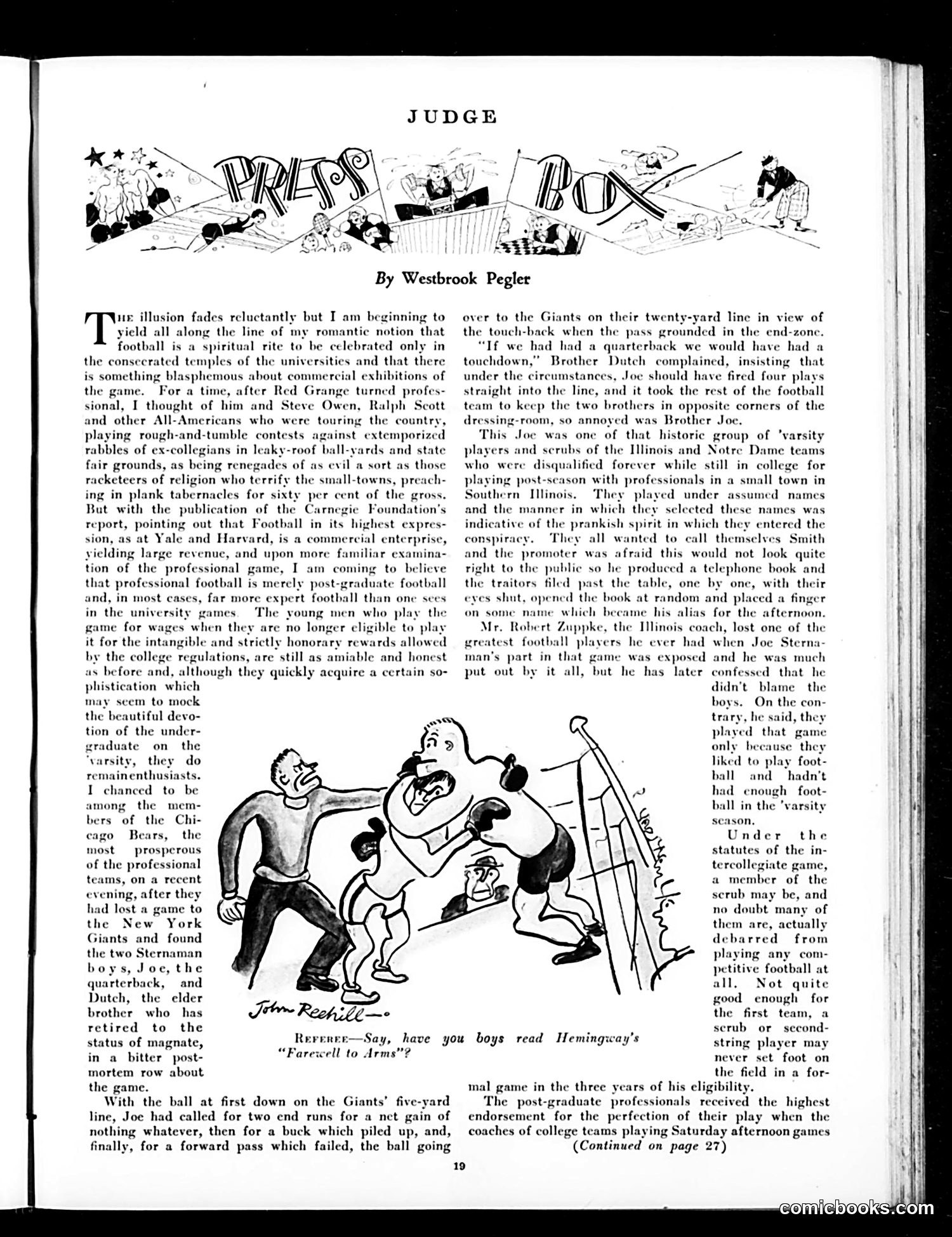
A restored page from Judge, 1929-12-07. Page through the whole issue in the reader above.
📄 Transcribed text from this page (OCR, searchable)
Machine-transcribed from the original scan — historical spelling and the odd misread are preserved.
By Westbrook Pegler usion fades reluctantly but I am beginning to yield all along the line of my romantic notion that football is a spiritual rite to be celebrated only in the consecrated temples of the universities and that there is something blasphemous about commercial exhibitions of the game. For a time, after Red Grange turned profes- sional, I thought of him and Steve Owen, Ralph Scott and other All-Americans who were touring the country, playing rough-and-tumble contests against extemporized bbles of ex-collegians in leaky-roof ball-yards and state fair grounds, a ing renegades of as evil a sort as those racketeers of religion who terrify the small-towns, preach- ing in plank tabernacles for sixty per cent of the gross. But with the publication of the Carnegie Foundation's report, pointing out that Football in its highest expres- sion, as at Yale and Harvard, is a commercial enterprise, yielding large revenue, and upon more familiar exami tion of the professional game, I am comin that professional football is merely post and, in most cases, far mor in the university games game for wa it for the intangible tly honorary rewards allowed by the college regulations, are still as amiable and honest as before and, although they quickly acquire a certain so- phistication which may seem to mock the beautiful devo- tion of the under- aduate on the rsity, they do remainenthusiasts. I chanced to be among the of the Chi- cago Bears, the most prosperous of the professional teams, on a recent evening, after they had lost me to the York Giants and found the two Sternaman boys, Joe, the quarterback, and Dutch, the elder brother who has retired to the status of magnate, in a bitter post- mortem row about the game. With the ball at first down on the Giants’ five-yard line, Joe had called for two end runs for a net gain of nothing whatever, then for a buck which piled up, and, finally, for a forward pass which failed, the ball going to believe » football mem- bers “Farewell to Arms”? over to the Giants on their twenty-yard line in view of the touch-back when the pass grounded in the end-zonc, If we had had a quarterback we would have had a touchdown,” Brother Dutch complained, insisting that under the circumstances, Joe should have fired four plays ight into the line, and it took the rest of the football n to keep the two brothers in opposite corners of the sing-room, so annoyed was Brother Joe. This Joc was one of that historic group of ’varsi players and scrubs of the Ilinois and Notre Dame teams who were disqualified forever while still in colle playing post-season with professionals in a small town in Southern Mlinois. They played under assumed names and the manner in which they selected these names was indicative of the prankish spirit in which they entered the conspiracy. They all wanted to call themselves Smith and the promoter was afraid this would not look quite ight to the public so he produced a telephone book and the traitors filed past the table, one by one, with their eyes shut, opened the book at random and placed a finger on some name which became his alias for the afternoon. Mr. Robert Zuppke, the Hlinois coach, lost one of the est football players he ever had when Joe Sterna- man's part in that game was exposed and he was much put out by it all, but he has later confessed that he didn’t blame the boys. On the con- trary, he said, they that game ly because they liked to play foot- ball and hadn't had enough foot- 1 in the ‘varsity season, Under the statutes of the in- tercollegiate game, a member of the scrub may be, and no doubt many of them are, actually debarred from playing any com- petitive football at all, Not quite good enough for the first tea serub or second- string player may never set foot on the field in a for- mal game in the three years of his eligibility. The post-graduate professionals received the highest endorsement for the perfection of their play when the coaches of college teams playing Saturday afternoon games (Continued on page 27)