
Judge, 1929-11-16 · page 13 of 36
Judge — November 16, 1929 — page 13: what you’re looking at
What you’re looking at
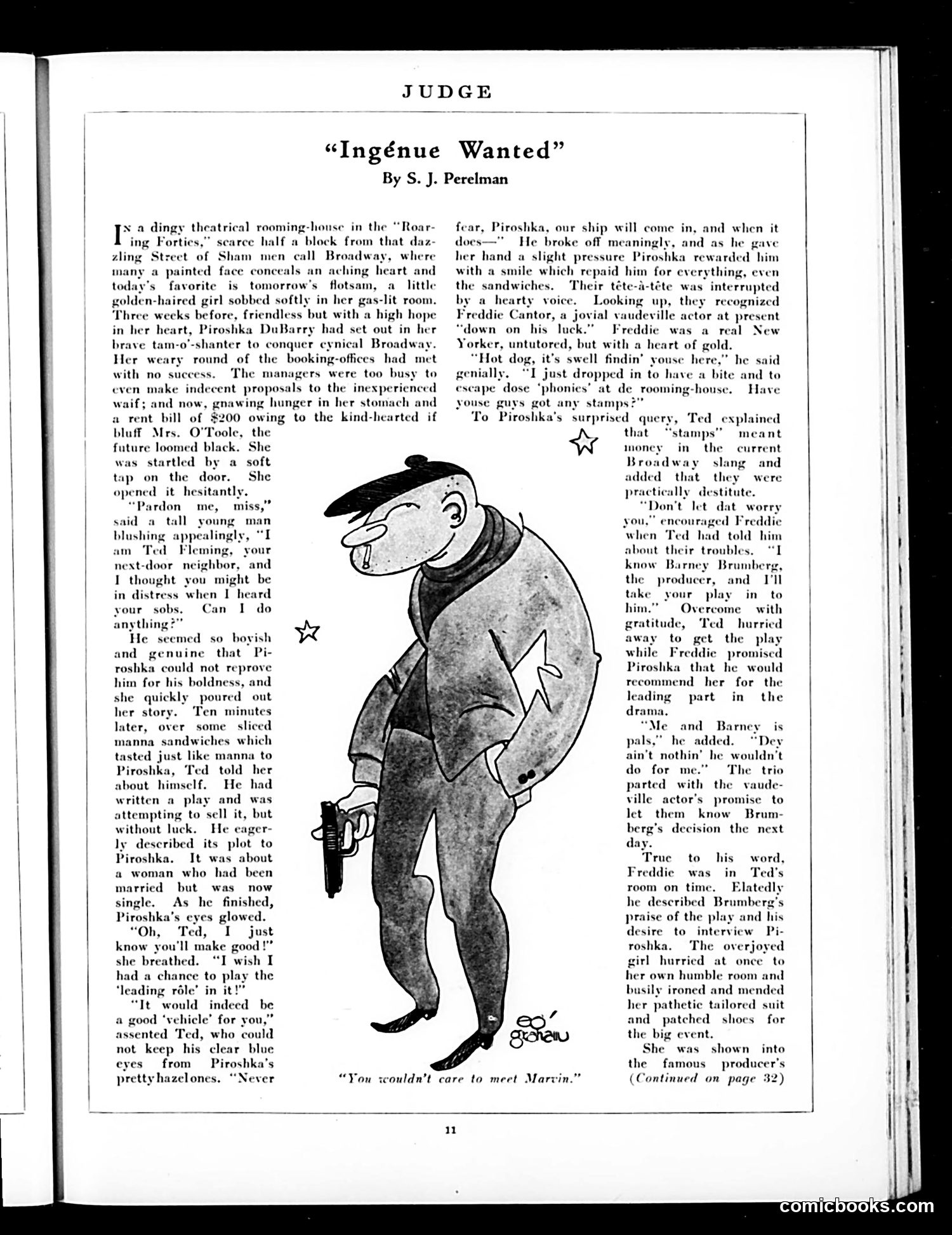
# "Ingénue Wanted" — A Satire of Broadway Dreams This is a comedic short story by S.J. Perelman satirizing Broadway's theatrical world and its stock characters. The narrative mocks the clichéd "struggling actress" plot: an innocent foreign girl (Piroshka DuBarry) arrives in New York hoping for stage success but faces poverty and rejection. She's aided by a neighborly playwright (Ted) and a vaudeville actor (Freddie Cantor), who promises to introduce her to a producer (Brumberg). The satire targets the romanticized desperation of aspiring performers, the patronizing "rescue" narratives common in theater, and Broadway's exploitative casting culture. Names like "DuBarry" suggest fabricated exoticism; the "manna sandwiches" joke underscores the melodramatic poverty. The illustration shows Freddie in exaggerated vaudeville style—broad gestures, flashy suit—embodying the stock "good-hearted show business type." The story continues on page 32, suggesting a twist ending that subverts these theatrical conventions.
📄 Transcribed text from this page (OCR, searchable)
Machine-transcribed from the original scan — historical spelling and the odd misread are preserved.
JUDGE “Ingénue Wanted” By S. J. Perelman re dingy theatrical rooming-house in the “Roar- ing Forties,” scarce half a block from that d zling Street of Sham men call Broadway, where many a painted face conceals an aching heart and today’s favorite is tomorrow's flotsam, a_ little golden-haired girl sobbed softly in her gas-lit room. Three weeks before, friendless but with a high hope in her heart, Piroshka DuBarry had set out in her brave tam-o'-shanter to conquer cynical Broadw Her weary round of the booking-offices had met with no success. The managers were too busy to even make indecent proposals to the inexperienced if; and now, gnawing hunger in her stomach and a rent bill of $200 owing to the kind-hearted if bluff Mrs. O'Toole, the future loomed black. She was startled by a soft tap on the door. She opened it hesitantly. “Pardon me, miss,” said a tall young man blushing appeali “I am Ted Flet your next-door neighbor, and I thought you might be in distress when I heard your sobs. Can 1 do anything?” He seemed so boyish and genuine that’ Pi- roshka could not reprove him for his boldness, and she quickly poured out her story. Ten minutes later, over some sliced manna sandwiches which tasted just like manna to Piroshka, Ted told her about himself. He had written a play and was attempting to sell it, but without luck. He eager- ly described its plot to Piroshka. It was about a woman who had been married but was now single. As he finished, Piroshka’s eyes glowed. “Oh, Ted, I just know you'll make good!” she breathed. “I wish I had a chance to play the ‘leading rale’ in it! “It would indeed be a good ‘vehicle’ for you,” assented Ted, who could not keep his clear blue eyes from Piroshka’s pretty hazelones. “Never “You wouldn't care to meet Marvin.” fear, Piroshka, our ship will come in, and when it docs—" He broke off meaningly, and as he gave her hand a slight pressure Piroshka rewarded him with a smile which repaid him for everything, even the sandwiches. Their téte te was interrupted by a hearty voice. Looking up, they recognized Freddie Cantor, a jovial vaudeville actor at present “down on his luck.” Freddie was a real New Yorker, untutored, but with a heart of gold. “Hot dog, it’s swell findin’ youse here,” he said ially, “I just dropped in to have a bite and to ape dose ‘phonies’ at de rooming Have youse guys got any stamps?” To Piroshka’s surprised query, Ted explained that “stamps” money in’ the Broadway slang and added that’ they were ally destitute. Don't’ let dat worry you,” encouraged Freddie when Ted had told him about their troubles. “I know Barney Brumber, the producer, and take your play in him.” Overcome — with itude, Ted hurried to get the play Freddie promised Piroshka that he would recommend her for the part in the Ouse. meant current and Barney is "he added. “Dey ain't nothin’ he wouldn do for me.” The trio parted with the vaude- ville actor's promise to let them know Brum- berg’s decision the next day. Truc to his word, Freddie was in Ted's room on time. Elatedly he described Brumberg’s praise of the play and his desire to interview Pi- roshka. The overjoyed girl hurried at once to her own humble room and busily ironed and mended her pathetic tailored suit and patched shoes for the big event. She was shown the famous prod (Continued on page into