
Judge, 1929-10-26 · page 18 of 36
Judge — October 26, 1929 — page 18: what you’re looking at
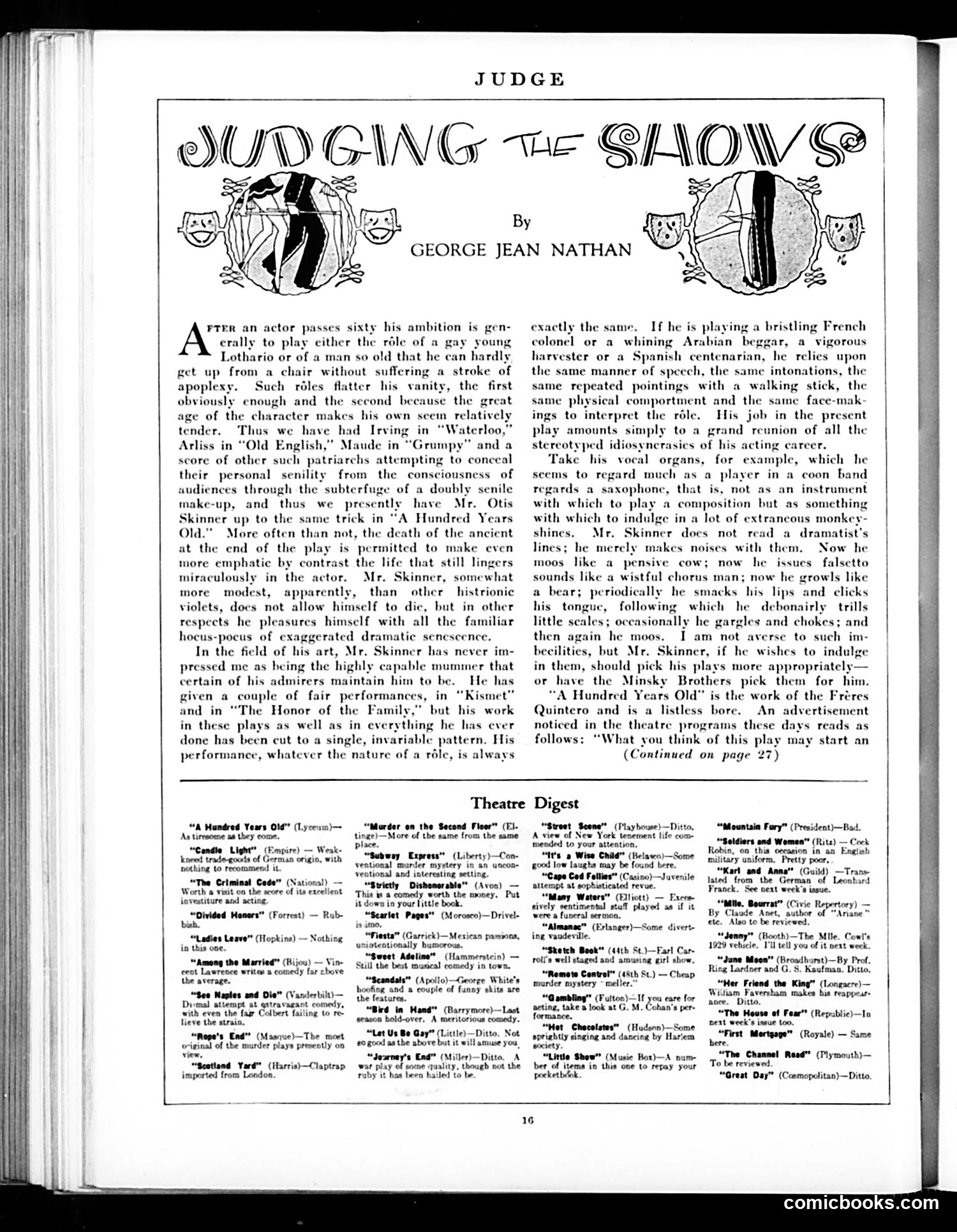
A restored page from Judge, 1929-10-26. Page through the whole issue in the reader above.
📄 Transcribed text from this page (OCR, searchable)
Machine-transcribed from the original scan — historical spelling and the odd misread are preserved.
JUDGE MUD GING He SHowe By GEORGE JEAN NATHAN PTER an actor passes sixty A erally to play either the man so old that he can hardly get up from a chair without suffering roles flatter obviously enough and the second bec Lothario or of apoplexy. Such age of the cl tender. Arliss in “Old English,” aracter makes his own seem re Thus we have had Irvi Maude in “Grump. xty his ambition is gen- role of a gay young stroke of nity, the first ise the great atively in “Waterloo,” "and a his v score of other such patriarchs attempting to conceal their personal senility from the consciousness of exactly the same, If he is pl colonel or a whining Arab ing a bristling French n beggar, a vigorous harvester or a Spanish centenarian, he relies upon the same manner of speech, the same intonations, the same repeated pointings with a same physical comportment and the same face ings to interpret the role. toa g asies of his acting carcer. organs, rd much as a player in a coon band play amounts simply stercotyped idiosyne his vocal seems to re walking stick, the mak. His job in the present nd reunion of all the for example, which he audiences through the subterfuge of a doubly senile make-up, and thus we presently have Mr. Otis Skinner up to the same trick in “A Hundred Years Old.” More often than not, the death of the ancient at the end of the play is permitted to make even more emphatic by contrast the life that still lingers miraculously in the actor. Mr. Skinner, somewhat more modest, apparently, than other histrionic violets, does not allow himself to die, but in other respects he pleasures himself with all the fan hocus-pocus of exaggerated dramatic senescene In the field of his art, Mr. Skinner has never im- pressed me as being the highly capable mummer that certain of his admirers maintain him to be. He has given a couple of fair performances, in “Kismet” and in “The Honor of the mily,” but his work in these plays as well as in everything he has ever done has becn cut to a single, invariable pattern. His performance, whatever the nature of a réle, is always Theatre regards a saxophone, that is, not as an instrument with which to play a composition but as something with which to indulge in a lot of extraneous monk shines. Mr. Skinner docs not read a dramatist's lines; he merely makes noises with them, Now he moos like a pensive cow; now he issues falsetto sounds like a wistful chorus man; now he growls like a bear; periodically he smacks hiy lips and clicks his tong following which he debonairly trills little scales; occasionally he gargles and chokes; and then again he moos. I am not averse to such im- becilities, but Mr. Skinner, if he wishes to indul in them, should pick his plays more appropriately— or have the Minsky Brothers pick them for him. “A Hundred Years Old” is the work of the Fréres Quintero and is a listless bore. An advertisement noticed in the theatre programs these days reads as follows: “What you think of this play may start an (Continued on page 27) Digest “A Handred Years Old" (Lyceum)— As tiresome aa they come. “Candle Light” (Empire) — Weak- Kneed trade-gocrs of German origin, with nothing to recommend it. “The Criminal Code” (National) — Worth a visit on the score of its exrelient investiture and acting. “Divided Honers” dish. “Ladies Leave” (Hopkins) — Nothing in this one. “Among the Married” (Bijou) — Vin- cont Lawrence writes a comedy far zbove the average. “See Naples and Die” (Vanderbilt) — Dicmal attempt at qttravagant comedy, with even the fagr Colbert failing to re lieve the strain. “Pope's End” (Masur)—The mowt inal of the murder plays presently oo view. “Seatiand Yaré" (Harris)—Claptrap imported {rom London, (Forrest) — Rub- “Murder on the Second Fleer” (Fl- tinge)—More of the same from the same place. “Subwey Express™ (Liberty) —Con- Yentional murder mystery in an uncoa- ventional and interesting setting. trietly Dishonerable"” (Avos) — This w a comedy worth the money. Put it down in your little book. “Scarlet Pages” (Morosco)—Drivel- is imo, “Fiesta” (Garrick)—Mexiean pareinns, voiatentionally humorous. “Sweet Adeline” (Hammerstein) — Still the best mumcal comedy in town. “Scandals” (Apollo)—George White's hoofing and a couple of funny skits are the features. “Bird in Hand” (Barrymore)—Last season hold-over. A meritorious comedy. “Let Us Be Gay” (Little) —Ditto. Not 0 good as the above but it will amuse you, “Jearney's End” (Miller)—Ditto. A war play of some quality, though not the ruby it has been hailed to be. “Street Scene” (Playhouse) —Ditto, A view of New York tenement life com: mended to your atteation, “It's Wise Child” (Belasco) —Some good low laughs may be found here. “Cape Cod Follies” (Casino) —Juvenile attempt at sophisticated revue. “Many Waters" (Elliott) — Excos tively sentimental stu played as if it were a funeral sermon. “Almanae” (Erlanger)—Some divert- ing vaudeville. “Sketch Book" (44th St.)—Farl Car- roll's well staged and amusing girl show. “Remote Control” (48th St.) — Cheap murder mystery ~ meller.” “Gambling” (Fultos)—If you care for acting, take a look at G. M. Cohan's per- formance. “Het Checelates™ (Hudsnn)—Some sprightly singing and dancing by Hariem society. “Little Show” (Music Bot)—A num- ber of items in this one to repay your pocketbdok. “Mountain Fory” (President)—Bat. “Soldiers and Women” (Rits) — Cock Robin, oa this cecagion in an English nilitary uniform, Pretty poor, “Kart and Anna” (Guild) —Trane- lated from the German of Leonhard Franck. See next week's issue. “Alle, Beurrat” (Civic Repertory) By Claude Anet, author of v Ariane ete. Also to be reviewed. “Jenny” (Booth)—The Mlle. Cow!’s 1929 vehicle. I'll tell you of it next week. “dane Moon” (Broadhurst)—By Prof. Ring Lardner and G. 8. Kaufman. Ditto, “Mer Friend the King” (Longacre)— Witham Faversham makes hia reappear ance. Ditto. “The House of Fear” (Republie)—In ext week's iseue too, “First: Mortgage” (Royale) — Same here. “The Channel Read” (Plymouth)— To be reviewed. “Great Day” (Cosmopolitan)—Ditto, ———— comicbooks.com