
Judge, 1929-10-12 · page 18 of 36
Judge — October 12, 1929 — page 18: what you’re looking at
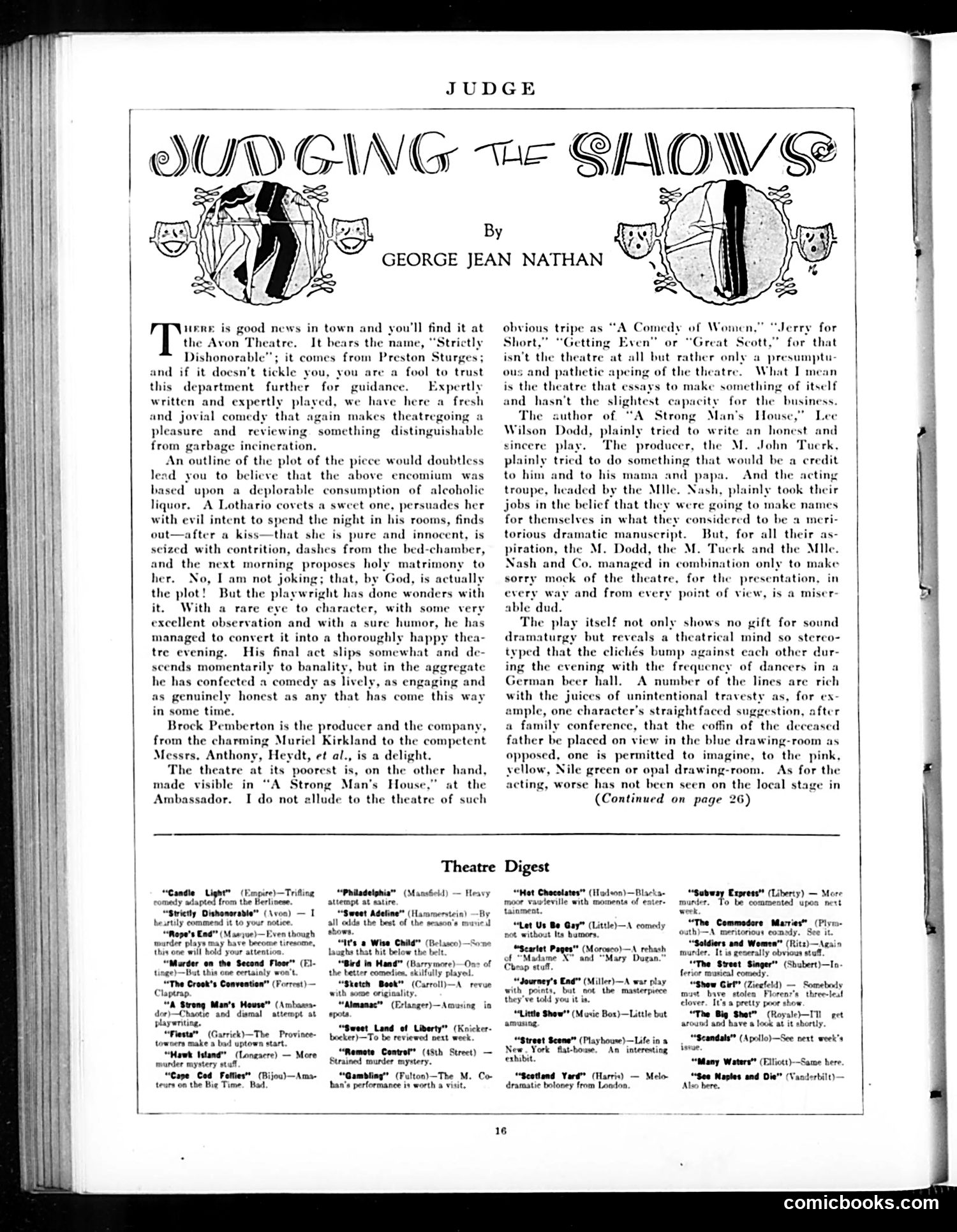
A restored page from Judge, 1929-10-12. Page through the whole issue in the reader above.
📄 Transcribed text from this page (OCR, searchable)
Machine-transcribed from the original scan — historical spelling and the odd misread are preserved.
JUDGE By GEORGE JEAN NATHAN the Avon Theatre. It bears the name, * Dishonorable”; it comes from Preston Sturges; and if it doesn't tickle you, you fool to trust this department further for ge Expertly written and expertly ] dy ow here a fresh and jovial comedy that regoing pleasure and reviewing something distinguishable from garbage incineration. An outline of the plot of the picce would doubtless lead you to believe that the above encomium was based upon a deplorable consumption of alcoholic liquor. A Lothario covets a sweet one, persuades her with evil intent to spend the night in his rooms, finds out—after a kiss—that she is pure and innocent, is seized with contrition, hes from the bed-chamber, and the next morning prapeses holy n her. No, Iam not joking; that, by God, the plot! But the p Bs titan is done wonders with it. With a rare eye to character, with some very excellent observation and with a sure humor, he has managed to convert it into a thoroughly happy thea- tre evening. His final act slips somewhat and de- scends momentarily to banality, but in the aggregate he has confected a comedy as lively, as engaging and genuinely honest as any that has come this way in some time. Brock Pemberton is the producer and the company, from the charming Muriel Kirkland to the competent Messrs, Anthony, Heydt, et al., is a delight. The theatre at its poorest is, on the other hand, made visible in “A Strong Man's House,” at the Ambassador. I do not allude to the theatre of such have obvious tripe as “A Comedy of Women,” “Jerry for Short,” “Getting Even” or “Great Scott,” for that isn’t the theatre at all but rather only a presumptu- ous and pathetic apeing of the theatre. What I mean is the theatre that essays to make something of itself and hasn't the slightest capacity for the business. The author of “A Strong Man’s House,” Lee Wilson Dodd, plainly tried to write an honest and sincere play. The producer, the M. John Tuerk, plainly tried to do something that would be a credit to him and to his mama and papa. And the acting troupe, headed by the Mlle. Nash, plainly took thei jobs in the belief that they were going to make name: for themselves in what they considered to be a me torious dramatic manuscript. But, for all their piration, the M. Dodd, the M. Tuerk and the Mile. Nash and Ce anaged in combination only to make sorry mock of the theatre, for the presentation, in y and from every point of view, is a miser- able dud. y itself not only shows no gift for sound y but reveals a theatrical mind so stereo- ped that the clichés bump against each other dur- ing the evening with the frequency of dancers in a German beer hall. A number of the lines are rich with the juices of unintentional travesty as, for ex- mple, one character's straightfaced suggestion, after a family conference, that the coffin of the deceased father be placed on view in the blue drawing-room as opposed, one is permitted to imagine, to the pink, yellow, Nile green or opal drawing-room. As for the acting, worse has not been seen on the local stage in (Continued on page 26) Theatre “Candle Light” (Empire) —Triting comedy adapted from the Berlinese. “Strictly Dishonorable™ (\voo) — I “Sweet Adeline” (Hammerstein) —By heurtily commend it to your notice. all odds the best of the seasoo’s muned “Rope’s End” (Masyue)—Even though murder plays may have become tiresome, this one will hold your attentioa. Jjarder on the Second Fleer” (F- But this one certainly w The Crests Conveaion’” (Foret) — Claptrap. “A Strong Man's House” (Ambasn- dor)—Chaotle and dismal attempt at playwriting. “Fiesta” (Garrick)—The Province towoers make a bad uptown start. “Hawk Island” (Longacre) — munter mystery stall ‘Cape Cod Fellies™ (Bijou)—Ama- teurs on the Big Time. Bad. “Philadelphia” (Mansfeld) — Heavy attempt at satire. “It's a Wise Child” (Belasco) —Some hat hit below the belt the better comedion. skilfully playel “Sketch Book” (Carroll)—A revue with some originality. “Almanac” (Erlanger)—Amasing in spots, “Sweet_Land of Liberty” (Knicker- boeker)—To be reviewed next week “Remote Control (18th Street) — Strained murder mystery. “Gambling” (Fulton)—The M. Co- han’s performance is worth a visit, More Digest “Hat Checelates” (ITodson)—Blacka- moor vauleville with moments of enter- tainment. “Let Us Be Gay” (Little)—\ comedy not without Its bumors “Scarlet Pages" (Morosco)—A rehash of “Madame X” and “Mary Dugan.” Cheap stuff. “Journey's End” (Miller)—A war play with points, but not the masterpiece they've told you it ia. “Little Show’? (Music Box)—Little but amusing, “Street Scene” (Playhouse)—Life in a New. York flat-boase, An interesting is. exhibit. “Many Waters” (Flliott)-—Same here. “Scotland Yard” (Harris) — Melo “See Maples and Die” (Vanderbilt) — dramatic boloney from Loadon. Also bere. Express” (Liberty) — More murder. To be commented upon nett werk. “The Commodore Marries” ‘outh)—A meritorious eomady. “Soldiers and Women” (Ritr)—Again murder. It is generally obvious stuf. ‘The Street Singer”? (Shubert)—In- jerior musical comedy. “Show Girt” (Zieefeld) (Ply Somebody three-leat “The Big Shot” (Royale)—IT! around and have a look at it shortly. “Scandals” (A pollo)—See next week's eet comicbooks.com