
Judge, 1929-09-28 · page 18 of 36
Judge — September 28, 1929 — page 18: what you’re looking at
A restored page from Judge, 1929-09-28. Page through the whole issue in the reader above.
📄 Transcribed text from this page (OCR, searchable)
Machine-transcribed from the original scan — historical spelling and the odd misread are preserved.
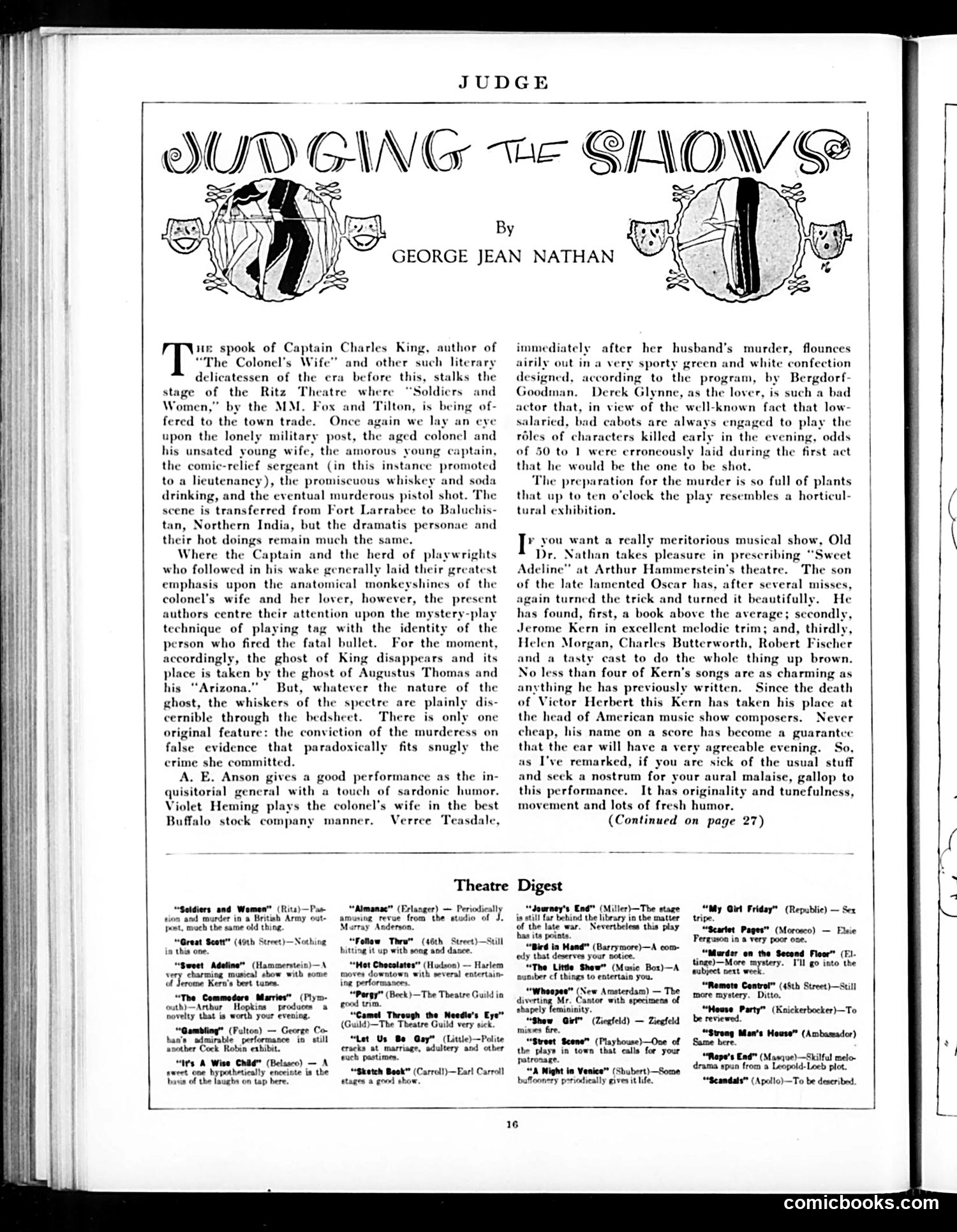
delicatessen of the stage of the Ritz Th fered to the town trade. era before this, s autre. where Women,” by the MM. Fox Once again we la n Charles King, author of The Colonel's Wife” and other such literary Iks the “Soldiers and nd Tilton, is being of- un eye upon the lonely military post, the aged colonel and his unsated young w ife, the amorous young captain, the comic-relief sergeant (in this instance promoted to a lieutenancy), th : promiscuous whiskey and soda drinking, and the eventual murderous pistol shot. The scene is transferred from tan, Northern India, but th ort Larrabee to Baluchis- ¢ dramatis personae and their hot doings remain much the same. Where the Captain and the herd of p who followed in his wake generally emphasis upon the anatomical monkeyshines of the colonel’s wife and her lc er, however, the present authors centre their attention upon the mystery-p! technique of playing tag with the identity of the person who fired the fatal bullet. For the moment, accordingly, the ghost of King disappears and its place is taken by the ghost of Augustus Thomas and his “Arizona.” But, whatever the nature of the ghost, the whiskers of the spectre are plainly dis- cernible through the bedsheet. There is only one original feature: the conviction of the murderess on false evidence that paradoxically fits snugly the crime she committed. A. E. Anson gives a good performance as the in- quisitorial general with a touch of sardonic humor. “let Heming plays the colonel's wife Buffalo stock company manner. the best Verrce Teasd: Theatre immediately after her husband’s murder, flounces y out ina very sporty green and white confection designed, according to the program, by Bergdorf- Goodman. Derek Glynne, as the lover, is such a bad actor that, in view of the well-known fact that low- 1 cabots are always engaged to play the les of characters killed early in the evening, “odds of 50 to 1 were erroncously laid during the first act that he would be the one to be shot. The preparation for the murder is so full of plants that up to ten o'clock the play resembles a horticul- tural exhibition. I you want a really meritorious musical show, Old Dr. Nathan te pleasure in prescribing “Sweet Adeline” at Arthur Hammerstein's theatre. The son of the late lamented Oscar has, after several misses, again turned the trick and turned it beautifully. He has found, first, a book above the average; second]; Jerome Kern in excellent melodic trim; and, thirdly, Helen Morgan, Charles Butterworth, Robert Fischer and a tasty cast to do the whole thing up brown. No less than four of Kern’s songs are as charming as anything he has previously written. Since the death of Victor Herbert this Kern has taken his place at the head of American music show composers. Never cheap, his name on a score has become a guarantee that the ear will have a very agreeable evening. So, as I've remarked, if you are sick of the usual stuff and seck a nostrum for your aural malaise, gallop to this performance. It has originality and tunefulness, movement and lots of fresh humor. (Continued on page 27) Digest “Soldiers and Women” (Rits)—Pas tion and murder in a British Army out- post, much the same old thing. “Great Scott” (49th Street) —Nothing in this one. “Sweet Adeline” (Hammerstein)—\ very charming musical show with some of Jerome Kern's beet tunes. “The Commodore Marries (Plym- outh)—Arthur Hopkins produces a novelty that is worth your evening. “Gambling” (Paltos) — George Co: ban's admirable performance in still another Cock Robin exhibit. “it's A Wise Chg” (Belasco) — A veeet one hypothetically enceinte is the basin of the laughs on tap “Almanac” (Erlanger) — Periodically amusing revue from the studio of J. Murray Anderson. Fellow Thre” (46th Street)—Still hitting it up with song and dasee. Chocolates” (Hudson) — Harlem moves downtown with several entertain- ing performances “Pergy” (Beck)—The Theatre Guild in ood trim. “Camel Through the Needle’s Eye” (Guild)—The Theatre Guild very sick. “Lat Us Be Gay" (Little) Polite cracks at marriage, adultery and other euch pastimes. “Sketch Book™ (Carrol!) —Ear! Carroll tages a good show. “aa ary of the war. Nevertheless this play has its points. “Bird in Hand” (Barrymore)—A com- ey that deserves your notice. “The Lite Show" (Music Box)—A pumiber cf things to entertain you. “Whoopee” (New Amsterdam) — The diverting Mr. Cantor with specimens of shapely femininity. “Show Gir (Ziegfeld) — Ziegfeld mises fre. ‘Street Scene” (Playhouse)—One of the plays in town that calls for your Patronage. “A Might in Venice” (Shubert)—Some buffoonery periodically gives it life. “My Girt Friday” (Republic) — Sex tripe. “Scarlet Pages™ (Moreaco) — Eaie Ferguson in a very poor one. “Murder on the Second Floor” (FI- tinge)—More my Tl go into the eubject next weel “Remote Control” (48th Street)—Still more mystery. Ditto, poyhteradly Party” (Knickerbocker)—To “Seng Man's House” (Ambamad: on ml lor) “Rape’s End” (Masyve)—Skilful melo drama spun from a Leopold-Loeb plot. “Scandals” (Apollo) —To be described. a comicbooks.com