
Judge, 1929-09-28 · page 15 of 36
Judge — September 28, 1929 — page 15: what you’re looking at
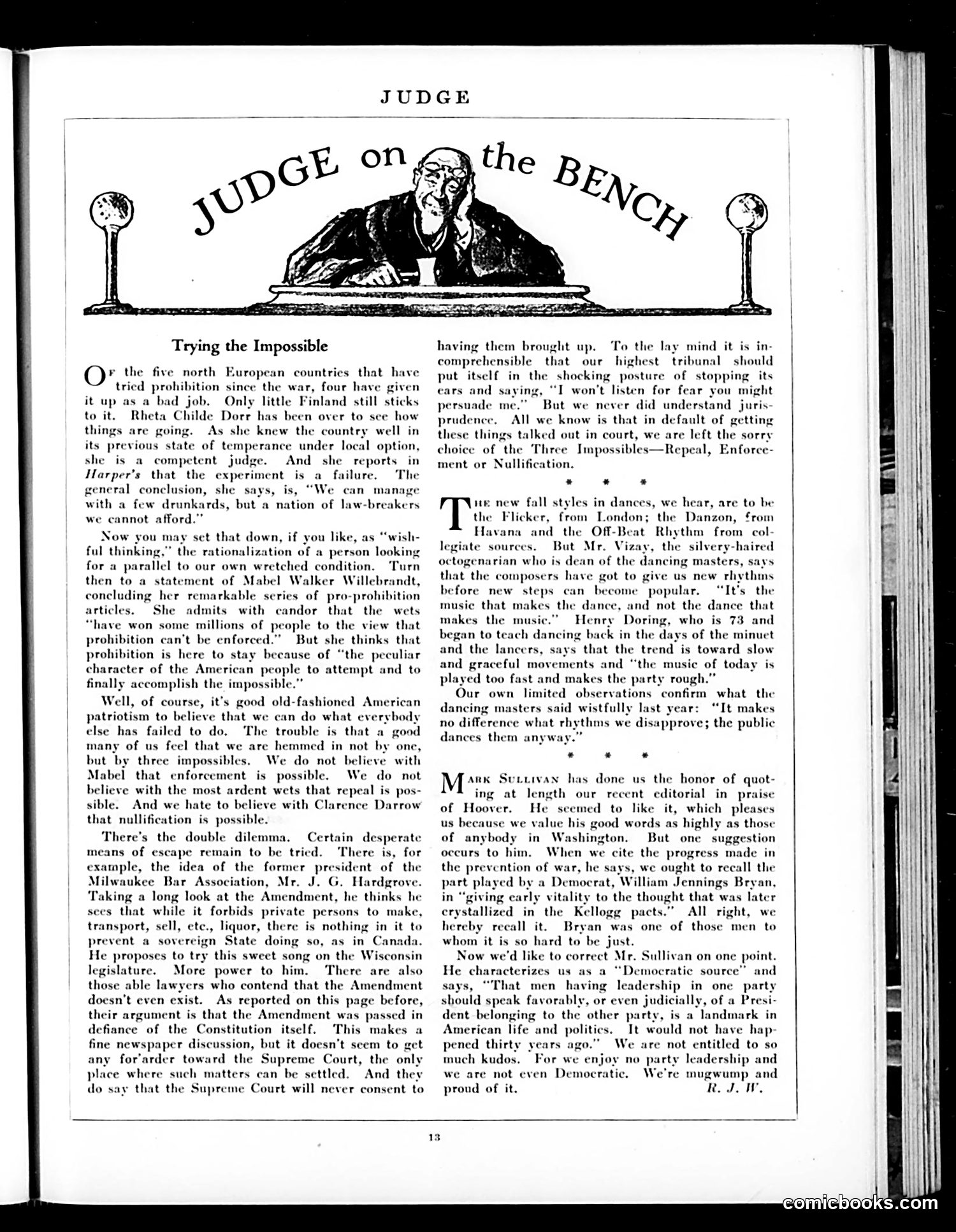
A restored page from Judge, 1929-09-28. Page through the whole issue in the reader above.
📄 Transcribed text from this page (OCR, searchable)
Machine-transcribed from the original scan — historical spelling and the odd misread are preserved.
Trying the Impossible Ov the five north European countries that have tried prohibition since the war, four have given it up as a bad job. Only little Finland still sticks to it. Rheta Childe Dorr has been over to see how things are goi As she knew the country well in its previous state of temperance under local option, she is a competent judge. And she reports in Harper's that the experiment is a failure. ‘The neral conclusion, she says, is, “We can manage with a fewdrunkards, bit a nation of law-breakers nnot afford. Now you m ful thinking,” y set that down, if you like, as “wish- the rationalization of a person looking for a parallel to our own wretched condition. Turn then to a statement of Mabel Walker Willebrandt, concluding her remarks es of pro-prohibition articles. She admits candor that the “h prohibition can’t be enforced.” But she thinks that prohibition is here to stay because of “the peculiar aracter of the American people to attempt and to finally accomplish the impossible.” Well, of course, it’s nd old-fashioned American patriotism to believe that we can do what everybody else has failed to do. The trouble is that a good many of us feel that we are hemmed in not by one, but by three impossibles. We do not believe with Mabel that enforcement is possible. We do not believe with the most ardent wets that repeal is pos- sible. And we hate to believe with Clarence I that nullification is possible. There's the double with ye won some millions of people to the view that wets Arrow dilemma, Certain desperate means of escape r in to be tried. There is, for mple, the idea of the former preside nt of the aukee Bar Association, Mr. J. G. Hardgrove. ing a long look at the Amendment, he thinks he sees that while it forbids private persons to make, transport, sell, cte., liquor, there is nothing in it to prevent a sovereign State doing so, as in Canada. He proposes to try this sweet song on the Wisconsin legislature. More power to him. There are also those able lawyers who contend that the Amendment doesn’t even exist. As reported on this page before, their argument is that the Amendment was passed in defiance of the Constitution itself. This makes a fine newspaper discussion, but it doesn't seem to get any for'arder toward the Supreme Court, the only 1 where such matters can be settled. And they do say that the Supreme Court will never consent to having them brought up. To the lay comprehensible that our highest tribunal should put itself in the shocking posture of stopping its ears and ing, “I won't listen for fear you might persuade me.” But we never did understand juris prudence. All we know is that in default of getting these things talked out in court, we are left the sorry choice of the Three Impossibles—Repeal, Enforce- ment or Nullification, mind it is in- * * * new fall styles in dances, we hear, are to be Flicker, from London; the Danzon, from Havana and the Off-Beat Rhythm from col- legiate sources. But Mr. Vizay, the silvery-haired octogenarian who is d n of the dancing masters, says that the composers have got to give us new rhythins before new steps can become popular. “It's th music that makes the and not the dance that makes the Doring, who is 73 and began to teach dancing back in the days of the minuet and the lancers, says that the trend is toward slow and graceful movements and “the music of today played too fast and makes the party rough.” Our own limited observations confirm dancing masters said wistfully last year: no difference wh: d. M*« Suttivan has done us the honor of quot- ing at length our recent editorial in praise of Hoover. He seemed to like it, which pleases us because we value his good words as highly as those of anybody in Washington. But one suggestion occurs to him. When we cite the progress made in the prevention of war, he says, we ought to recall the part played by a Democrat, William Jennings Bryan, in “giving early vitality to the thought that was later crystallized in the Kellogg pacts.” All right, we hereby recall it. Bryan one of those men to whom it is so hard to be just. Now we'd like to correct Mr. Sullivan on one point. He characterizes us a music.” Henry what the “It makes t rhythms we disapprove; the public es them any * * * and party a “Democratic source” ng leadership in one should speak favors dent belonging to the other party American life and polities. pened thirty 3 We are not en much kudos. For we enjoy no party leadership and we are not even Democratic. We're mugwump and proud of it. RW. or even judicially, of a Presi- rk in sa landm It would not