
Judge, 1929-09-28 · page 12 of 36
Judge — September 28, 1929 — page 12: what you’re looking at
What you’re looking at
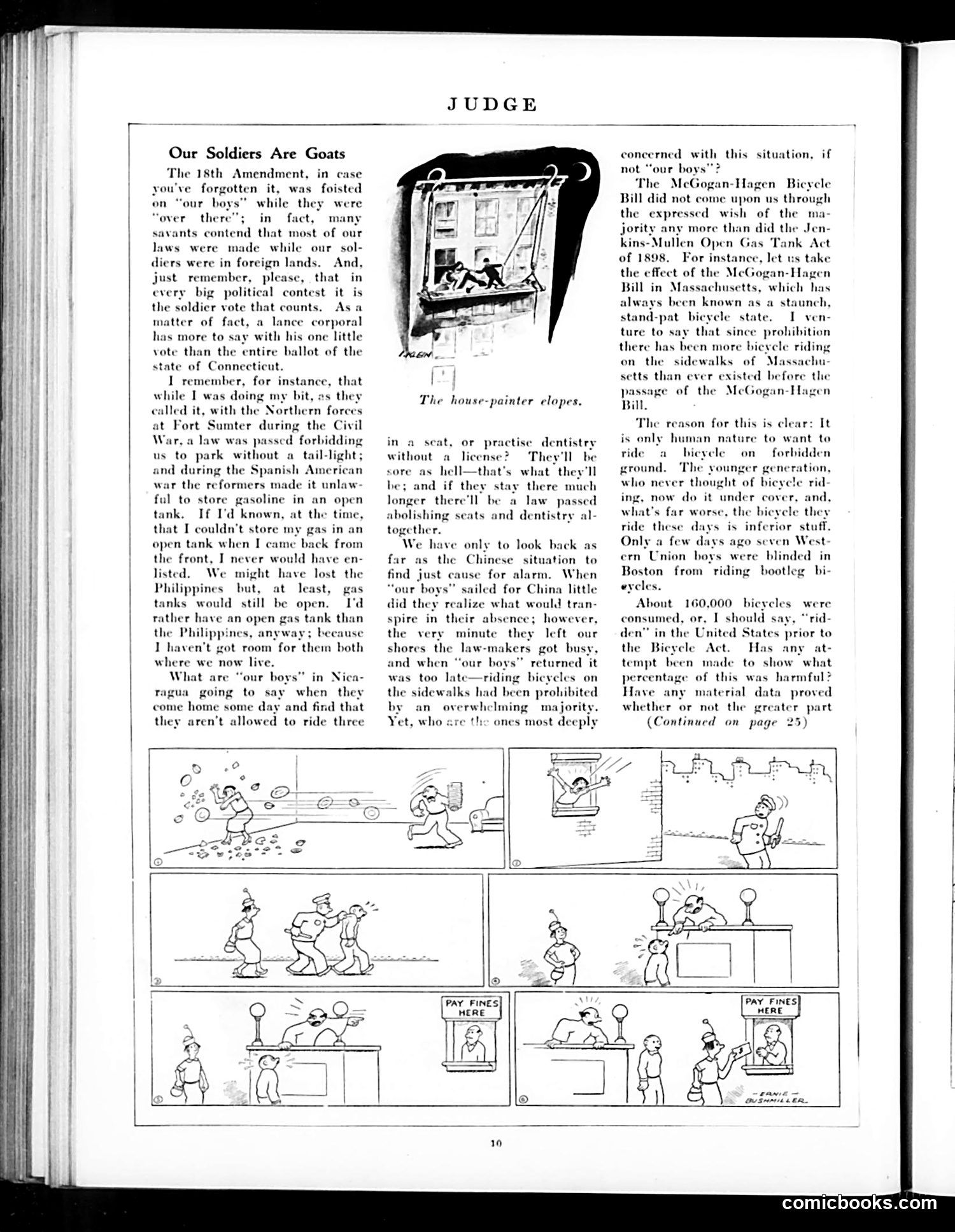
# "Our Soldiers Are Goats" - Judge Magazine Satire This article satirizes the ironic power of the soldier vote in American politics. The author argues that while soldiers sacrifice abroad, lawmakers pass restrictive legislation during their absence—then soldiers, having fought for their country, cannot even vote against these laws when they return. The piece mocks specific examples: the 18th Amendment (Prohibition), bicycle restrictions, and gas tank regulations passed while soldiers were overseas. The author notes soldiers have outsized electoral influence despite this treatment, using absurdist humor (preferring open gas tanks to the Philippines). The cartoon below depicts soldiers cycling through various bureaucratic obstacles and "pay fines" stations, visualizing the comic frustration: young men risk their lives abroad only to face petty legal restrictions at home. This reflects post-WWI American cynicism about government hypocrisy toward veterans—a common satirical target of 1920s publications.
📄 Transcribed text from this page (OCR, searchable)
Machine-transcribed from the original scan — historical spelling and the odd misread are preserved.
Our Soldiers Are Goats The 18th Amendment, in case you've forgotten it, was foisted n “our boys” while they were “over th in fact, many savants contend that most of our laws were made while our sol- diers were in foreign lands. And, just remember, please, that in every big political contest it is the soldier vote that counts. Asa matter of fact, a lance corporal has more to say with his one little vote than the entire ballot of the state of Connecticut. I remember, for instance, that while I was doing my bit, as they called it, with the Northern forces at Fort Sumter during the Civil War, a law was passed forbidding us to park without a tail-light; and during the Spanish American war the reformers made it unlaw- ful to store gasoline in an open tank. If I'd known, at the time, that I couldn't store my gas in an open tank when I came back from the front, I never would have en- listed. We might have lost the Philippines but, at least, gas tanks would still be open. I'd rather have an open gas tank than the Philippines, anyway; because I haven't got room for them both where we now live. What are “our boys” in Nica- ragua going to say when they come home some day and find that they aren't allowed to ride three The house-painter elopes. in a seat, actise dentistry without a lic They'll be as hell—tha at s what they'll and if they stay there much or there'll be a law. passed abolishing seats and dentistry al- together. We have only to look back as far as the Chinese situation to find just cause for alarm. When “our boys” sailed for China little did the ce what would tran- spire in their absence; however, the very minute they left our shores the law-makers got busy, nd when “our boys” returned it was too late—riding bicycles on the sidewalks had been prohibited by an overwhelming majority. Yet, who are the ones most deeply concerned with this situation, if not “our boy The MeGogan-Hagen Bicycle Bill did not come upon us through expressed wish of the ma- any more than did the Jen- Tank Act of 1898. For insta let us take the effect of the Me an-Hagen Bill in Massachusetts, which has as a staunch, stand-pat bieyele state. I ven- ture to say tl » prohibition there has be > bievele riding on the sidev of Massachu- setts than ever existed before the passage of the Me Bill. The reason for this is cl is only human nature to we ride hieyele on forbidden ground. The younger generation, who never thought of bicycle rid ing, now do it under cover, and, what's far worse, the bieyele they ride these days is inferior stuff. Only a few days ago seven West ern Union boys were blinded in Boston from riding bootleg bi- eycles. About 160,000 bicycles were consumed, or, I should sa “rid- den” in the United States prior to the Bicycle Act. Has any. at- smpt been made to show what percentage of this was harmful? Have any material data proved whether or not the greater part (Continued on page 25) in-Hagen PAY. ms canis OU sm ER. comicbooks.com