
Judge, 1929-08-31 · page 15 of 36
Judge — August 31, 1929 — page 15: what you’re looking at
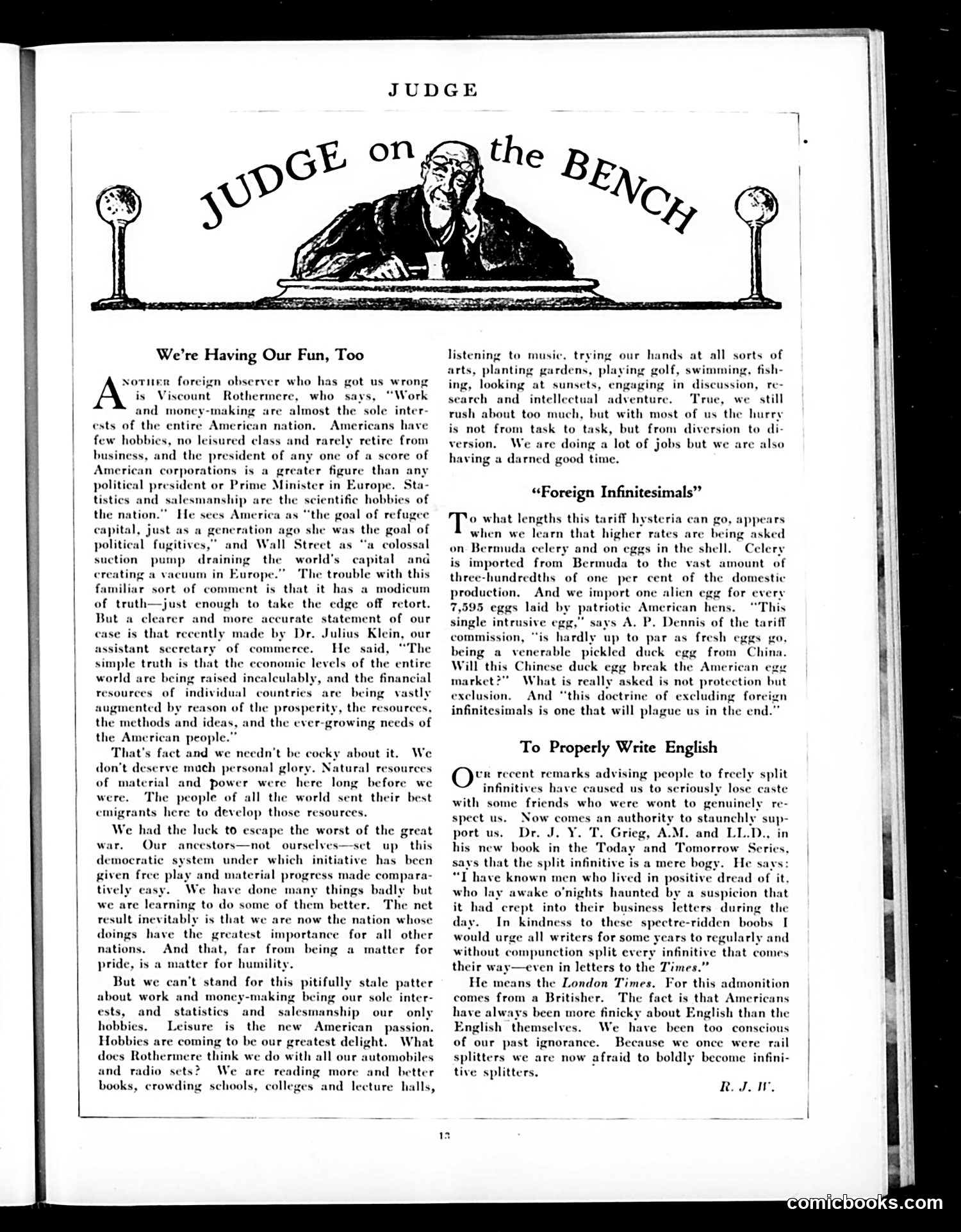
A restored page from Judge, 1929-08-31. Page through the whole issue in the reader above.
📄 Transcribed text from this page (OCR, searchable)
Machine-transcribed from the original scan — historical spelling and the odd misread are preserved.
JUDGE We're Having Our Fun, Too Notuer foreign observer who has got us wrong A is Viscount Rothermere, who says, “Work and moncy-making are almost the sole inter- ests of the entire American nation, Americans have few hobbies, no leisured class and rarely retire from business, and the president of any one of a score of n corporations ag er figure than any president or Prime Minister in Europe, Sta- nd salesmanship are the scientific hobbies of tion.” He sees Ame “the goal of refugee al, just as a generation ago she was the goal of al fugitives,” and Wall Street as “a colossal n pump draining the world’s capital and ng a vacuum in Europe.” The trouble with this familiar sort of comment is that it has a modicum of truth—just enough to take the edge off retort. But a clearer and more accurate statement of our case is that recently made by Dr. Julius Klein, our assistant secretary of commer He said, ‘The simple truth is that the economic levels of the entire world are being raised incalculably, and the financial resources of individual countries are being vastly augmented by reason of the prosperity, the resources, the methods and ideas, and the ever-growing needs of the American people. That's t and we needn't be cocky about it. We don’t deserve mach personal glory. Natural resources of material and power were here long before we were. The people of all the world sent their best emigrants here to develop those resources. We had the luck to escape the worst of the great war. Our ancestors—not ourselves—set up this cratic system under which initiative has been given free play and material progress made compara- tively easy. We have done many things badly but we are learning to do some of them bet The net result inevitably is that we are now the nation whose doings have the greatest importance for all other i And that, far from being a matter for pride, is a matter for humility. But we can't stand for this pitifully stale patter about work and moncy: ests, and statistics and hobbies. Leisure is the new American passion. Hobbies are coming to be our greatest delight. What does Rothermere think we do with all our automobiles and radio sets? We are reading more and better books, crowding schools, colleges and lecture halls, ing our sole inter- alesmanship our only listening to music, trying our hands at all sorts of arts, planting gardens, playing golf, swimming, fish- ing, looking sunsets, engaging in discussion, re- search and intellectual adventure. True, we still rush about too much, but with most of us the hurry is not from task to task, but from diversion to di version. We are doing a lot of jobs but we are also having a darned good time. “Foreign Infinitesimals” T » what lengths this tariff hysteria can go, appears when we learn that higher rates are being asked on Bermuda celery and on eggs in the shell. Celery is imported from Bermuda to the vast amount of three-hundredths of one per cent of the domestic production. And we import one alien egg for every 7,595 eggs laid by patriotic American hens. “This ingle intrusive egg,” says A. P. Dennis of the tariff commission, “is hardly up to par as fresh eggs go, being a venerable pickled duck egg from Chi Will this Chinese duck egg break the American market?" What is really asked is not protection but exclusion. And “this doctrine of excluding foreign infinitesimals is one that will plague us in the end.” To Properly Write English nt remarks advising people to freely split have caused us to seriously lose caste with some friends who were wont to genuinely. re- spect us. Now comes an authority to staunchly sup- port us. Dr. Y. T. Grieg, A.M. and LL.D., in his new book in the Today and Tomorrow Se says that the split infinitive is a mere bogy. He ¢ known men who lived in positive dread of awake o’nights haunted by a suspicion that it had crept into their business letters during the day. In kindness to these spectre-ridden boobs I would urge all writers for some years to regularly and without compunction split every their v nfinitive that comes —even in letters to the Times.” He means the London Times. For this admonition comes from a Britisher. The fact is that Amer have always been more finicky about English than the English themselves. We have been too conscious of our past ignorance. Because we once were rail splitters we are now afraid to boldly become infini- tive splitters. RILW.