
Judge, 1929-08-17 · page 15 of 36
Judge — August 17, 1929 — page 15: what you’re looking at
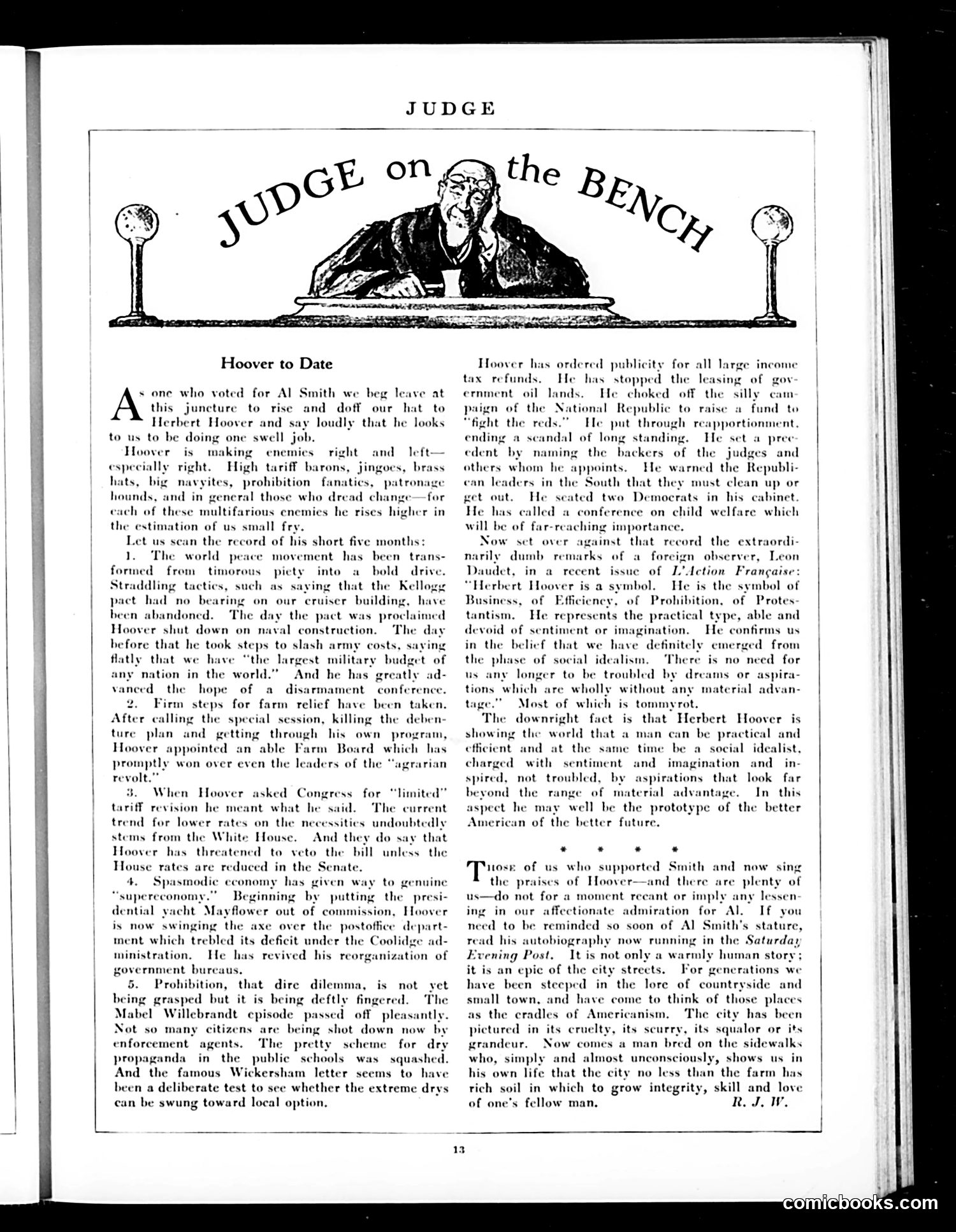
A restored page from Judge, 1929-08-17. Page through the whole issue in the reader above.
📄 Transcribed text from this page (OCR, searchable)
Machine-transcribed from the original scan — historical spelling and the odd misread are preserved.
Hoover to Date s one who voted for Al A this juncture to ris Herbert Hoover and s: to us to be doing one swell j Hoover is making enemies especially right. High tariff ba hats, big navyites, prohibition f hounds, and i nith we beg leave at and doft our hat to y loudly that he looks right) and left— ns, jingoes, brass cs, patronage general those who dre or each of these multifarious enemies he rises higher in the estimation of us small fry. Let us scan the record of his short five months: 1, The world peace movement has been trans- formed from timorous piety into. a bold drive. Straddling tacties, such as saying that the Kellogg pact had no bearing on our cruiser building, have been abandoned. The day the pact was proclaimed Hoover shut down on naval construction. The day before that he took steps to slash army costs, saying flatly that we have “the largest military budget of any nation in the world.” And he has greatly ad- d the hope of a disarmament conference. Firm steps for farm relief have been taken. After calling the special session, killing the deben- ture plan and getting thro Hoover appointed an able promptly won over even the revolt.” 3. When Hoover asked Congress for “limited” tariff revision he meant what he said. The current trend for lower rates on the necessities undoubtedly stems from the White House. And they do say that Hoover has threatened to veto the bill House rates are reduced in the Senate. his own pre arm Board rs of the am, which has agrarian unless the 4. Spasmodic economy has given way to genuine “supercconc * Beginning by putting the presi- denti. cht Mayflower out of commission, Hoover is now swinging the axe over the postoffice de ment which trebled its deficit under the Coolid, 1- ministration. He has revived his reorganization of government bureaus, 5. Prohibition, that dire dilemma, is not yet being grasped but it is being deftly fingered. The Mabel Willebrandt episode passed off pleasantly. Not so many citizens are being shot down now by enforcement agents. The pretty scheme for dry propaganda in the public schools was squast And the famous Wickersham letter seems to h: been a deliberate test to see whether the extreme drys can be swung toward local option. art~ Tloover has ordered publicity for all large income tax refunds. He has stopped the leasing of gov ernment oil lands. He choked off the silly cam } of the National Republic to raise a fund te “fight the reds.” He put thro ending a scandal of long standing. He set a pre edent by naming the backers of the judges and others whom he appoints. He warned the Republi- can leaders in the South that they must clean up or get out. He seated two Democrats in his ecabi He has called a conference on child welfare which will be of far-reaching importance. Now set over against that record the extraordi- narily dumb remarks of a foreign observer, Li Daudet, in a recent issue of L’Action Francaise: “Herbert Hoover is a symbol. He is the symbol of Business, of Efficiency, of Prohibition, of Protes tantism. He represents the practical type, able and devoid of sentiment or imagina He confirms us in the belief that we have definitely emerged from the phase of social idealism, There is no need for us any longer to be troubled by dreams or aspira- tions which are wholly without any 1 tage.” Most of which is tommyrot. The downright fact is that Herbert Hoover is showing the world that a man can be practical and efficient and at the same time be social idealist, charged with sentiment. and imagination and_ in- spired, not troubled, by aspirations that look far beyond the range of material advantage. In_ this aspect he may well be the prototype of the better American of the better future. h reapportionment. on * . * * Tire of us who supported Smith and now sing the praises of Hoover—and there are plenty of us—do not for a moment reeant or imply any lessen ing in our affectionate admiration for Al. If you need to be reminded so soon o nith’s stature, read his autobiography now running in the Saturday Evening Post. It is not only a warmly human story; it is an epic of the city streets. For generations we have been steeped in’ the lore of countryside and IL town, and have come to think of those places s the cradles of Ame nism, The city has been pictured in its cruelty, its scurry, its squalor or its grandeur. Now comes a man bred on the sidewalks who, simply and almost unconsciously, shows us. in his own life that the city no less than the farm has rich soil in which to grow integrity, skill and love of one’s fellow man, RJILW,