
Ibis #1
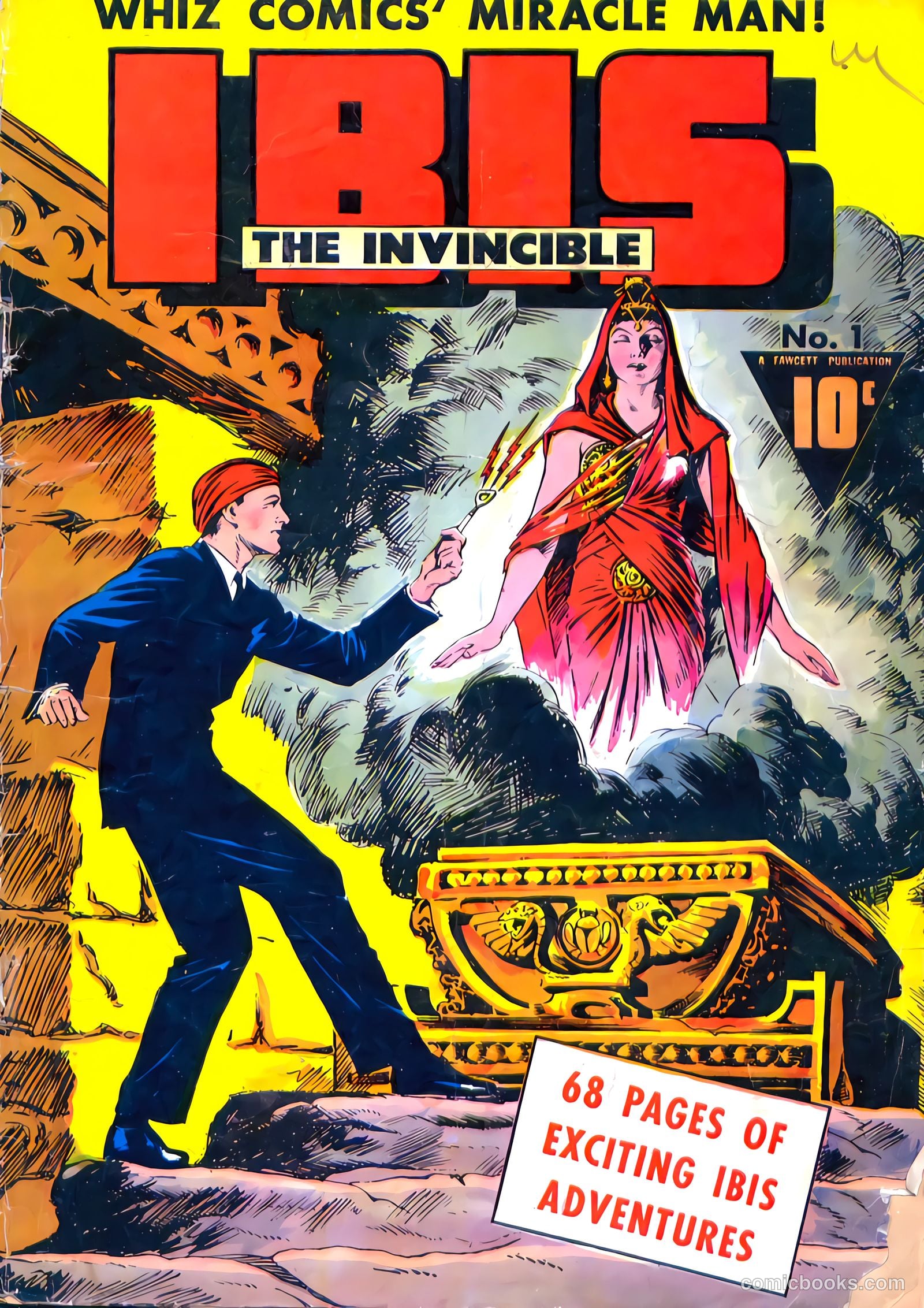
☆ Be the first to review + Add to your collection — Join freeIbis the Invincible #1 (Fawcett, December 1942; reprinted by L. Miller & Son for the British market) marks the graduation of one of the Golden Age's most distinctive magic-wielding heroes from a backup strip to a standalone anthology title. Having run continuously in every issue of Whiz Comics alongside Captain Marvel since February 1940, Prince Amentep earned his own 68-page showcase at a moment when Fawcett was at the peak of its superhero publishing power. The issue is historically significant as the first place Otto Binder delivered a definitive, expanded origin for the character — canonizing the Ibistick's mythology, the Black Pharaoh as arch-villain, and the suspended-animation framework that distinguished Ibis from contemporaries like Mandrake the Magician by grounding his sorcery in Egyptian dynastic history rather than stage-magic showmanship. As one of the rare Golden Age superhero titles built entirely around a non-violent, wish-fulfilling magic wand whose only limitation was that it could not be used for evil, Ibis #1 also represents an early experiment in what a 'white magic' superhero could look like — a template DC Comics would revisit decades later when they absorbed the Fawcett line.
Ibis the Invincible uses his magical wand to help a priest and tribal people who are being terrorized by an ancient bat god named Zoltil. After discovering the source of the evil through magical means, Ibis confronts the creature and its worshippers, ultimately delivering the tribe from the bat god's grip. The issue demonstrates Ibis's supernatural powers as he uses his wand to create magical objects and gain magical insights to resolve the supernatural threat facing the people.
ComicBooks.com Value
Show all 21 grades ▾
Find on ebay
Sell my copy
Have this issue — or a whole collection? Get a fair offer from us, skip the marketplace fees and the hassle.
We Buy Collections ▸History
The character debuted in Whiz Comics #2 (February 1940), created by writer Bill Parker and artist Bob Kingett as part of Fawcett's founding superhero lineup — the same issue that introduced Captain Marvel. By late 1942, editor Rod Reed greenlit a solo quarterly title; the debut issue was cover-dated for December 10, 1942 and priced at ten cents for its 68 pages. The lead origin story was scripted by Otto Binder — already the driving creative force behind the Captain Marvel family — with interior art attributed (with some uncertainty) to Pete Costanza, while cover duties went to Mac Raboy, then at the height of his reputation as Fawcett's most accomplished cover painter. A secondary feature, a horror-inflected prose-and-art werewolf tale, was contributed by pulp and fantasy writer Manly Wade Wellman writing under the house pseudonym 'Juan Lopez,' and a humor strip, 'Sir Butch,' was both written and drawn by the young Dave Berg. L. Miller & Son, the British reprint house that licensed much of Fawcett's output for UK readers, subsequently published their own edition for the British market, making the issue part of the transatlantic reach of the Fawcett superhero line.
Trivia · 10 facts
- Prince Amentep / Ibis the Invincible first appeared in Whiz Comics #2 (February 1940), created by writer Bill Parker and artist Bob Kingett — the same landmark issue that introduced Captain Marvel.
- Ibis the Invincible #1 is dated December 10, 1942, runs 68 pages, and was published by Fawcett Publications at a cover price of ten cents; it is the character's first solo title after two-plus years as a Whiz Comics backup strip.
- The cover was painted by Mac Raboy, who was simultaneously the definitive artist of Captain Marvel Jr. and later spent two decades drawing the Sunday Flash Gordon newspaper strip.
- The lead story, 'Origin of Ibis the Invincible,' was scripted by Otto Binder (with interior art attributed to Pete Costanza) and provides the first full, expanded retelling of the character's origin — introducing the Black Pharaoh (Mesu), the demon-god Set as his ally, and the Ibistick's rule that it can only be used for good.
- The issue also contains three additional 14-page Ibis adventures pitting him against Asian dictator Ching Fang, the supernatural demon Nightmare (conjured by blackmailing gangsters), and a Mayan bat-god named Zoltil — stories whose writers and artists remain unidentified in surviving records.
- A secondary horror-prose feature scripted by Manly Wade Wellman (billed under the pseudonym 'Juan Lopez') and a 6-page humor strip by Dave Berg round out the issue's contents.
- The origin story from this issue was reprinted in the same year as Ibis [Mighty Midget Comic] #11 (Samuel E. Lowe & Co., 1942) in a slightly edited miniature format, as well as in Fawcett's own Gift Comics #1 (1942), and again in Flashback #34 (DynaPubs Enterprises, 1973) — and most recently in PS Artbooks Softee: Ibis the Invincible #1 (May 2024).
- The solo series ran for six issues total, from 1942 through 1948; the character himself appeared in every issue of Whiz Comics from #2 through #155 (1940–1953), making him — according to research at RPGnet forums — the second-longest-running magician character of the Golden Age behind only Mandrake the Magician.
- After Fawcett ceased publishing in 1953, DC Comics licensed the Fawcett characters in 1972 (placing them on the parallel world Earth-S) and bought them outright in 1991; Ibis subsequently appeared in DC's All-Star Squadron, The Power of Shazam!, and the 2007 one-shot Helmet of Fate: Ibis the Invincible #1 (written by Tad Williams, art by Phil Winslade), which introduced a successor character, Daniel Khalifa.
- The character is now in the public domain, as evidenced by Antarctic Press publishing new Ibis material within Exciting Comics beginning in 2022.
Reviews
Reader reviews
No reader reviews yet.