
Amazing Fantasy #15
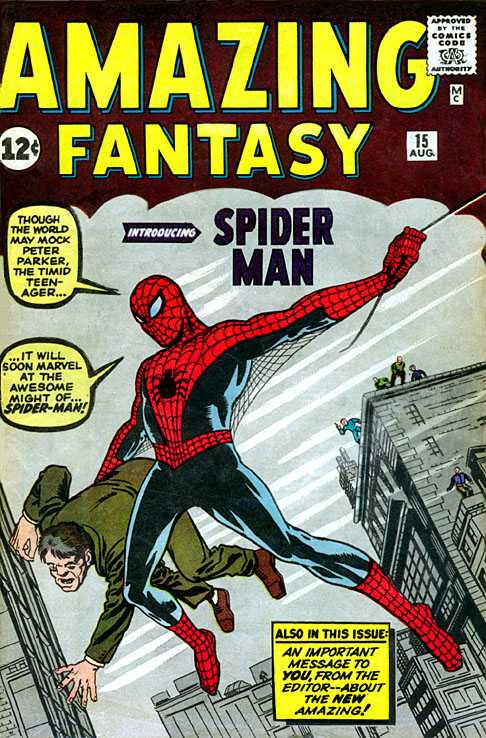
Amazing Fantasy #15 is the issue that introduced Peter Parker — a bullied, financially struggling Queens teenager — as a new kind of superhero to the Silver Age: one defined not by nobility or destiny but by moral failure redeemed, a structural innovation that permanently widened what superhero comics could do emotionally and narratively. The story's closing moral — that power carries an obligation to act — arrived not as a speech from a mentor but as an authorial caption after Uncle Ben's death, a storytelling choice that made the lesson feel earned rather than preached, and it has anchored Spider-Man's character across six decades of comics, animation, film, and games. Published at a moment when Marvel's superhero line consisted of barely seven issues of two titles, it signaled that the company's emerging "Marvel Method" could sustain intimate, psychologically complex characters alongside its monster and cosmic books. In 2001, Marvel's own editorial poll of 100 Greatest Marvels placed this issue at the top of the list, and the Library of Congress later accepted Ditko's original 24 pages as a cultural artifact — institutional recognition of how fully the issue had moved beyond genre.
Find on ebay
Read it digitally
Sell my copy
Have this issue — or a whole collection? Get a fair offer from us, skip the marketplace fees and the hassle.
We Buy Collections ▸History
Stan Lee conceived Spider-Man after the success of Fantastic Four and pitched publisher Martin Goodman on a teenage hero who would carry real-world anxieties — money trouble, social rejection, self-doubt — rather than the frictionless confidence typical of the era's protagonists; Goodman was skeptical, but agreed to a tryout precisely because Amazing Adult Fantasy (a Lee–Ditko science-fiction anthology that had run since issue #7) was already slated for cancellation, giving him nothing to lose. Lee first approached Jack Kirby, who produced sample pages Goodman and Lee both found too conventionally heroic — 'Captain America with cobwebs,' in Joe Simon's memorable phrase — so the assignment passed to Steve Ditko, who designed the costume (originally envisioned in orange and purple), the wrist-mounted web-shooters, and the Spider-Signal, and whose tightly wound, anxiety-drenched art style proved far better suited to the character's neurotic interiority. For the cover, Lee rejected Ditko's subjectively framed composition (Spider-Man swinging toward the viewer) in favor of a bolder, more muscular image he had Jack Kirby pencil and Ditko ink; Ditko's original cover lay unused for 51 years until Marvel published it as a 1-in-200 variant for Amazing Spider-Man #700 in 2013. The original 24 pages of interior Ditko artwork had gone missing from Marvel's files sometime in the late 1970s or early 1980s and resurfaced only in 2008, when an anonymous donor gave them to the Library of Congress.
Trivia · 8 facts
- First appearance of Peter Parker / Spider-Man, including his origin story told across 11 pages split into two parts — an unusual length forced by the anthology format, which typically capped stories at three to five pages.
- First appearances of Aunt May, Uncle Ben (who dies in this issue), Flash Thompson, and the unnamed character later identified as Liz Allan, establishing the core supporting cast from the very beginning.
- Written by Stan Lee and drawn (pencils and inks) by Steve Ditko; cover penciled by Jack Kirby and inked by Ditko — the published cover was a last-minute replacement for Ditko's own rejected cover design.
- The issue was the final installment of the anthology series that had run as Amazing Adventures (#1–6), Amazing Adult Fantasy (#7–14), and was renamed simply Amazing Fantasy for this single concluding issue (#15).
- The moral 'with great power there must also come great responsibility' appears in the final caption box as the narrator's coda — it is never spoken by Uncle Ben in this story; that attribution came in later retellings.
- Sales proved strong enough that Marvel launched The Amazing Spider-Man as an ongoing solo title approximately seven months later, in March 1963.
- The issue went on sale June 5, 1962 (per copyright indicia and Marvel's own records), despite the cover being dated August 1962 — a standard distribution practice of the era; the indicia inside carries a September 1962 date, adding further confusion to the issue's official release.
- In 2008, an anonymous donor — confirmed by the Library of Congress to be neither Stan Lee, Steve Ditko, nor Marie Severin — gave the original 24 pages of Ditko art to the Library of Congress, where they remain as a publicly accessible cultural artifact.
Key issues in Amazing Fantasy
Reviews
Reader reviews
No reader reviews yet.