
A complete issue · 120 pages · 1781
A Month's Tour, &c.
# Victorian Penny Dreadful Title Page This is a title/cover page from a Victorian penny dreadful. The visible text reads "A MONTH'S TOUR, &c." as the main title, with "[PRICE TWO SHILLINGS.]" printed below in brackets. The page is largely blank with decorative horizontal lines above and below the title text. The layout and typography are typical of cheap Victorian serialized fiction covers, though the OCR text appears corrupted—the actual printed words on the page are limited to the title, subtitle notation, and price information shown above.
This appears to be a title or cover page of a Victorian penny dreadful. The page is predominantly blank with visible wear, aging, and foxing typical of period documents. Centered on the page is text that reads "A DROIT NATION" (though the OCR is uncertain and the exact wording is difficult to verify from the degraded image). Below this appears to be a subtitle or secondary line of text that is largely illegible in this reproduction. The page shows significant age deterioration with dark stains and creasing along the left edge. The "comicbooks.com" watermark indicates this is a digital archive image rather than original period material.
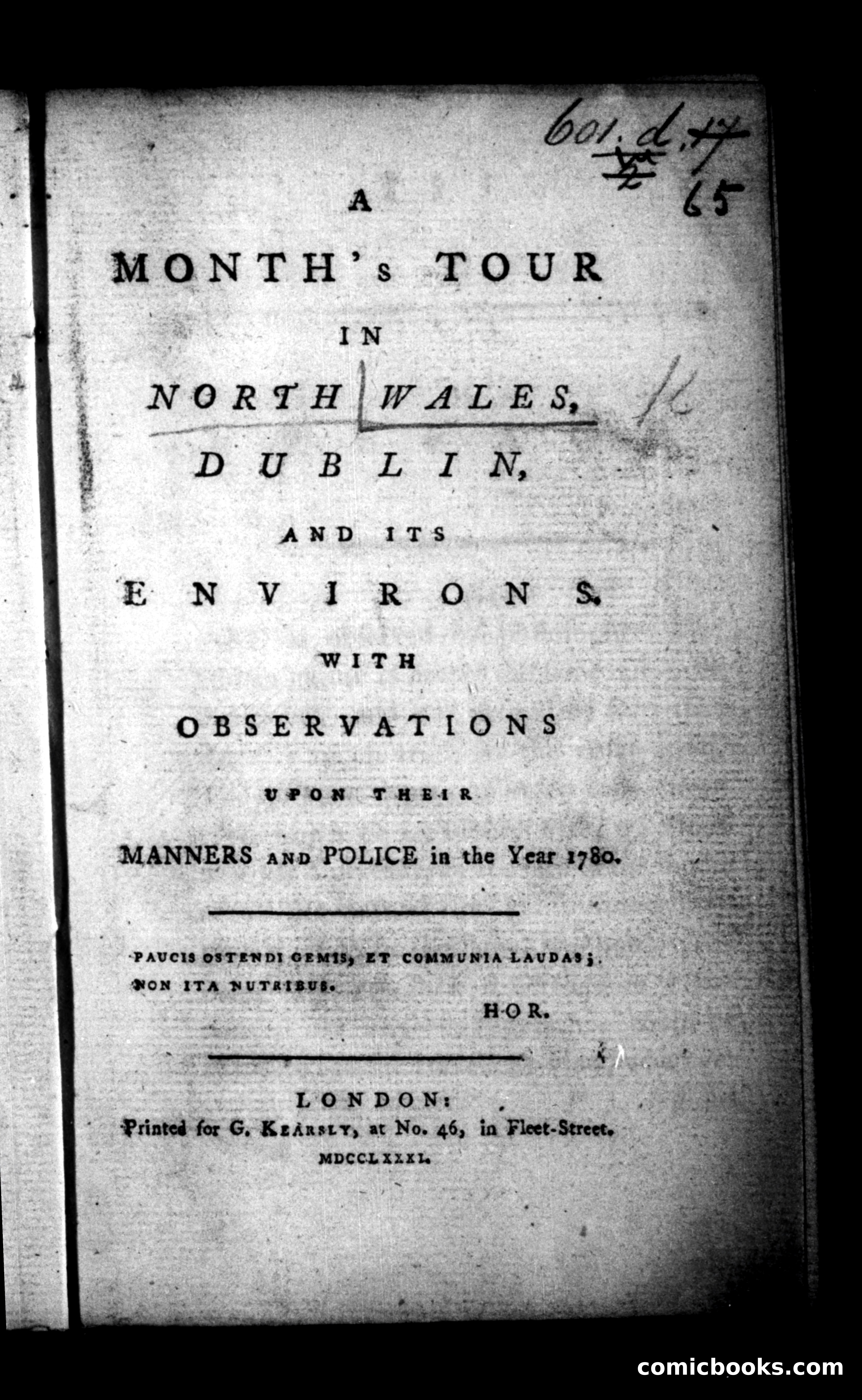
This is a title page from a book published in London in 1780 by printer G. Kearsley. The work is "A Month's Tour in North Wales, Dublin, and its Environs," presenting observations on manners and police (civic order) during that year. The page includes a Latin epigraph and publication details indicating it was printed at Fleet Street. This appears to be a travel narrative or guidebook rather than penny dreadful fiction—a genre focused on describing regions and social customs of the period.
This is a title or opening page of a Victorian penny dreadful, though the image quality is poor and the OCR has largely failed to capture readable text. The page appears mostly blank or heavily faded, with only scattered fragments visible—isolated letters and marks that do not form coherent words or sentences. There may be a title or heading at the top of the page, but it is too unclear in this reproduction to read with confidence. The page layout suggests this is preliminary matter rather than story prose, but the specific content and subject matter cannot be reliably determined from what is legible here.
This is a page of running prose from a Victorian penny dreadful, marked as page [53]. The text, printed in period typography with long "s" characters, discusses philosophical observations about human nature. It argues that while human nature is essentially similar across the globe, differences in cultivation and civilization create significant moral diversity among mankind. The passage suggests that without such variations in development, humanity would present a uniform appearance to travelers everywhere.
This is a page of running prose text, marked as page [6], from what appears to be an instructional or philosophical work about travel and observation. The visible text discusses how the moral character of different regions varies according to education, government, laws, customs, and climate, and argues that travelers should carefully observe the manners and virtues of the inhabitants they encounter, so they might learn to model their own conduct accordingly. The prose employs period spelling conventions (such as "vifited," "diverfified," "fhould").
# Description of Page This is a running prose page (numbered 7) from what appears to be a travel narrative or guidebook. The text argues for the health and mental benefits of travel, claiming it provides "a continual change of scene" that refreshes the mind and spirits. It specifically recommends travel as a remedy for melancholy and ill-health, asserting that visiting different countries—though none perfect—allows one to extract useful knowledge and ideas from each. The author concludes by requesting indulgence for the "numerous imperfections" of the observations that follow, suggesting this prefaces a longer travel account.
# Page Description This is a prefatory or introductory prose page from a Victorian-era text. The visible text explains the author's original intent—to write merely for his own memory and a friend's entertainment—before being persuaded by friends to publish for the public. A Latin epigraph appears mid-page. The page ends with what appears to be a chapter or section heading: "A MONTH's" (text cut off). The typography and condition suggest an 18th or early 19th-century printed book, though the penny dreadful designation cannot be confirmed from this page alone.
# Page Analysis This is a prose text page from what appears to be a travel narrative or memoir section titled "A MONTH's TOUR, &c." The visible text describes the opening of a journey: on May 19th, the narrator departed from an obscure village in Lancashire with two companions, arrived at Chester for dinner, then traveled toward Holywell via Hawarden and Northop, where they lodged for the night. The narrator notes the roads were excellent and the scenery beautiful. The page is marked with section letters (A, B) and contains typical 18th-century typography (the long 's' character). This appears to be mid-narrative prose rather than a title page or illustration.
# Page Analysis This is a page of running prose from what appears to be a travel narrative or tour journal. The page is numbered 10 and titled "A MONTH'S TOUR." The text describes the county of Flint in Wales, praising its pleasantness and fertility, mentioning geographical features like the rivers Dee and Merfey, and towns including Liverpool and Chester. It then shifts to a first-person account of a walk on the 20th (of an unspecified month) with someone identified only as "Mr. W—" to copper-works near St. Winifred's Well, where a Gothic temple supposedly built during King Henry VII's reign stands. The passage notes that twenty-three mills are powered by the stream there.
This is a page of running prose from "A Month's Tour," page 11. The text describes the narrator's travels through what appears to be Wales, noting Mr. Sm——by's fustian (cloth) manufactory with its underground spring that emits eighty tons of water per minute. After dining on lamb and port at Holywell, the travelers encounter Mr. St——ple, described as an honest Briton descended from Cadwallader, who is an acquaintance of Mr. W——'s and waits at his gate to receive them. The narrative continues mid-sentence at page's end.
This is a page of running prose from what appears to be a travel narrative titled "A Month's Tour." The text describes a journey three miles from Holywell, where the traveler observes the estates of Thomas and Pennant and Sir Roger Moftyn situated between the turnpike road and sea shore. The passage details the scenic view, which includes the rivers Dee and Mersey, the Wirral peninsula, the Lancashire flatlands, and an extended seacoast visible to the north from Chester.
This is a page of running prose from what appears to be a travel narrative or tour account (page 13, titled "A MONTH's TOUR"). The text describes the author's journey through Wales, mentioning arrival at Brekil, where a hunting club met at the Swan Inn, and subsequently the vale of Clwyd, which the narrator describes as fertile and beautiful, running nearly east and west for twenty miles from the mountains above Rythin to the sea at Ryddlan. The passage includes a quoted poetic couplet about hills and alps.
# Analysis of Page 14: "A Month's Tour" This is a page of running prose text from what appears to be a travel narrative or descriptive essay. The passage describes a valley in Great Britain bounded by mountains and diversified with farmland and water features. It mentions the river Clwyd flowing through the valley, locating Denbigh near the middle and St. Asaph to the east, where a cathedral is undergoing repairs and beautification. The text concludes by noting that Bottle-within, the seat of Bennett Williams, Esq., lies two miles away. The page number "14" suggests this is mid-narrative. The precise valley referenced remains unclear from this excerpt alone.
# Page Analysis This is a page of running prose from what appears to be a travel narrative titled "A Month's Tour." The text describes a journey through Wales, mentioning locations like Kymmel, Abergeley, and a cave called Black and Blue. It recounts an anecdote about four men who attempted to explore the cave's depths with three pounds of candles, which were exhausted before they reached the end. Only two men returned; the fate of the other two remains unknown. The narrative tone suggests this is sensation-driven popular literature, using the mysterious disappearance as a hook for reader interest.
# Page Analysis This is a page of running prose from a Victorian travel narrative titled "A Month's Tour" (page 76). The text describes the author's journey through the Conway valley in Wales, detailing how their carriage crossed the river by ferry at high tide, the cost of passage (a shilling per passenger), and the characteristics of the Conway River, which is noted for fine salmon and navigability to Llanrwift. The passage concludes by cataloging several notable estates on the east side of the river, including properties belonging to Lawyer Walsh, Mr. Stoddard, Sir Roger Moftyn, and Mrs. Moftyn—though this appears to be a travel guide or memoir rather than sensational fiction.
# Page Analysis This is running prose from a travel narrative titled "A Month's Tour" (page 17). The text describes the author's arrival in Conway, Wales, around eight o'clock in the evening, where they lodged at Mr. Read's Bull's-Head Inn. It characterizes Mrs. Read, a native of Cheshire, as talkative and somewhat extravagant in her management. The passage then moves to the following morning, when the author rose at six o'clock to survey the town, which they describe as situated on the west side of a river and governed as a corporation town with a mayor.
# Page Analysis This is a page of running prose from "A Month's Tour," appearing on page 18. The text describes a castle surrounded by a strong wall formerly adorned with fifty towers, several still remaining. It notes a fine tower on the south-east with a solid rock foundation, damaged on one side where inhabitants blasted the stone for building materials. The passage states the castle was built by King Edward the First and mentions Oliver Cromwell's erection of a battery at a distance south of the town, with his attempts to capture it beginning at the page's end.
# Page Description This is running prose from a chapter titled "A Month's Tour" (page 19) in what appears to be a travel narrative or historical account. The text describes military tactics used during what seems to be a siege at Conway castle—specifically how someone named Oliver used nine-pound cannonballs without success, then resorted to destroying lead water pipes to force the town's surrender through deprivation. The passage concludes with the narrator's account of leaving Conway and ascending Penmaen-Ross, noting the steep descent on one side and mentioning "great terror." The text uses period spelling conventions (e.g., "favour," "defence") typical of eighteenth or early nineteenth-century printing.
This is a page of running prose from "A Month's Tour," appearing as page 20. The text describes a traveler's journey through Welsh terrain, detailing the impressive and threatening Penmaen-madir mountain with its steep cliffs and massive stones, and an arch built to support the road nearby. The passage then relates how, after passing through a village called Llanaber, the travelers' carriage suffered damage to its hind wheel's linch-pin, causing repeated problems until they reached Bangor. The narrative uses archaic spelling conventions typical of the period.
# A Month's Tour, Page 28 This is a page of running prose text from what appears to be a travel narrative or travelogue. The narrator describes arriving at Bangor around eleven o'clock, breakfasting a second time, and attending divine service at the cathedral, where they note a musical organ built by Mr. Green at considerable expense (three hundred and sixty guineas). After the service, they proceed by Conway chaise to a ferry, cross into Anglesey, and take a fresh carriage. The page number indicates this is part of a serialized or multi-chapter work titled "A Month's Tour."
# Page Analysis This is a page of running prose from what appears to be a travel narrative or tour account. The text describes the author's journey through an island (likely Anglesey, given references to "Holy-head road"), passing Sir N. Bailey's seat, and arriving at Gwinda where they meet Mrs. H——s at an inn. The passage concludes with a notable digression: a detailed description of an unusually large grey cat measuring a yard and an inch from head to tail and standing sixteen inches high. The page number "22" indicates this is mid-narrative, not a title page or cover.
# Page Analysis This is a page of running prose from what appears to be a travel narrative or travelogue section titled "A MONTH's TOUR." The text describes the author's journey from Gwinda to Holyhead in Anglesey, Wales, detailing the landscape's dreary appearance, its rocky terrain covered with furze, and a navigable channel crossing. It then describes Holy-head as a small western town in Anglesey with a church, Saturday market, and five King's packets (merchant vessels of seventy to eighty tons) that sail daily to Dublin except Thursdays. The page ends mid-sentence with "On," continuing to the next page.
# A Month's Tour This is a page of running prose from what appears to be a travel narrative or adventure story. The text describes the narrator's embarkation on the 22nd aboard the ship *Dartmouth* under Captain Hartwell, bound for Dublin. The passengers—three land officers, a sergeant, a servant, four Jesuits, a lady, and a young boy—initially expect an eight-hour voyage, but the narrator cautions that the uncertain sea elements soon prove otherwise. The passage ends as a prodigious swell develops after the ship advances six leagues. The archaic spelling and typography are consistent with late 18th or early 19th-century printing.
This is a page of running prose from what appears to be a travel narrative or ship's log, labeled "A MONTH's TOUR" (page 25). The text describes challenging maritime conditions: the wind shifting to the west and then north-west, blowing violently for twenty hours with mountainous waves that made navigation difficult. The ship reached the Hibernian (Irish) shore at three o'clock P.M., then steered north to catch the tide, requiring multiple tacks against the wind while being buffeted by squalls. The passage emphasizes the danger and tedium of the voyage.
# A Month's Tour — Running Prose Page This is a page of running prose text from what appears to be a travel narrative or voyage account. The passage describes a ship's difficult passage during a storm, with persistent hailstorms and rain driven by north-westerly winds. The crew adjusts sails at nine P.M. and again at four A.M., then attempts to reach Dublin Bay by sailing windward. They successfully anchor near Dunleary (modern Dun Laoghaire), two leagues from Dublin, at eight o'clock. The text notes that despite the "toilsome and dangerous passage," the mariners—all Welsh except for the Captain—remained composed, though the final sentence appears to continue onto the next page.
# Analysis This is a page of running prose (page 27) from what appears to be a serialized travel narrative titled "A Month's Tour." The text describes passengers aboard a ship suffering from seasickness, with all except one Mr. W—— confined to their cabins. It details the "profound silence" broken only by the stomach disturbances of the afflicted passengers until Tuesday morning, when news that the ship was traveling quickly prompted the officers and Jesuits to begin eating. The tone is darkly humorous and descriptive of maritime discomfort, typical of Victorian popular serial fiction.
# Page Analysis This is a page of running prose from what appears to be a travel narrative or memoir titled "A Month's Tour" (page 28). The text describes the narrator's uncomfortable experience sharing lodgings with rowdy guests who consumed food and drink heavily while discoursing about snuff, then recounts traveling by boat to Dublin. The passage concludes with observations about Dublin's port, noting that while nature provided no advantages, human art has enhanced it with a stone wall and wooden piles. The text uses eighteenth-century spelling conventions (e.g., "mcft" for "most," "thefe" for "these").
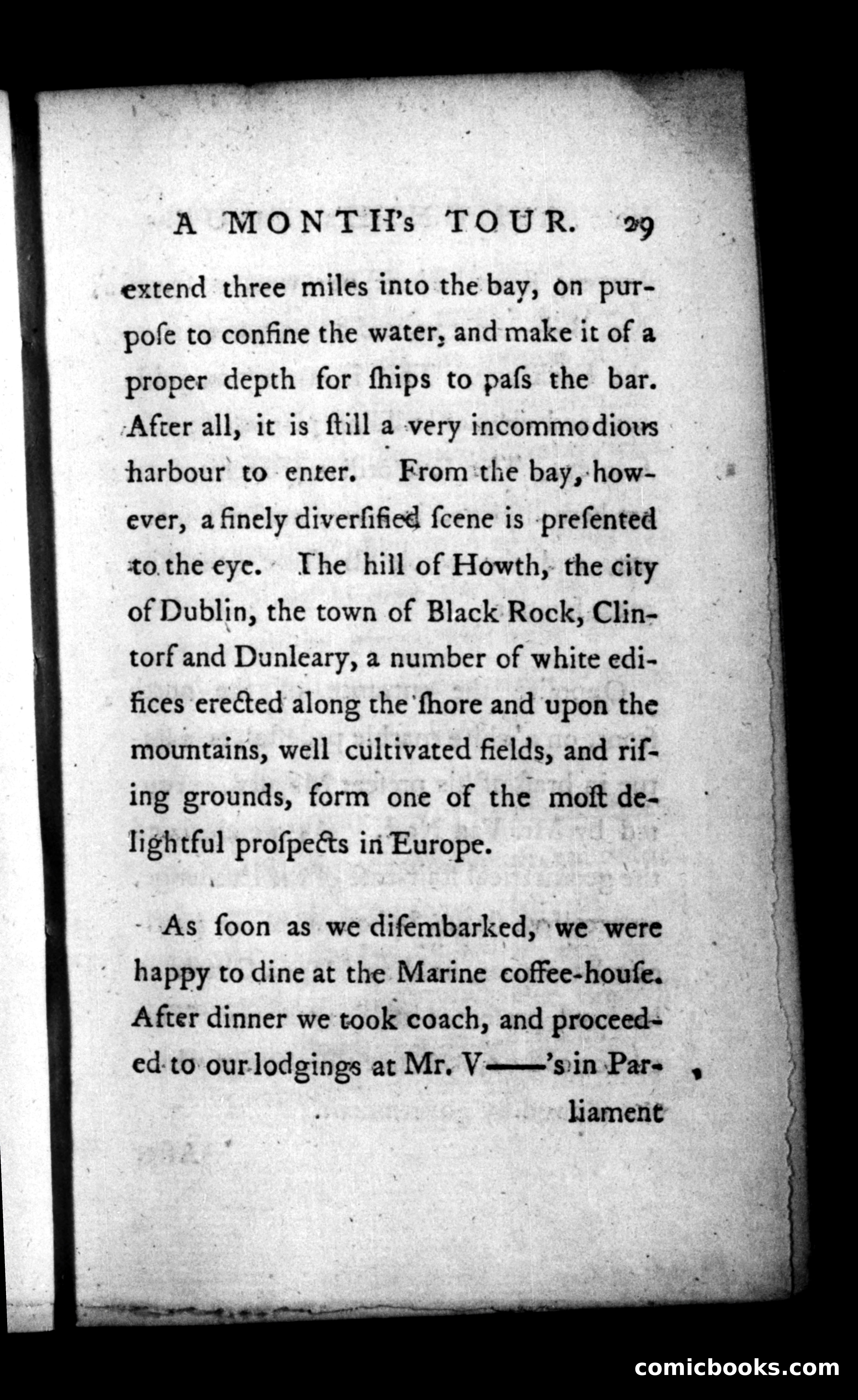
This is a page of running prose from what appears to be a travel narrative titled "A Month's Tour" (page 29). The text describes the approach to Dublin Bay, Ireland, noting the difficulties of its harbor entrance but praising the scenic landscape visible from the bay, which includes Howth, Dublin, Black Rock, Clontorf, and Dunleary with their white buildings and cultivated fields. The narrator then recounts disembarking and dining at the Marine coffee-house before proceeding by coach to lodgings at an address in Parliament (the name appears redacted or partially obscured). The page uses period typography with archaic spelling conventions typical of late 18th or early 19th-century publishing.
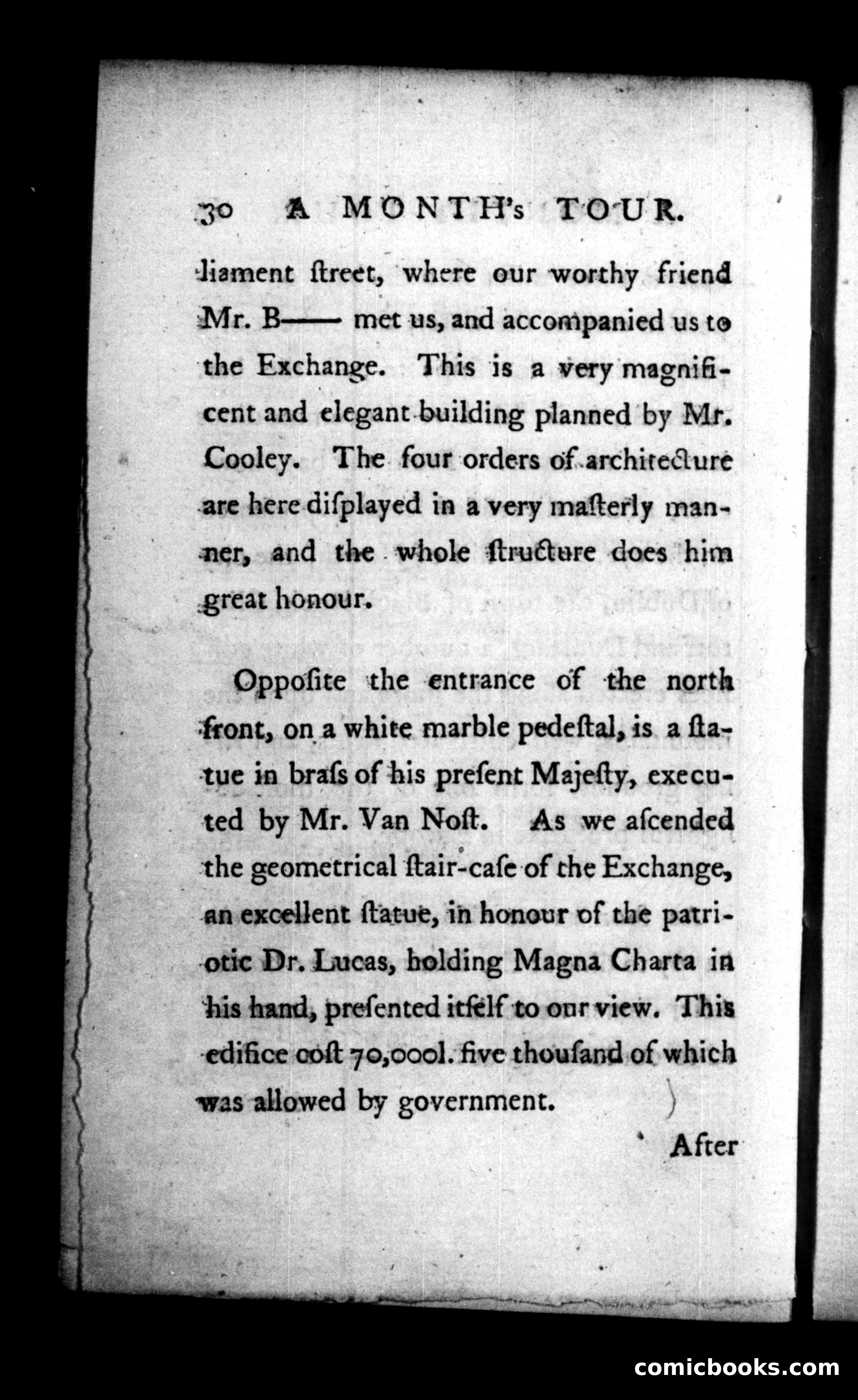
# Page Analysis This is running prose text from "A Month's Tour," a descriptive travel narrative. The passage describes a visit to the Exchange building (likely the Dublin Exchange), designed by architect Mr. Cooley. The text details architectural features, including statues of the present Majesty in brass by Van Noft and of patriotic Dr. Lucas holding Magna Carta, and notes the building's cost of 70,000 pounds with 5,000 provided by government. The page uses period typography with long 's' characters.
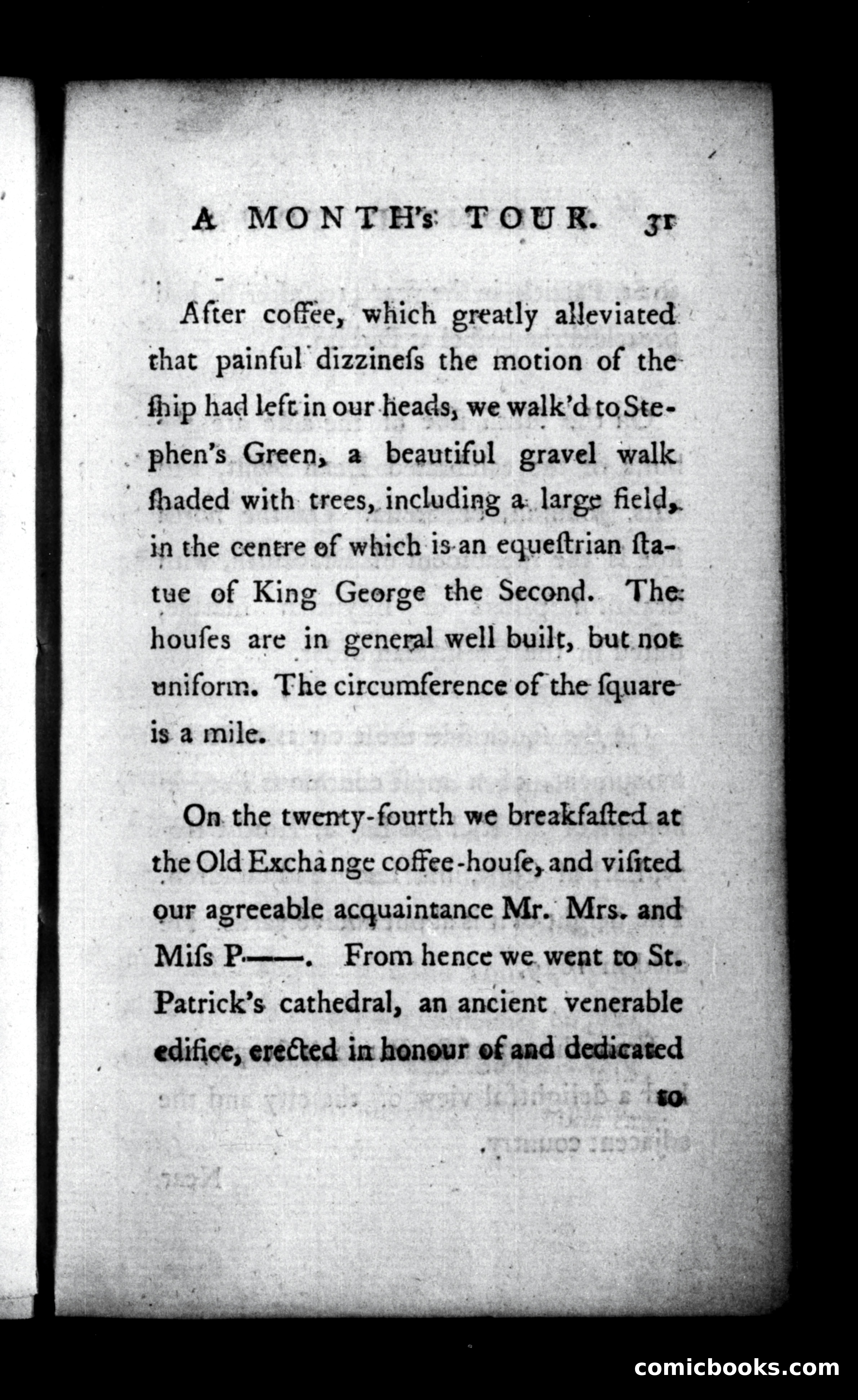
# Page Description This is a page of running prose from "A Month's Tour," page 3 of the text. The narrator describes a walking tour of Stephen's Green in Dublin, noting its gravel paths, trees, and an equestrian statue of King George the Second at its center. The passage then shifts to recount events of the twenty-fourth, when the travelers breakfasted at the Old Exchange coffee-house, visited acquaintances (names redacted as "Mr. Mrs. and Mifs P——"), and proceeded to St. Patrick's cathedral, which the text describes as "an ancient venerable edifice."
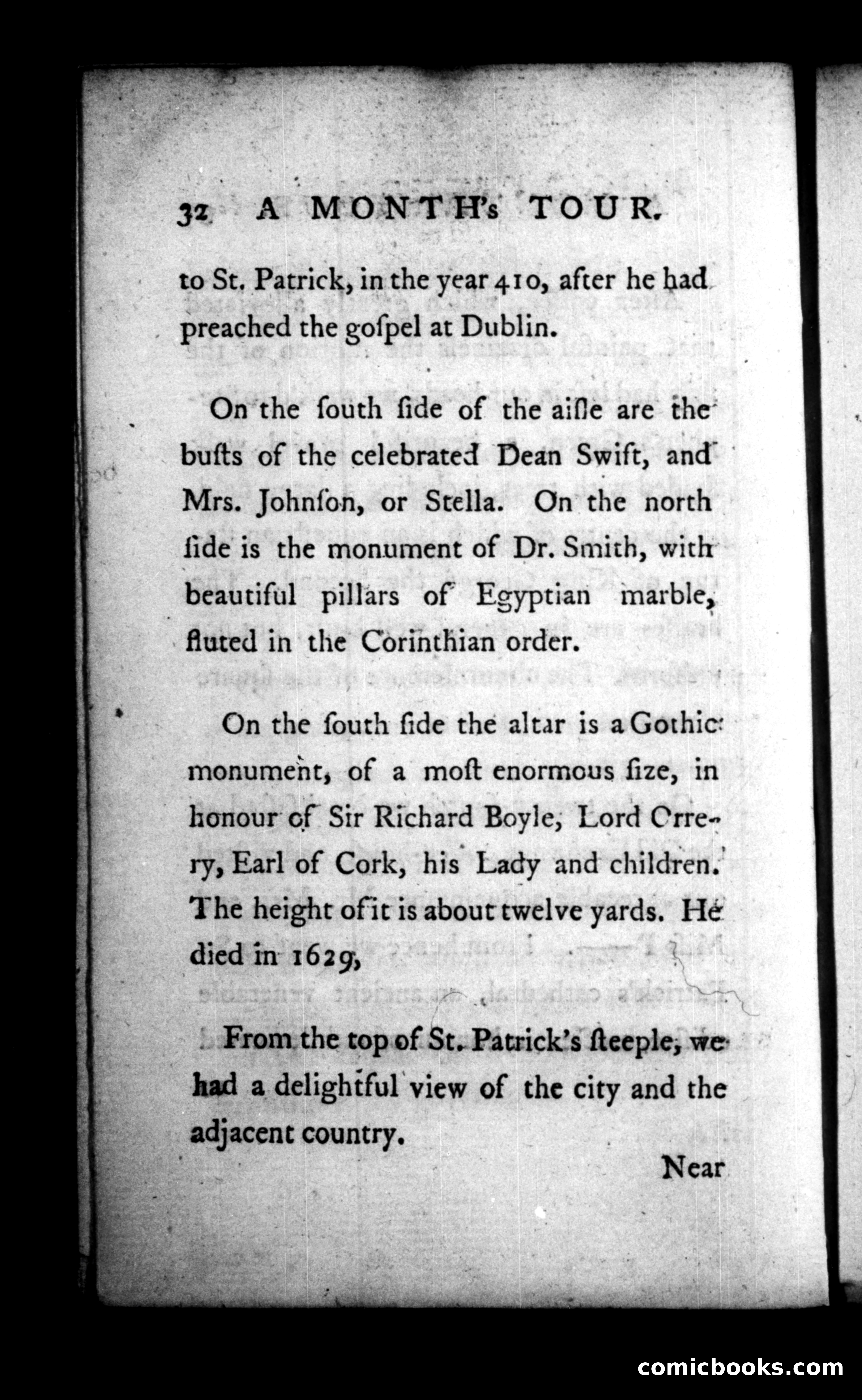
This is a page of running prose from what appears to be a travel narrative or guidebook section titled "A Month's Tour." The text describes monuments and notable burials within St. Patrick's Cathedral in Dublin, including the busts of Dean Swift and Mrs. Johnson (Stella), a monument to Dr. Smith featuring Egyptian marble pillars, and a large Gothic monument to Sir Richard Boyle, Earl of Cork, who died in 1629. The passage concludes by noting the pleasant view of Dublin and surrounding countryside from the top of St. Patrick's steeple.
This is a page of running prose from what appears to be a travel narrative or tour guide. The text describes a visitor's observations of Dublin landmarks, including the public library (described as an elegant room with a tolerable book collection), a picture exhibition (deemed unremarkable), and Trinity College (detailed at length with descriptions of its four-story height, twenty-three front windows, Portland stone quadrangle, and various interior spaces). The writing uses eighteenth-century typography (long 's' characters) and matter-of-fact architectural commentary typical of period travel writing.
# Page Analysis This is running prose from page 34 of "A Month's Tour," a travel narrative. The text describes Trinity College (likely Trinity College Dublin), detailing its library with Irish oak pillars, its administrative structure (a Provost, Fellows, and scholars), and notably an anatomical school containing wax figures depicting pregnant females in various stages of pregnancy. These figures, created on real skeletons, are attributed to a French artist named Denoue and represent his life's work. The passage presents these anatomical models as a remarkable achievement of artistic genius. The page uses period typography with long "s" characters typical of the era.
# Analysis This is a page of running prose from what appears to be a travel narrative or guidebook (titled "A MONTH'S TOUR," page 35). The text describes architectural and institutional features of what is likely London, including references to a college museum with an Egyptian mummy (erected in 1591), and the Houses of Parliament opposite, noting the Commons chamber accommodates three hundred members and features large pillars supporting a low dome. The page contains no illustrations, only printed text in period typeface with characteristic 18th-century spelling conventions (such as "pofterity" and "muvuseunr"). The text appears descriptive and informational rather than sensational, though without broader context, it's unclear whether this document is actually penny dreadful fiction or another genre of Victorian popular literature.
This is a page of running prose from what appears to be a travel narrative or tour guide titled "A Month's Tour." The text describes various public buildings in what is likely London, including Parliament's House of Lords (with 162 members), a blue-coat school for citizens' sons, a House of Industry, and a newly constructed prison. The writing employs period typography (long s's, older spelling conventions) typical of late 18th or early 19th-century printing. The descriptions focus on architectural form and practical utility rather than ornamental beauty.
This is a page of running prose, numbered 38, from what appears to be a travel narrative titled "A Month's Tour." The text describes visiting a rotunda (built by a charitable gentleman as an imitation of London's Ranelagh) where the author attended an evening of singing and concerts by named performers; the profits support a hospital. The passage concludes by noting a visit to barracks, described as a noble structure with one quadrangle and three courts. The text uses 18th-century typography conventions (long s's rendered as f's in OCR).
# Page Description This is a page of running prose from what appears to be a travel narrative or account titled "A Month's Tour" (page 39). The text describes the authors' arrival at a large military barracks accommodating six thousand soldiers, where they witnessed officers assembling their men for the Lord Lieutenant. The passage then characterizes the Lord Lieutenant himself, noting that his unpopularity in Ireland is offset by his wife's family connections to Mr. Conolly, a gentleman of rank and fortune. It remarks critically on the Lord Lieutenant's frugal spending habits, suggesting this trait poorly suits someone of his regal position, though it acknowledges he is "no enemy to pomp."
# Description This is a page of running prose text from "A Month's Tour," a work of Victorian-era travel literature. The passage describes the narrator's exhaustion after a day spent sightseeing and gratefully acknowledges the hospitality of a friend, Mr. B—the younger, who provided them dinner and refreshments including claret whisky and perficо (a liqueur made from citrus, brandy, and milk). The text uses period typography with long "s" characters and discusses a procession conducted with magnificence comparable to the King's attendance at Parliament.
# Page Analysis This is a page of running prose from what appears to be a travel narrative or travelogue, not a penny dreadful. The text describes a journey in Ireland, recounting a meal at a tavern and a subsequent excursion by chariot on the twenty-fifth (of an unspecified month) toward Lipzlip, a town west of Dublin. The narrator notes landmarks passed en route—the Bishop of Derry's residence, the King's lodge, Phoenix Park, and villas belonging to Dublin merchants—and mentions passing Strawberry gardens, which extended four miles along a riverbank. The page number suggests this is part of a longer serialized work titled "A Month's Tour."
This is a page of running prose from what appears to be a travel narrative or tour account. The text describes the author's journey through Irish locations, noting Dublin's food supply, a spa-like water feature near the "five mile stone," their arrival at Lipzlip where they ate eggs and drank tea, and Lord Masereene's estate situated romantically near the banks of the Liffey river, which features a pleasant wooded walk. The prose is broken across multiple paragraphs in period typography with long 's' characters.
This is a page of running prose from what appears to be a travel narrative or travelogue. The text describes a visit to the Salmon-leap waterfall in Ireland, formed by the River Liffey, which the narrator finds beautiful though inferior to the waterfall at Bally-Shannon. The passage includes the narrator's appreciative reflections on how nature has been refined by art at this location, accompanied by a poetic quotation about solitude and contemplation. The page ends as the narrator begins describing paintings and views seen from a house at the site.
# Page Analysis This is a running prose page (page 44) from what appears to be a travel narrative titled "A Month's Tour." The text describes visiting a residence inhabited by Lady Dowager Maffereene, whose son has been imprisoned in France since a recent war for allegedly attempting to set French docks on fire. The narrator then reflects on the return journey, making disparaging generalizations about Irish peasants as "indolent" and "lazy," before noting departure from Dublin at eight o'clock. The page uses period typography (long "s" characters) typical of late 18th-century printing.
# Page Analysis This is a page of running prose (page 45) from a Victorian travel narrative titled "A Month's Tour." The text describes the author's frustrating experience with a sluggish carriage driver in Leipzig. The narrator complains that the driver was impudent and lazy, ignoring requests to speed up and even abandoning his post during slight inclines to offer passengers his hand. The author theorizes that the driver's slowness stems from the payment system—drivers earned sixteen pence per hour initially, then eight pence thereafter—which gave them no financial incentive to travel quickly. The passage employs period spelling conventions (e.g., "almoft" for "almost," "fuch" for "such").
This is a page of running prose from what appears to be a travel narrative titled "A Month's Tour" (page 46). The text describes observations about Irish people encountered during the author's excursion, specifically commenting on their alleged propensity for swearing. The author recounts an anecdote about a landlord at Lipzlip whose ordinary speech consisted primarily of oaths, and notes that the Irish, unlike people in other countries, freely intermix profanities with everyday conversation rather than reserving them for moments of indignation. The passage employs period-appropriate spelling conventions (e.g., "courfe," "confifted").
This page is running prose from what appears to be a travel narrative titled "A Month's Tour" (page 47). The text describes a recreational walk to a bafon (likely "bason," a public promenade) at the west end of a city near navigation connected to the Shannon River. The narrator notes a porter screens visitors by genteel appearance, and describes spending an hour observing the landscape and "certain moving objects" passing in view. The passage ends mid-sentence mentioning "our very worthy and good-natured friend Mr. B——." The text uses period spelling conventions ("fpent," "weft," "pafs'd"). This appears to be from a travel account rather than typical penny dreadful sensational fiction.
# Analysis This is a page of **running prose text** from the middle of a serialized narrative titled "A Month's Tour" (page 42). The visible text describes a social visit: an introduction to a celebrated Dublin beauty named Miss B—, praised for her physical appearance, followed by a visit on the 26th to a royal hospital for disabled soldiers. The narrator details the hospital's founding by Charles II, its first stone laid by the Duke of Ormond, and notes its spacious hall decorated with valuable paintings, including a work by Rubens depicting Sir Cecil Wicke, with four hundred stands of arms displayed on the walls.
# Page Analysis This is a page of running prose from what appears to be a travel narrative or guidebook titled "A Month's Tour" (page 49). The text describes a visit to what seems to be a hospital or institutional building in Dublin, detailing its chapel's Gothic architecture, views visible from the roof (including Phoenix Park, Knock Castle, and the Wicklow mountains), and the lime tree-lined walkway on the grounds. The prose is written in eighteenth-century style with period spelling conventions.
# Page Analysis This is a page of running prose from "A Month's Tour," part of a larger travelogue or descriptive narrative. The text describes a medieval burial ground formerly belonging to the Knights Templar in Jerusalem, where a stone monument of a King of Munster was recently discovered. It details a nearby tower with a water cistern serving a hospital, notes the building's architectural plan derives from the Paris Hospital of Invalids, and mentions the hospital's revenue comes from deductions made from military officers' pay. The final paragraph begins introducing the next location visited: the Foundling Hospital. The page shows typical period typography with long s characters (ſ).
# Analysis This is a page of running prose from what appears to be the middle of a longer narrative titled "A Month's Tour." The text describes a charitable institution that accepts orphans of all denominations from anywhere in the world, requiring only that they be human. It details the institution's operations: a nurse receives infants without making inquiries, over 115 infants were admitted within eighteen days about two months prior, they are sent out to wet nurses until ages three or four (currently numbering three thousand), and they arrive wearing labels around their necks with their names inscribed.
# Page Description This is a page of running prose from what appears to be a travel narrative or tour account (page 52, titled "A MONTH's TOUR"). The text describes charitable institutions in an unspecified location: a foundling hospital where abandoned infants are cared for, nursed, and trained in useful trades; revenue from carriage licensing that supports the institution; a nearby Lunatic Hospital founded with an eleven-thousand-pound bequest from Dean Swift; and a dinner the narrator attended at an unnamed location where a facetious Mr. St——ns provided entertainment. The names and places are partially obscured or abbreviated, typical of period publishing conventions.
This is a page of running prose from what appears to be a travel narrative titled "A Month's Tour" (page 53). The text describes the narrator and companions retiring early to bed in Dublin, only to be disturbed by riots and discord in the streets. A Mr. T——— goes to his window and addresses the rioters in menacing terms but to little effect, witnessing a scene of indecency that shocks him. The passage ends as the narrator begins to describe how they spent the next morning.
# Page Analysis This is a page of running prose from "A Month's Tour," page 54. The text describes a traveler's account of a disappointing dinner where the meat was poorly cooked, upsetting a companion named Mr. T——. It mentions an unusual vegetable dish of young cabbages served as sauce with veal and bacon, an evening visit from Mr. B——, and an unsuccessful attempt to attend divine service at St. Patrick's, which was prevented by delays from their barber. The writing employs 18th-century spelling conventions and appears to be travel narrative or memoir prose.
# Page Analysis This is a page of running prose, likely from the middle of a narrative. The text describes a visit to Christ Church where the narrator attended a service with companions, noting Dean Coote's sermon. The passage then catalogs monuments on the south aisle, including a statue of Justice in white marble commemorating Lord Chancellor Bowes, and a bust of Thomas Prior (sculpted by Van Nott in 1756) depicting him between two boys—one weeping, one holding a scroll. The writing appears to be an architectural or travel description rather than sensation fiction content.
# Page Analysis This is a page of running prose from page 36 of "A Month's Tour," describing historical monuments and burials. The text discusses the tomb of Richard Lord Strongbow, the first principal invader of Ireland who died in Dublin in 1177, noting that a figure beside him represents either his son or wife Eva, though their identity remains uncertain according to tradition. The passage also mentions a stately monument erected on the north side of an altar in memory of the Earl of Kildare, grandfather of the current Duke of Leinster. The prose is written in eighteenth-century style typography, with long "s" characters and period spelling conventions.
# Analysis This is a page of running prose from the middle of a serialized narrative titled "A Month's Tour" (page 57). The text describes a scene where an Earl lies dead, attended by his widow and daughter in sorrowful poses, while another figure (apparently the previous Earl) wrings his hands—this composition was apparently executed by an artist named Cheere. The narrator then recounts their day: attending service at Stephen's Green, dining at Mr. P——'s house, attending evening service at St. Anne's, taking tea, and finally supping on cockles at their lodgings. The narrative appears to be a leisurely travel account interspersed with melodramatic domestic scenes.
This is a page of running prose from "A Month's Tour," describing events on the 29th of an unspecified month. The narrator expresses disappointment at the lack of public celebration in what appears to be Dublin (Phoenix Park is mentioned), noting the absence of oak branches and church bells. The passage then recounts dining with Mr. W—, a Quaker gentleman afflicted with gout, who philosophizes that both animals and vegetables require exercise to survive—labor for animals, and wind and breezes for plants. The text uses eighteenth-century typography and spelling conventions.
# Page Description This is a running prose page (numbered 59) from what appears to be a travel narrative or essay titled "A Month's Tour." The visible text discusses two topics: first, a brief scientific observation about how labour and wind promote circulation in bodies and plants respectively; second, an anecdote about Quakers in Dublin, noting they are more sociable there than in England, followed by a dialogue in which a young Quaker defends his love of music as characteristic of taste and genius. The page breaks mid-sentence at the bottom.
# Page Analysis This is a page of running prose from the middle of a serialized narrative titled "A Month's Tour" (page 60). The text discusses Quaker religious practices and social insularity, using a anecdote to illustrate their supposed indifference toward non-Quakers. A seven-year-old Quaker child, dining with an Anglican clergyman, allegedly expressed a crude wish that all the table's wine and glassware were in his stomach—behavior the narrator presents as evidence of Quaker teachings that promote loyalty to their own community while cultivating "total disregard for all others." The passage employs period typography (long s's) typical of late eighteenth or early nineteenth-century printing.
This is a page of running prose from a Victorian travel narrative titled "A Month's Tour" (dated 1861). The text describes a social evening spent with friends Mr. B— and Reverend Mr. P—, where the narrator and companions enjoyed supper with various drinks and were entertained by the reverend's self-composed songs, which reflected his lively temperament. The evening concluded with a toast to King William, whose memory the locals apparently revere deeply, with an equestrian statue of him mentioned at the page's end.
This is a page of running prose from what appears to be a travel narrative or diary. The text describes events on the 30th of an unspecified month, including reading and writing in the morning, dining at Mr. P——'s residence, and attending the Lord Lieutenant's ball in the evening. The passage provides detailed descriptions of the ball room's elegant appointments—its wallpaper, five glass chandeliers, green moreen-covered benches, and scarlet seating reserved for female nobility—suggesting this is an account of social activities, likely in Dublin given the reference to College Green.
# Analysis of Page 63 This is a page of running prose from what appears to be a travel narrative or memoir titled "A Month's Tour." The text describes a formal social gathering in Dublin presided over by the Lord Lieutenant and his Lady. The narrator critiques Mr. Twiss's earlier observation about Irish women's legs, arguing that Twiss unfairly generalized about all ladies when his criticism should have been limited to lower-class women, whose leg thickness the narrator attributes to childhood deprivation (going barefoot and without stockings). The page uses period typography including the long "s" character.
# Description This is a page of running prose from "A Month's Tour," numbered 64. The text appears to be a travel narrative describing observations of Irish society and customs. The passage discusses the accomplishments and manners of Irish women and ladies of various ranks, contrasting them favorably with English counterparts. The final paragraph shifts to a travelogue entry dated the 31st, describing a journey by coach to County Wicklow and noting a geological curiosity called "the Scalp," where a road cuts through a craggy mountain. The page uses period typography with long s-characters characteristic of eighteenth-century printing.
# Analysis This is a page of running prose from what appears to be a travel narrative or descriptive essay titled "A Month's Tour" (page 65). The text describes a scenic excursion through Irish landscape—specifically traveling to the Dargle (or "Dingle"), passing a ninth mile-stone, walking through fields of gorse blossoms, and descending into a wooded valley where a brook flows among rocks. The prose emphasizes the picturesque and romantic qualities of the natural scenery. The page uses eighteenth-century typography and spelling conventions (long "s" characters, older orthography).
# Page Analysis This is a page of running prose from what appears to be a travel narrative or travelogue titled "A Month's Tour" (page 66). The text describes a journey through Ireland, detailing natural landmarks encountered—the Lover's Leap (a large rock formation), a hawthorn tree with drooping branches, and the village of Tina-Hinche where the travelers stopped for breakfast. The passage concludes with them continuing toward a waterfall in Lord Powerscourt's park. The prose is descriptive and leisurely in tone, typical of Victorian travel writing.
This is a page of running prose from what appears to be a travel narrative or travelogue. The text describes a journey through picturesque countryside, noting blooming hawthorn hedges and cultivated fields, before arriving at a waterfall that astonishes the traveler. The author remarks that previous accounts of this "phenomenon" had not prepared them adequately for its actual appearance, as it descends from a steep rock (the sentence continues on the next page). The page number is 63, titled "A MONTH'S TOUR."
# Analysis This is a **page of running prose** from the body text of a Victorian-era travel narrative or tour account (indicated by the header "A MONTH: TOUR"). The page describes a spectacular waterfall or cascade of "stupendous height of 350 feet," detailing its appearance when falling (resembling drifting snow), the spray that reaches spectators at considerable distance, and its transformed appearance after heavy rain. The narrator describes ascending a winding path alongside dangerous precipices to view the phenomenon from multiple vantage points, noting that viewing it from the top causes dizziness. The text employs period-appropriate spelling conventions (e.g., "ftupendous," "Fpectators") characteristic of 18th-century printing.
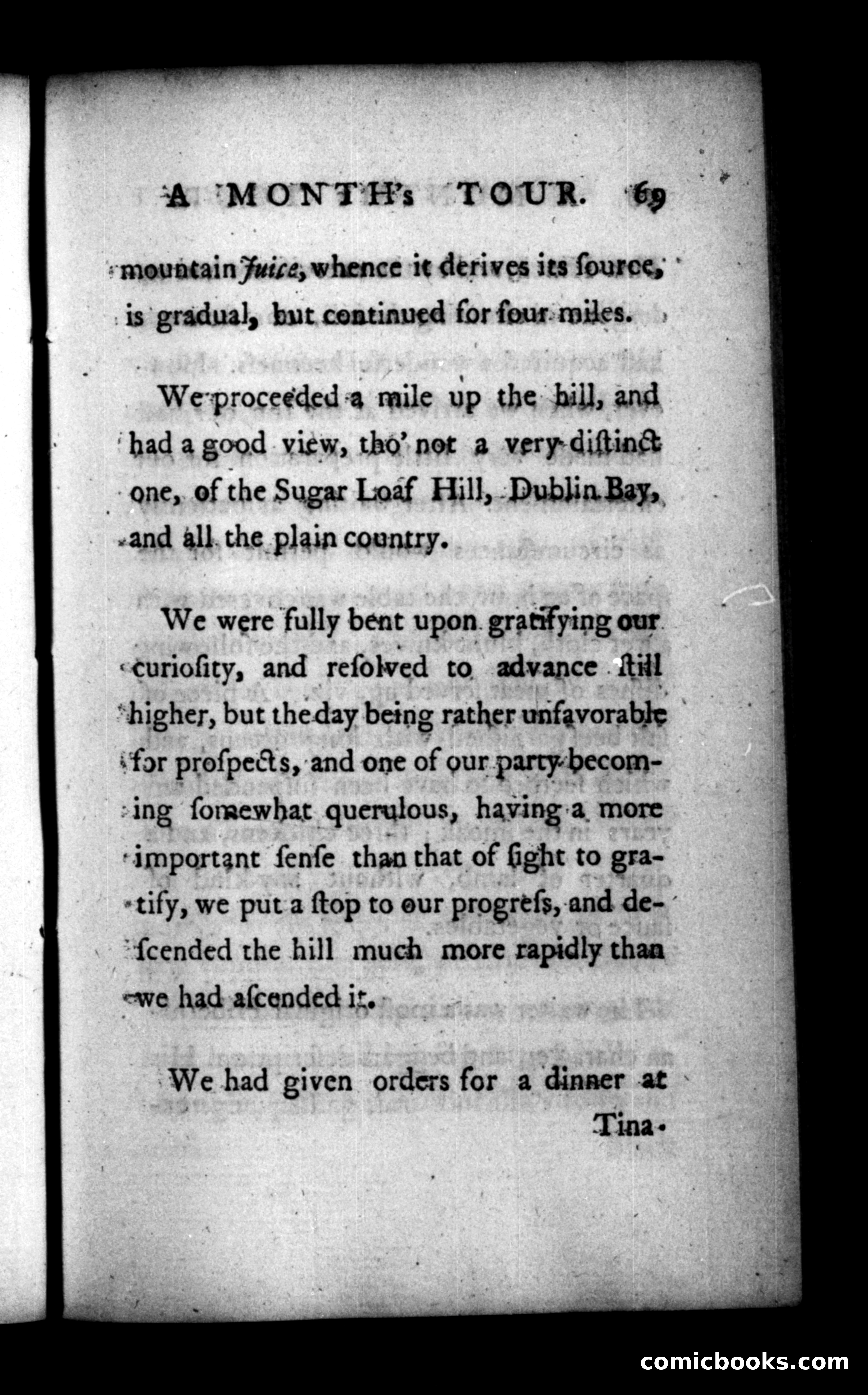
# Analysis This is a page of running prose from a travel narrative titled "A Month's Tour" (page 69). The text describes an excursion up a hill with a view of Sugar Loaf Hill and Dublin Bay. The party initially intended to climb higher to satisfy their curiosity, but abandoned the ascent when weather proved unfavorable and one member of the group became querulous, citing a more pressing need (apparently hunger) than continuing the sightseeing. They descended more quickly than they had climbed and had arranged for dinner elsewhere. The page appears to be mid-narrative, ending as it begins describing dinner preparations.
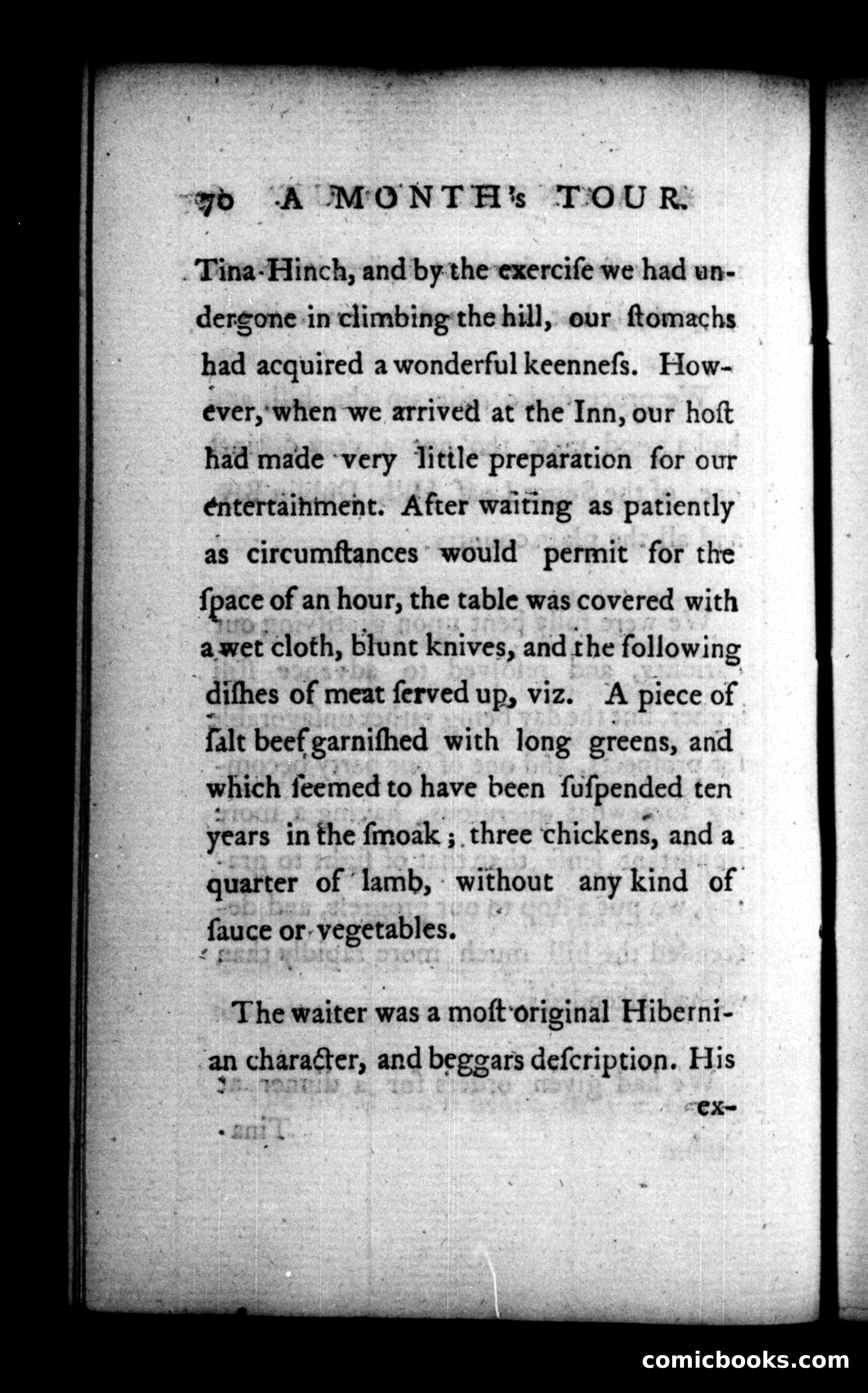
This page contains running prose from what appears to be a travel narrative or adventure tale. The text describes the narrator and a companion named Tina-Hinch arriving at an inn after climbing a hill, only to find the host has prepared meager hospitality. The meal consists of poorly-preserved salt beef, three chickens, and a quarter of lamb, served without sauce or vegetables, along with a wet cloth and blunt knives. The passage concludes by introducing the waiter as "a most original Hibernian character" whose description apparently follows on the next page.
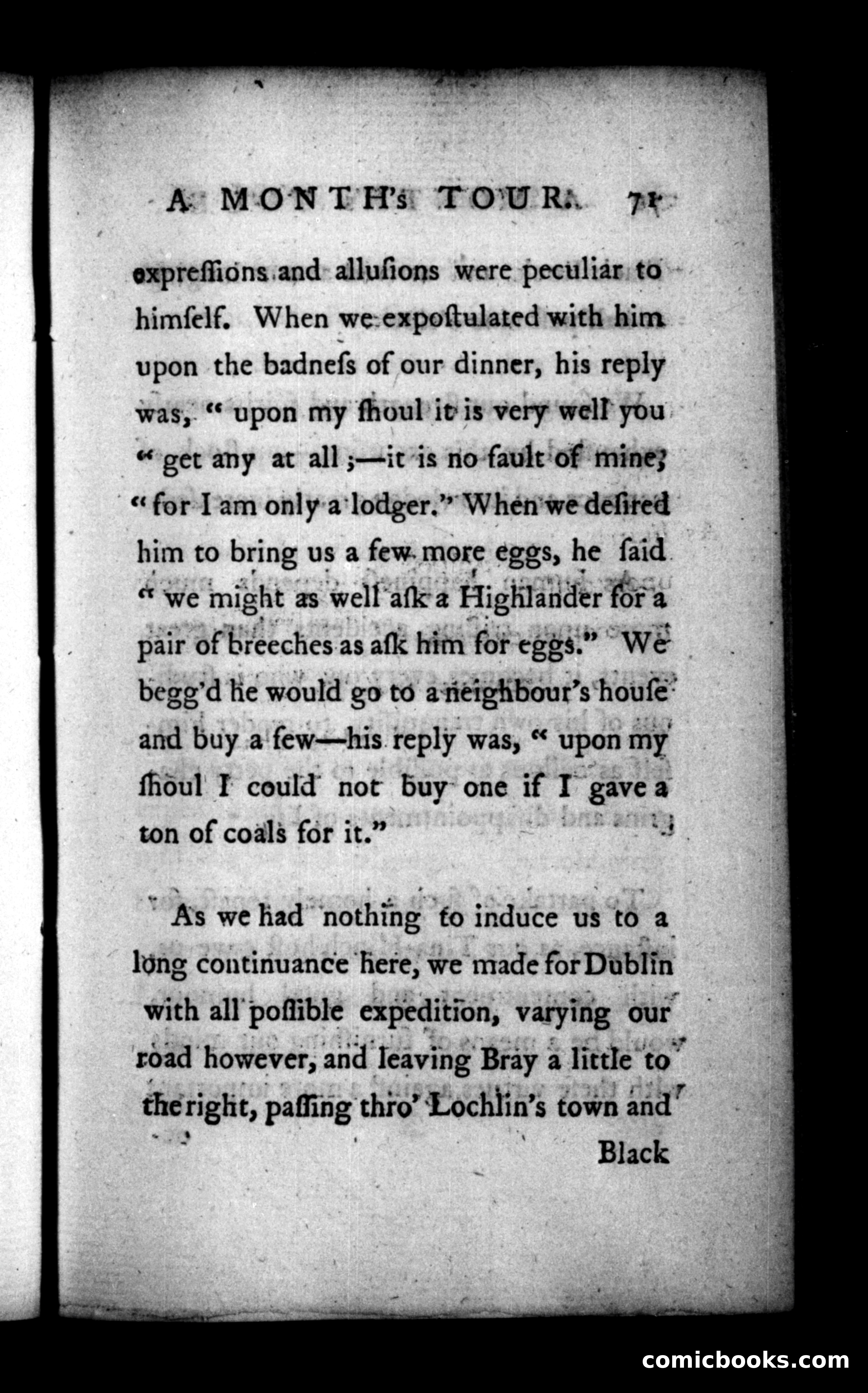
This is a page of running prose from "A Month's Tour," a Victorian travel narrative. The text describes the narrator's frustrating interactions with a lodger at an inn, quoting his defensive and colorful Irish expressions about providing poor dinner and being unable to procure eggs. The passage concludes with the travelers departing for Dublin, noting their route variations including a detour around Bray and passage through Lochlin's town. The page employs period typography with long 's' characters.
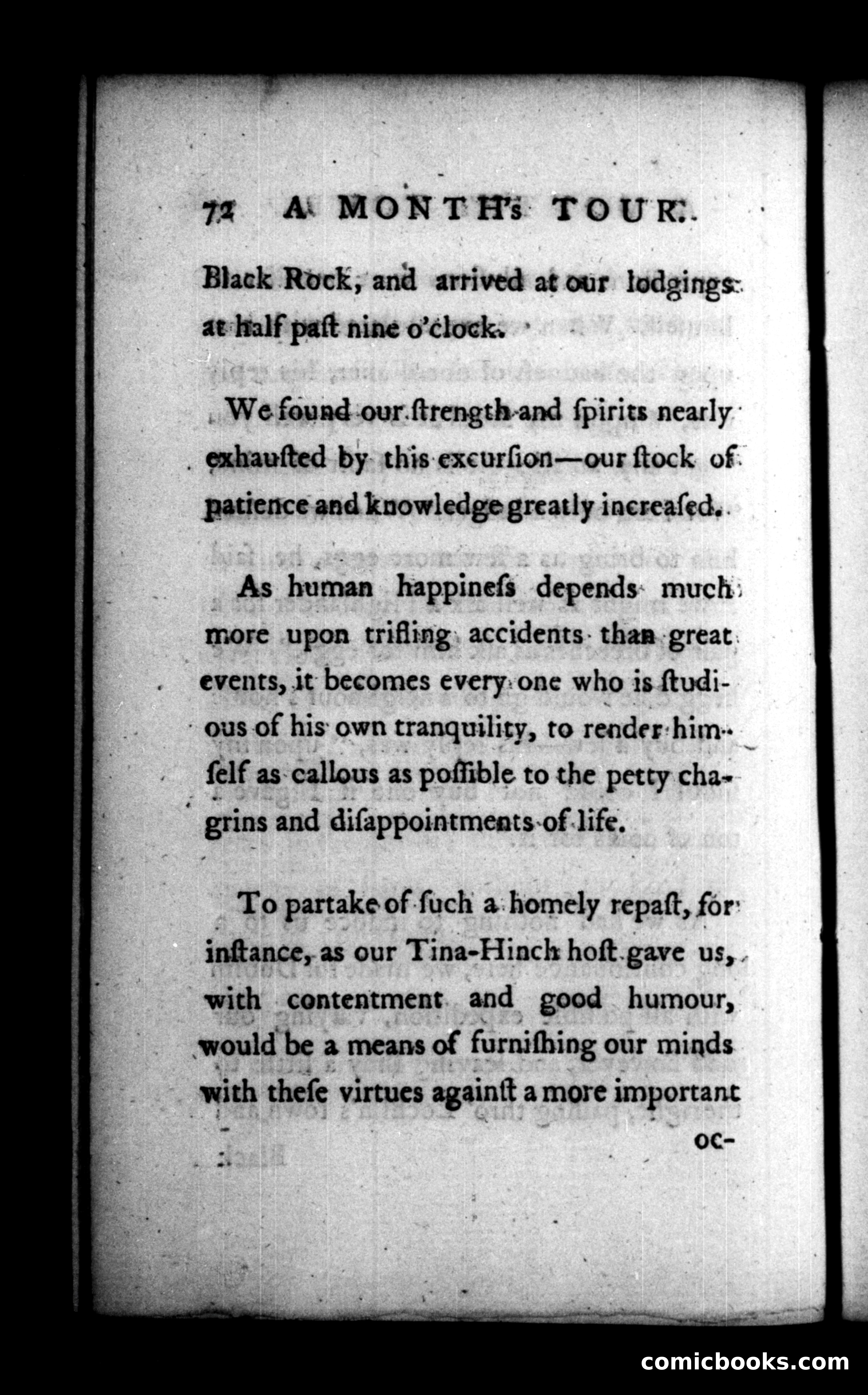
# Page Analysis This is a page of running prose from what appears to be a travel narrative or journal, marked as chapter 72 ("A Month's Tour"). The text describes the narrator's arrival at Black Rock and lodgings at half past nine o'clock, noting their exhaustion but increased patience and knowledge from the excursion. The passage then philosophizes about human happiness depending more on trivial accidents than great events, and uses an example of a meal shared with a "Tina-Hinch host" as illustration of how contentment and good humor build virtue. The page breaks mid-sentence with "oc-" suggesting continuation on the next page. The typography shows period-appropriate long 's' characters and irregular spelling conventions.
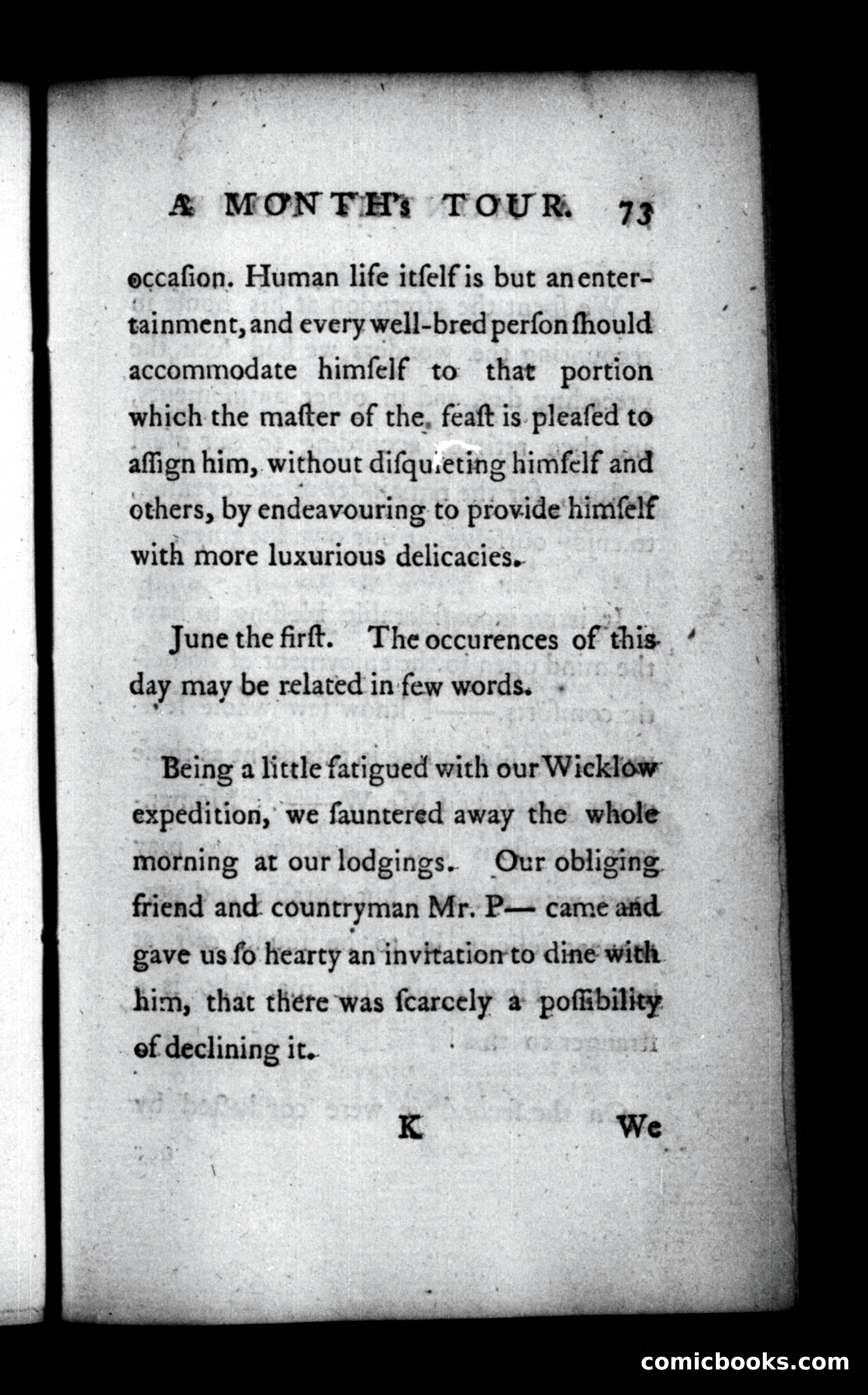
# Page Description This is a page of running prose from what appears to be a travel narrative or diary, numbered 73 and titled "A MONTH'S TOUR." The text begins with philosophical observations about human life as entertainment, then shifts on June 1st to recount the day's events: the narrator rested at their lodgings after a Wicklow expedition and received a hearty dinner invitation from an acquaintance, Mr. P—, which they found impossible to decline. The page contains no illustrations or advertisements.
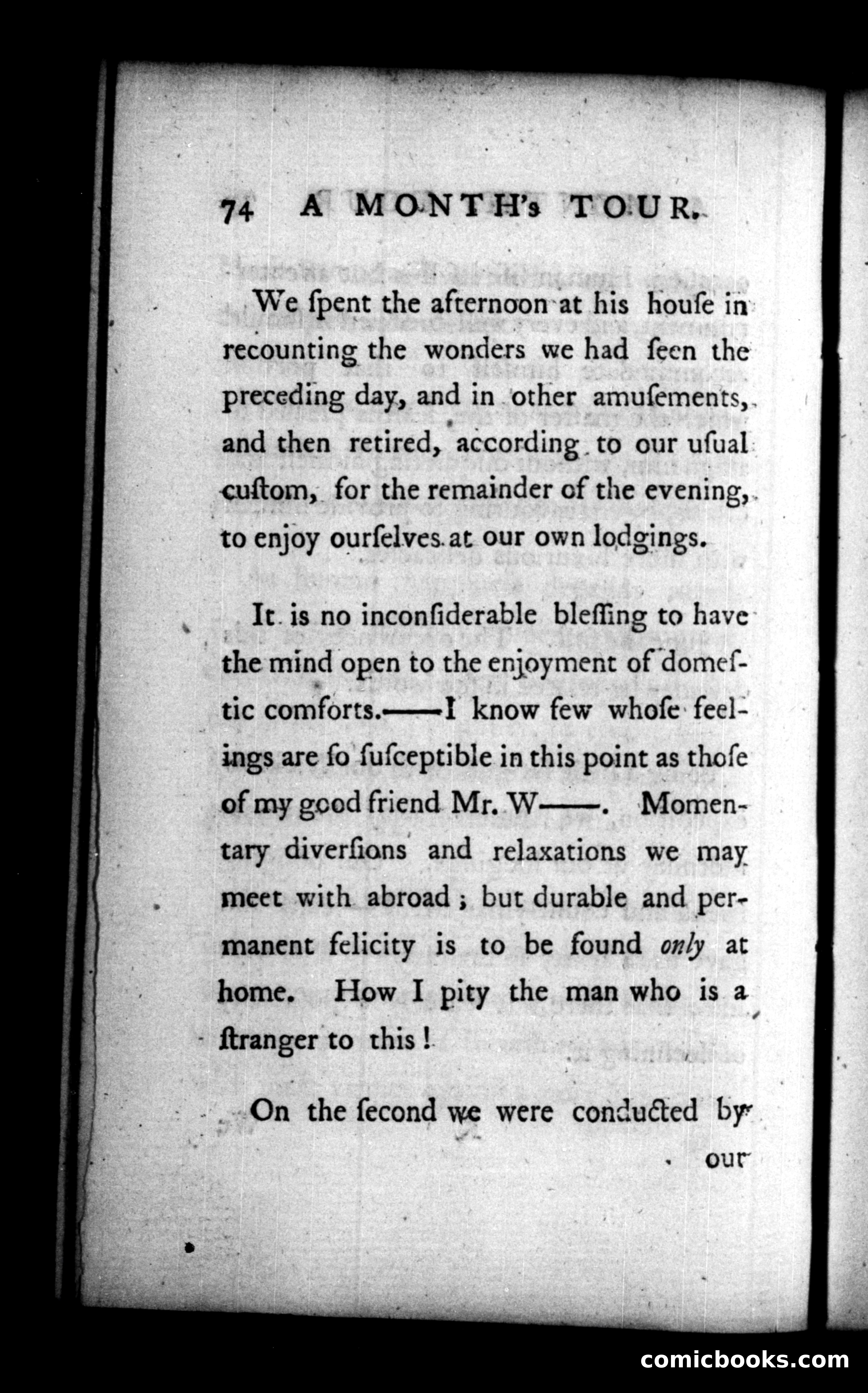
This is a page of running prose from what appears to be a travel narrative or travelogue titled "A Month's Tour" (page 74). The text describes the narrator spending an afternoon at a friend's house recounting previous sightings and amusements, then retiring to their lodgings for the evening. The passage then digresses into a reflective meditation on domestic comfort, praising the "durable and permanent felicity" found at home over momentary diversions abroad, with particular mention of the narrator's good friend "Mr. W——" as someone especially susceptible to appreciating such domestic pleasures. The page breaks mid-sentence as a new day's account begins.
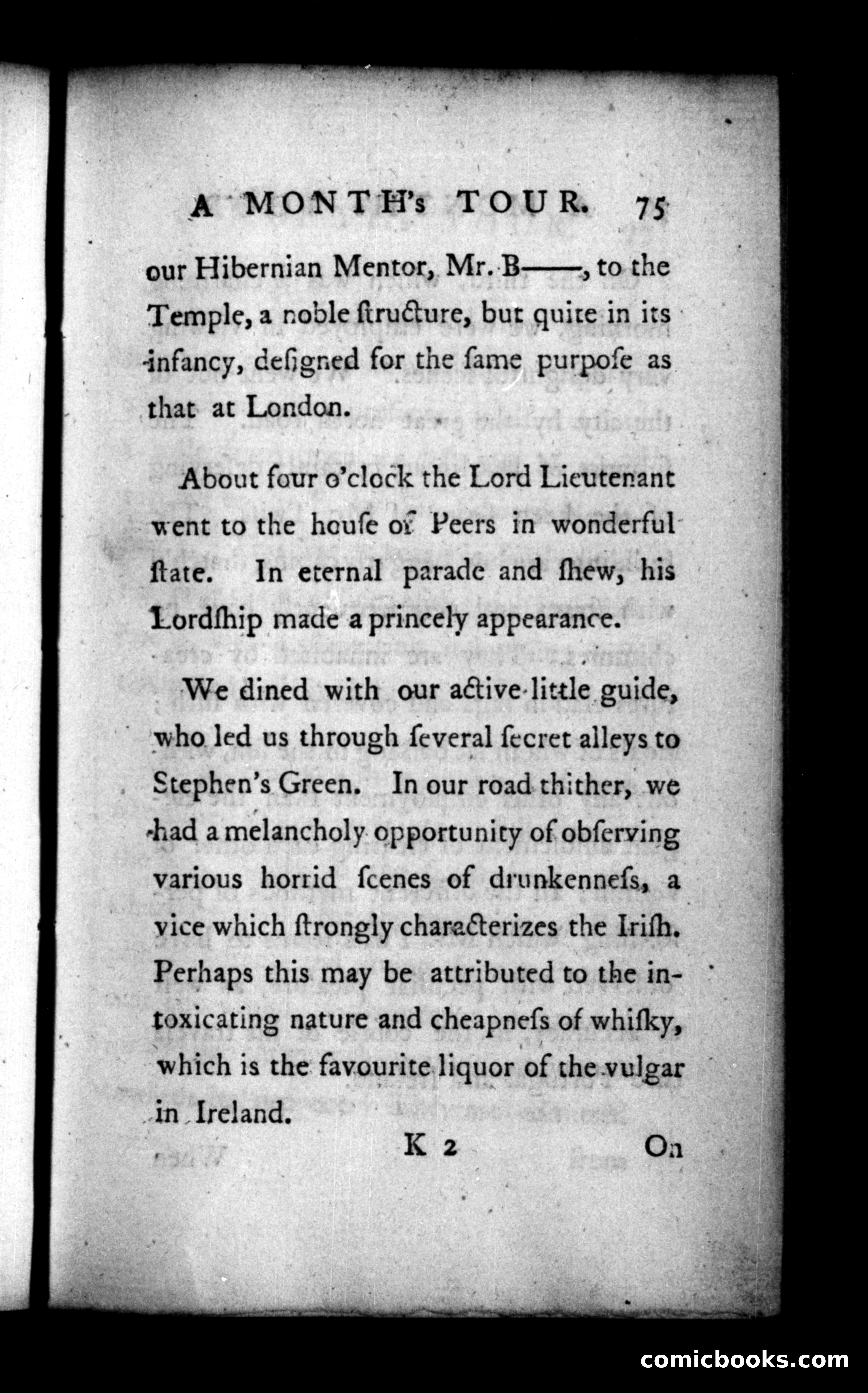
This is a page of running prose from what appears to be a travel narrative titled "A Month's Tour," describing a visit to Dublin. The text recounts the author's tour of the Temple (a building in its early stages), an official visit by the Lord Lieutenant to the House of Peers, and a dinner excursion through Stephen's Green. The passage concludes with the author's observations on Irish drunkenness, attributing it to whisky's intoxicating potency and low cost among the Irish working classes. The tone reflects period stereotypes about Ireland and its inhabitants.
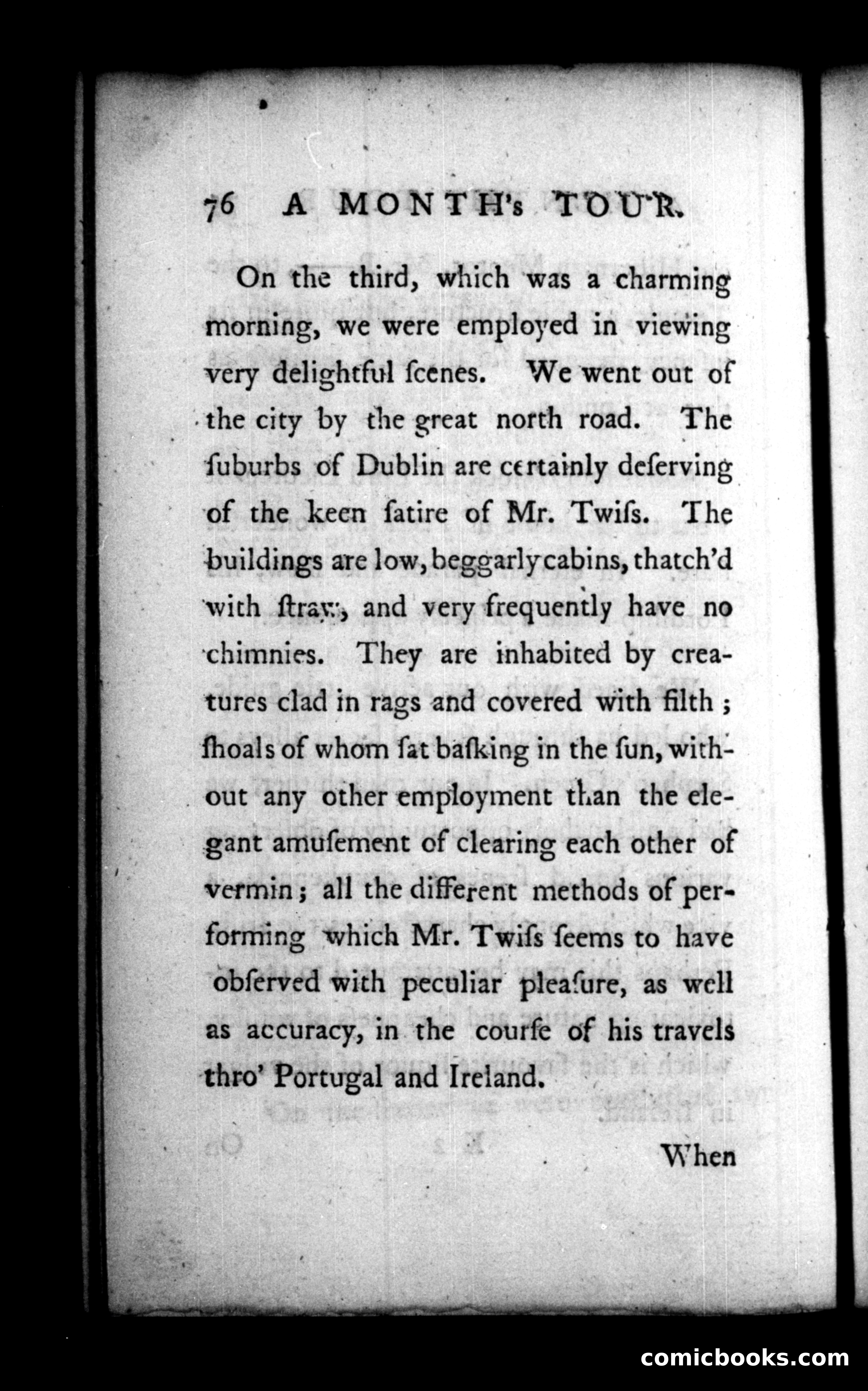
# Page Description This is a page of running prose from a Victorian serialized narrative, numbered page 76, titled "A MONTH'S TOUR." The text describes a tour of Dublin's suburbs on the third day of travel, where the narrator criticizes the poor conditions of the area—low, thatched cabins inhabited by people in rags. The passage sarcastically references "Mr. Twifs" (likely Dickens's *Pickwick Papers* character) and his supposed observations of poverty and filth during travels through Portugal and Ireland. The text employs period typography including the long 's' character (ſ).
# Description of Page This is a page of running prose (page 77) from the body of a travel narrative titled "A Month's Tour." The text describes a journey away from a city through countryside dotted with white villas, passing Sir Edward Newnham's estate with its lawn and bird-filled plantation. The narrator then reaches a bay view and describes a nearby Charter-school for "Popish children" (Catholics) receiving Protestant education, noting that the government has granted thirty thousand pounds for its current year support. The page uses period typography with long 's' characters and appears to be from an 18th or early 19th-century printed work.
This is a page of running prose from the body text of a Victorian travel narrative or guide. The passage describes Marino, Lord Charlemont's residence near Dublin, praising its elegant architecture, fine paintings (including one depicting Judas's repentance), and scenic views overlooking Dublin Bay and surrounding mountains. The text also mentions the grounds are laid out in exquisite taste and references a casino building. The page number "78" and header "A MONTH's TOUR" suggest this is part of a longer descriptive travel account.
This is a page of running prose from what appears to be a travel narrative or memoir titled "A Month's Tour" (page 79). The text describes architectural features the narrator has observed, including a round building modeled after the casino at Naples with Doric pillars and statues of classical deities, and a Gothic temple in a shrubbery with painted glass windows and marble floors. The passage concludes by mentioning a decorative water feature adorned with a Carolina duck.
This is a page of running prose from "A Month's Tour," likely from a travel narrative or descriptive work rather than a penny dreadful. The text describes a pleasant walk through shrubbery and grove, noting the songs of birds like thrushes and blackbirds, before transitioning into a poetic effusion about spring. The passage concludes with four lines of verse celebrating the end of winter and the arrival of spring's gentle winds and fertilizing showers. The prose is genteel and sentimental in tone, focused on natural beauty and picturesque scenes.
# A Month's Tour This page contains poetry rather than prose—specifically, a romantic poem titled "A Month's Tour." The verses celebrate nature's pleasures across the seasons, invoking classical imagery (Aurora, Philomela, Flora, Elysium) while describing pastoral scenes of flowers, fields, and countryside retreat. The speaker expresses a desire to spend time in "calm reflection and poetic ease," tending flowers and vines while exploring spring's beauty and offering praise to nature's creator. The poem employs archaic spelling and orthography typical of earlier printing traditions.
This is a page of running prose from the body text of a Victorian penny dreadful titled "A Month's Tour" (page 82). The narrative describes the narrator's return from a countryside excursion to the city, where they dined at a tavern and attended a theatrical performance of the tragedy *Cato*. The text comments critically on the play's performance, praising actor Rider's portrayal of Marcus while suggesting the work is better suited for private study than public theatrical presentation. The page uses period typography including the long 's' character.
# Analysis This is a **running prose page** (page 83) from what appears to be a travel narrative or diary titled "A Month's Tour." The text describes the narrator's visit to an asylum for Magdalens (a refuge for women), praising the institution built through the charitable efforts of Lady Arabella Denny and Dean Bailey. It mentions the Foundling Hospital and notes a dinner engagement at "Mr. P——'s" house. The page employs period typography (long s's) and is clearly mid-narrative, breaking off mid-sentence at the bottom.
# Page Description This is a page of running prose text from what appears to be a travel narrative or memoir titled "A Month's Tour." The visible text describes the author's activities in Dublin, Ireland, including attendance at evening service at St. Patrick's Cathedral and a day trip to Harlem (about four miles west of Dublin) to visit bleaching mills. The narrator and companions traveled by coach, took breakfast, toured the industrial facilities, and returned to dine in Dublin. Several names are partially redacted with dashes, a common practice in Victorian-era publications.
# Page Description This is running prose from the body text of a penny dreadful. The passage, titled "A Month's Tour," recounts a dinner conversation with a Captain of the Dublin volunteers. The Captain expresses heterodox views, arguing that the volunteers took up arms not merely to defend Ireland from invasion and preserve internal peace, but to redress grievances—which the narrator dismisses as imaginary military passion rather than legitimate complaints. The passage concludes by suggesting that if the volunteers use their arms prudently, they could benefit their country.
# Analysis This is a page of running prose from what appears to be a travel narrative or essay titled "A Month's Tour" (page 86). The text discusses a kingdom's relationship with Britain, arguing that its people must maintain loyalty to their "mother country" and the British navy for prosperity, while attributing their grievances to "pride and laziness." The passage compares their land favorably to Canaan, praising its natural resources and blessings from Providence. The language and typography are distinctly 18th or early 19th century, with period spelling conventions (such as "fuch" for "such" and "ftrenuoufly" for "strenuously").
# Page Analysis This is a page of running prose (page 87) from a travel narrative titled "A Month's Tour." The text describes the author's visit to Rath-Farnham, an estate near Dublin owned by Lord Ely. The passage criticizes Irish transport methods, contrasting small carts with two-foot wheels (used in Ireland) against English wheel-barrows. The author suggests the Irish persist in using these antiquated vehicles out of patriotic stubbornness ("amor patrie") rather than practical sense, claiming they date to primitive mechanical times. The text continues mid-thought at page's bottom, suggesting the critique extends further.
# Analysis This is a **page of running prose** from what appears to be a travel narrative titled "A Month's Tour" (page 88). The visible text describes Irish one-horse carriages with unflattering details about drivers' appearances, then shifts to commentary on Irish character and honesty. It concludes with a description of sculptural figures on Lord Ely's estate depicting the rape of the Sabines, with mention of a nearby stable. The page uses period typography (long "s" characters) typical of 18th or early 19th-century printing.
# Page Description This is a page of running prose from what appears to be a travel narrative or tour guide (page 89, titled "A MONTH's TOUR"). The text describes a country estate in Ireland where Oliver Cromwell held his first parliament. It details the grounds, including a small grove with a circular aviary housing peacocks, pheasants, swans, and ducks; extensive gardens with fruit walls on the north side; and notably, a magnificent brick green-house measuring approximately one hundred and twenty feet long by thirty feet wide. The author expresses admiration for the greenhouse while dismissing the plant collection as unremarkable to English eyes.
# Page Description This is running prose from page 90 of "A Month's Tour," describing the interior of a house. The text details the building's simple exterior but elegant interior furnishings, listing notable paintings including religious scenes (Mary Magdalen washing Christ's feet, the Ascension) and classical subjects (Apotheosis of Hercules, the Grecian Daughter). It then describes views from a bow-window overlooking a bay and distant rising hills. The page appears to be part of a travel narrative or descriptive tour rather than sensational fiction.
# Page Content Analysis This is running prose from page 91 of a Victorian travel narrative titled "A Month's Tour." The page describes the narrator's experiences in Dublin: an afternoon return to the city, dining at a gentleman's house where they receive a masquerade ticket, and the chaotic evening and morning that follows. The text captures vivid details of Dublin street life—rattling carriages, shouting crowds, and clouds of dust—as the narrator experiences the city's public spaces for the first time. The page uses period typography (long s's, ligatures) typical of late 18th-century printing.
# Page Analysis This is a page of running prose from a Victorian penny dreadful titled "A Month's Tour" (page 92). The text contains moral moralizing about masquerades, warning against their corrupting influence on virtue and decency. It specifically addresses Irish women ("Ye Hibernian fair"), cautioning them that masquerades endanger conjugal fidelity and domestic happiness, urging them not to sacrifice lasting marital joys for transitory evening pleasures. The passage concludes with a narrative transition: "On the seventh we went to the courts of..." The typography shows characteristic 18th/19th-century typography with long 's' characters.
This is a page of running prose from "A Month's Tour" (page 93). The text describes observations about various gentlemen, including Mr. Burgh, who speaks eloquently on points of law, and Mr. Yelverton, characterized as blunt and vehement. The narrator then recounts dining at Mr. G——'s house and describes this gentleman's parochial attachment to England despite having traveled there, comparing his amazement at English superiority to Virgil's rustic clown. A Latin quotation appears mid-page, and the passage ends mid-sentence, discussing the misfortune of those who never venture beyond their homeland's boundaries.
# Page Description This is a page of running prose from what appears to be a travel narrative or essay titled "A Month's Tour" (page 94). The text discusses how travel broadens the mind by wearing away narrow prejudices, then shifts to a specific anecdote about a Londoner accustomed to refined tavern dining who finds himself uncomfortable in Dublin. The passage advises that such a person must adopt philosophical patience and accept conditions as found, rather than expecting the delicacy he knew in London. The page ends mid-sentence with "With this refo-lution," suggesting continuation on the next page.
# Page Analysis This is a page of running prose from what appears to be a travel narrative or journal titled "A Month's Tour" (page 963). The text describes the narrator's social activities on the eighth and ninth of an unspecified month: visiting Mr. C—'s tavern for dining, spending an afternoon with Mr. and Mrs. P—, walking to Ranelagh to observe fireworks and a beautiful temple, and experiencing music performed by musicians placed in the branches of a garden tree. The passage concludes mid-sentence on the ninth day. The prose is written in eighteenth-century style spelling and typography.
# Page Description This is running prose text from page 66 of a travel narrative titled "A Month's Tour." The passage describes the author's attendance at House of Commons debates, where he criticizes an unnamed senator (identified only as "Sir L—— O-——n") for delivering lengthy, tedious speeches while saying nothing of substance. The text sarcastically praises the senator's hand gestures and uses this as a springboard to comment on the importance of graceful physical deportment in public speaking. The passage concludes with the beginning of a new paragraph about dining with "Mr. B——," whose full name is redacted.
# Page Analysis This is a page of running prose from what appears to be a travel narrative or tour account titled "A Month's Tour." The text describes an encounter with an elderly woman (wife of someone identified only as "B—— fenior") who expresses her political views, notably her loyalty to the King and pity for his situation. The passage then shifts to describe the narrator's efforts to explore Dublin, mentioning that on the eleventh day they were directed to a tavern called the Eagle in Eustace-street, which is frequented by the Duke of Leinster. The page number is 97.
# Analysis This is a page of **running prose** from the middle of a narrative. The text describes a traveler's visit to London, including a disappointing meal of tough chickens and peas, a tea visit, and an account of attending the House of Commons. The narrator comments sarcastically on parliamentary proceedings, praising the "delightful repetitions" of Counsellor Tydd and the "facetious motion" of Sir H—y H—tit—, which apparently provoked laughter. The redacted names and the satirical tone suggest this is political or social commentary from a Victorian-era serialized narrative.
# Page Analysis This is a page of running prose from the middle of a serialized narrative (page 99, marked "A MONTH'S TOUR"). The text consists of two paragraphs: the first offers philosophical reflection on the power of eloquent speech, praising those skilled at using the tongue to instruct and delight audiences. The second recounts a visit the narrator and a friend named W— made to a Catholic mass-house, where they witnessed religious practices they found superstitious, ridiculous, and indecent, prompting the narrator to launch a rhetorical condemnation of Catholicism for enslaving the human mind. The anti-Catholic sentiment is characteristic of period popular literature.
# Page Description This is a page of running prose (page 200) from a work titled "A Month's Tour." The text describes the narrator and companions leaving a mass-house (Catholic chapel) where they were criticized by a congregation member for not kneeling during worship. The narrator dismisses this rebuke, attributing it to the place's dirtiness, and expresses relief at returning to the established Anglican church, which they characterize as "decent, rational and edifying" compared to the "mansion of ignorance and superstition" they've left behind. The passage appears anti-Catholic in sentiment.
# Page Analysis This is a page of running prose text from what appears to be a travel narrative or memoir titled "A Month's Tour" (page 101). The narrator describes their final days in Dublin: dining at Mr. P——'s on the Sabbath, attending evening service at the Round Church, visiting Stephen's Green, and preparing to depart for England on the twelfth. The page concludes as the author prepares to offer concluding remarks about Dublin before leaving the city. The text uses period spelling conventions (such as "ufual" for "usual" and "fabbath" for "sabbath").
This is a page of running prose from what appears to be the body text of a penny dreadful serial titled "A Month's Tour." The visible text contains observations about Dublin, Ireland, describing the city as a mixture of grandeur and poverty, noting its approximately 200,000 inhabitants, the River Liffey's division of the city into two parts crossed by five bridges (with Effex and Queen's bridges highlighted as noteworthy), and details about its circular road and poorly-paved principal streets. The tone is that of a traveler's descriptive commentary.
# Analysis This is a page of running prose from what appears to be a serialized work titled "A Month's Tour" (page 103). The text discusses the police force and poor relief systems in Dublin, comparing conditions around 1775—when streets were crowded with beggars and the poor received only casual charity—with improvements made through the establishment of a "house of Industry," an institution where those found begging in the streets could be sent. The passage emphasizes Dublin's efforts to regulate and improve both policing and social welfare, written in 18th-century typography with characteristic long "s" characters.
# Analysis of Page 104 This is a page of running prose text from what appears to be a descriptive travel or social commentary work titled "A Month's Tour." The page discusses welfare provisions for Protestant poor in Dublin, comparing Irish parish collections and workhouses unfavorably to English poor relief systems. The text notes that Irish paupers view the House of Industry as a place of confinement rather than refuge, and reluctantly surrender their liberty and independence for its comforts. The passage then transitions to discussing Ireland's natural deficiencies, identifying a scarcity of coal and timber as primary disadvantages.
# A Month's Tour, Page 105 This is a page of running prose text from what appears to be a travel narrative or descriptive work about Ireland (page 105 of "A Month's Tour"). The author discusses Ireland's potential for timber production, arguing that the historical lack of oak trees resulted from past neglect during wars rather than the soil's inability to support them. The passage goes on to praise Ireland's water resources, particularly the River Shannon as exceptionally fine, and notes the abundance of good harbors throughout the island. The text employs 18th-century spelling conventions ("ifland," "beft," "Shannen").
# Page Analysis This is a page of running prose from what appears to be a travel narrative or descriptive account titled "A MONTH's TOUR" (page 106). The text discusses the state of manufactures and useful arts in an unnamed location, noting that most crafts remain in their infancy compared to neighboring kingdoms. It specifically mentions that the region excels in linen, cabinets, and stuffs, but observes they have little familiarity with woolens and are unlikely to succeed in that trade despite efforts to rival the English. The passage breaks off mid-sentence discussing "The White-boys," a group identified only by their manner of dress.
# Description This is a page of running prose text from page 107 of what appears to be a travel narrative titled "A Month's Tour." The text describes Irish agrarian unrest, specifically the "Oak-boys"—a group named for wearing oak branches in their hats—whom the author characterizes as a "baneful pest to Ireland." The passage details their targets (landlords, tenants, and tithe-collectors) and violent activities, then praises volunteer militias (numbering around 50,000) for suppressing these "lawless tribes." The tone is decidedly hostile toward the Oak-boys and sympathetic to established authority.
# A Month's Tour - Page 108 This is a page of running prose text from what appears to be a travel narrative or descriptive account titled "A Month's Tour." The visible text discusses Irish military gentlemen and their potential for either serving their country's welfare or falling into rebellion (comparing them unfavorably to their ancestors under Elizabeth). The passage then shifts to characterizing the Irish people generally as "open, generous, lively, intrepid" and hospitable, while noting this represents "the bright side of their character" before promising to discuss "the most predominant vices among" them (the text cuts off mid-sentence).
# Page Description This is running prose from page 109 of "A Month's Tour," presenting the author's observations about a foreign population (likely Continental European, given references to French manners). The text critiques the lower classes for poor hygiene and drunkenness, describes the ladies as well-mannered but overly concerned with finery rather than neatness, and notes that French customs appear to be their cultural model. The author also remarks that painting has become fashionable among them and that separations and divorces are rare. The page breaks mid-sentence with "A {pi-" at the bottom.
# A Month's Tour: Page of Running Prose This is a page of running text from what appears to be a travel narrative or descriptive work titled "A Month's Tour" (likely focused on Ireland, based on content). The visible prose discusses Irish society and conditions: it criticizes extravagance among lower classes who wear multiple coats and wigs beyond necessity; describes Ireland's wet climate with rain occurring roughly five days weekly; and notes the growing influence of Protestant institutions like the Foundling Hospital and Charter Schools. The text breaks off mid-sentence at "The superiority," suggesting this is an interior page of a longer work.
# Page Description This is running prose from the middle of a travel narrative titled "A Month's Tour." The text describes a journey departing Dublin on the thirteenth of an unspecified month, with the narrator embarking aboard the ship *Hillsborough* under Captain Parry. The passage details the departure from George's Quay, the favorable weather conditions, and the scenic views of Dublin's surrounding geography—including Howth, Lambey Island, Black-rock, Dunleary, Bray-head, and the Wicklow mountains. It concludes with mention of a brisk gale arising around six P.M. that safely propels the vessel onward. The page also contains earlier text discussing religious demographics in Ireland and Dublin specifically.
This is a page of running prose from what appears to be a travel narrative or serial fiction titled "A Month's Tour" (page 112). The text describes the narrator's arrival at Holy-head harbour in the evening, where they were forced to stay overnight due to customs officers examining their trunks. It recounts their meal of mutton broth, lamb, and lobsters, and then their departure the following morning by coach to Gwindu, where they arrived and breakfasted at what the narrator praises as a comfortable inn that accommodates travellers with ease and civility.
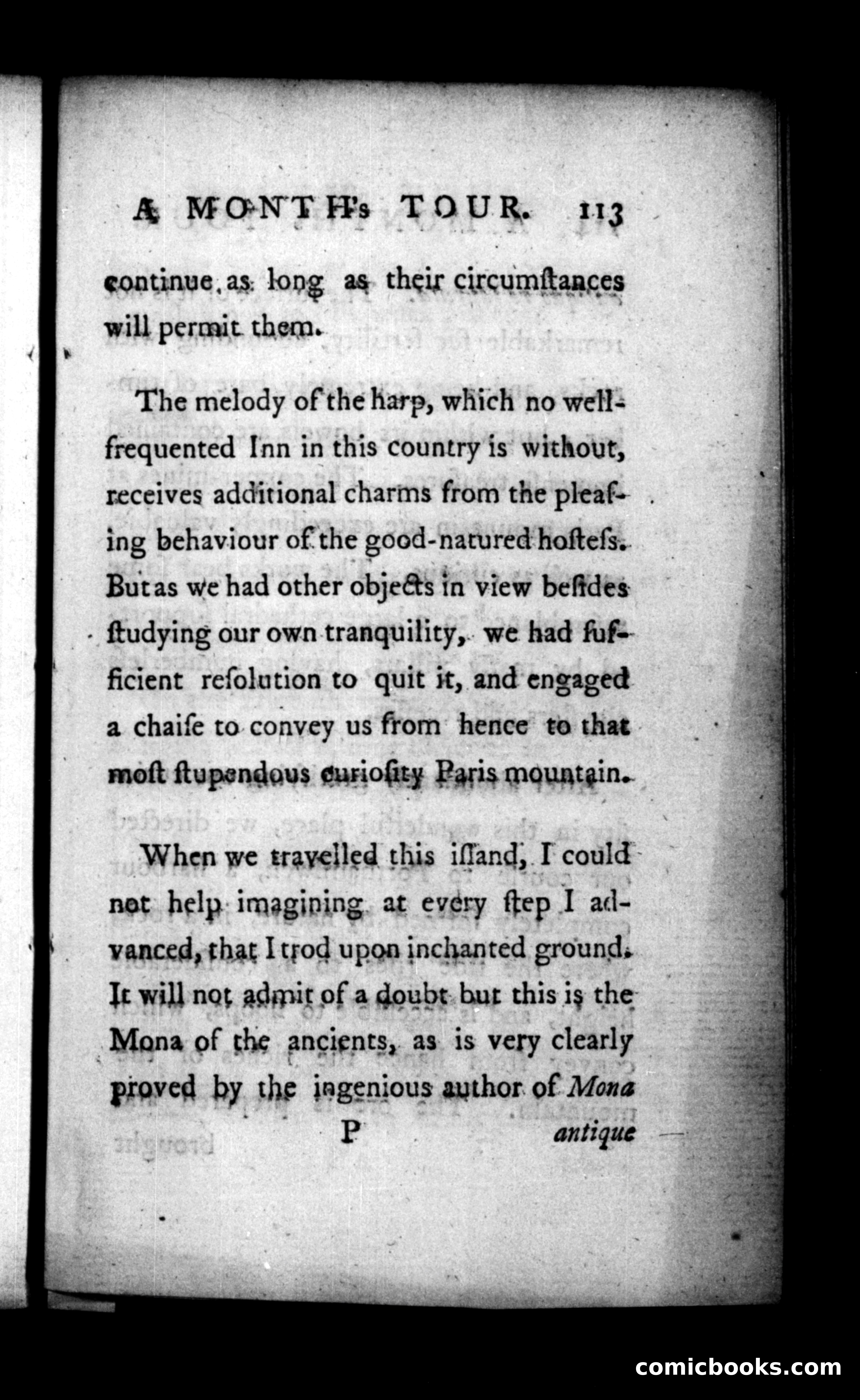
# Page Description This is a page of running prose (page 113) from what appears to be a travel narrative titled "A MONTH'S TOUR." The text describes the author and companions leaving an inn where they enjoyed harp music and hospitable service, then hiring a carriage to travel to "Paris mountain" on an island. The author reflects that the landscape feels enchanted and claims it represents the "Mona of the ancients," citing an author of *Mona antique* as evidence. The prose is written in eighteenth-century style with period spelling and typography.
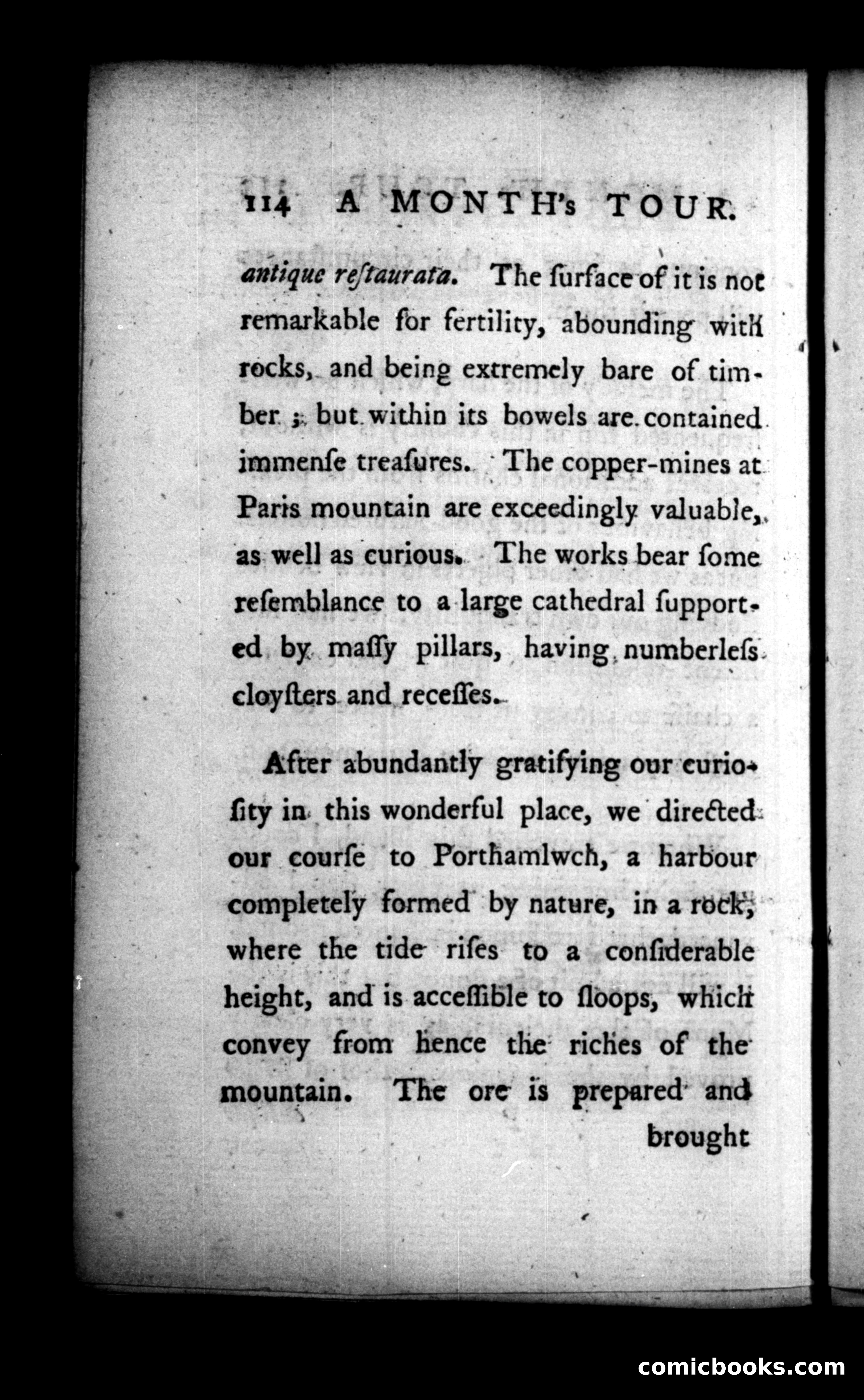
# Page Analysis This is a page of running prose from "A Month's Tour," page 114. The text describes a visit to Paris mountain's copper mines, noting the barren rocky surface but "immense treasures" within. The author compares the mining works to a cathedral supported by massive pillars with numerous cloisters and recesses. The passage then recounts traveling to Porthamlwch, a naturally formed harbor in rock where tides rise considerably and allow sloops to transport ore from the mountain. The text breaks off mid-sentence at the bottom ("The ore is prepared and brought").
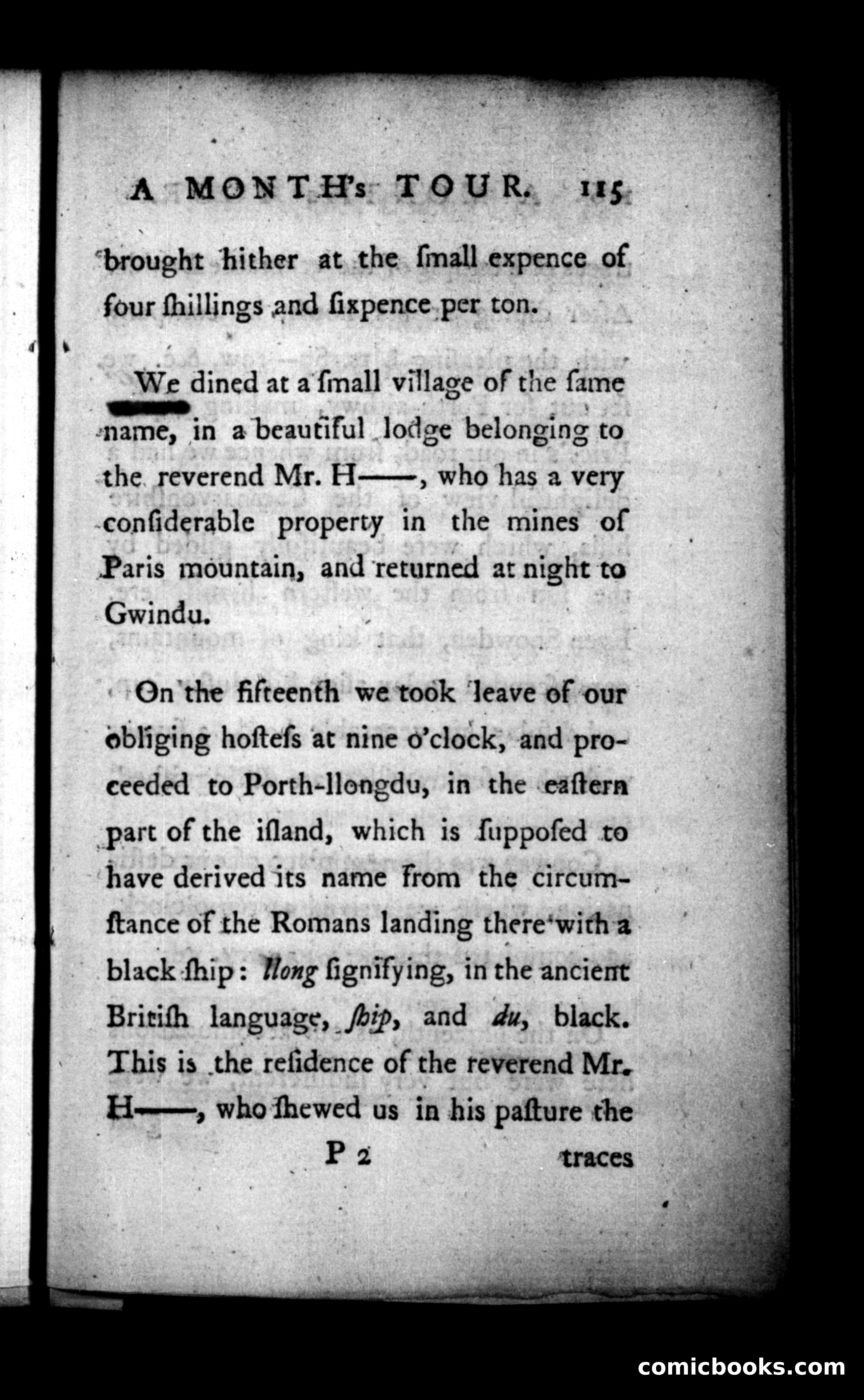
# Analysis This is a page of running prose from what appears to be a travel narrative or travelogue, marked "A MONTH's TOUR" at the top. The text describes a journey through Wales (references to places like Gwindu and Porth-llongdu, with etymologies from "ancient British language"). The narrator recounts dining at a lodge belonging to a clergyman with mining interests, then departing on the fifteenth to visit Porth-llongdu, whose name is explained as deriving from Romans landing there with a "black ship"—the word "Mong" signifying "ship" and "du" meaning "black" in ancient British. The page ends mid-sentence with the phrase "who shewed us in his pasture the" followed by page number "P 2" and the word "traces."
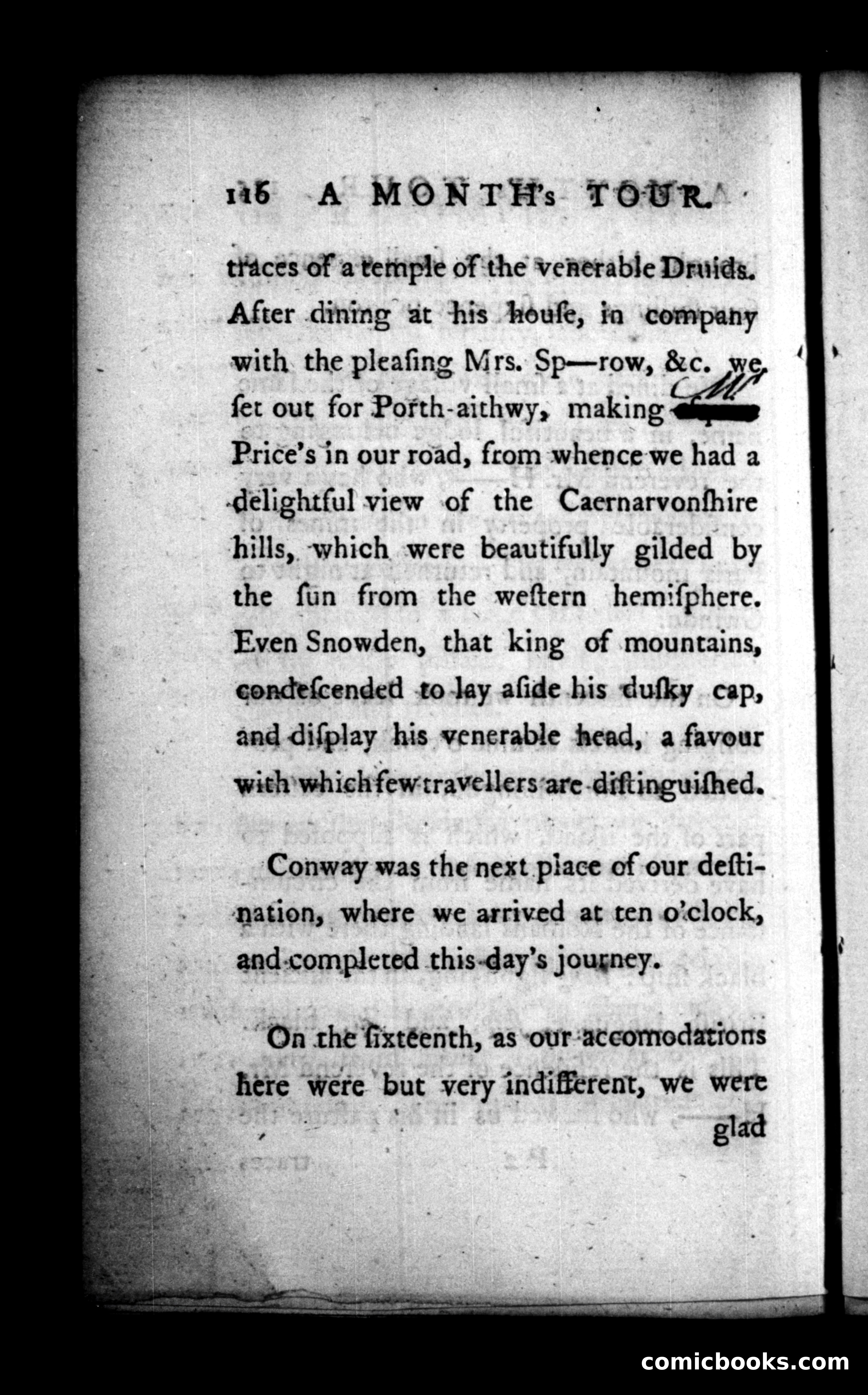
This is a page of running prose from what appears to be a travel narrative or tour account. The text describes a journey through Wales, detailing the author's departure from a host's house in company with "Mrs. Sp—row," traveling toward Porth-aithwy with stops at Price's and views of the Caernarvonshire hills and Snowdon mountain. The party then proceeds to Conway, arriving at ten o'clock. The passage concludes with a note about accommodations on "the sixteenth," suggesting this is part of a day-by-day tour journal.
# A Month's Tour, Page 117 This is a page of running prose from what appears to be a travel narrative. The narrator describes hastily crossing a ferry at seven o'clock and returning home by the same route they arrived, traveling so rapidly due to homesickness that they made few observations. The text reflects melancholically that England, though a fine country, is inhabited by people insensible to their own happiness—a sentiment supported by a Latin quotation. The passage concludes with a observation about Englishmen not being conscious of their blessings instead of enjoying them.
# Analysis of Page This is the **concluding page** of a prose work, containing running text rather than illustration or title page. The visible text presents the author's closing exhortation to "countrymen and fellow-citizens," featuring a Latin quotation attributed to Virgil followed by an English translation. The passage urges Britons to avoid fierce wars and civil discord, to cease laying waste to their country and cities, and to refrain from turning destructive force upon themselves—ending with the assertion that "Nought e'er can Britain conquer, but the British sword." The page ends with "FINIS" and a reference to "Books," suggesting this concludes either a serialized installment or complete work. The tone is patriotic and cautionary rather than sensational.
This is a title/advertisement page for "The Gentleman's Guide in his Tour through France," written by an officer and published by G. Kearby in Fleet Street. The page advertises the Sixth Edition, which includes a map of French post-roads with town distances, and notes additions covering routes through Italy and a description of Paris. A separate advertisement below promotes another work on Holland, Brabant, and the Austrian Netherlands. The page mixes multiple book advertisements rather than presenting narrative fiction content.