A complete issue · 61 pages · 1935
Life — November 1935
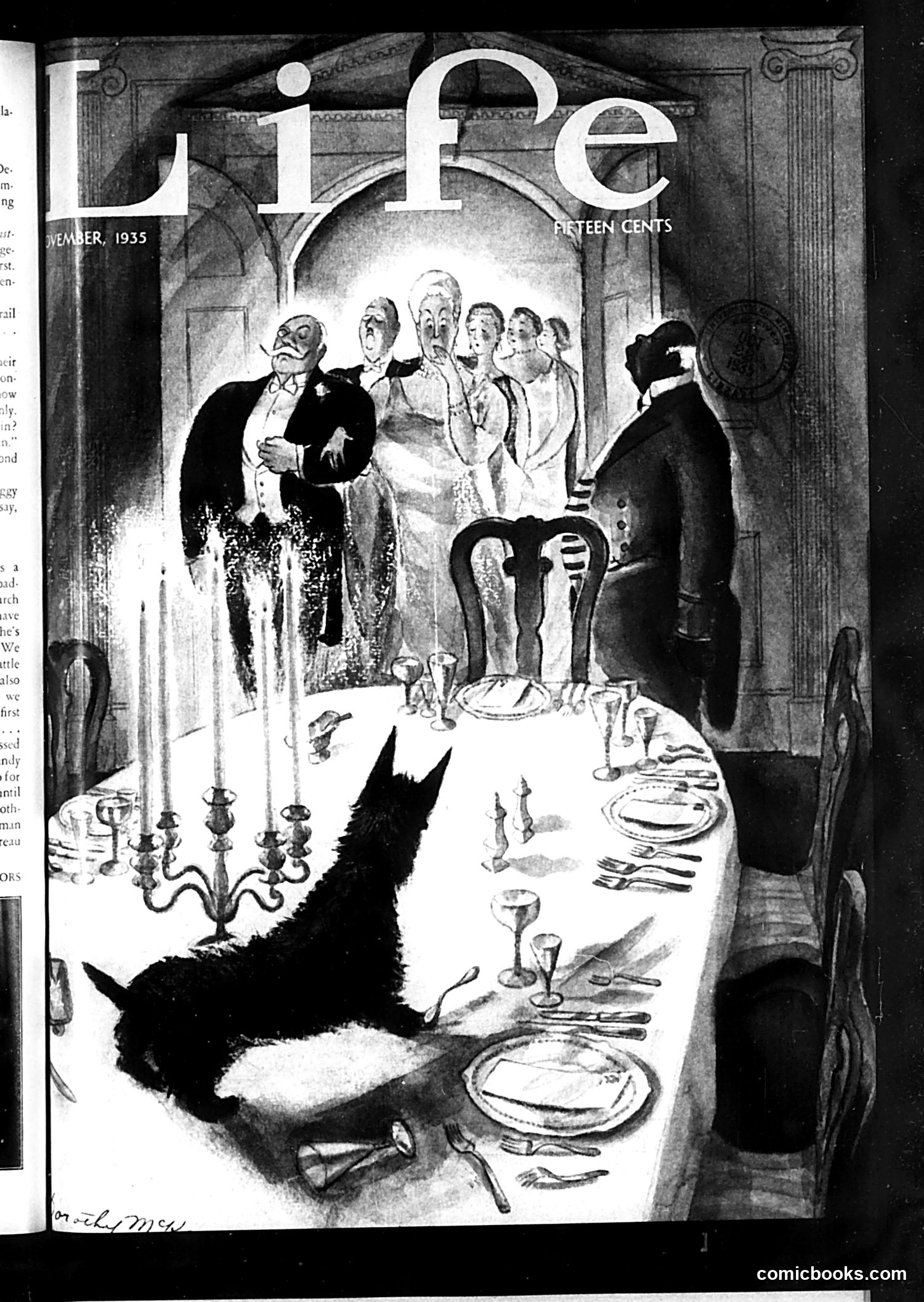
# Life Magazine Cover, November 1935 This satirical illustration depicts a formal dinner party interrupted by an uninvited guest—a large black dog beneath the table. The well-dressed gentlemen appear shocked and dismayed by the animal's presence at their elegant meal, with candelabras and place settings visible. The cartoon likely comments on social disruption or an unwelcome intrusion into high society. The dog may represent a political figure, social movement, or scandal of 1935 that threatened to "crash" respectable gatherings. Without additional context from the magazine's text, the specific target of satire is unclear, though the visual metaphor effectively conveys how something considered vulgar or inappropriate has invaded a refined setting, causing considerable discomfort among the establishment figures present.
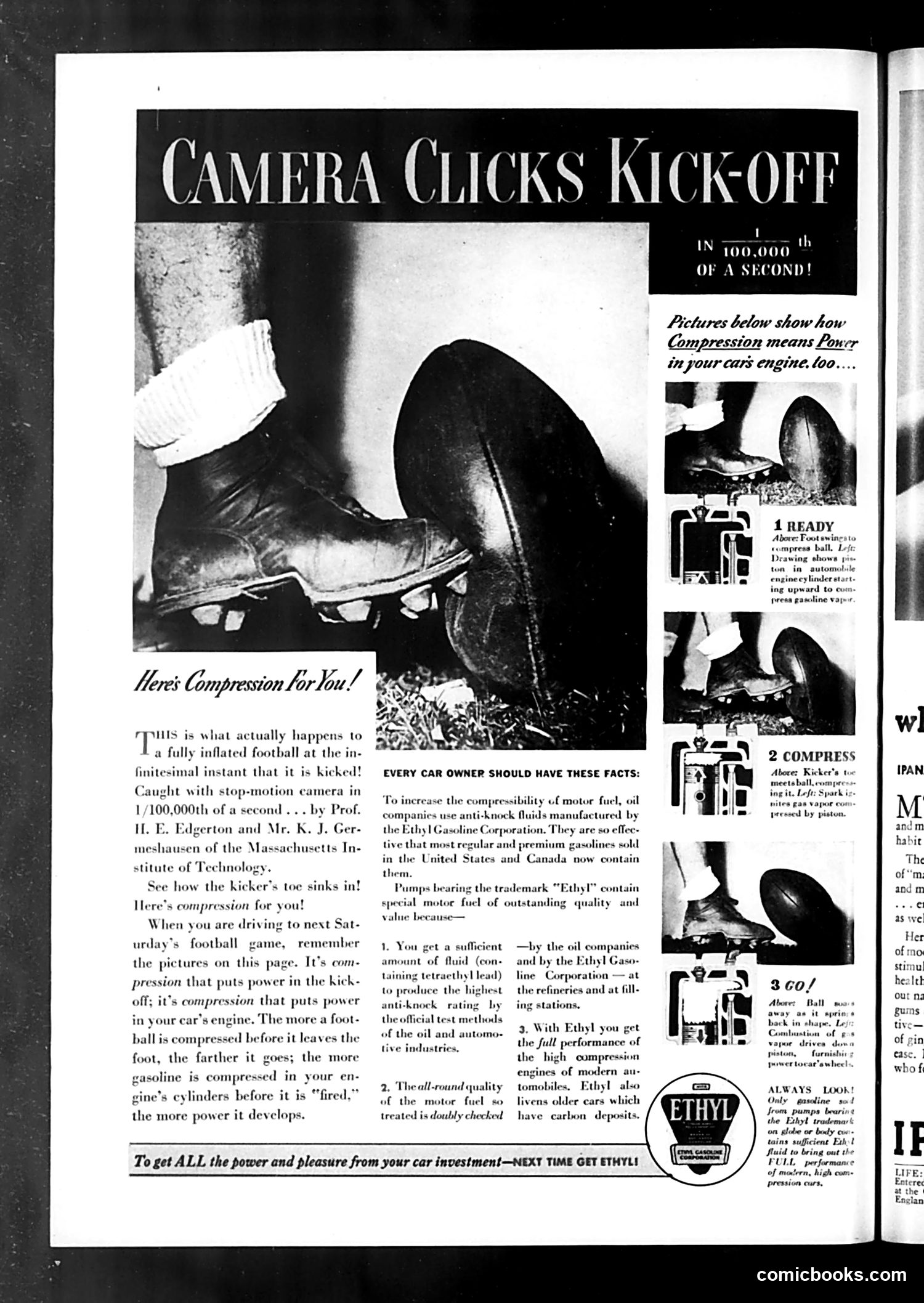
# Analysis This is primarily a **paid advertisement** for Ethyl gasoline, not a satirical cartoon. The page uses a visual metaphor comparing engine compression to a football being kicked: just as compressing a football before kicking increases power, Ethyl gasoline's compression-enhancing additives increase engine power. The "Camera Clicks Kick-off" headline refers to high-speed photography (1/100,000th of a second) capturing a football at the moment of compression—a visual demonstration of the compression concept. The accompanying text and diagrams explain how Ethyl's anti-knock fluids improve fuel performance in automobile engines. This is straightforward commercial advertising using a clever sports analogy, not satire or political commentary.
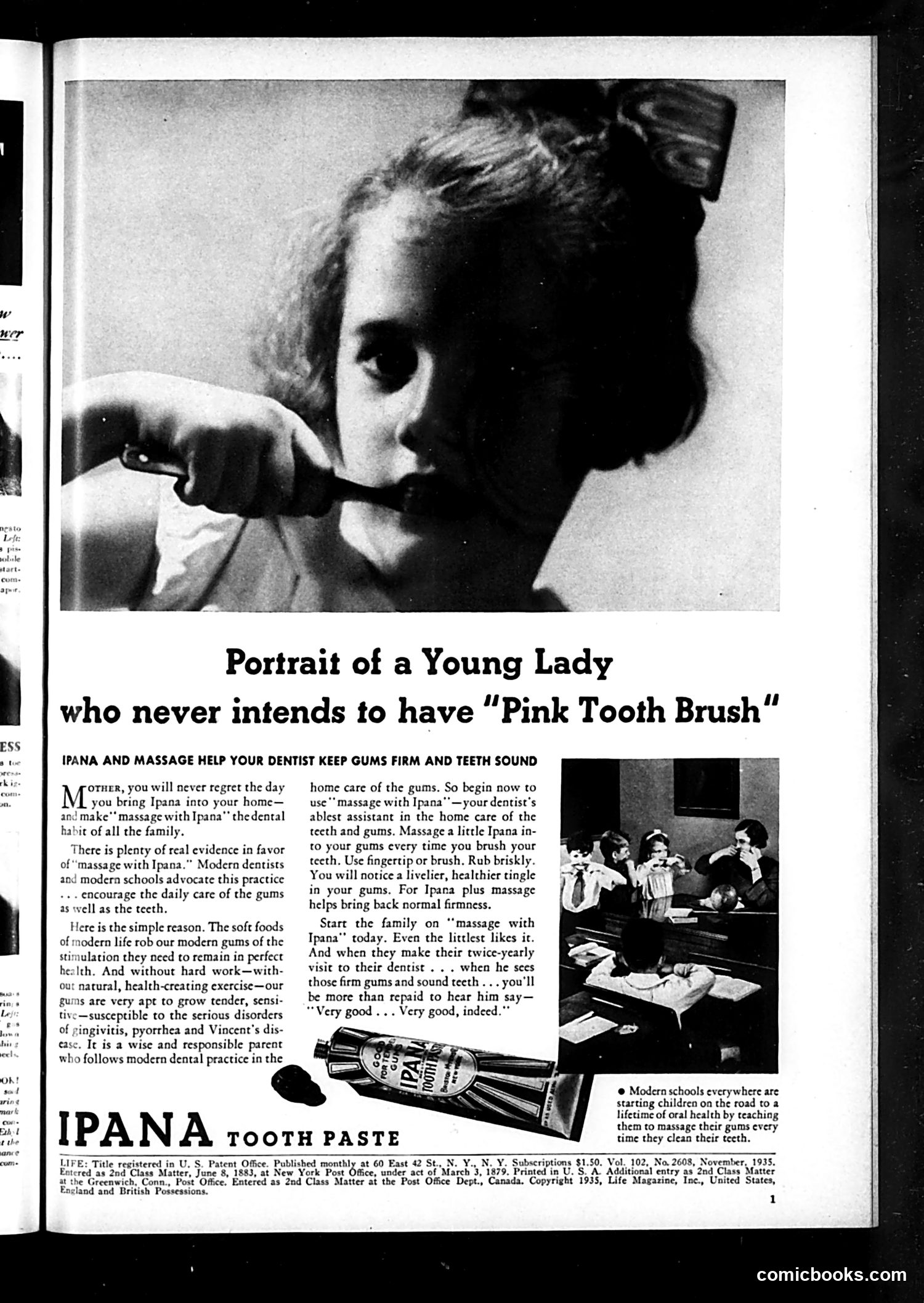
# Analysis This is primarily a **toothpaste advertisement**, not political satire or a cartoon. The page promotes Ipana Tooth Paste using a portrait of a young woman and testimonial-style text. The ad's messaging reflects 1930s dental hygiene attitudes: it advocates for gum massage and regular dental care, positioning Ipana as a modern solution. The phrase "Pink Tooth Brush" in the headline appears to reference a common dental condition (inflamed gums), which the product claims to prevent. The accompanying photograph showing what appears to be a dental demonstration or family education scene reinforces the advertiser's authority on oral health. The copy emphasizes that following these practices prevents serious dental disease—a selling point in an era before widespread preventive dentistry. This is commercial advertising, not editorial content or satire.
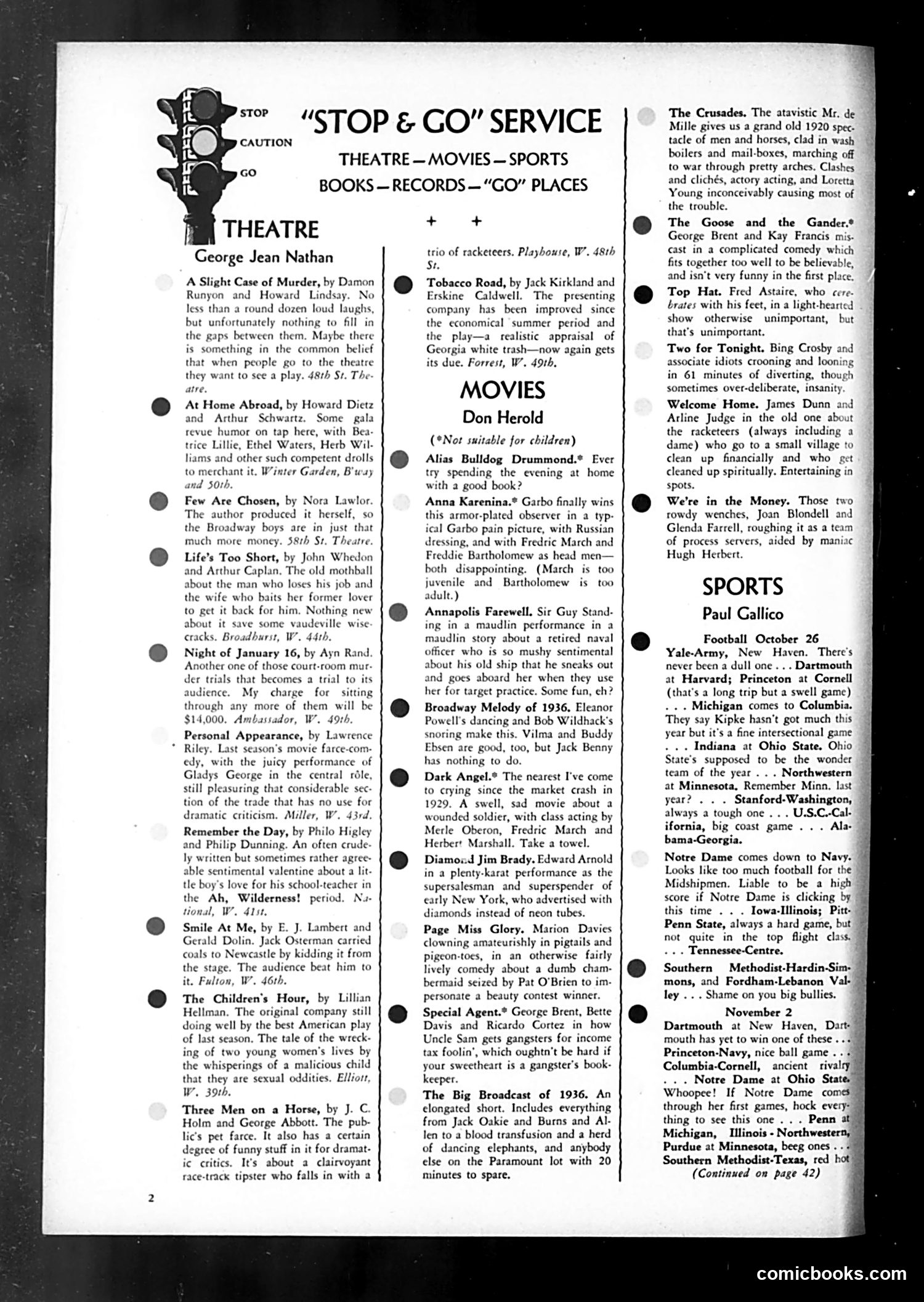
# "Stop & Go" Service Page from Life Magazine This is a **review and recommendation page**, not a political cartoon. It's a "Stop & Go Service" guide — Life's critical ratings system for entertainment and cultural products (theater, movies, sports, books, records). The traffic light graphic at top left symbolizes the rating system: **STOP** (don't see/read), **CAUTION** (mixed reviews), and **GO** (recommended). The page contains brief reviews by critics George Jean Nathan (theater) and Don Herold (movies), plus Paul Gallico (sports). Each review uses the traffic light system to guide readers on what's worth their time and money. Examples: *Dark Angel* gets a STOP (sad, not recommended); *Alias Bulldog Drummond* gets a GO (entertaining). This was Life's practical service to readers navigating 1930s entertainment options.
I'm unable to provide a reliable analysis of this page. The image is predominantly black with very poor visibility—the main content area is nearly illegible, making it impossible to identify specific figures, caricatures, or visual details that would be essential for understanding the cartoon or satire. While text fragments are visible on the left margin, they are too fragmented and unclear to reconstruct meaningful context. Without being able to read both the visual content and accompanying text clearly, I cannot accurately identify the political or social references, the intended subjects of satire, or explain the joke to a modern reader. A higher-quality or clearer scan of this page would be necessary for proper analysis.
I can see this is a mostly black page with minimal visible content. On the right side, there's a partial text box beginning with "Here's" and what appears to be fragmented text below it, though it's too unclear to read reliably. The image quality and darkness make it difficult to discern any distinct cartoon figures or clear satirical content. Without being able to read the text clearly or identify specific illustrations, I cannot accurately explain what political or social references this page contains. The page appears to be either heavily damaged, poorly scanned, or primarily consisting of a dark advertisement or illustration that isn't legible in this reproduction. To provide accurate historical context, I would need a clearer version of the image.
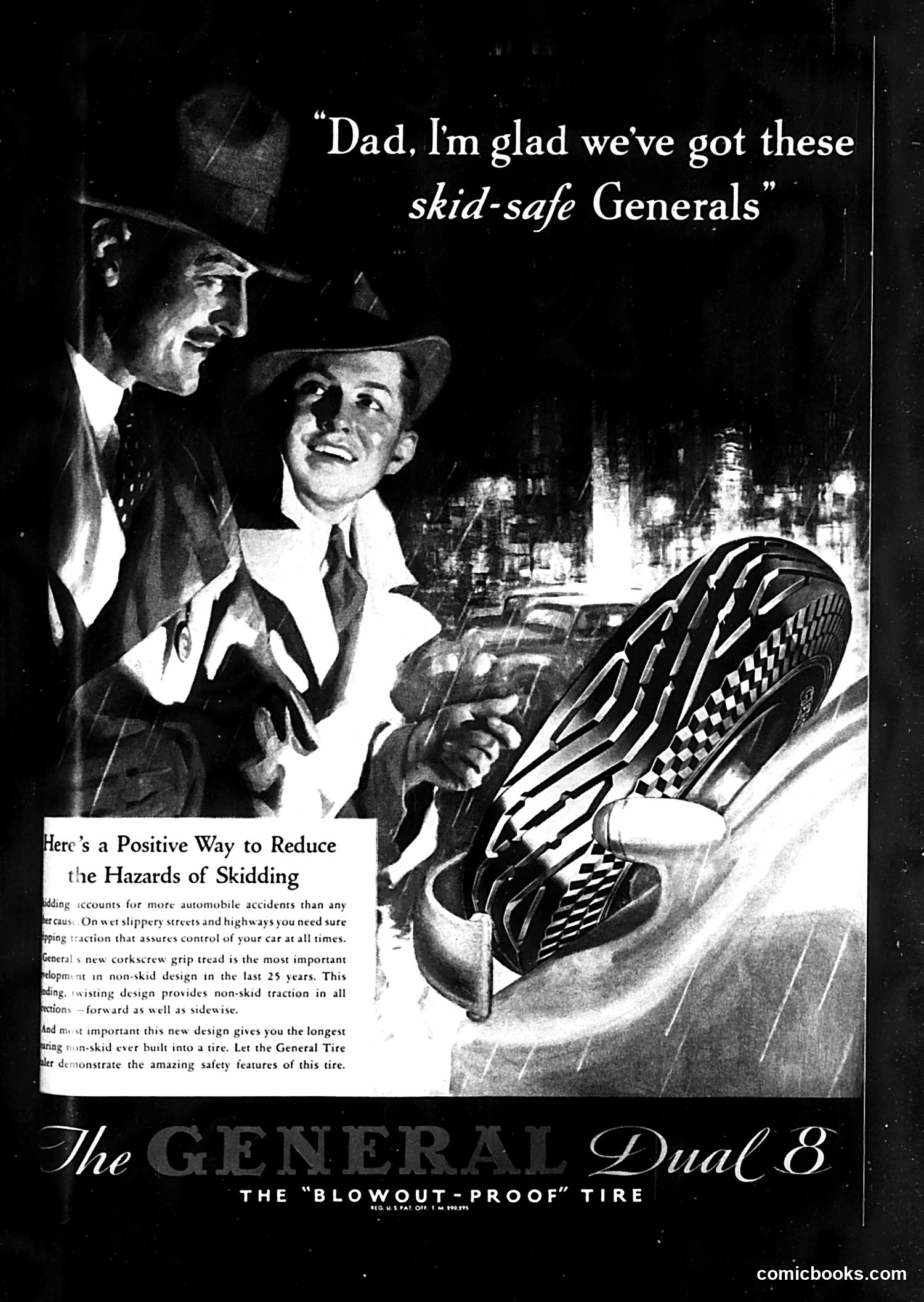
# Analysis This is a **vintage advertisement**, not political satire. It's a General Tire company ad for their "Dual 8" tire, marketed as "blowout-proof." The image shows two men in formal dress and hats examining a tire. The younger man (apparently a son) says to the older man (his father): "Dad, I'm glad we've got these skid-safe Generals." The ad's humor is gentle and domestic rather than satirical—it plays on paternal reassurance. The father's pleased expression suggests approval that his son is using safe tires. The copy emphasizes the tire's non-skid tread design for safety "on wet slippers streets and highways." This reflects **early-to-mid 20th century automotive safety messaging**, when tire technology was a significant selling point and family safety was a key advertising appeal. The formal attire and language date it to roughly the 1920s-1930s era.
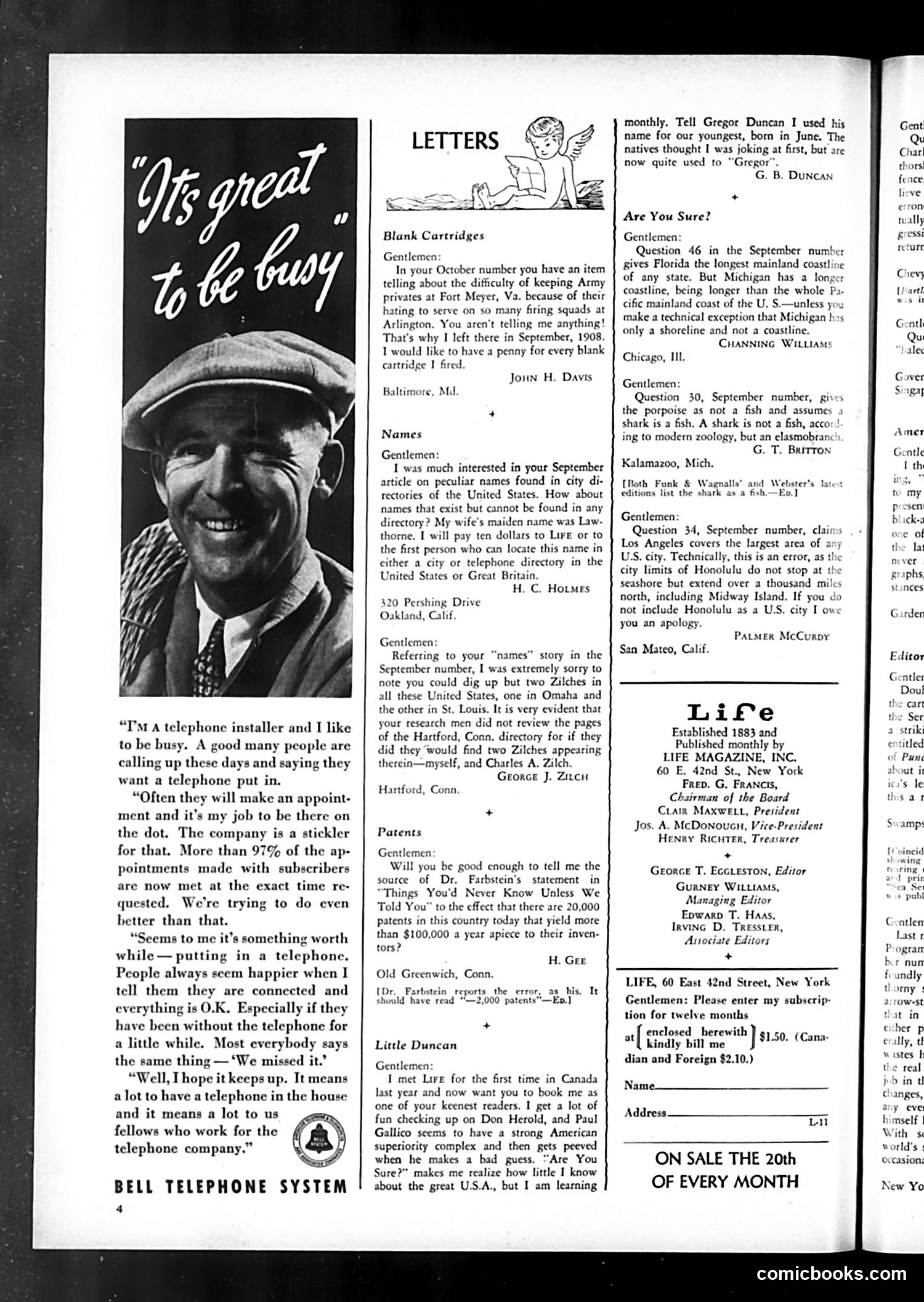
# Bell Telephone System Advertisement This page is primarily a **Bell Telephone System advertisement**, not political satire. The large left-side image shows a smiling telephone installer in work clothes and cap, with the headline "It's great to be busy." The accompanying testimonial presents the installer's perspective: telephone installation work keeps him constantly busy and occupied, which he views positively. He emphasizes that the job offers steady employment, good pay, and the satisfaction of essential work. The ad argues that telephone company employment provides reliable, respectable work—a key selling point during economic uncertainty. The right side contains unrelated reader letters to *Life* magazine addressing various factual questions about geography, animals, and names.
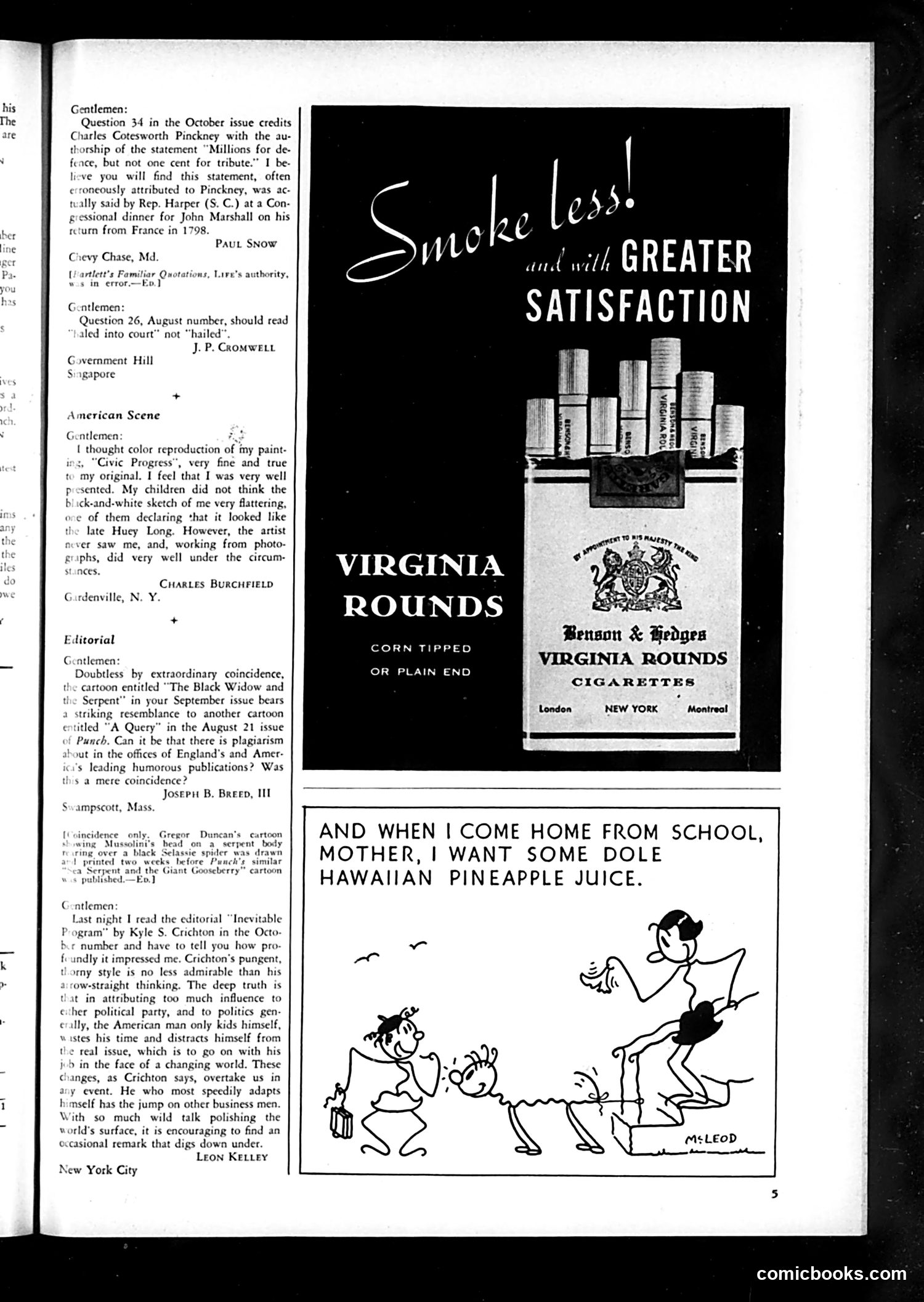
# Analysis This page contains primarily **advertisements and editorial letters**, not political cartoons. The main visual content includes: 1. **Virginia Rounds Cigarettes ad** — a straightforward product advertisement emphasizing "smoke less and with greater satisfaction," featuring cigarette packages. 2. **Dole Hawaiian Pineapple Juice cartoon** — a simple, whimsical domestic scene showing a child returning from school requesting juice from their mother. This is a consumer product advertisement using humor and relatability rather than satire. The editorial letters address various magazine content questions, including references to artwork reproduction and cartoon attribution debates. There is **no political satire** on this page. It's primarily commercial advertising typical of mid-20th century magazines, using lighthearted illustration to market products to American consumers.
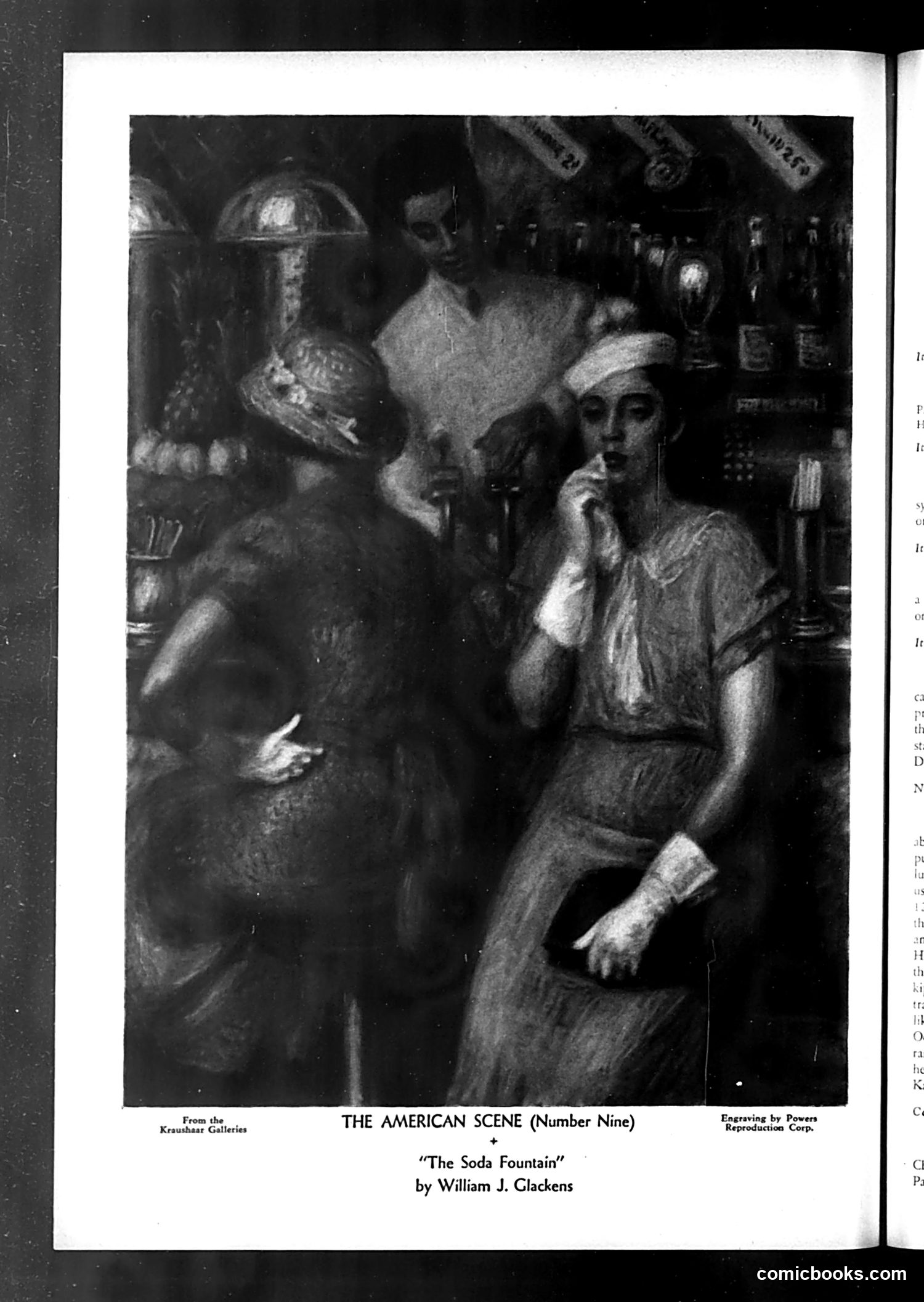
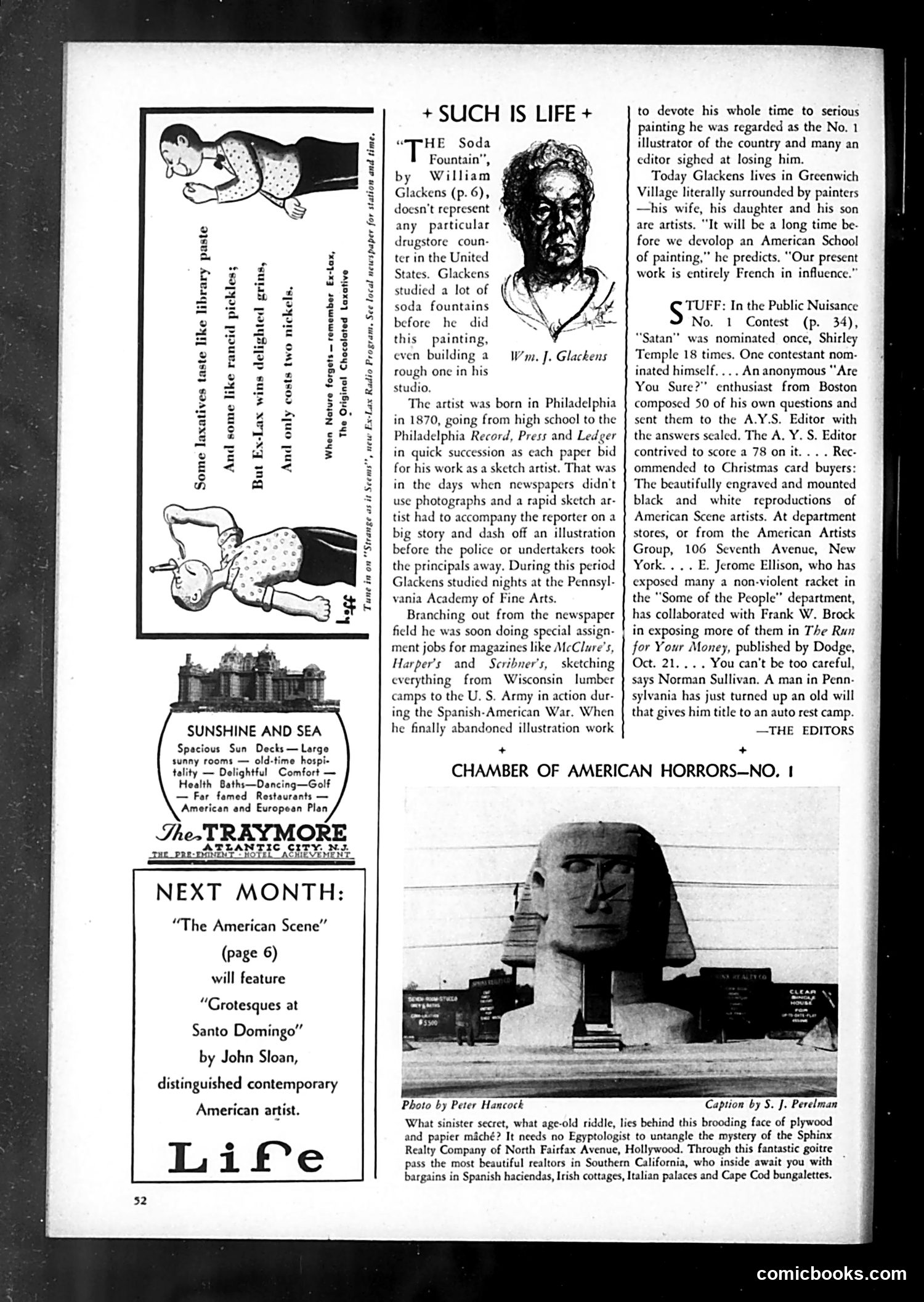
# Analysis This is an engraving titled "The Soda Fountain" by William J. Clackens, presented as part of "The American Scene" series from the Kraushaar Galleries. Rather than political satire, it appears to be social commentary depicting everyday American life. The scene shows figures at what appears to be a soda fountain counter—a popular social gathering spot in early 20th-century America. The work captures ordinary people in a casual commercial setting, likely satirizing or observing class interactions, fashion, and social behaviors of the era. Soda fountains were important social spaces where different social strata mixed informally. Without additional contextual information about Clackens's specific intent or contemporary references, the precise satirical message remains unclear, though the subject matter itself—American consumer culture and social mixing—was itself often a target of commentary.
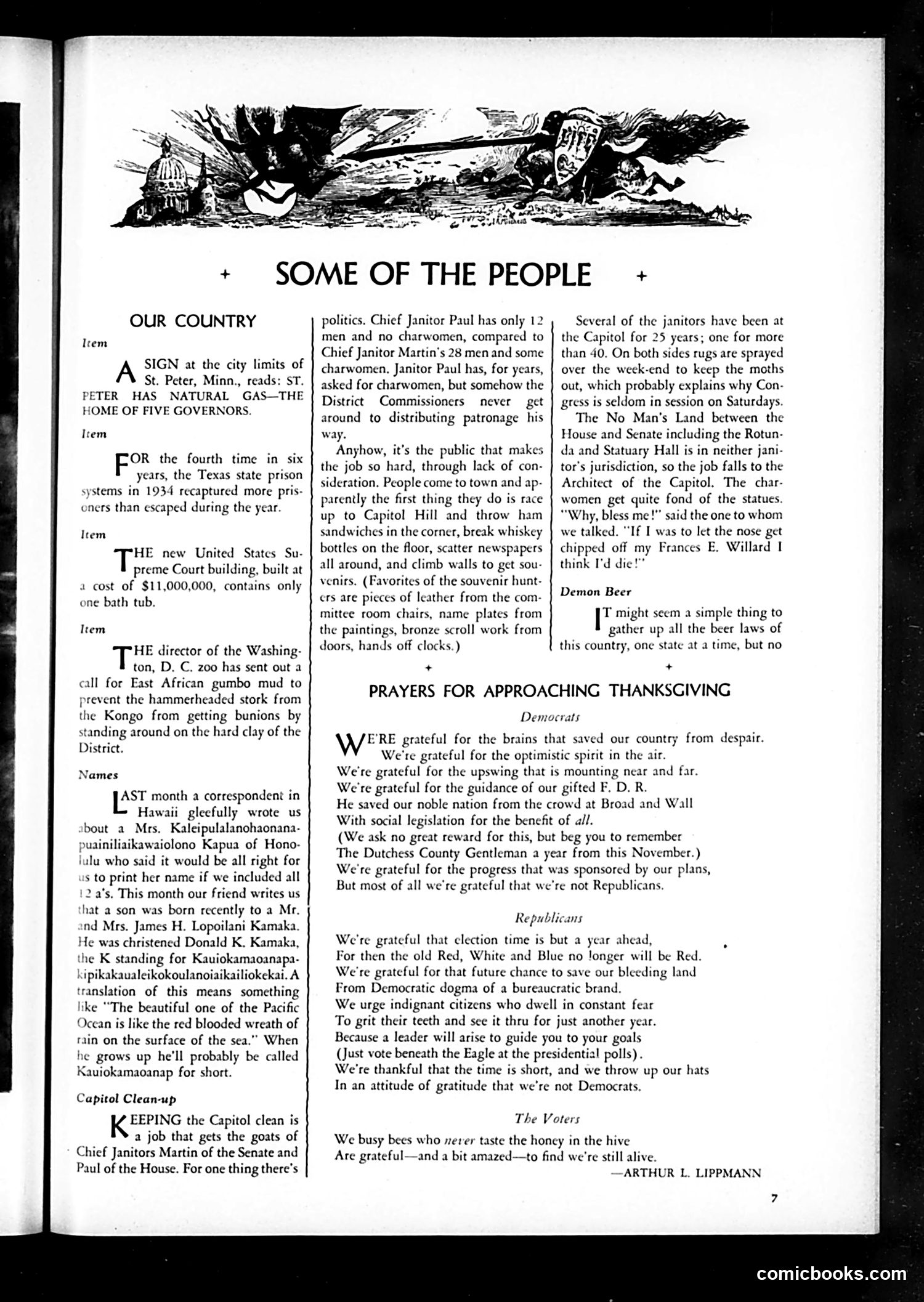
# Analysis of "Some of the People—Our Country" Page This satirical page critiques American government inefficiency and political hypocrisy during the New Deal era. The header cartoon depicts chaos and disorder, setting a mocking tone. The left column lists absurd government facts: a zoo director's call to import gumbo to stop storks, Texas prison escapes, the Supreme Court building's single bathtub, and Capitol janitors struggling with vermin—all highlighting bureaucratic incompetence and waste. The "Prayers for Approaching Thanksgiving" section parodies both parties: Democrats praise FDR's social legislation while Republicans mock Democratic dogma and urge faith in a future Republican leader. "The Voters" cynically portrays citizens as bees merely surviving, grateful simply to be alive—suggesting widespread political apathy and resignation rather than engaged citizenship.
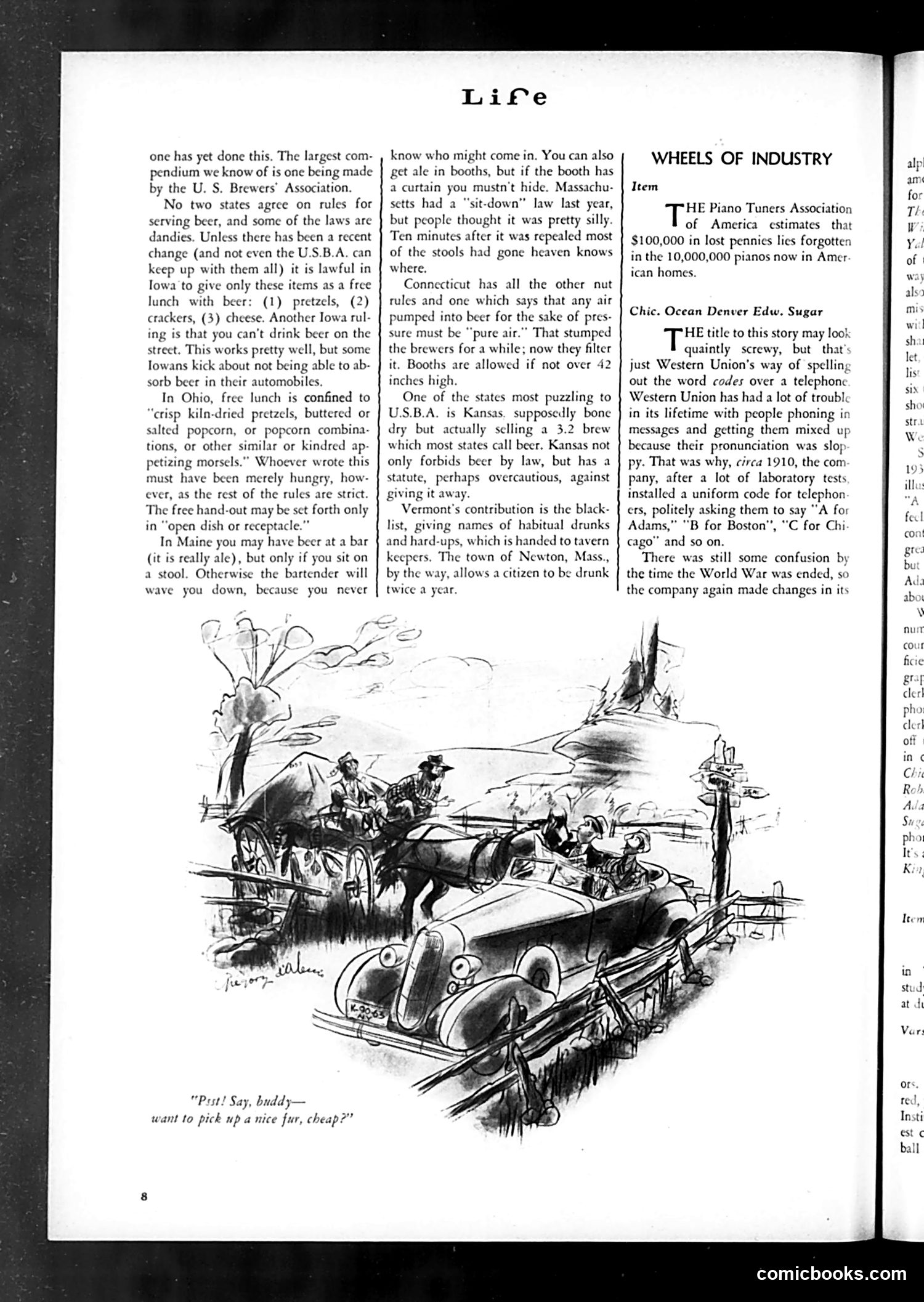
# Cartoon Analysis: "Psst! Say, buddy—want to pick up a nice far, cheap?" This cartoon satirizes post-Prohibition era automobile culture and economic inequality. The sketch shows a well-dressed motorist in a sleek, modern car encountering a shabby figure with a horse-drawn cart—a visual contrast between new wealth and rural/working-class poverty. The caption's whispered proposition ("want to pick up a nice far, cheap?") suggests street hustling or black-market dealings, likely referencing the economic desperation of the Depression era. The juxtaposition mocks both the nouveau riche flaunting new automobiles and the impoverished who remained dependent on obsolete transportation. The surrounding text discusses state-by-state alcohol regulations post-Prohibition, contextualizing an era of rapid social change and class tensions in 1920s-30s America.