A complete issue · 50 pages · 1935
Life — October 1935
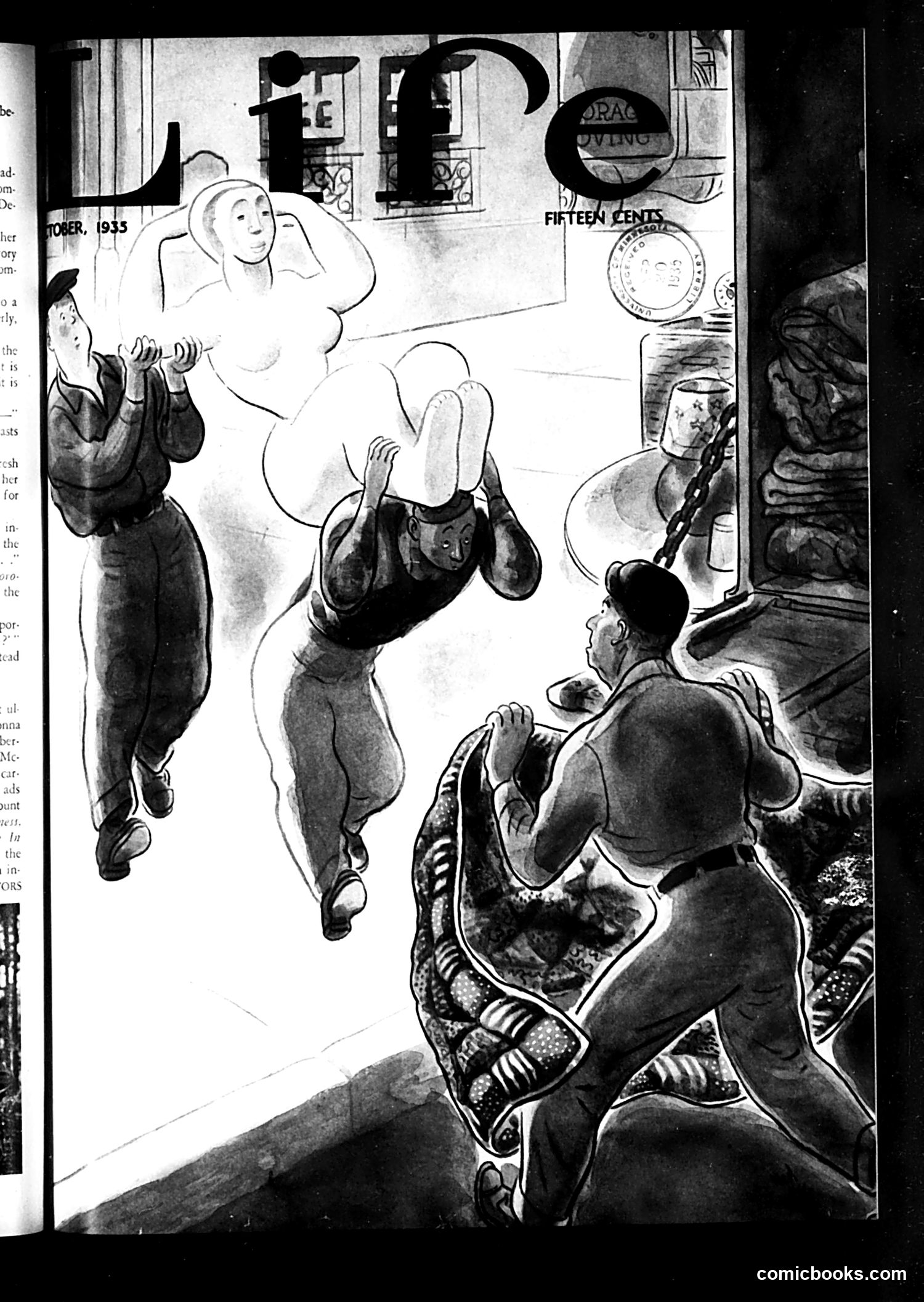
# Analysis This appears to be a 1935 *Life* magazine cartoon satirizing the economic hardships of the Great Depression. The image depicts several figures in what looks like a Parisian street scene (note the French architecture and "Fifteen Cents" price marking, suggesting European tourism). The cartoon likely mocks either wealthy Americans vacationing abroad despite economic depression at home, or contrasts European leisure culture with American financial struggles. The exaggerated, rotund figures and their carefree demeanor suggest satire of excess or obliviousness to suffering. The "October, 1935" date and composition style are consistent with *Life's* satirical commentary on contemporary social and economic conditions during the Depression era. Without clearer text or identifying details, the specific targets remain unclear.
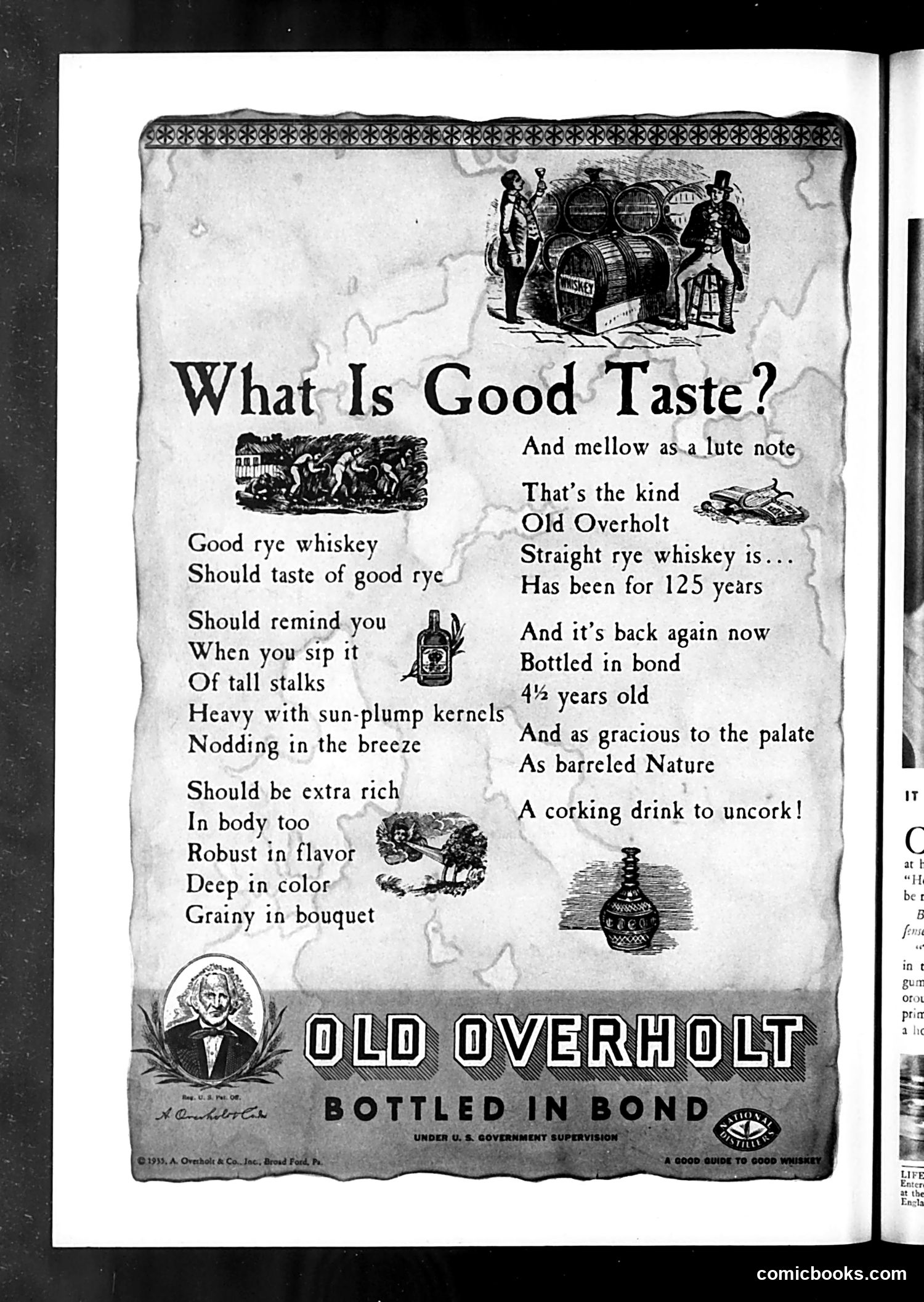
# Old Overholt Whiskey Advertisement This is a straightforward advertisement rather than satire or political commentary. The page promotes Old Overholt straight rye whiskey, emphasizing its 125-year history and recent return to market after being "bottled in bond" for 4½ years. The ad uses poetic language to describe desirable whiskey qualities—"mellow as a lute note," "robust in flavor," "deep in color," "grainy in bouquet." It positions the product as refined and traditional ("A corking drink to uncork!"). The decorative illustrations include barrels, rye stalks, and a bottle. A period gentleman's portrait appears at the bottom. This appears to be from the 1930s era when whiskey was reintroduced after Prohibition's repeal, explaining the emphasis on the product's revival and legitimacy under government supervision.
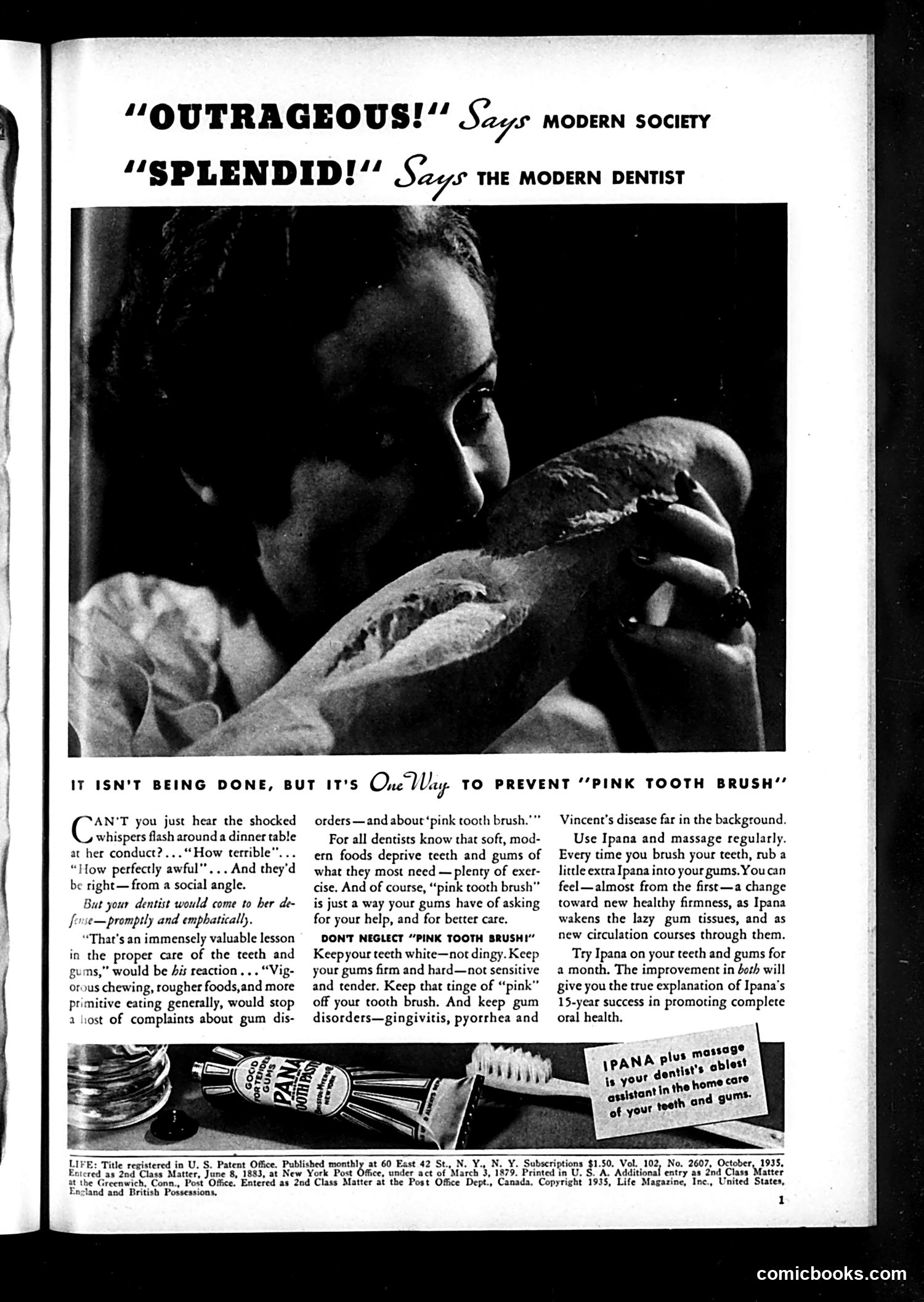
# Analysis This is primarily a **dental product advertisement** for Ipana toothpaste and massage, not political satire. The page uses social commentary as marketing strategy. The ad presents a dinner table scene where guests react with shock ("OUTRAGEOUS!") to someone's dental hygiene practices. A modern dentist endorses Ipana, calling the situation "SPLENDID!"—meaning he approves of using Ipana to prevent "pink tooth brush," a condition where gums bleed during brushing. The satire targets **social embarrassment**: the implication is that poor oral hygiene causes visible gum disease, which is socially mortifying. The ad warns against neglecting teeth and gums, promoting Ipana massage as the modern solution to prevent conditions like gingivitis and pyorrhea. This reflects 1930s advertising's appeal to status anxiety and social conformity.
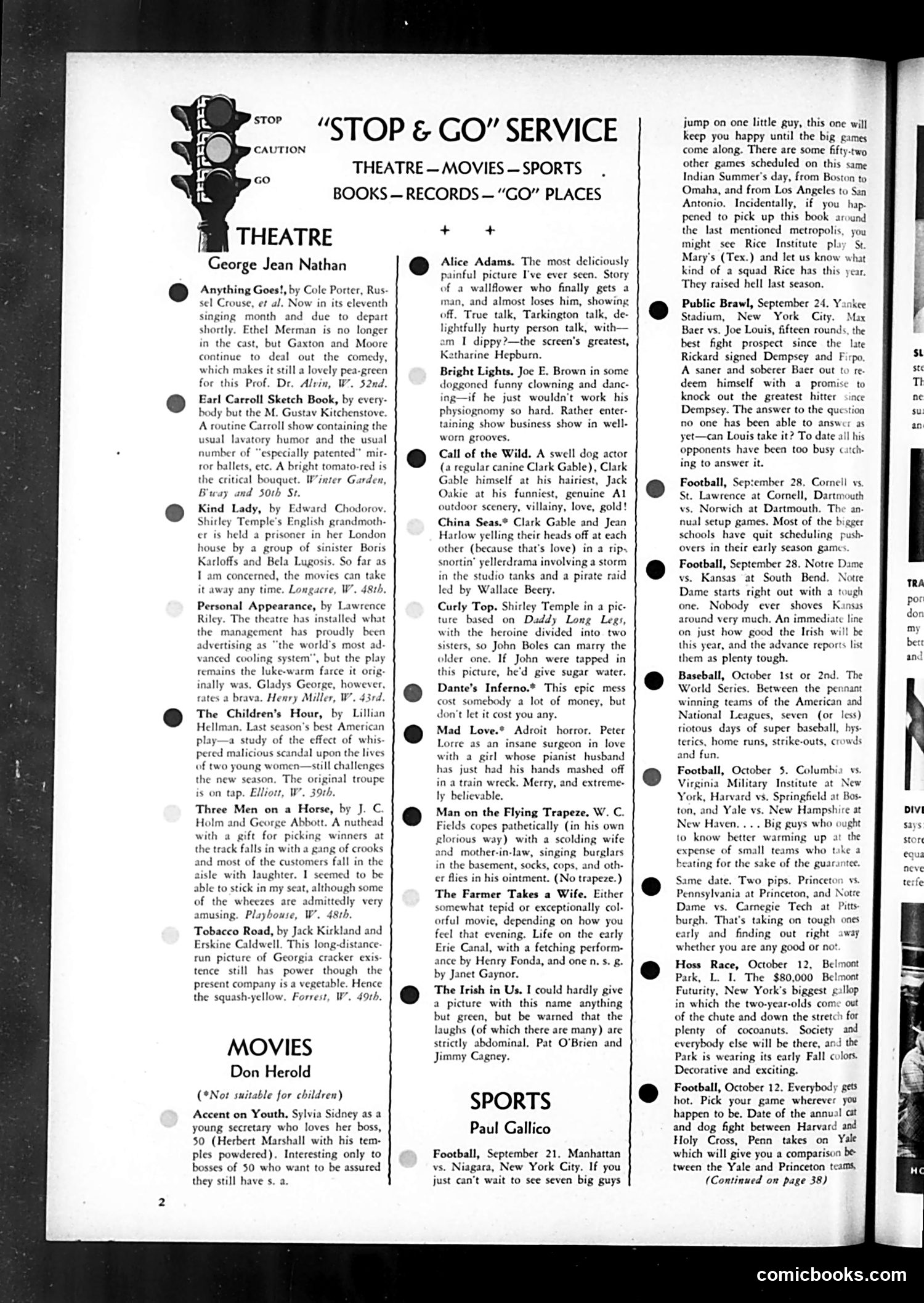
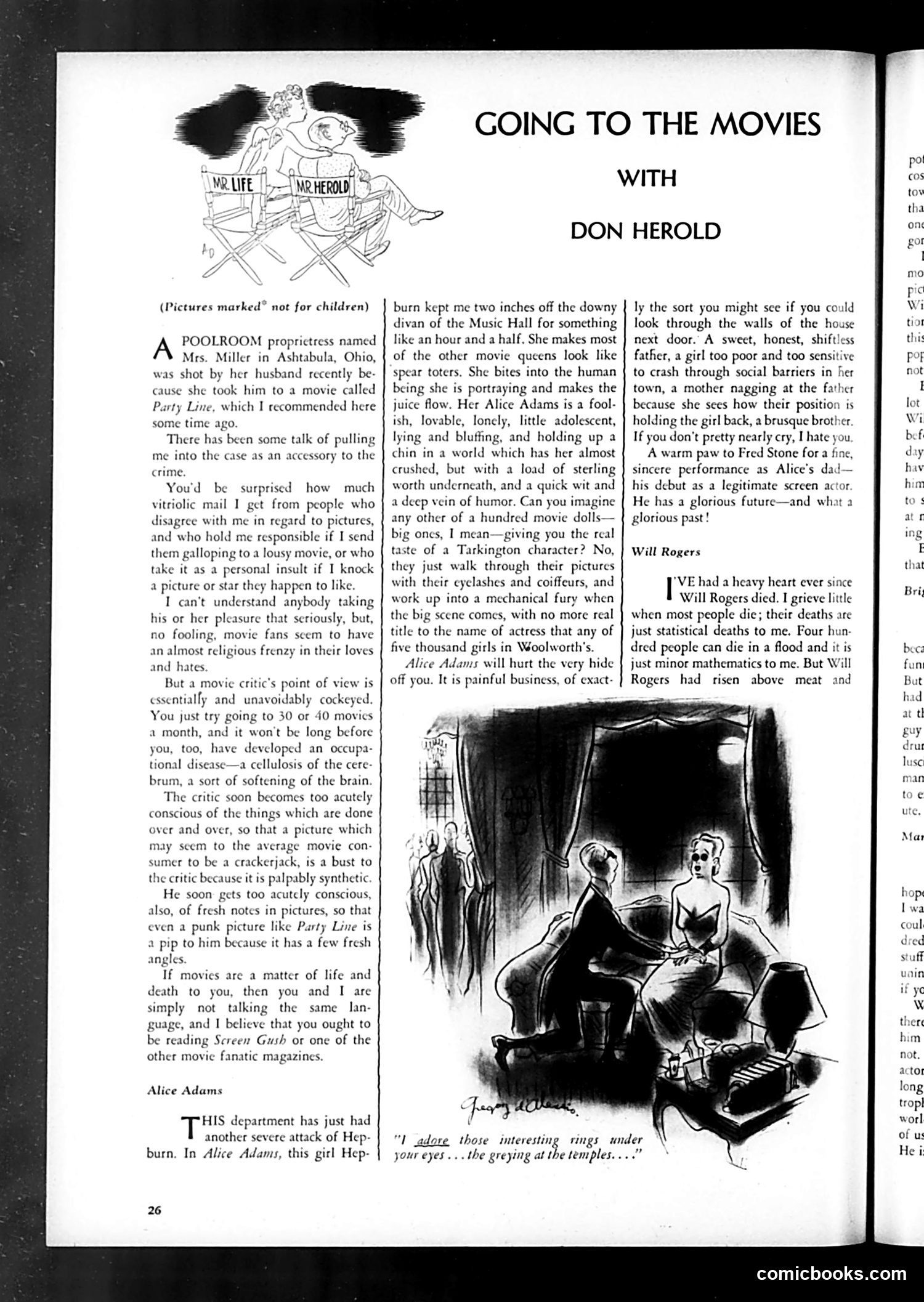
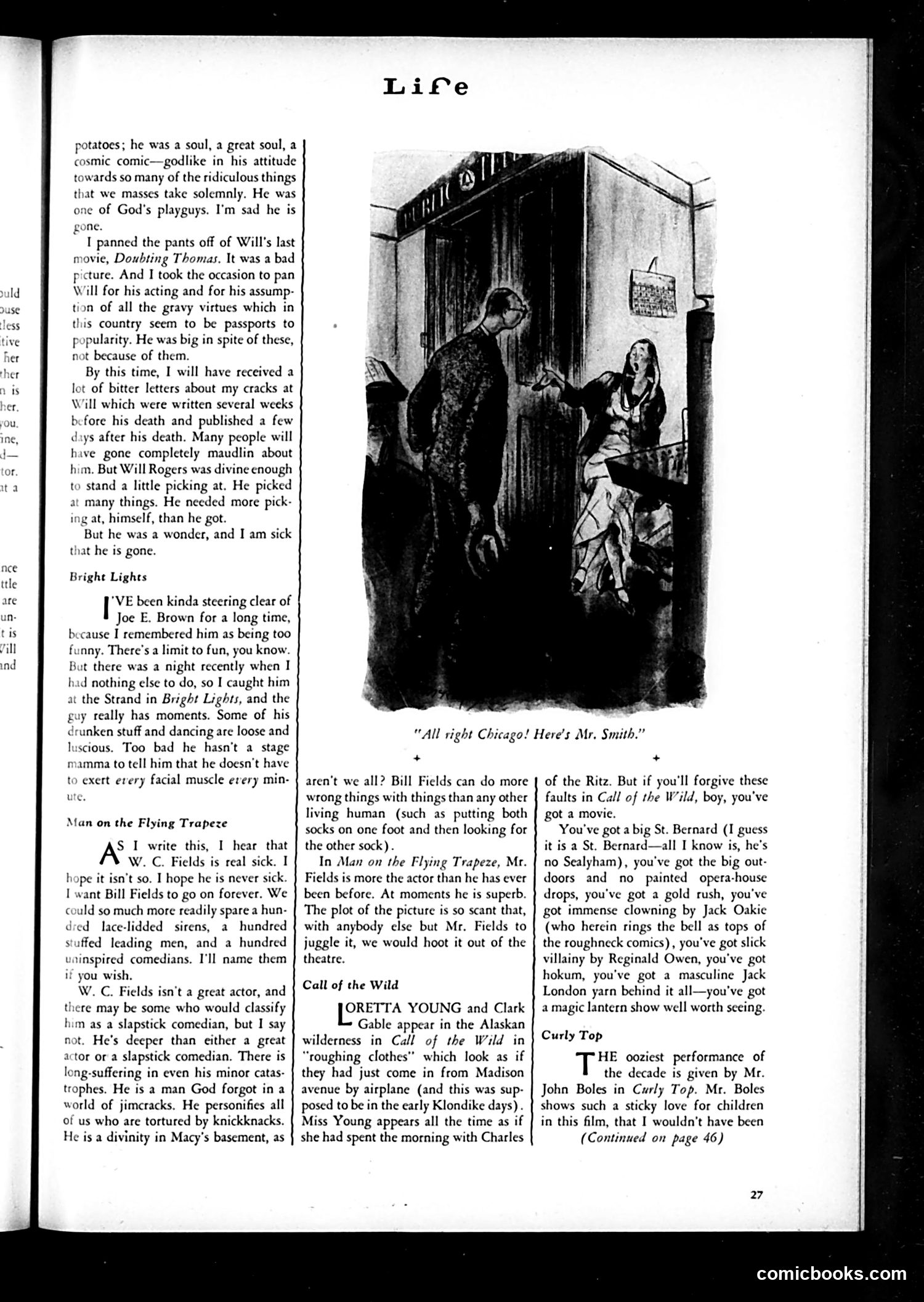
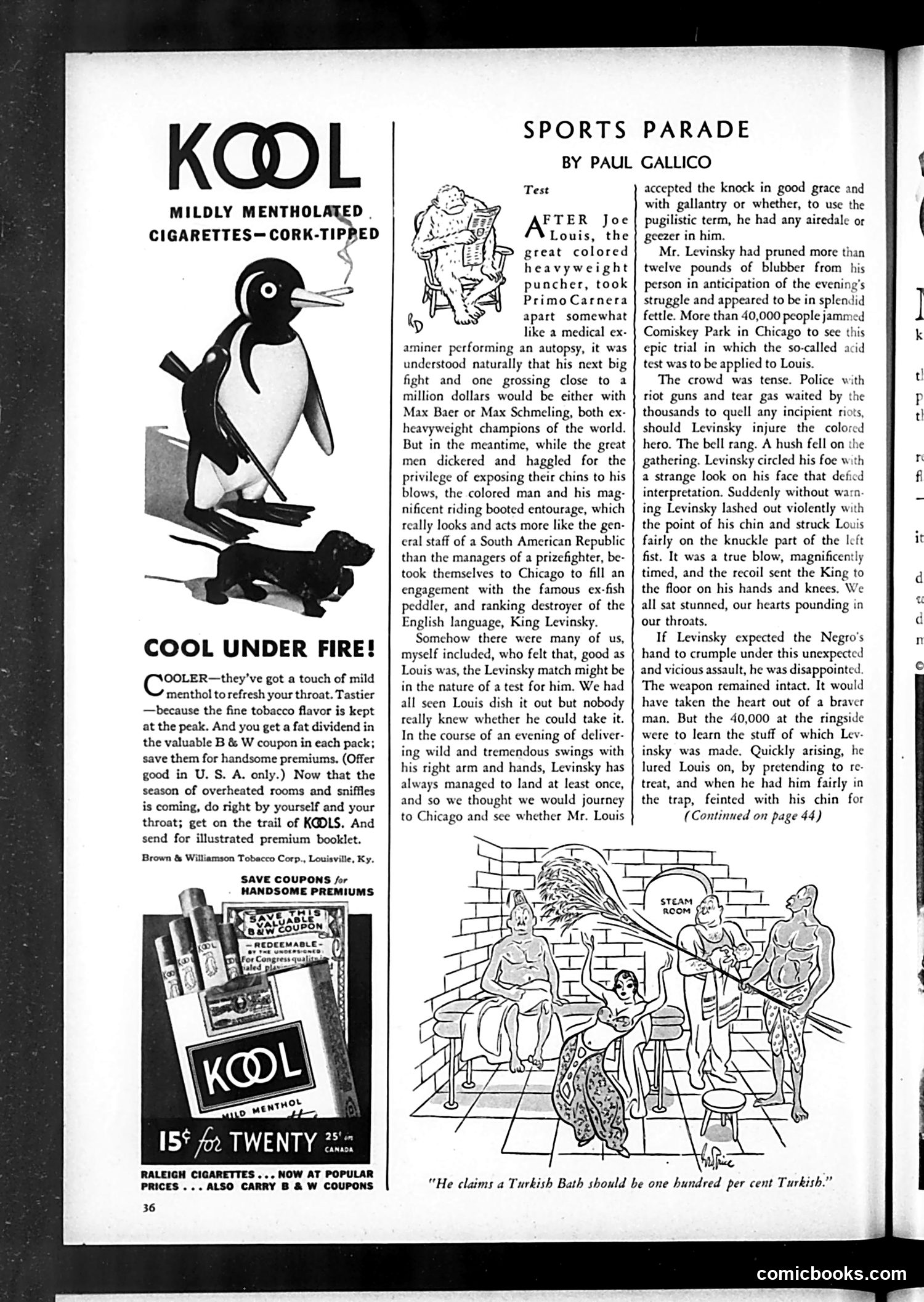
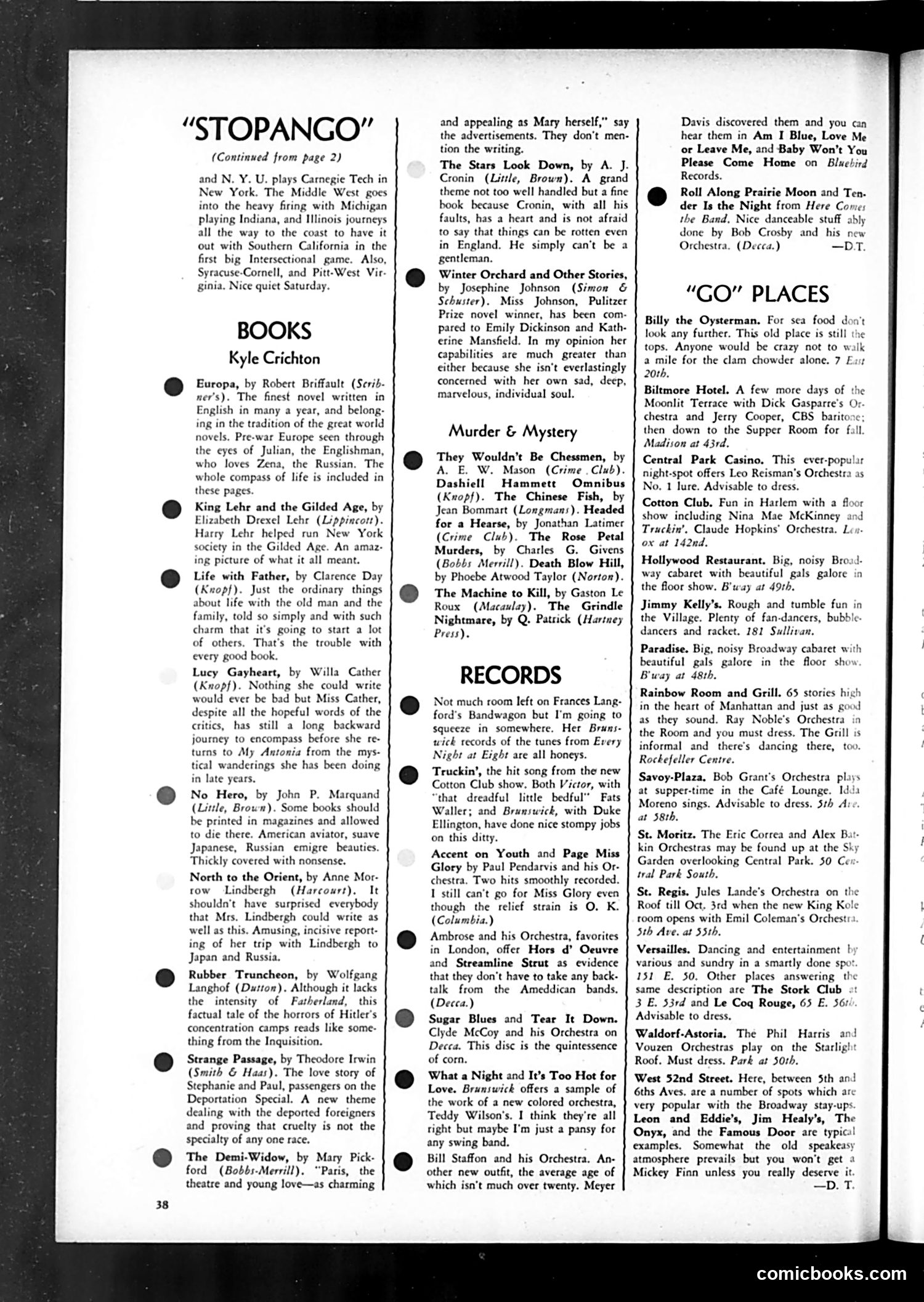
# "Stop & Go" Service Page Analysis This is a **guide page**, not a political cartoon. It's a "Stop & Go" service feature recommending entertainment options across theatre, movies, and sports—organized by reviewer (George Jean Nathan for theatre, Don Herold for movies, Paul Gallico for sports). The traffic light graphic at top is merely a visual metaphor: "Stop" (red light—avoid), "Caution" (yellow—proceed carefully), "Go" (green—recommended). The content reviews contemporary 1930s films like *Alice Adams* and *Call of the Wild*, Broadway plays, and upcoming football games. Don Herold notes some films are "*Not suitable for children*." This is straightforward entertainment guidance—satirical magazine Life's curated recommendations for readers seeking leisure activities.
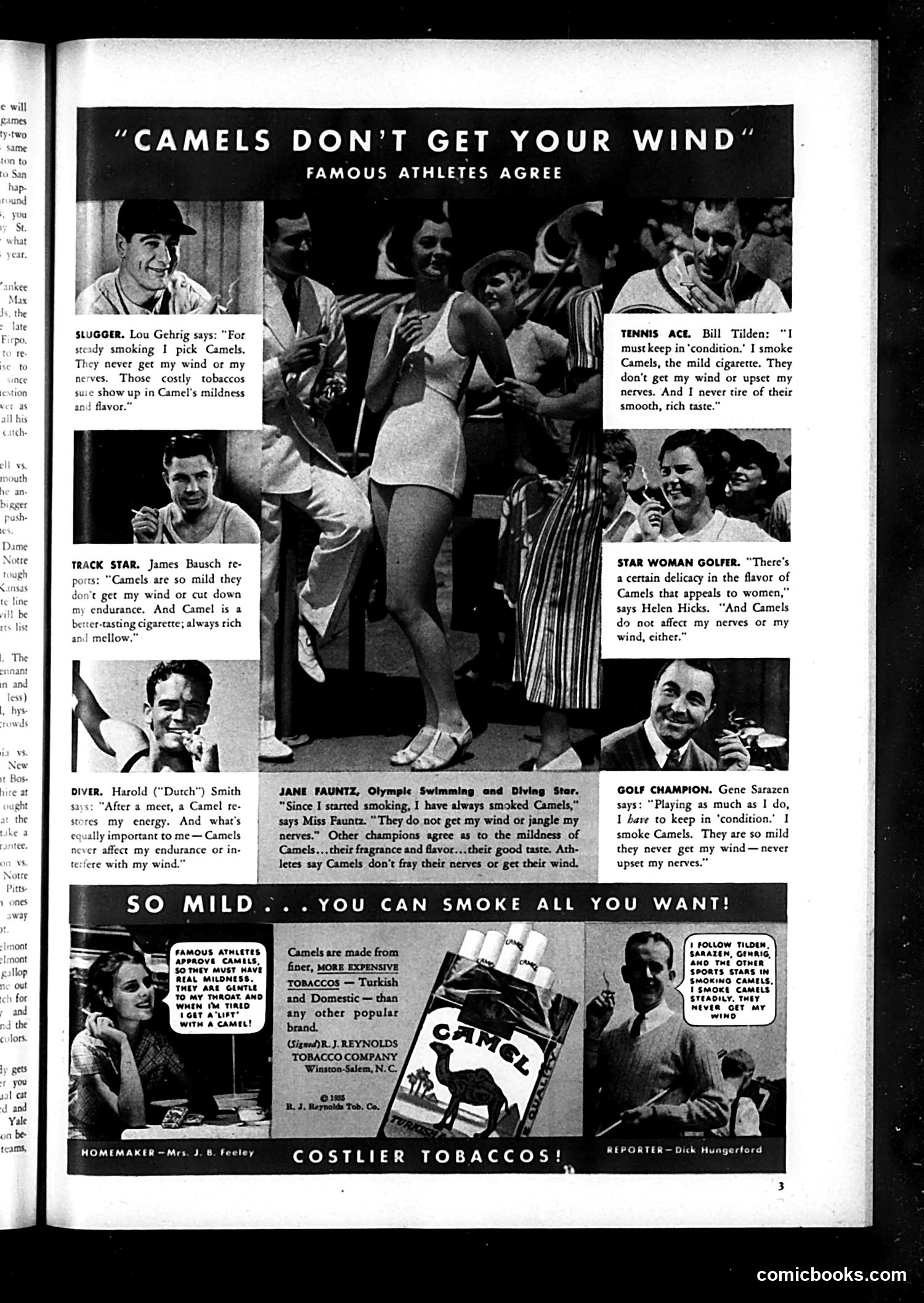
# Analysis This is a **cigarette advertisement**, not satire or political commentary. It's a pro-smoking ad featuring testimonials from famous athletes of the era (Lou Gehrig, Bill Tilden, James Bausch, Harold Smith, Jane Fauntz, and Gene Sarazen), claiming that Camel cigarettes "don't get your wind" and won't affect athletic performance. The appeal is straightforward marketing: associating smoking with physical prowess and health. Each athlete endorses the product's mildness and claims it poses no threat to their conditioning or nerves. The bottom section emphasizes Camels use premium Turkish and domestic tobacco, positioning them as a luxury product. **Modern context**: This represents pre-regulation tobacco advertising, when health risks were completely unacknowledged and celebrity endorsements by elite athletes were considered persuasive selling tactics.
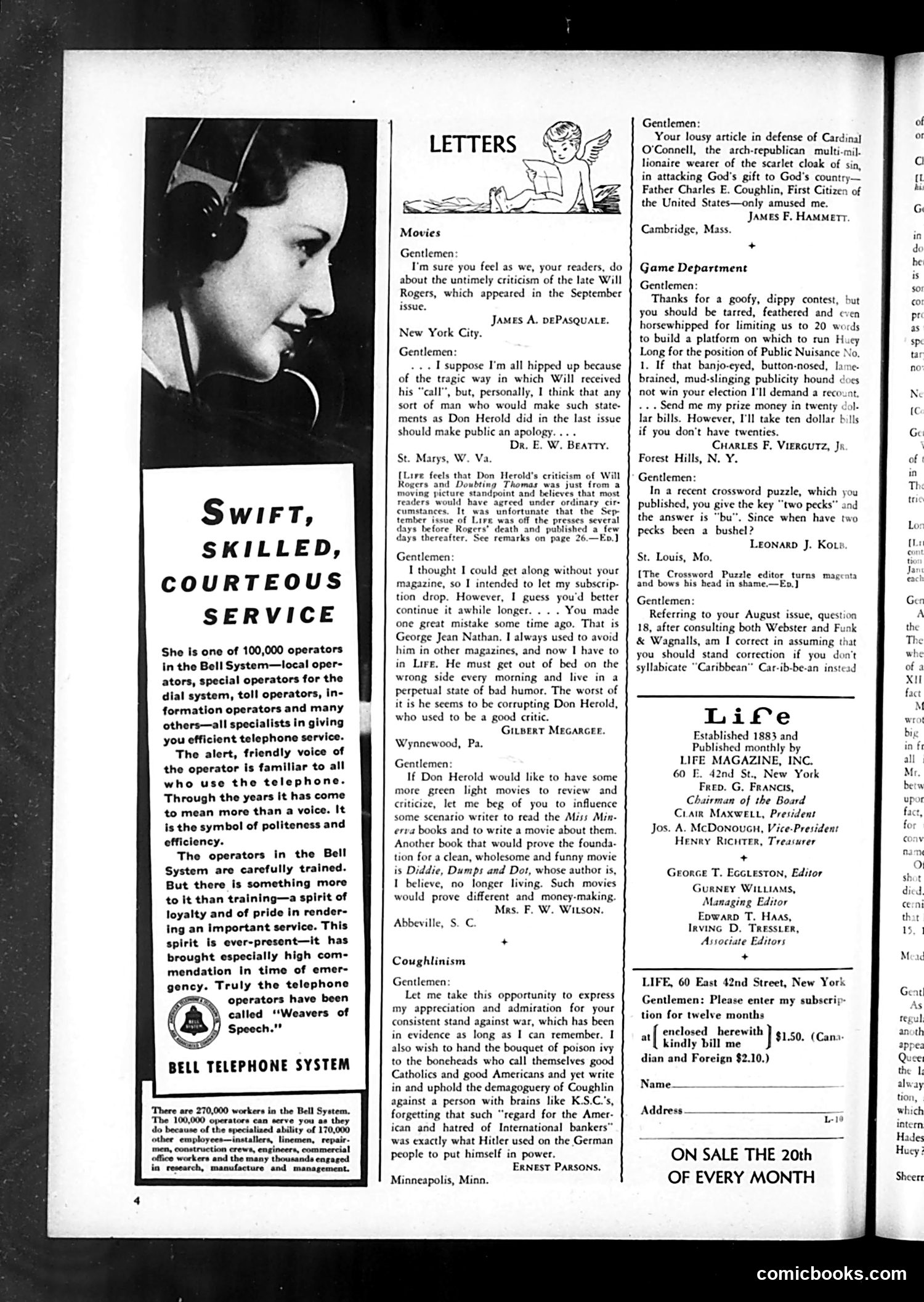
# Analysis of Life Magazine Page This page is primarily **advertising and editorial content**, not political satire. The left side features a Bell Telephone System advertisement celebrating female telephone operators as "Swift, Skilled, Courteous" workers—part of early 20th-century corporate branding that positioned women in telephone service as essential infrastructure workers. The right side contains a **Letters section** with reader responses about movies, games, and other topics, plus **Life Magazine masthead information**. One letter references "Don Herold," a humorist, indicating contemporary magazine criticism. The content reflects **1930s-era concerns**: job training, telephone service quality, and entertainment preferences. The photograph shows a telephone operator wearing headset equipment typical of that era. This is a **corporate PR page**, not political commentary—its purpose is legitimizing women's labor in emerging technology industries.
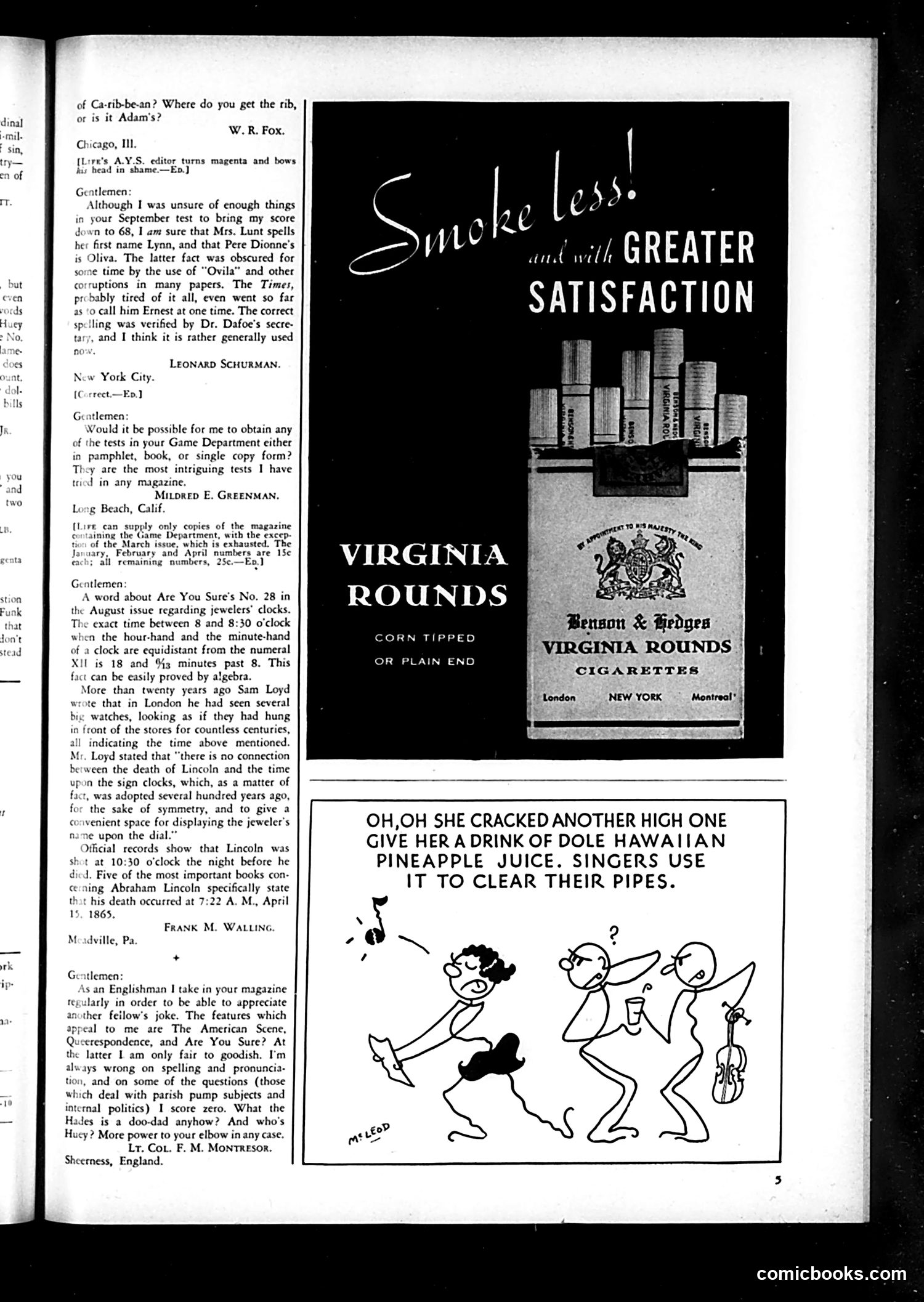
# Analysis This page contains reader correspondence and advertisements rather than political satire. The left column features letters to the editor debating minor topics—spelling of character names, clock mechanisms, and Lincoln assassination timing. The right side displays a **Virginia Rounds cigarette advertisement** promising "smoke less...with greater satisfaction," and an **unrelated cartoon** about someone named Dole offering Hawaiian pineapple juice to "clear their pipes"—likely a crude digestive health joke common to early 20th-century humor. The cartoon depicts simple stick figures in exaggerated poses, typical of the era's style. There's no identifiable political content or satire on this particular page—it's primarily reader mail and period advertising.
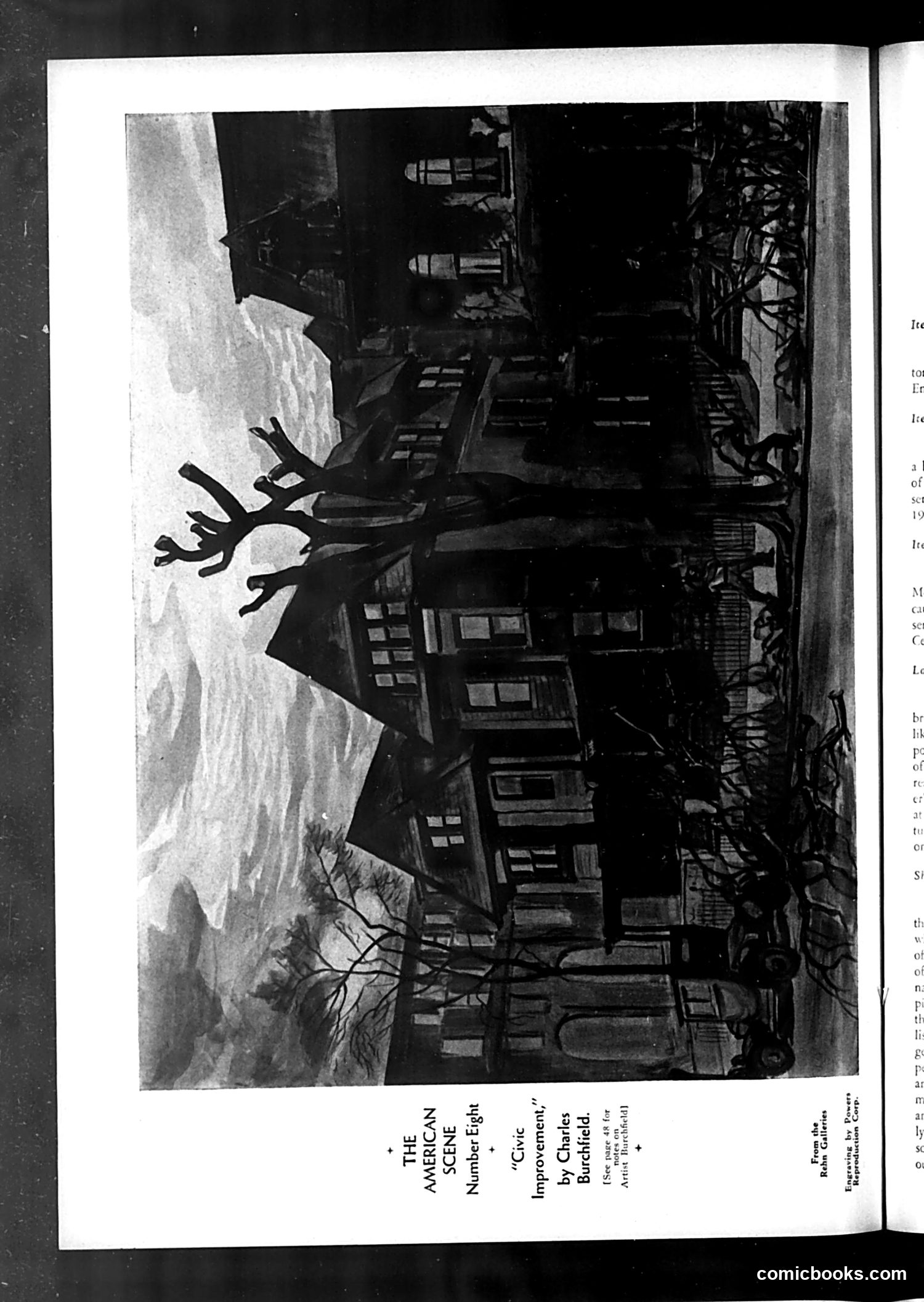
# Analysis This page appears to be rotated 90 degrees in the scan, showing what should be viewed sideways. The caption reads "THE AMERICAN SCENE / Number Eight / Civic Improvements / by Corey Ford / Burchfield" (the artist). The image depicts a bare, gnarled tree in front of residential buildings with multiple windows. The tree appears skeletal and dead or severely damaged. This is likely satirical social commentary about urban development and "civic improvements" in America—suggesting that modernization efforts destroyed natural features. The juxtaposition of the dead tree against orderly residential architecture critiques how progress often came at nature's expense. The artist Corey Ford and illustrator Burchfield were known for such satirical observations of American life and culture in the mid-20th century.
# "Some of the People" - Life Magazine Satire Page This page satirizes American political and governmental absurdities circa 1936. The "Our Country" section mocks: 1. **Congressional waste**: A House doorkeeper's budget submission of $11,000 to cover speeches sent to members during 1936—criticized as excessive spending. 2. **Military morale efforts**: The Army's attempts to keep soldiers happy at Fort Meyer through firing squads at Arlington Cemetery funerals (appears to reference grim military tradition as "entertainment"). 3. **Ship naming practices**: The arbitrary, sometimes ridiculous logic behind christening U.S. Navy vessels after states, fish, mythological characters, and deceased officials. The "Return to Arms" section uses stock-market gossip and cryptic conversation between investors to mock speculative stock trading and financial hype during the Depression recovery period.
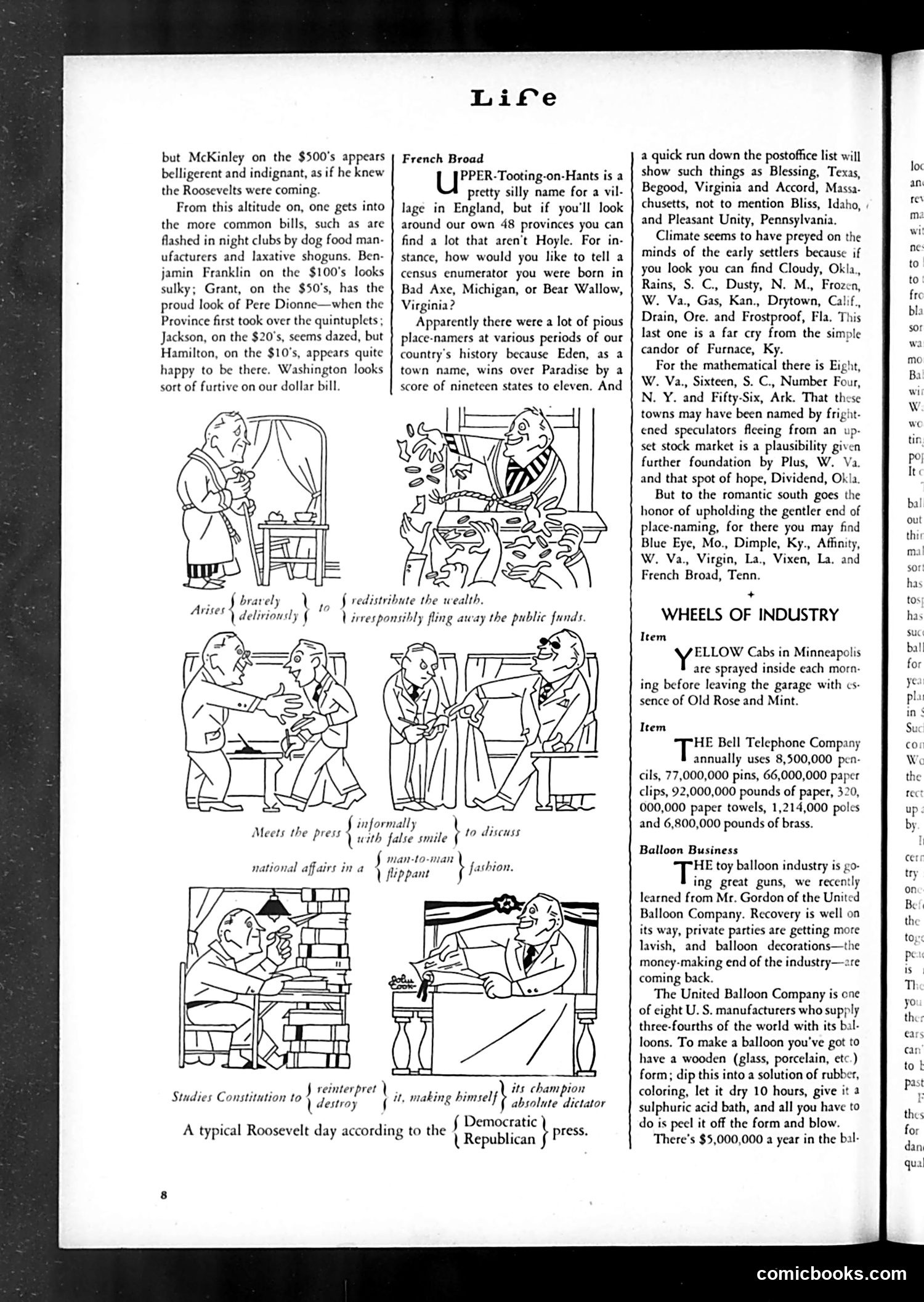
# Analysis of Life Magazine Page This page contains satirical cartoons about **President Franklin D. Roosevelt's daily activities**, labeled "A typical Roosevelt day according to the [Democratic/Republican] press." The six cartoon panels mock how differently Democratic and Republican newspapers portrayed FDR's routine. Each panel shows the same activity interpreted two opposing ways: - "Briskly to redistribute the health" vs. "irresponsibly fling away the public funds" - "Informally with false smile" vs. "man-to-man fashion" - "Reinterpret destiny" vs. "make himself absolute dictator" The satire highlights **partisan media bias**—how the same presidential actions were spun as either progressive leadership (Democratic view) or reckless overreach (Republican view). This reflects 1930s New Deal-era political polarization, where FDR's expanding executive power was deeply controversial.
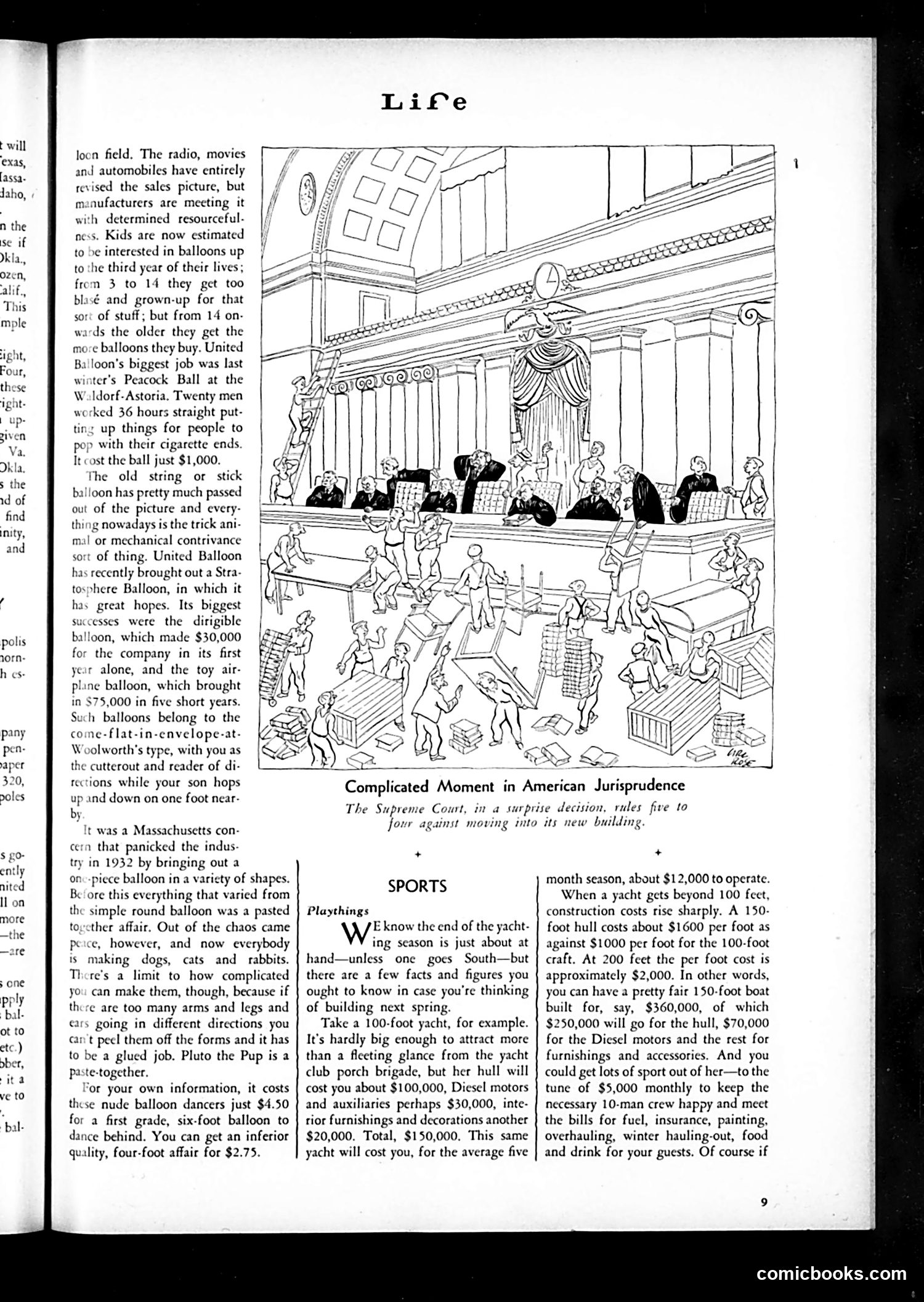
# "Complicated Moment in American Jurisprudence" This cartoon satirizes the Supreme Court moving into its new building. The illustration shows the justices seated in an ornate courtroom while below, numerous people are physically engaged in moving activities—carrying boxes, furniture, and belongings in apparent chaos. The satire targets the contrast between the dignified, formal nature of the Supreme Court and the practical, messy reality of a major institutional move. By depicting the justices presiding over literal moving day chaos, the cartoonist mocks the idea that such an elevated body must deal with mundane administrative matters. The "complicated moment" of the title ironically suggests that even America's highest legal authority cannot escape ordinary logistical complications.
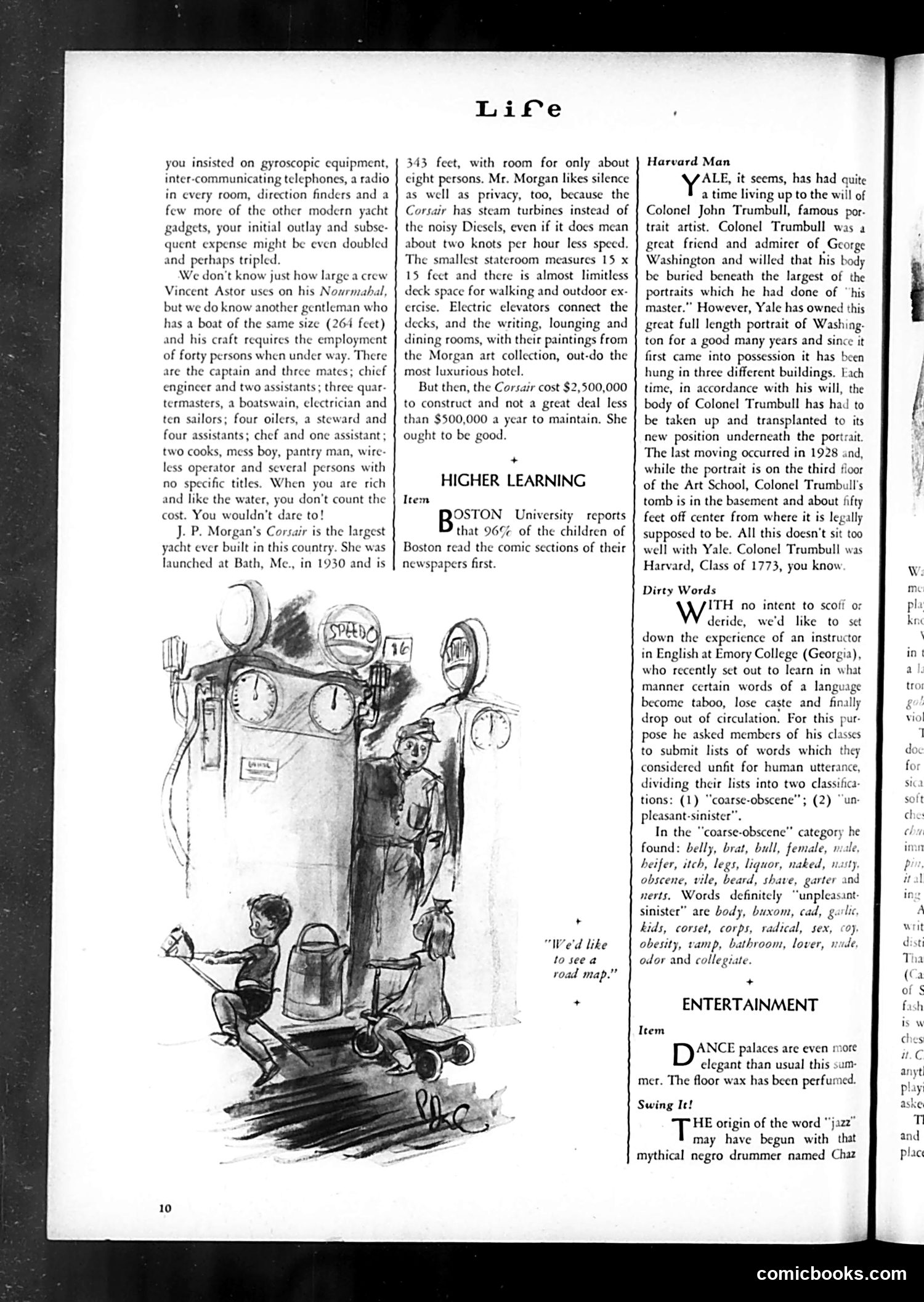
# Analysis of Life Magazine Page (Page 10) This page contains three distinct sections: **Top left:** A satirical article about J.P. Morgan's yacht *Corsair*, mocking the wealthy banker's extravagant vessel—343 feet long, requiring 40+ crew members and costing $2.5 million to build and maintain annually. The satire targets gilded-age excess. **Center illustration:** A humorous cartoon showing a man surrounded by clocks and timing devices, captioned "We'd like to see a road map"—likely satirizing the complexity of modern scheduling or navigation. **Right column:** Sections on "Higher Learning" (Boston University's comic readership), "Dirty Words" (linguistic taboos), and "Entertainment" (dance venues and jazz origins). These are informational rather than satirical. The overall tone mocks wealth disparity and modern life's complications.