A complete issue · 50 pages · 1935
Life — August 1935
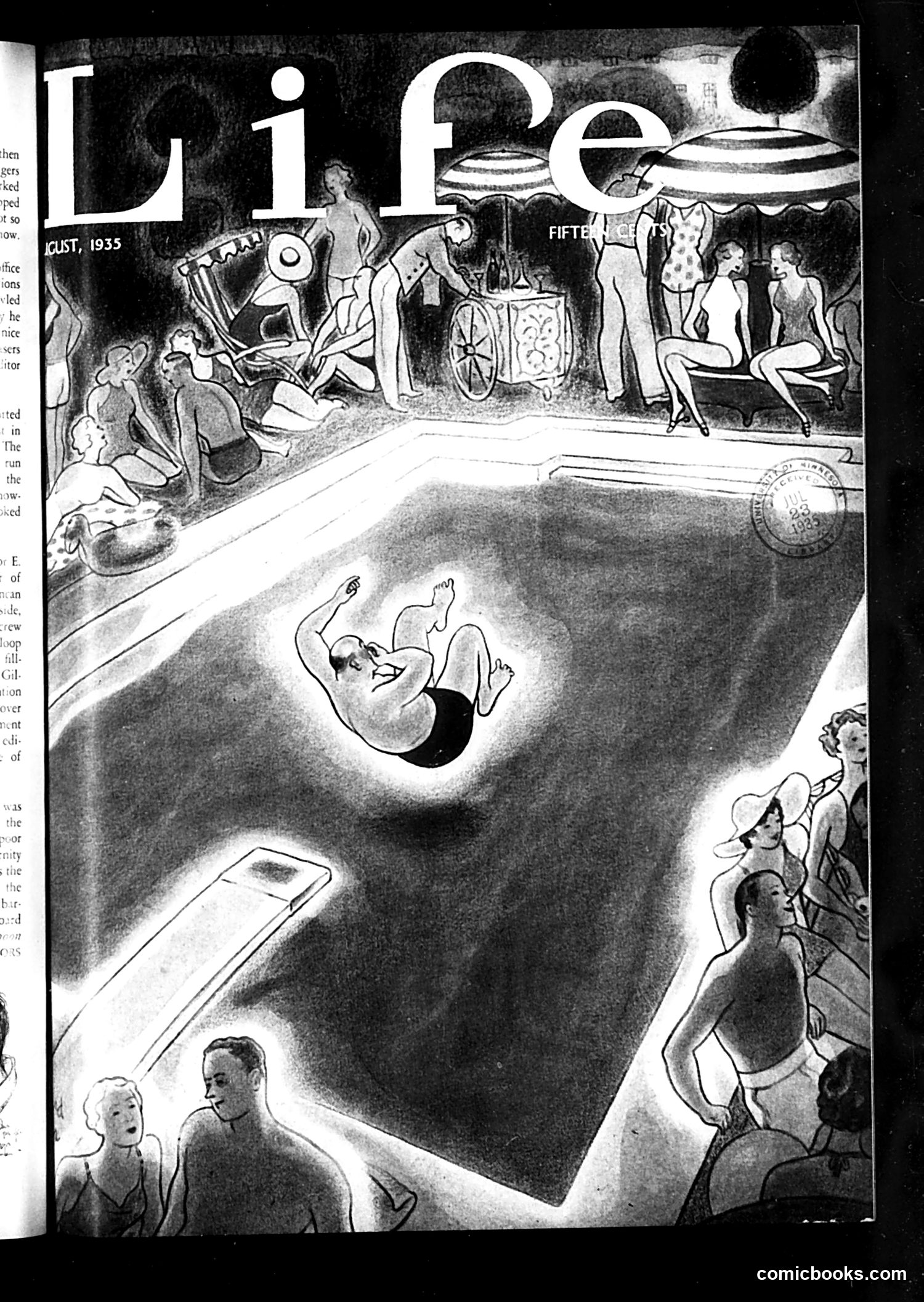
# Life Magazine Page Analysis This appears to be a **Life magazine cover from August 1935** featuring a satirical illustration of a swimming pool scene. The main cartoon shows a man diving or falling into an illuminated pool while well-dressed spectators watch from the sides—some seated, others standing near umbrellas and refreshment stands. The satire likely comments on **leisure culture and class divisions during the Depression era**. The contrast between the carefree poolside socialites and the figure in the water (who appears undignified or in distress) suggests commentary on social pretension or the gap between wealthy society and ordinary people's circumstances. The detailed rendering of the fashionable crowd emphasizes the artificiality of 1930s high-society recreation. Without additional text visible, the specific satirical target remains unclear.
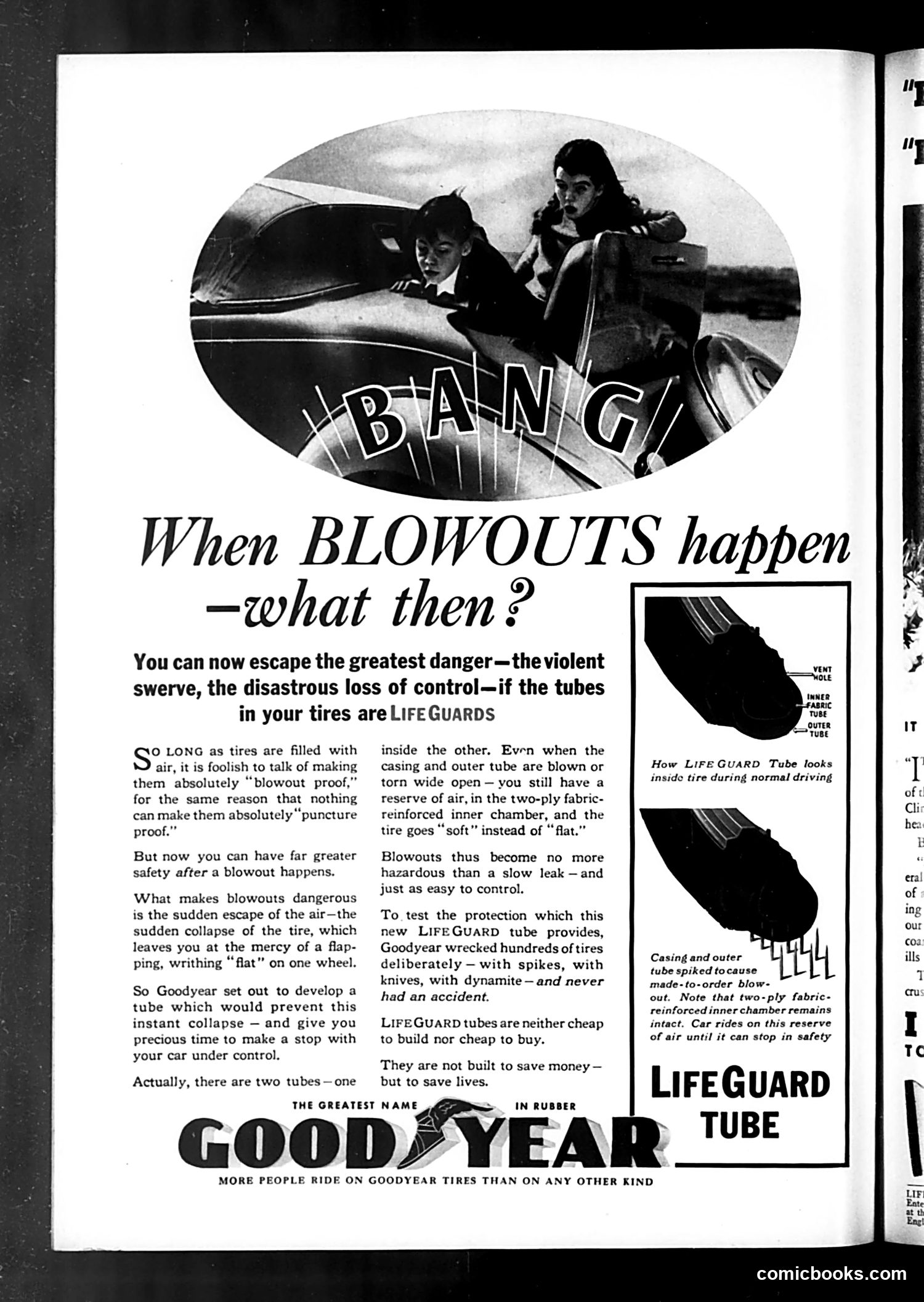
# Analysis This is a **Goodyear tire advertisement, not satire or political cartoon**. The page promotes Goodyear's new "LifeGuard Tube" technology designed to prevent blowouts—a genuine safety hazard of early automotive travel. The dramatic oval illustration at top shows two men in a car experiencing a blowout ("BANG!"), emphasizing the danger. The ad explains that traditional tires could collapse suddenly when punctured, causing loss of control. Goodyear's innovation uses a two-ply reinforced inner chamber that allows gradual deflation instead of catastrophic failure. The diagrams show how the tube performs during normal driving versus after a blowout. The tagline "More people ride on Goodyear tires than on any other kind" establishes market dominance. This reflects genuine 1920s-30s automotive safety concerns—blowouts were common and genuinely dangerous at highway speeds.
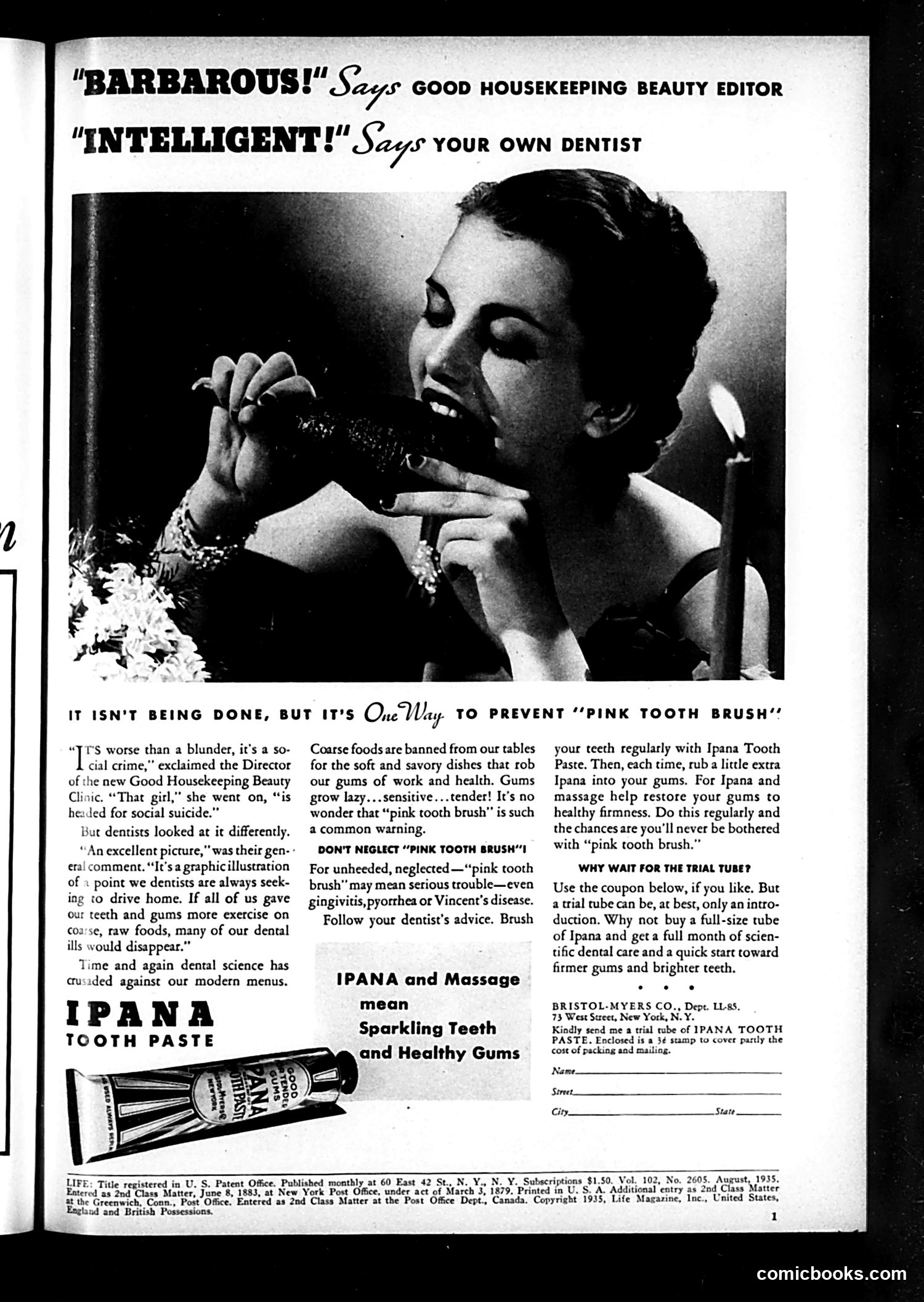
# Analysis This page is primarily an advertisement for Ipana Tooth Paste, not a political cartoon. The ad uses a framing device where it quotes the "Good Housekeeping Beauty Editor" calling the product "barbarous" and "your own dentist" calling it "intelligent." The central image shows a woman applying the toothpaste. The advertisement addresses a then-common dental concern called "pink tooth brush"—bleeding gums caused by neglect or coarse foods. It warns that this condition could indicate serious diseases like gingivitis or pyorrhea, and promotes Ipana as a preventative solution through regular massage and brushing. This reflects mid-1930s advertising's strategy of creating anxiety about health conditions to drive consumer purchases.
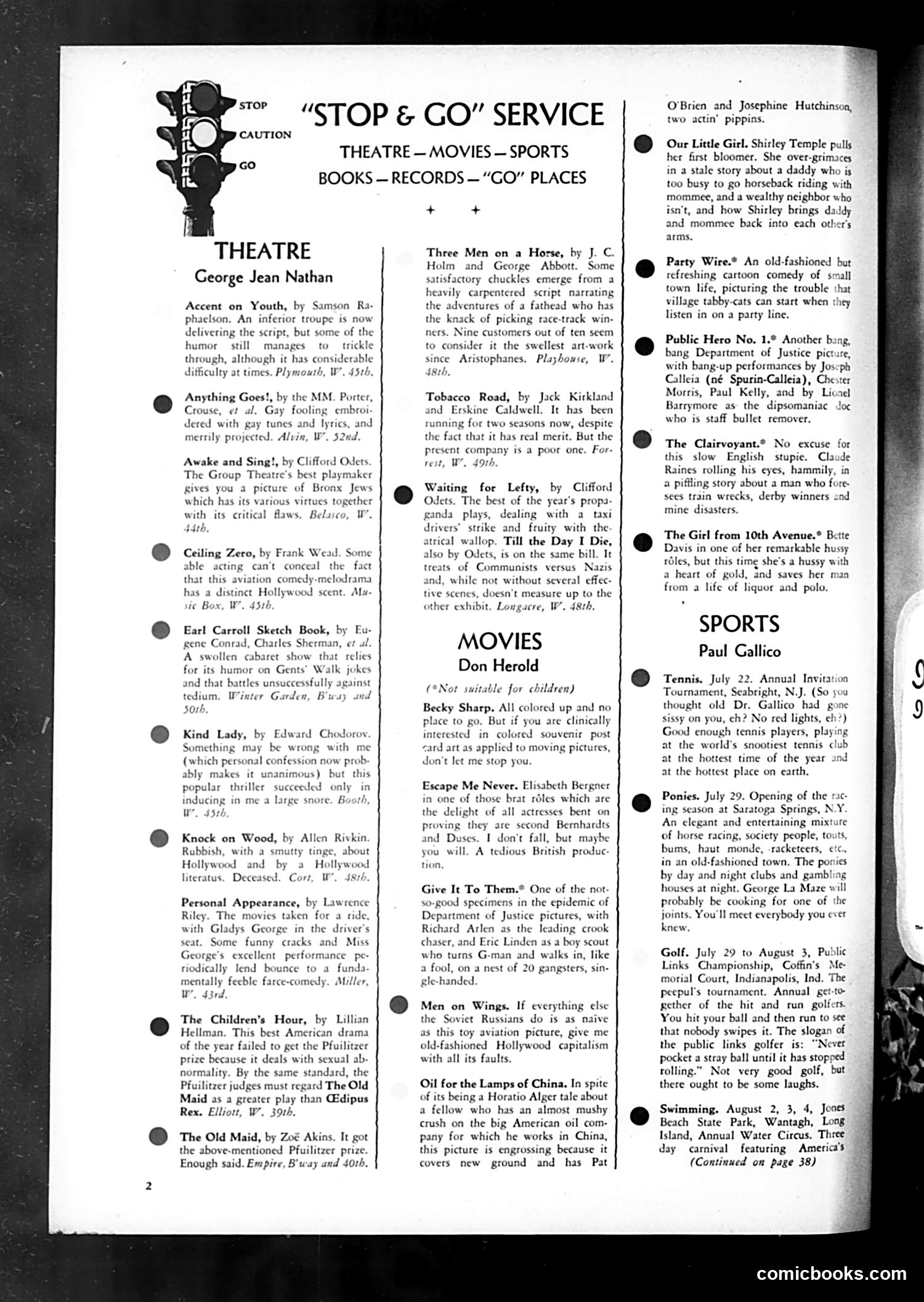
# "Stop & Go" Service Page - Life Magazine This page is primarily **entertainment listings and reviews**, not political satire. It's a "Stop & Go Service" guide covering theatre, movies, sports, and cultural venues. The masthead features a **traffic light** illustration—a visual pun on the "Stop & Go" title, suggesting readers should "stop" to read reviews before deciding where to "go" for entertainment. The content includes brief theatrical reviews (e.g., "Three Men on a Horse," "Waiting for Lefty"), movie recommendations with warnings (noting one film is "*Not suitable for children*"), and sports event listings (tennis, ponies, golf, swimming). This was a **practical consumer guide** helping readers navigate entertainment options during what appears to be the 1930s-40s era. The humor is gentle and informational rather than political.
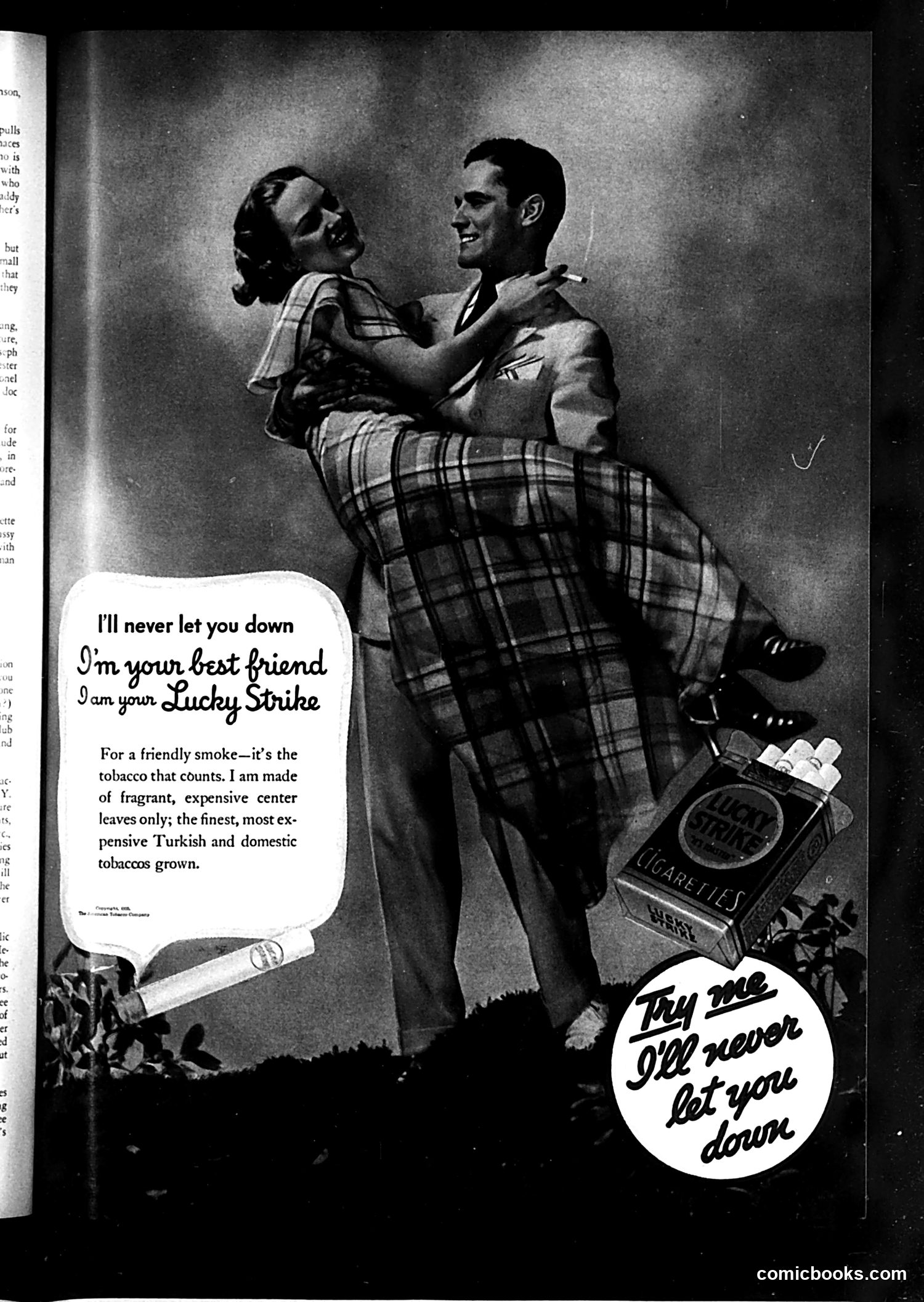
# Analysis This is a **Lucky Strike cigarette advertisement**, not political satire. The ad uses romantic imagery to market cigarettes to mid-20th-century consumers. The scene depicts a man carrying a woman wrapped in a plaid blanket, both smiling. The accompanying text presents the cigarettes as a "best friend" and "Lucky Strike"—using friendship and romance as selling points. The ad emphasizes that Lucky Strikes are made from "fragrant, expensive center leaves only" and "the finest, most expensive Turkish and domestic tobaccos grown." **For modern readers:** This represents pre-warning-label cigarette advertising that normalized smoking as desirable, romantic behavior. The "friendly smoke" messaging targeted consumers before widespread understanding of health risks. Such ads are now prohibited, making this a historical artifact of mid-century marketing practices.
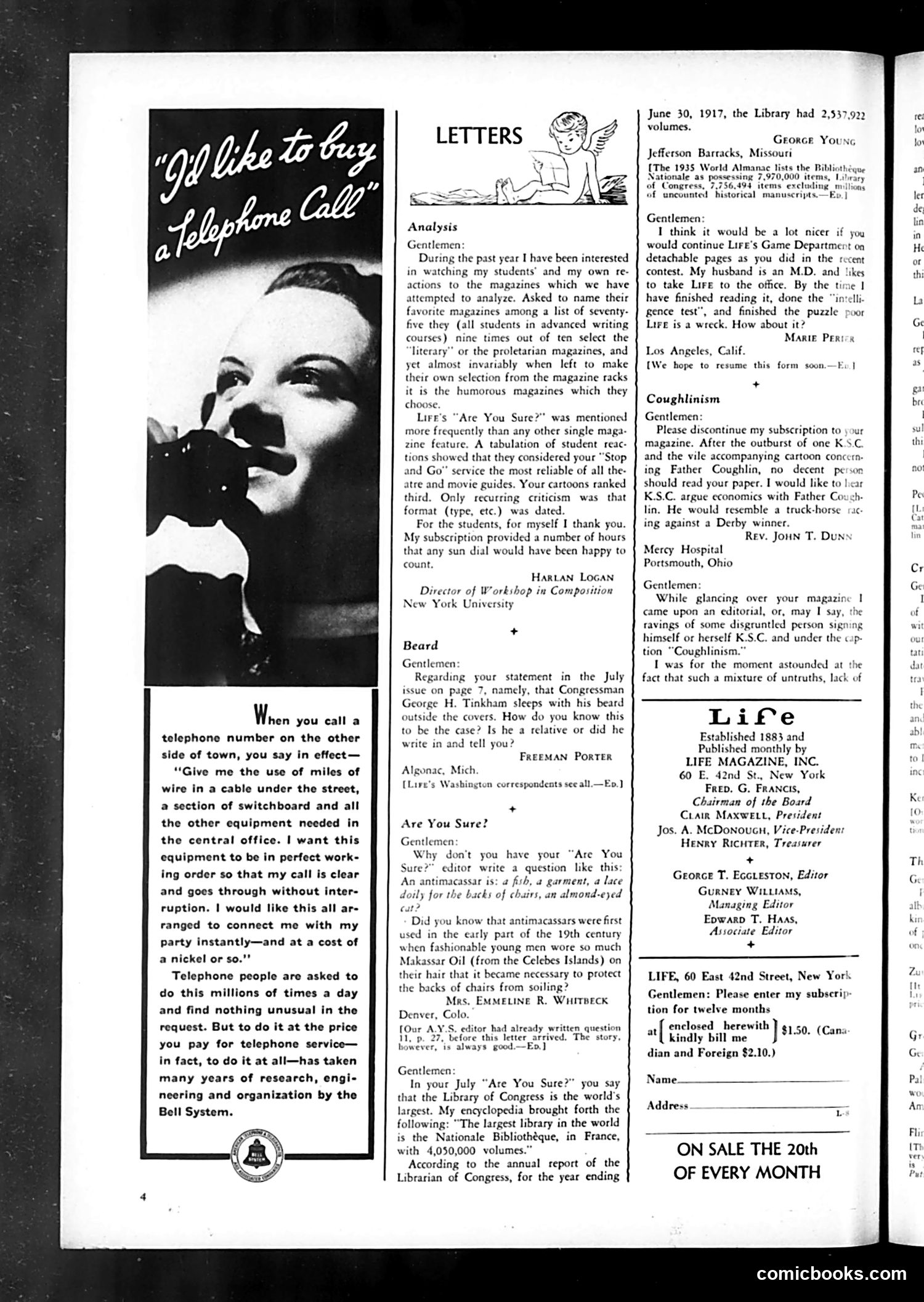
# Analysis of This Life Magazine Page This page is primarily a **letters section and masthead** rather than a satirical cartoon. The left side features a **Bell System telephone advertisement** showing a man using a telephone, promoting the reliability and reach of telephone service across distances. The right side contains reader letters on various topics—magazine preferences, subscription complaints about "Coughlanism" (an anti-Catholic viewpoint the reader opposes), and editorial questions about library sizes and historical facts. The magazine's masthead identifies it as *Life*, established 1883, published monthly by Life Magazine, Inc., with Fred G. Francis as Chairman and George T. Eggleston as Editor. **No political satire or caricature appears on this page**—it's functional magazine infrastructure with advertising.
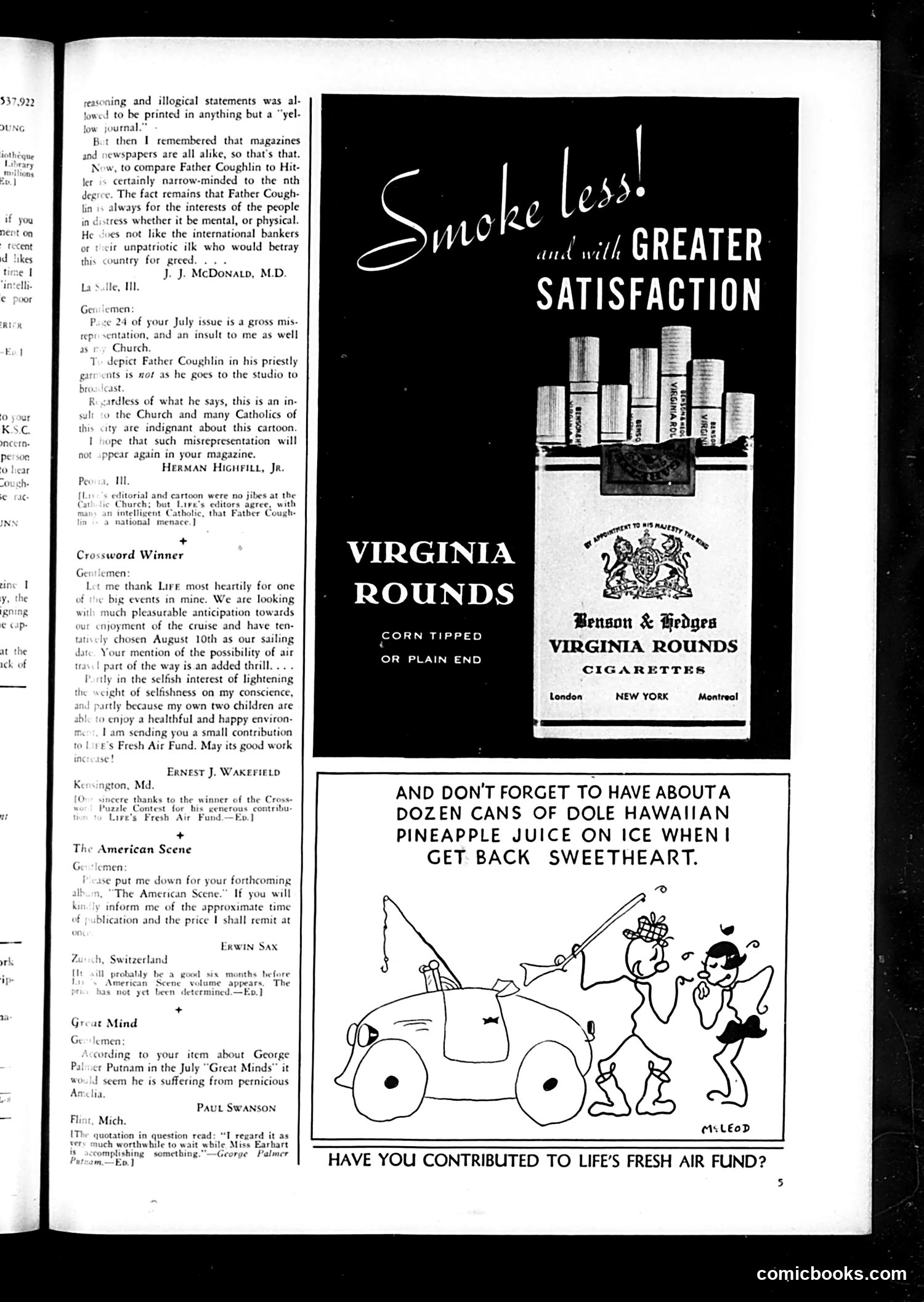
# Content Analysis This page contains **mostly advertisements and reader letters**, not political cartoons. The main visual content includes: 1. **Virginia Rounds cigarette ad** (top right) - promoting "smoke less and with greater satisfaction," showing cigarette packages 2. **Dole Hawaiian Pineapple juice advertisement** (bottom) - featuring a cartoon of people enjoying juice, with the tagline "AND DON'T FORGET TO HAVE ABOUT A DOZEN CANS OF DOLE HAWAIIAN PINEAPPLE JUICE ON ICE WHEN I GET BACK SWEETHEART" The left column contains reader letters addressing previous magazine content, including discussion of Father Coughlin (a controversial Catholic priest of the era) and complaints about editorial decisions. The bottom asks "HAVE YOU CONTRIBUTED TO LIFE'S FRESH AIR FUND?" - referring to a charitable initiative. This appears to be a typical magazine page mixing advertising revenue with reader correspondence.
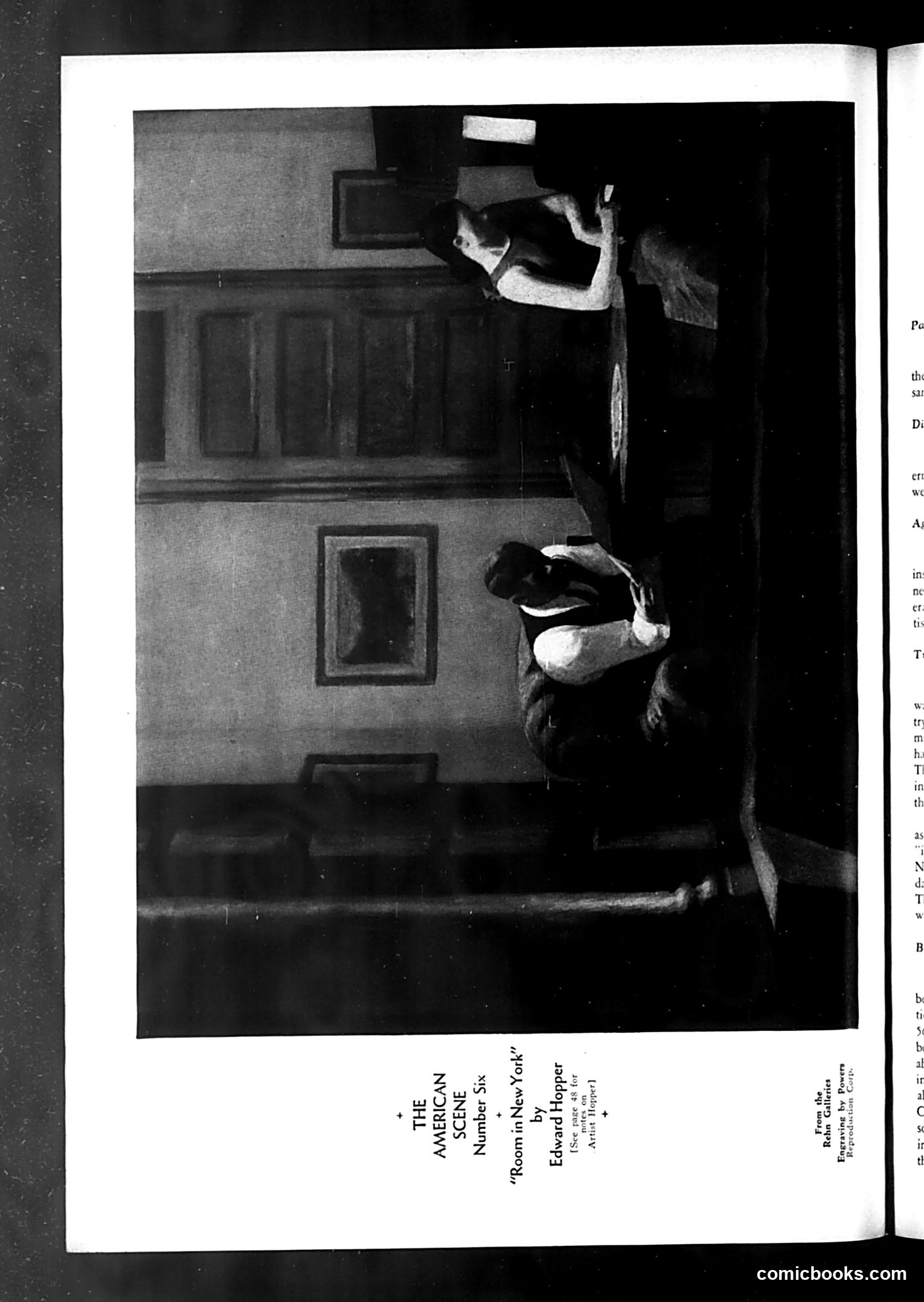
# Analysis This page from *Life* magazine shows "The American Scene" titled "Number 5-x" with a scene labeled "Room in New York" by Edward Hopper. The image depicts Hopper's famous painting of urban isolation: a man and woman in a sparse apartment interior. The woman sits on a bed reading while the man stands nearby, both absorbed in separate activities, indifferent to each other's presence. Rather than political satire, this represents *Life*'s cultural commentary section featuring fine art. The "American Scene" series documented contemporary American life through visual art. Hopper's work exemplifies early 20th-century modernism's exploration of urban alienation and emotional distance—themes particularly resonant during America's industrial expansion. The painting critiques modern relationships' emotional disconnection within crowded city living.
# Analysis of Life Magazine Page This satirical page mocks Congressional inefficiency and waste. The "Bill Yards" section notes that since 1789, Congress has introduced over 1,500,000 bills and resolutions—yet only about 13 or fewer per cent become law. Senator Copeland allegedly led the pack in 1936 with 250 bills and resolutions introduced. The "Song of the Supreme Court" parodies judicial self-importance, with nine justices singing that they avoid common concerns (postage stamps, telephones, infants) while serving as the "court of last resort in litigational legal." The chorus celebrates constitutional authority. The overall satire criticizes both legislative prolixity and judicial pomposity—Congress generates mountains of useless paperwork while the Supreme Court remains aloof from ordinary life.
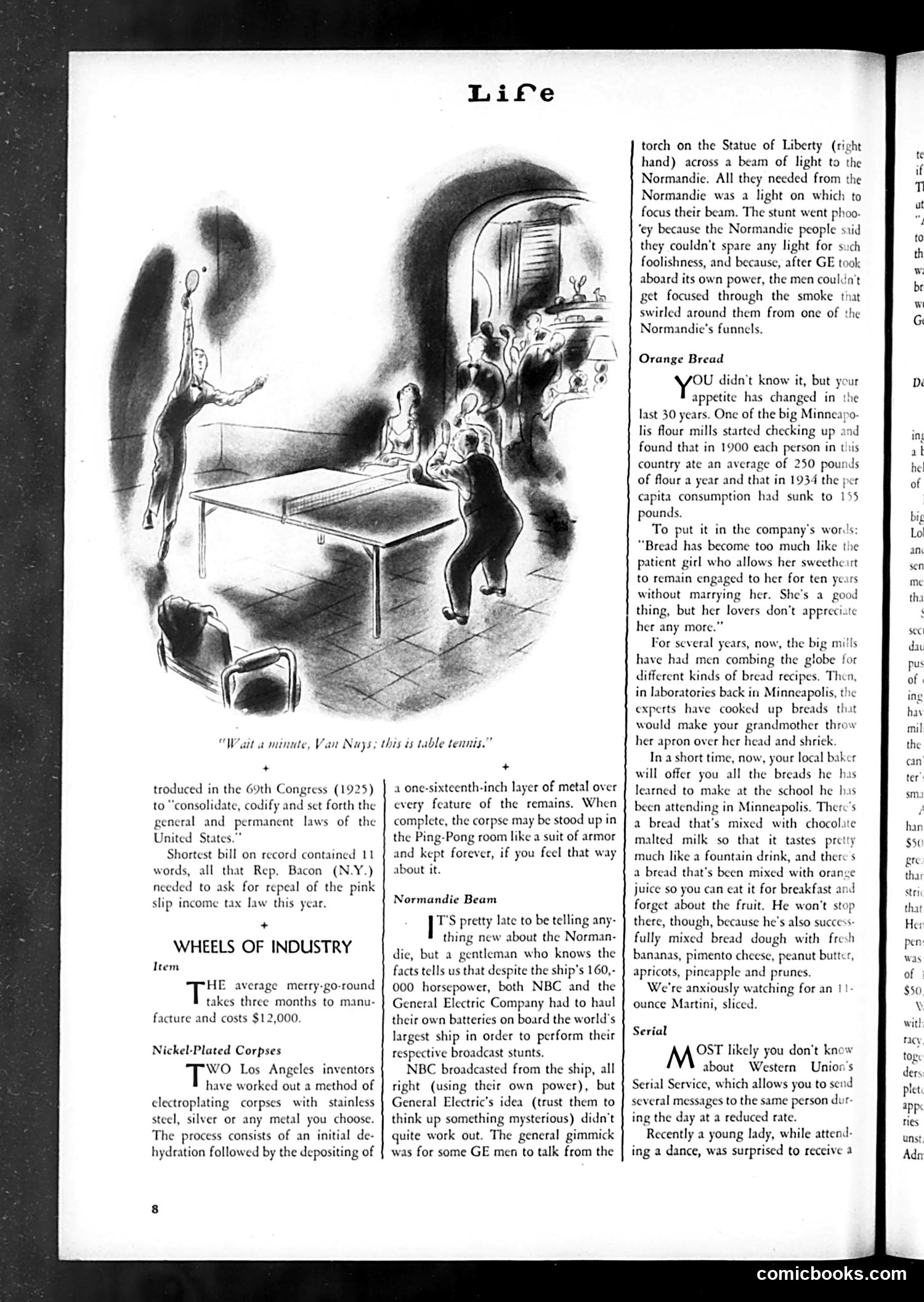
# Political Cartoon Analysis The main cartoon on this page depicts a surreal, nightmarish scene with angelic and demonic figures around a table, captioned "Wait a minute, Wait Nays; this is table tennis." The image appears to be satirizing congressional debate or political maneuvering, likely referencing a specific legislative dispute. The caption's wordplay on "Wait" (possibly referencing a legislator's name) and "Nays" (voting terminology) suggests this mocks the formal procedures of Congress while the chaotic illustration emphasizes the absurdity or pandemonium behind closed doors. The accompanying articles discuss industrial manufacturing and consumer products, placing this in a broader context of American economic and technological commentary typical of *Life* magazine's satirical approach to contemporary issues.
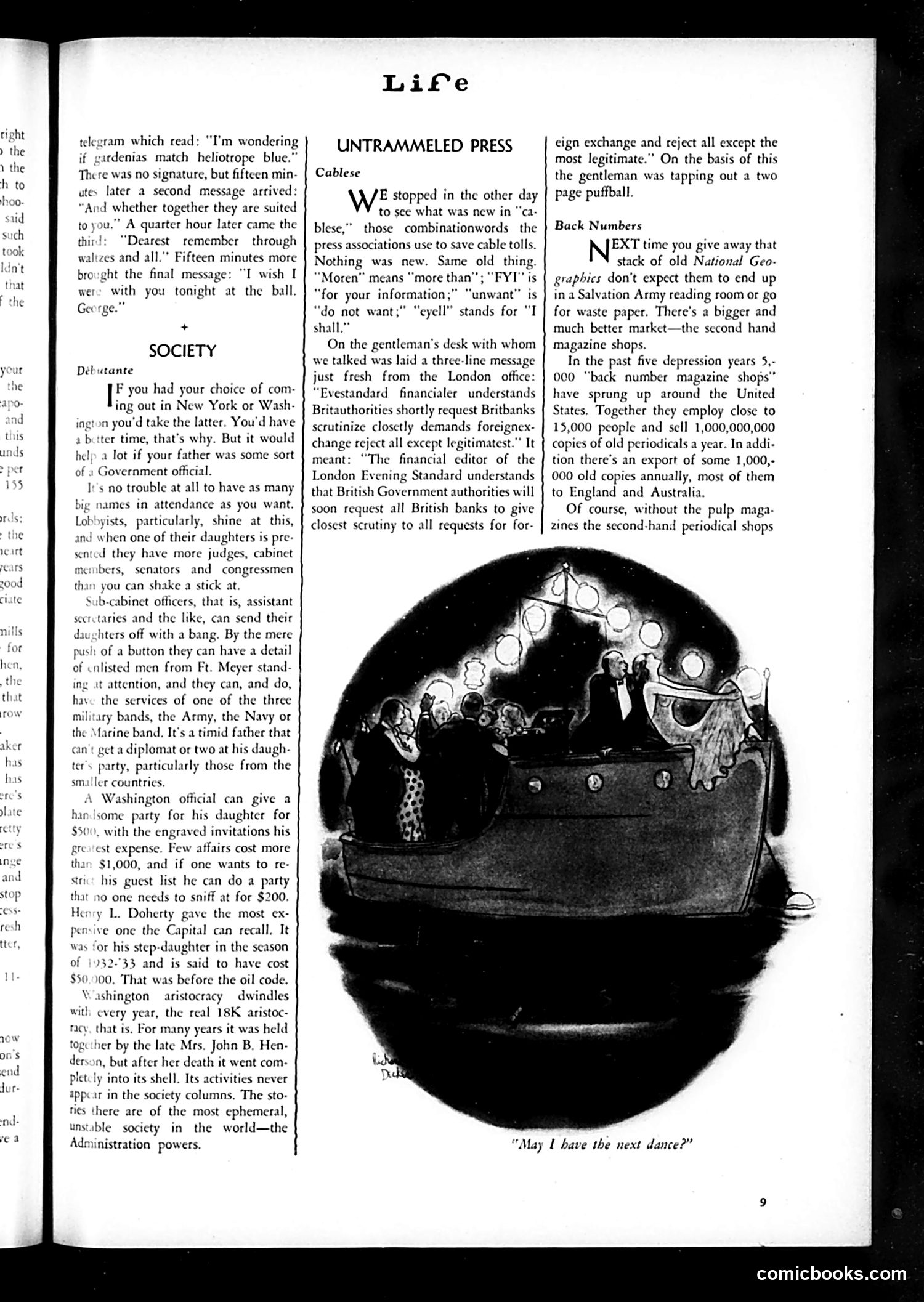
# "May I have the next dance?" — Life Magazine Cartoon This cartoon depicts a formal dance or nightclub scene, showing elegantly dressed couples in what appears to be an upscale venue with hanging lights. A man in formal wear is asking a woman to dance, a conventional social interaction. The humor likely stems from the contrast between the refined, polished social setting and whatever unspoken tension or awkwardness the simple request implies. Given the page's "Society" section discusses Washington aristocracy and social conventions of the era, the cartoon probably satirizes the artificial politeness and rigid etiquette governing upper-class social interactions—where even a dance request carries weight and formality. The cartoon's point appears to be gentle mockery of how seriously high society treats routine social rituals.
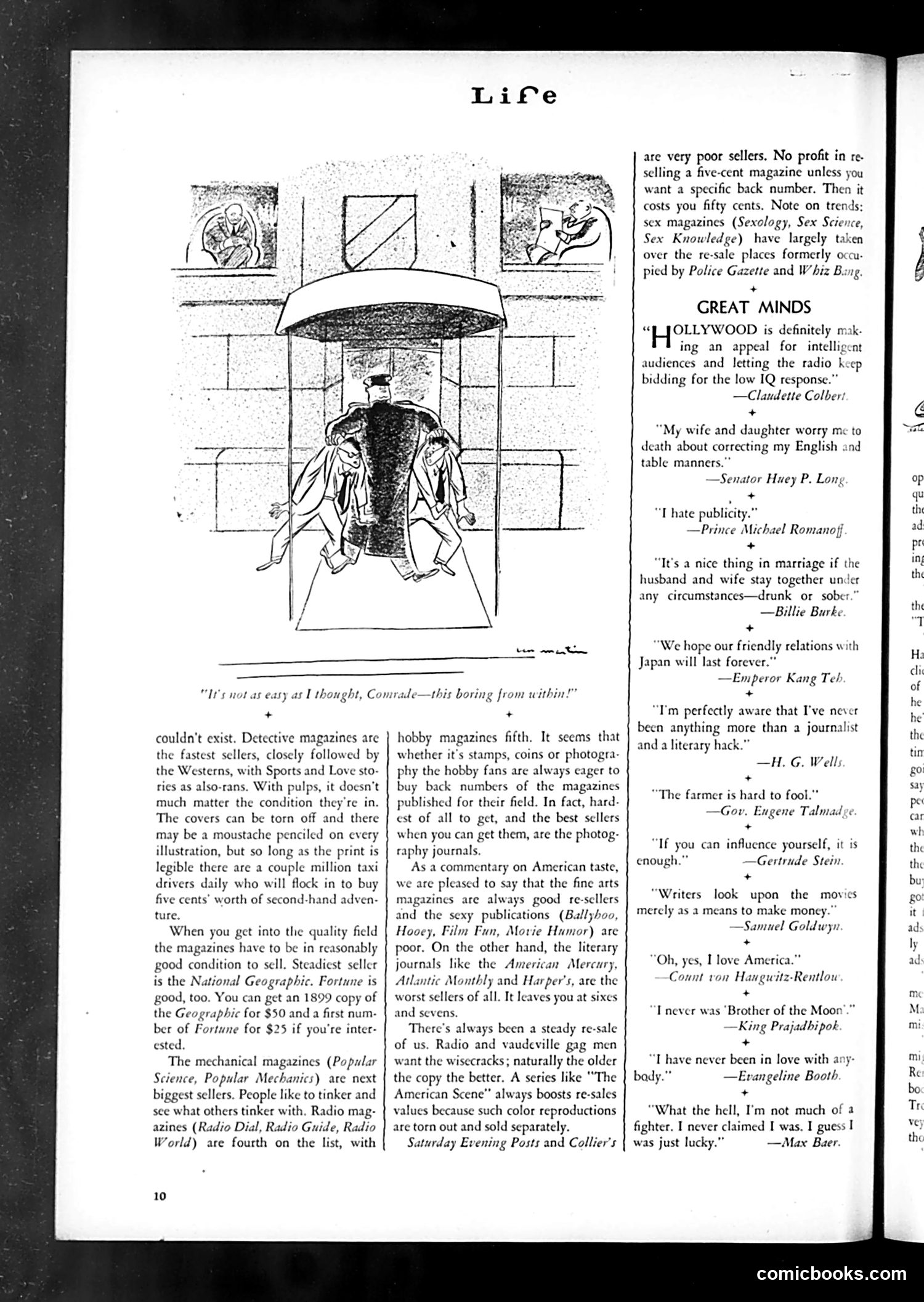
# Analysis of Life Magazine Page The central cartoon depicts a person emerging from what appears to be a large radio or broadcasting device, with the caption "It's not as easy as I thought, Comrade—this boring from within!" The joke references communist infiltration fears during the Cold War era. The figure (likely representing a Soviet agent or communist propagandist) expected to easily undermine American society through radio broadcasting but is frustrated by the difficulty of the task. "Boring from within" was a contemporary phrase describing communist subversion tactics. The right column contains humorous quotes attributed to public figures (Claudette Colbert, Prince Michael Romanoff, etc.), typical of Life's satirical format. This reflects 1950s American anxiety about communist propaganda and media influence during the Red Scare period.