A complete issue · 50 pages · 1934
Life — October 1934
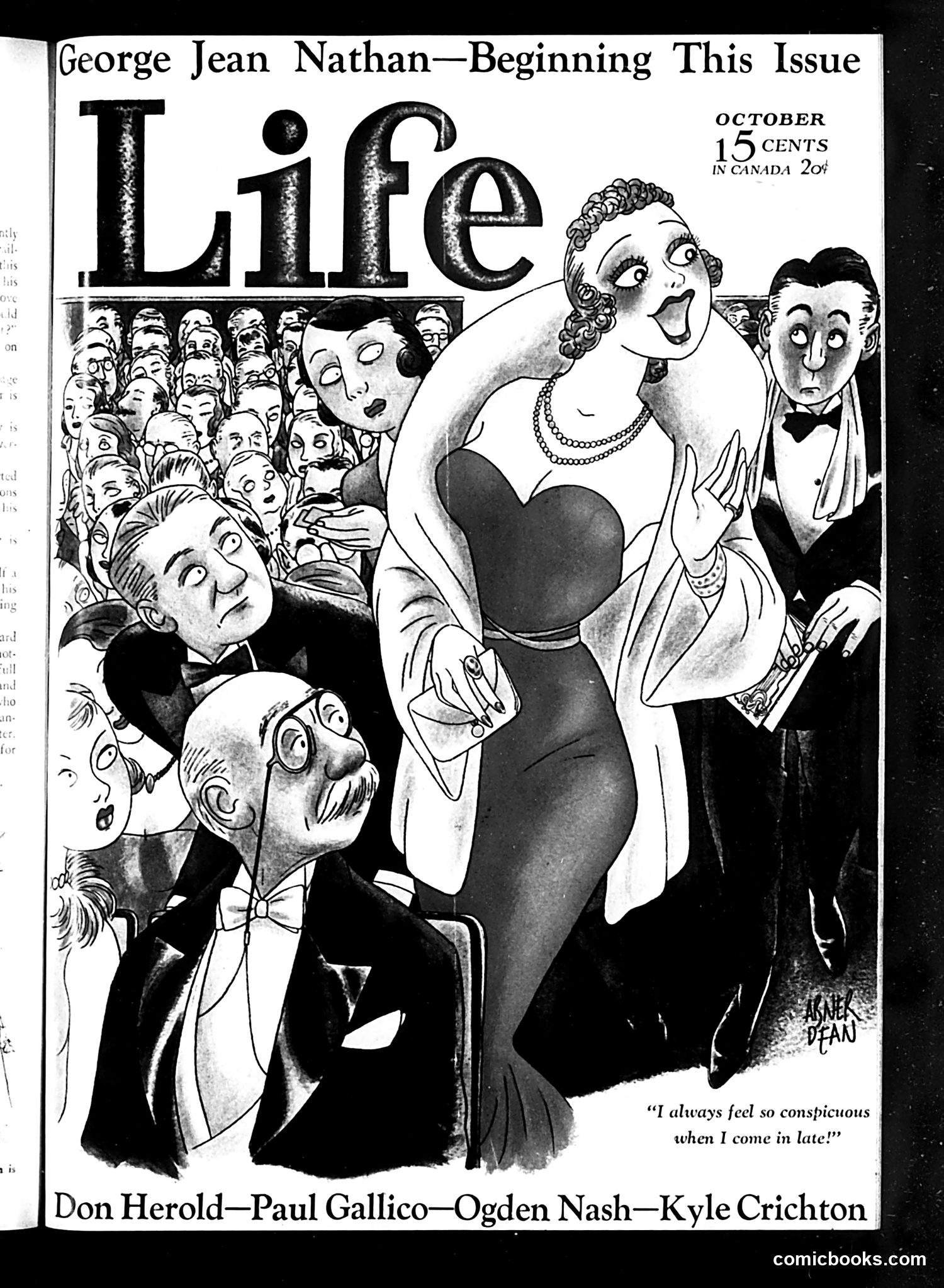
# Life Magazine Cover Analysis This is the October cover of *Life* magazine (15 cents), featuring an illustration by Arsne Péan. The cover depicts a theatrical scene—likely from a Broadway show or nightclub—where a woman in an elegant dress and pearls enters late, drawing the attention of the formally dressed audience members around her. The caption reads: "I always feel so conspicuous when I come in late!" The satire is straightforward social humor: the woman's concern about being conspicuous contradicts reality, as her glamorous appearance and confident demeanor actually make her the center of attention. The joke plays on the disconnect between her self-consciousness and the obvious admiration she receives. The issue features contributions from Don Herold, Paul Gallico, Ogden Nash, and Kyle Crichton.
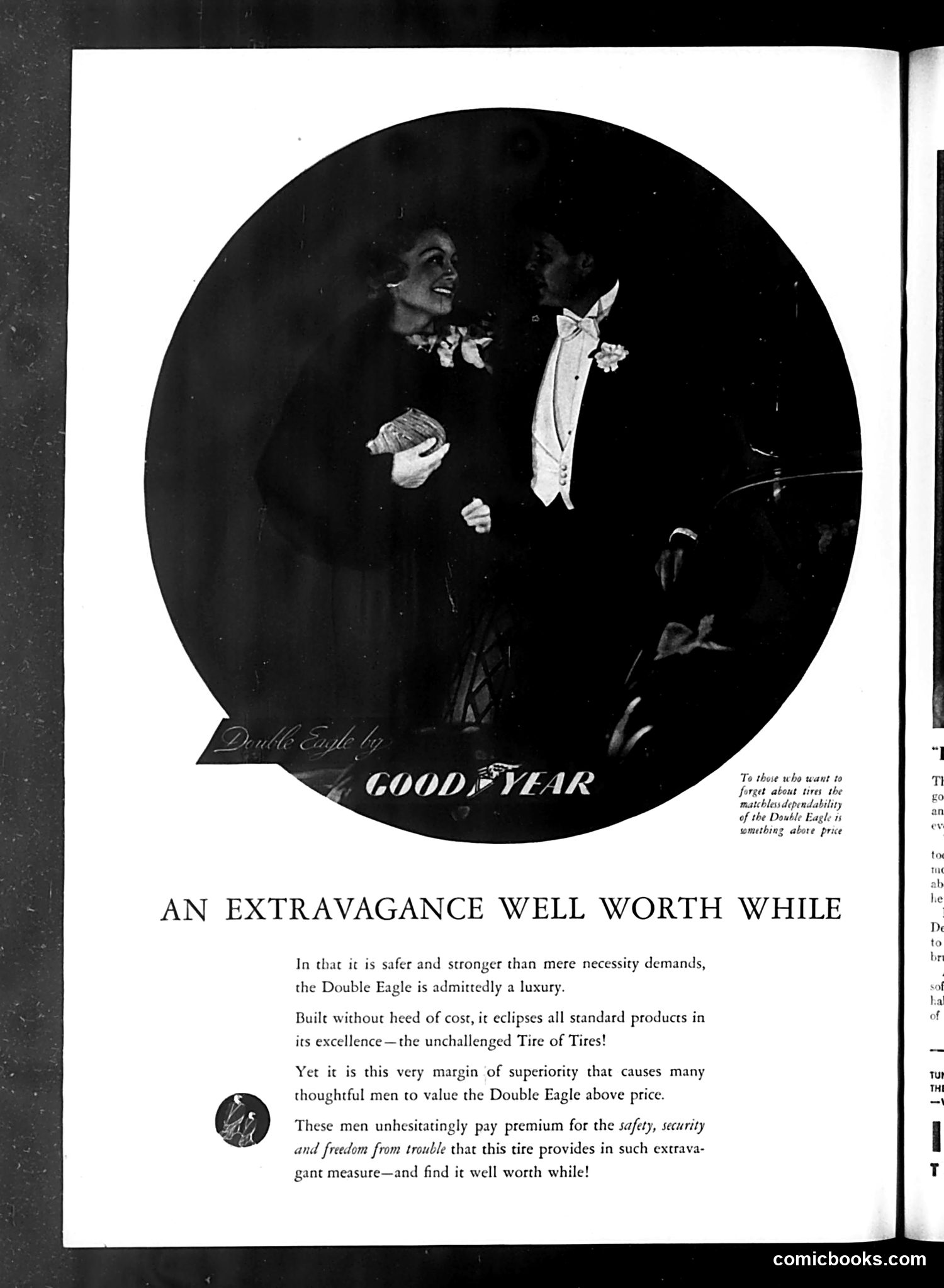
# Analysis This is a **Goodyear tire advertisement**, not political satire. The circular vignette shows two well-dressed figures in formal evening wear (tuxedo and elegant gown) appearing to converse at what seems to be a social event. The ad headline reads "AN EXTRAVAGANCE WELL WORTH WHILE." The marketing pitch argues that Goodyear's "Double Eagle" tire is a luxury product—"safer and stronger than mere necessity demands"—positioned above standard tires. The copywriting appeals to affluent consumers, suggesting that "thoughtful men" willingly pay premium prices for superior "safety, security and freedom from trouble." This reflects 1920s-era advertising strategy: marketing durability and reliability as aspirational luxury goods for the wealthy, rather than practical necessities for all drivers.
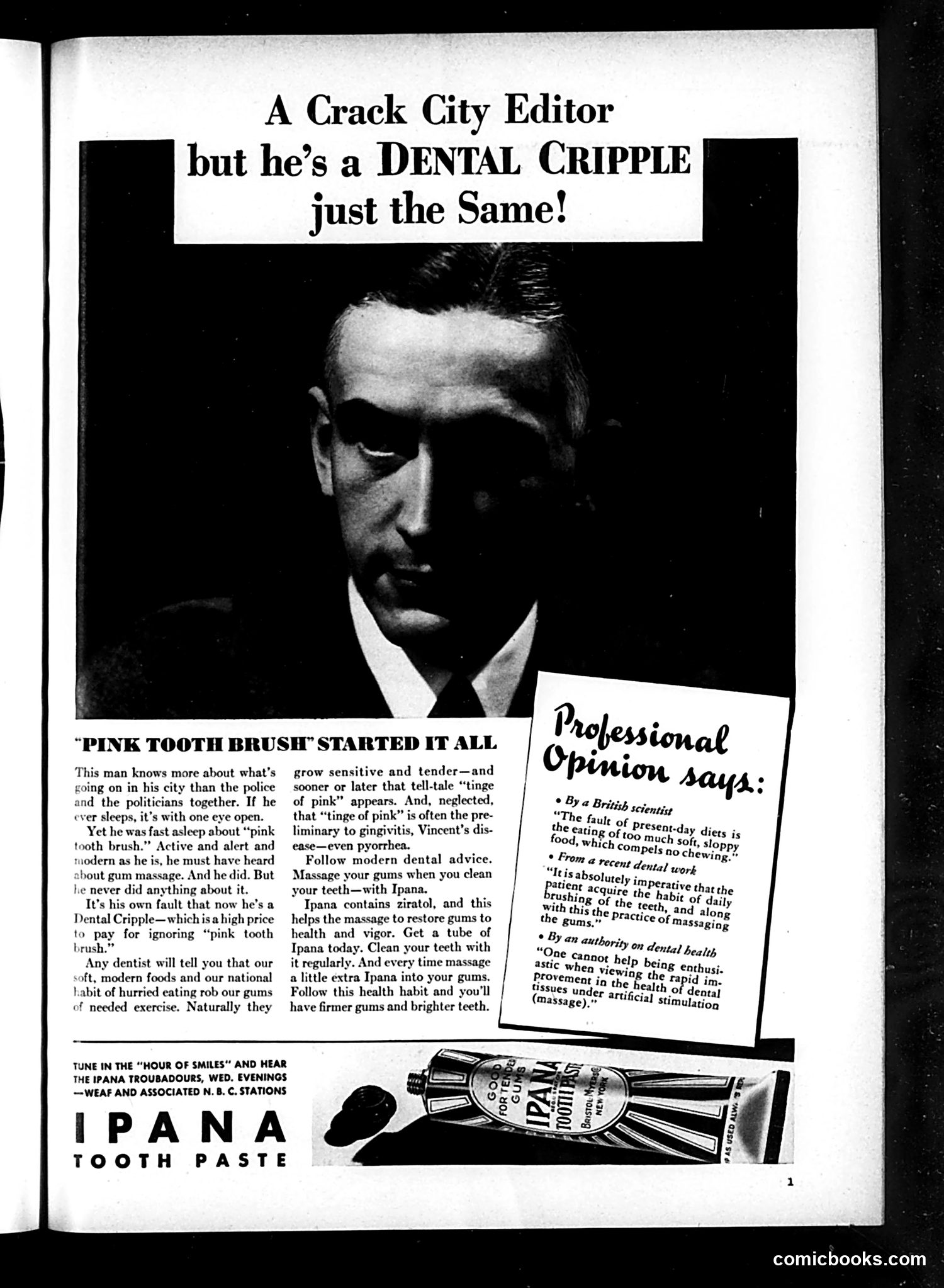
# Analysis This is a **Ipana toothpaste advertisement**, not political satire. The headline mockingly identifies the subject as "A Crack City Editor but he's a DENTAL CRIPPLE just the same!" The ad uses shame-based marketing: it portrays a professional man (the "crack city editor") who, despite his competence and alertness in his job, supposedly suffers from poor dental health due to neglecting the "pink tooth brush" routine. The implication is that even successful, intelligent men can be undermined by bad teeth. The "Professional Opinion" sidebar quotes British dental experts endorsing Ipana's gum-massage approach and the use of Ipana toothpaste containing ziratel. The satire targets the gap between professional competence and personal grooming standards—a common mid-century advertising trope suggesting that dental neglect could undermine one's social standing.
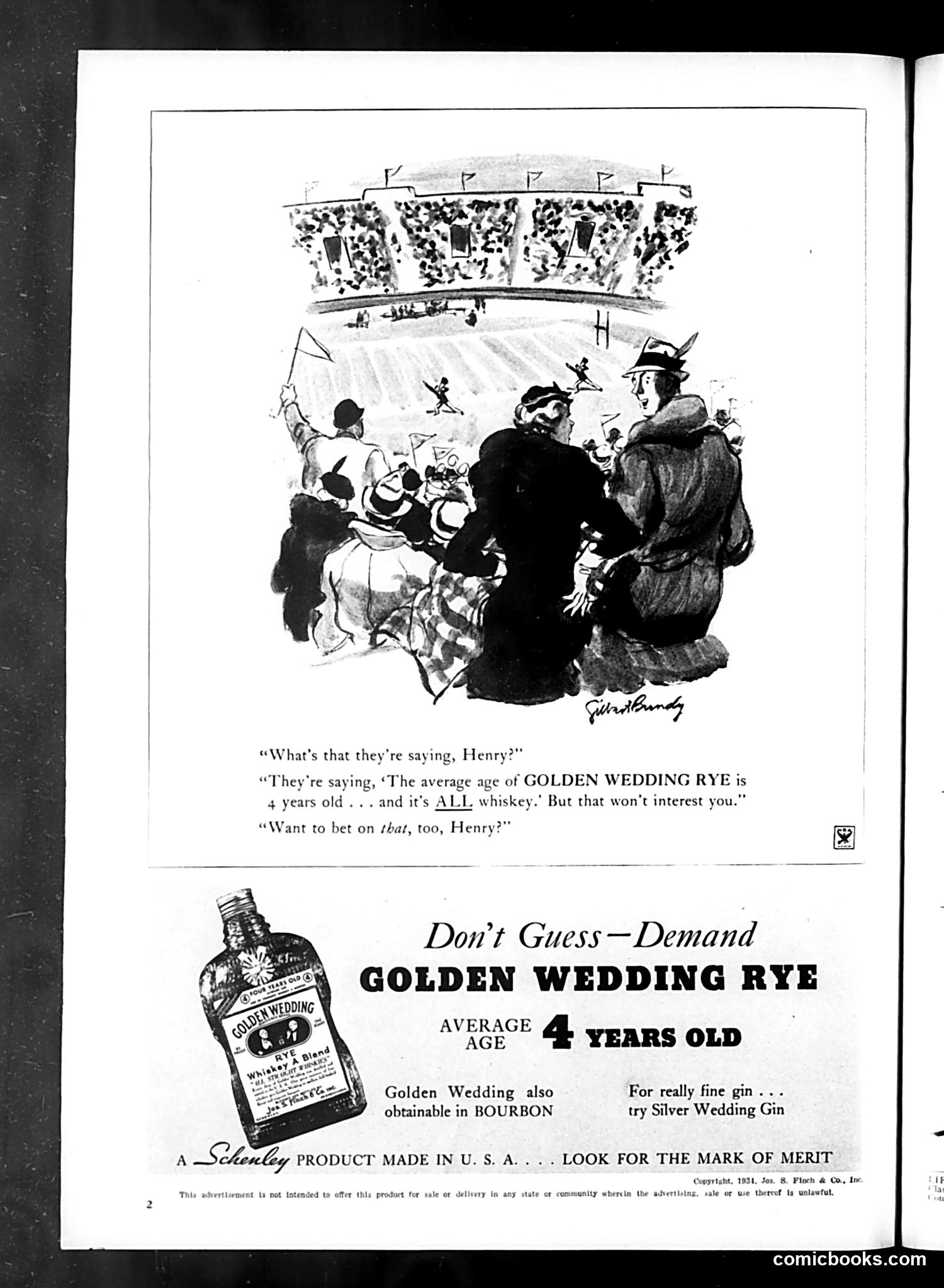
# Analysis This page is primarily a **whiskey advertisement** for Golden Wedding Rye, disguised as editorial content. The cartoon depicts well-dressed spectators at what appears to be a sporting event or horse race, discussing the whiskey's age. The joke plays on the phrase "Don't guess—demand," suggesting consumers should insist on Golden Wedding Rye rather than accept inferior substitutes. The humor hinges on treating whiskey age as conversation-worthy at social events—the implication being that knowledgeable drinkers discuss spirits' quality the way they might discuss horses or sporting outcomes. The characters are generic gentlemen of apparent wealth, representing the target demographic. The advertisement emphasizes the product is "4 years old" and "ALL whiskey," positioning Golden Wedding as premium. A secondary product line, Silver Wedding Gin, is mentioned. This is typical 1930s advertising strategy: wrapping commercial messages in satirical cartoon format to increase engagement.
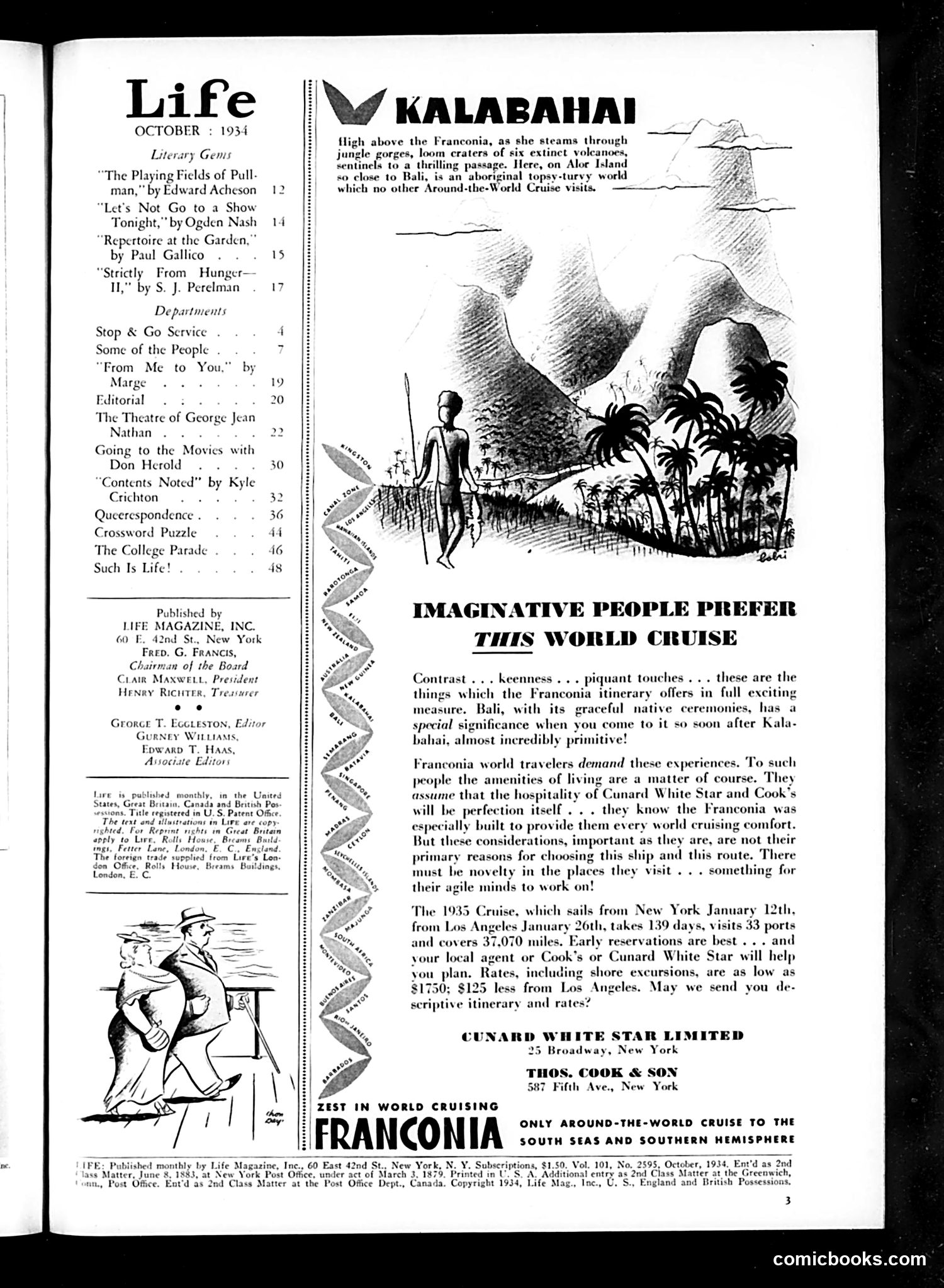
# Analysis This page is primarily **advertising** for the Franconia, an around-the-world cruise ship. The main illustration depicts a traveler observing exotic volcanic peaks and palm trees, representing the adventure of global travel. The small cartoon at lower left shows a man at a ship's railing, likely illustrating the leisure and romance of ocean cruising—a common marketing image of the era. The text emphasizes that wealthy travelers seeking novelty and exotic experiences prefer this cruise because it visits unusual ports like Bali and Kalabahi (in Indonesia), offering "something for their agile minds to work on." The 1935 cruise would depart from New York or Los Angeles and cost around $1,750. This reflects 1934 American aspirations for luxury travel during the Depression era, targeting affluent audiences who could afford such indulgences.
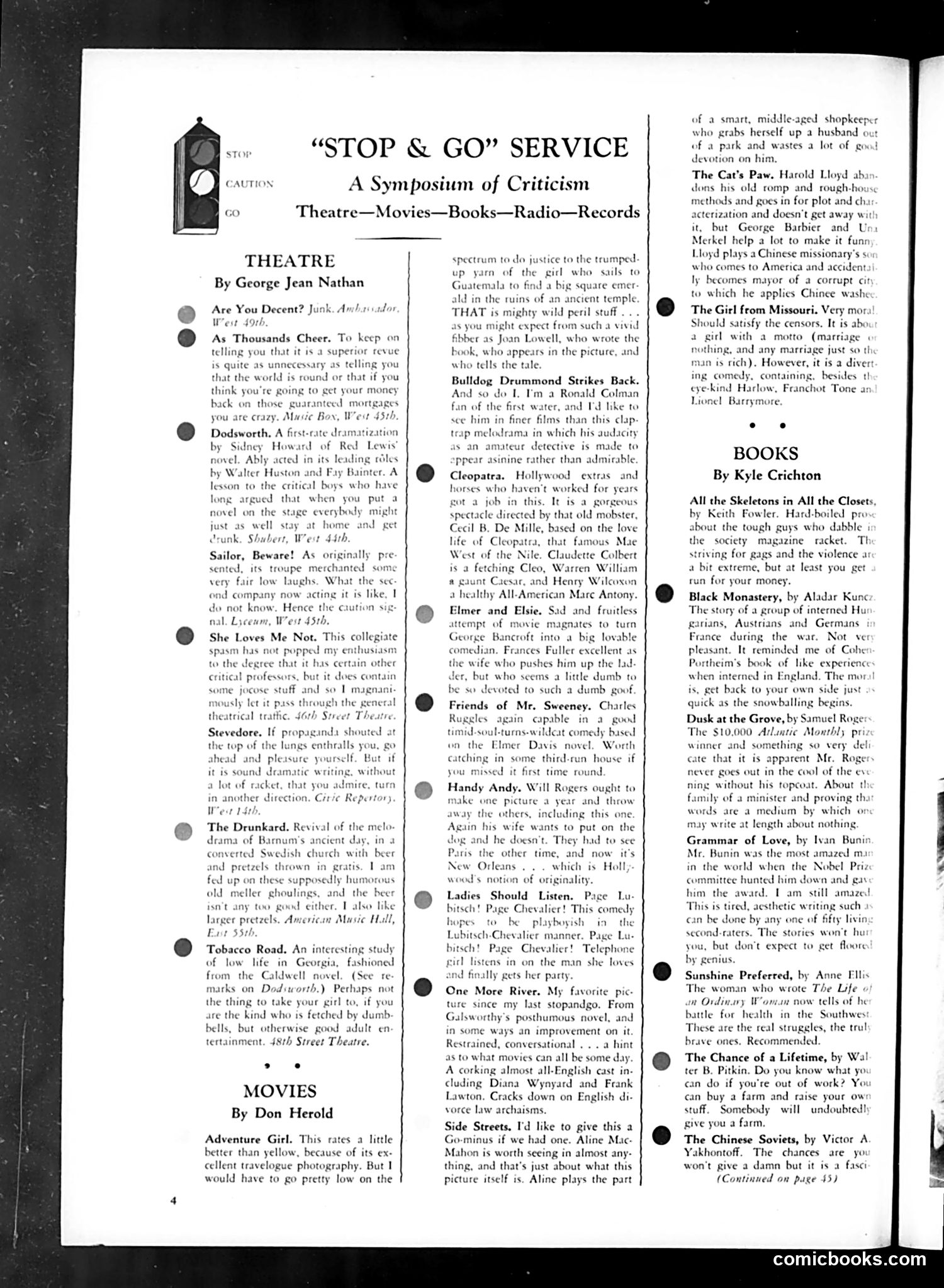
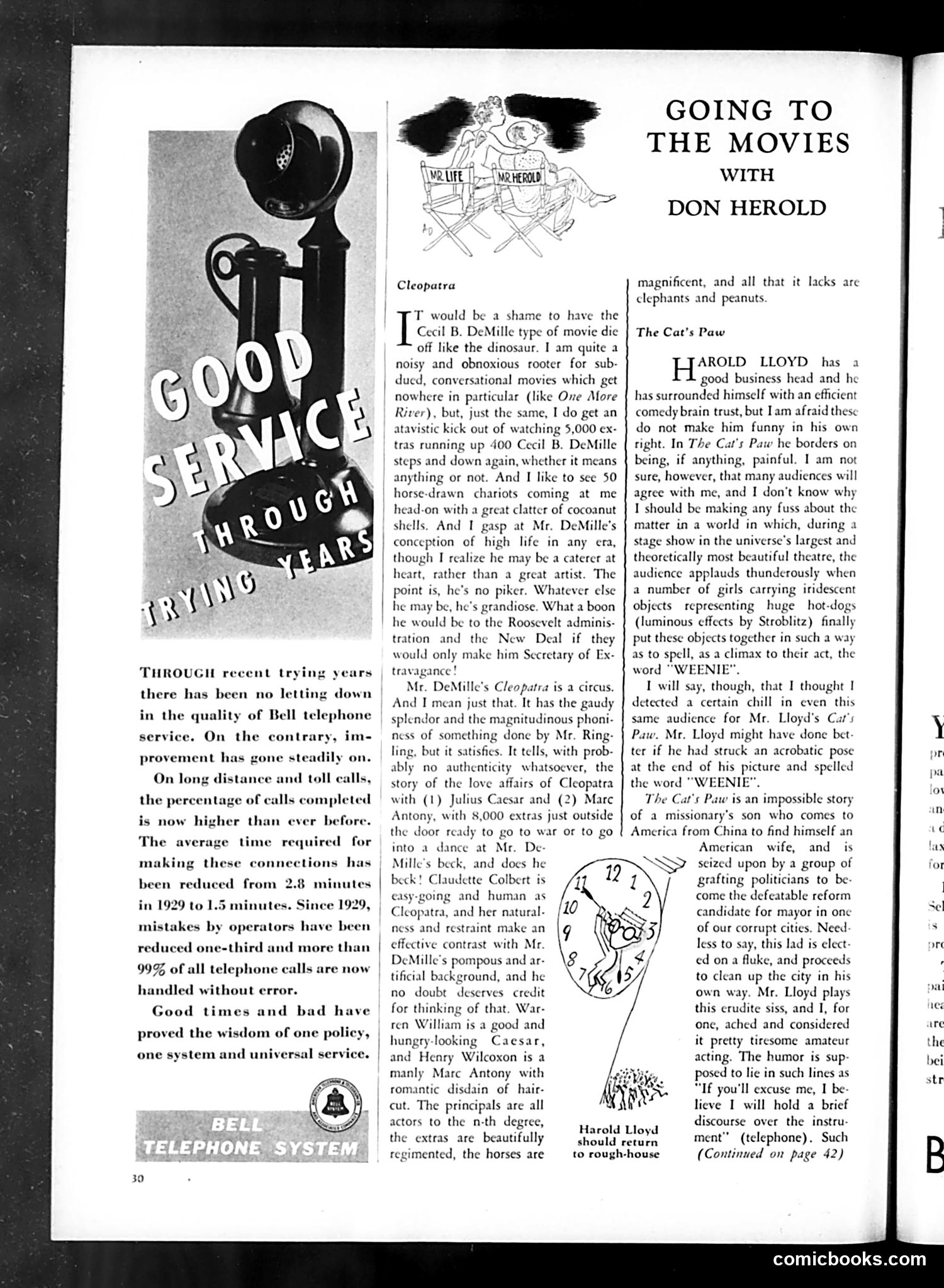
# "Stop & Go" Service: A Symposium of Criticism This page presents reviews of contemporary theatrical and film offerings by George Jean Nathan and Kyle Crichton. The "Stop & Go" header with its traffic-light imagery suggests the reviewers are directing audiences toward or away from various entertainments. The theater section critiques films and plays featuring Hollywood stars of the era—Harold Lloyd, Joan Lowell, Cecil B. DeMille, and others. Nathan and Crichton offer pointed judgments on plot, acting, and execution, praising some works while dismissing others as derivative or poorly conceived. The reviews serve Life magazine's satirical mission: providing witty, informed cultural commentary that entertains while guiding readers' entertainment choices. This format exemplifies how mid-century magazines positioned themselves as arbiters of taste.
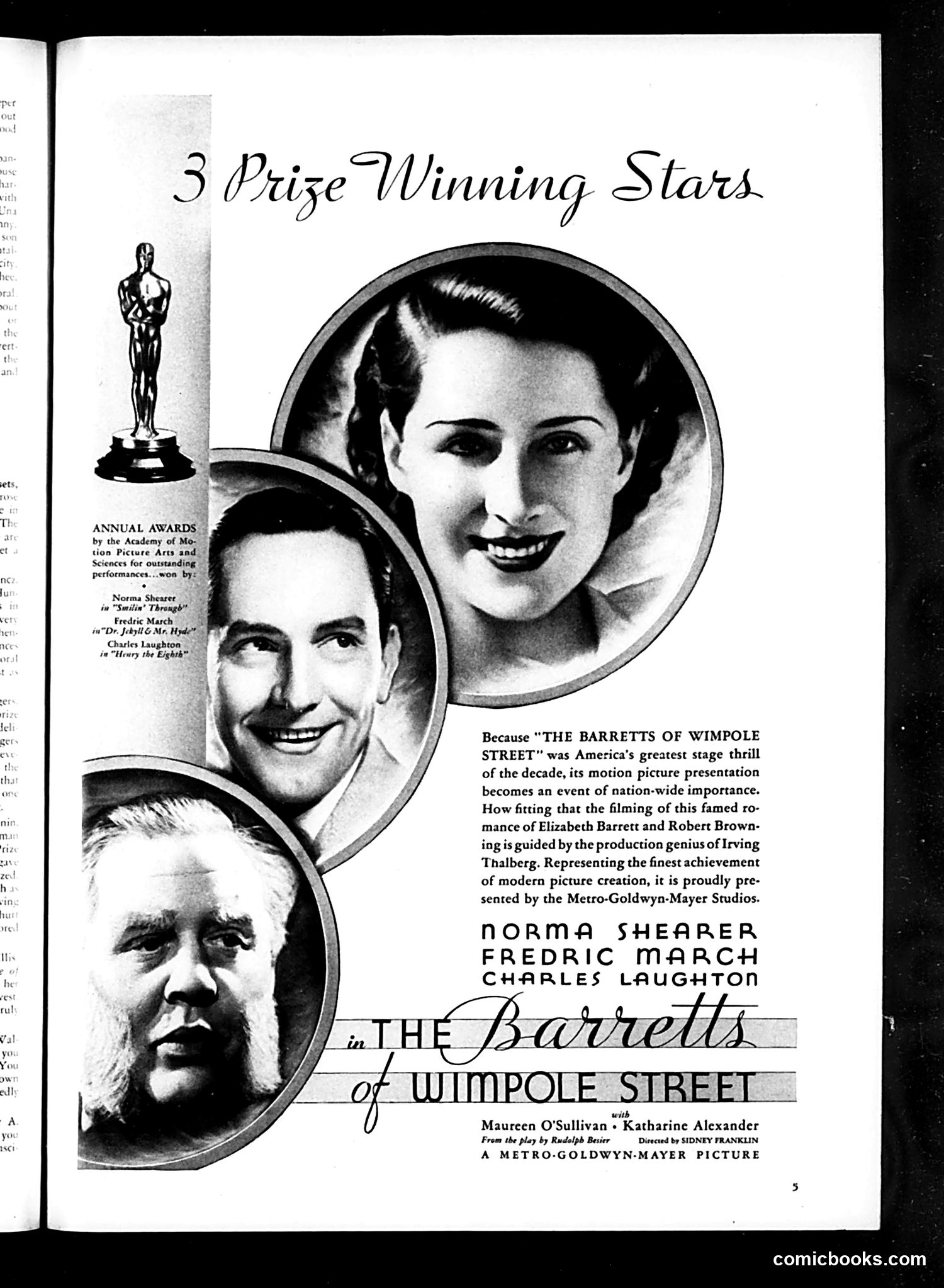
# Analysis This is **not a political cartoon**, but rather a **movie advertisement** from Life magazine. It promotes "The Barretts of Wimpole Street," a Metro-Goldwyn-Mayer film starring Norma Shearer, Fredric March, and Charles Laughton. The page celebrates the film's adaptation of a famous stage play into a major motion picture production. The headline "3 Prize Winning Stars" highlights the actors' prestige. An Oscar statue appears on the left, suggesting awards recognition. The text emphasizes how Irving Thalberg's production genius transformed this theatrical work into a cinema event "of nation-wide importance." This is essentially a studio promotional piece celebrating Hollywood's ability to translate celebrated stage drama into prestigious film entertainment—a common concern during cinema's transition from silent to talking pictures.
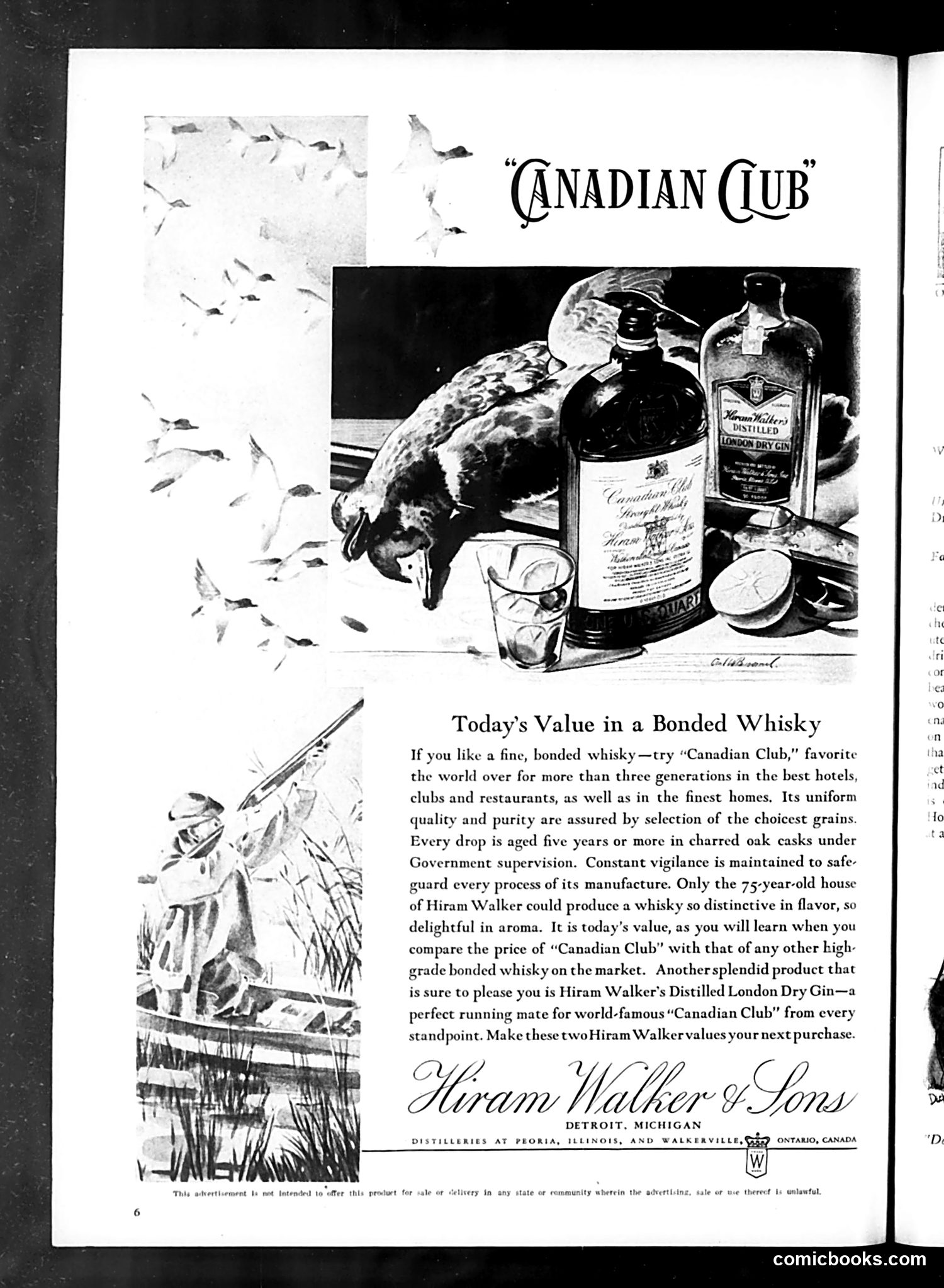
# Analysis This page is primarily a **Hiram Walker whisky advertisement**, not a political cartoon. There is no satire or social commentary present. The ad promotes "Canadian Club" bonded whisky, emphasizing its quality, purity, and five-year aging process in charred oak casks under Government supervision. The imagery shows bottles, a glass, hunting game, and a duck—evoking leisure and affluence. The text explicitly pitches the product as a "value" compared to other high-grade whiskies, and recommends pairing it with "Hiram Walker's Distilled London Dry Gin." The company is based in Detroit, Michigan with distilleries also in Peoria, Illinois and Walkerville, Ontario. This is straightforward commercial advertising from the Prohibition or early post-Prohibition era.
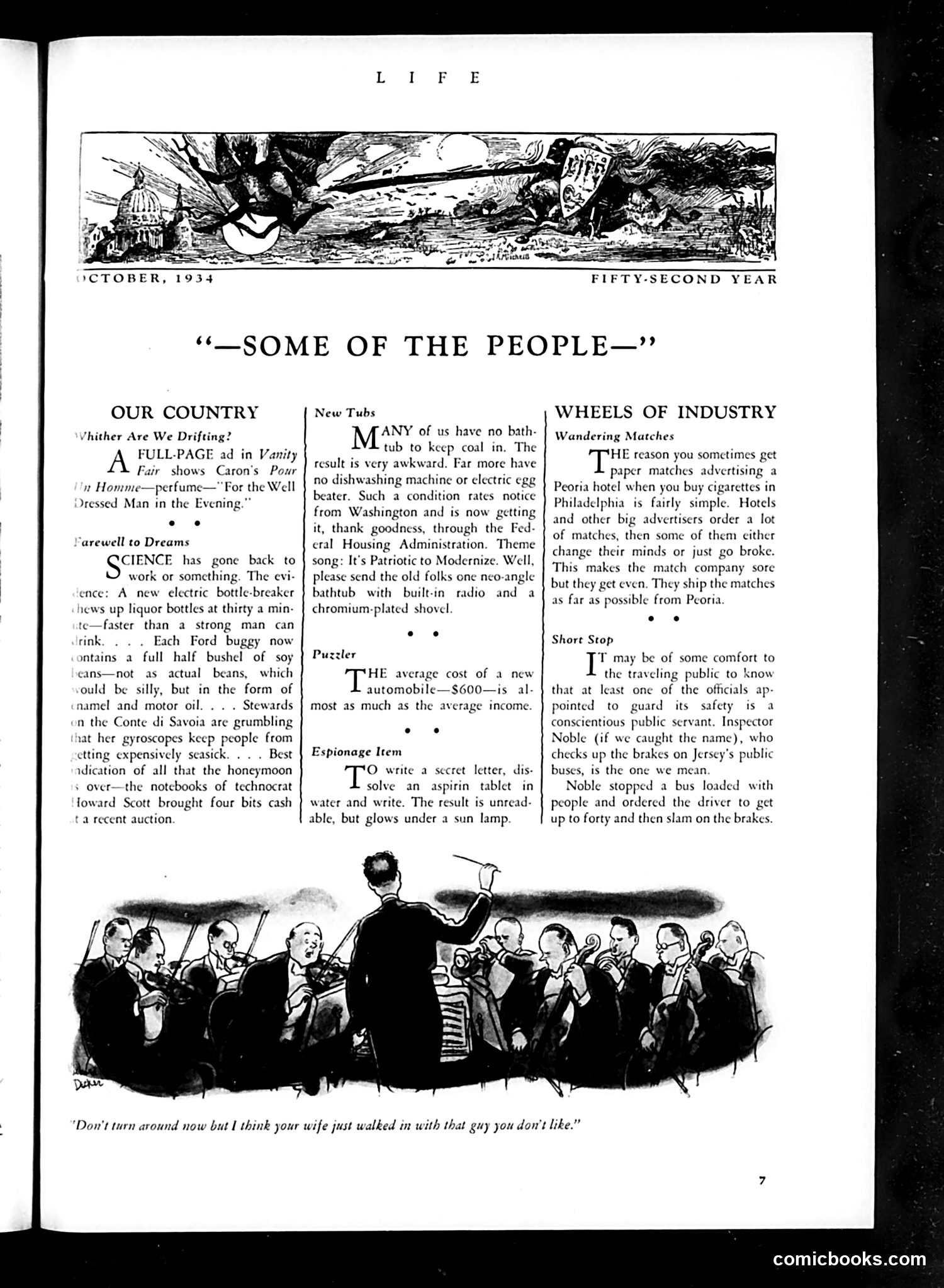
# October 1934 Life Magazine - Page Analysis This page contains three satirical pieces about contemporary American life during the Depression era: **"Our Country"** criticizes modernization and consumerism—mocking things like electric bottle-breakers and chromium-plated shovels as impractical luxuries when basic needs aren't met. **"Wheels of Industry"** humorously discusses match advertising and a conscientious bus safety inspector named Noble who aggressively enforces brake standards. **The cartoon** at bottom shows a conductor addressing an orchestra with the caption: "Don't turn around now but I think your wife just walked in with that guy you don't like." This is a domestic joke about infidelity, playing on the awkwardness of public social embarrassment. The overall tone satirizes American consumer culture, industrial "progress," and contemporary social anxieties during economically uncertain times.
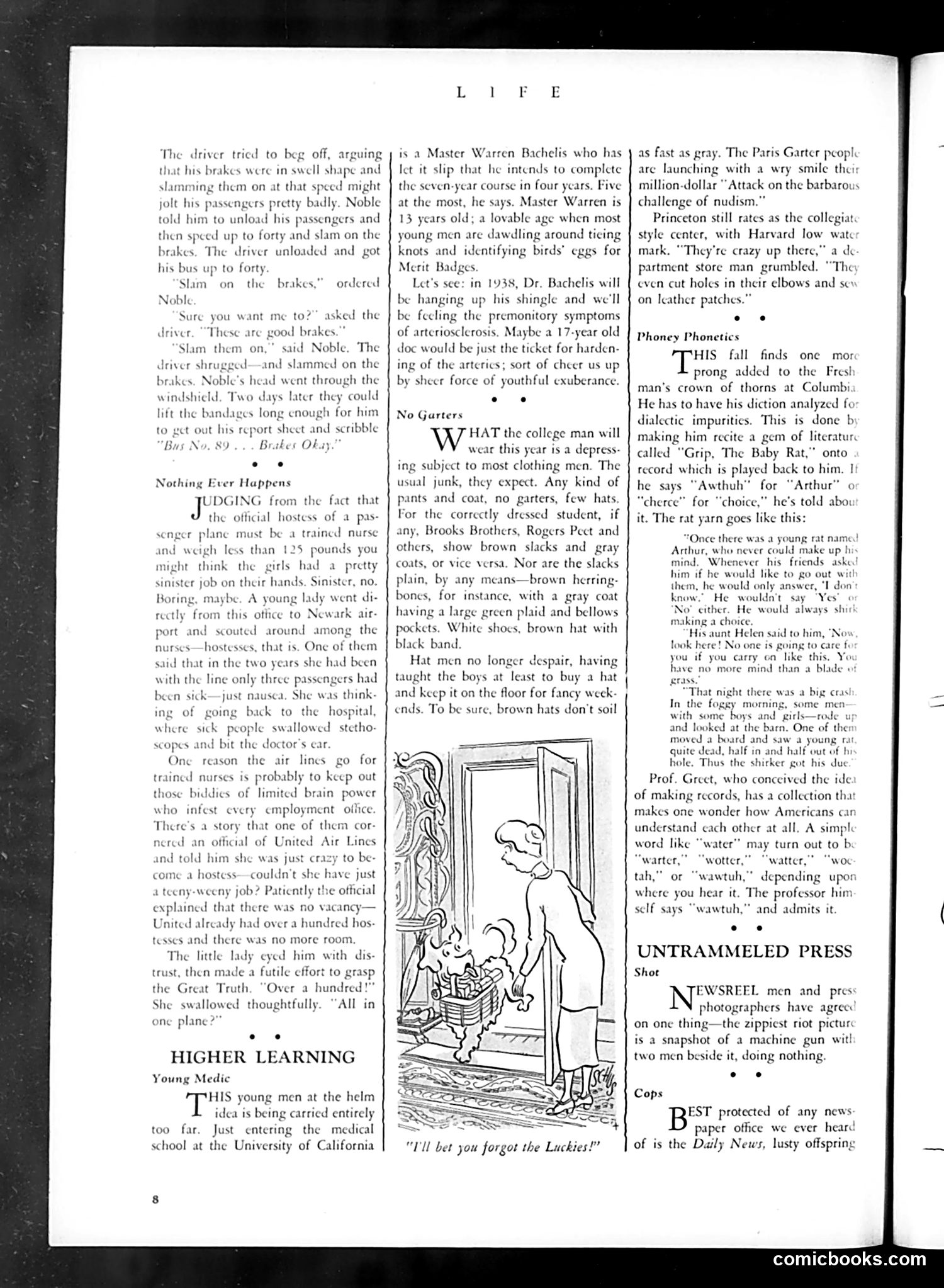
# Analysis of Life Magazine Page This page contains several brief satirical pieces typical of Life magazine's humor section. The main cartoon depicts a man at a doorway with a child, captioned "I'll bet you forgot the Luckies!" — advertising Lucky Strike cigarettes. The text sections mock various subjects: an airline passenger plane incident involving nurse "hostesses"; college fashion (mocking brown hats and proper dress codes); and phonetic humor where a French boy's mispronunciations of English words are presented as comedy ("Grip" for "gripe," "Arthur" for "Arthur"). Additional humor sections include "Untrammeled Press" (satirizing newsreel photographers) and "Cops" (about newspaper offices). The overall tone is light, domestic satire typical of 1930s-40s American humor magazines, blending social observation with product placement and casual stereotyping.
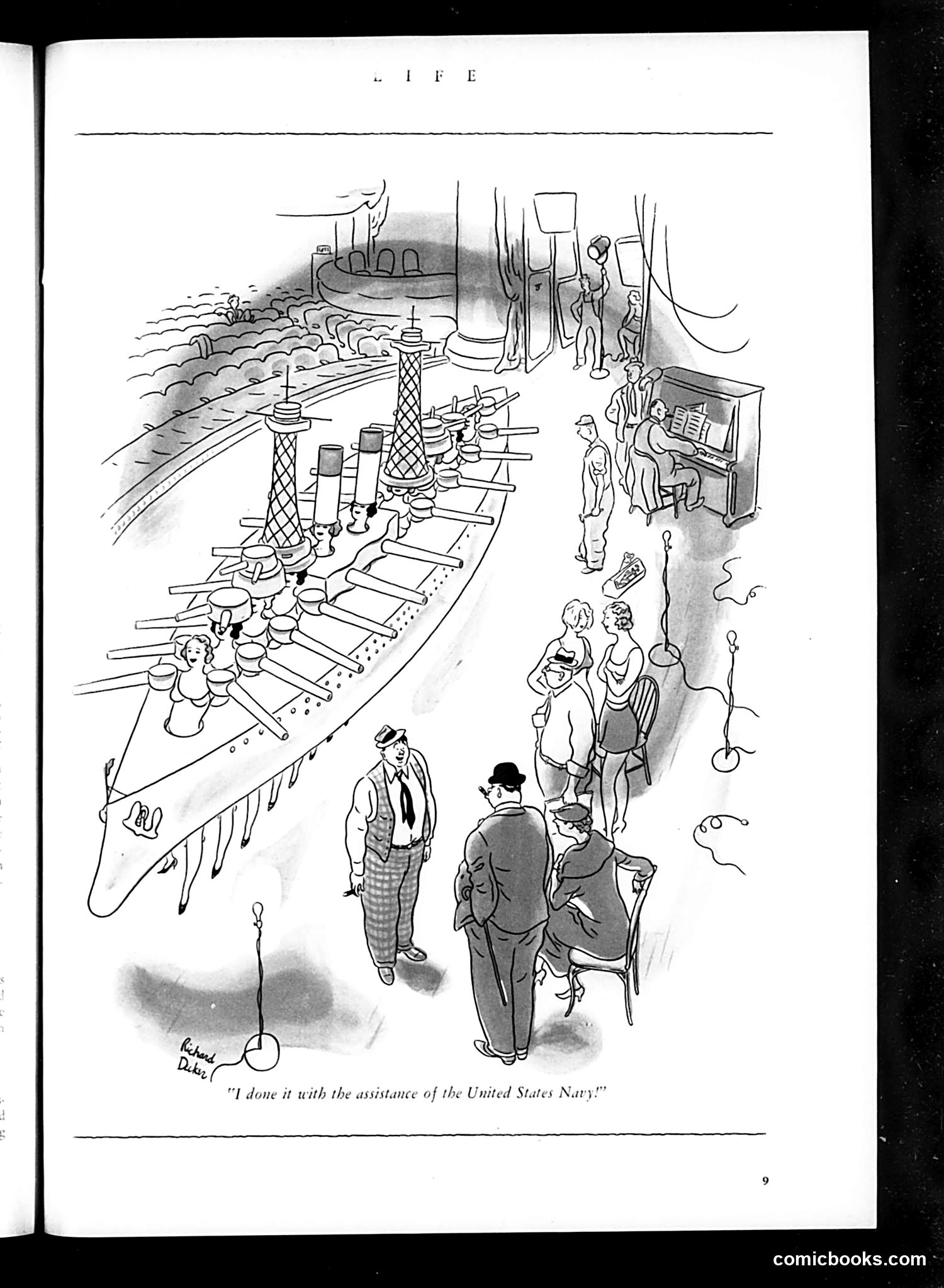
# Cartoon Analysis This single-panel cartoon depicts a man in a suit and fedora standing on a dock, gesturing toward a large naval vessel. Two other men in business attire stand nearby, apparently listening to his explanation. The caption reads: "I done it with the assistance of the United States Navy." The cartoon satirizes someone taking personal credit for an achievement while acknowledging—somewhat sheepishly—that government/military resources made it possible. The humor lies in the contradiction: claiming individual accomplishment while simultaneously admitting dependence on substantial institutional support. The casual phrasing ("I done it") contrasts with the formal setting, adding to the satirical effect. Without additional context, the specific achievement being mocked remains unclear, though it likely references a contemporary news event from Life magazine's publication period.
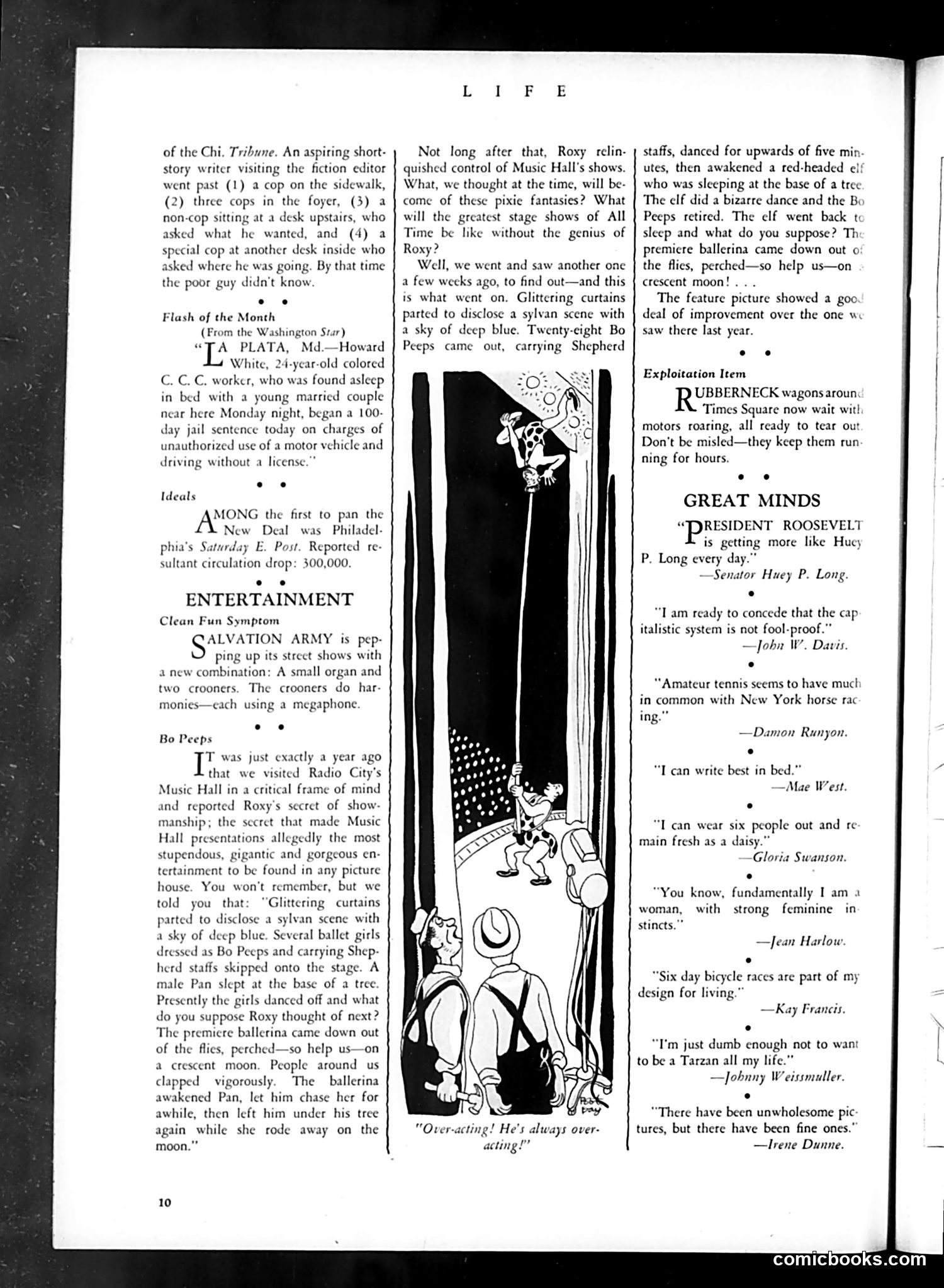
# Analysis This page from *Life* magazine contains entertainment commentary and quotes from celebrities rather than political cartoons. The central illustration depicts a theatrical scene with performers in what appears to be a vaudeville or stage show setting—figures in costume on a stage with curtains. The "Bo Peeps" section discusses Radio City Music Hall's elaborate shows, specifically praising performer Rosy's contributions. The accompanying cartoon illustrates an over-the-top stage performance, with the caption "Over-acting! He's always over-acting!" satirizing theatrical excess. The right column features celebrity quotes on various topics (writing, tennis, bicycling), offering humorous observations typical of *Life's* celebrity commentary feature. The overall page reflects 1930s entertainment culture and magazine editorial style rather than political satire.