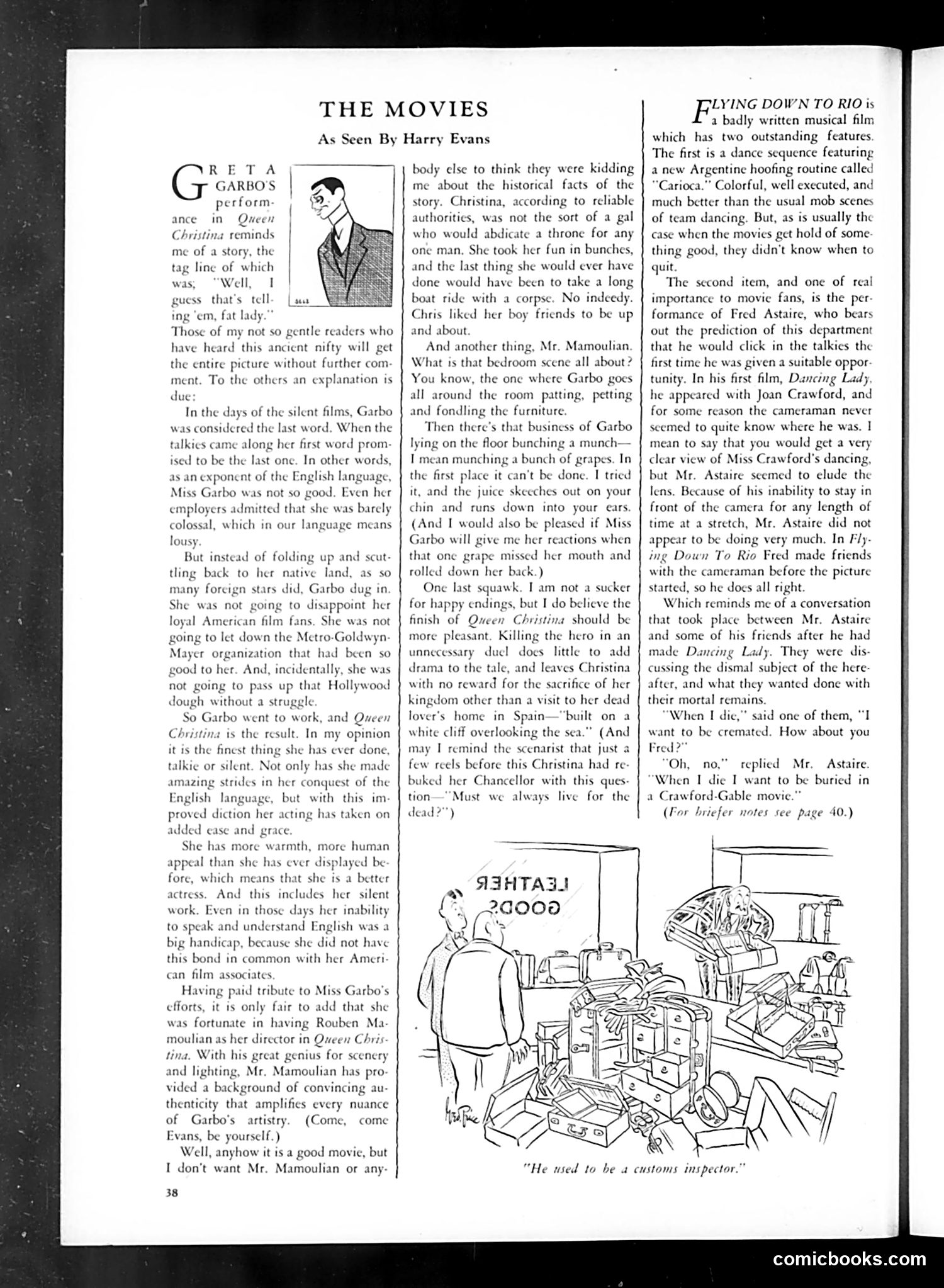
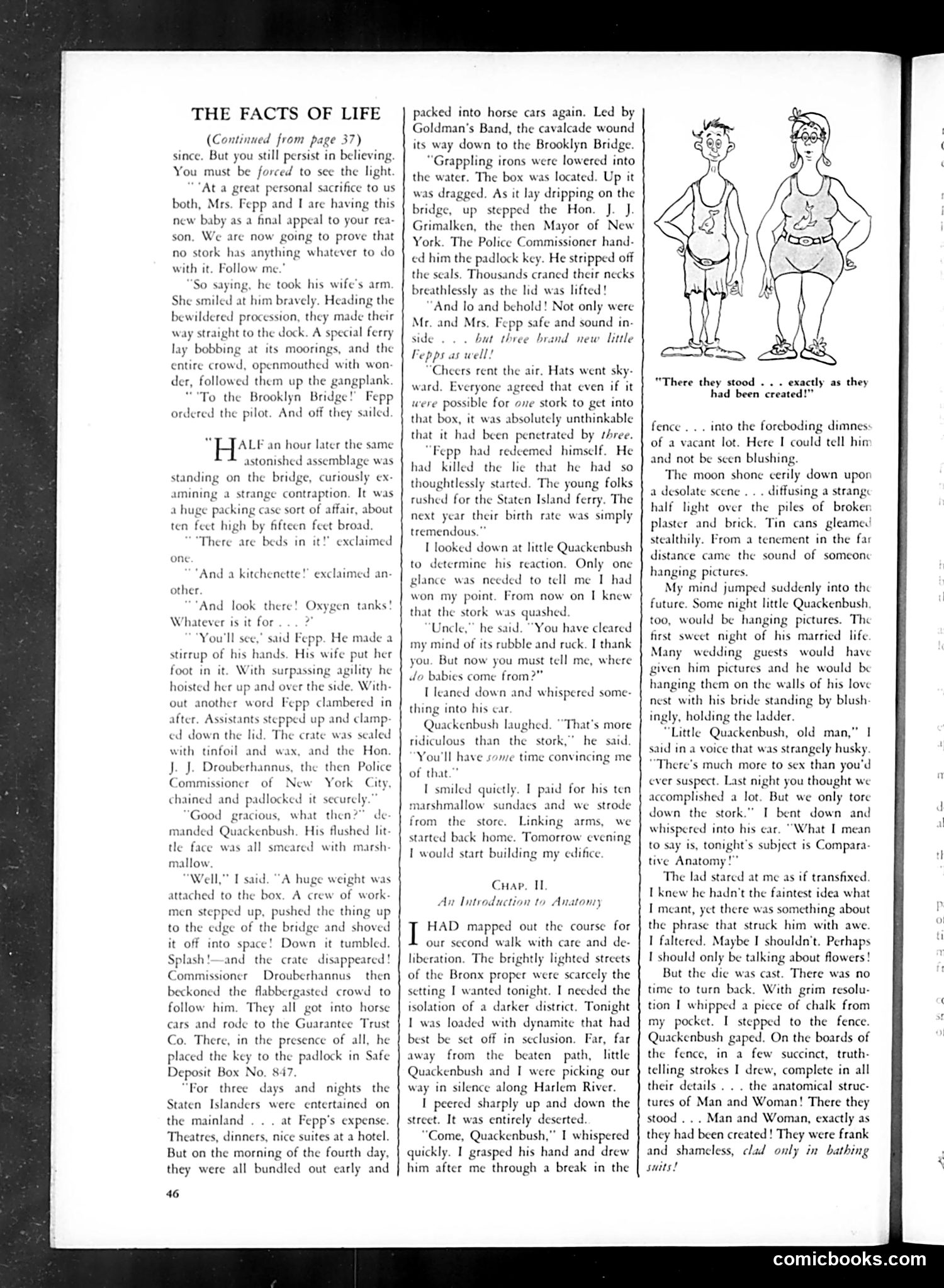
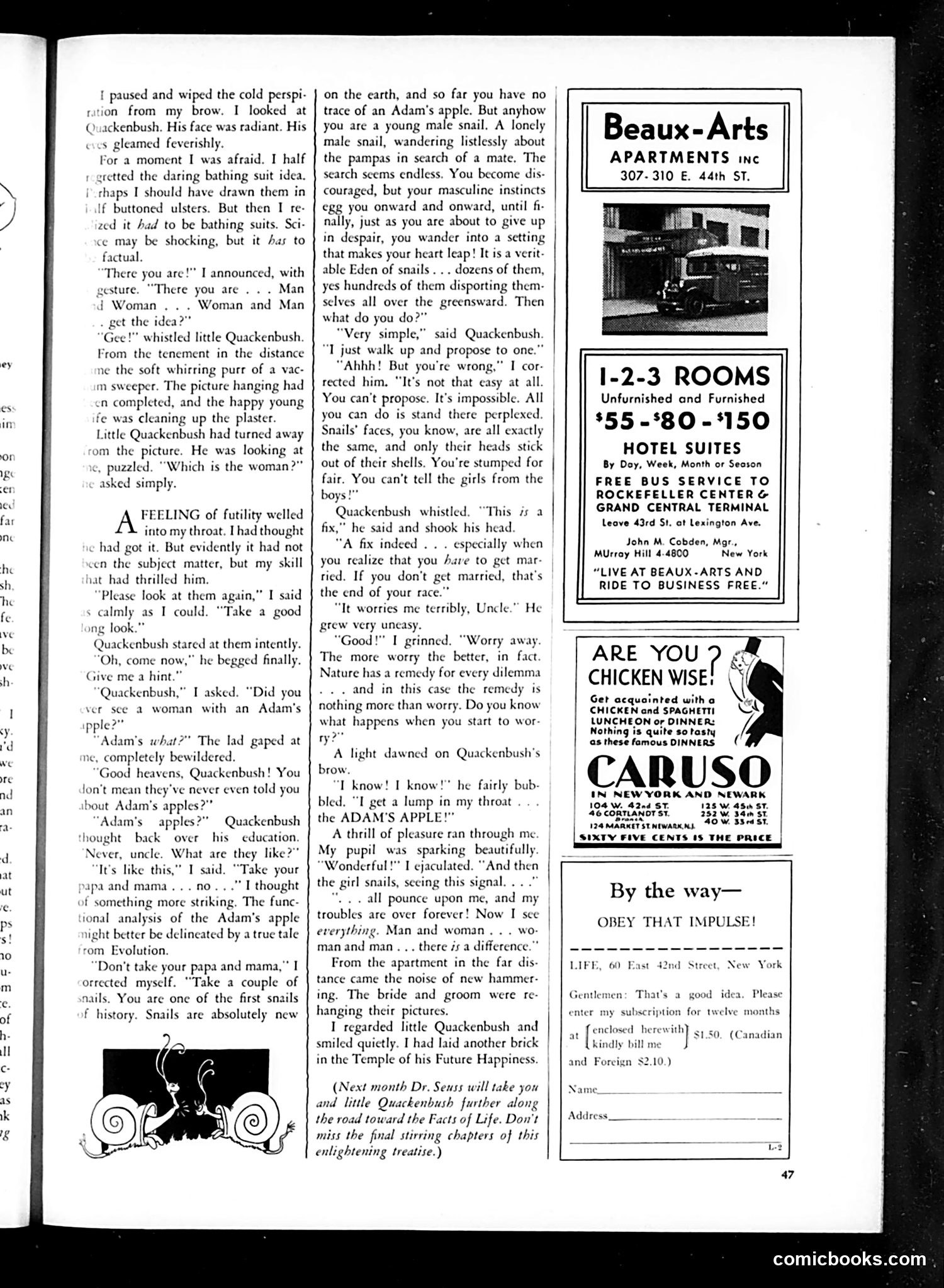
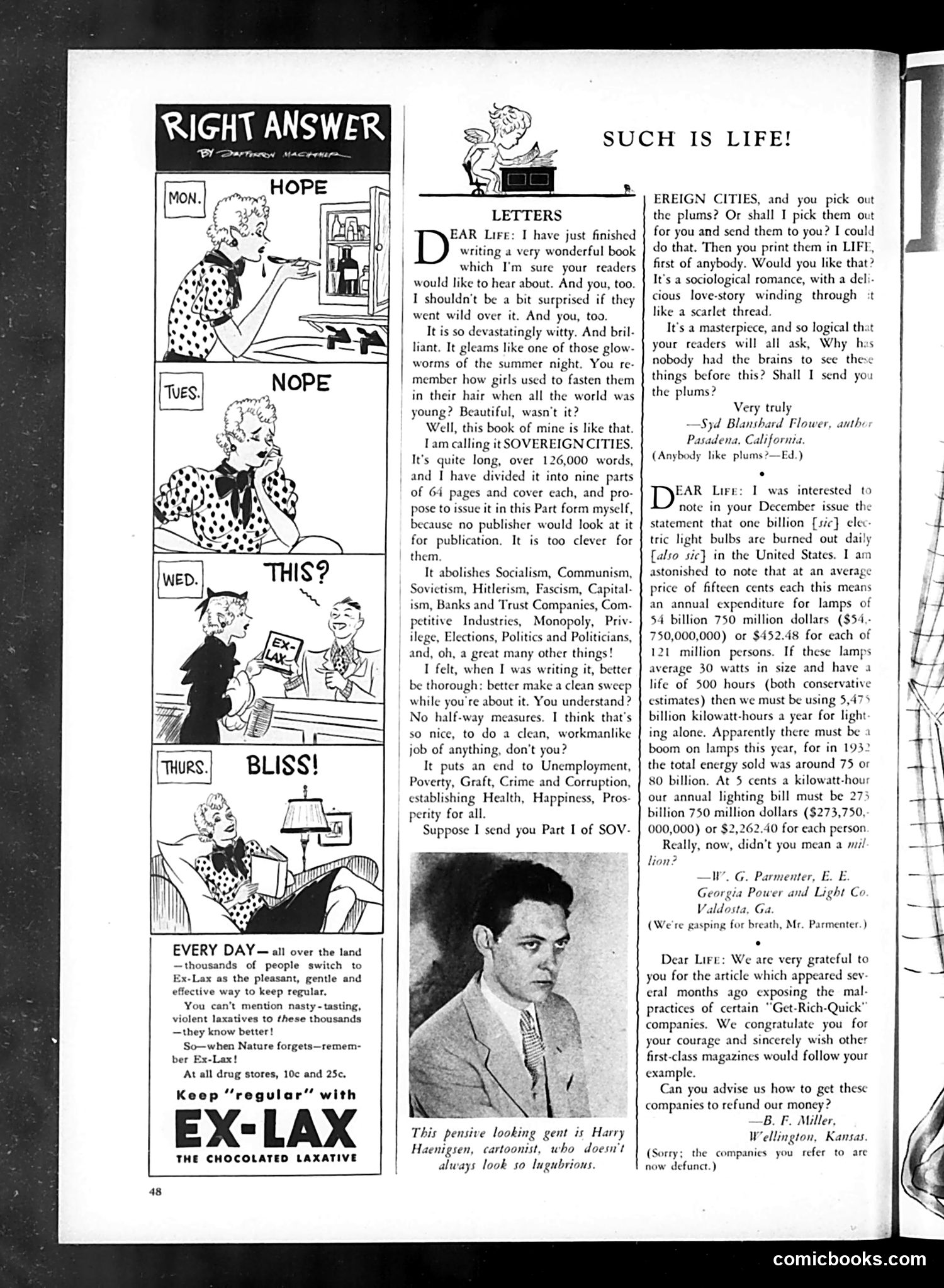
A complete issue · 52 pages · 1934
Life — February 1934
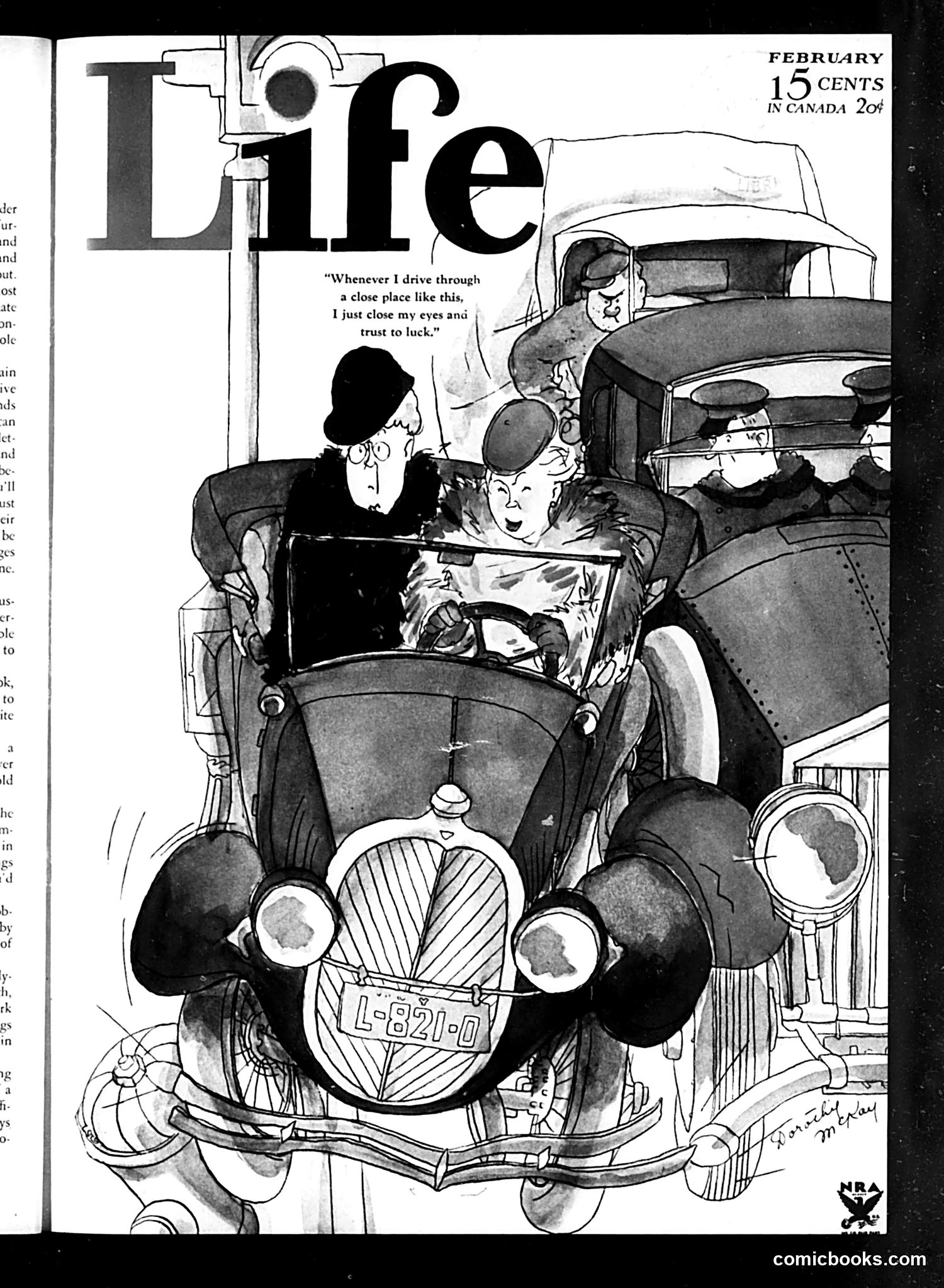
# Life Magazine Cover - February, Early 1920s This is a **Life magazine cover** satirizing dangerous driving habits. The illustration shows a car full of passengers—a woman driver and what appears to be a family—passing dangerously close to other vehicles on the road. The driver's quote states: "Whenever I drive through a close place like this, I just close my eyes and trust to luck." The satire mocks reckless motorists of the era, particularly highlighting how some drivers—possibly women drivers, a newer phenomenon—operated vehicles with alarming disregard for safety. The cartoon critiques both the dangerous behavior and the fatalistic attitude ("trust to luck") that characterized some early automobile users. This reflects 1920s concerns about traffic safety as car ownership rapidly expanded.
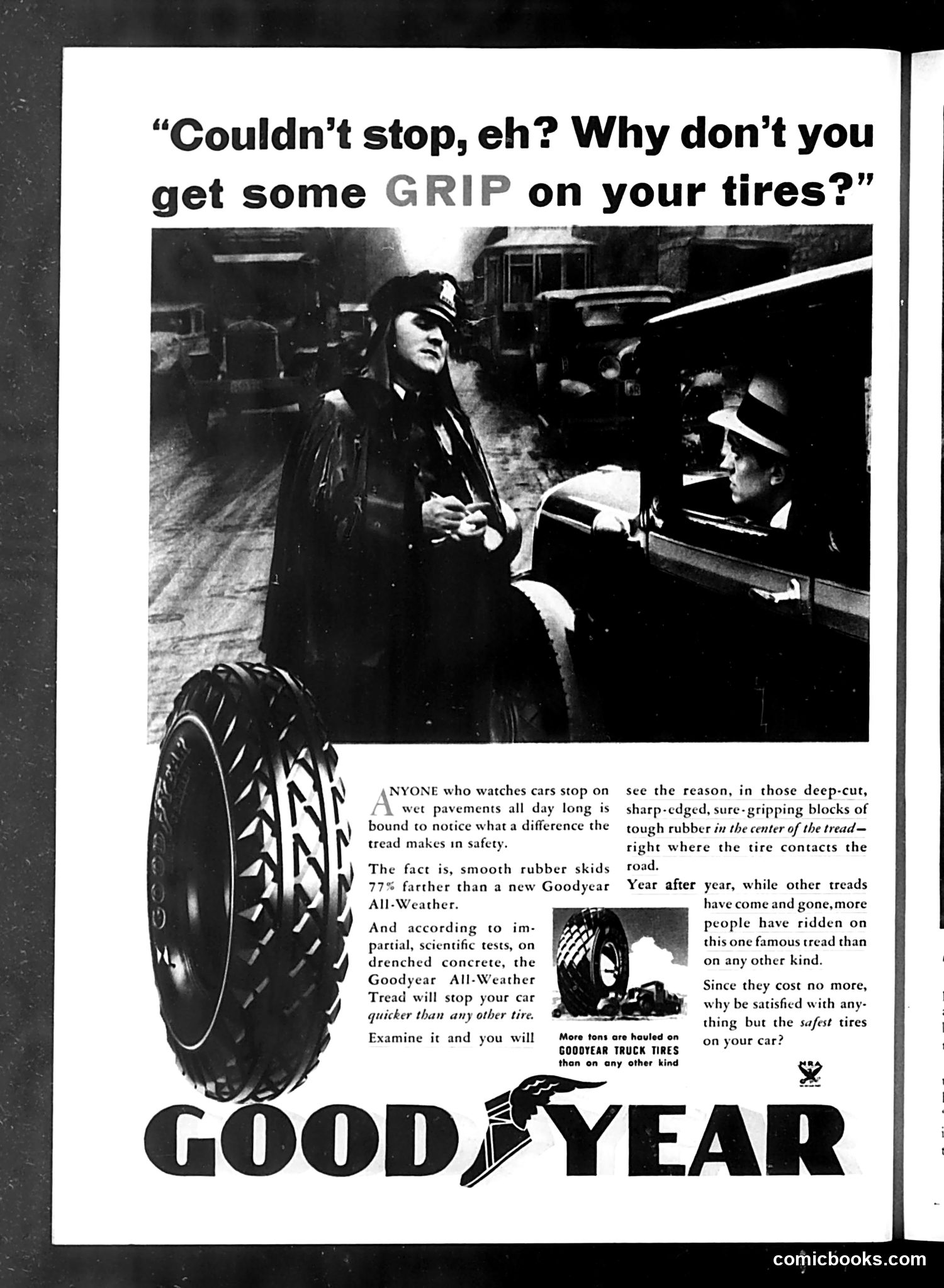
# Analysis This is a **Goodyear tire advertisement**, not a political cartoon. The page shows a staged scene where a traffic officer appears to be scolding a driver for poor tire grip on wet pavement. The dramatic headline—"Couldn't stop, eh? Why don't you get some GRIP on your tires?"—uses the officer's authority to deliver the sales pitch. The ad argues that Goodyear All-Weather tires stop faster than competitors on wet roads, supported by "impartial scientific tests." A large tire image displays the distinctive tread pattern, presented as the reason for superior safety. The appeal is practical rather than satirical: purchase better tires to avoid accidents and legal trouble. This reflects early-20th-century automotive safety concerns when tire quality significantly affected braking performance.
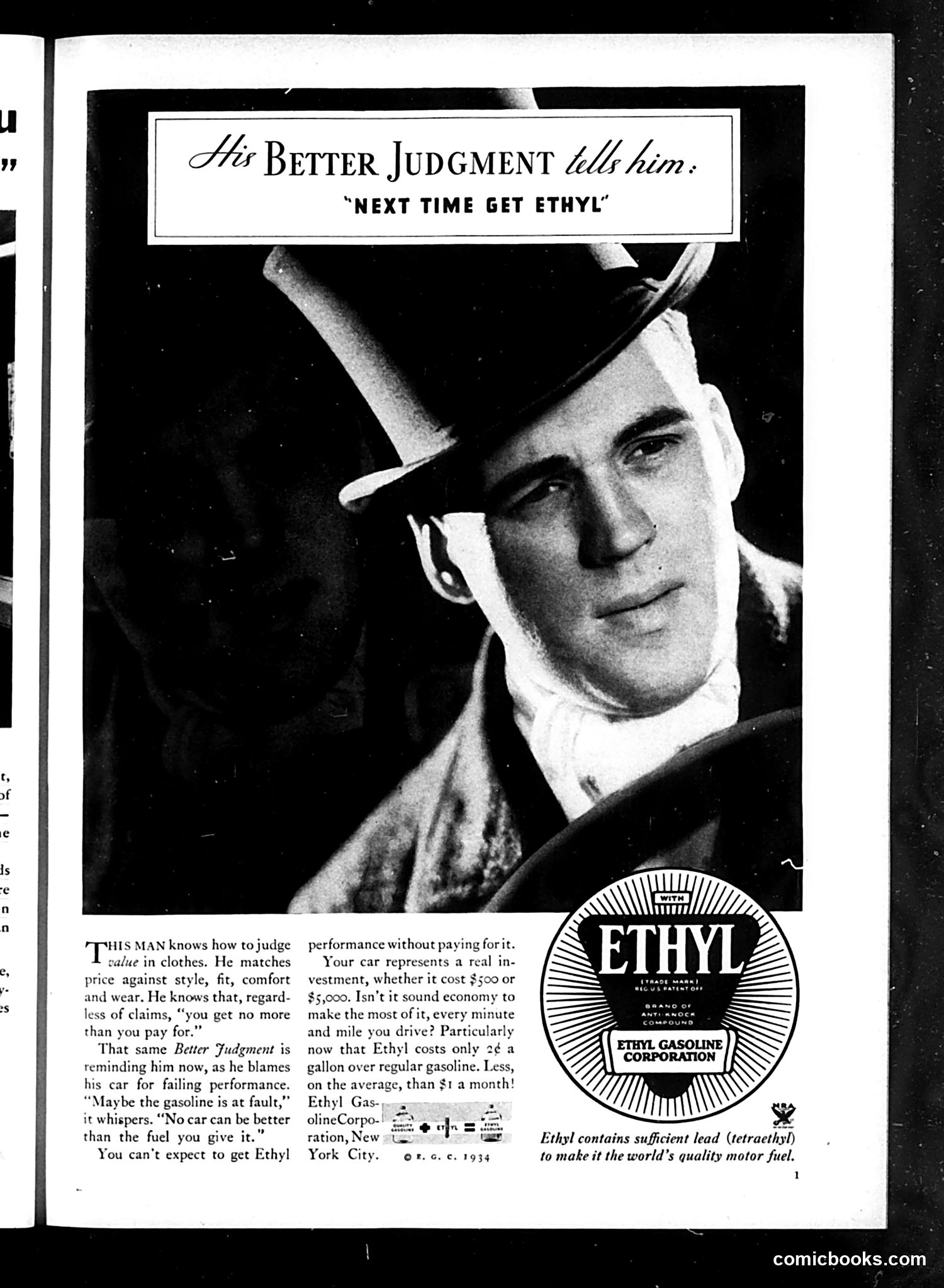
# Analysis This is primarily an **advertisement for Ethyl gasoline** (1934), not satire or political commentary. The ad features a man in formal attire with a knowing expression—described as someone with "better judgment"—who understands automotive value. The joke is straightforward: this sophisticated man recognizes that Ethyl gasoline, though only 2¢ more per gallon than regular fuel, represents smart economics. The ad plays on class aspiration—suggesting that discerning people judge quality in clothes, cars, and fuel the same way. The circular logo emphasizes that Ethyl contains lead (tetraethyl), which was marketed as improving fuel quality. This advertisement predates widespread awareness of lead's health dangers; the lead content was actually promoted as a selling point for "world's quality motor fuel."
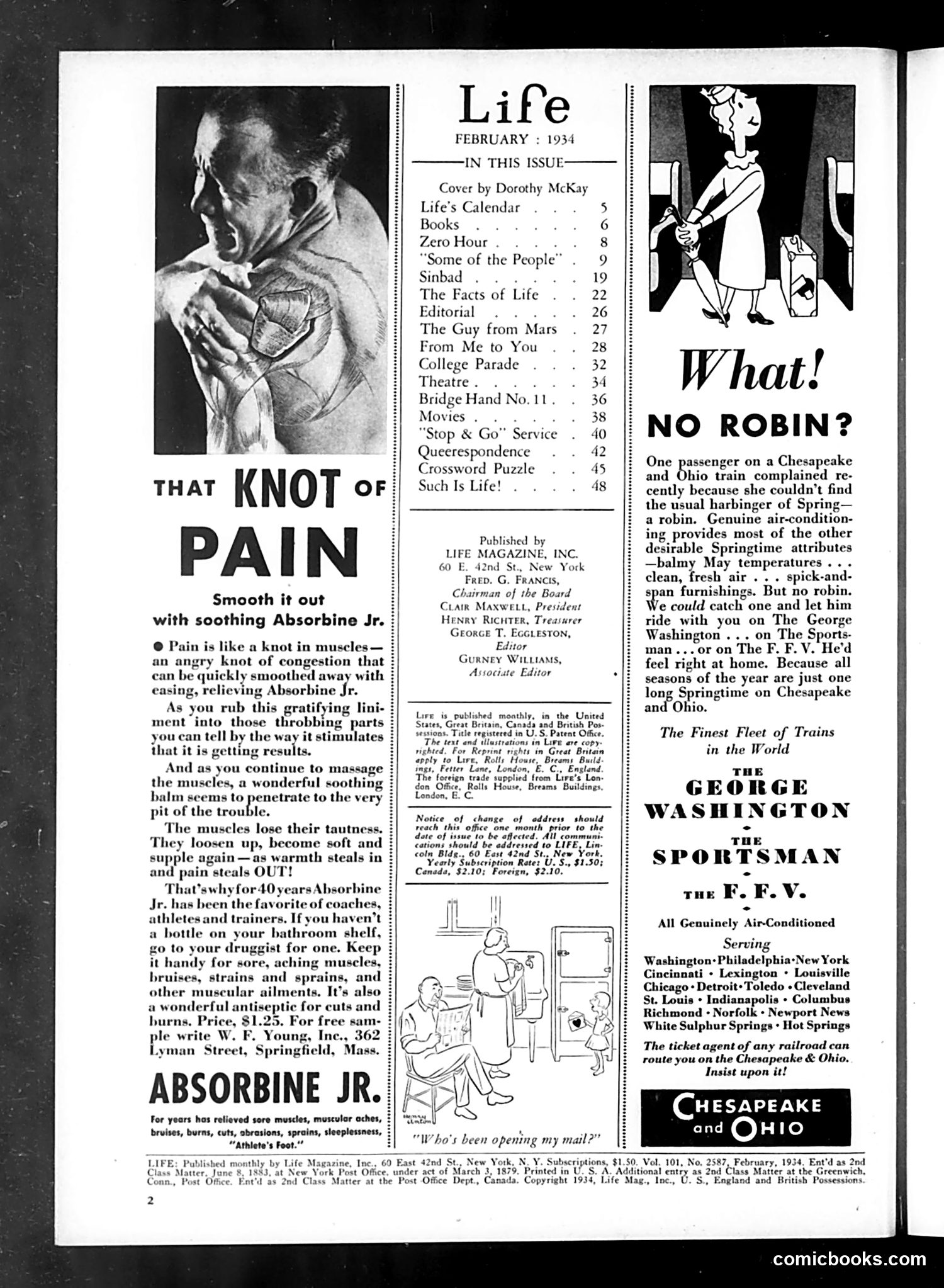
# Analysis of Life Magazine, February 1934 This page is primarily a **table of contents and advertisements** rather than political satire. The main content includes: - A cover illustration by Dorothy McKay (right side) - An advertisement for "Absorbine Jr." pain relief (left side), featuring an anatomical drawing of muscular pain points - Railroad advertisements for the Chesapeake and Ohio line, promoting air-conditioned trains to major US cities - A small cartoon at bottom showing someone asking "Who's been opening my mail?" The "No Robin?" article (right) is a lighthearted complaint about missing springtime birds on a train route—not political commentary. This appears to be a standard magazine issue from the Great Depression era, focused on consumer products and travel rather than satirical commentary.
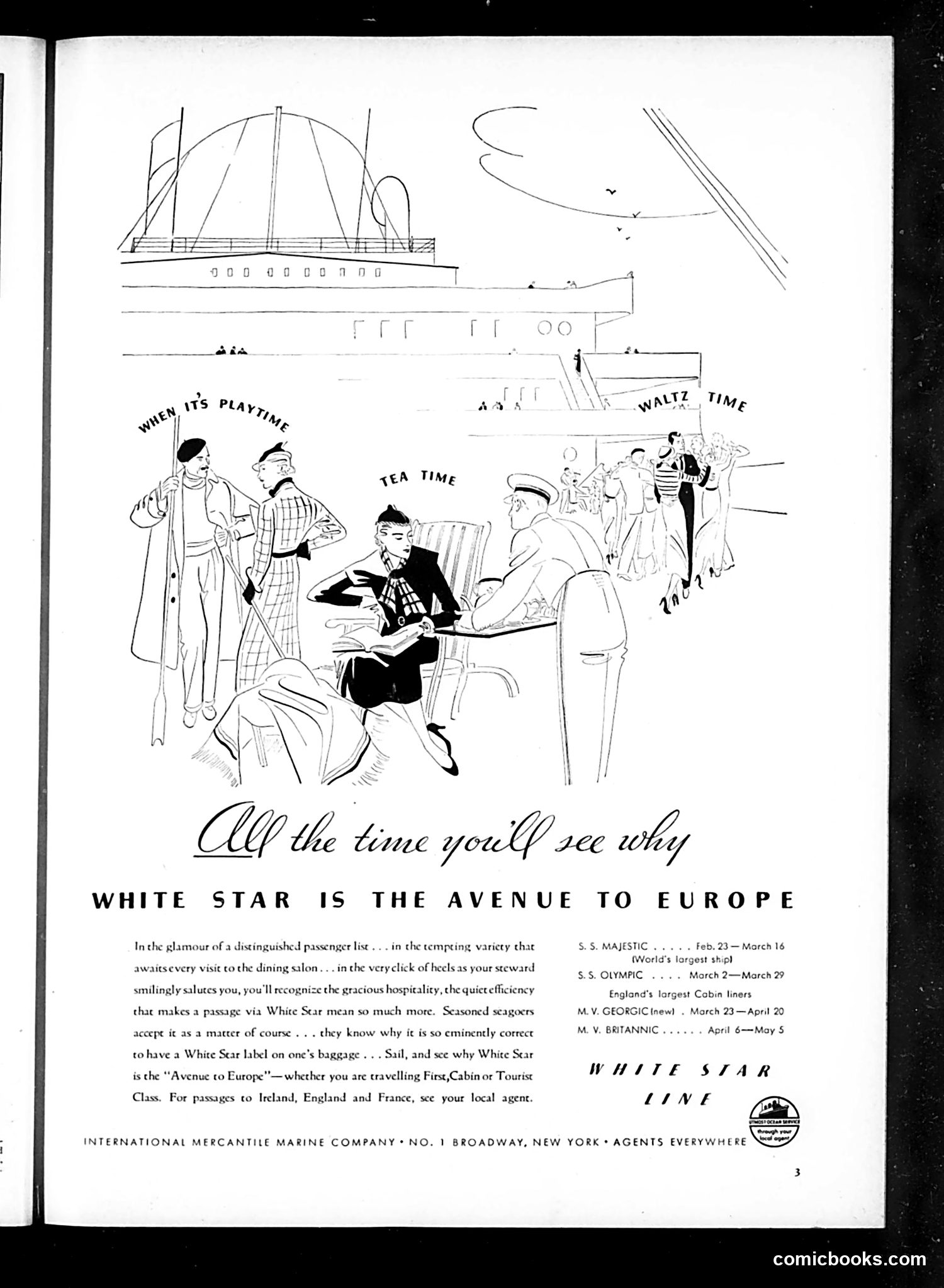
# White Star Line Ocean Liner Advertisement This is a commercial advertisement for the White Star Line shipping company, not political satire. The page promotes luxury ocean travel to Europe via their passenger ships, including the S.S. Majestic, S.S. Olympic, and M.V. Britannic. The illustration depicts shipboard social activities—"playtime," "tea time," and "waltz time"—showing well-dressed passengers enjoying entertainment and dining. The accompanying text emphasizes the "gracious hospitality" and "quiet efficiency" of White Star service, positioning ocean liners as the prestigious mode of transatlantic travel. The headline promises that traveling White Star is "the avenue to Europe," appealing to affluent travelers seeking luxury passage to Ireland, England, and France. This reflects the pre-commercial aviation era when ocean liners dominated international travel.
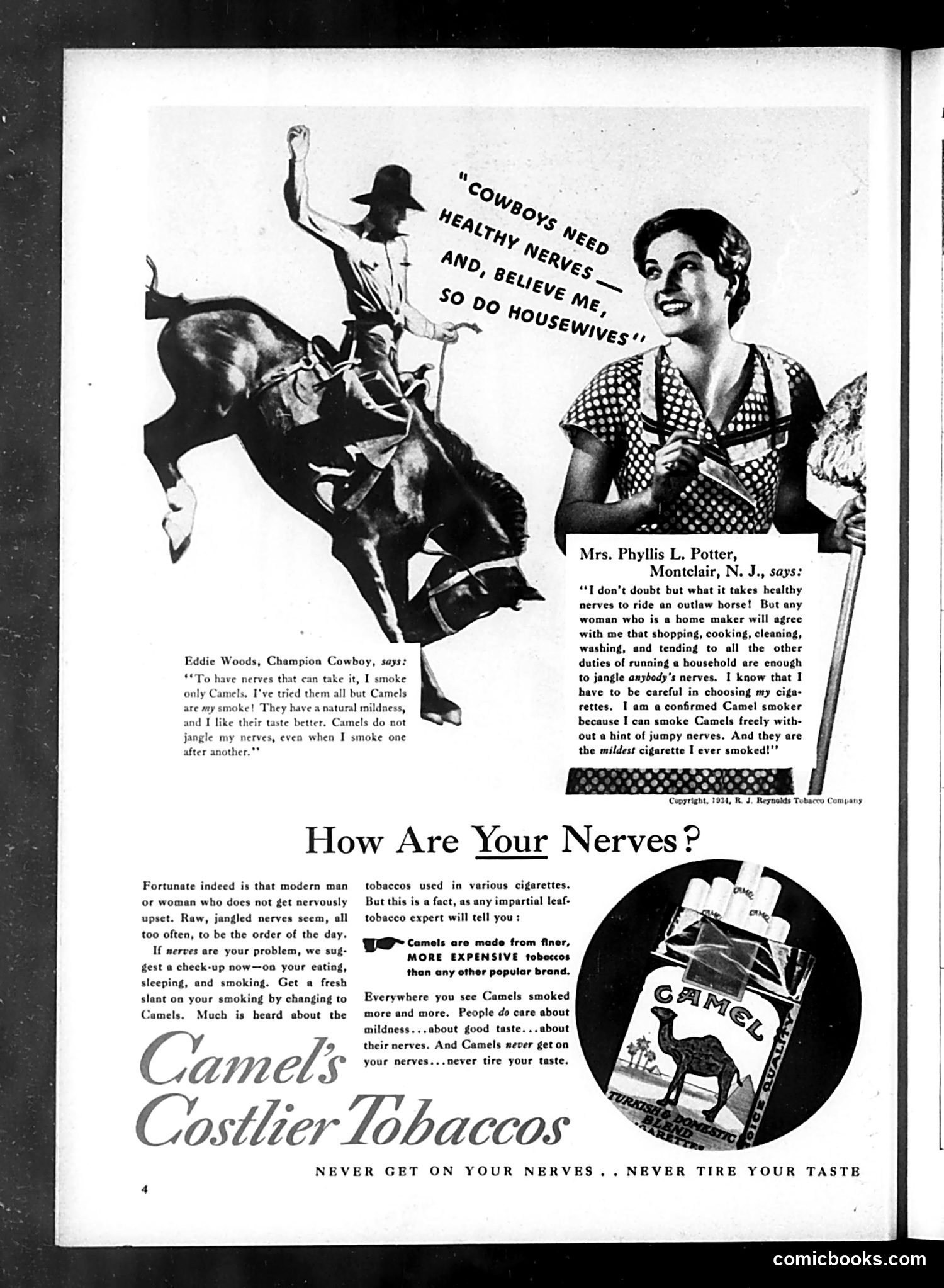
# Analysis This is a **Camel cigarette advertisement** disguised as editorial content, a common 1930s marketing practice. The ad features testimonials from two figures claiming cigarettes don't harm nerves: - **Eddie Woods, Champion Cowboy**: Claims Camels won't "jangle" his nerves despite chain-smoking - **Mrs. Phyllis L. Potter, Montclair, N.J.**: A housewife who argues that managing a household is more nerve-wracking than smoking, so she smokes Camels freely The satire targets **gender roles and health claims**. Both testimonials ironically prove the opposite: cowboys and homemakers both experience genuine stress, yet both accept smoking as a solution rather than questioning it. Modern readers would recognize this as deceptive advertising—pre-regulation tobacco marketing that explicitly made unproven health claims to vulnerable audiences.
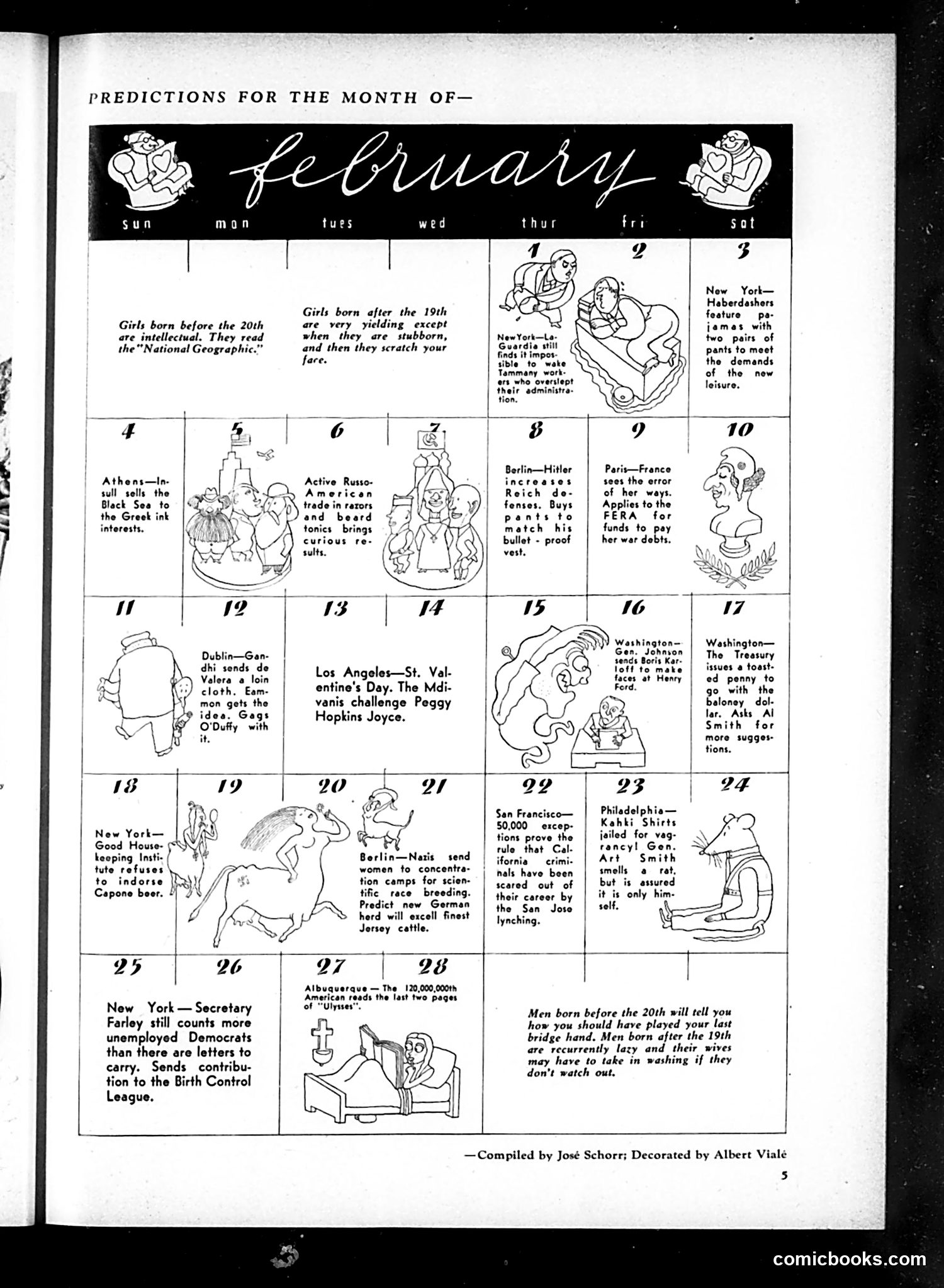
# February Predictions Calendar - Life Magazine This is a satirical perpetual calendar offering tongue-in-cheek "predictions" for each day of February. The humor relies on gender stereotypes and contemporary 1930s-40s references: **Key satirical points:** - Early-month entries mock women's intellectualism and stubbornness (Feb 1-3) - Mid-month items reference Hitler, Berlin, and Paris—likely WWII-era political commentary - Feb 12 jokes about Dublin and Irish stereotypes - Feb 25 references Democratic politics and birth control advocacy - The bottom text contrasts men and women born before/after the 19th by personality traits (women: intellectual; men: lazy) The calendar combines domestic humor with contemporary political/social commentary typical of Life's satirical approach during the wartime period.
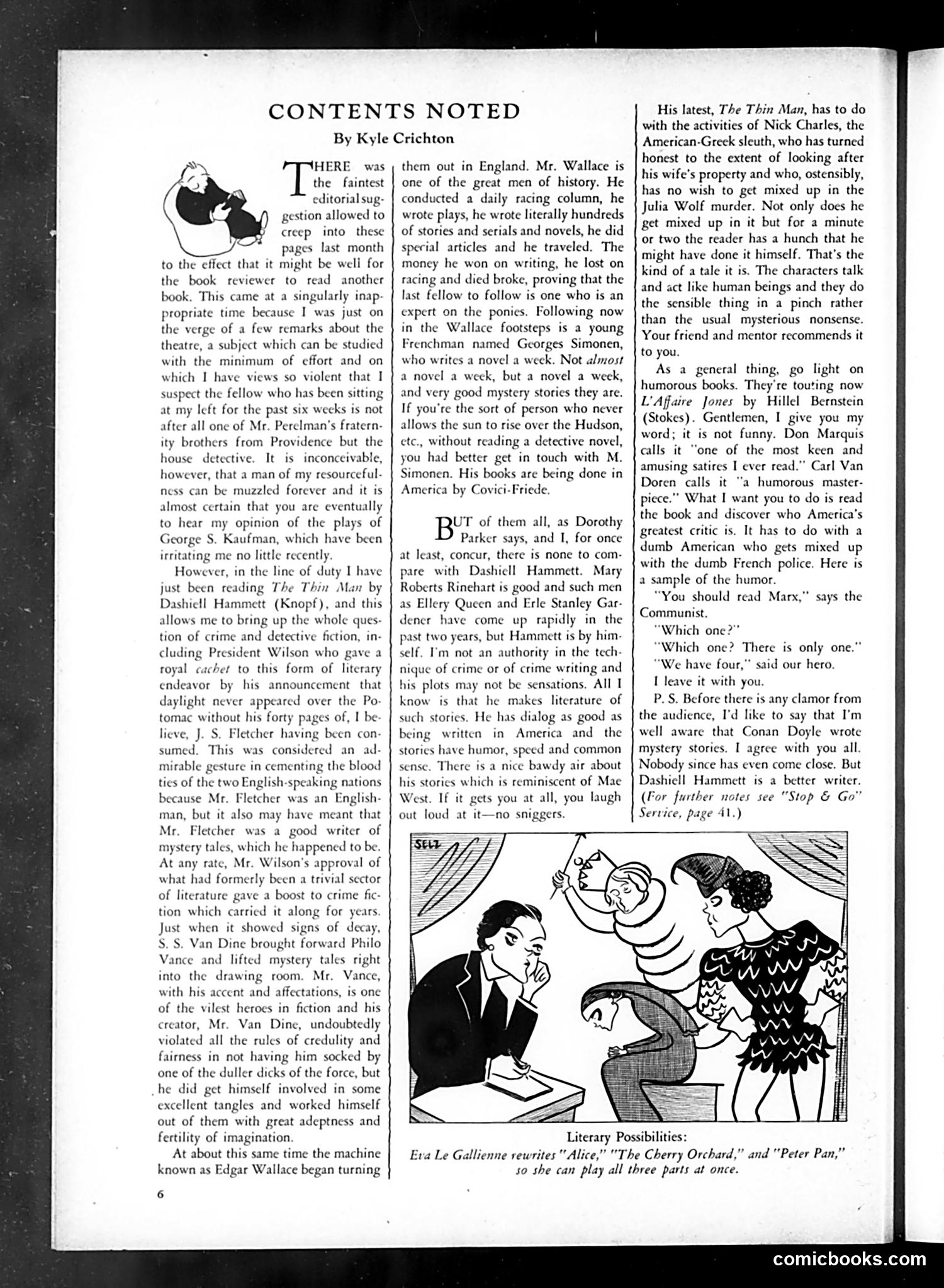
# Analysis of "Contents Noted" Page, Life Magazine This is a book review column by Kyle Crichton discussing recent crime and detective fiction. The cartoon below illustrates "Literary Possibilities: Era Le Gallienne rewrites 'Alice,' 'The Cherry Orchard,' and 'Peter Pan,' so she can play all three parts at once." The joke depicts actress Eva Le Gallienne as an ambitious performer attempting to perform three classic works simultaneously—shown as her juggling multiple theatrical roles and characters literally at once. It's satirizing theatrical vanity and the desire for starring vehicles, suggesting an absurd solution to her ambitions. The cartoon mocks both Le Gallienne's theatrical aspirations and the impracticality of such theatrical "possibilities." The humor relies on readers' familiarity with these famous works and Le Gallienne's prominence in 1920s-30s theater.
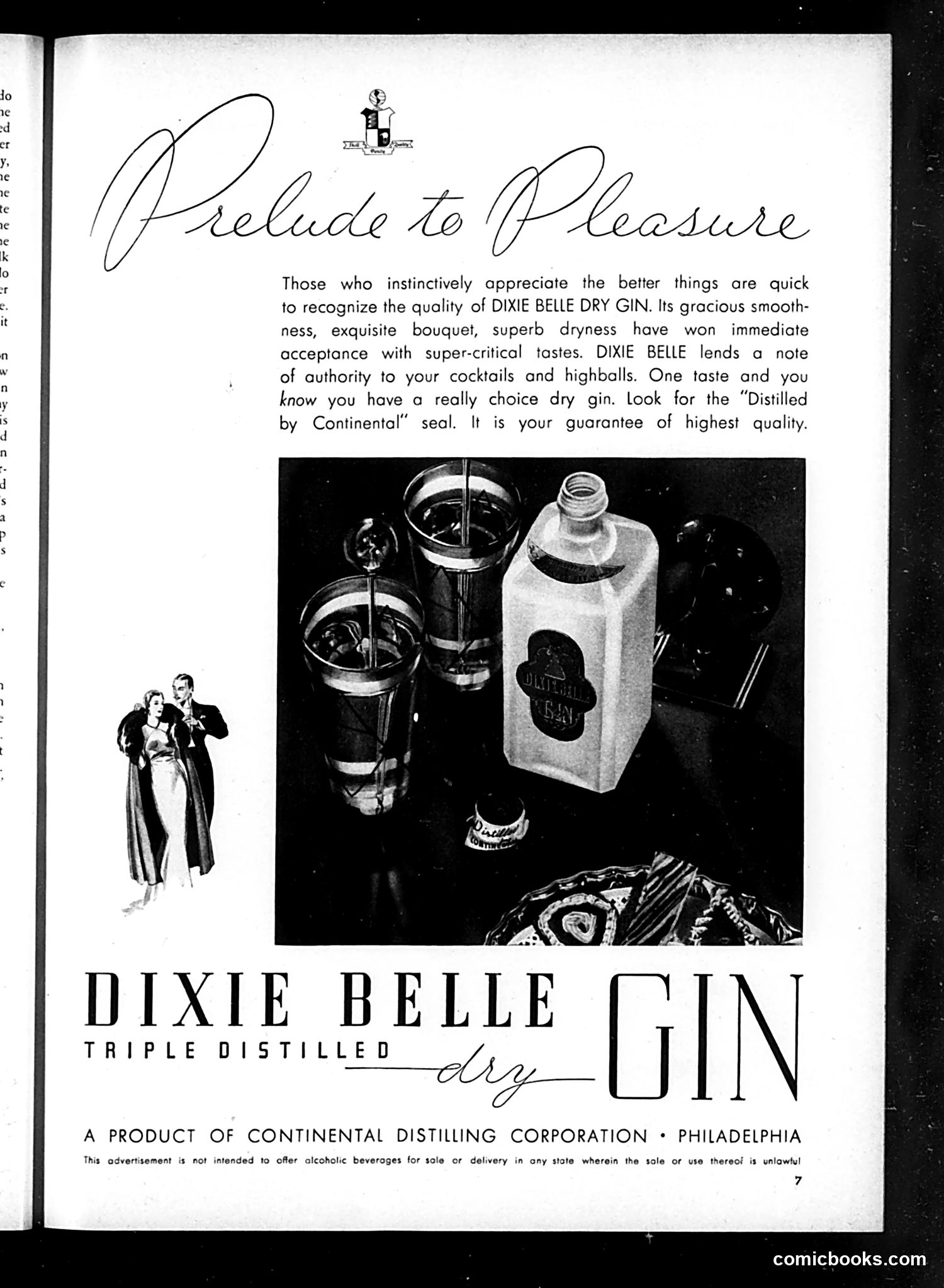
# Analysis This is a **full-page advertisement**, not editorial content or satire. It promotes Dixie Belle Dry Gin, a product of Continental Distilling Corporation in Philadelphia. The ad features decorative illustrations (a couple in formal attire on the left, cocktail glasses and a gin bottle in the center photograph) alongside marketing text emphasizing the gin's quality, smoothness, and "dryness." The phrase "Prelude to Pleasure" frames gin-drinking as a refined leisure activity. The "Distilled by Continental" seal serves as a quality guarantee. The small disclaimer at bottom notes the ad complies with alcohol advertising restrictions of the era—this appears to be from the **Prohibition repeal period** (post-1933) when alcohol advertising resumed in American magazines. This is straightforward product promotion, not political or social satire.
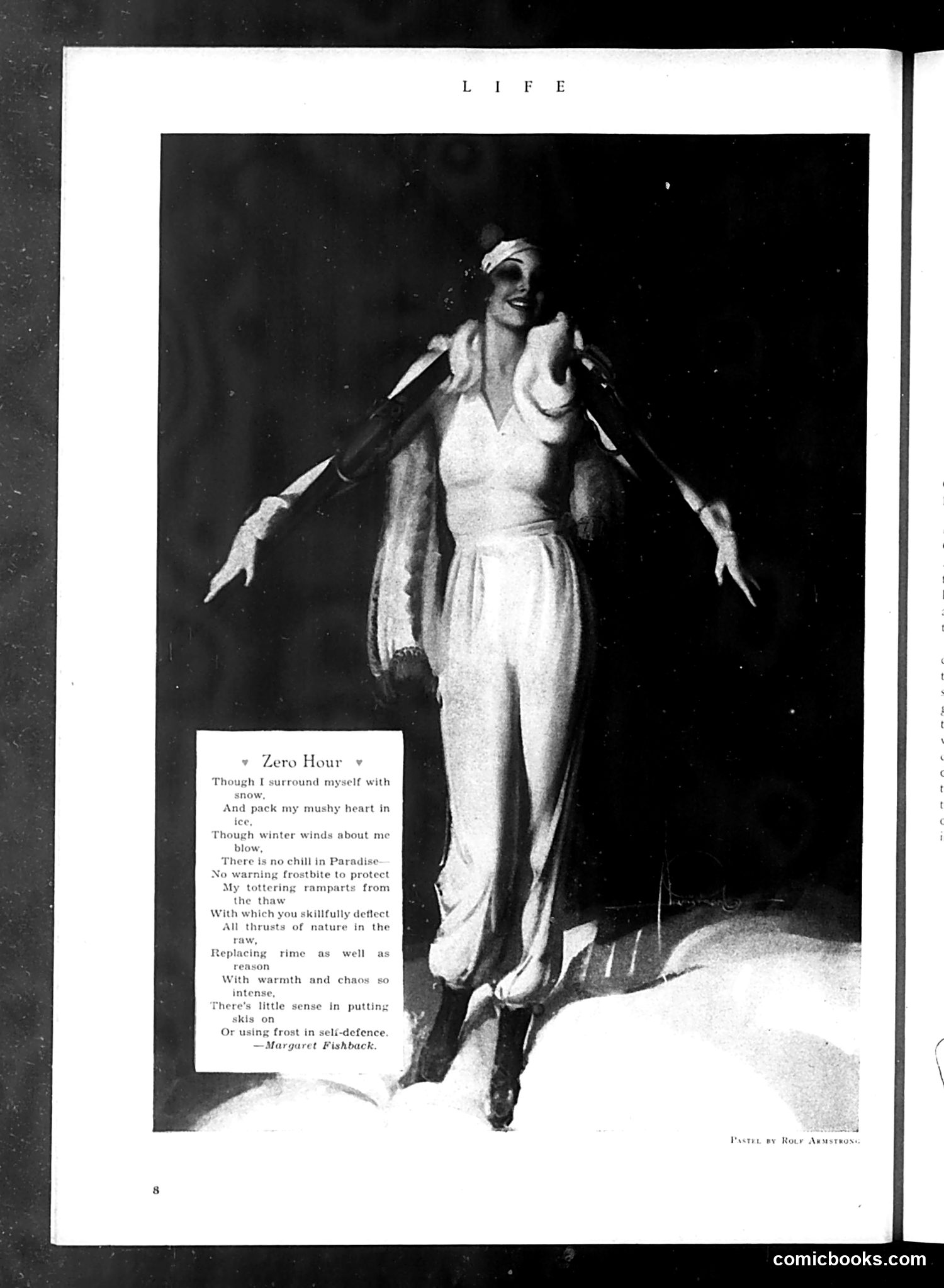
# "Zero Hour" - Life Magazine Page This page features a dramatic illustration titled "Zero Hour" by poet Margaret Fishback, with a pastel by Rolf Armstrong. The image shows a woman in classical dress and fur stole, standing in snow against a dark background. The accompanying poem uses winter and freezing imagery metaphorically—"pack my mushy heart in ice," "winter winds," "frostbite"—to describe emotional coldness or defensive detachment. The poem suggests suppressing natural human warmth and feeling to protect oneself, replacing "rime as well as reason / With warmth and chaos so intense." This appears to be a romantic or psychological meditation on emotional self-protection rather than political satire. The "Zero Hour" likely references a critical personal moment where one must choose between emotional vulnerability and self-defense.
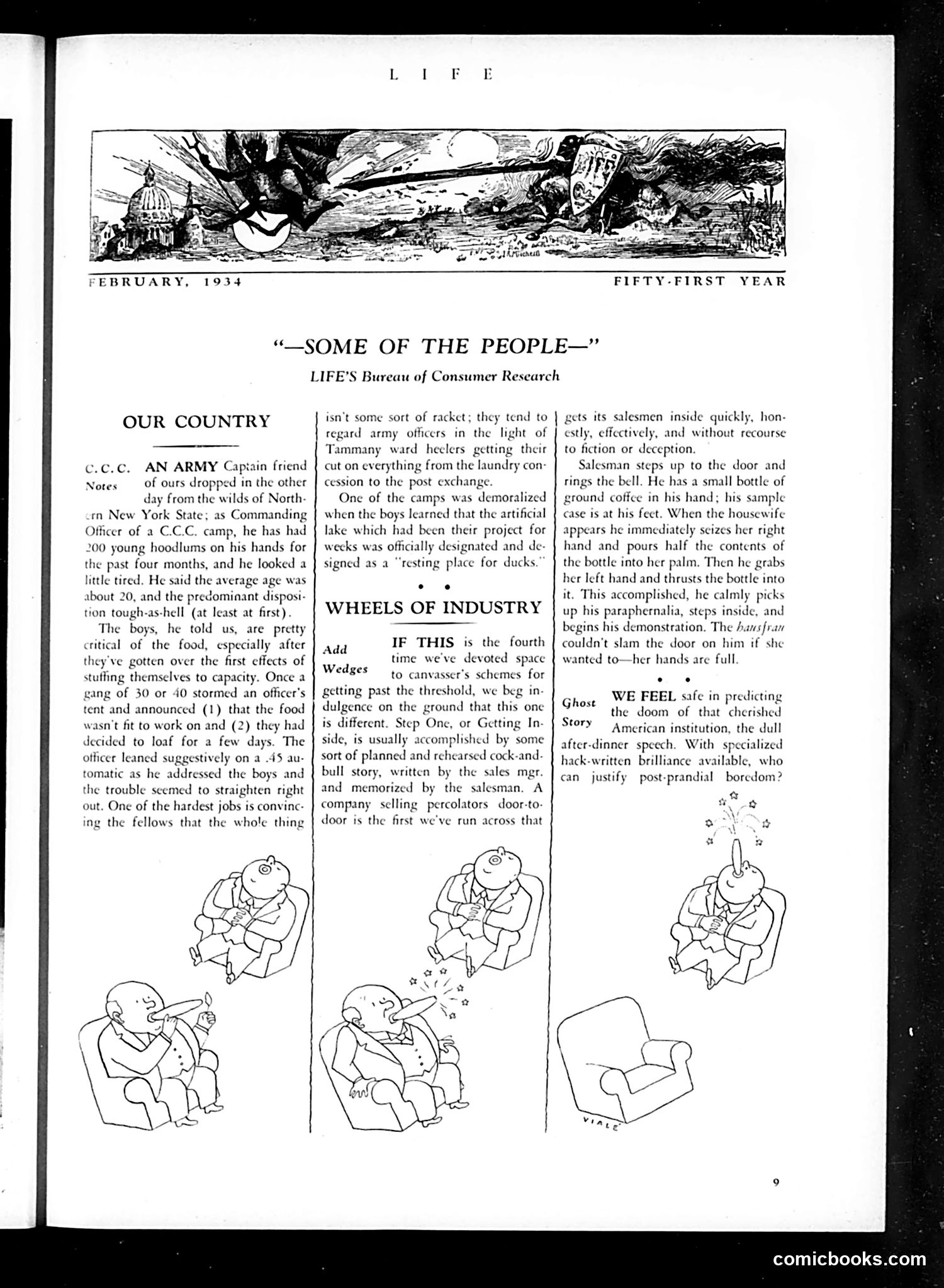
# Explanation for Modern Readers This February 1934 *Life* magazine page satirizes door-to-door salesmen and consumer culture. The three cartoon sequences ("Add Wedges," "Wheels of Industry," and "Ghost Story") humorously depict aggressive sales tactics. In each scenario, a salesman demonstrates his pitch to a housewife sitting in an armchair. The "Add Wedges" and "Wheels" sequences show the salesman performing elaborate, rehearsed demonstrations—standard sales techniques of the era. The "Ghost Story" sequence appears to mock the hollow rhetoric of post-sales pitches, questioning whether such "specialized hack-written brilliance" can truly justify the product. The satire targets the manipulative door-to-door sales culture prevalent during the Depression, where salesmen used scripted stories and demonstrations to pressure consumers into purchases they didn't need.
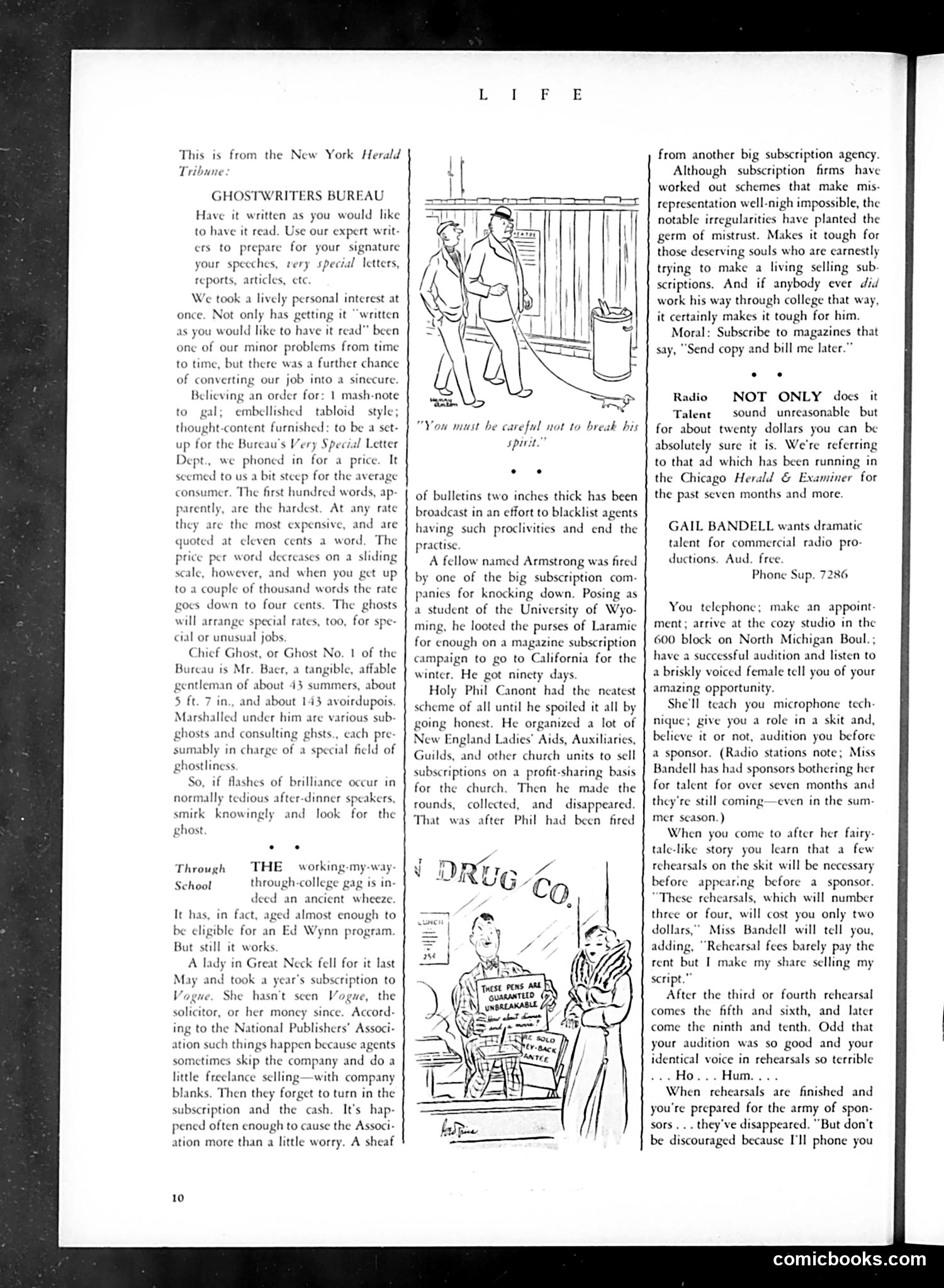
# Analysis of Life Magazine Page This page contains three distinct sections mixing editorial content with satirical commentary: 1. **Ghostwriters Bureau** (top left): A New York Herald Tribune advertisement offering professional writers to compose speeches and articles for clients. The cartoon depicts two businessmen, with accompanying text warning that such services, while convenient, create problems—notably that people earning money through ghostwriting may harbor resentment or plant "germs of distrust." 2. **Drug Company Cartoon** (center): A sketch showing what appears to be pharmaceutical or drug company representatives, though the specific satirical point is unclear from the visible portions. 3. **Radio Talent Advertisement** (right): Text discussing radio auditions and dramatic talent recruitment, with practical details about rehearsal costs and sponsor preparation. The page targets 1930s-40s professional and commercial practices through light satire.