A complete issue · 53 pages · 1933
Life — February 1933
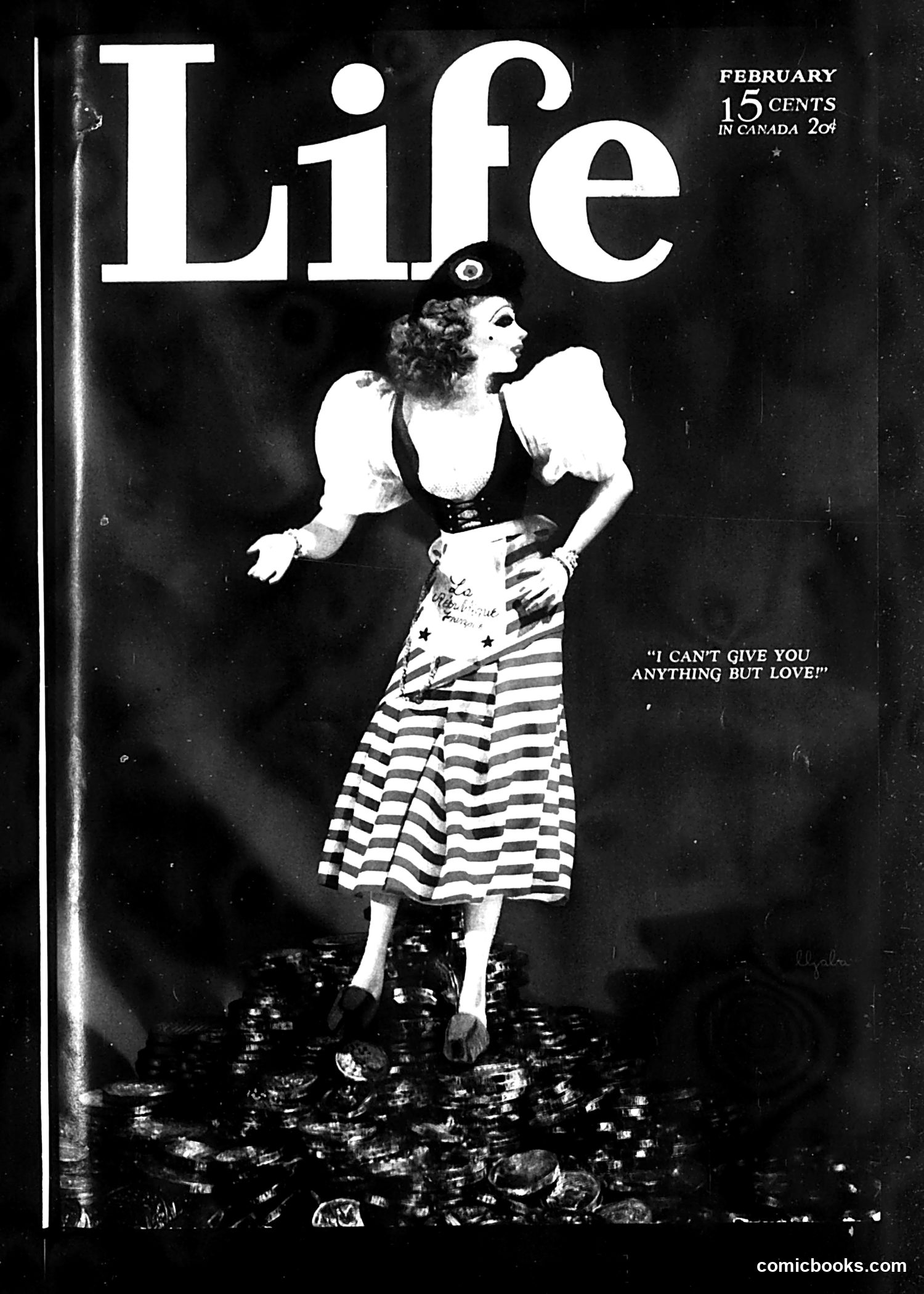
# Life Magazine Cover Analysis This is a **Life magazine cover from February** (price: 15 cents US, 20 cents Canada), functioning primarily as a **title page rather than satirical content**. The image shows a woman in 1930s-style dress—puffy sleeves, striped skirt with stars, and a decorative belt—standing on a pile of coins. She appears glamorous and optimistic. The caption reads: **"I CAN'T GIVE YOU ANYTHING BUT LOVE"**—a reference to the popular 1928 jazz song. **The satire**: During the Great Depression, this cover ironically juxtaposes the upbeat sentiment of romantic love with the visible symbol of financial hardship (the coins beneath her feet). The woman's cheerful pose contrasts with economic reality, suggesting that love is all one can afford to give during economically desperate times.
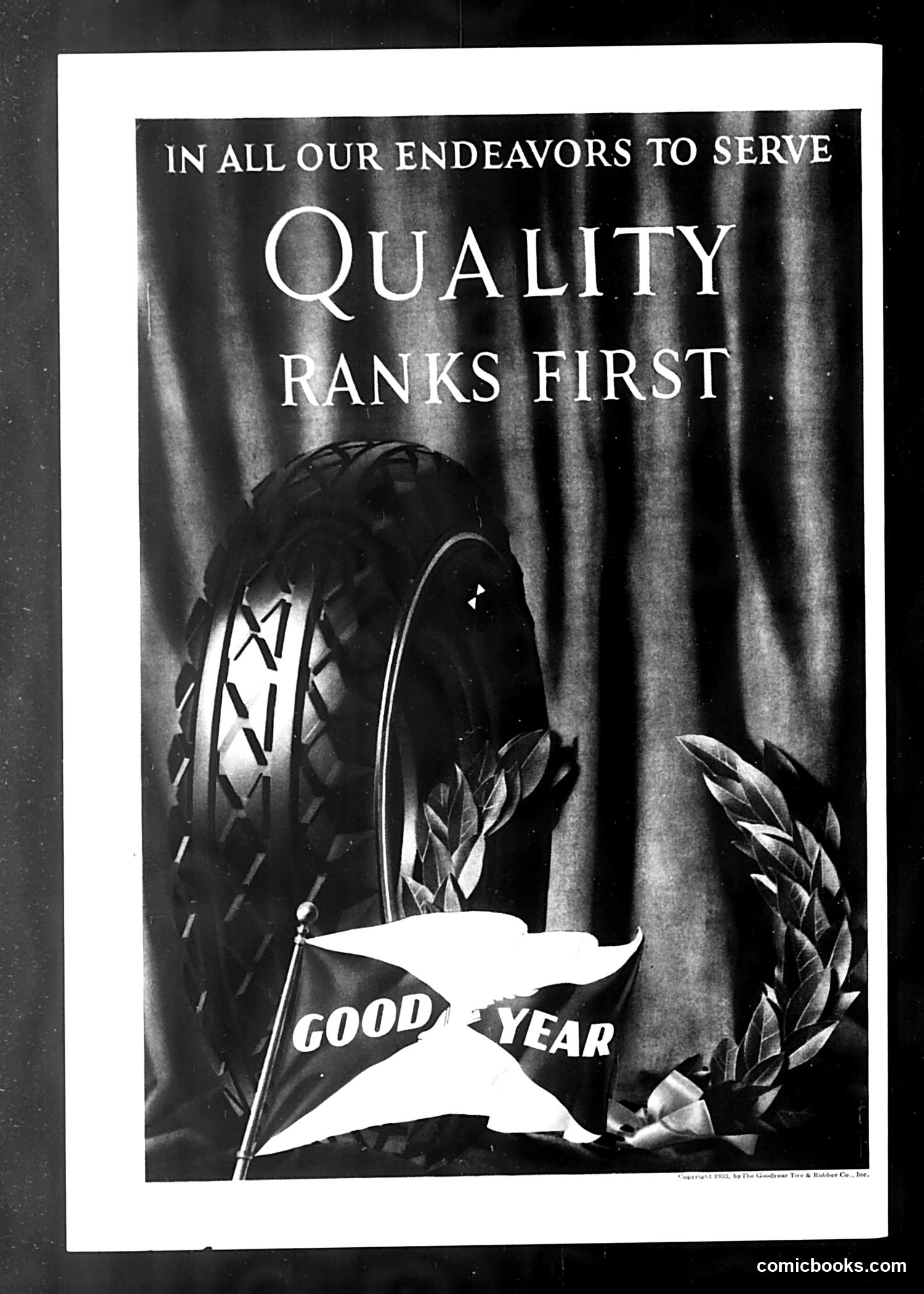
# Analysis This is a Goodyear tire advertisement, not political satire. The image shows a tire displayed against a draped backdrop with laurel wreaths flanking it—visual elements evoking prestige and victory. The text "IN ALL OUR ENDEAVORS TO SERVE / QUALITY RANKS FIRST" presents the company's motto emphasizing manufacturing standards. The Goodyear winged logo appears prominently at the bottom. For a modern reader: this is corporate messaging from an era (likely 1930s-40s) when tire quality significantly affected vehicle safety and reliability. The classical design language—laurels, theatrical lighting, formal typography—suggests Goodyear positioned quality as a noble, worthy achievement deserving respect. This appeals to consumer values around durability and trustworthiness.
I appreciate your detailed instructions, but I must be honest: this image is almost entirely black with minimal visible content. The only clearly legible element is the watermark "comicbooks.com" in the bottom right corner. I cannot reliably identify any cartoon figures, text, political references, or satirical content from what's visible in this reproduction. The image appears to be either severely degraded, underexposed, or a blank/mostly blank page from the original publication. To provide accurate analysis following your rules, I would need a clearer, higher-contrast version of this page where the actual cartoon artwork and OCR'd text are legible. I cannot responsibly speculate about content I cannot see.

I can see this is a mostly blank or very dark page from what appears to be a vintage publication, with "comicbooks.com" visible at the bottom right. There is a faint curved line visible in the lower center portion of the page, and the right edge shows what appears to be a white binding or margin. Unfortunately, the image is too dark and the content too obscured for me to reliably identify any specific cartoons, caricatures, political figures, or satirical content. The OCR text provided contains only the website attribution, offering no contextual information about the page's subject matter or intended satire. Without clearer visibility of the actual cartoon or text content, I cannot accurately explain what this page means to modern readers.
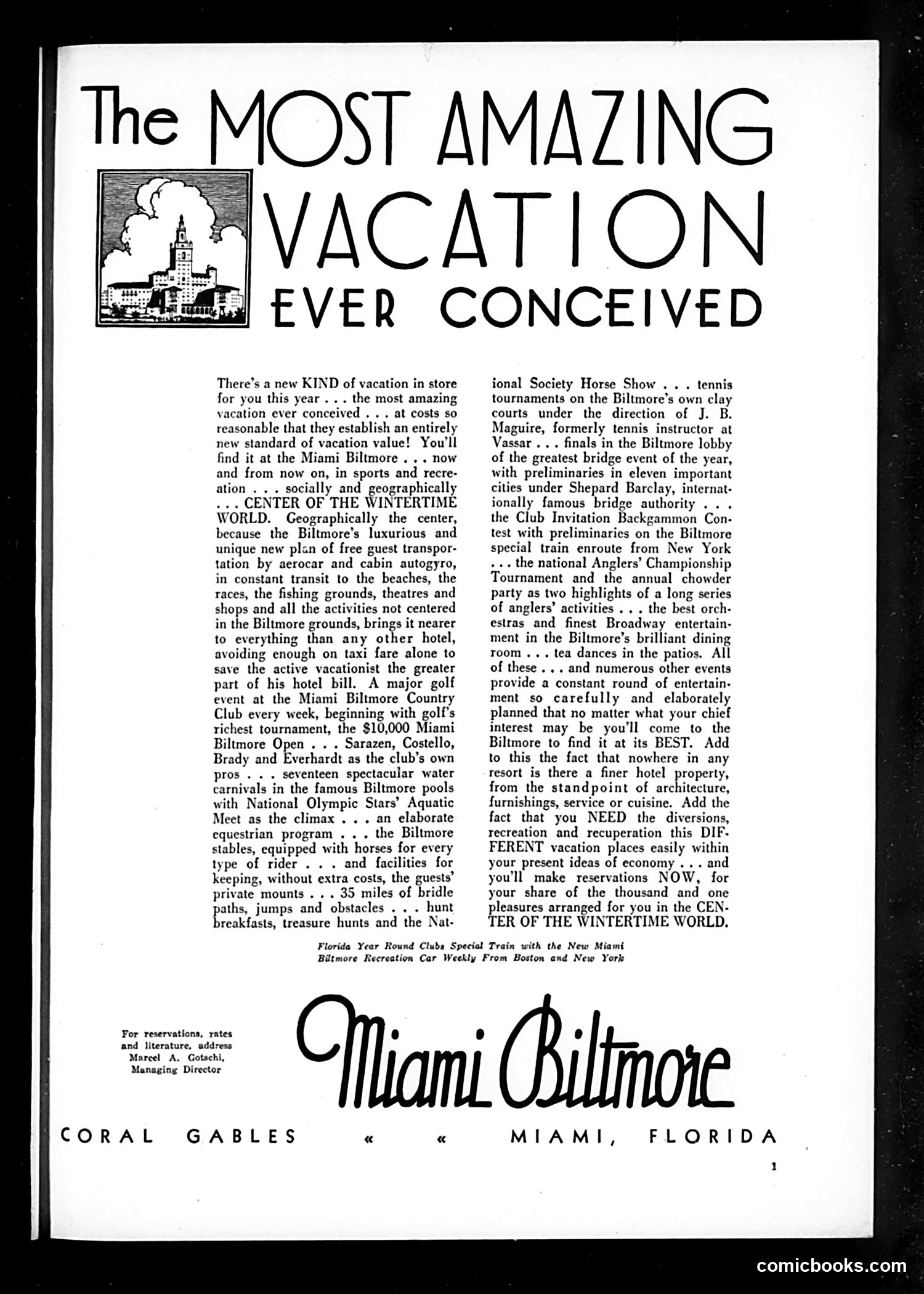
# Analysis This is **not a political cartoon or satirical content**—it's a full-page **advertisement** for the Miami Biltmore hotel in Coral Gables, Florida. The ad promotes the Biltmore as "the most amazing vacation ever conceived," emphasizing luxury amenities: golf tournaments, tennis, equestrian facilities, bridge competitions, fishing, Broadway entertainment, and elaborate social events. It highlights transportation convenience (aerocars, cabin autogiros) and positions the resort as the "CENTER OF THE WINTERTIME WORLD." The small illustration shows the hotel's distinctive architecture—its prominent tower. The copy emphasizes exclusivity and comprehensive recreation, suggesting this was marketed to wealthy winter visitors during Florida's tourism boom (likely 1920s-30s based on style and the reference to "aerocars"). There is no satire here—it's straightforward hospitality marketing.
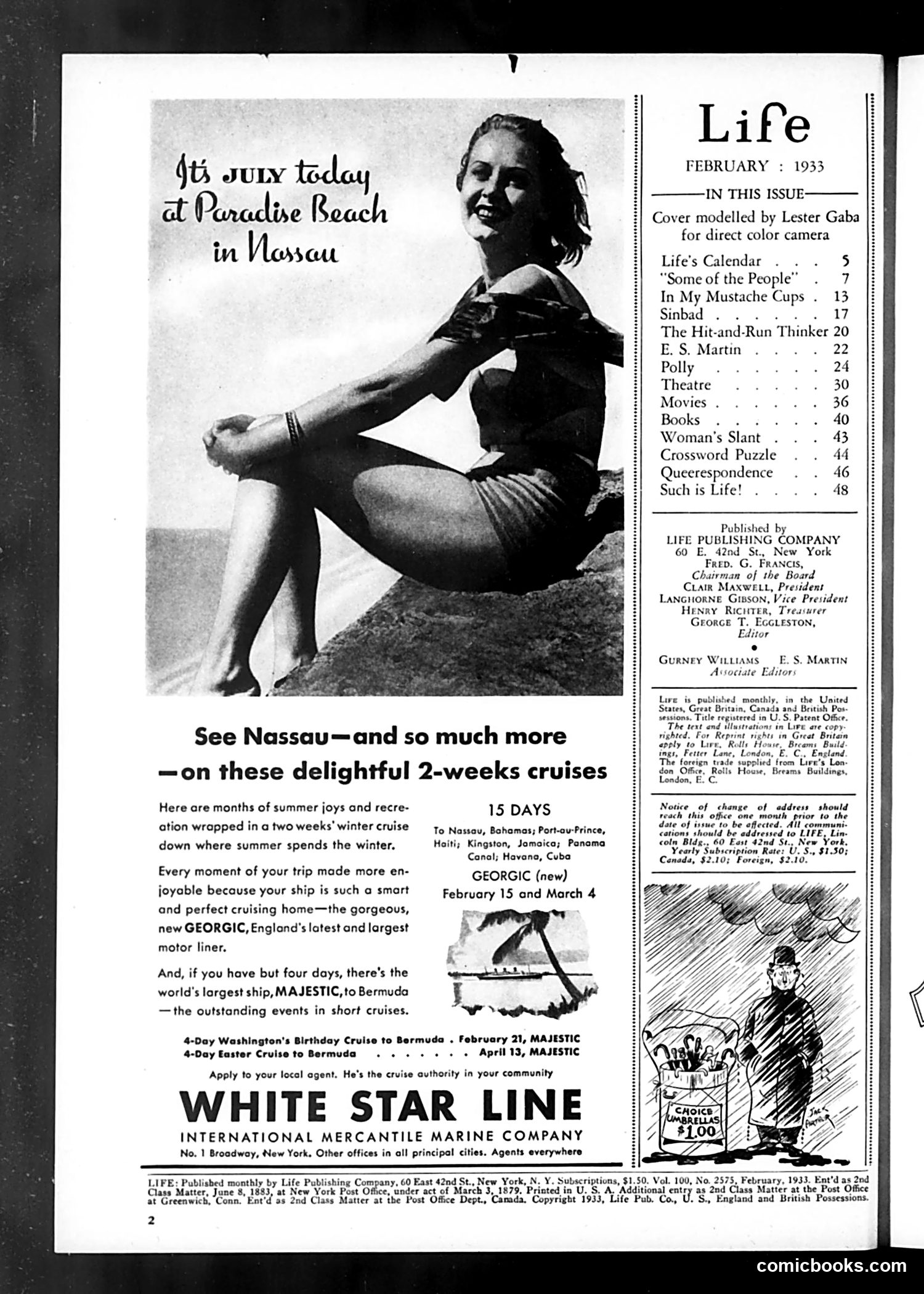
# Analysis This is primarily a **title/contents page and advertisement section** for Life magazine's February 1933 issue, not a political cartoon page. The main image shows a young woman in a bathing suit at Paradise Beach in Nassau, advertising cruise vacations—typical glamour photography for the era. The accompanying advertisement promotes two-week winter cruises via the White Star Line (the company that operated the Titanic), featuring ships like the GEORGIC and MAJESTIC to Caribbean destinations. The small cartoon visible in the lower right appears to show a figure with a dish or cup marked "$1.00," but without clearer context, its specific satirical meaning is unclear. The page reflects 1933 content: luxury travel advertising during the Great Depression, when such vacations remained aspirational for most Americans.
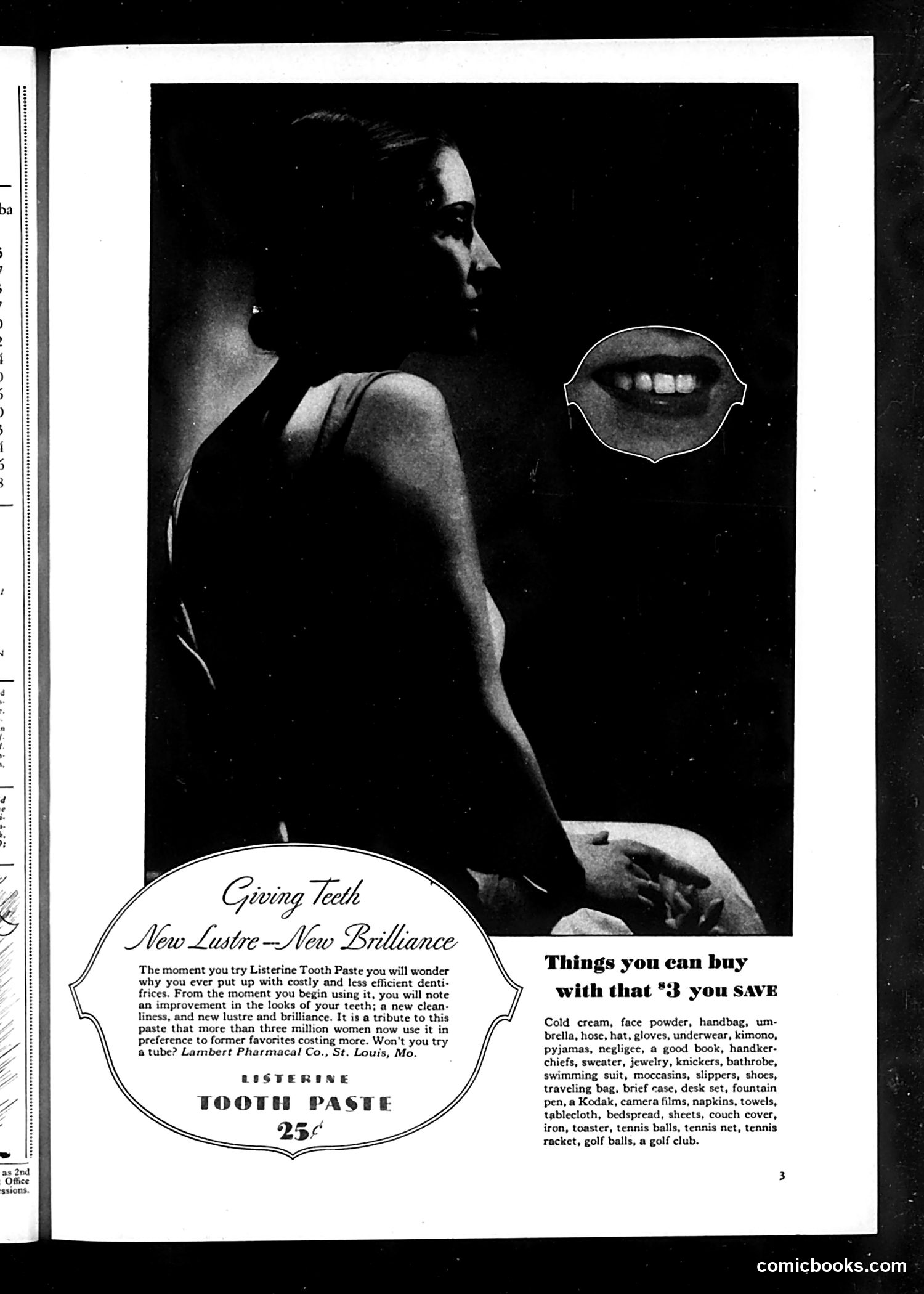
# Analysis This page is primarily **advertising**, not political satire. It features a Listerine Tooth Paste advertisement (25¢) promoting "New Lustre—New Brilliance." The ad uses a glamorous photograph of a woman in profile with an inset close-up of teeth/smile, a common advertising technique of the era. Below the main ad is a sidebar titled "Things you can buy with that '$' you SAVE"—a Depression-era or wartime marketing appeal listing affordable purchases (cold cream, hats, gloves, sporting equipment, etc.) to emphasize the product's low cost and value. There is no political cartoon or satirical content on this page. It's a straightforward commercial advertisement typical of mid-20th century magazine publishing.
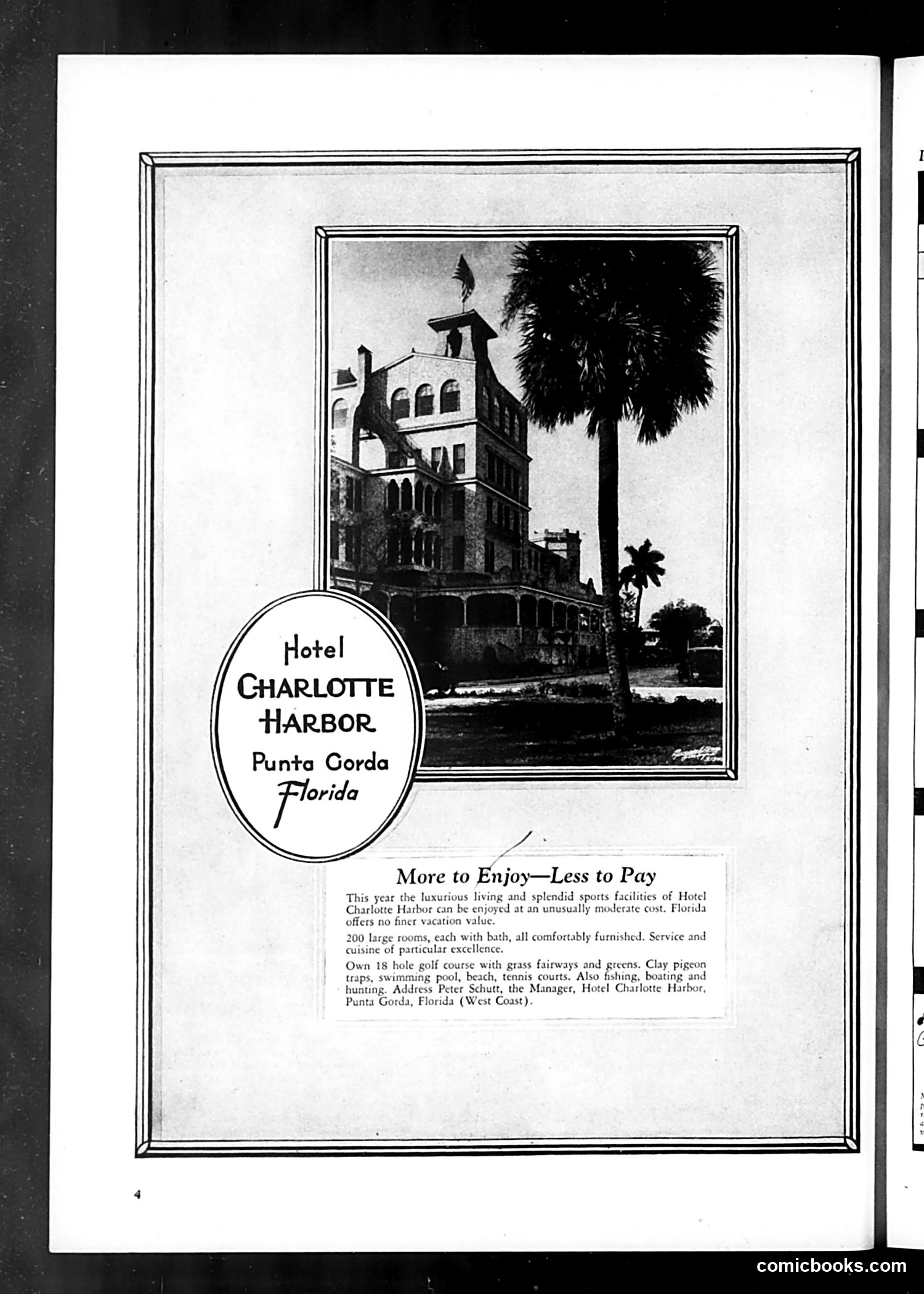
# Analysis This is not a political cartoon but rather a **hotel advertisement** for the Hotel Charlotte Harbor in Punta Gorda, Florida. The page features a photograph of the hotel building—a multi-story structure with Spanish Colonial Revival architecture, complete with a tower and palm trees—positioned above promotional text. The headline "More to Enjoy—Less to Pay" emphasizes the hotel's value proposition, highlighting amenities like 200 rooms, an 18-hole golf course, clay pigeon shooting, tennis courts, and water sports. The advertisement lists Peter Schutt as the manager and is addressed to potential vacationers seeking luxury accommodations at moderate cost. This appears to be from an era when Florida resort tourism was actively promoted to American travelers.
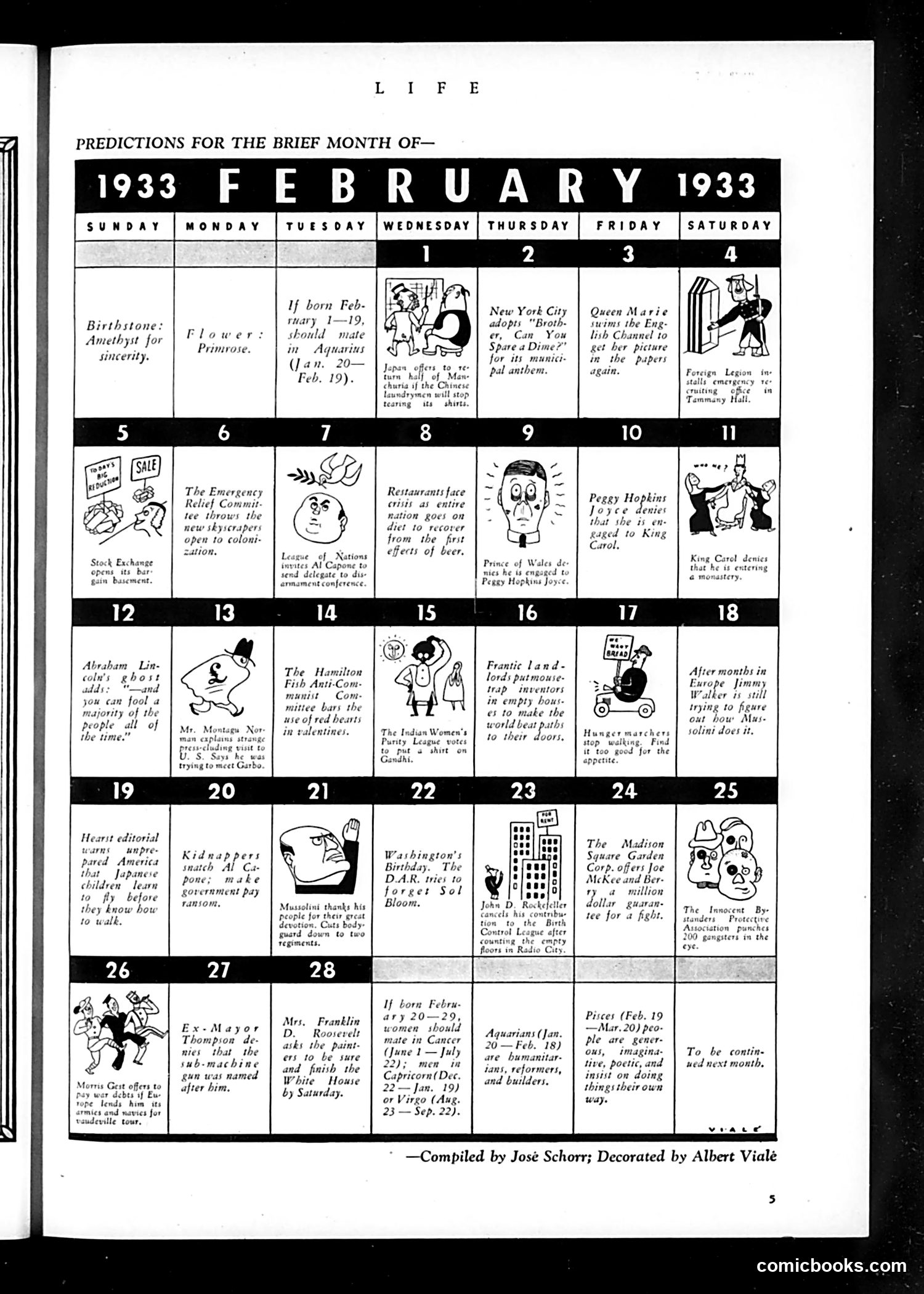
# February 1933 Calendar Commentary This Life magazine calendar page mixes satirical predictions with topical humor from early 1933—during the Great Depression and Franklin D. Roosevelt's first weeks as president. Notable entries include references to: - **February 2**: "New York City adopts 'Broadsides'"—likely mocking economic desperation - **February 15**: Indian Women's Party League visiting Gandhi - **February 22**: Washington's birthday and D.A.R. (Daughters of the American Revolution) activities - **February 27**: Ex-Mayor Thompson and political machinery - **Throughout**: Various economic hardship jokes (stock exchange, relief organizations, kidney apples) The cartoons use simple line drawings to illustrate everyday Depression-era struggles and contemporary news. The satire targets government institutions, wealthy organizations, and social absurdities of 1933, though specific political figures are difficult to identify with certainty from the crude illustrations.
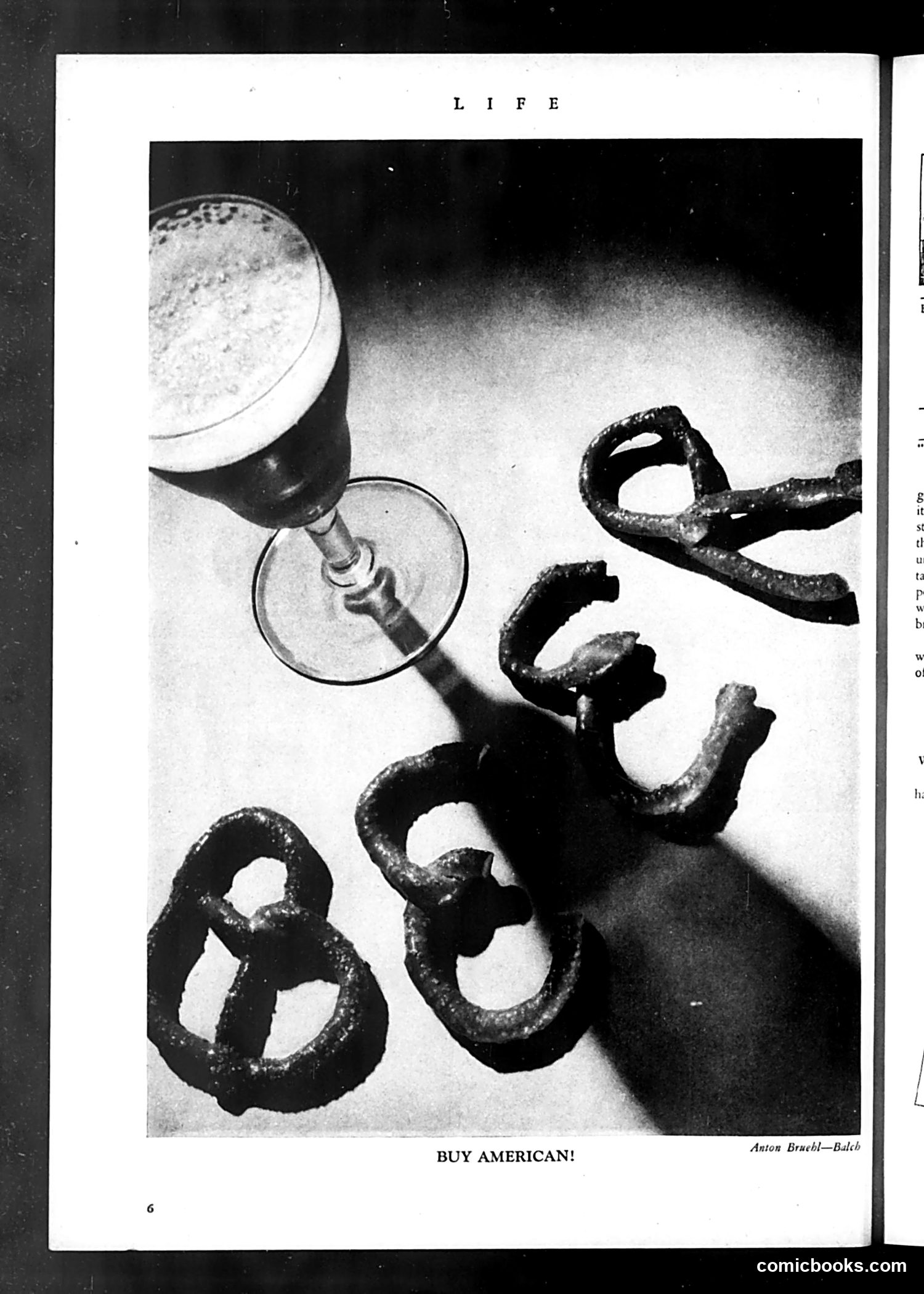
# Analysis This is a patriotic advertisement photographed by Anton Bruehl, showing pretzels arranged around a beer mug filled with what appears to be foam or beer head. The caption reads "BUY AMERICAN!" The satire targets German-American cultural products—pretzels and beer being iconic German foods—during a period of American economic nationalism (likely 1930s based on the style). The joke is ironic: these quintessentially "German" foods are being promoted as American products to buy, highlighting how thoroughly German immigrant culture had become woven into American identity. The photograph's stark, dramatic lighting emphasizes these humble foods as worthy of patriotic consumption, gently mocking both nationalist sentiment and the absurdity of claiming foreign-origin foods as "American."
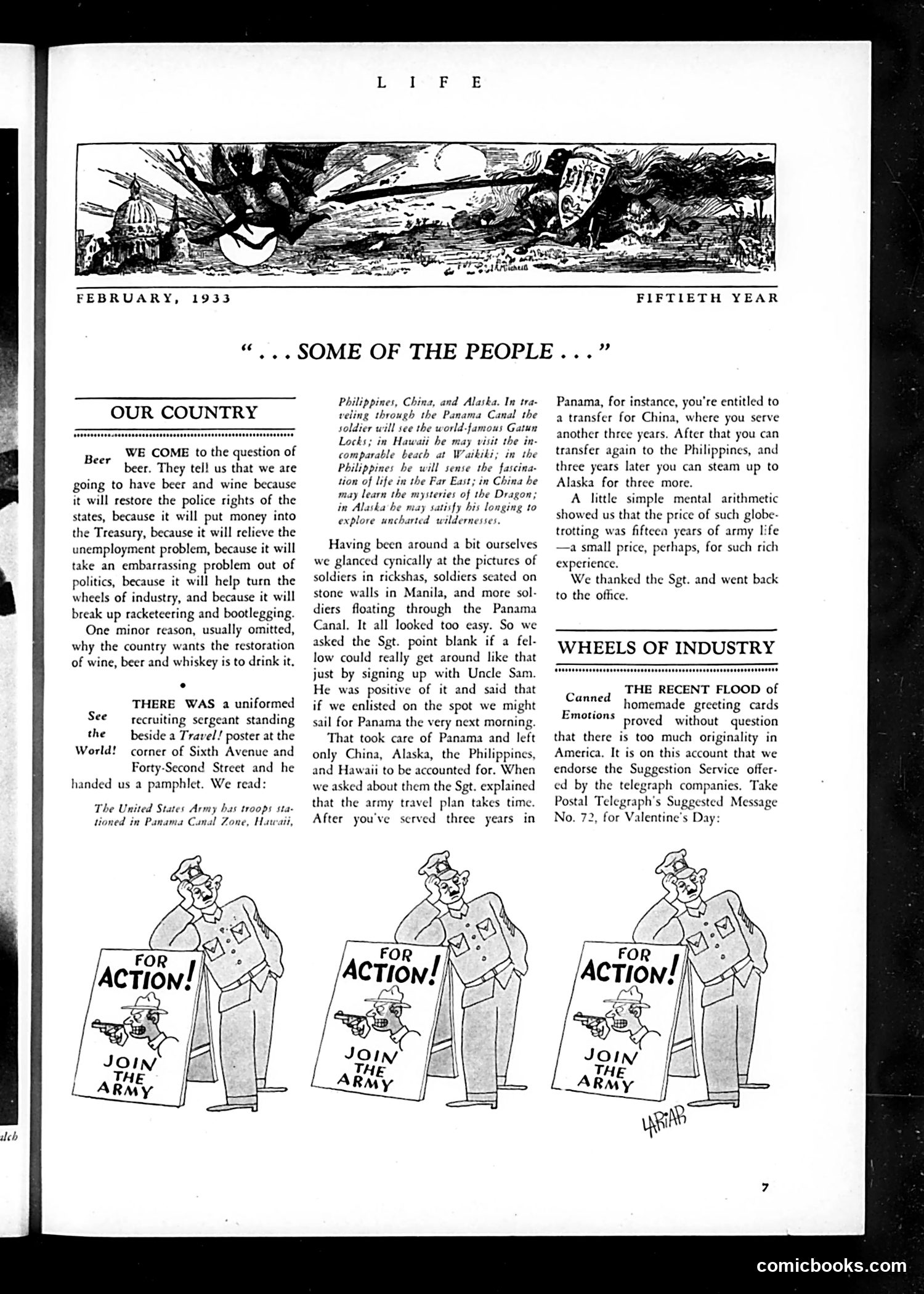
# Political Content Analysis: Life Magazine, February 1933 This page discusses military recruitment and the beer/wine question during Prohibition's final months (Prohibition ended in December 1933). The main cartoon shows a U.S. Army recruiting sergeant holding three identical "FOR ACTION! JOIN THE ARMY" posters. The repetition appears satirical—suggesting the Army was desperately reusing the same recruitment pitch rather than offering compelling reasons to enlist during the Great Depression. The left column debates whether restoring beer and wine sales would help the economy and reduce bootlegging. The right column discusses overseas Army postings (Panama, China, Philippines, Alaska), where soldiers had minimal attractions. The overall satire: the Army's recruitment efforts seemed unconvincing and repetitive during economically desperate times when soldiers faced unappealing duty assignments.
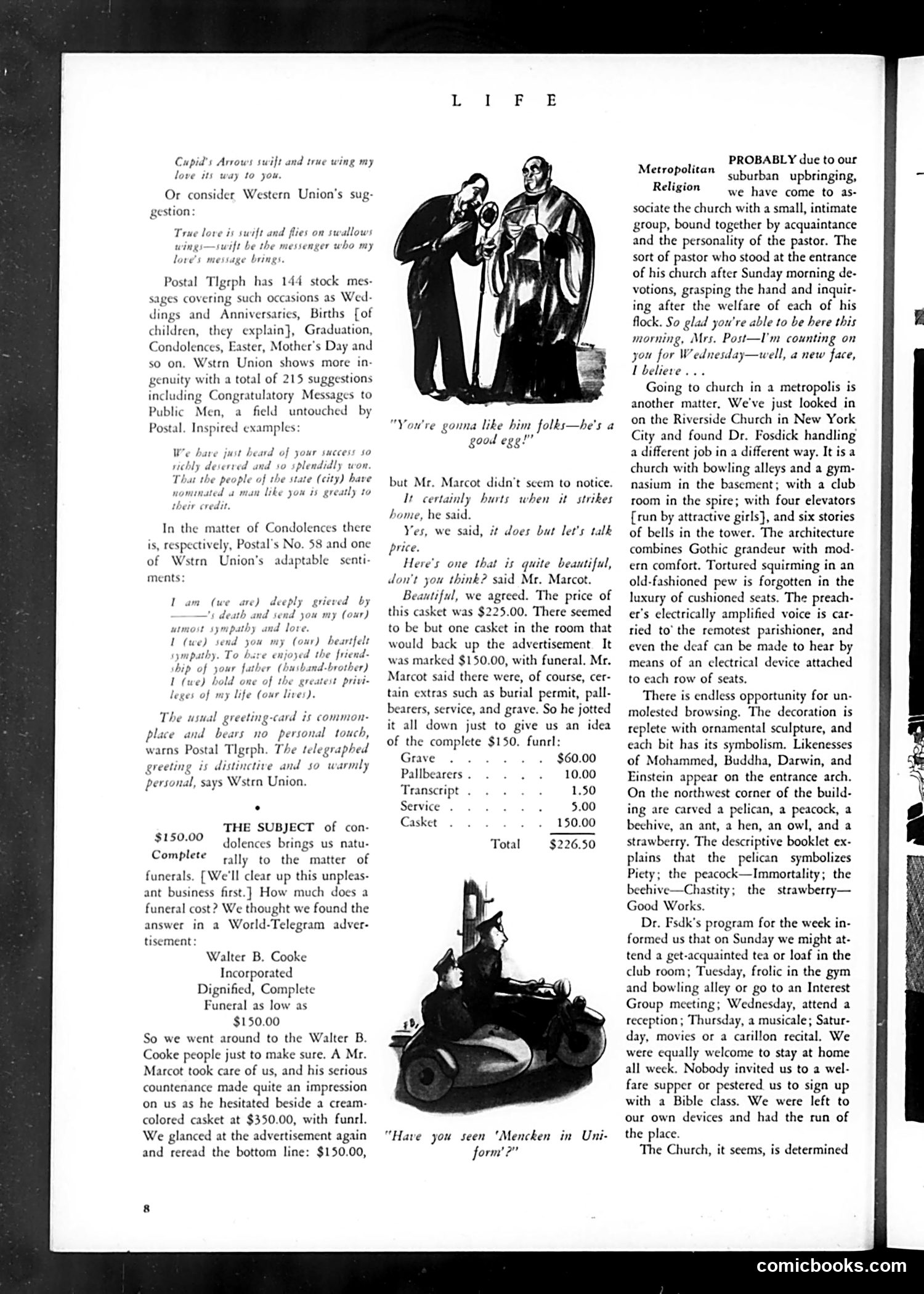
# Analysis of Life Magazine Page This page satirizes funeral industry practices and church culture in early 20th-century America. **Top Cartoon**: Shows two men discussing a casket purchase. The caption "You're gonna like him folks—he's a good egg!" suggests cynical salesmanship—the funeral director marketing an expensive casket with superficial charm rather than genuine concern. **Bottom Cartoon**: Depicts a rotund man in a chair, captioned "Have you seen 'Mencken in Uniform'?" This likely references H.L. Mencken, a prominent satirist known for social criticism, though the specific reference is unclear from the image alone. **Main Article**: Mocks the cost of funerals through a breakdown showing a $226.50 "complete funeral" (advertised as "$150.00"), revealing hidden fees and upselling tactics by funeral homes like Walter B. Cooke Incorporated—exposing consumer deception and commercialization of death.