A complete issue · 53 pages · 1932
Life — December 1932
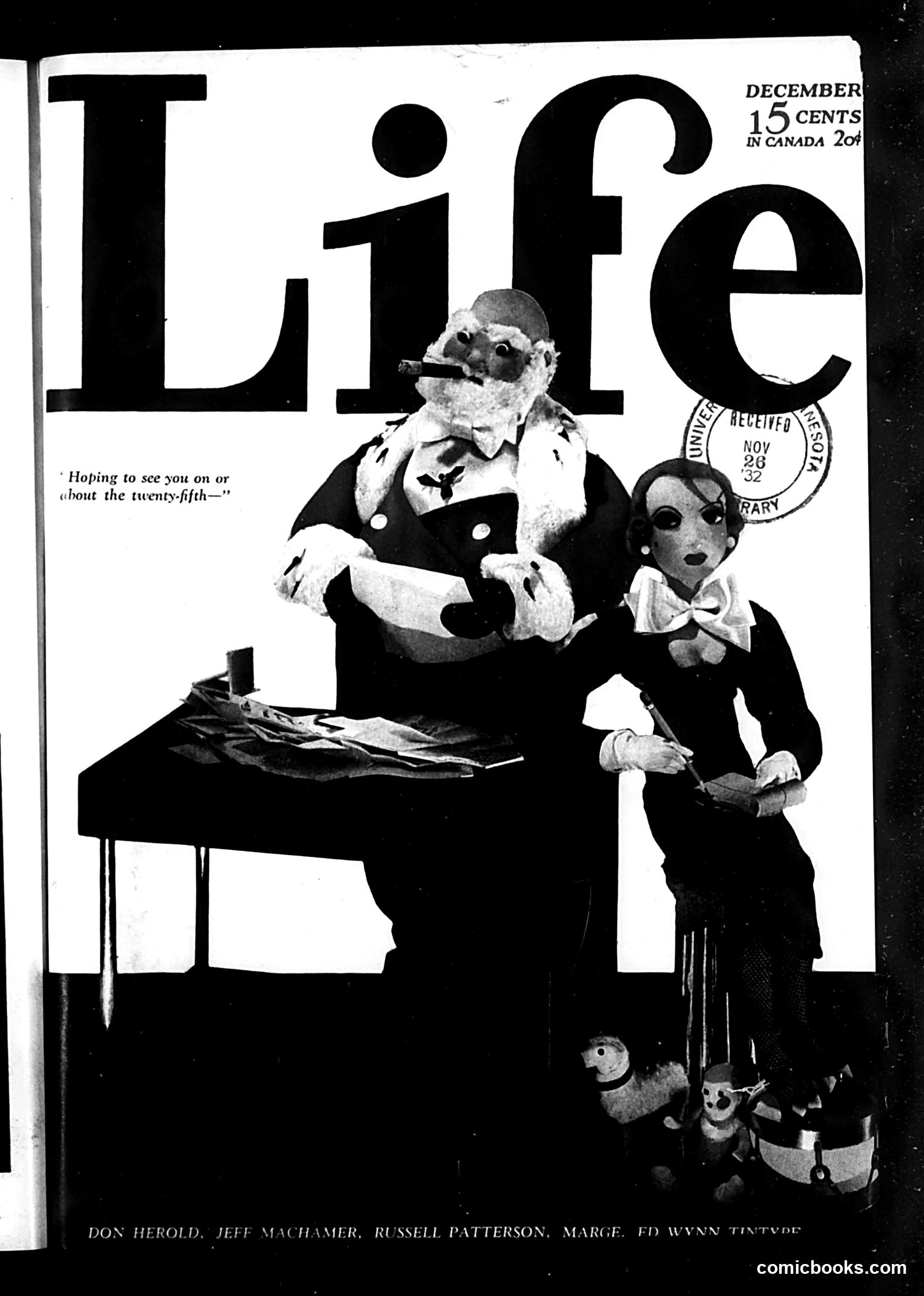
# Life Magazine Cover Analysis (December, circa 1932) This is a **Christmas-themed Life magazine cover** featuring costumed characters in a holiday scene. A rotund figure dressed as Santa Claus holds what appears to be a gift list or ledger, while a smaller character in formal attire (possibly representing a child or helper) stands beside him at a table. The cover's tagline reads "Hoping to see you on or about the twenty-fifth—" a play on Santa's traditional Christmas Eve visit. The caption credits Don Herold, Jeff Machamer, Russell Patterson, Marge, and Ed Wynn. **Ed Wynn was a famous comedian of the era**, suggesting this may be a theatrical or entertainment-related holiday piece rather than political satire. The 15-cent price and Canadian marking date this to the early 1930s Depression era.
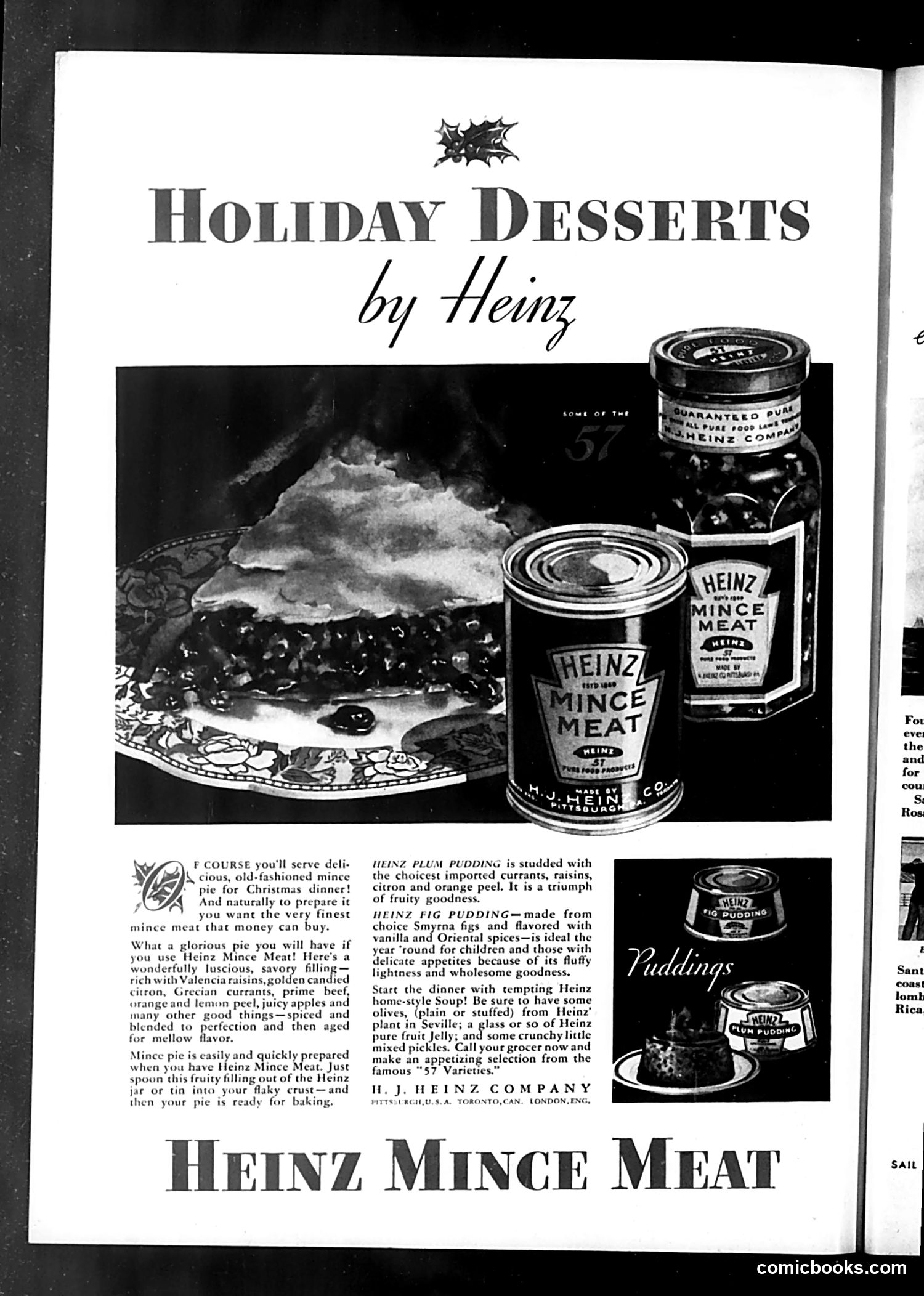
# Analysis This is primarily a **vintage advertisement**, not political satire. It's a Heinz company ad promoting their mince meat and pudding products for holiday desserts, circa early-to-mid 20th century. The page features: - A photograph of an elegant mince pie with whipped topping - Product images of Heinz mince meat and pudding jars - Descriptive text encouraging readers to use Heinz products for Christmas dinner preparation - A section on "Puddings" highlighting their fig pudding and plum pudding varieties The decorative holly leaf at the top establishes the holiday theme. There is no political cartoon or satire present—this is straightforward consumer advertising emphasizing convenience and quality ingredients for holiday cooking, targeting home cooks planning festive meals.
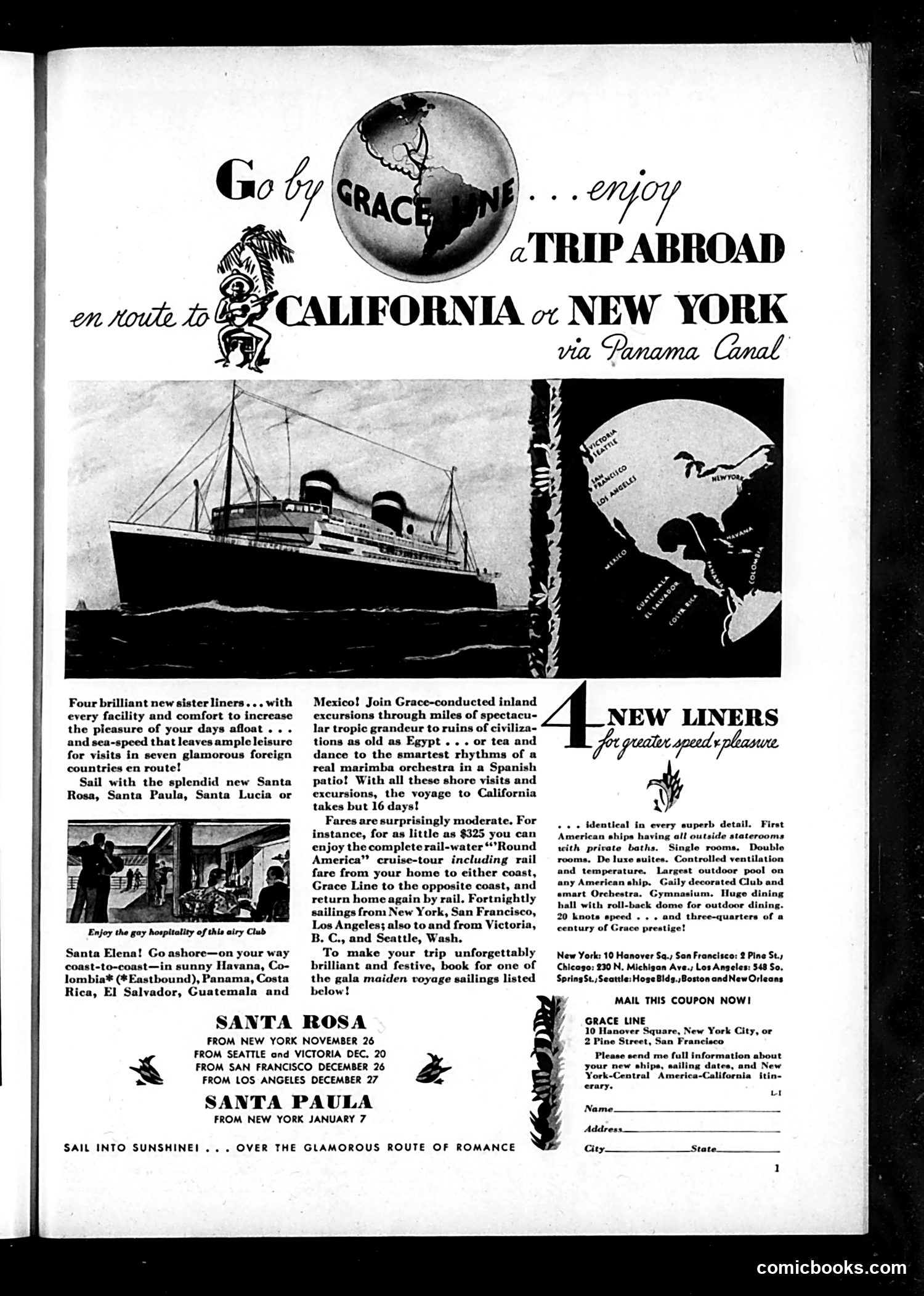
# Analysis This is primarily a **cruise line advertisement**, not a political cartoon. It promotes Grace Line's new steamships (Santa Rosa, Santa Paula, and Santa Lucia) offering luxury voyages to California and New York via the Panama Canal. The small decorative figure on the left appears to be a **generic "tropical" character** — likely meant as lighthearted exotica rather than a specific political caricature. The advertisement emphasizes leisure travel, moderate fares ($325), and route options between coasts. The page targets affluent American travelers interested in glamorous voyages during what appears to be the 1930s-40s era. The "Panama Canal" routing was a major selling point for transcontinental ocean travel. This is commercial marketing, not satire or political commentary.
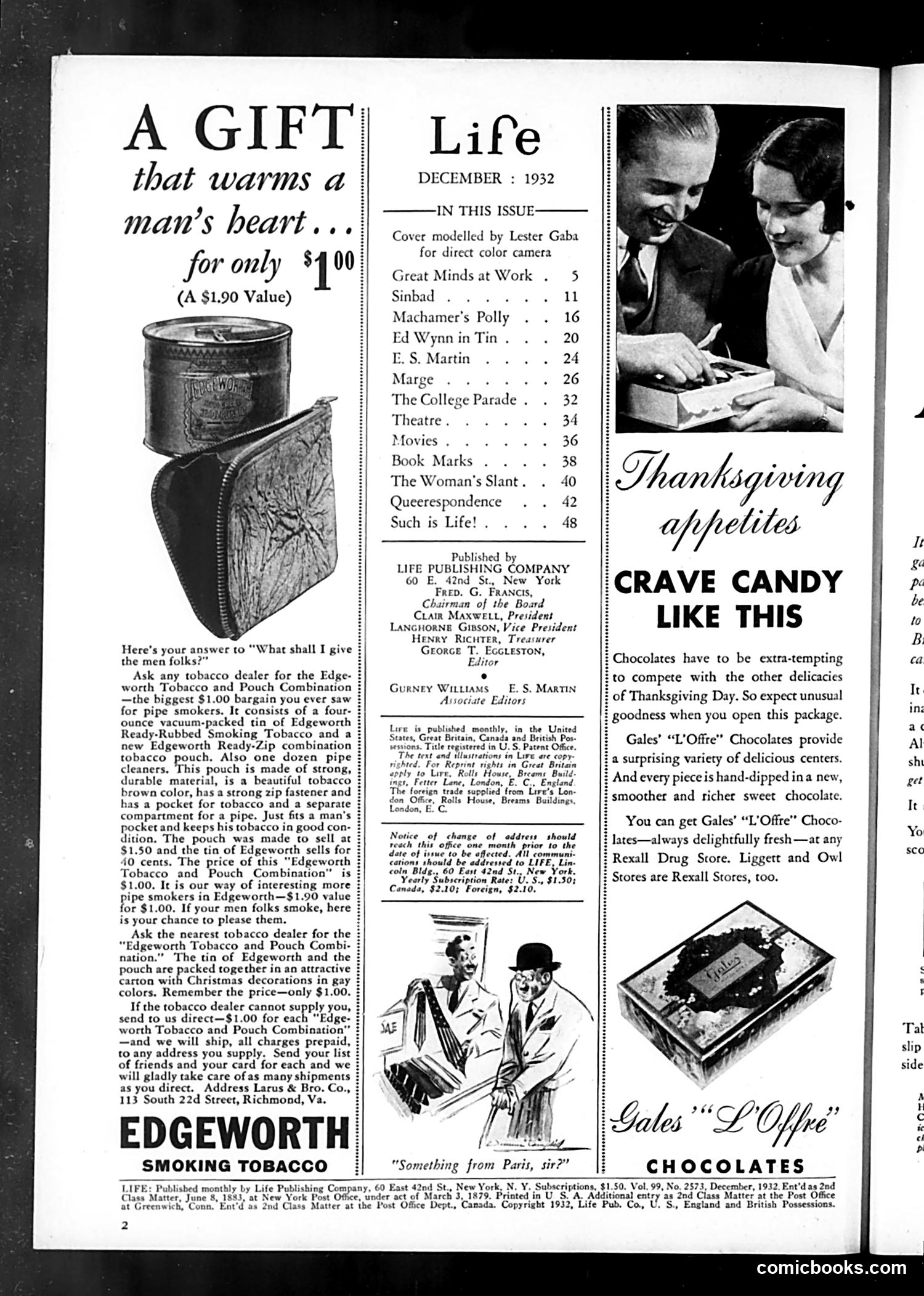
# Content Analysis: Life Magazine, December 1932 This is primarily a **table of contents and advertising page** rather than a satirical cartoon page. The left side advertises Edgeworth Smoking Tobacco with a gift tin ($1.00), while the right features Gales' "L'Offre" Chocolates with a small cartoon showing two men examining a wrapped package—one saying "Something from Paris, sir?" The cartoon's joke appears to be a mild double entendre: the wrapped chocolates package could humorously suggest something more risqué from Paris, playing on Paris's reputation for sophistication and romance. However, this is subtle advertising humor rather than political satire. The magazine contents list includes articles on entertainers (Ed Wynn, F.S. Martin) and topics typical of 1932: "The College Parade," theater reviews, and "Book Marks."
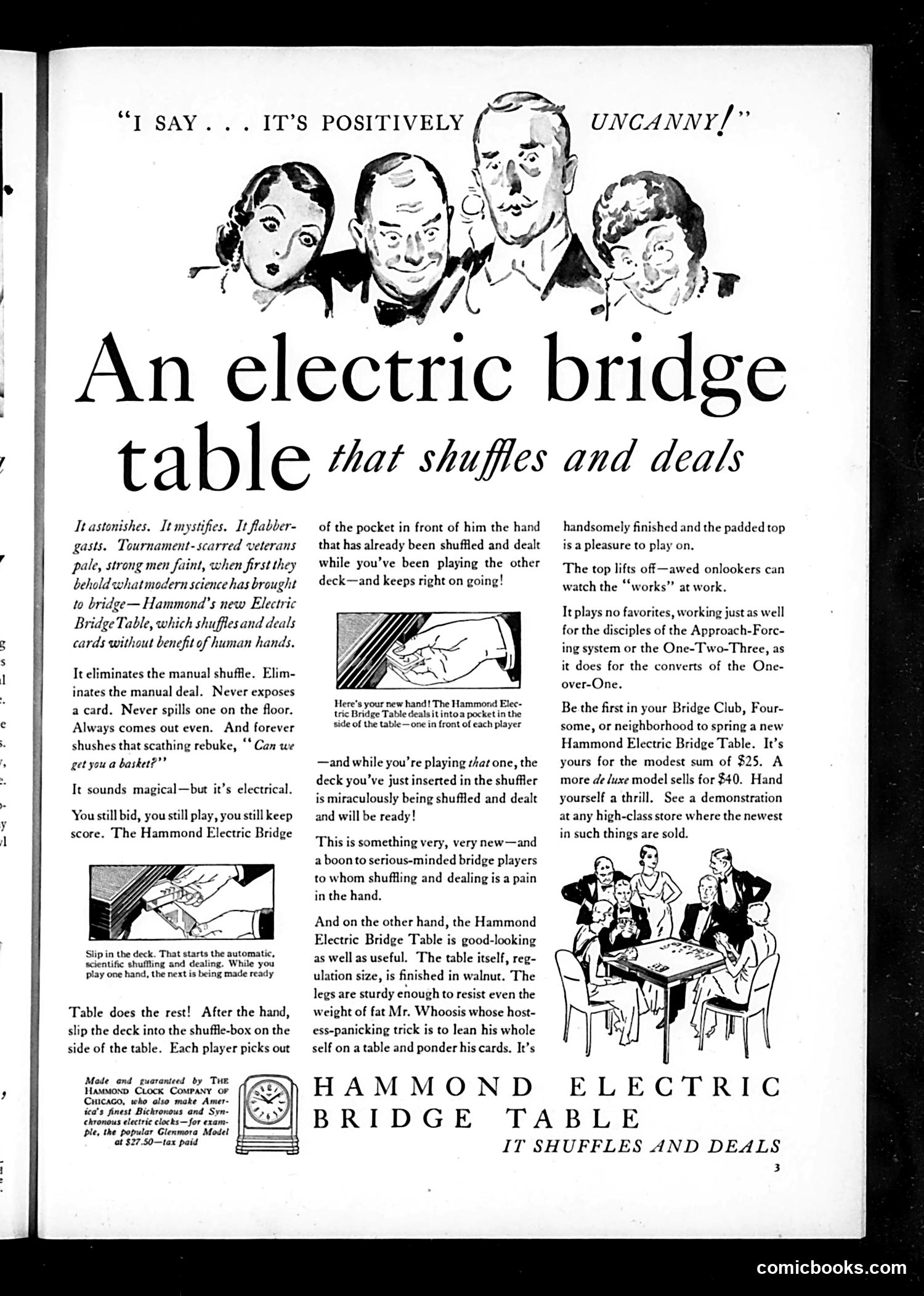
# Hammond Electric Bridge Table Advertisement This is primarily a **product advertisement** for an electric bridge table, not political satire. The page promotes an automated card-shuffling device marketed to bridge players. The cartoon figures at the top are generic 1920s-30s socialites expressing amazement at the technology. The ad's humor derives from the novelty of applying electricity to a leisure activity—the table automatically shuffles and deals cards "without benefit of human hands," eliminating manual drudgery. The satire is gentle: it pokes fun at bridge enthusiasts' obsession with the game and cheekily suggests this device solves the "pain in the hand" of shuffling. The ad emphasizes both convenience and aesthetic appeal, positioning the table as a status symbol for affluent social circles. There are no identifiable political figures or references—this is straightforward period advertising targeting the emerging consumer electronics market.
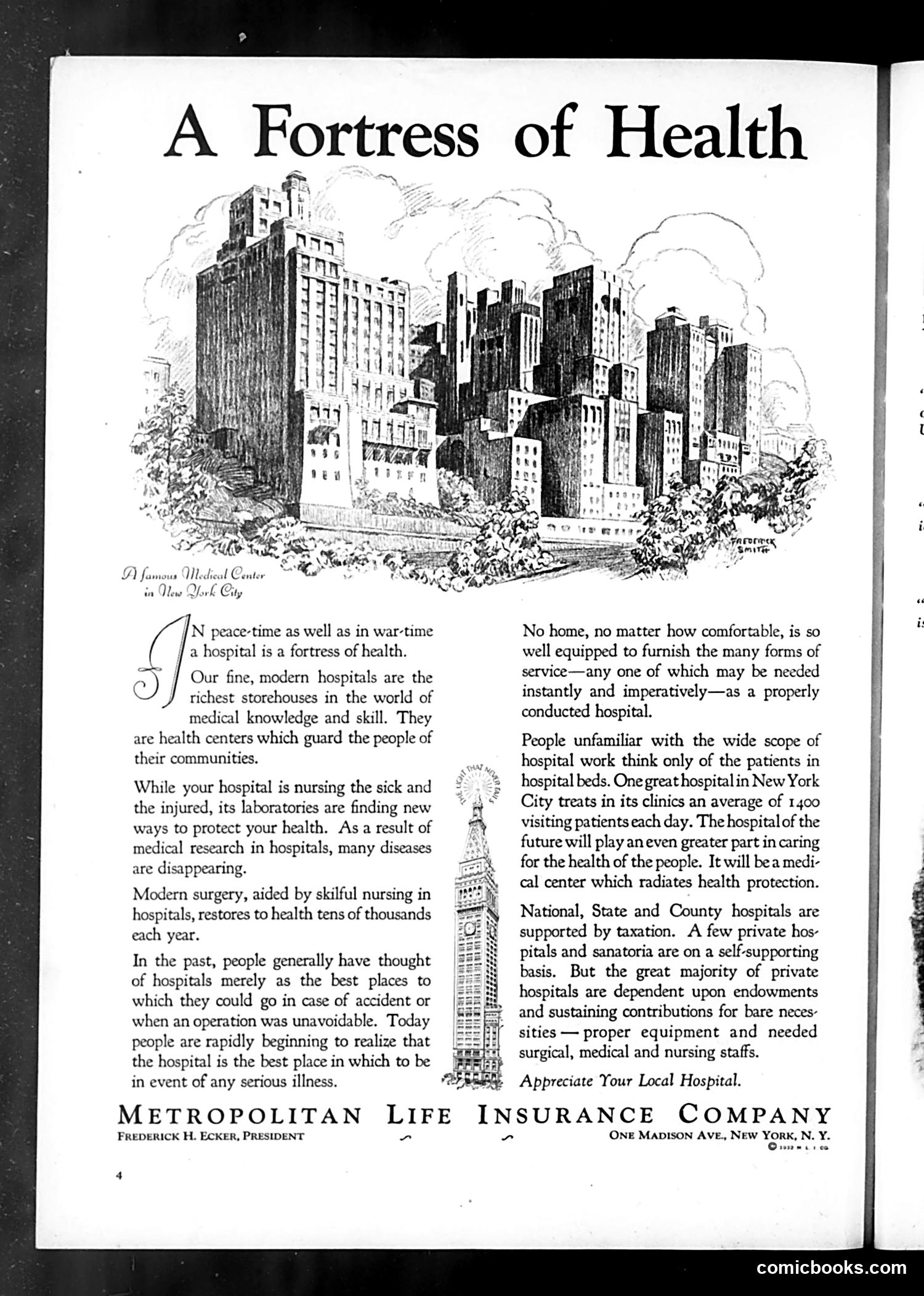
# Analysis: "A Fortress of Health" This is primarily an **advertisement** for Metropolitan Life Insurance Company, not satire or political commentary. The page features a sketch of a famous medical center in New York City and promotional text about hospitals. The "fortress" metaphor frames hospitals as institutions that protect public health—both in peacetime and wartime. The ad argues that modern hospitals serve as essential community resources for medical research and care, treating thousands annually through surgery and nursing. The content emphasizes hospitals' expanding role beyond patient beds, mentioning clinics serving 1,200 visitors daily. The final line—"Appreciate Your Local Hospital"—is a call to recognize and support these institutions. This represents early-20th-century corporate messaging promoting both healthcare infrastructure and insurance as protective services.
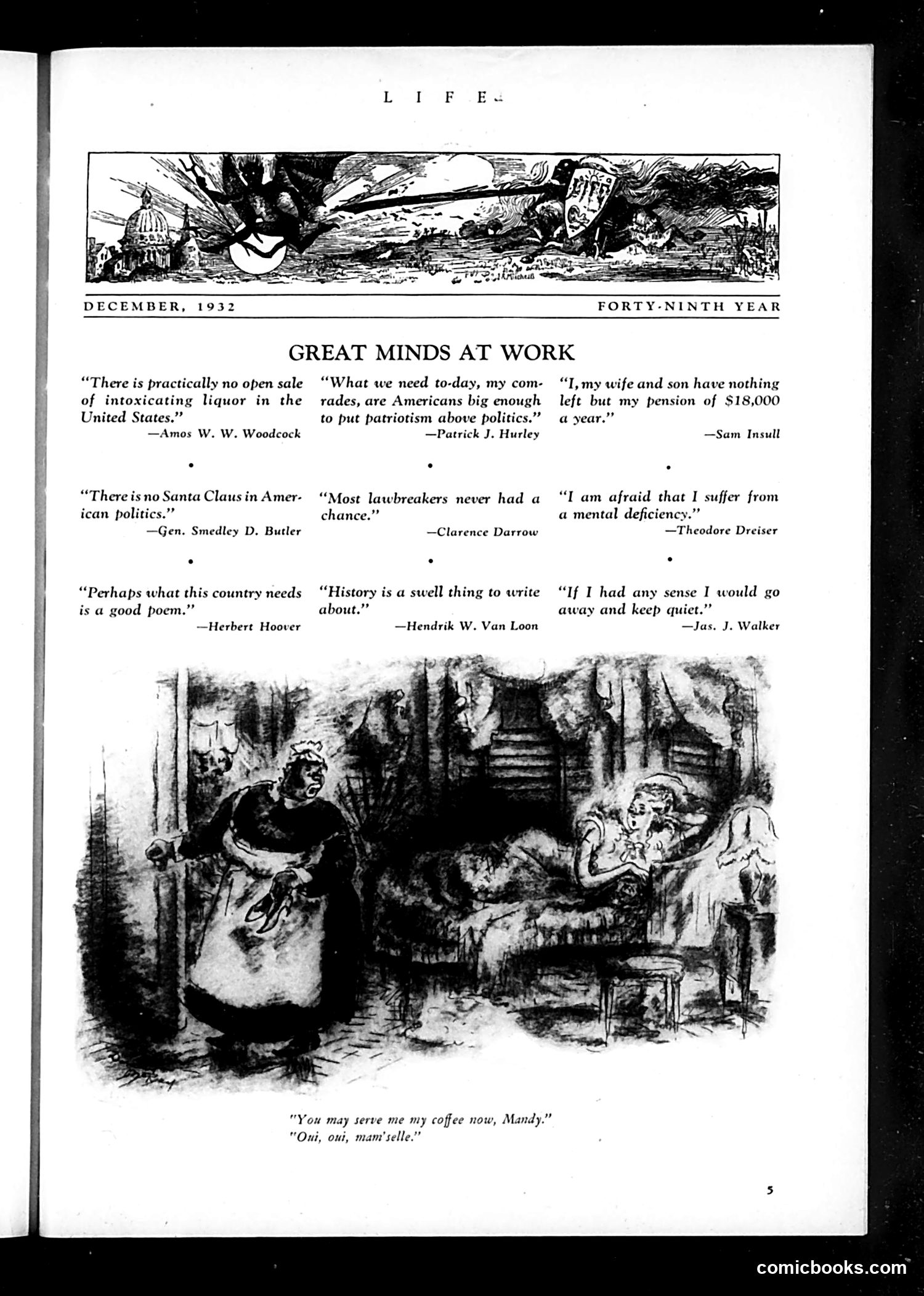
# "Great Minds at Work" — Life Magazine, December 1932 This page presents satirical quotes from prominent figures during the Great Depression, paired with a cartoon showing a maid serving coffee to a wealthy woman. **The Satire:** The quotes mock public figures' disconnected remarks about serious problems—liquor sales bans, patriotism, lawbreaking, and national needs—suggesting they lack understanding of ordinary citizens' struggles. The cartoon reinforces this disconnect: while Depression-era Americans faced poverty, wealthy households maintained servants and comfort. **Key figures quoted include** Herbert Hoover (president), Gen. Smedley Butler, and others. Sam Insull's quote about living on $18,000 yearly pension particularly highlights the disconnect between elite and working-class experiences during economic collapse. **The joke** lies in juxtaposing these obtuse public statements with the visual reminder that some Americans still enjoyed significant privilege.
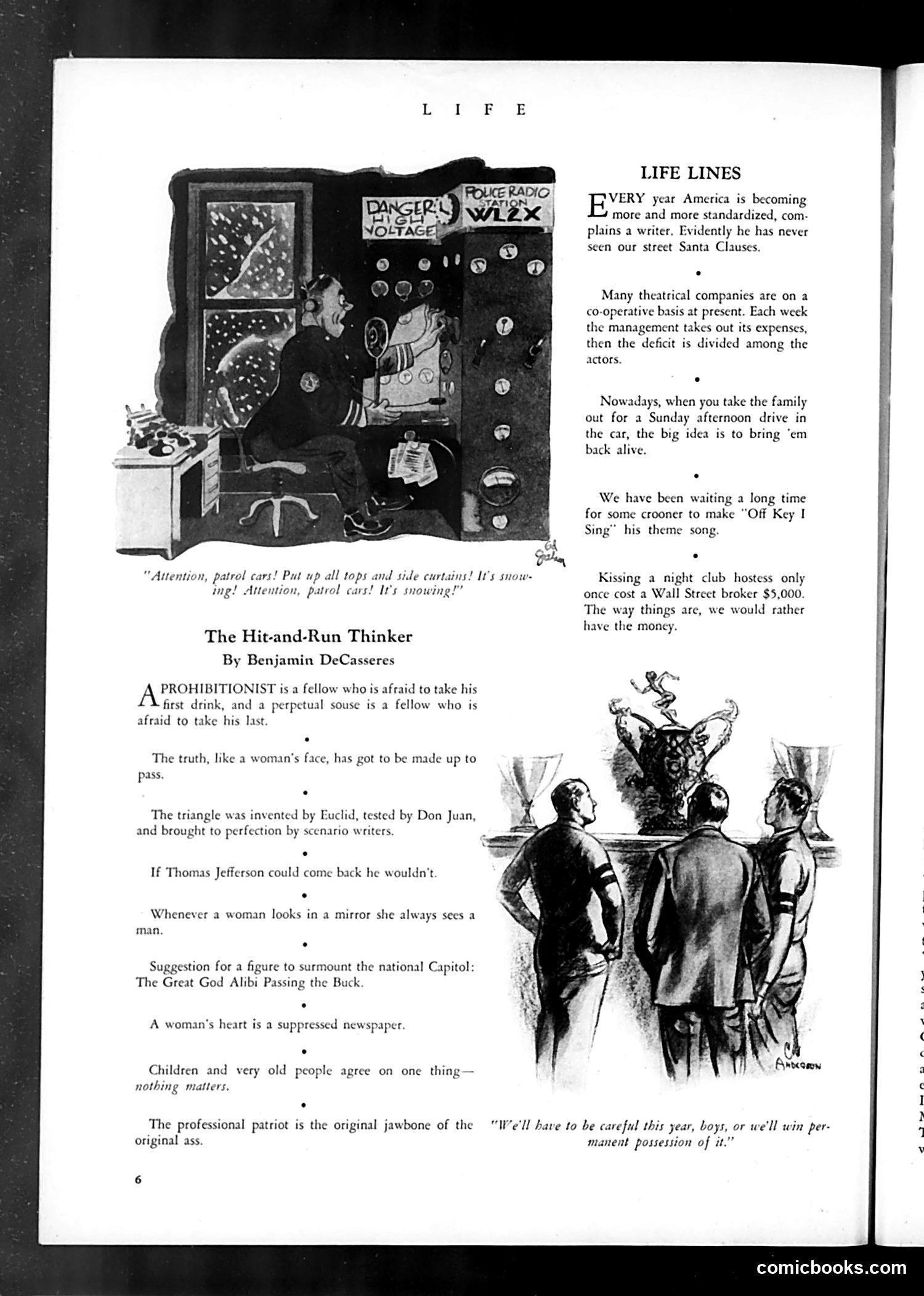
# "Life Lines" and "The Hit-and-Run Thinker" This page contains two humor sections from *Life* magazine. The top left shows a cartoon of someone at an elaborate radio control panel labeled with warnings like "DANGEROUS VOLTAGE" and "POLICE RADIO," captioned about turning on "all tops and side curtains" during snow—a joke about domestic radio entertainment becoming overly complicated. The "Life Lines" column offers brief satirical observations on contemporary American culture: standardized writing, theatrical cooperatives, Sunday drives, and Prohibition-era references (mentioning a Wall Street broker kissing a nightclub hostess). "The Hit-and-Run Thinker" by Benjamin DeCasseres presents philosophical quips mocking prohibition, women, Thomas Jefferson, and patriotism—typical satirical aphorisms of the era reflecting 1920s-30s sensibilities.
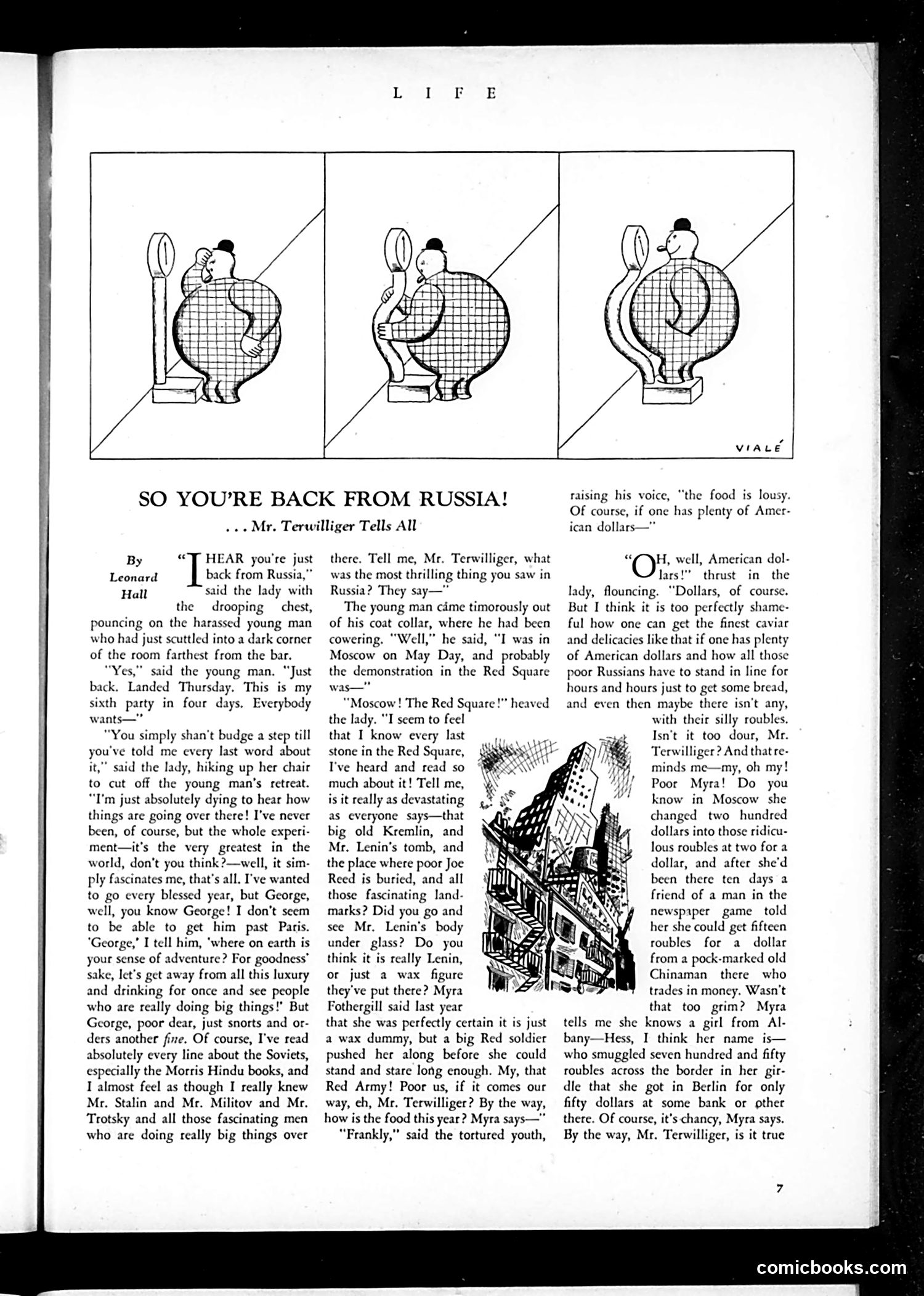
# Analysis of "So You're Back from Russia!" The three-panel cartoon at the top depicts a woman repeatedly weighing herself on a scale, with her weight increasing in each panel—a visual joke about gaining weight. The accompanying story by Leonard Hall is a satirical dialogue between a lady and a young man recently returned from Russia. The humor centers on **Cold War contrasts**: while the young man witnessed Soviet spectacles (Red Square demonstrations, Lenin's tomb), the lady is preoccupied with American consumer abundance and vanity—her concerns are dollars, caviar, and her weight. The satire targets **American materialism and superficiality** during the early Cold War era, suggesting Americans prioritize luxury goods and appearance over geopolitical significance, even when someone has witnessed momentous Soviet events.
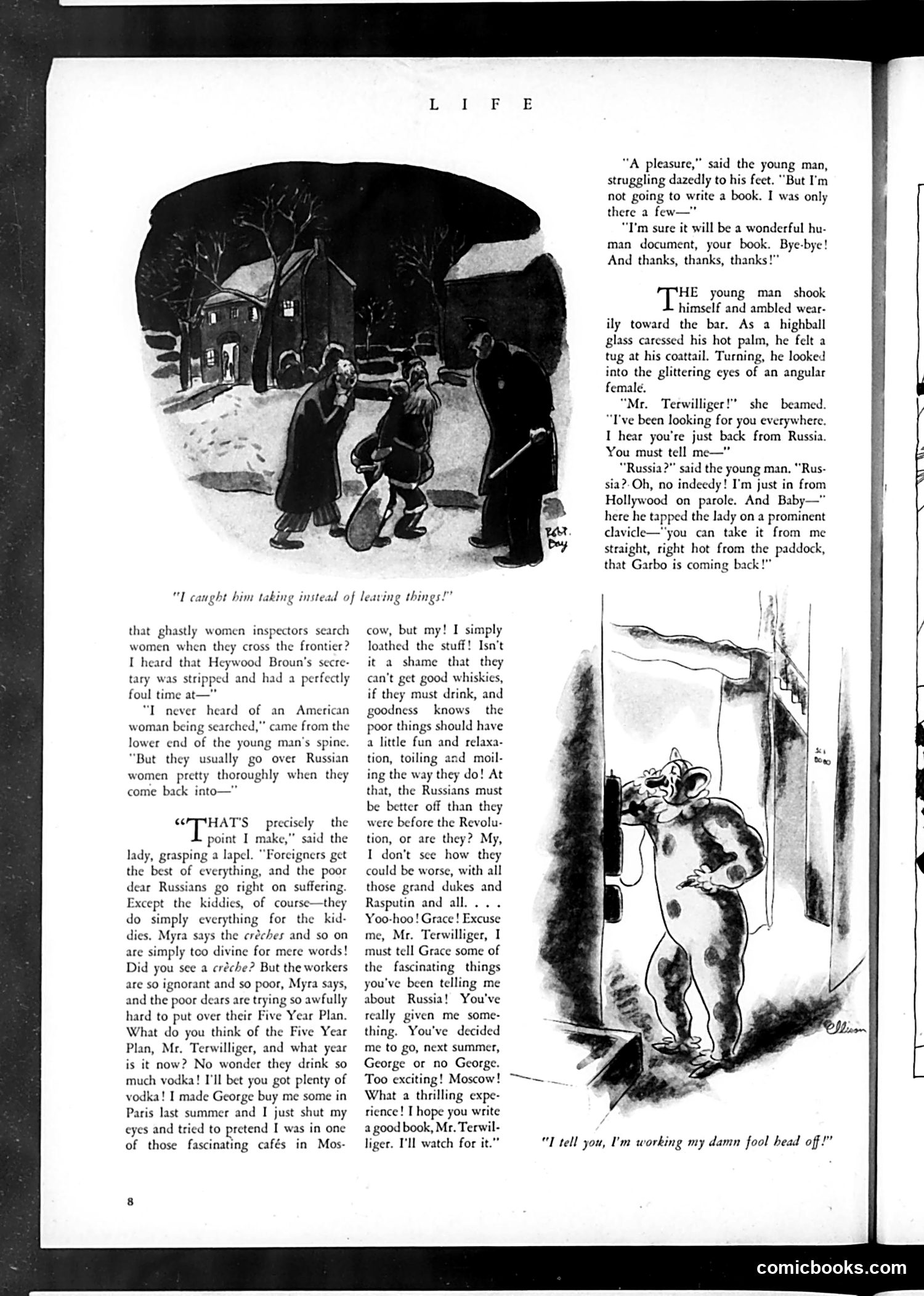
# Analysis of Life Magazine Page This page satirizes American attitudes toward Soviet Russia during the early post-Revolutionary period. The narrative features a young man named Terwilliger who has just returned from Hollywood (on parole) claiming to be fresh back from Russia. An angular female character expresses fascination with Russia, asking him to share stories. The satire targets two groups: wealthy American women romanticizing Soviet Russia as exotic and politically progressive, and men fabricating false experiences for social credibility. The dialogue mocks the "Five Year Plan" and suggests Russians drink excessive vodka. The cartoons illustrate the absurdity of casual, uninformed discussion about Soviet life among privileged Americans more interested in fashionable ideology than actual conditions.
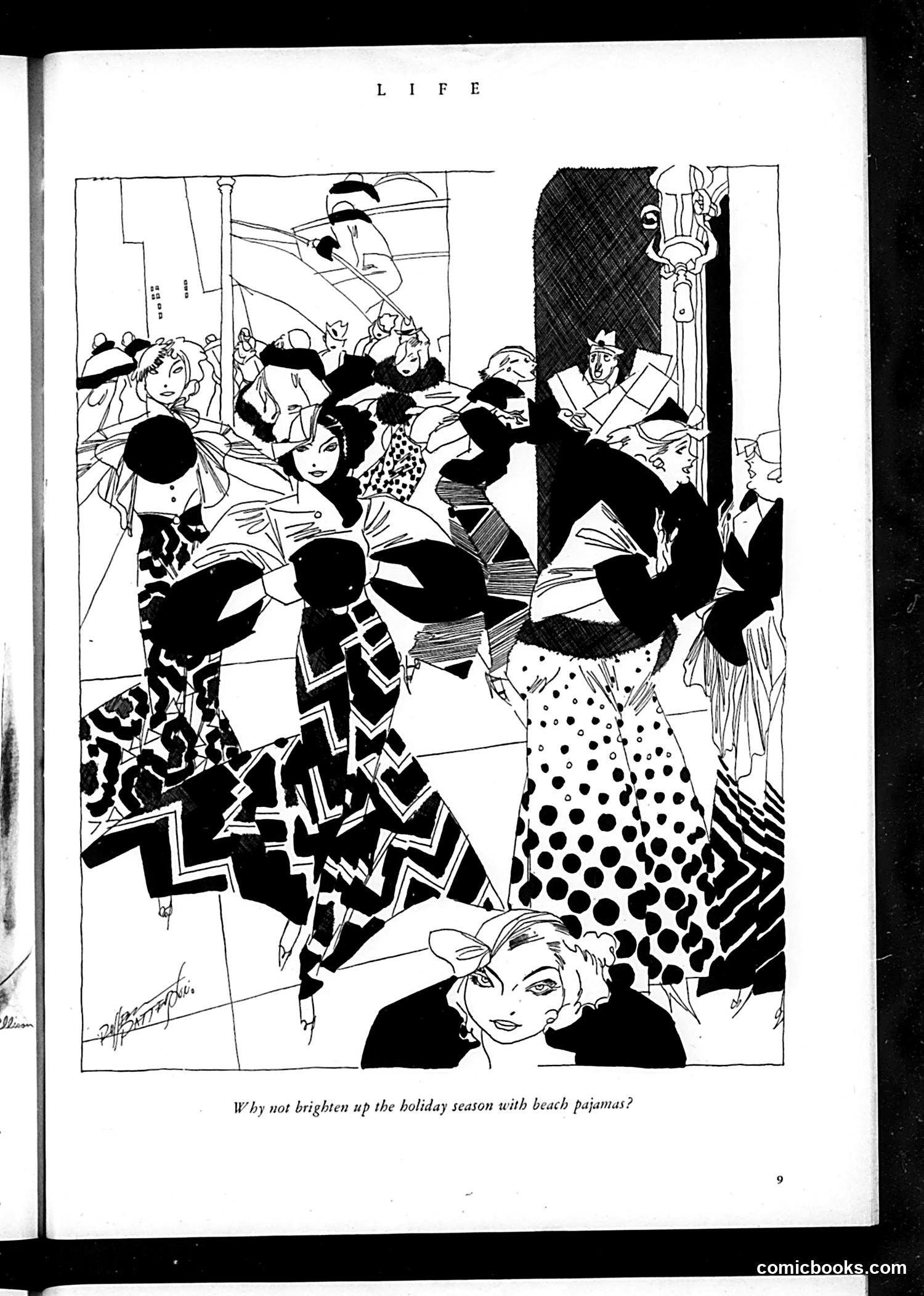
# Analysis This is a single cartoon illustration from *Life* magazine's "Life" section (page 9). The image depicts a crowded, fashionable social gathering—likely a holiday party or upscale event—filled with elegantly dressed women displaying various bold patterns and styles: geometric designs, polka dots, and striped fabrics. The caption reads: "Why not brighten up the holiday season with beach pajamas?" The satire targets fashion trends and consumer culture. "Beach pajamas"—a 1920s-30s casual loungewear style—are being humorously suggested as formal holiday wear. The joke critiques both the absurdity of applying casual beachwear to formal occasions and, more broadly, the fashion industry's constant push to sell new clothing items by promoting trendy items for inappropriate contexts. The crowded, chaotic scene emphasizes conspicuous consumption.
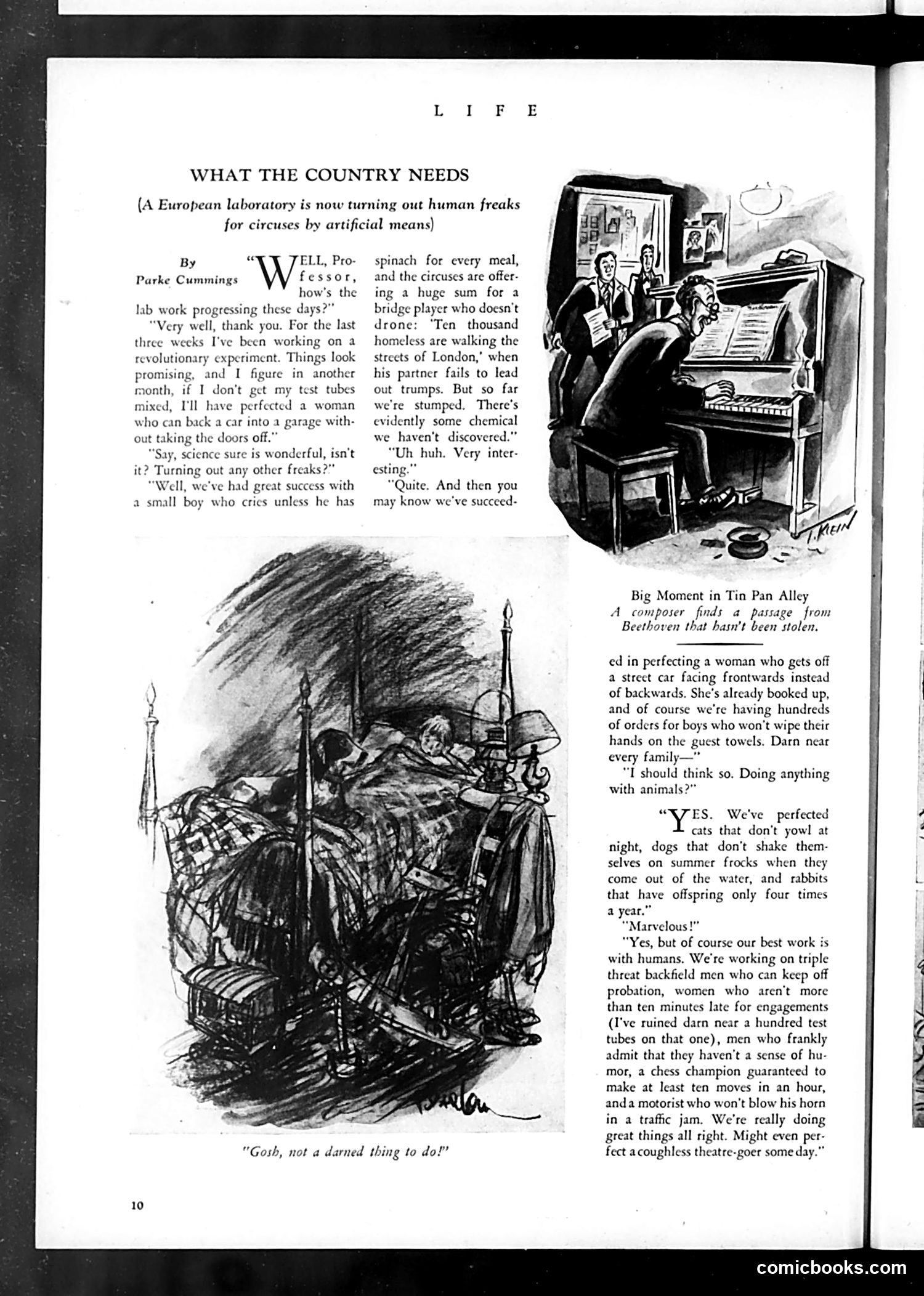
# Analysis: "What the Country Needs" This satirical article by Parke Cummings mocks eugenic pseudoscience popular in the early 20th century. The piece purports to describe a "European laboratory" selectively breeding humans to eliminate undesirable traits—creating boys who don't cry, women who arrive punctually, men without humor, chess champions, and motorists who won't honk horns. The cartoons illustrate the absurdity: one shows a cluttered laboratory workspace ("Gosh, not a darned thing to do!"), another depicts a piano player in a domestic scene, mocking the notion that human behavior could be engineered through breeding. The satire critiques both scientific overreach and social control, ridiculing the idea that human personality flaws could be "fixed" through artificial selection—a concept the author presents as simultaneously ridiculous and slightly appealing to readers' frustrations.