A complete issue · 52 pages · 1932
Life — October 1932
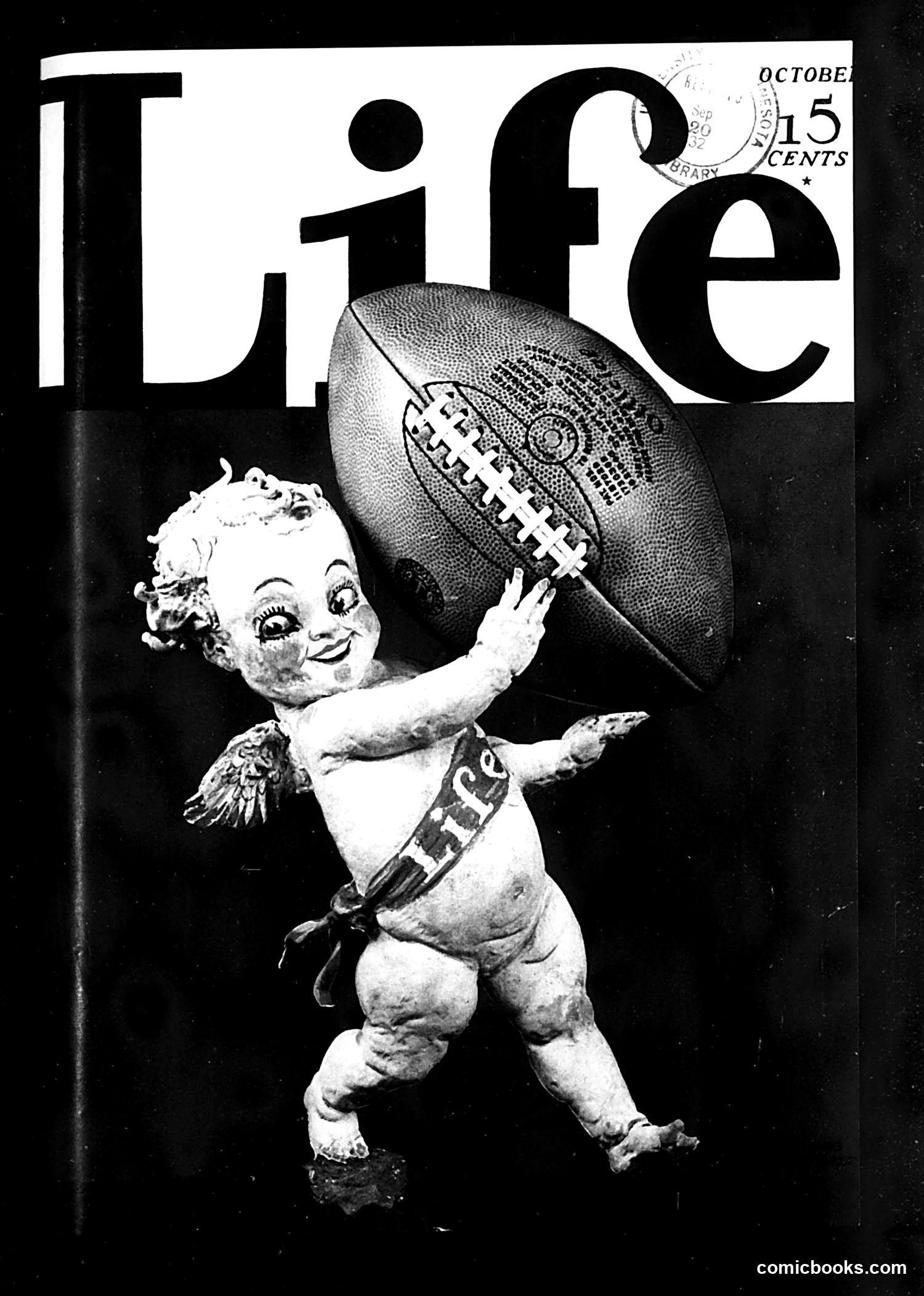
# Life Magazine Cover Analysis This October 1915 Life cover features a cherubic baby character—likely a generic "cupid" or cherub figure rather than a specific political figure—holding an oversized American football. The baby wears what appears to be a sports banner or sash across its torso. The satire likely comments on American football's popularity and cultural significance during this era, presenting the sport as something even infants are invested in. The exaggerated musculature of the baby and its determined expression humorously emphasize football's dominance in American culture and public consciousness. Without additional text context, the specific satirical target remains unclear, though it clearly plays on football fever sweeping the nation during the early 20th century.
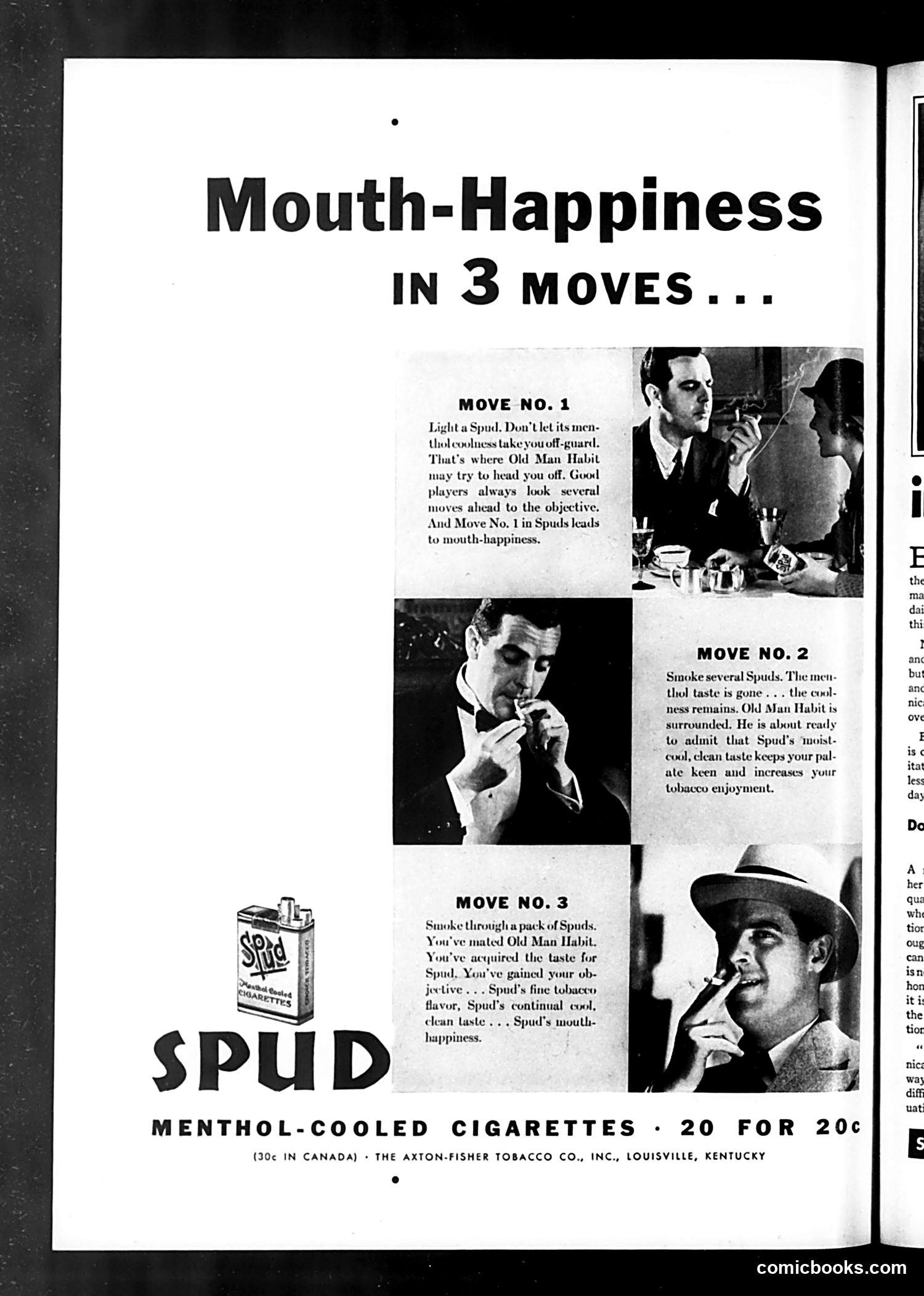
# Analysis This is a **vintage cigarette advertisement**, not political satire. The page advertises "Spud" menthol-cooled cigarettes (20 for 20¢), manufactured by Axton-Fisher Tobacco Co. in Louisville, Kentucky. The "3 moves to mouth-happiness" is a marketing gimmick presenting cigarette smoking as a sequential pleasure: lighting a spud, smoking several to develop taste preference, and continuing through a pack to achieve "mouth-happiness." The three photographs show men at different stages of smoking. The advertisement references "Old Man Habit" as a humorous acknowledgment that regular smoking creates dependency—presented here as a selling point rather than a warning. This reflects mid-20th-century advertising's open promotion of tobacco before health risks were widely acknowledged.

This page is primarily an **advertisement for the Britannica Encyclopedia**, not a political cartoon or satire. The ad uses testimonials from satisfied owners (identified by name and location) claiming the encyclopedia is "the best investment I've ever made." It emphasizes practical benefits: helping children with homework, providing reference material, and offering convenient credit terms ($5 down, $5 monthly). The small photograph shows a dark wooden encyclopedia cabinet—the physical product being sold. The marketing pitch targets middle-class families concerned about their children's education and practical home reference needs. This represents typical mid-20th-century American advertising strategy: combining authority (expert sources), emotional appeal (parental concern), and financial accessibility (installment plans) to drive consumer purchases.
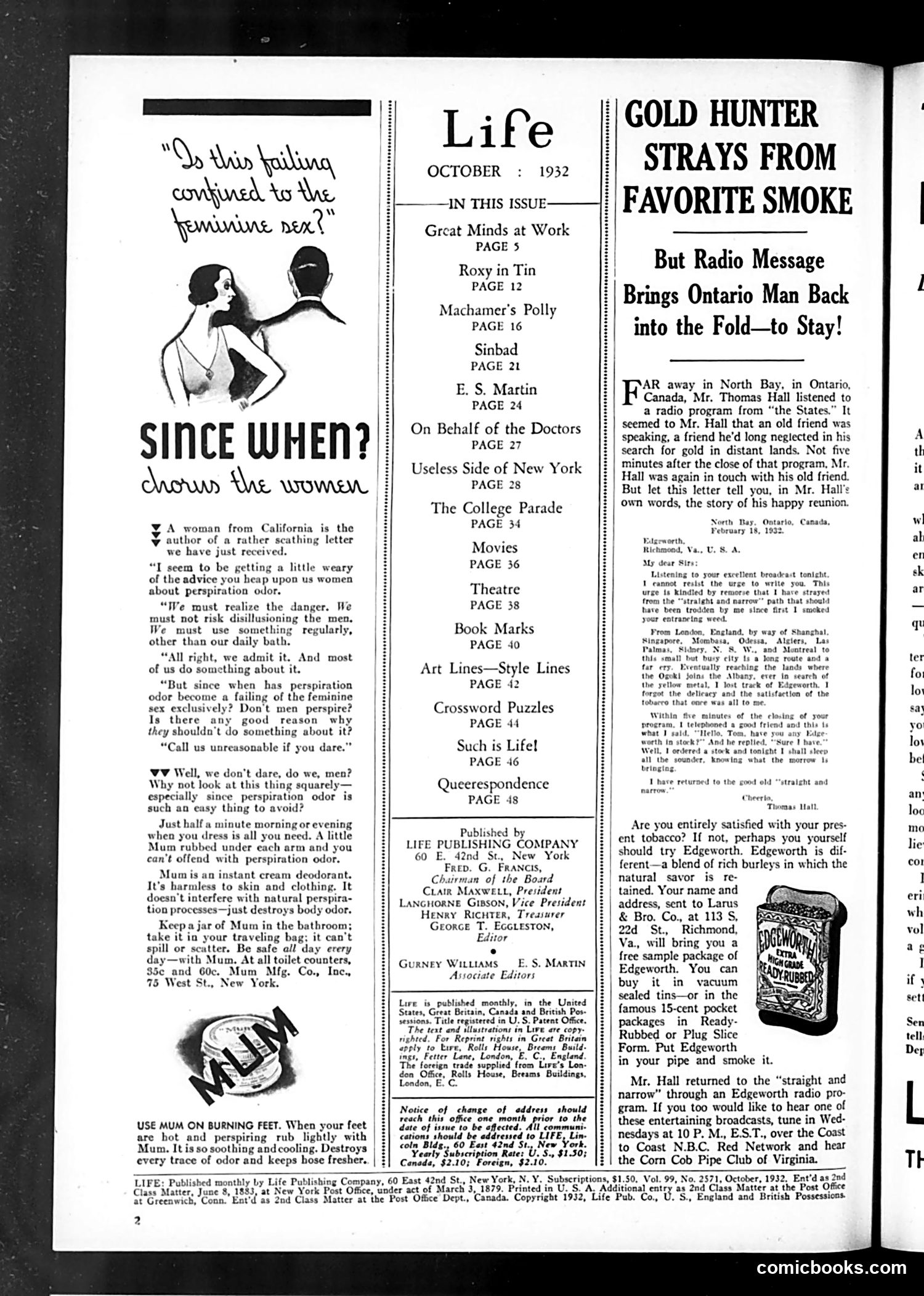
# Analysis of Life Magazine, October 1932 This page is primarily a **table of contents and masthead**, not a political cartoon. The main visual element is a **satirical illustration** (upper left) depicting a woman touching a man's back, with handwritten text reading "body failing confined to the feminine sex" and the caption "SINCE WHEN?" **The satire**: A California author is responding to advice about "perspiration odor" being a women's problem. The cartoon mocks the gendered advertising claim that body odor is exclusively female. The response sarcastically questions this assumption—men also perspire and have odor concerns. The accompanying text advocates using "Mum" deodorant as a solution for both sexes, challenging the era's gender-stereotyped marketing that positioned hygiene concerns as primarily women's issues. This reflects 1932 social commentary on advertising's narrow gendering of everyday products.
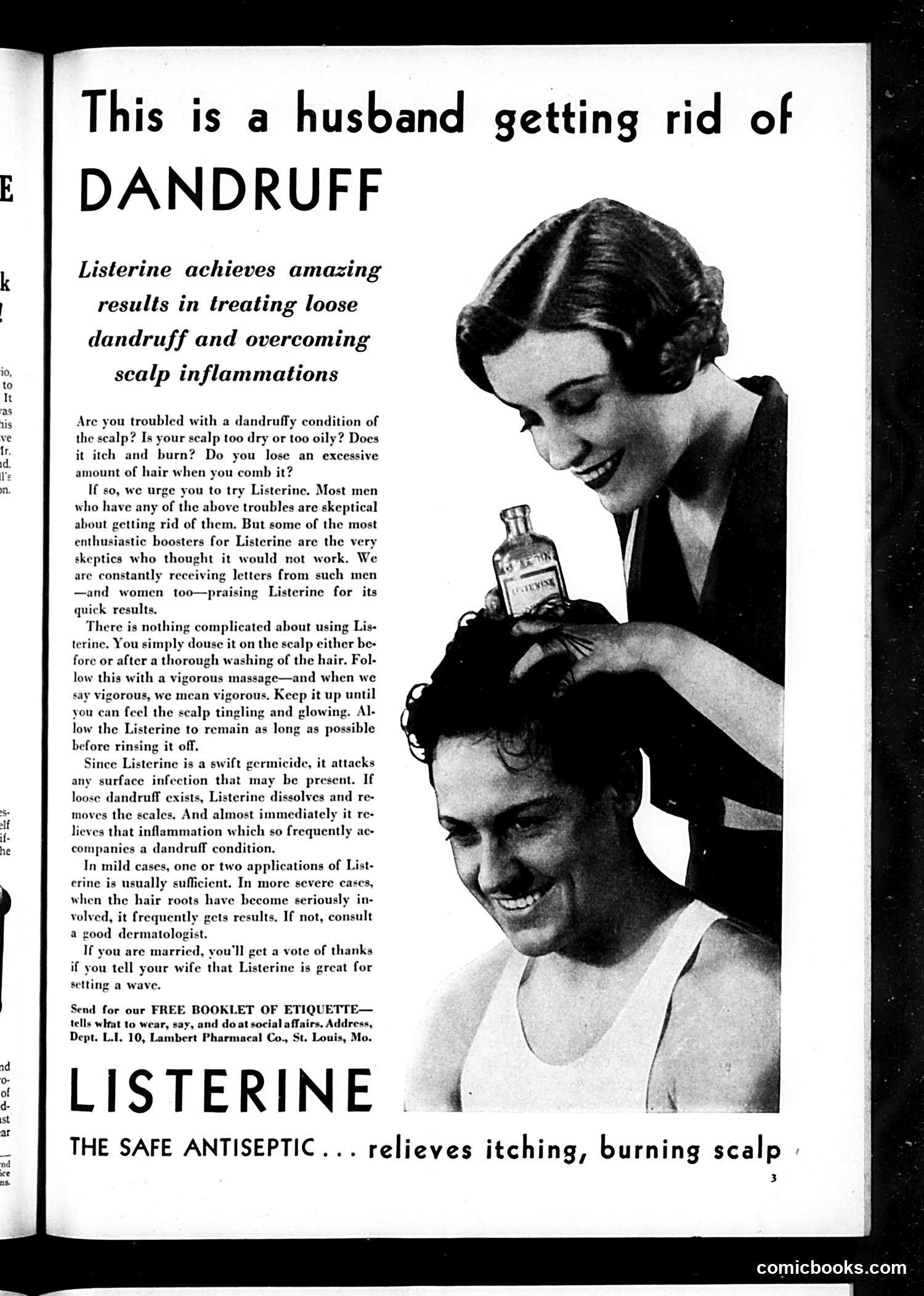
# Analysis This is a **vintage advertisement, not satire or political cartoon**. It's a Listerine mouthwash ad from an early 20th-century *Life* magazine promoting the product's use as a dandruff treatment. The image shows a woman applying Listerine to a man's scalp. The ad copy emphasizes that Listerine is a "swift germicide" that dissolves dandruff scales and relieves scalp inflammation through vigorous massage application. The humor is typical of period advertising: it suggests a wife would be grateful to her husband for using the product to treat dandruff (implying marital discord over poor hygiene). The ad includes a promotional offer for a free "Booklet of Etiquette" from Lambert Pharmacal Co., St. Louis. This reflects outdated advertising that normalized using antiseptics broadly beyond their actual medical purposes.
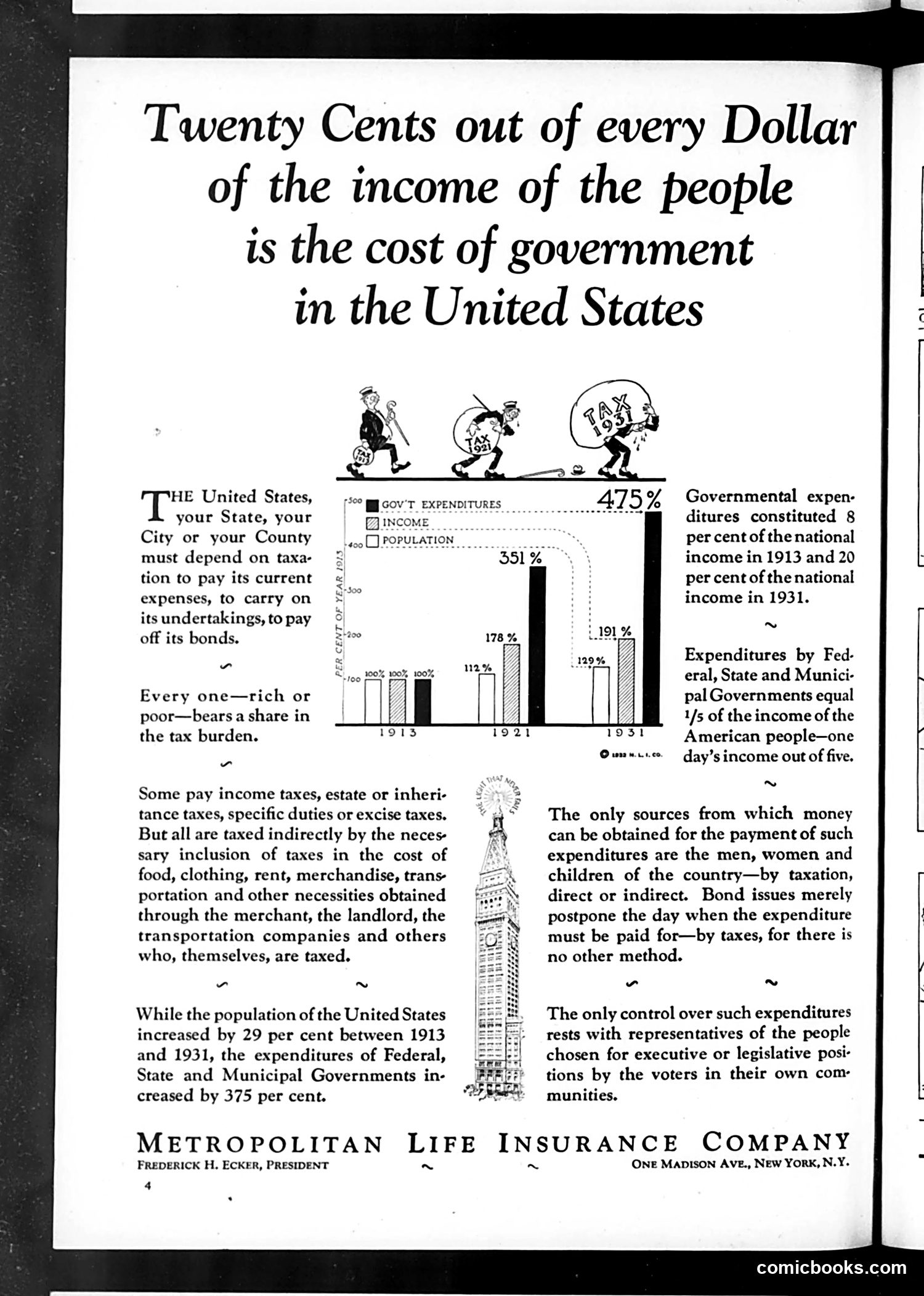
# Analysis This is a **Metropolitan Life Insurance Company advertisement** using political satire to argue against government spending growth. The page depicts three stylized figures labeled "TAX" progressively burdening taxpayers, illustrating how taxation has grown. The accompanying bar chart shows government expenditures increased 475% between 1913-1931, while population grew only 29%—the core argument: government is expanding far faster than necessary. The text argues that all government spending ultimately comes from citizens through direct or indirect taxation, and that only democratic representatives can control this spending. The piece criticizes the disproportionate growth of Federal, State, and Municipal expenditures. This reflects **1930s conservative opposition to New Deal expansion**, presenting government growth as an excessive burden on ordinary Americans' income.
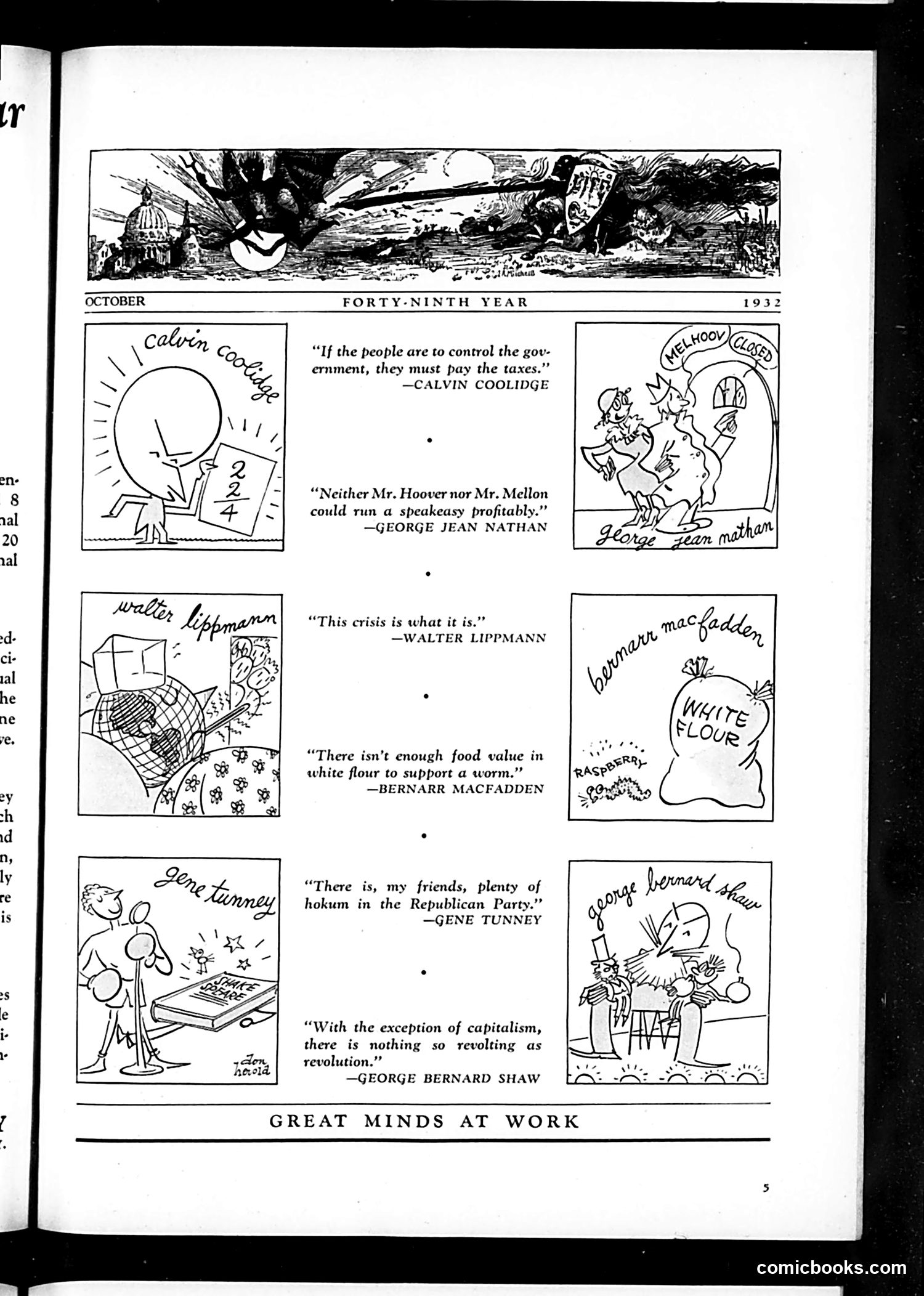
# "Great Minds at Work" - October 1932 This satirical page presents quotes from prominent figures alongside cartoons mocking their commentary on the Great Depression. The page critiques political and intellectual leaders for offering simplistic or unhelpful responses to economic crisis. Featured figures include Calvin Coolidge (on taxation), George Jean Nathan (on speakeasies), Walter Lippmann (on the crisis itself), Bernarr Macfadden (on nutrition), Gene Tunney (on the Republican Party), and George Bernard Shaw (on capitalism). The cartoons visually ridicule these statements—showing figures like Coolidge as a lightbulb (suggesting dim ideas) and Macfadden with white flour and raspberries (mocking his nutritional claims). The overall message: these "great minds" offer platitudes disconnected from ordinary Americans' desperate economic suffering during the Depression.
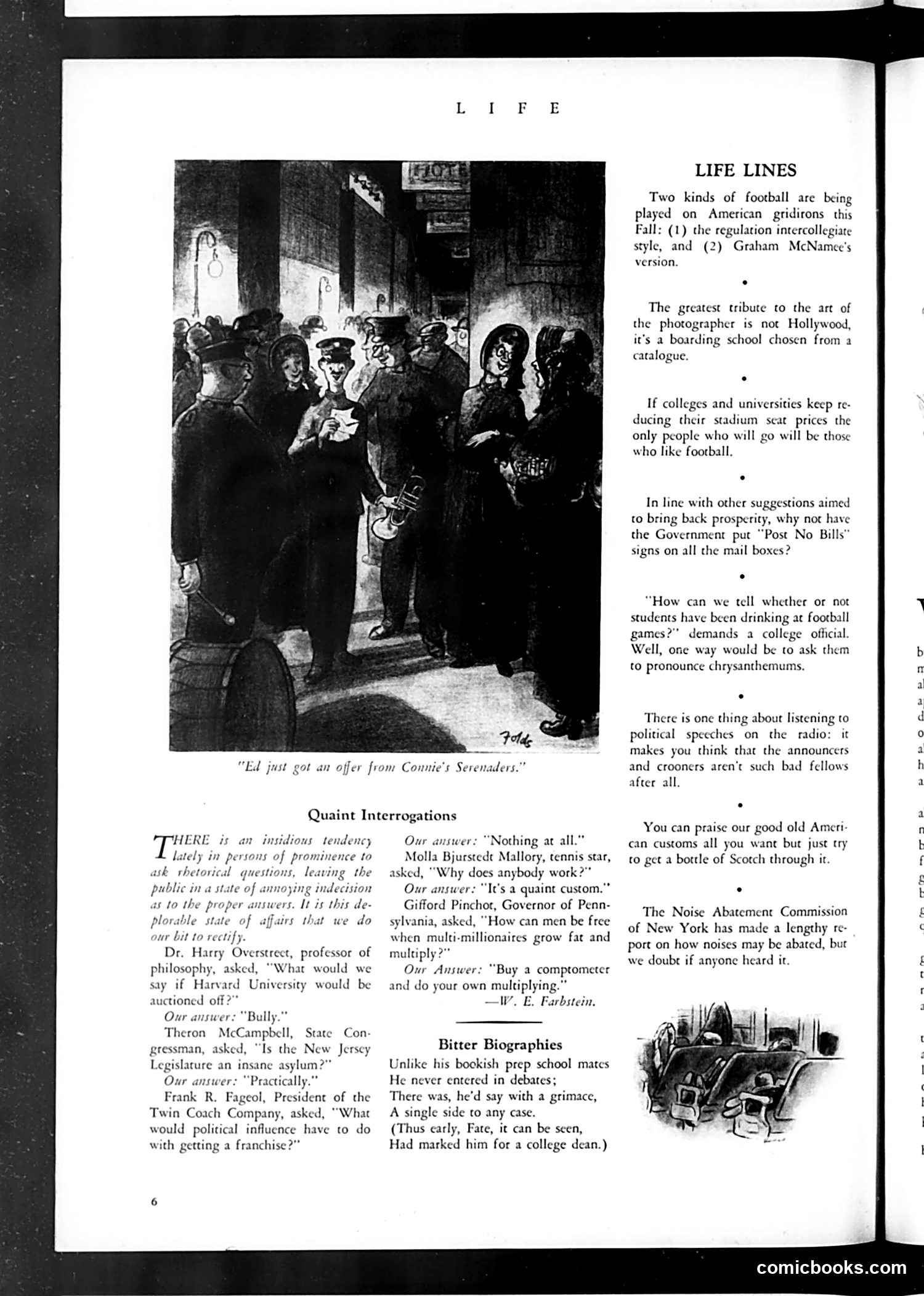
# Analysis of Life Magazine Page This page contains satirical commentary on American society rather than a specific political cartoon. The main image shows a crowded indoor scene with the caption "Ed just got an offer from Connie's Serenaders"—likely referencing a popular musical group of the era. The "Life Lines" section offers humorous social observations about football attendance, stadium prices, mail service, student drinking, and radio political speeches. The "Quaint Interrogations" section presents absurd questions and answers mocking prominent figures like Harvard University and Frank Faggol (Twin Coach Company president), using deadpan responses for comedic effect. "Bitter Biographies" offers witty character sketches. Overall, the page satirizes American institutions, politics, and social customs through ironic commentary rather than visual caricature.
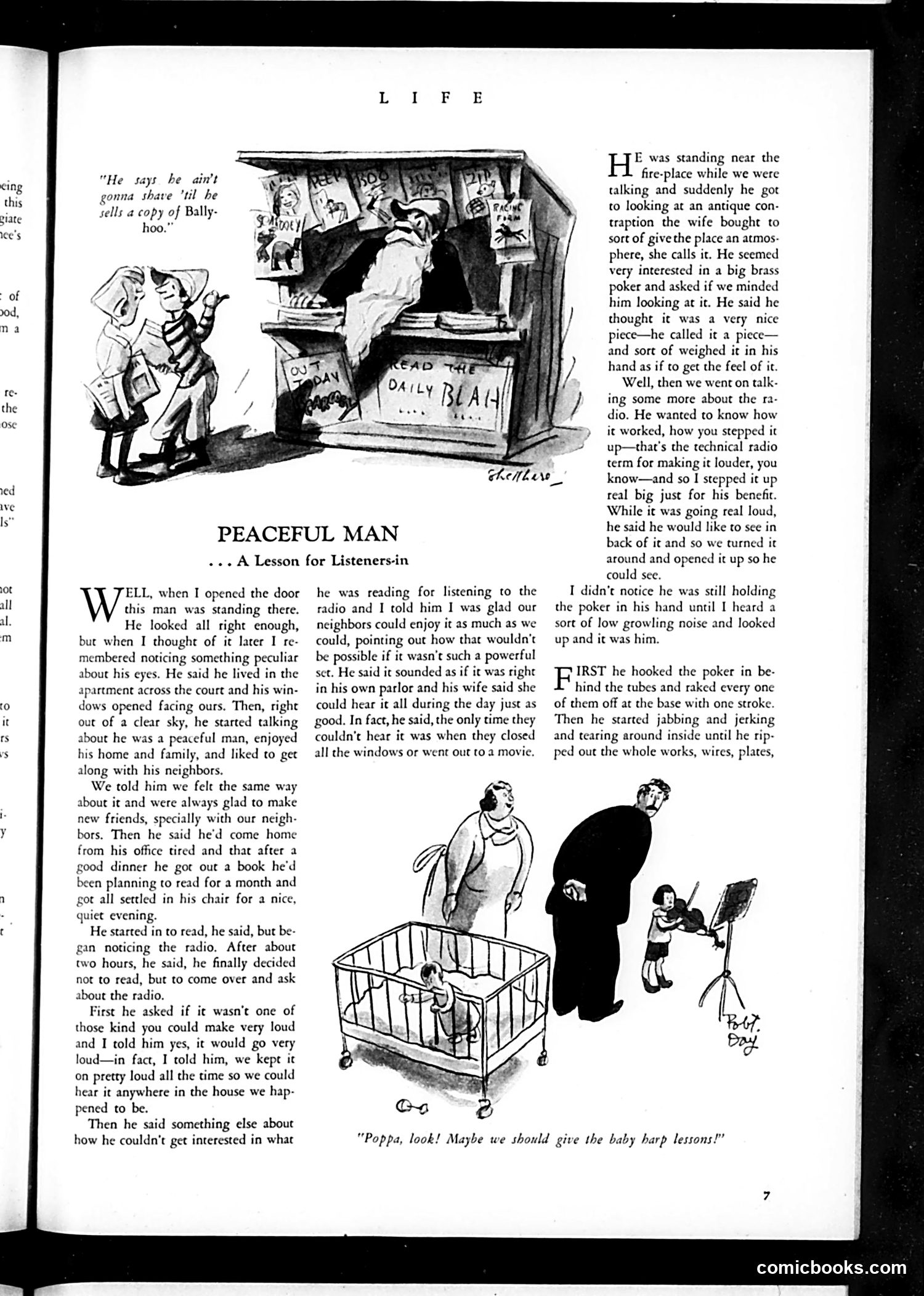
# Analysis of "Peaceful Man: A Lesson for Listeners-in" This satirical piece mocks a neighbor obsessed with his new radio set. The story describes a man who constantly adjusts the volume to irritating levels, claiming he's conducting "technical" experiments. The humor targets 1920s-30s radio enthusiasm—specifically how new radio owners would monopolize family time and annoy neighbors with excessive noise while tinkering with their sets. The caption "He saith he ain't gonna share 'til he gets a eighth of Ballyhoo" references *Ballyhoo*, a contemporary satirical magazine, adding meta-humor. The domestic illustrations show the radio's disruptive effect on family life and the exasperated reactions of those around him. The satire critiques not the technology itself, but the peacefully-inclined neighbor's selfish, inconsiderate obsession with it.
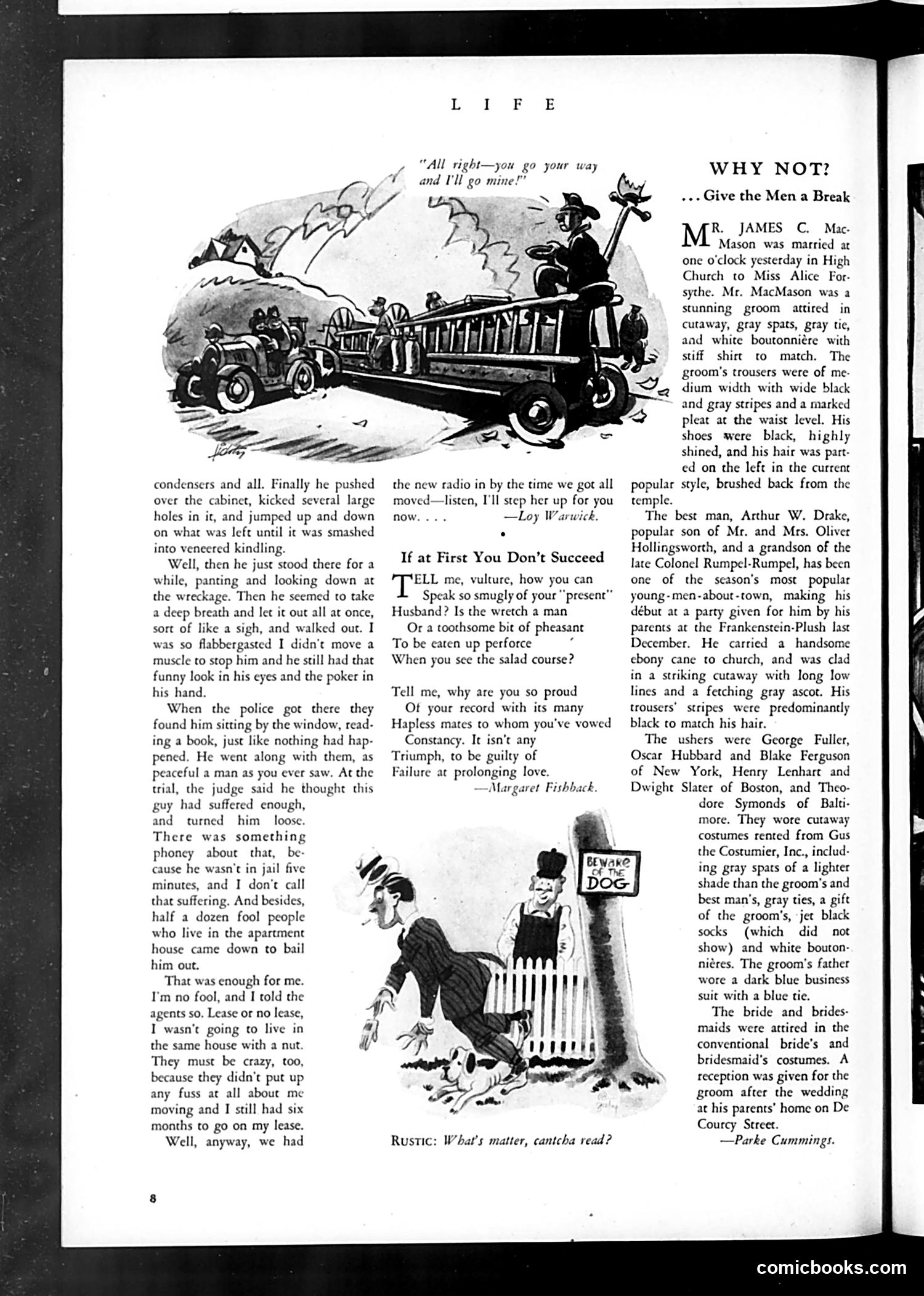
# Analysis of Life Magazine Page This page contains two distinct cartoon commentaries: **Top cartoon**: Illustrates a car-versus-trolley collision scenario, humorously depicting the chaos of early automotive traffic. The caption "All right—you go your way and I'll go mine" satirizes drivers' inability to coordinate on shared roads, a common concern as automobiles became widespread. **Bottom cartoon**: Shows a man with a "BEWARE OF DOG" sign but no actual dog present. Captioned "Rustic: What's matter, cantichas read?" This mocks rural illiteracy—the joke being the farmer posted a warning sign he cannot himself read, suggesting he's mimicking urban practices without understanding them. The right column contains a wedding announcement for Mr. James C. MacMason, describing guests' formal attire in detail—typical society page content of the era.
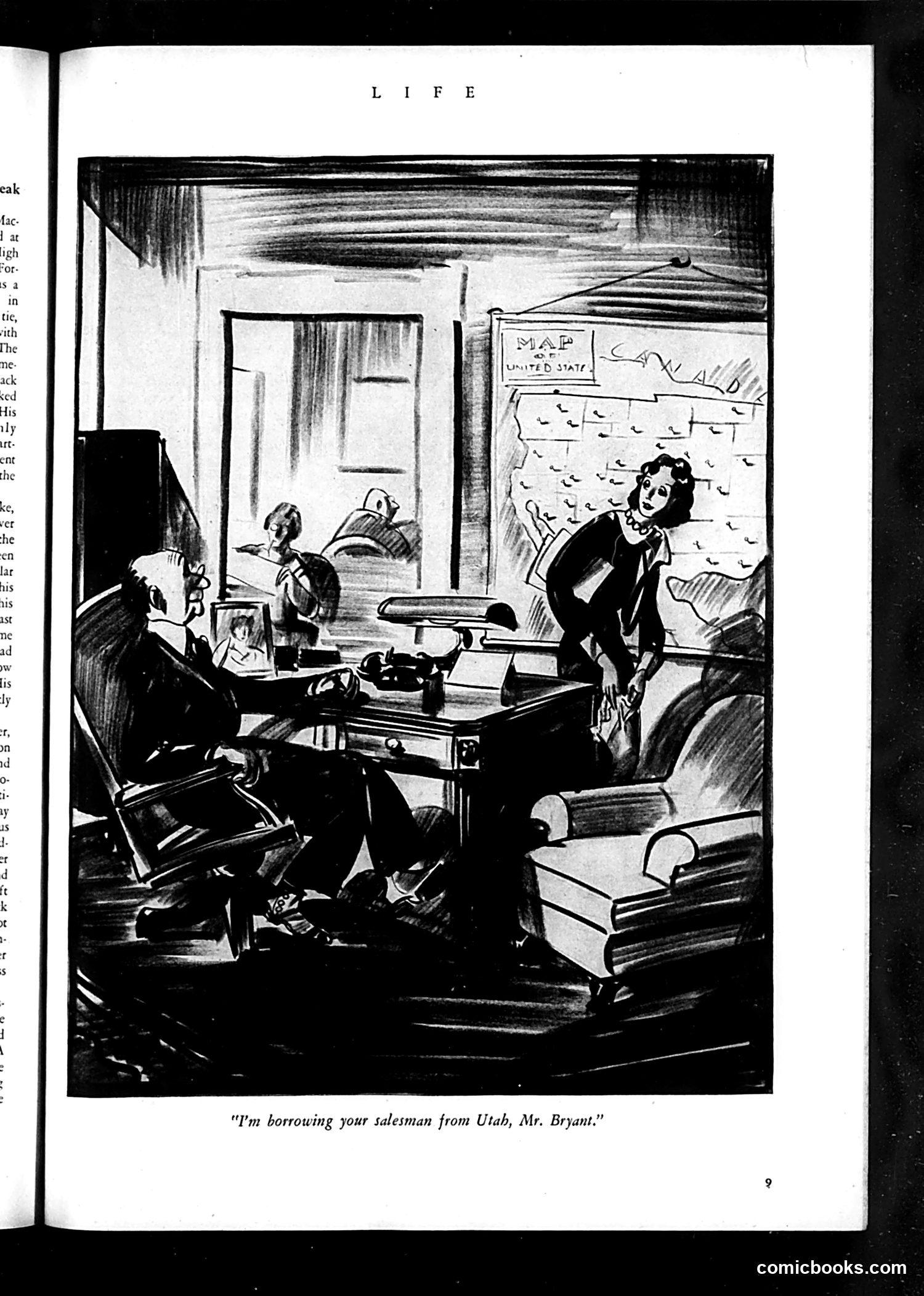
# Cartoon Analysis This single-panel cartoon depicts an office scene where a woman stands confidently while a man sits at a desk. The caption reads: "I'm borrowing your salesman from Utah, Mr. Bryant." The humor relies on a business/workplace joke about temporarily taking someone's employee. The woman appears to be a businessperson or manager, and she's casually informing Mr. Bryant (presumably her colleague or superior) of this arrangement. The satire appears to target either workplace dynamics, gender relations in business, or perhaps the casual way resources—including people—were borrowed or reassigned in mid-20th century offices. The specific reference to Utah is unclear without additional context, though it may suggest the salesman is notably far from his home territory.
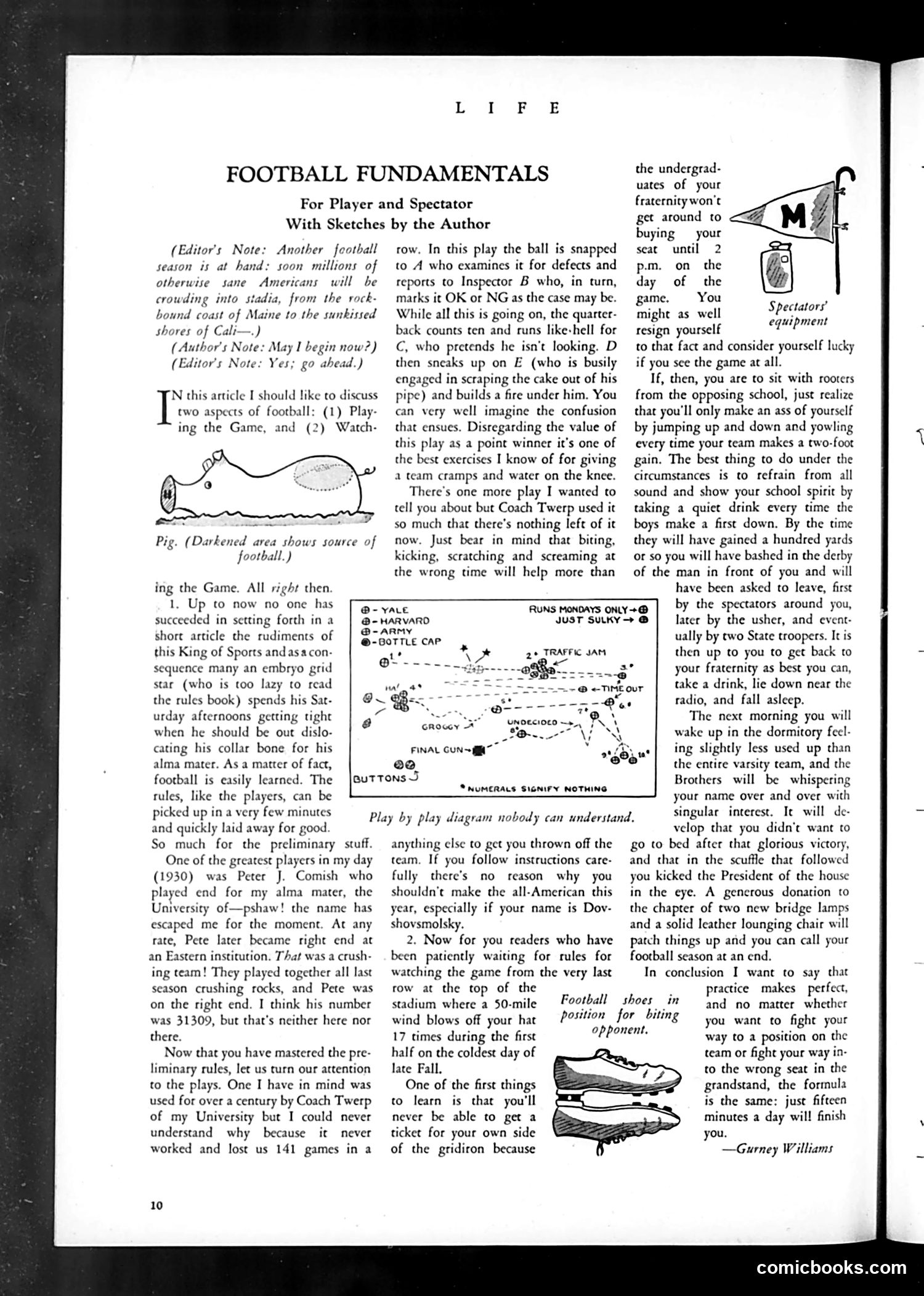
# Analysis This page from *Life* magazine presents "Football Fundamentals" — a humorous instructional article about playing and watching football, not a political cartoon. The piece includes: **Content:** - A diagram showing a football play with positions marked (Yale, Harvard, Army, etc.) - Sketches depicting football shoe positioning and spectator etiquette - Satirical commentary on football culture, including advice about obtaining stadium tickets and managing fan behavior **The Satire:** The humor targets college football's social pretensions — the difficulty acquiring good seats, the expectation to dress formally, and the status-consciousness surrounding the sport. References to specific institutions (Yale, Harvard) reflect football's association with elite universities in the 1930s. **Historical Context:** College football was a major social event for the wealthy during this era, and *Life* regularly mocked upper-class affectations through lighthearted sports commentary.