A complete issue · 68 pages · 1932
Life — June 1932
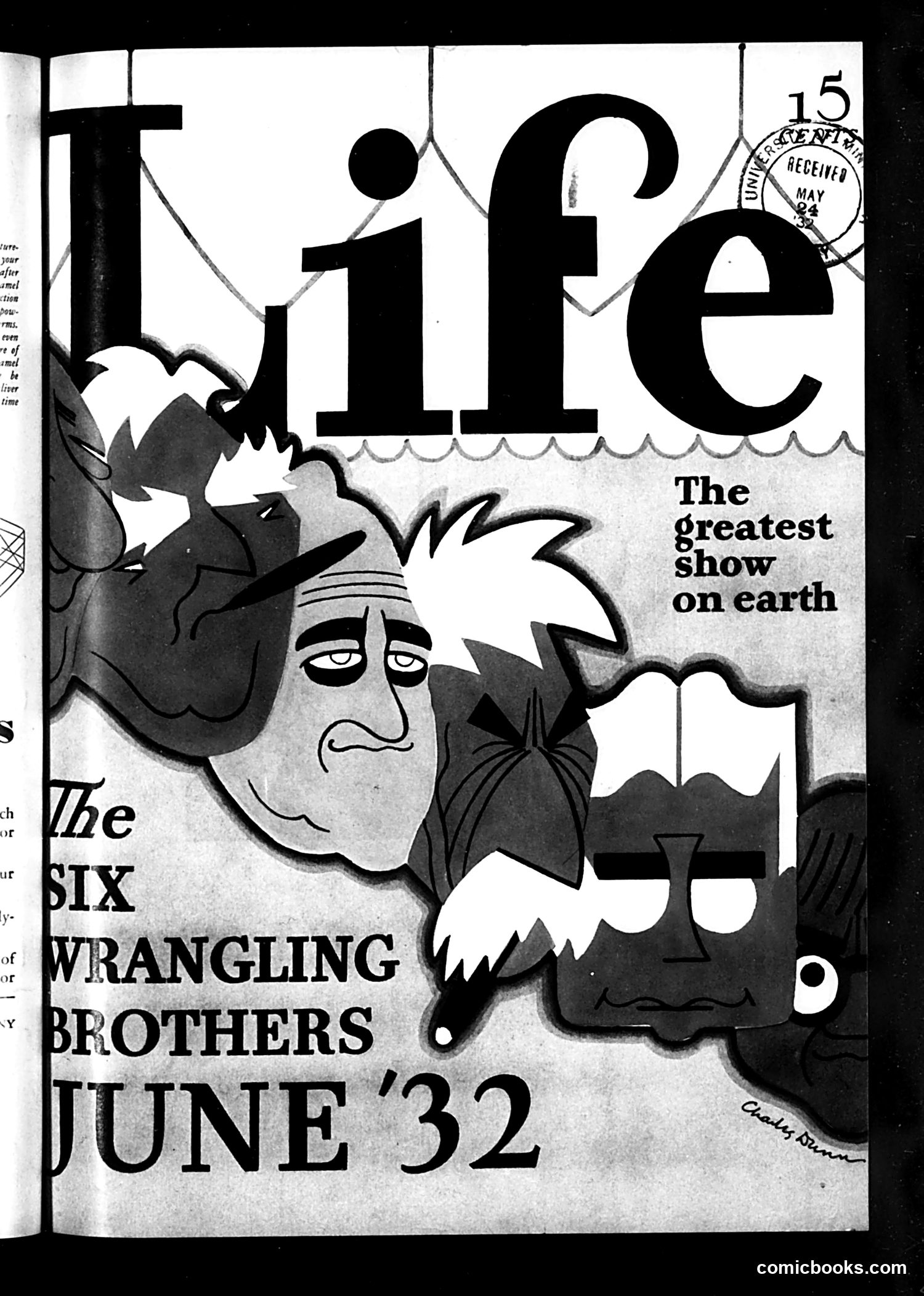
# Life Magazine Cover Analysis This is a **Life magazine cover from June 1932**, advertising "The Six Wrangling Brothers" as "the greatest show on earth." The cartoon depicts a caricatured man with exaggerated features—wild hair, prominent nose, and sad expression—wearing a bow tie and formal attire. The "six wrangling brothers" likely refers to a **contemporary vaudeville or circus act**, though the specific performers aren't clearly identified in this image alone. The phrase "greatest show on earth" is ironic—a stock circus advertisement cliché used here to mock petty arguing or conflict. The satire appears to target **public figures or performers known for bickering**, using the circus metaphor to mock their disputes as mere entertainment. The melancholic expression reinforces the mockery of these "brothers" and their contentious behavior.
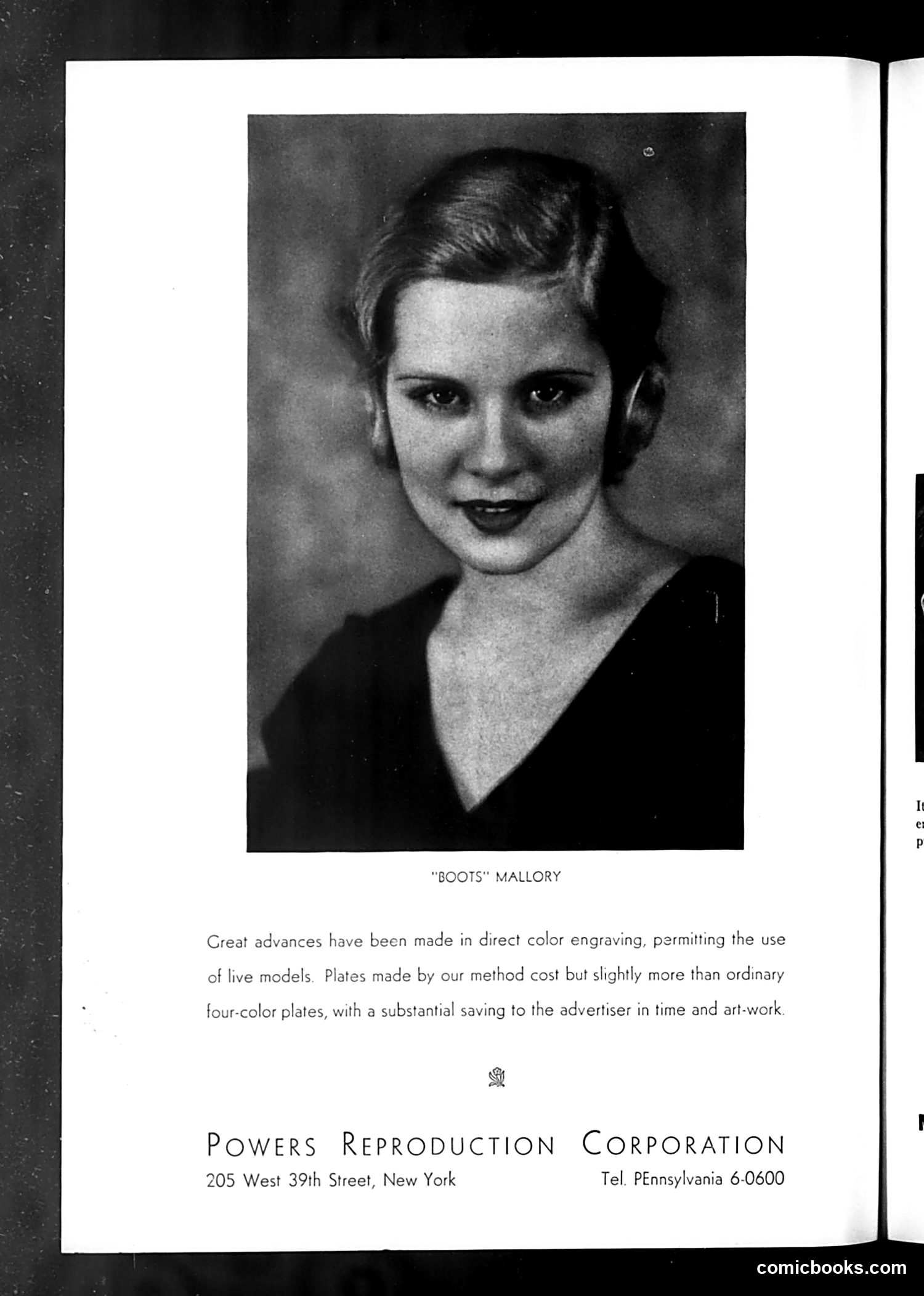
This page is primarily an advertisement for Powers Reproduction Corporation, a printing/engraving company based in New York. The image shows a portrait photograph labeled "BOOTS" MALLORY—likely referring to an actress or public figure of the era, though her specific identity and relevance isn't clear from the page itself. The accompanying text promotes the company's advances in "direct color engraving," which allowed use of live models for color plates. The ad claims their method costs only slightly more than standard four-color plates while saving advertisers time and artwork costs. This is not a political cartoon or satire—it's a straightforward trade advertisement demonstrating their printing capabilities using a professional portrait as an example.
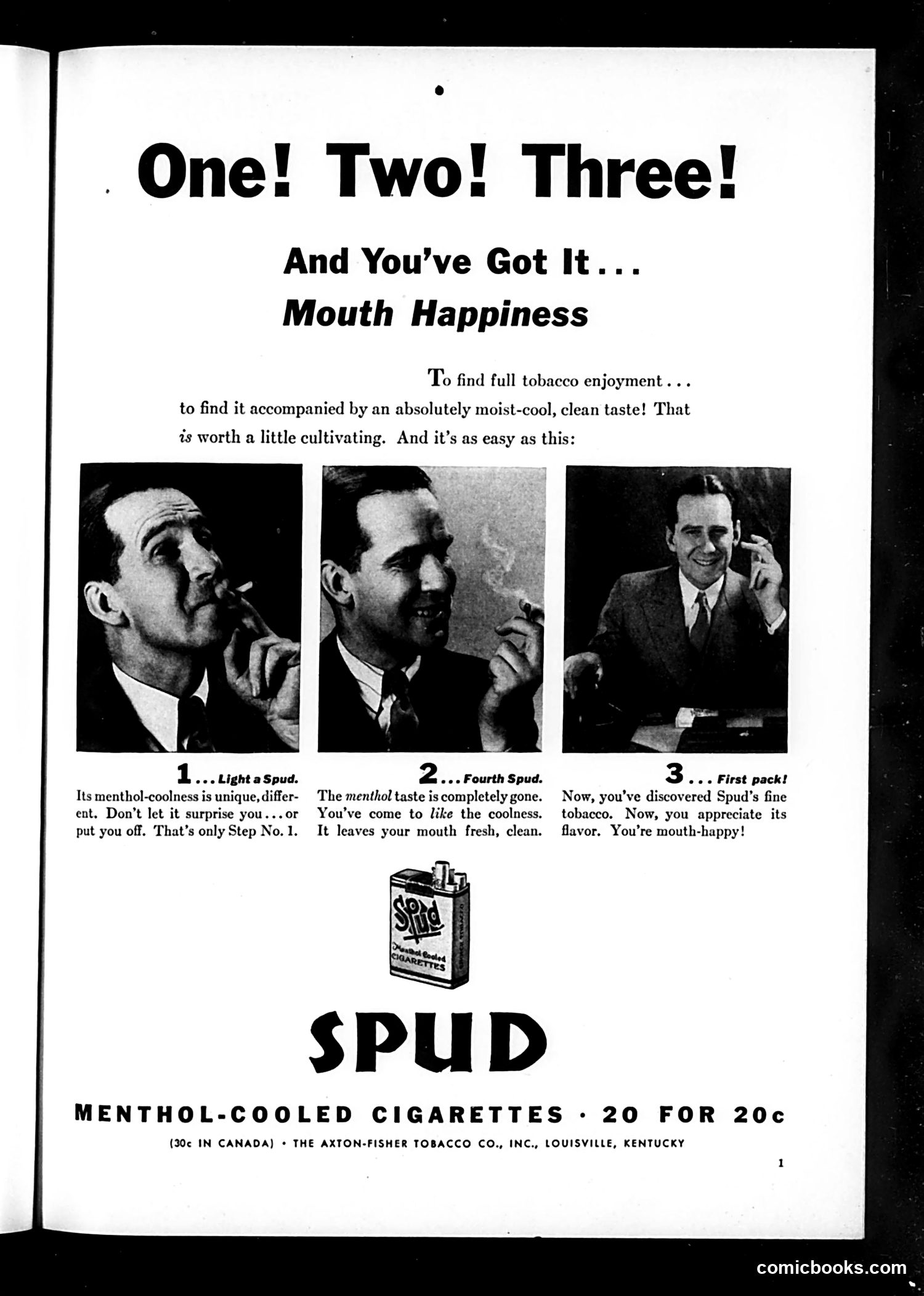
# Analysis This is a **cigarette advertisement**, not a political cartoon. It promotes Spud brand menthol-cooled cigarettes (20 for 20¢) manufactured by Axton-Fisher Tobacco Co. in Louisville, Kentucky. The "One! Two! Three!" refers to a three-step process showing men smoking cigarettes in sequence. The ad's humor plays on the surprise of discovering menthol's cooling sensation (step 1), becoming accustomed to it (step 2), and finally appreciating the underlying tobacco flavor (step 3). The term "Month Happiness" suggests sustained pleasure from regular smoking. By modern standards, this cheerful promotion of cigarettes to general audiences—without health warnings—represents the pre-regulation advertising era when tobacco marketing faced no restrictions on claims or target audiences.
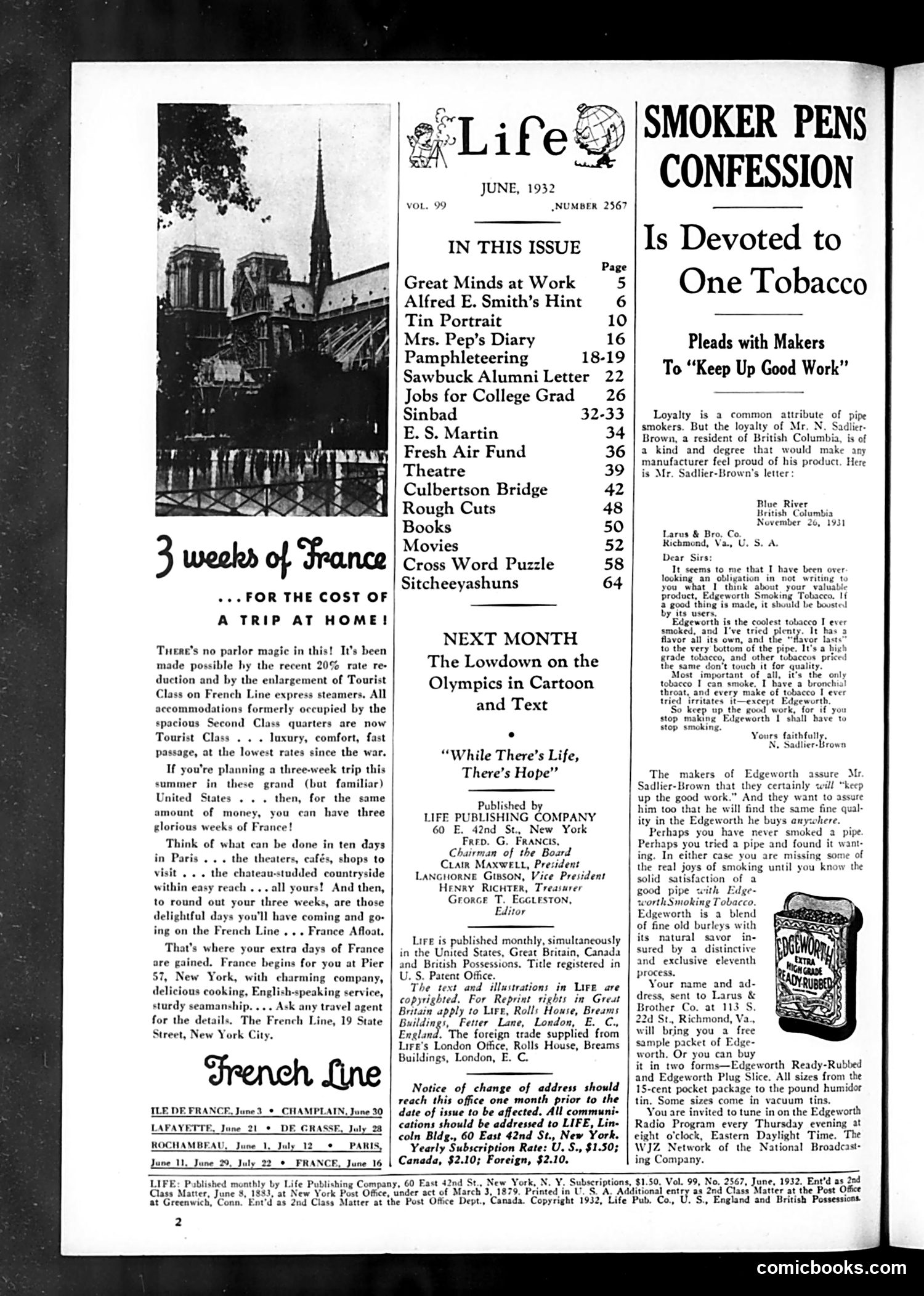
# Life Magazine, June 1932 - Page Analysis This is primarily a **table of contents and masthead page** for Life magazine's June 1932 issue, featuring travel and lifestyle content. The left side showcases a striking photograph of **Notre-Dame Cathedral in Paris**, with advertising copy promoting "3 weeks of France...for the cost of a trip at home!" The right side contains a **"Smoker Pens Confession"** — a sponsored advertisement disguised as reader testimony. A British Columbia resident named N. Sadler-Brown praises **Edgeworth tobacco**, claiming loyalty to this specific brand. The ad employs a flattering tone, positioning the product as superior quality. This represents **early 20th-century native advertising**: editorial-style testimonials promoting commercial products to appear as genuine consumer endorsements rather than paid promotion. The approach blurs advertising and editorial content deliberately.
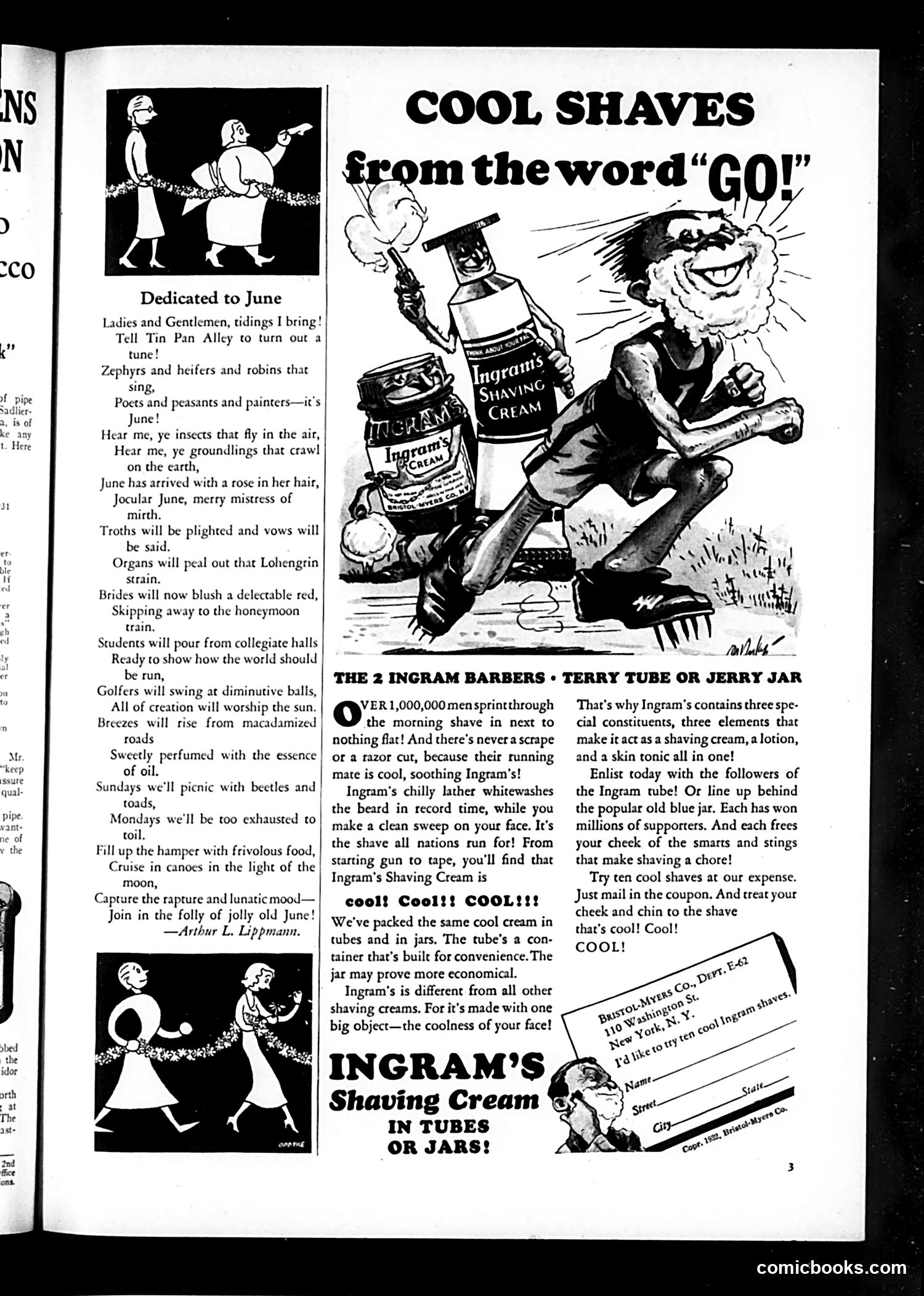
# Analysis This page is **primarily an advertisement** for Ingram's Shaving Cream, disguised as editorial content. The main cartoon depicts a caveman enthusiastically shaving with Ingram's products—making the satirical point that the product is so good, even primitive man would use it. The visual joke plays on the absurdity of this anachronism. The left side contains "Dedicated to June," a poem celebrating the month in flowery, romantic language. This appears designed to create an appealing editorial context around the advertisement. The ad emphasizes that Ingram's Shaving Cream comes "in tubes or jars" and promises a cool, soothing shave without razor cuts or irritation. The messaging targets practical male consumers concerned with convenience and skin care. This represents early 20th-century advertising disguised as magazine content.
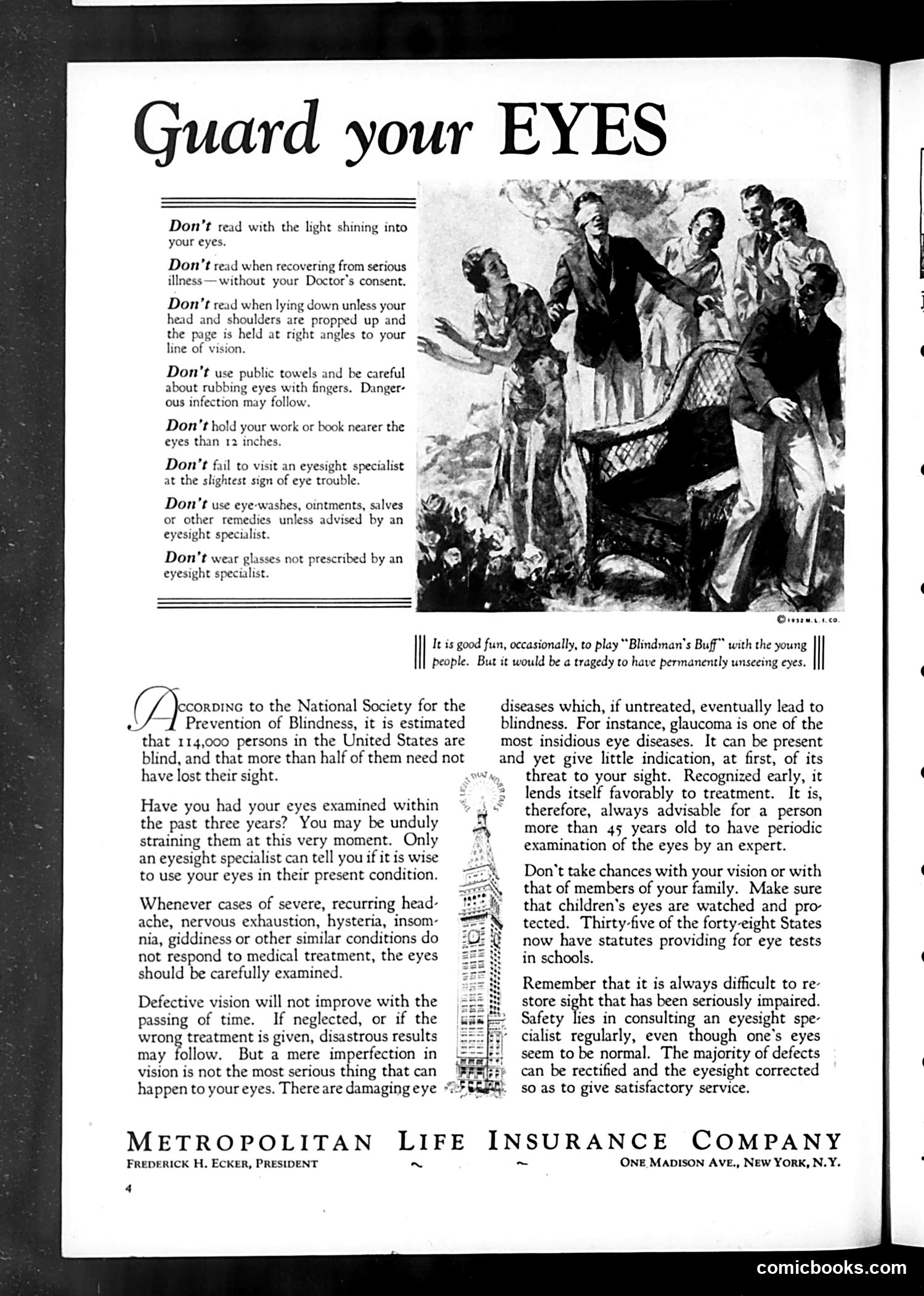
# Analysis This page is primarily a **public health advertisement** by Metropolitan Life Insurance Company promoting eye care, not political satire. The illustration shows a family group (adults and children) gathered outdoors, appearing to represent diverse social classes—likely emphasizing that eye health concerns affect everyone. The "Don'ts" list addresses common early-20th-century health concerns: reading in poor light, sharing towels (disease transmission), holding materials too close, and avoiding eye specialists. The mention of "Blindman's Buff" as dangerous reflects genuine anxiety about preventable blindness. The text cites the National Society for Prevention of Blindness' claim that 114,000 Americans were blind, attributing many cases to treatable conditions like glaucoma. This represents Progressive Era public health advocacy—using insurance company resources to promote preventive medical care and professional medical consultation over folk remedies.
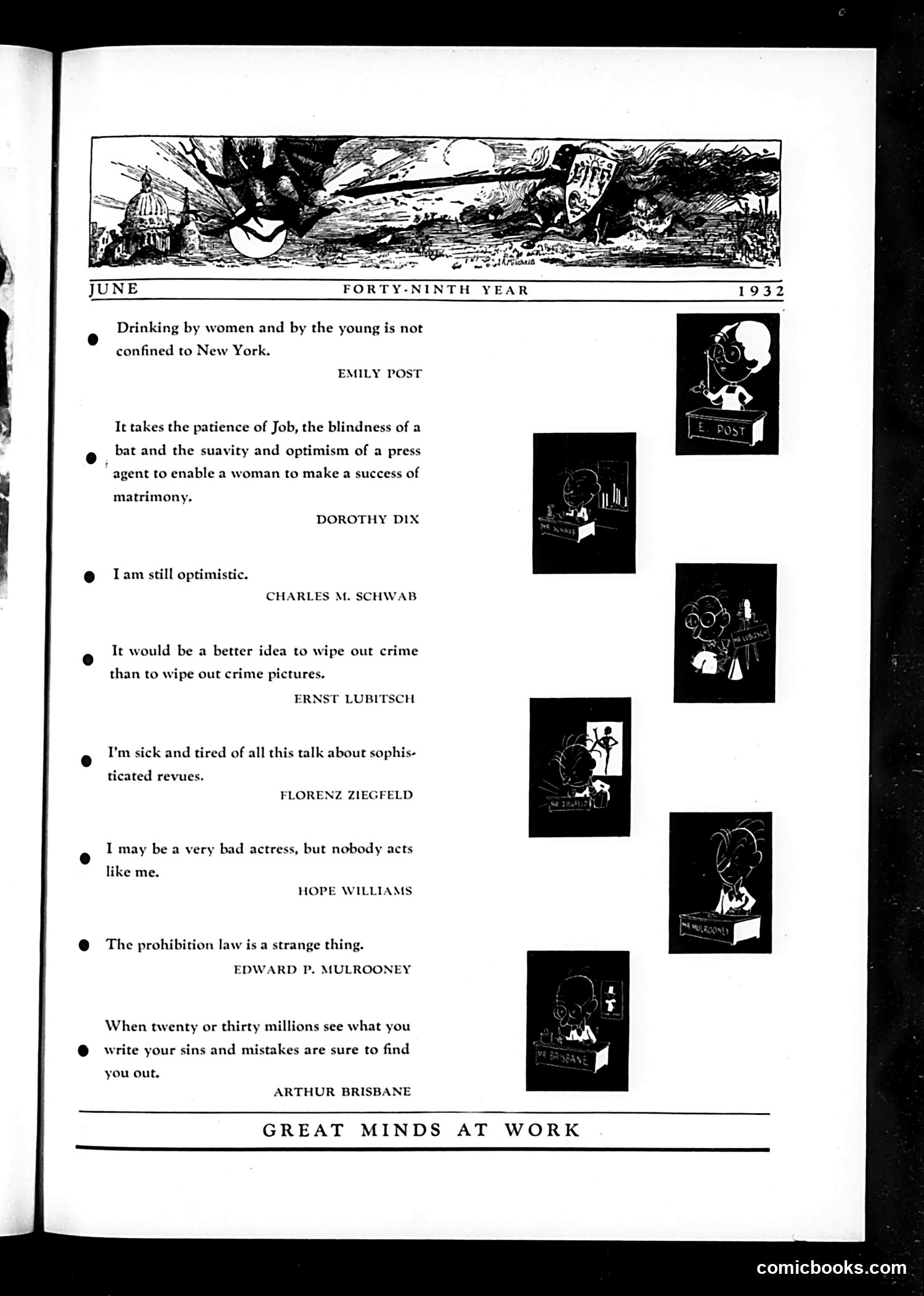
# Analysis of Life Magazine, June 1932 This page features a collection of witty quotes from notable figures commenting on contemporary social issues. The quotes address: - **Women drinking** (Emily Post on etiquette) - **Marriage difficulties** (Dorothy Dix on relationships) - **Crime and morality** (Ernst Lubitsch and Edward P. Mulrooney on crime prevention) - **Prohibition** (Mulrooney's observation about the strange nature of Prohibition law) The small silhouette illustrations on the right appear to be decorative vignettes rather than political cartoons. The 1932 date places this during the Great Depression and near Prohibition's end (repealed 1933). The quotes suggest contemporary anxieties about social upheaval, changing morals (especially women's newfound freedoms), and the failure of Prohibition—a major policy debate of the era. This is primarily a quotes/commentary page rather than satirical cartooning.
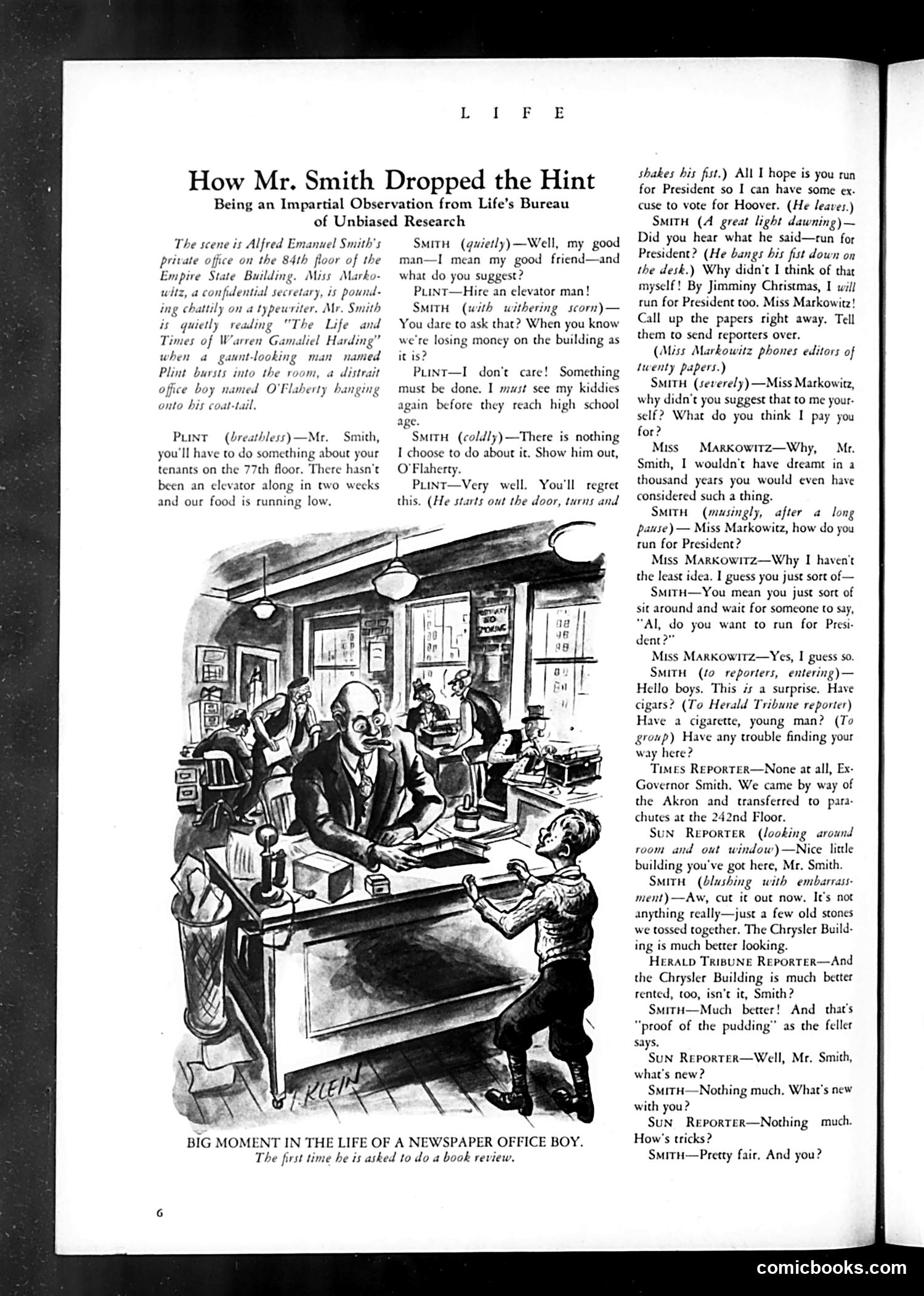
# "How Mr. Smith Dropped the Hint" This satirical piece depicts a newspaper office scene where Mr. Smith, an elevator operator, casually mentions to reporters that he's considering running for President. The joke hinges on the absurdity of an ordinary working man—someone with no political experience or credentials—casually announcing presidential ambitions to journalists. The humor reflects early 20th-century American political satire about how easily political rumors spread through press coverage. The reporters immediately become excited, phones ring, and the story threatens to become a news event simply because journalists are present. The cartoon satirizes both the gullibility of the press and how democratic systems allow any citizen to theoretically become president, regardless of qualifications.
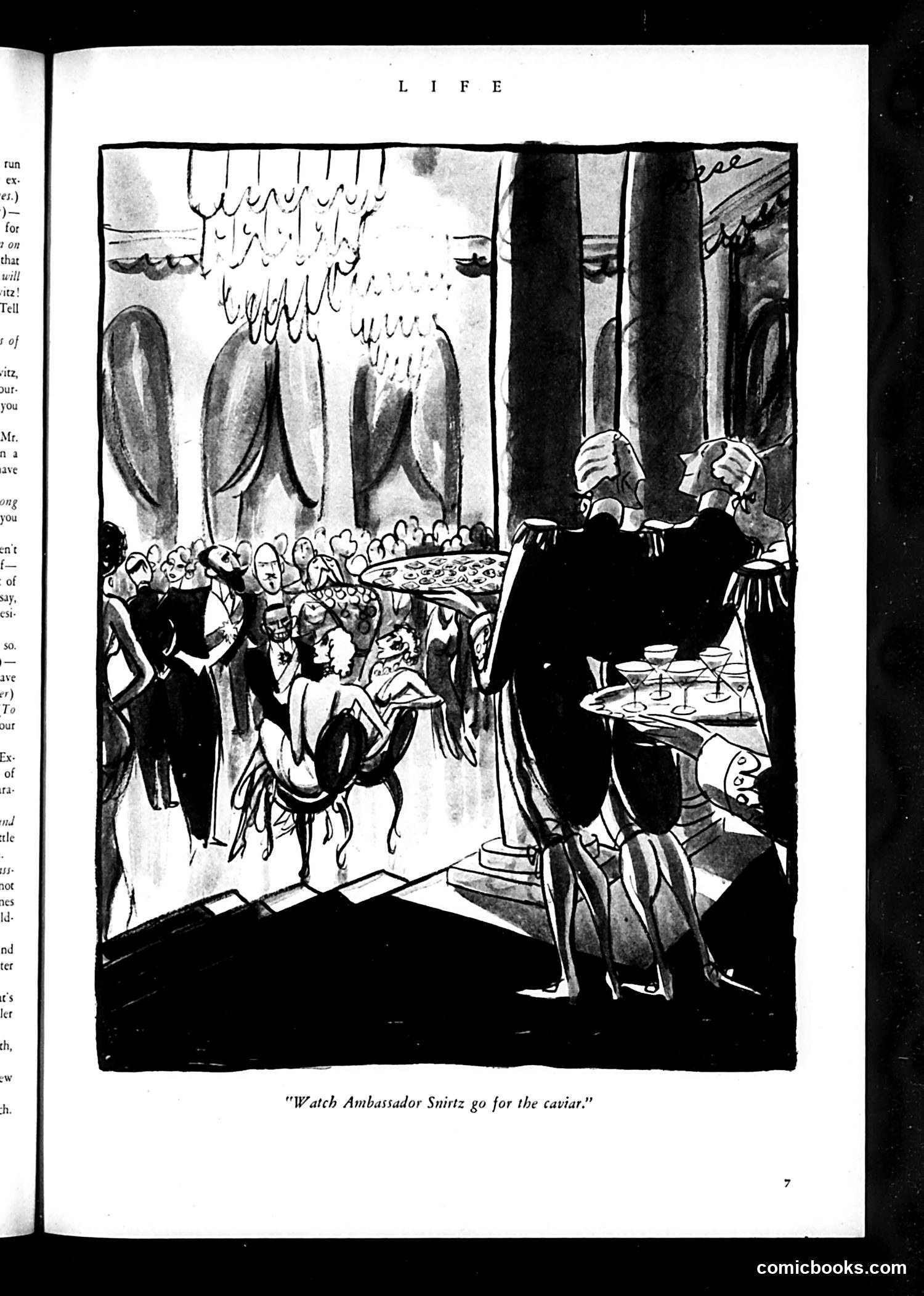
# Cartoon Analysis: "Watch Ambassador Smirtz go for the caviar" This satirical cartoon depicts a formal diplomatic reception or banquet. The caption identifies "Ambassador Smirtz" as the subject of ridicule. The joke appears to satirize diplomatic excess and materialism—specifically, mocking an ambassador's eagerness to indulge in expensive caviar at an official function. The scene shows elegantly dressed guests at what appears to be a luxurious venue with large decorative columns. The cartoon suggests that diplomats prioritize personal indulgence and fine foods over serious diplomatic work. The humor relies on characterizing diplomatic life as frivolous consumption rather than substantive statecraft. Without additional context about who "Ambassador Smirtz" references specifically, this appears to be general satire of diplomatic pretension and gluttony common to Life magazine's social commentary.
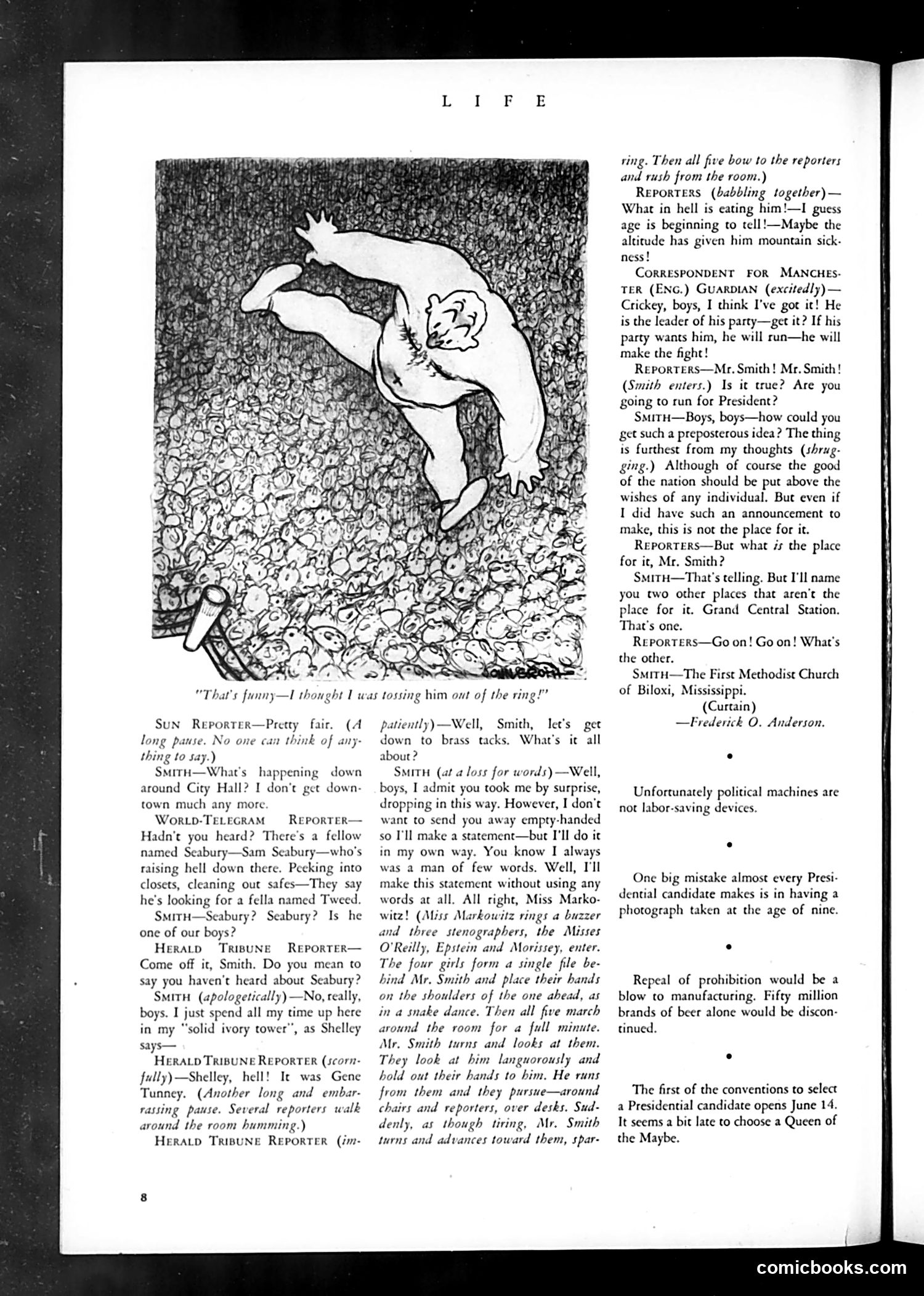
# Analysis of Life Magazine Page This page satirizes a political candidate's press conference, likely from the 1920s-1930s based on the style. A disheveled man (identified as "Mr. Smith") is shown doing acrobatic contortions while reporters bombard him with questions about running for President. The satire targets: 1. **Political evasion**: Smith refuses to directly answer whether he's running, instead deflecting by suggesting other locations (Grand Central Station, a Methodist church) to discuss it. 2. **Candidate absurdity**: The cartoon mocks how candidates perform ridiculous physical feats while avoiding straightforward answers—the contorted pose illustrates his verbal gymnastics. 3. **Press frenzy**: Multiple reporters pursue sensational angles rather than substantive policy discussion. The humor lies in depicting politics as theatrical performance rather than serious governance.
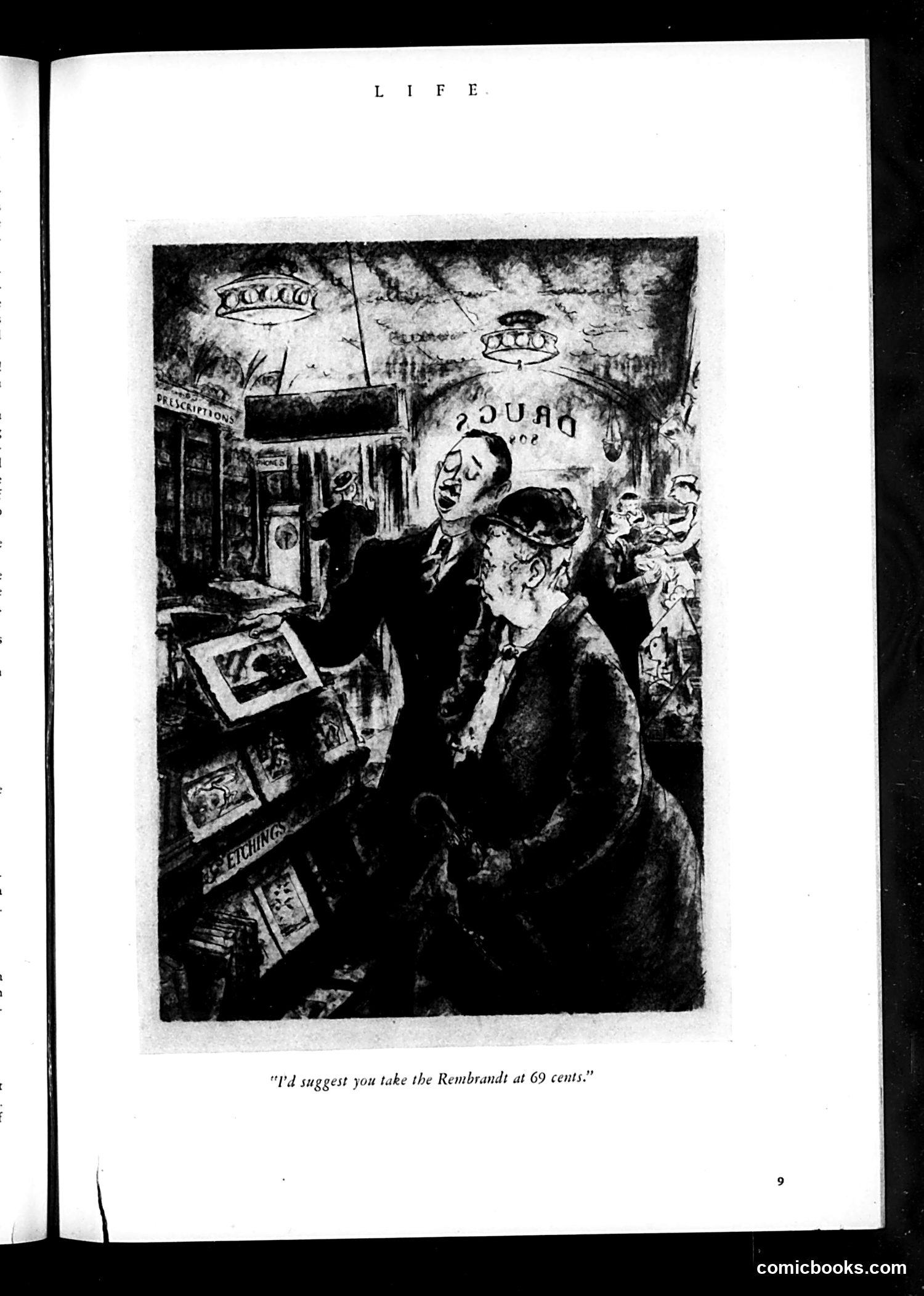
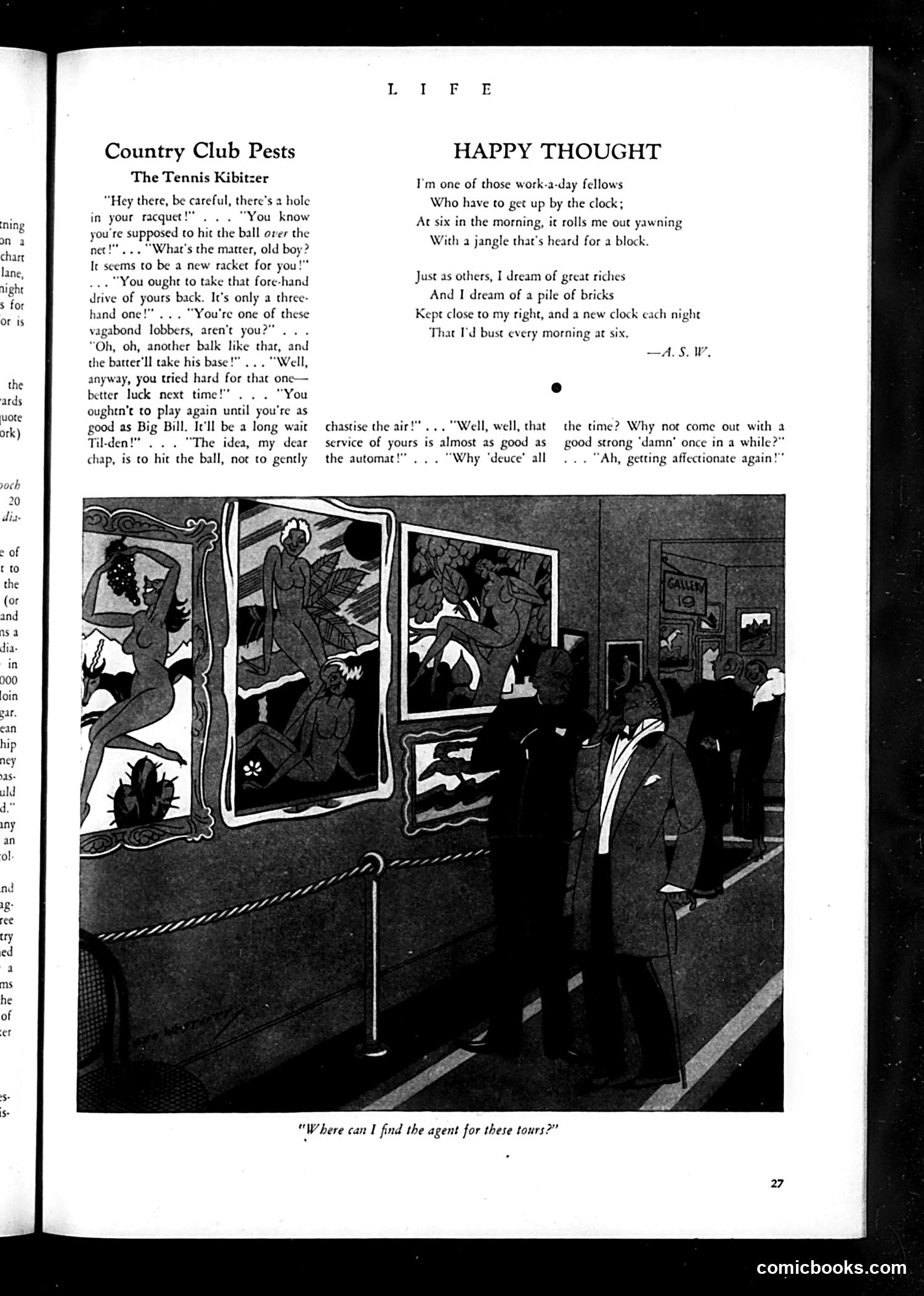
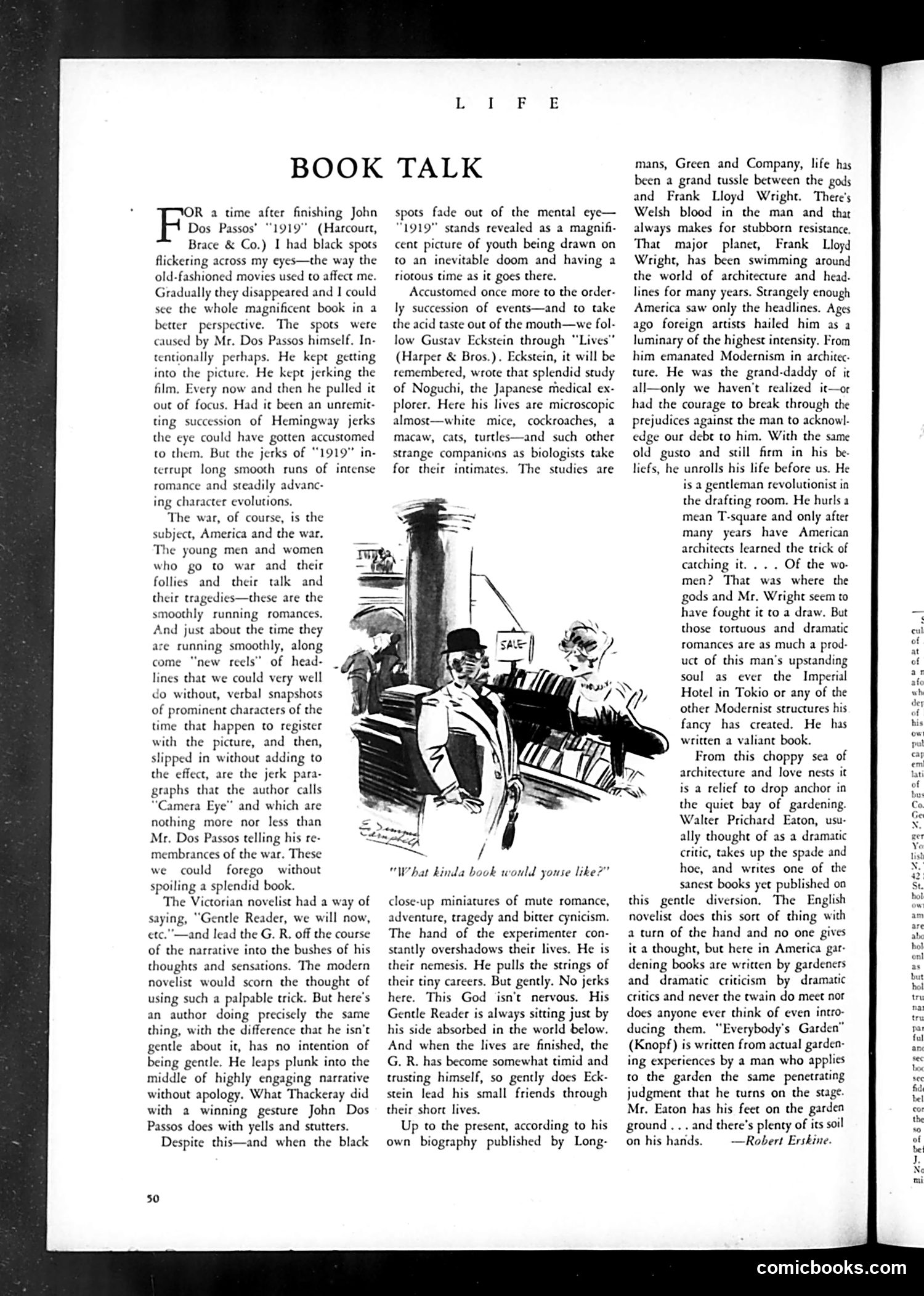
# Analysis This is a satirical illustration from *Life* magazine depicting an art dealer or gallery owner suggesting to a customer that they purchase a Rembrandt painting for 69 cents. The cartoon mocks the commercialization of fine art and the devaluation of masterworks in the marketplace. The scenario is absurd—a genuine Rembrandt would cost far more—suggesting either that the painting is a cheap reproduction/forgery, or that the art world has become so debased by commercialism that even Old Masters are being hawked at bargain prices like cheap merchandise. The elegantly dressed figures in the gallery setting contrast sharply with the trivial price point, emphasizing the satire. The joke critiques both art dealers' dishonest sales tactics and society's reduced appreciation for authentic artistic value.
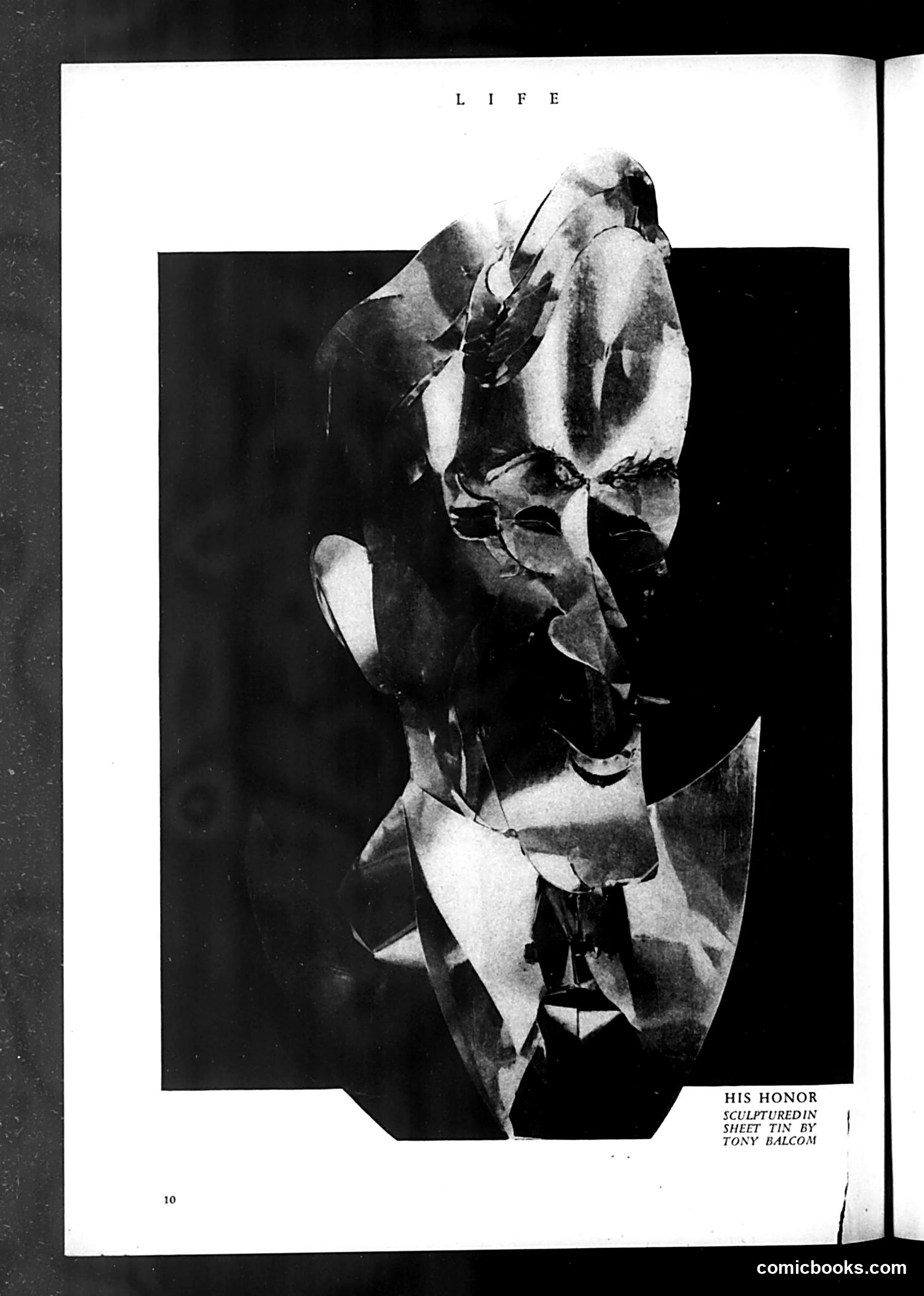
# Analysis This page from *Life* magazine features a sculptural work titled "His Honor," created in sheet tin by artist Tony Balcom. The image shows an abstract, modernist sculpture of a human head rendered in angular, fragmented planes of metal. The sculpture appears to be a satirical portrait—likely of a political figure or public official, given the caption "His Honor" (a title for mayors, judges, or dignitaries). The jagged, distorted metal forms suggest mockery of the subject's character or integrity, as if deconstructing their dignity. The modernist style emphasizes this critical commentary through deliberate fragmentation rather than flattering representation. Without additional context identifying the specific figure depicted, the exact target of satire remains unclear, though the work's aesthetic aggressiveness indicates pointed political or social criticism.