A complete issue · 68 pages · 1932
Life — February 1932
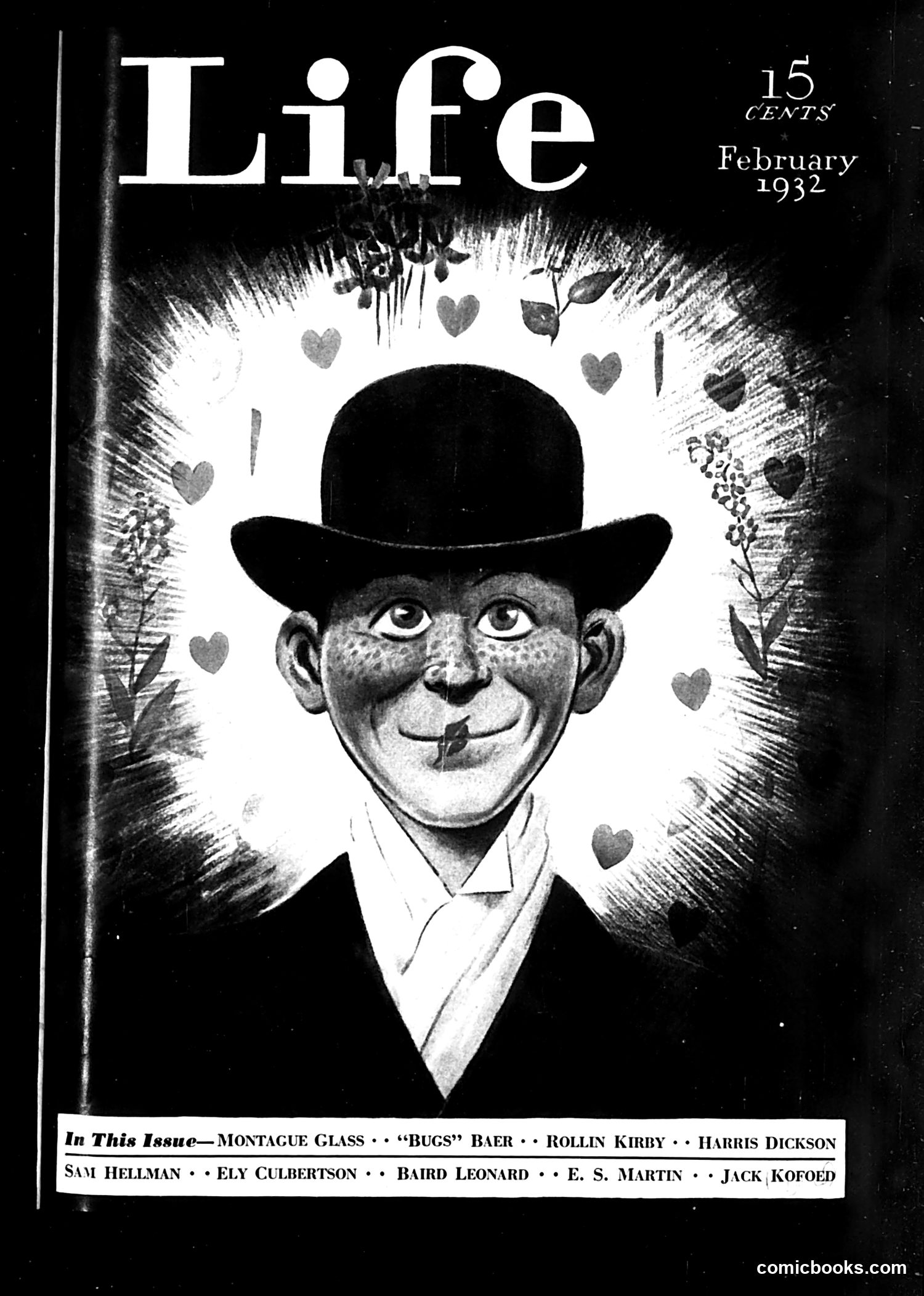
# Life Magazine Cover, February 1932 This is a **title page** for Life magazine's February 1932 issue (15 cents). The cover features a caricatured male face wearing a bowler hat, surrounded by hearts and floral designs—clearly a Valentine's Day themed cover for the month. The exaggerated facial features (large eyes, prominent ears, wide grin) suggest this is **satirical portraiture**, though the OCR'd text doesn't specify which public figure is depicted. The listing of celebrities "In This Issue" (Montague Glass, "Bugs" Baer, Rollin Kirby, Harris Dickson, and others) indicates Life's typical mix of comedy, social commentary, and celebrity content. The Valentine imagery and smiling caricature suggest a humorous, lighthearted issue despite the Great Depression's severity in early 1932.
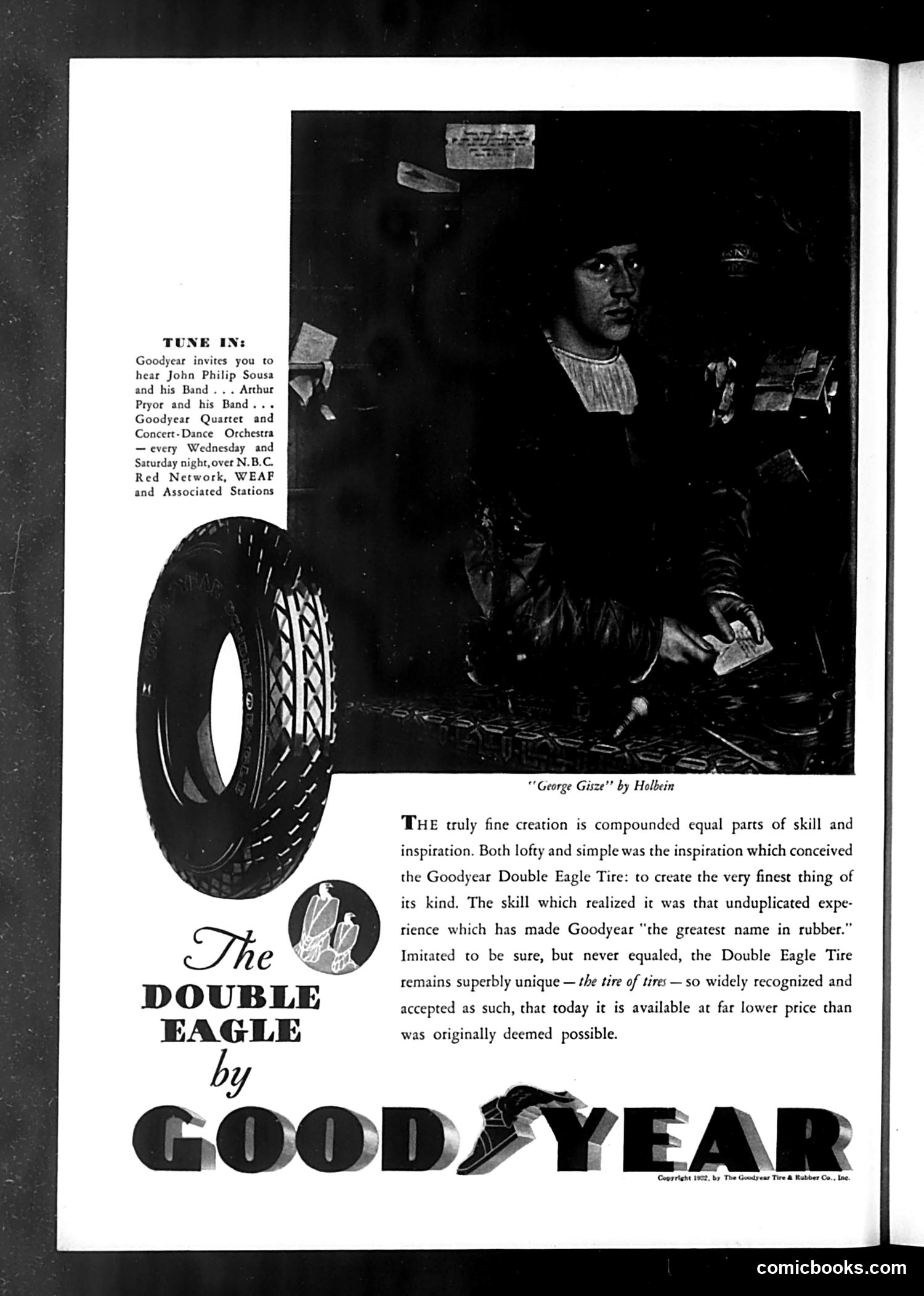
# Analysis This page is primarily a **Goodyear tire advertisement**, not political satire. The top section includes a "TUNE IN" notice promoting radio broadcasts featuring John Philip Sousa and other orchestras on NBC's Red Network and affiliated stations—typical 1920s-30s programming information. The main content advertises Goodyear's "Double Eagle Tire," featuring a photograph labeled "George Gizz" by Holbein (likely a portrait or caricature, though unclear of whom). The ad emphasizes the tire's superior quality, claiming it's "the tire of tires" and noting that despite imitations, the Double Eagle remains uniquely superior while now available at lower prices than originally expected. This is straightforward commercial advertising without political commentary or satire.
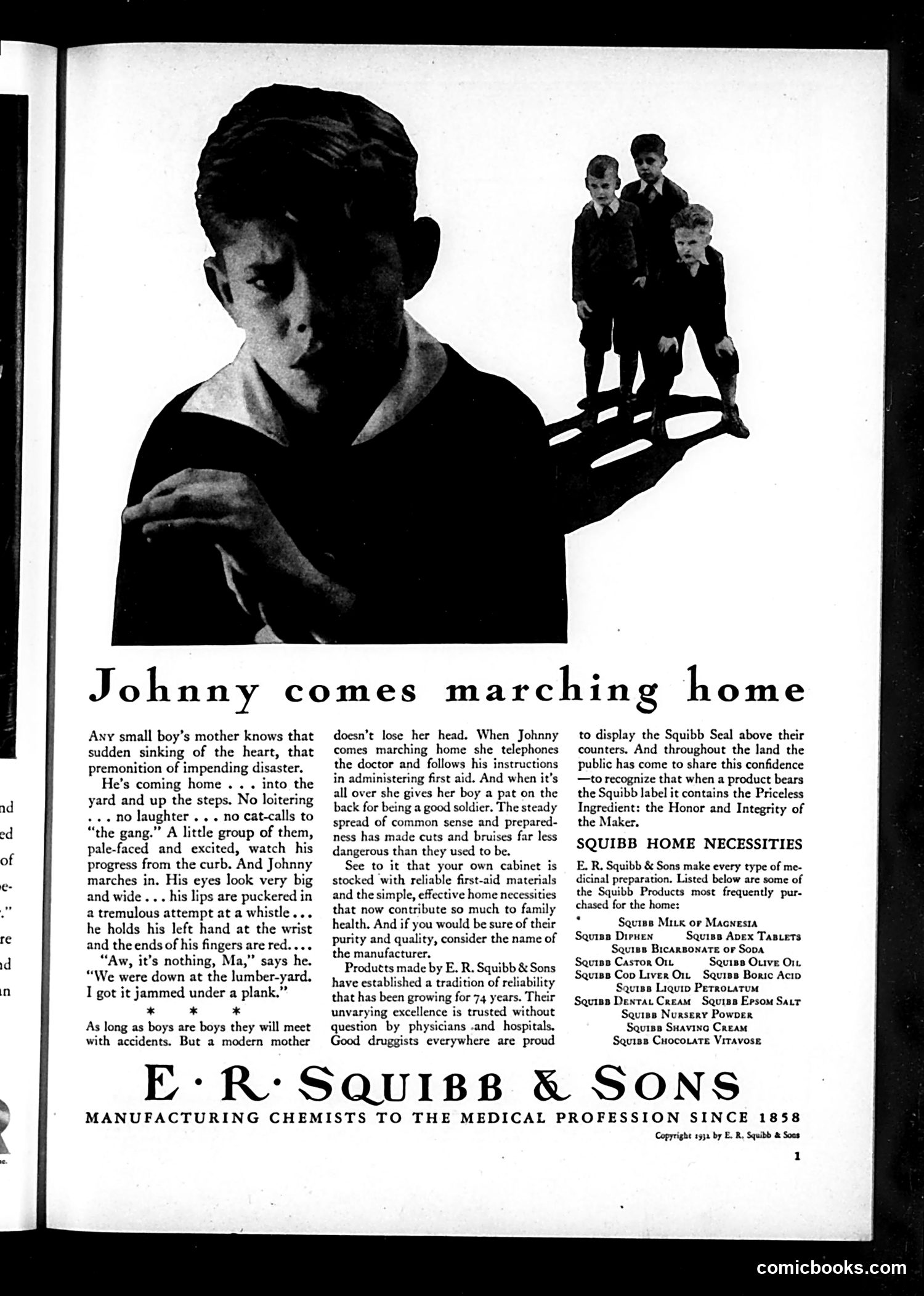
# Analysis This is primarily **an advertisement for E.R. Squibb & Sons**, a pharmaceutical company (established 1858). The visual narrative depicts a mother's anxiety about her son "Johnny" coming home from what appears to be military service, with references to potential injury ("sinking of the heart," "premonition of disaster"). The ad's emotional appeal—focused on maternal worry and a son's safe return—likely references **World War I or the interwar period**, when such concerns were culturally acute. The text reassures mothers that Squibb's "home necessities" (listed as medicinal preparations like milk of magnesia, cod liver oil, and other remedies) provide reliable first-aid care. The propaganda strategy uses anxiety about male vulnerability to market over-the-counter medical products as essential household items for responsible mothers.
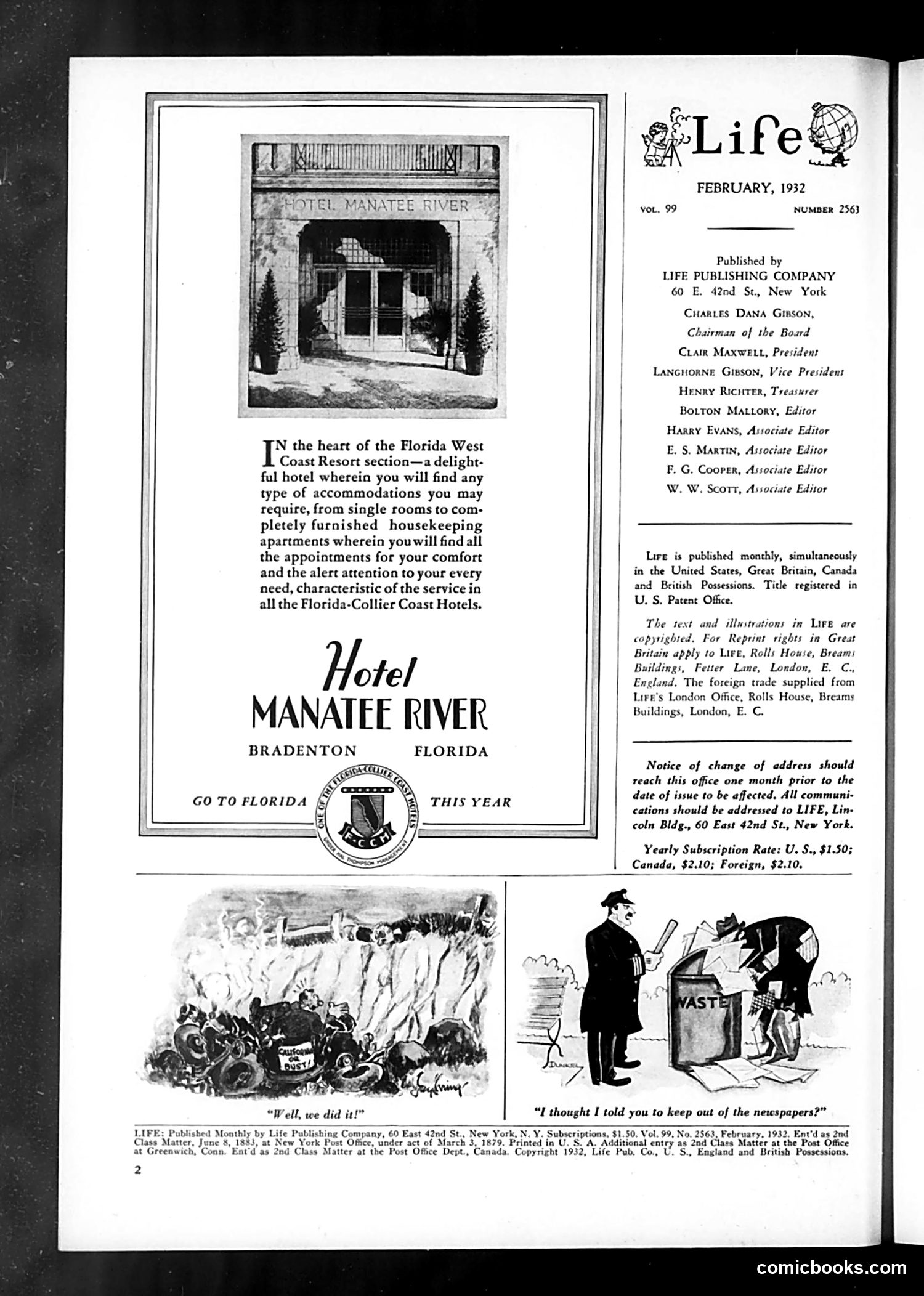
# Two Cartoons from Life Magazine, February 1932 **Bottom Left ("Well, see did it!"):** This cartoon appears to depict a chaotic scene with multiple figures in what looks like destruction or upheaval, though the specific reference is unclear from the image alone. **Bottom Right ("I thought I told you to keep out of the newspapers?"):** A well-dressed man in a suit and hat confronts another figure near a trash can labeled "VAST" (possibly "WASTE"). The joke appears to reference someone getting into trouble or scandal that reached the newspapers—suggesting embarrassment about public exposure of private matters. This was common satirical territory during the 1930s, poking fun at social embarrassment or impropriety becoming public knowledge. The page is otherwise dominated by a Hotel Manatee River advertisement.
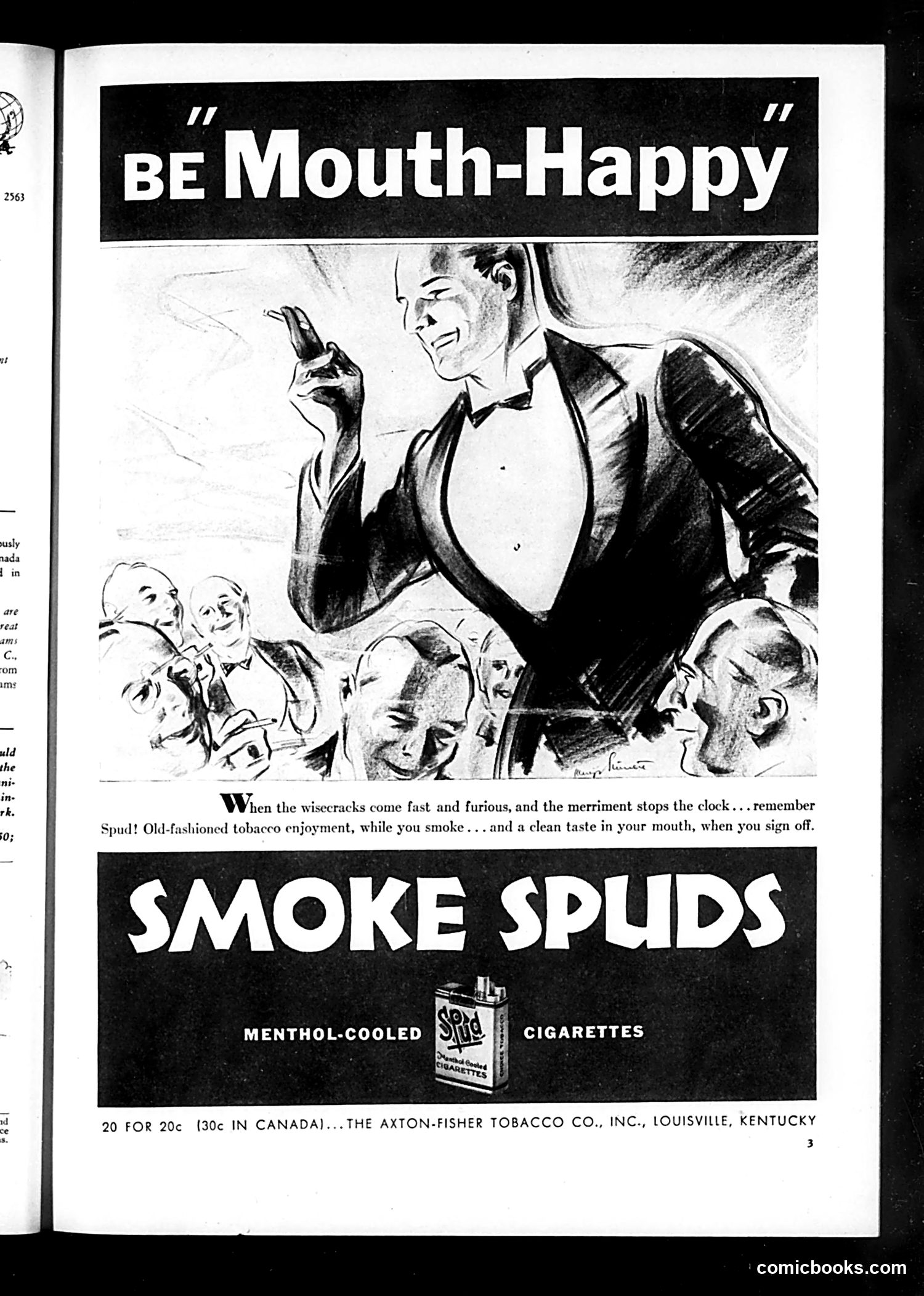
# Analysis This is a **cigarette advertisement**, not political satire. The "Smoke Spuds" ad promotes menthol-cooled cigarettes from the Axton-Fisher Tobacco Company in Louisville, Kentucky (20 cigarettes for 20 cents, or 30 cents in Canada). The illustration shows a well-dressed man at what appears to be a formal social gathering, smiling broadly while holding a cigarette. The headline "BE 'Mouth-Happy'" uses period slang to suggest the product delivers satisfaction. The accompanying text references "wisecrack" humor and promises "a clean taste in your mouth" — a marketing claim about the menthol cooling effect. The surrounding figures suggest a party or social scene where smoking was presented as sophisticated and desirable. This represents typical mid-20th century tobacco marketing that made no health warnings.
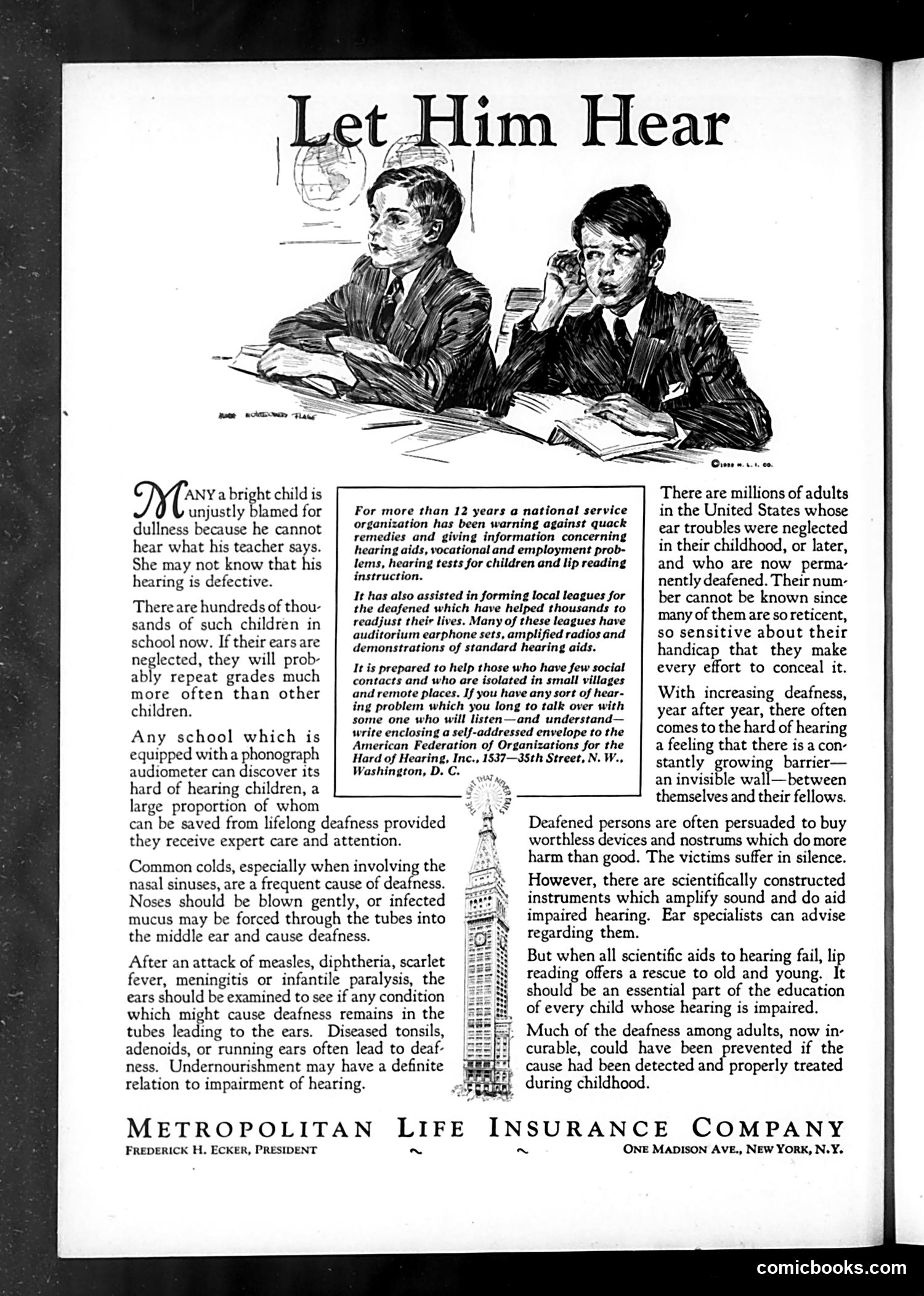
# Analysis This is a **public service advertisement** from Metropolitan Life Insurance Company, not satire. The headline "Let Him Hear" and illustration show two businessmen in an office setting, apparently discussing a hearing problem. The text addresses childhood deafness, explaining that many children are wrongly labeled "dull" when they actually have undetected hearing impairments. It advocates for hearing tests in schools and proper medical treatment, noting that some deafness is preventable through early detection. The advertisement promotes the American Federation of Organizations for the Hard of Hearing, encouraging readers with suspected hearing problems to contact them. This reflects early 20th-century progressive public health messaging—using a major insurance company's platform to raise awareness about a treatable medical condition affecting children's education and development.
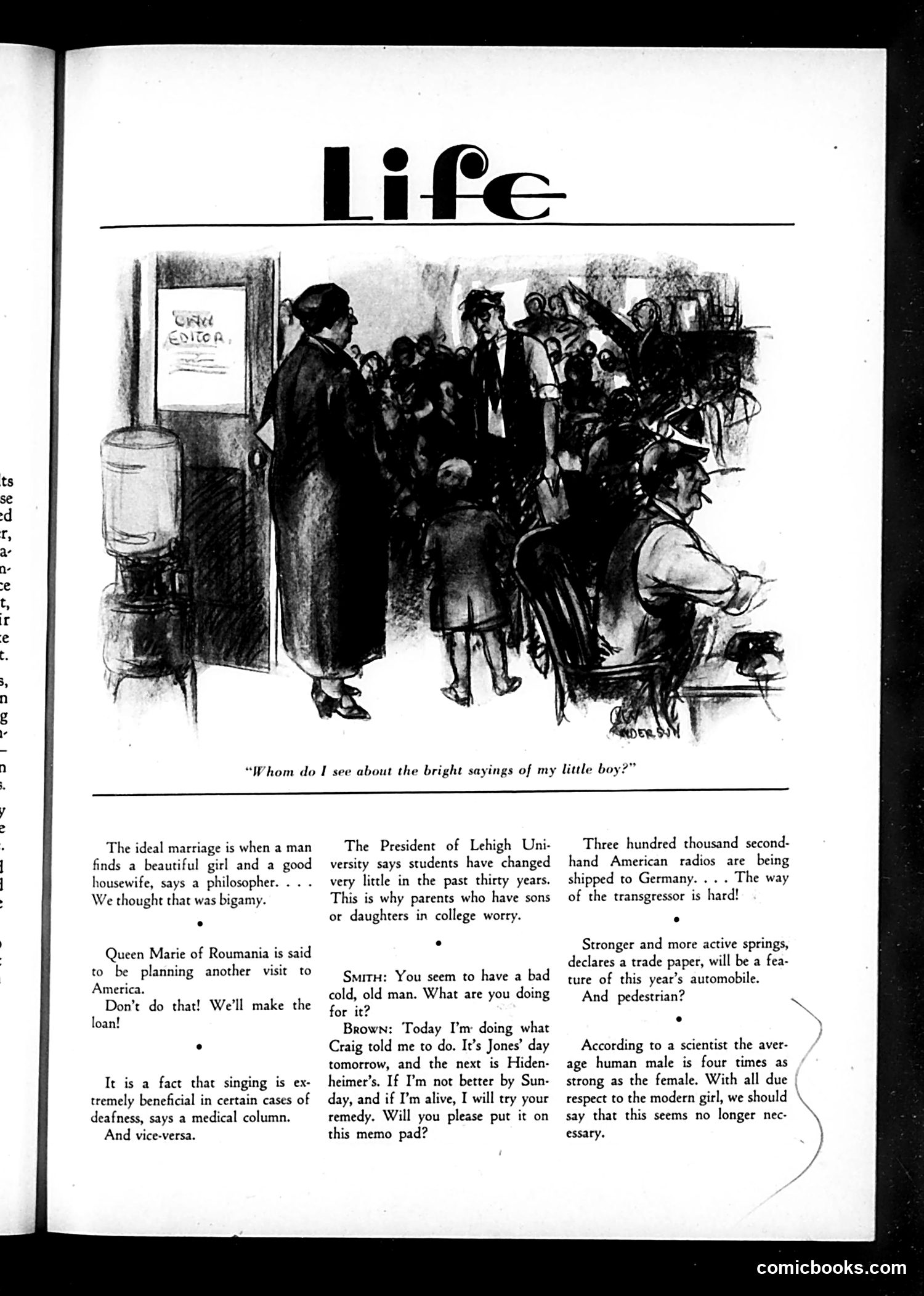
# Analysis of Life Magazine Page The main cartoon depicts a crowded doctor's or clinic waiting room, with the caption: "Whom do I see about the bright sayings of my little boy?" The satire plays on parents' anxiety about their children's precocious or embarrassing remarks. The crowded office suggests this is a widespread concern requiring professional help—likely a psychiatrist or physician—implying that bright children's candid observations pose such a social problem that parents need expert intervention to manage them. The page also includes brief humorous snippets about marriage philosophy, Queen Marie of Romania's visit to America, singing as medical treatment, and automobile springs. These represent typical Life magazine satirical commentary on contemporary social and technological topics.
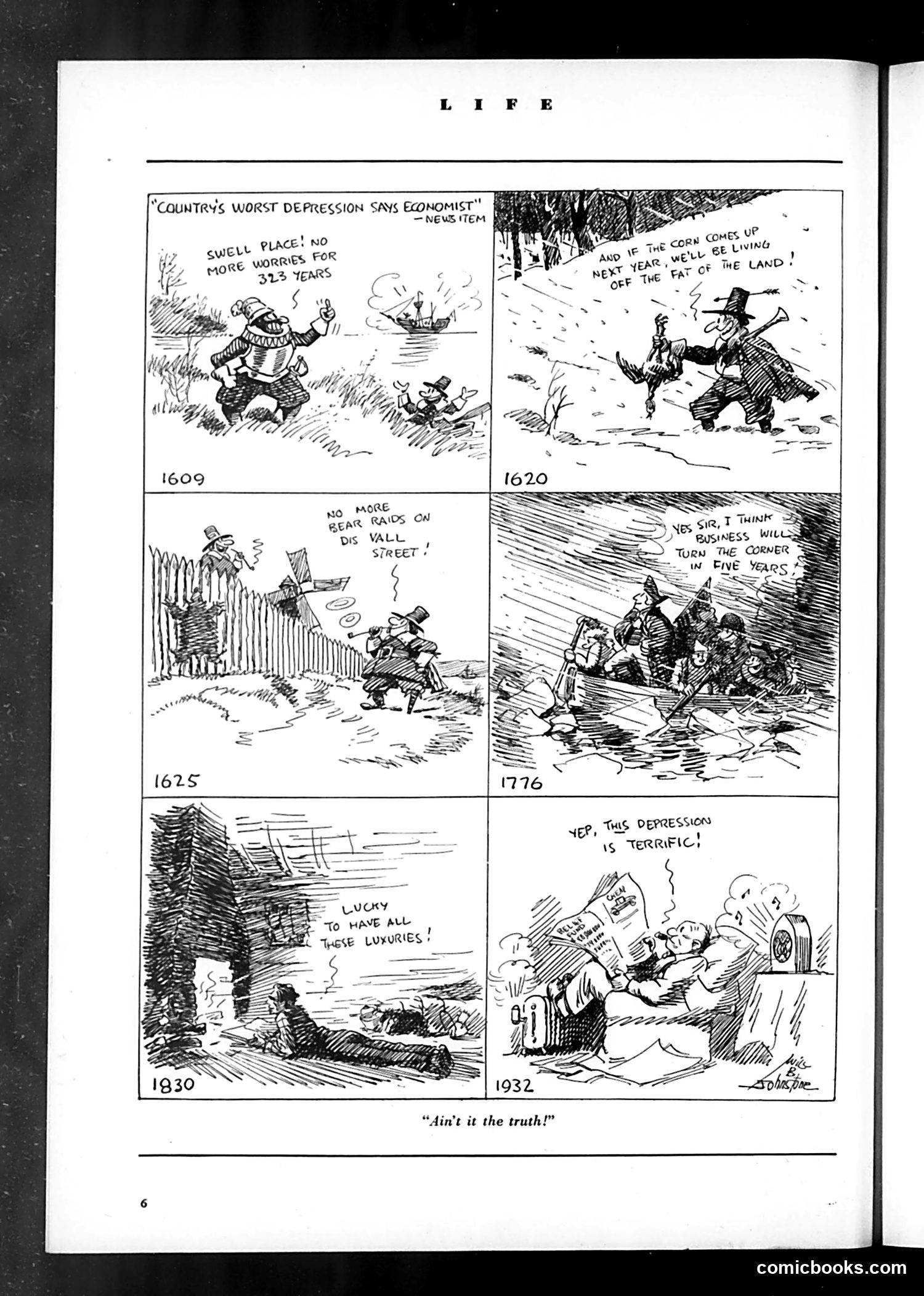
# Political Cartoon Analysis: "Country's Worst Depression Sans Economist" This six-panel cartoon traces American economic hardship from 1609 to 1932, titled "ain't it the truth!" The comic sarcastically compares historical disasters—starvation (1609), crop failure (1620), Indian raids (1625), flood (1716), and famine (1830)—to the 1932 Great Depression. In 1932, a figure lies in bed reading newspaper headlines about the depression, remarking "Yep, this depression is terrific!" while surrounded by financial ruin. The satire suggests that despite claiming to have "economists" advising the country (unlike previous eras), Americans are experiencing economic collapse as severe as actual disasters their ancestors faced. The joke criticizes economists' failure to prevent or manage the Depression.
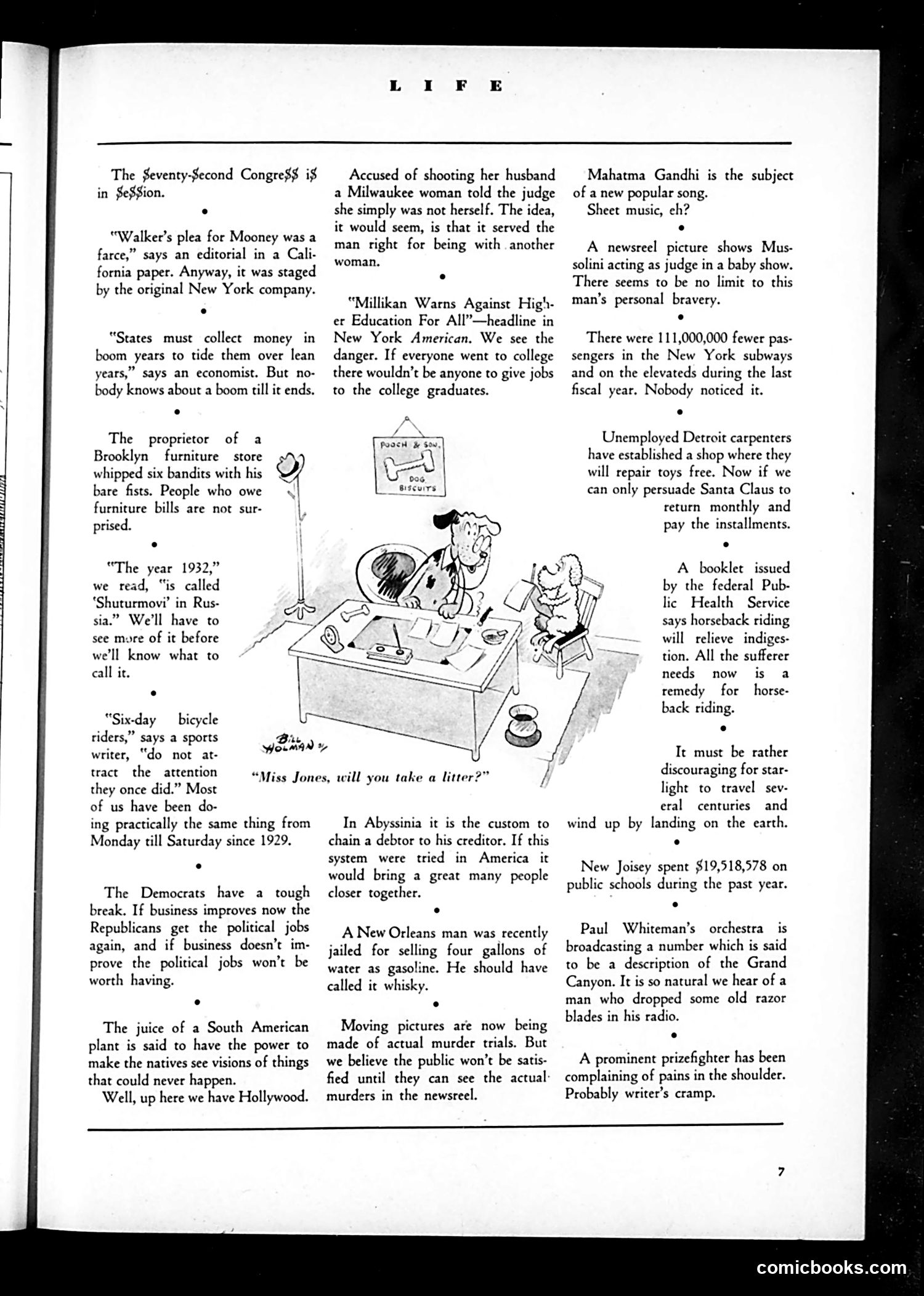
# Analysis of Life Magazine Page 7 The main cartoon shows a disheveled man at a desk captioned "Miss Jones, will you take a litter?" - a pun playing on "letter" versus "litter," suggesting the office is in complete disarray with trash/mess scattered about. The page consists primarily of brief satirical news items and observations rather than political cartoons. Topics include: - Congressional proceedings and political job-switching between Democrats and Republicans - Economic commentary on 1932 as "Shutdown" year - Social observations (Brooklyn furniture store owner fighting bandits, unemployed Detroit carpenters repairing toys) - Humorous notes on odd laws in Abyssinia and New Orleans selling "water" as whiskey The humor is light, domestic satire reflecting Depression-era American life and minor political ironies rather than hard-hitting political commentary.
# Analysis of Life Magazine Page This is a text-only editorial page with no cartoons or illustrations visible. The article "Go On Living!... Gandhi and the Pope... England's Destiny" by E.S. Martin discusses three topics: 1. **Economic hardship**: Commentary on lean times and survival during what appears to be economic difficulty 2. **Gandhi and the Pope**: Martin suggests the Pope appropriately discouraged Gandhi's ascetic practices, arguing that going without material comforts isn't necessary for salvation 3. **Winston Churchill and British destiny**: Martin praises Churchill's views on English-speaking nations' superiority and their likely future dominance, while acknowledging the British can be "hard fighters" and "greedy and cruel" The piece reflects early-to-mid 20th century attitudes about Western superiority and Anglo-American partnership.
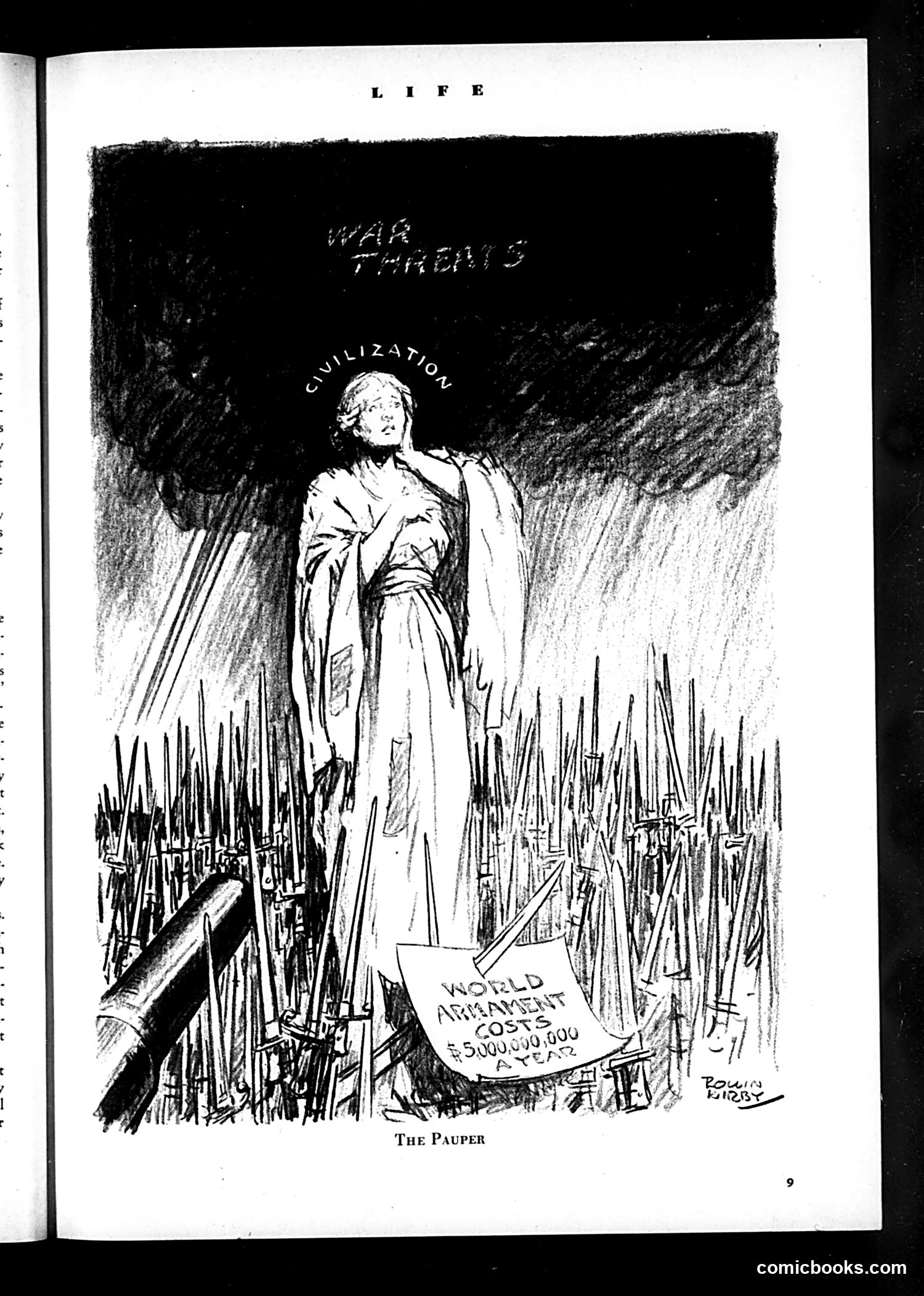
# "The Pauper" - Political Cartoon Analysis This cartoon depicts a winged female figure labeled "Civilization" standing amid a field of bayonets and weapons. She holds a document reading "World Armament Cost $5,000,000,000 P.A." (per annum). **The satire**: The image criticizes massive global military spending as fundamentally at odds with civilization itself. The contrast between the ethereal, benevolent figure of Civilization and the forest of weapons surrounding her suggests that such enormous defense budgets undermine rather than protect civilization. The title "The Pauper" reinforces this irony—despite vast wealth, civilization is impoverished by militarism. This likely reflects post-World War I anxieties about arms races and the enormous costs of modern warfare. The cartoon advocates for disarmament by showing military spending as incompatible with civilized society.
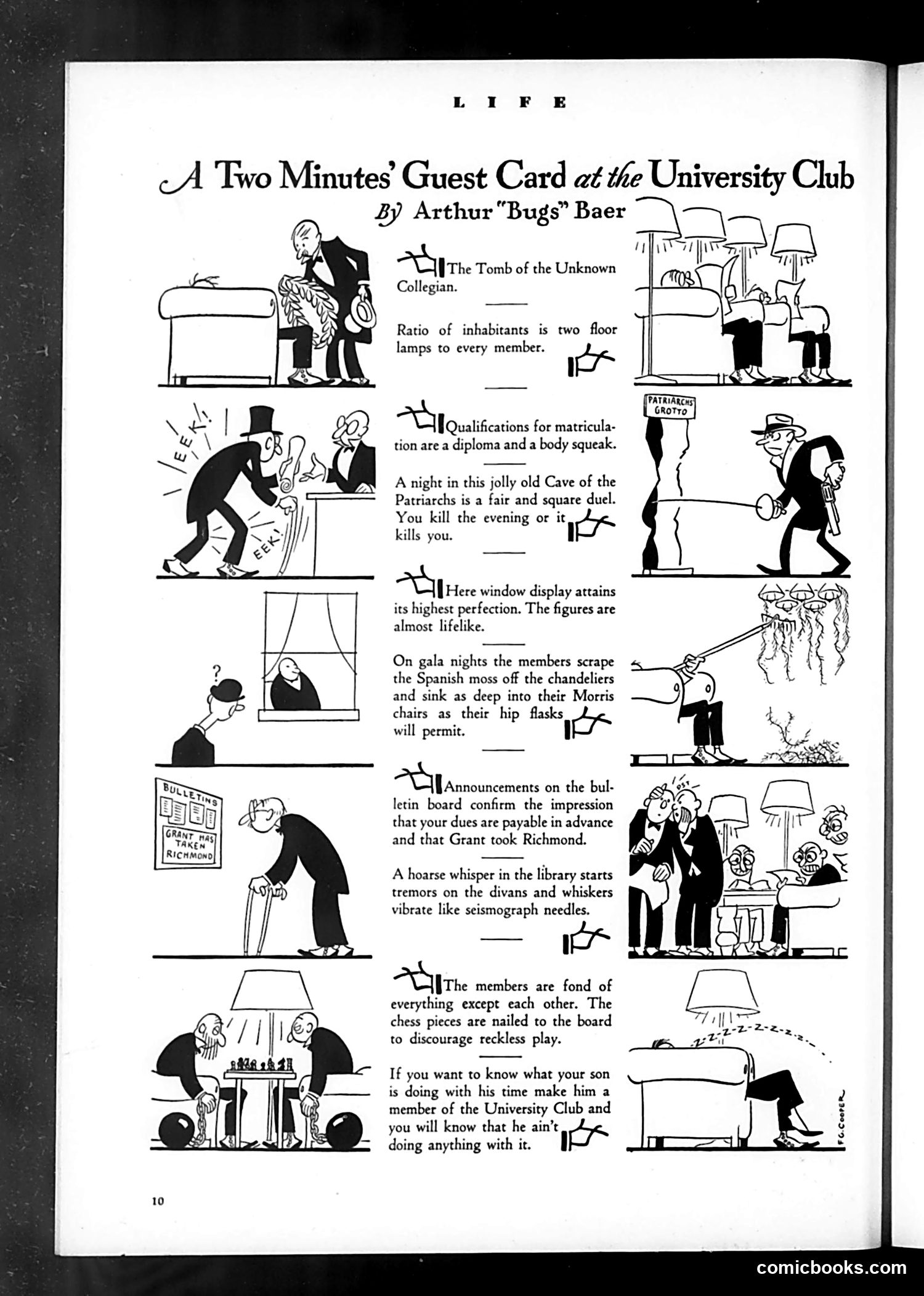
# Analysis of "A Two Minutes' Guest Card at the University Club" This satirical piece by Arthur "Bugs" Baer mocks the University Club, a prestigious men's social institution. The cartoons humorously describe club features and member behavior through exaggerated observations: - The "Tomb of the Unknown Collegian" and overcrowded lighting suggest the club feels ancient and stuffy - "Qualifications for matriculation are a diploma and a body squeak" pokes fun at admission standards - References to members scraping "Spanish moss" from chandeliers and sinking into Morris chairs mock their sedentary, aging nature - A bulletin board joke about dues and "Grant took Richmond" (likely a historical/financial reference) satirizes administrative inefficiency - The final observation—that membership keeps sons occupied doing nothing—suggests the club's primary function is providing idle distraction for wealthy men's sons The humor targets old-money institutions and their purposelessness.