A complete issue · 73 pages · 1931
Life — December 1931
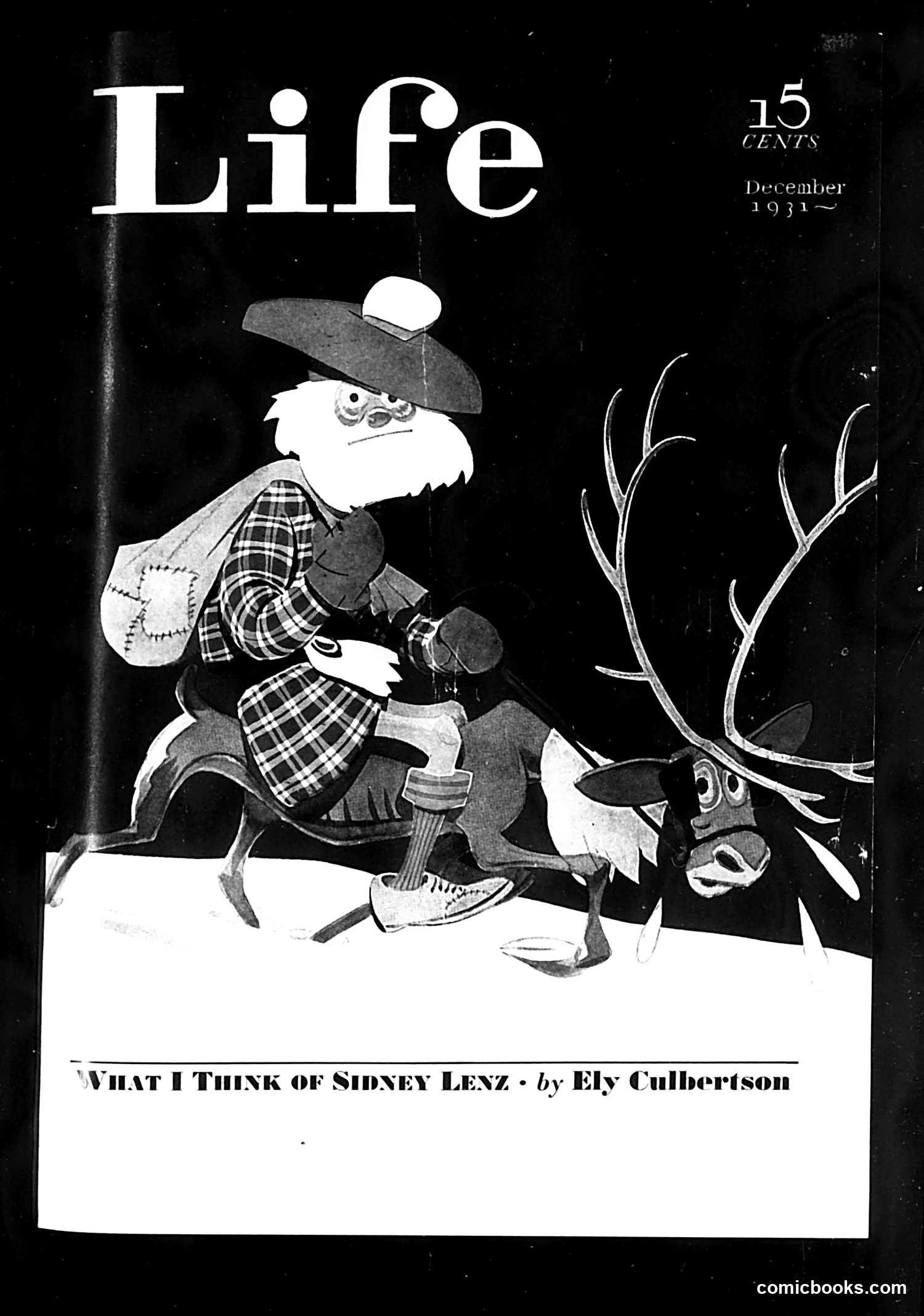
# Life Magazine, December 1931 This is a **title page** for Life magazine's December 1931 issue (15 cents). The cover illustration shows a **caricatured eagle character** dressed as a cowboy or frontiersman—wearing a plaid shirt, wide-brimmed hat, and carrying a rifle—riding what appears to be a reindeer with prominent antlers. The visible text promises an article titled "What I Think of Sidney Lenz - by Ely Culbertson," suggesting the issue contains commentary on Sidney Lenz, likely a bridge player, by Ely Culbertson, a famous bridge champion of the era. The eagle-as-cowboy imagery suggests American frontier themes, though the specific satirical point requires seeing the full article inside the magazine.
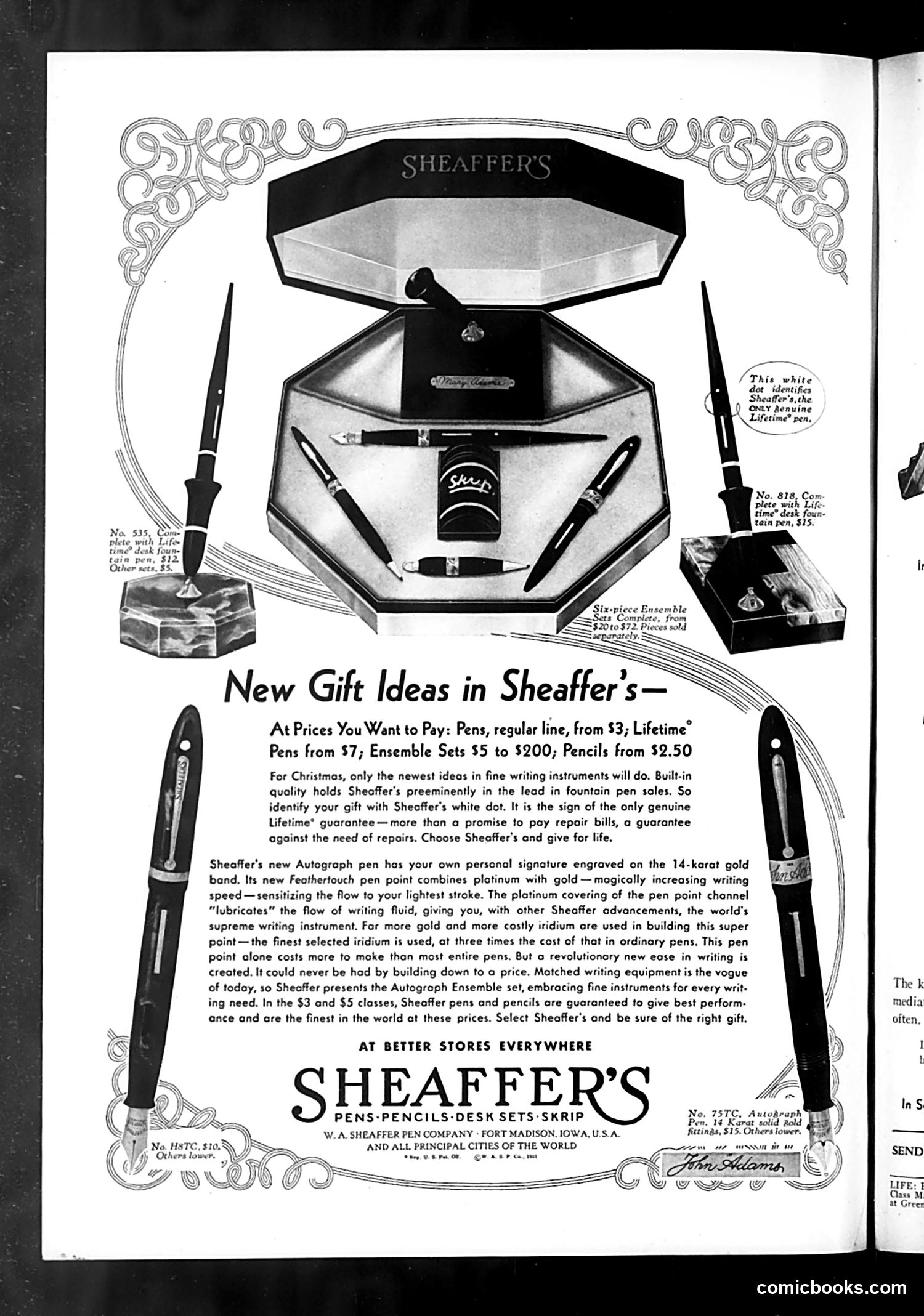
# Analysis This is a **Sheaffer's fountain pen advertisement**, not a political cartoon. The page promotes "New Gift Ideas in Sheaffer's" with product photography showing elegant writing instruments and desk sets arranged in an octagonal display box. The ad emphasizes luxury features: the "Lifetime" guarantee, platinum and gold components, and the prestigious "white dot" identifier of genuine Sheaffer pens. Prices range from $3 to $200, positioning these as gifts for affluent consumers. The ornamental border design is period-appropriate for 1920s-30s advertising aesthetics. There is no political satire or social commentary—this is straightforward luxury goods marketing targeting wealthy gift-buyers during what appears to be a holiday shopping season.
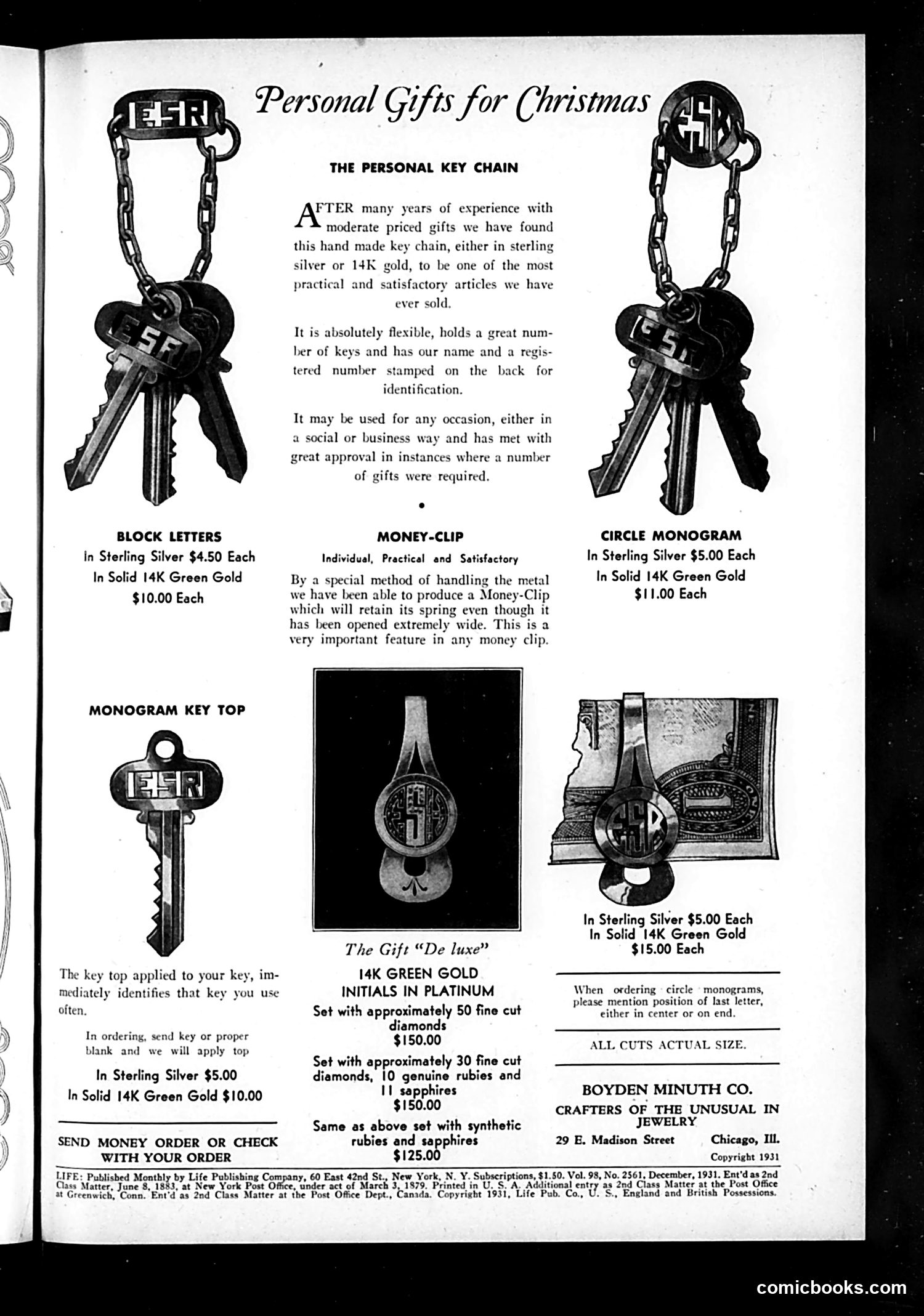
# Analysis This is not a cartoon page but rather a **Christmas gift advertisement** from Life magazine (Copyright 1931). It promotes personal gifts from Boyden Minuth Co., a Chicago jewelry company. The page showcases various personalized items: key chains in sterling silver or 14K gold, money clips, and monogrammed key tops. The centerpiece is "The Gift 'De luxe'"—a 14K green gold item with platinum initials and diamonds, priced at $150. There is **no political satire or cartoon content**. This is straightforward period advertising emphasizing practical, customizable gifts for both social and business occasions. The design reflects 1931 Art Deco styling typical of the era's luxury goods marketing.
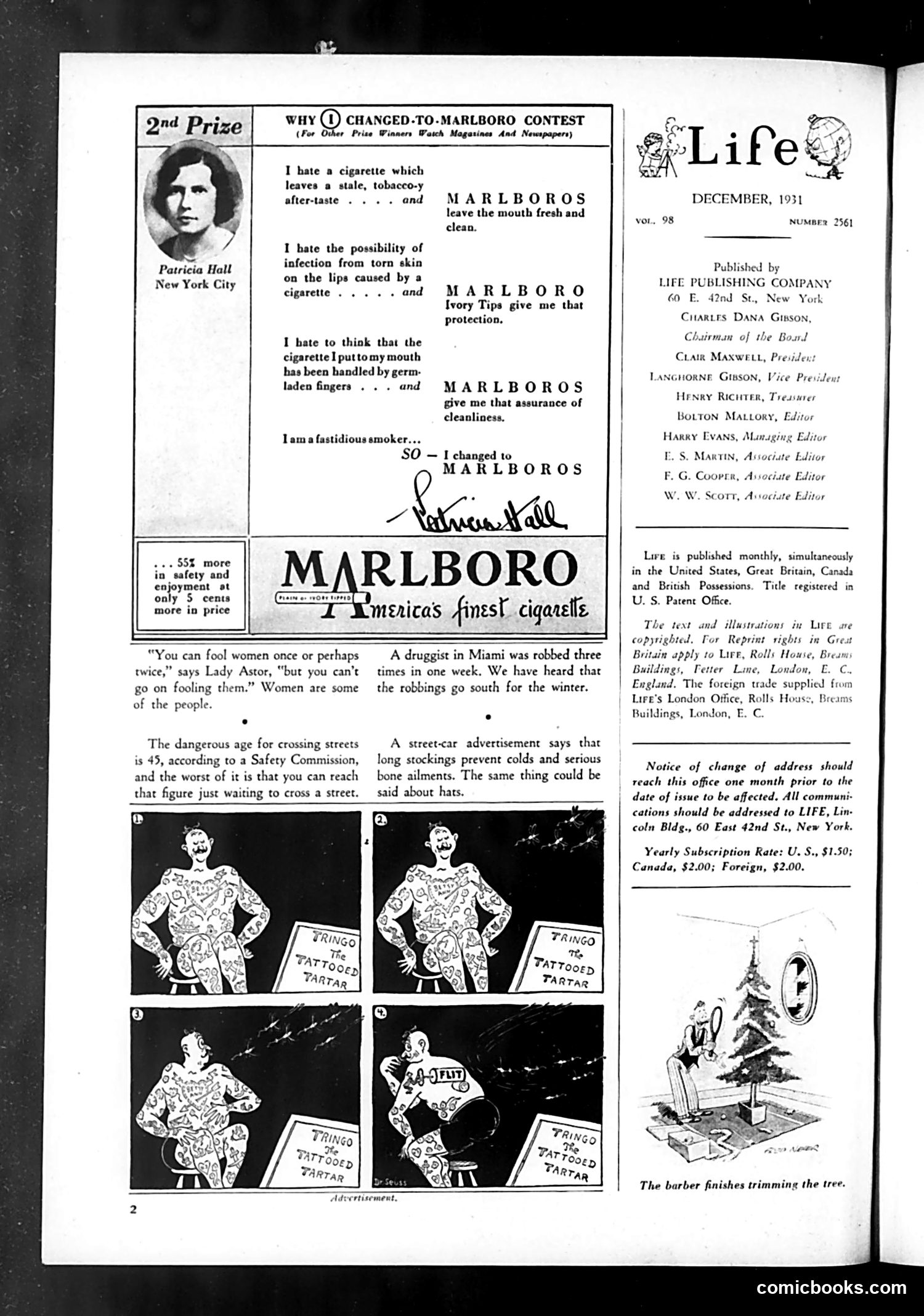
# Life Magazine, December 1931: Page Analysis This page combines a Marlboro cigarette advertisement featuring Patricia Hall (2nd Prize winner in a "Why I Changed to Marlboro" contest) with unrelated content including a four-panel comic strip about "Fringo the Tattooed Tartar" and a holiday cartoon. The Marlboro ad presents Hall's testimonial about cigarette quality—addressing common smoking concerns like stale taste, lip infections, and hygiene. This reflects 1931 advertising strategies that addressed health anxieties by emphasizing product cleanliness rather than denying risks. The "Fringo" comic appears to be a nonsense humor strip popular in 1930s Life magazine, depicting absurdist scenarios. The page also includes brief satirical quips about Lady Astor, street safety, and robbery—typical of Life's miscellaneous humor format.
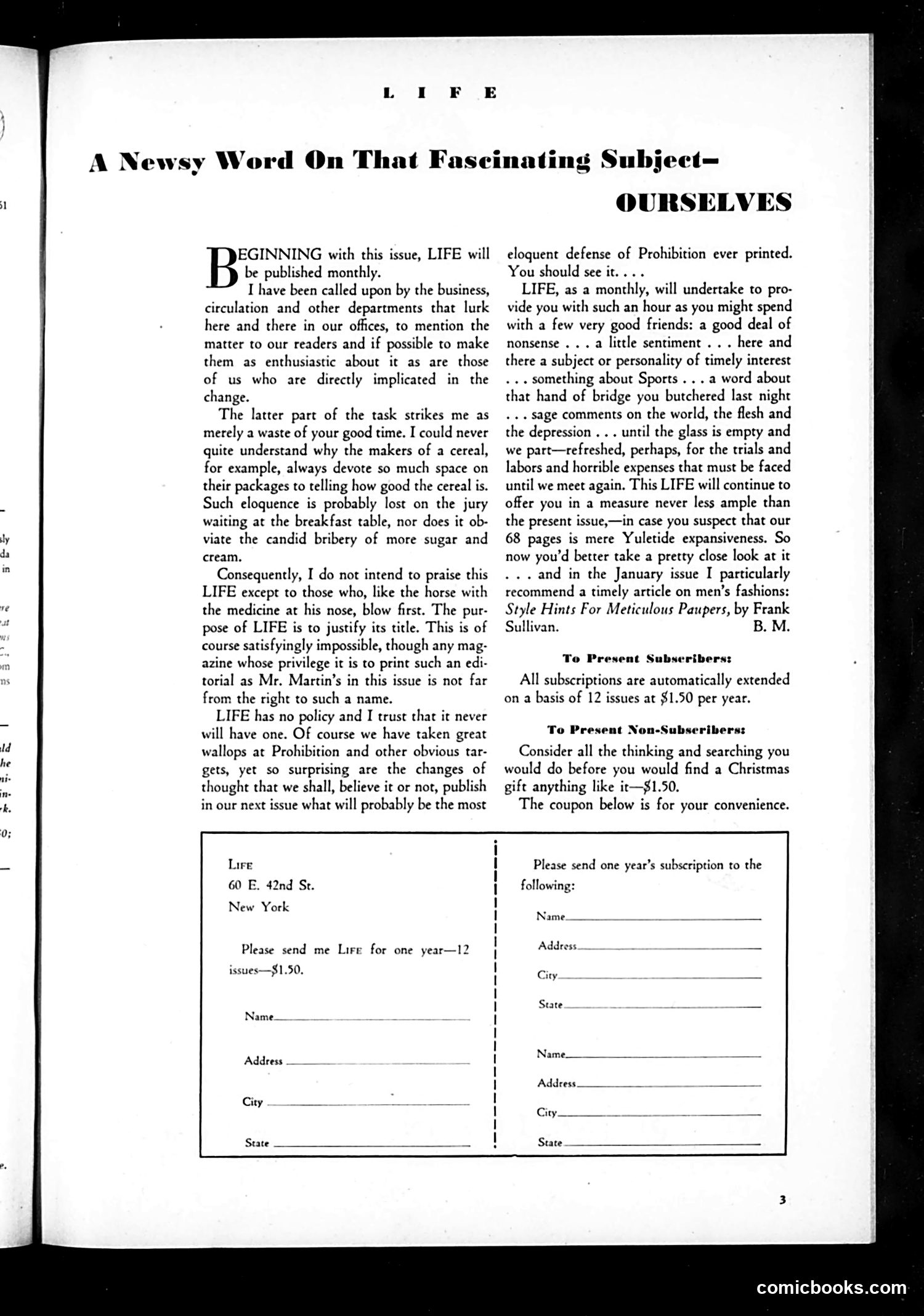
# Analysis This is primarily a **title page and subscription advertisement** for *Life* magazine's first monthly issue, rather than a satirical cartoon page. The text is an editorial statement explaining *Life*'s mission: to publish monthly with "good deal of nonsense," sentiment, and timely commentary on sports, current events, and society. The editor (B.M., likely referring to the magazine's leadership) promises content lighter than typical journalism—good for entertaining friends between substantive reading. The page includes **two subscription forms** offering one year (12 issues) for $1.50, with spaces for gift subscriptions. There are **no political cartoons visible** on this page—it functions as an introductory manifesto establishing the magazine's humorous, accessible tone for what appears to be a newly launched or relaunched publication.
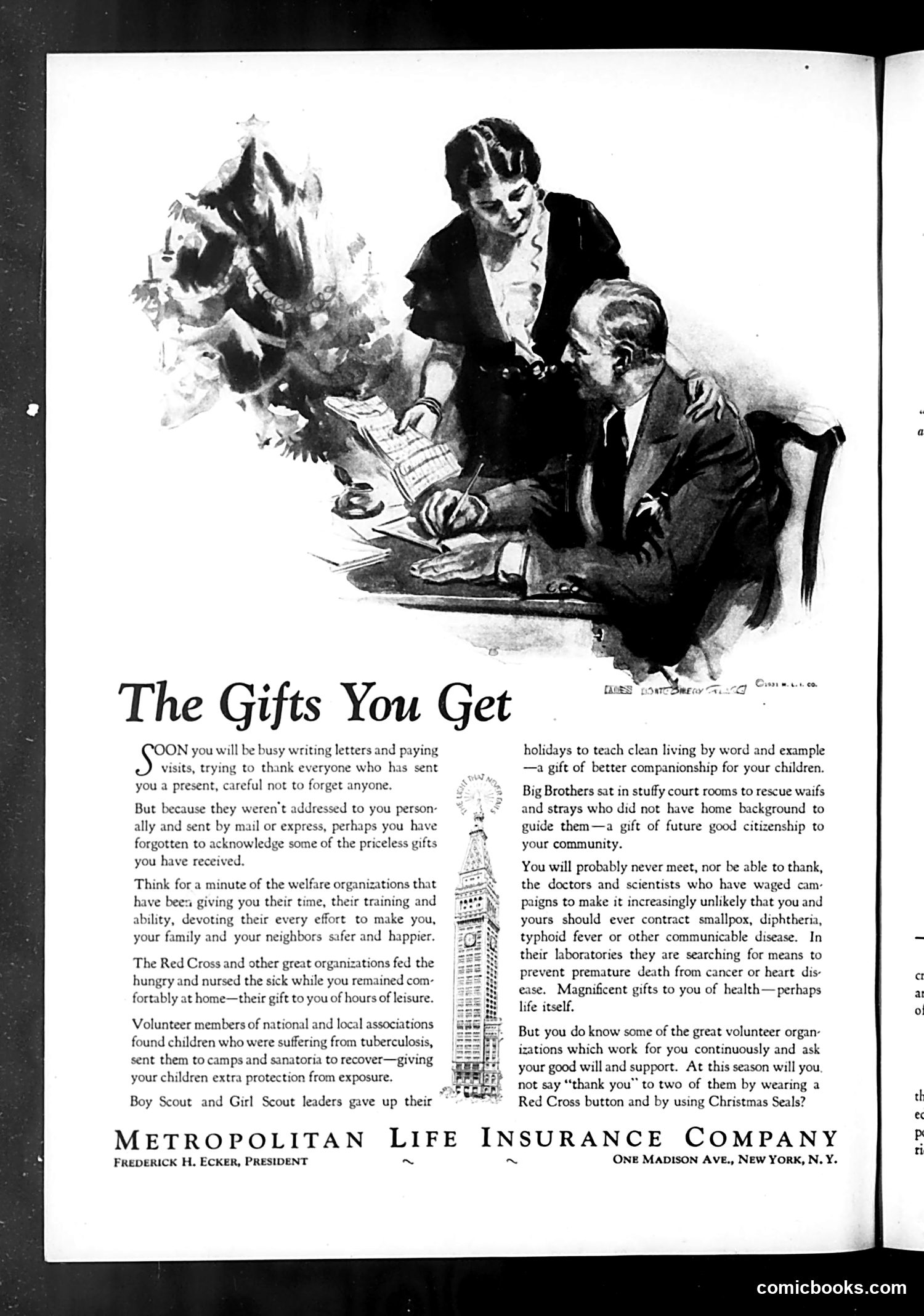
# "The Gifts You Get" - Metropolitan Life Insurance Advertisement This is a **full-page advertisement**, not satire or political commentary. The illustration shows a woman standing between two men examining what appears to be documents or correspondence, depicting the act of writing thank-you letters. The ad's message uses the holiday season to encourage readers to reflect on charitable organizations—the Red Cross, welfare organizations, Boy Scouts, Girl Scouts—that have provided "priceless gifts" of service during the year. It argues these organizations deserve recognition and support, suggesting readers donate via Red Cross buttons or Christmas Seals. The "gift" framing recontextualizes charitable giving and volunteerism as reciprocal benefits to one's family and community, positioning Metropolitan Life Insurance as aligned with civic virtue and social responsibility.
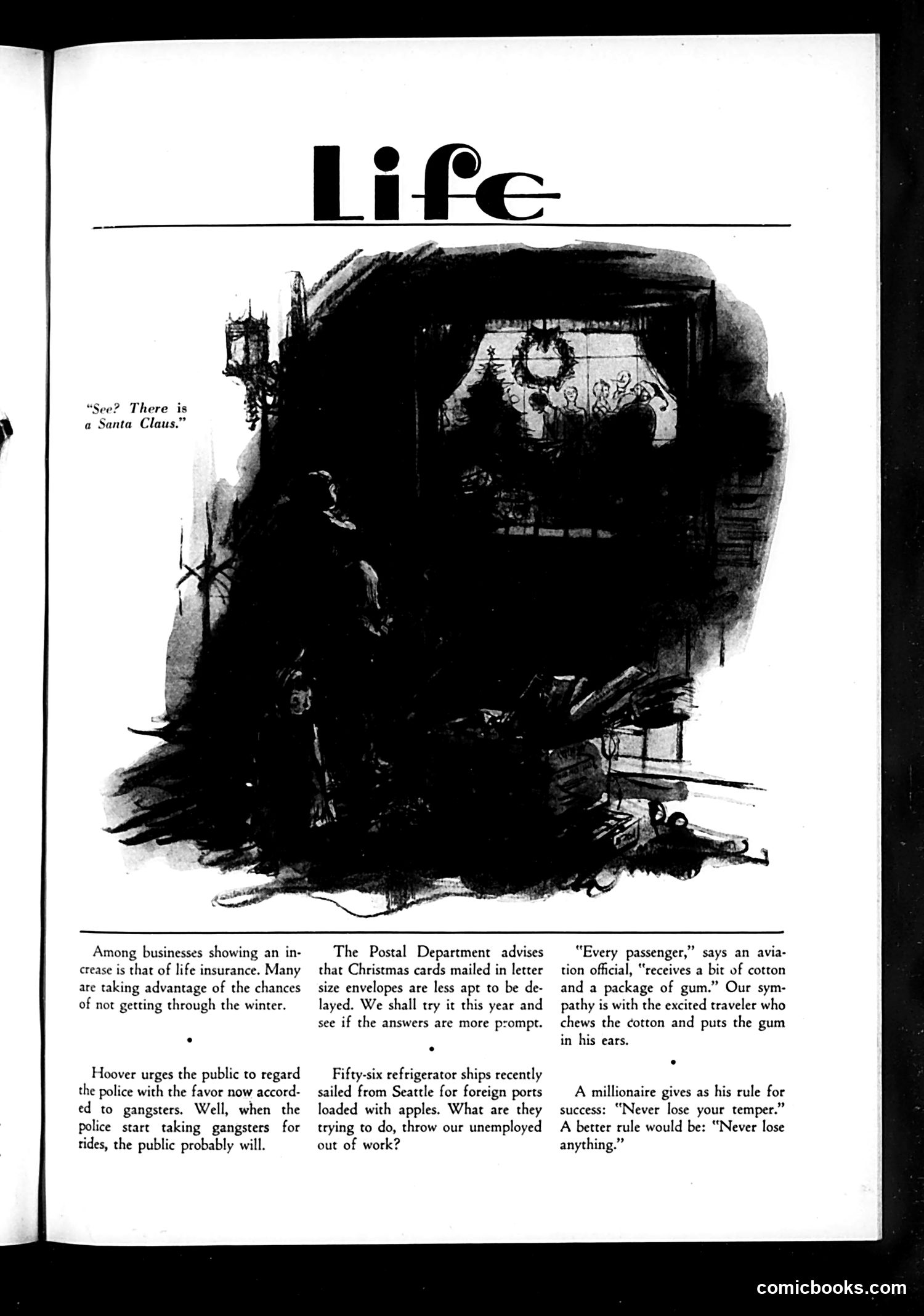
# Analysis of Life Magazine Page This page contains a satirical illustration titled "See? There is a Santa Claus" paired with brief commentary pieces. The main cartoon depicts a silhouetted figure looking through a window at a Christmas scene, suggesting childhood wonder about Santa's existence. The surrounding text addresses practical Depression-era concerns: life insurance business growth, postal advice about Christmas card delays, refrigerated apple shipments from Seattle (likely addressing unemployment), aviation cotton-gum products, and police tactics against gangsters. The "Santa Claus" title appears ironic—juxtaposing innocent holiday imagery with contemporary economic hardship and crime issues. The overall page mixes festive sentiment with sharp social commentary about 1930s American life, typical of *Life* magazine's satirical approach to current events and social conditions.
# Analysis of "What Christmas Message This Year?" by E.S. Martin This is a **text essay, not a cartoon**. It's a editorial commentary on economic inequality and corporate consolidation during what appears to be the **early 20th century** (references to 1899 and William James suggest this period). The piece critiques **big business monopolies** that are eliminating small manufacturers and merchants, creating poverty and unemployment. Martin argues that wealthy corporations are prioritizing profit over human welfare, particularly during Christmas season—traditionally associated with charity. The essay advocates for redistribution of wealth to help "the hungry and unemployed" and warns that unchecked corporate consolidation threatens individual liberty and equality of opportunity. The "Christmas message" Martin proposes is essentially a call for social reform and economic justice—a radical statement for its era.
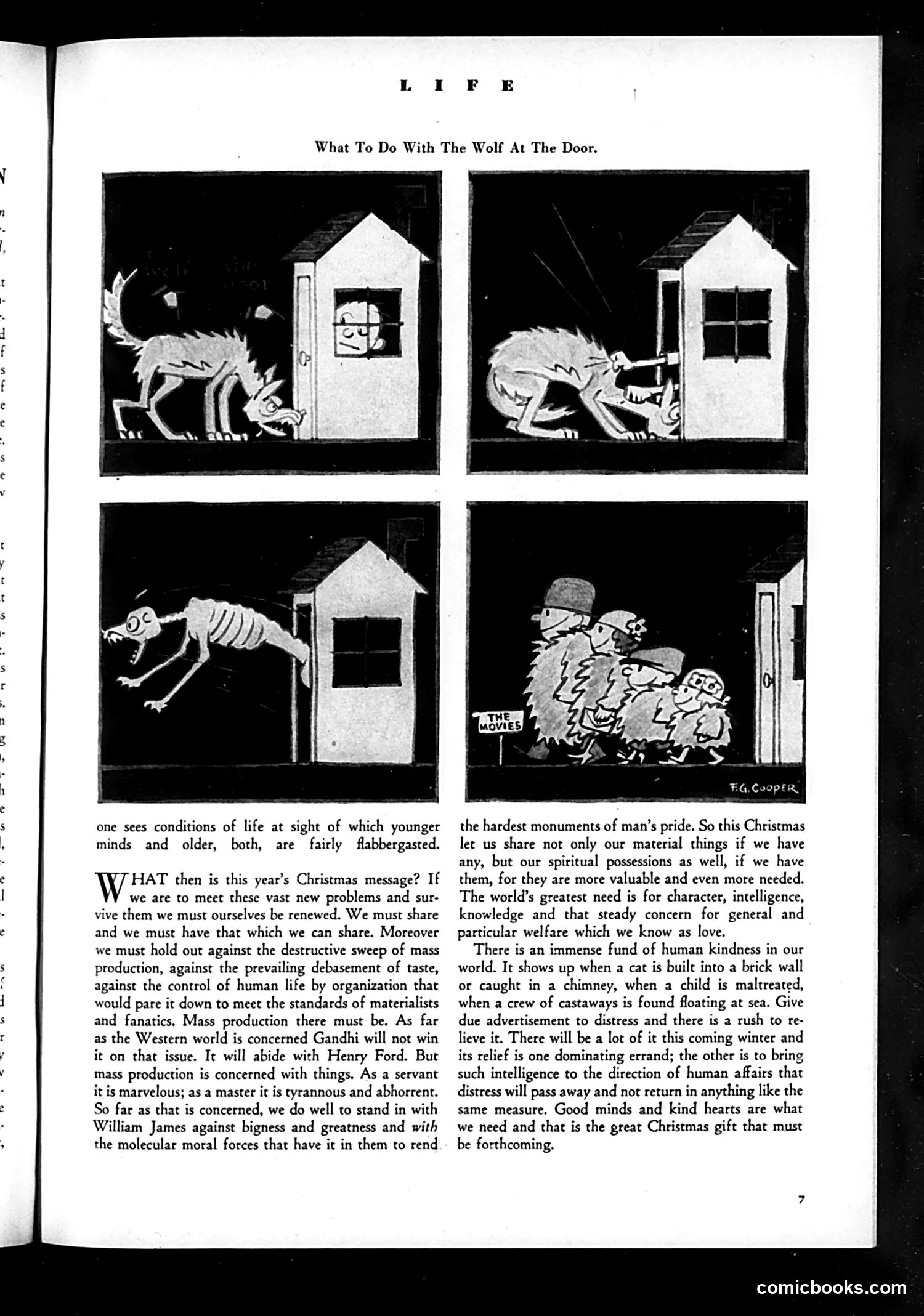
# "What To Do With The Wolf At The Door" This four-panel cartoon by T.G. Cooper illustrates the idiom "the wolf at the door"—meaning poverty or financial hardship. The sequence shows a person in a house confronted by an actual wolf: 1. **Top left**: Wolf scratches at the door 2. **Top right**: Person attempts to fight it off with a stick 3. **Bottom left**: Person appears to be hiding or fleeing 4. **Bottom right**: Multiple figures (appearing to be soldiers or officials) are called in to deal with the threat The accompanying editorial text discusses Christmas charity and addressing social welfare needs. The cartoon satirizes inadequate individual responses to economic hardship, suggesting that serious social problems require collective institutional action rather than personal defense alone.
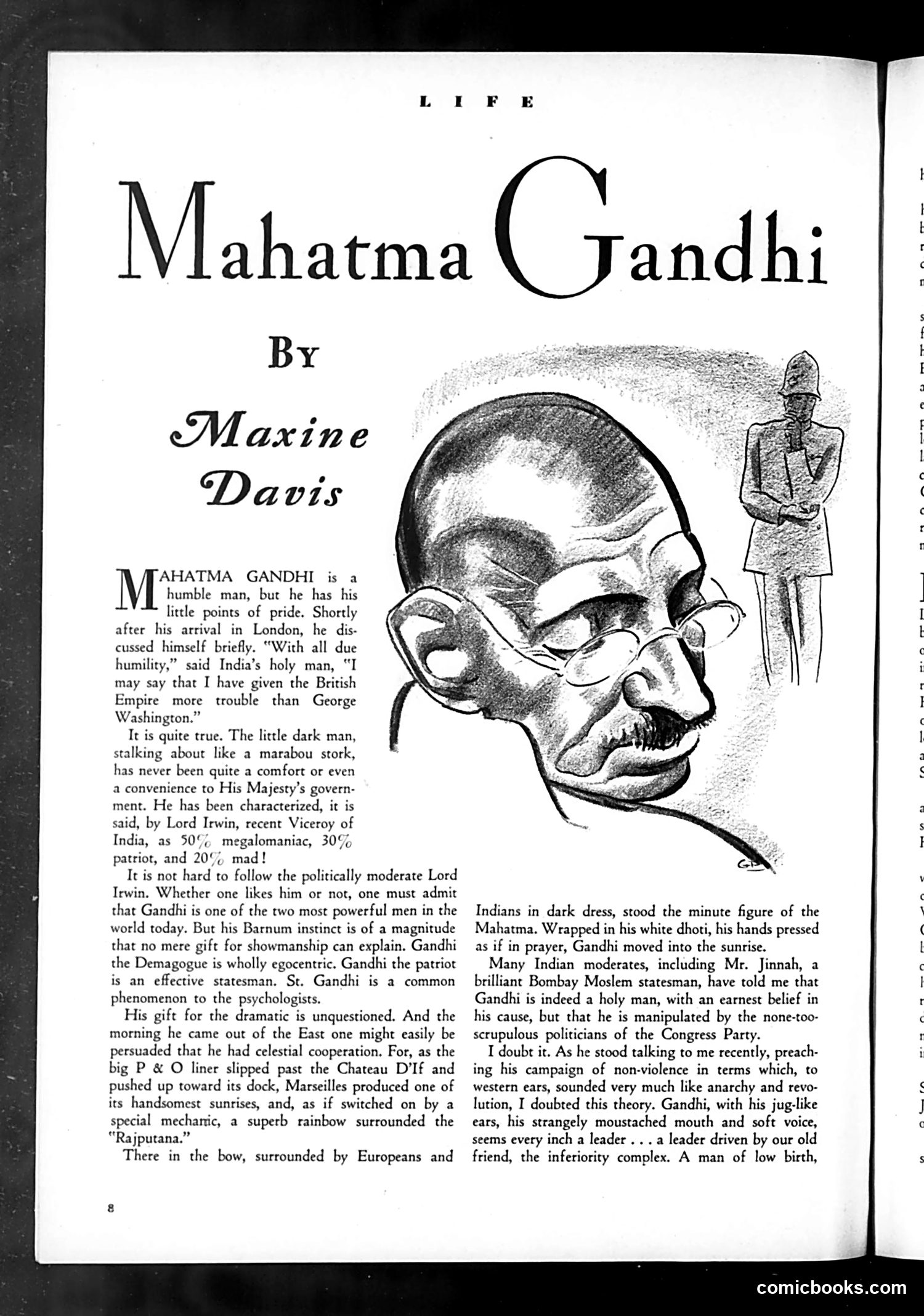
# Analysis: "Mahatma Gandhi" by Maxine Davis (Life Magazine) This article presents a satirical political portrait of Mahatma Gandhi. The caricature exaggerates his distinctive features—glasses, thin face, and prominent ears—in a mocking style typical of 1920s-30s Life magazine satire. Davis characterizes Gandhi as a "humble man" whose actual power is far greater than his modest appearance suggests. She references Lord Irwin's characterization of him as "50% megalomaniac, 30% patriot, and 20% mad," indicating British colonial skepticism about his motives. The article suggests Gandhi manipulates Indian moderates and Congress politicians through non-violence rhetoric, while actually being driven by an "inferiority complex." The satire portrays him as a shrewd political operator whose apparent humility masks significant ambition and influence—a common Western criticism of Gandhi during India's independence movement.
# Commentary on Gandhi and British Rule This page is a political-historical essay (not a cartoon) discussing Mohandas Gandhi's character and independence movement. The author presents a critical perspective on Gandhi, describing him as physically unattractive ("one of the uglest men") but intellectually formidable. The text covers Gandhi's opposition to British rule—his advocacy for boycotts, passive resistance, and non-payment of taxes—which the author views as insincere, arguing Gandhi's real grievance was lack of recognition for Indian officers in the British military. The piece mocks Gandhi's ascetic practices (spinning wheel, simple diet) as performative "sanctity" and includes a dismissive anecdote about his costume ("plus fours" vs. "minus fours"). It expresses skepticism that Gandhi would genuinely support Indian independence if Britain made concessions.
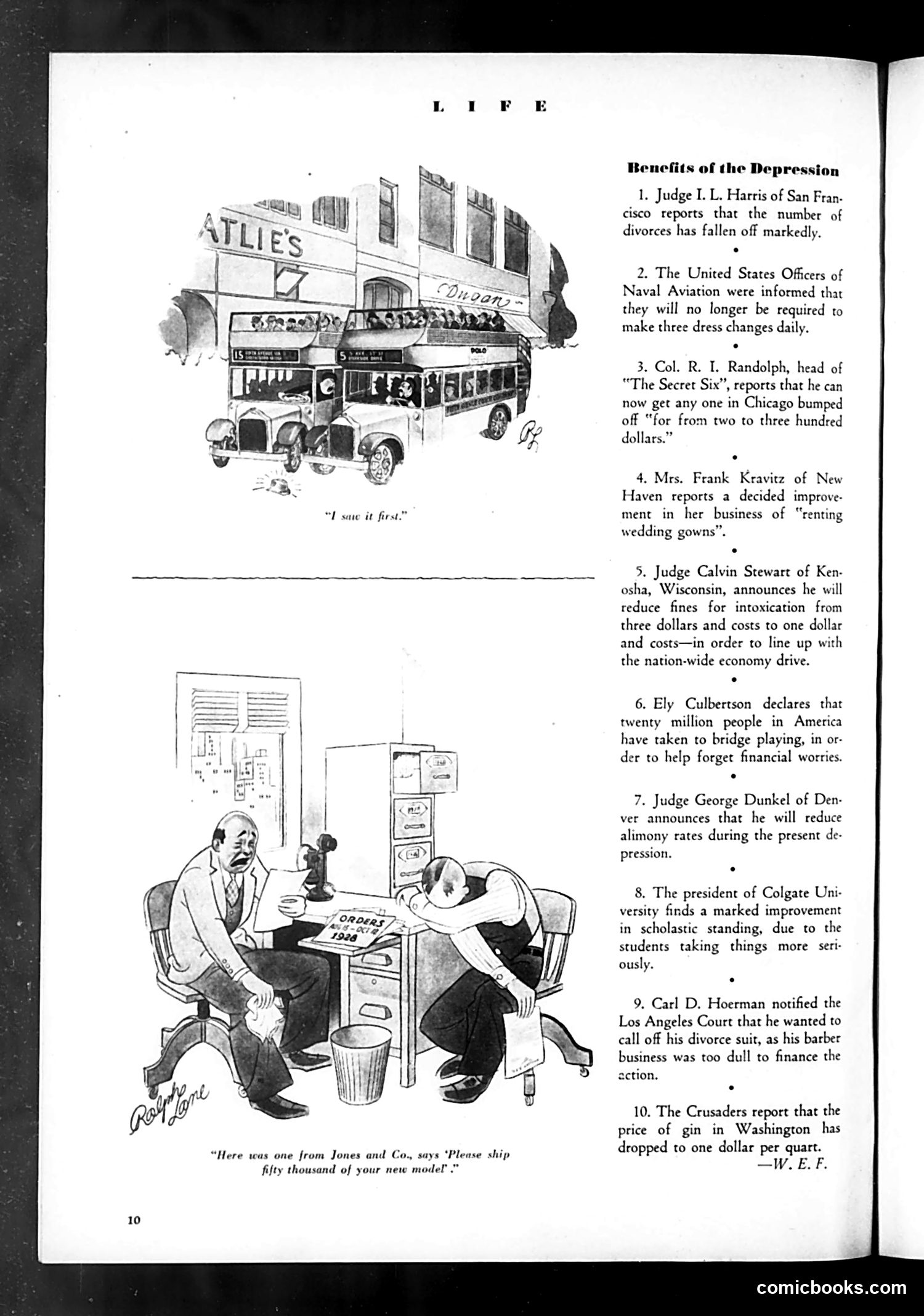
# "Benefits of the Depression" - Life Magazine Satire This page satirizes supposed "silver linings" during the Great Depression through humorous anecdotes and cartoons. The top cartoon shows a crowded multi-story building labeled "ALLIES" with various businesses, captioned "I saw it first"—likely mocking competition and desperation during economic hardship. The bottom cartoon depicts two men in an office, one appearing distressed while reading documents, with the caption about ordering "fifty thousand of your new model"—satirizing how businesses struggled with inventory and demand during the Depression. The numbered list (1-10) presents ostensibly "positive" Depression outcomes: reduced divorces, lower crime rates, price drops, and increased bridge-playing. The satire lies in treating economic devastation's side effects as genuine benefits, mocking those seeking optimistic narratives during genuine hardship. The tone is darkly humorous, highlighting Depression-era hardship through ironic inversion.