A complete issue · 38 pages · 1931
Life — October 30, 1931
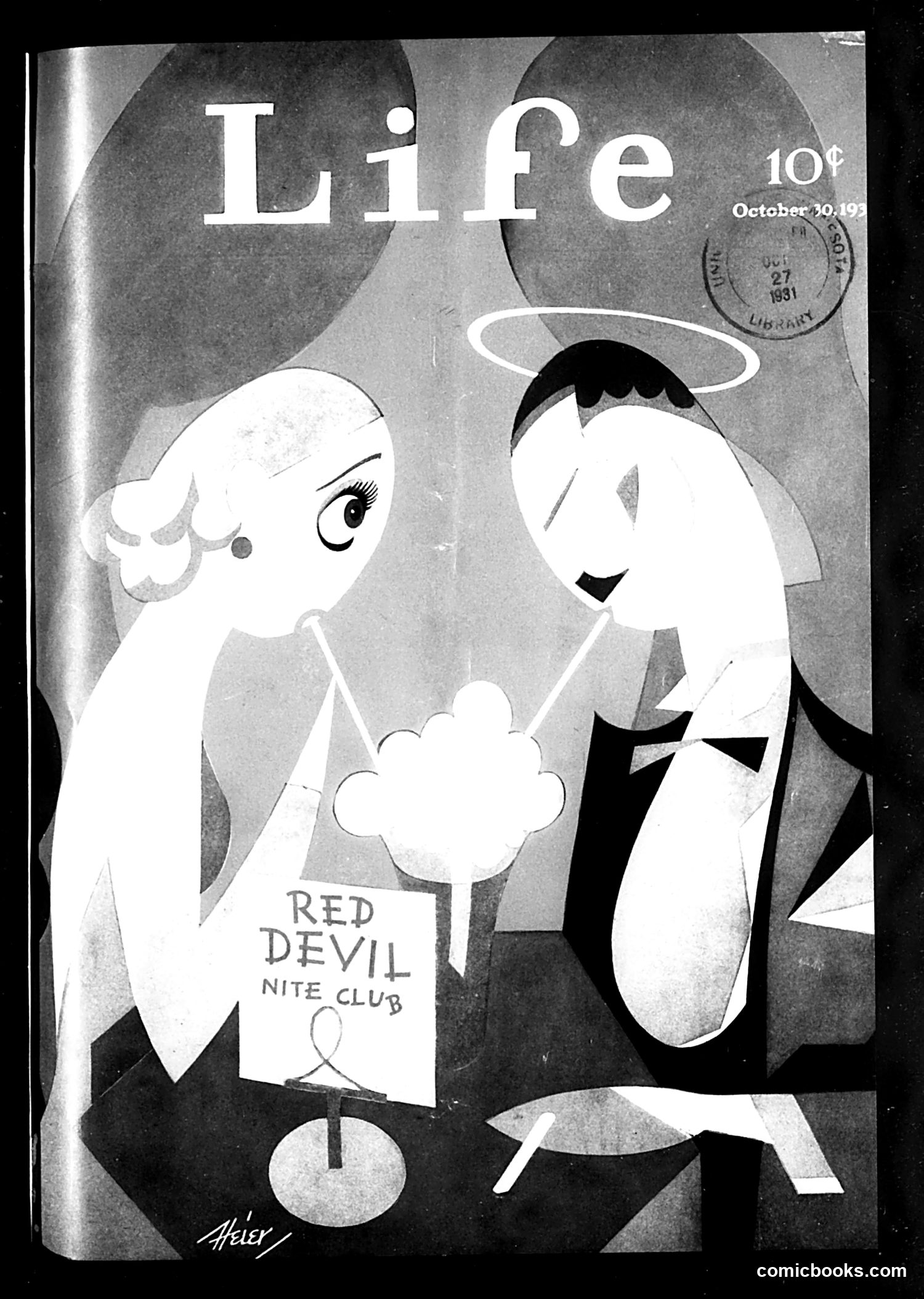
# Life Magazine Cover Analysis This is the October 20, 1931 cover of Life magazine, priced at 10 cents. The illustration by Aler depicts two stylized figures at what appears to be the "Red Devil Nite Club" (visible on a sign they're holding). The cartoon likely satirizes 1930s nightlife and Jazz Age culture. One figure wears a halo, suggesting angelic pretense, while the other sports a bow tie and appears more devilish—a visual contrast emphasizing hypocrisy about morality in speakeasy culture. The "Red Devil" club reference suggests prohibition-era illicit drinking establishments that operated despite legal bans. The juxtaposition of the halo'd "good" figure with the "devil" figure comments on the moral ambiguity and hidden nature of 1930s nightclub society, where respectable citizens frequented illegal establishments.
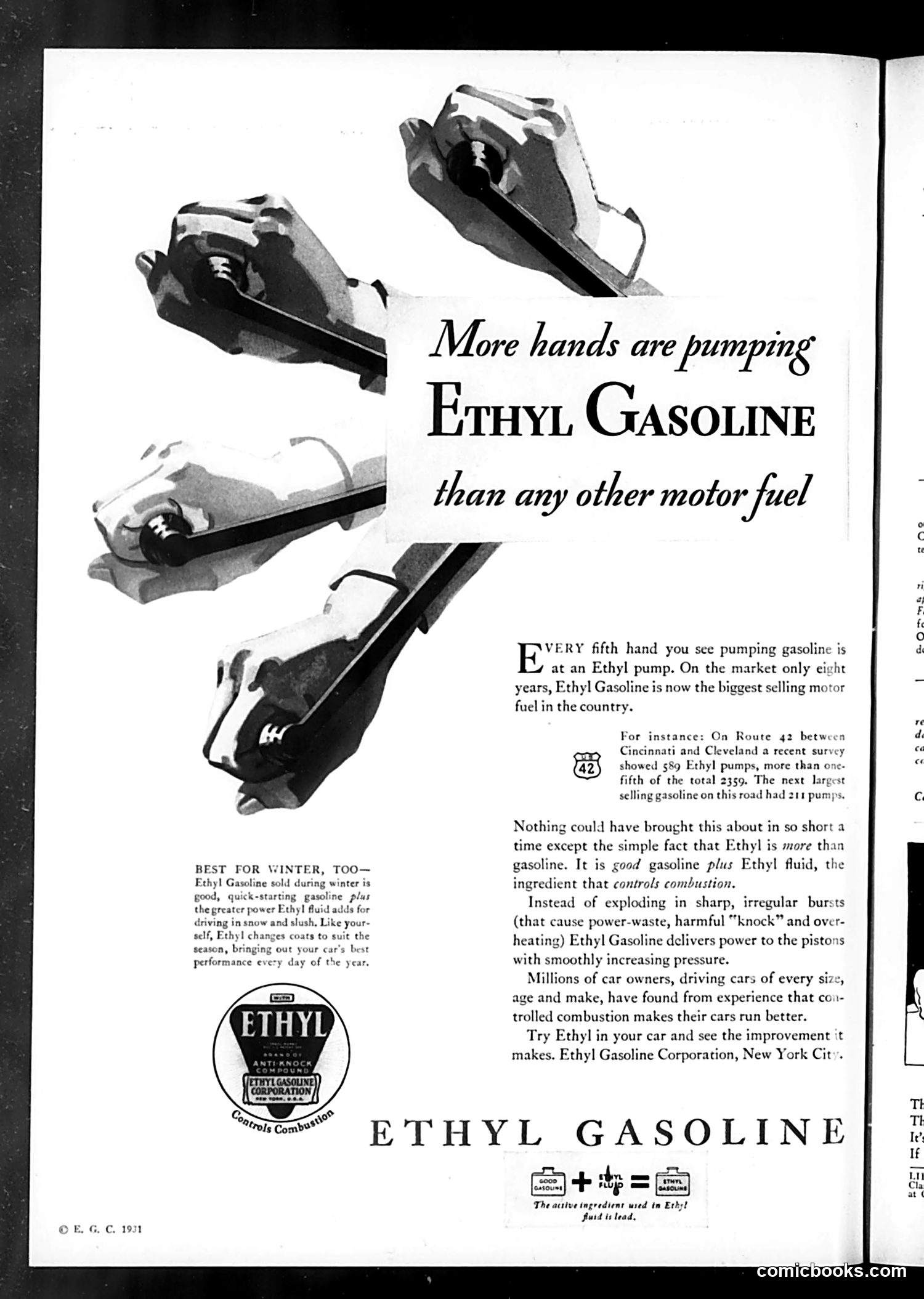
# Ethyl Gasoline Advertisement This is a **straightforward advertisement**, not satire or political commentary. The page promotes Ethyl Gasoline, a motor fuel product from the Ethyl Gasoline Corporation (New York City). The four photographs show hands at gas pumps, emphasizing that Ethyl is the market's best-selling fuel. The ad claims that "every fifth hand" belongs to an Ethyl pump customer, citing Route 42 between Cincinnati and Cleveland as evidence. The pitch emphasizes Ethyl's superiority: it contains an "Ethyl fluid" that "controls combustion," enabling smoother engine performance without harmful "knock." The ad targets car owners broadly, promising improved performance through controlled fuel combustion. The era and marketing approach suggest this dates to the 1920s-1930s, when leaded gasoline was widely promoted without health concerns.
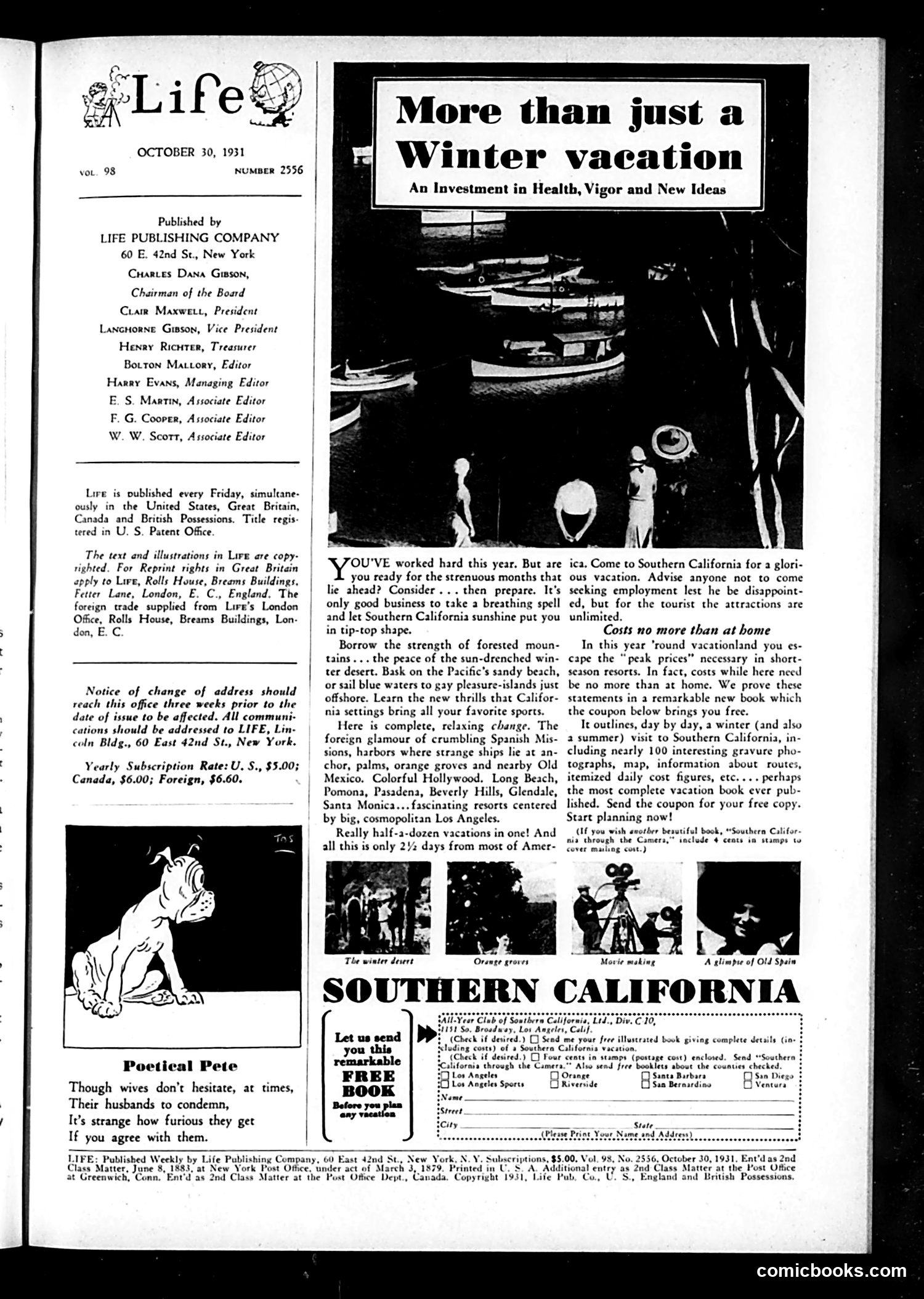
# Life Magazine Page Analysis (October 30, 1931) This page is primarily an **advertisement for Southern California tourism**, occupying most of the right side. The ad promotes winter vacations as "more than just a vacation" — framed as an investment in health and vigor. It emphasizes Southern California's accessibility (2½ days from most of America) and includes photos of attractions: desert scenery, orange groves, movie-making, and "a glimpse of Old Spain." The left side contains a small illustration labeled **"Poetical Pete"** — a cartoon bulldog — accompanying a brief humorous verse about wives getting "furious" when husbands disagree with them. Given the **October 1931 date**, this advertisement reflects the Great Depression era, when affordable leisure travel to California was promoted as economically accessible rejuvenation for working Americans. The ad's emphasis on cost and health benefits targets Depression-era readers seeking affordable escape.
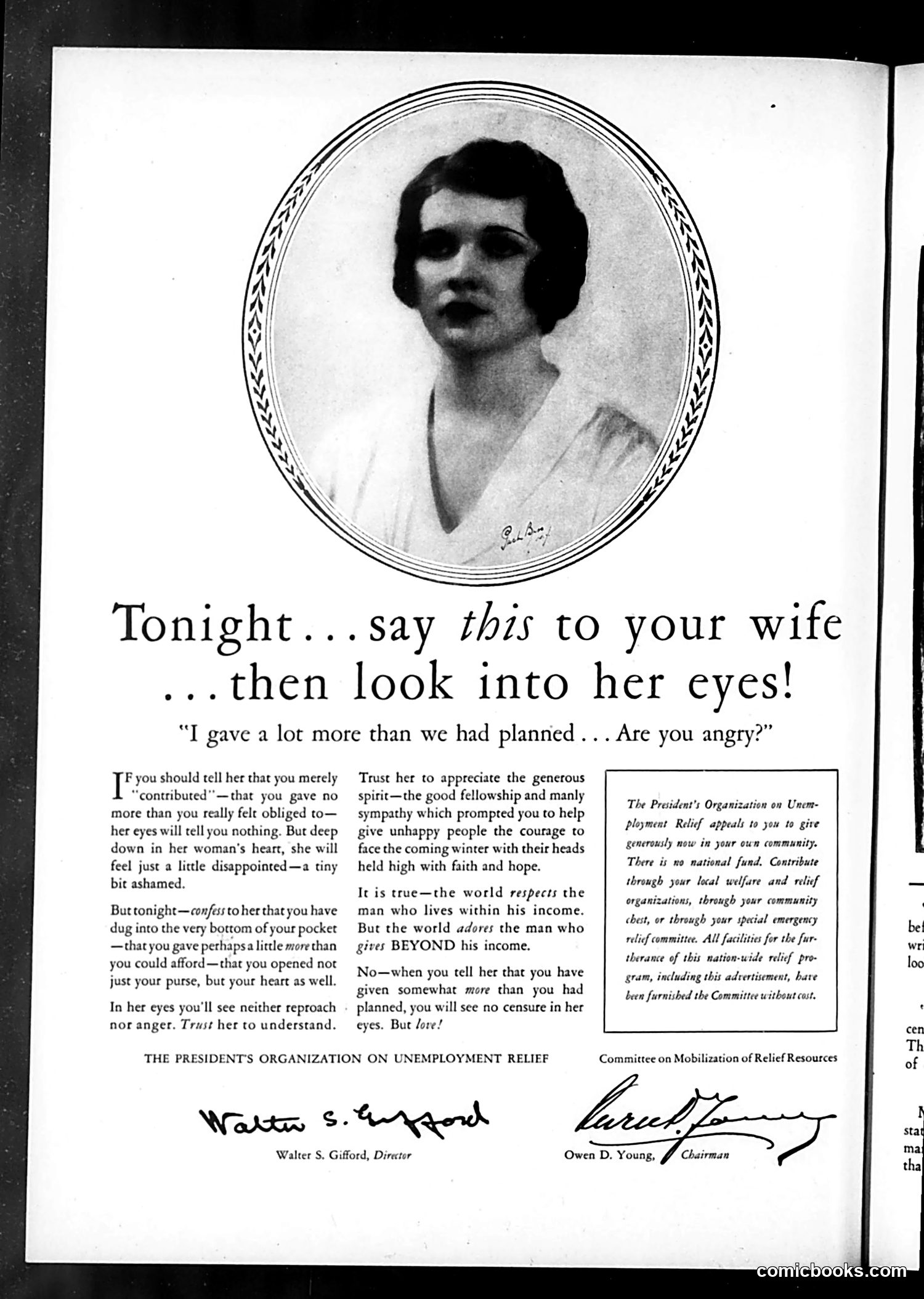
# Advertisement for Unemployment Relief, circa 1930s This is a **public service advertisement** rather than political satire. It features an oval portrait photograph of a woman and appeals to male readers to donate generously to unemployment relief. The ad's emotional argument: Tell your wife you've given "more than we had planned" to relief efforts. The text suggests that wives will respect husbands who give beyond their means, seeing this as moral generosity rather than financial irresponsibility. Signed by **Walter S. Gifford** (Director) and **Owen D. Young** (Chairman) of the President's Organization on Unemployment Relief, this reflects **Depression-era fundraising** that emphasized patriotic duty and masculine honor to motivate charitable donations during severe economic crisis.
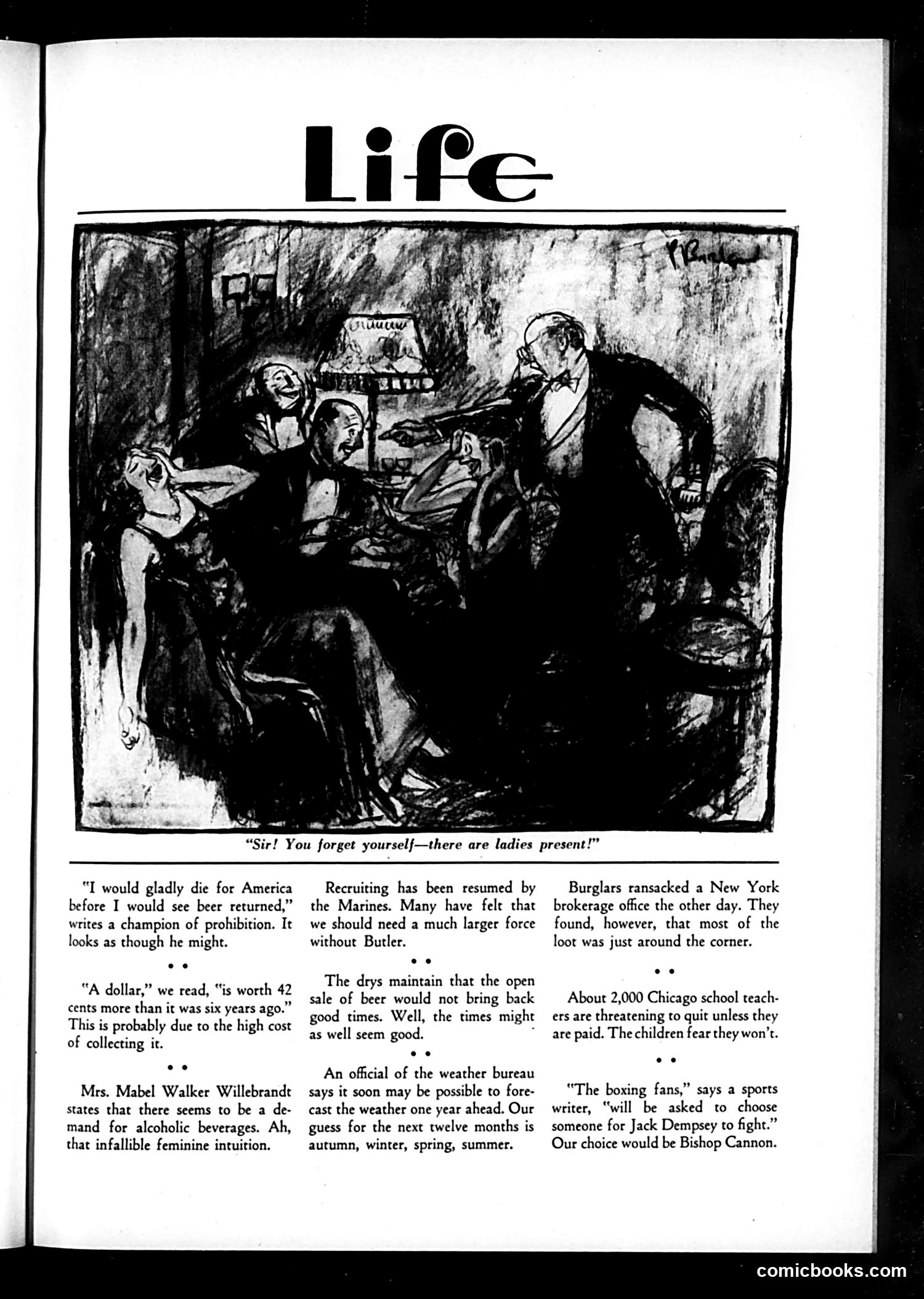
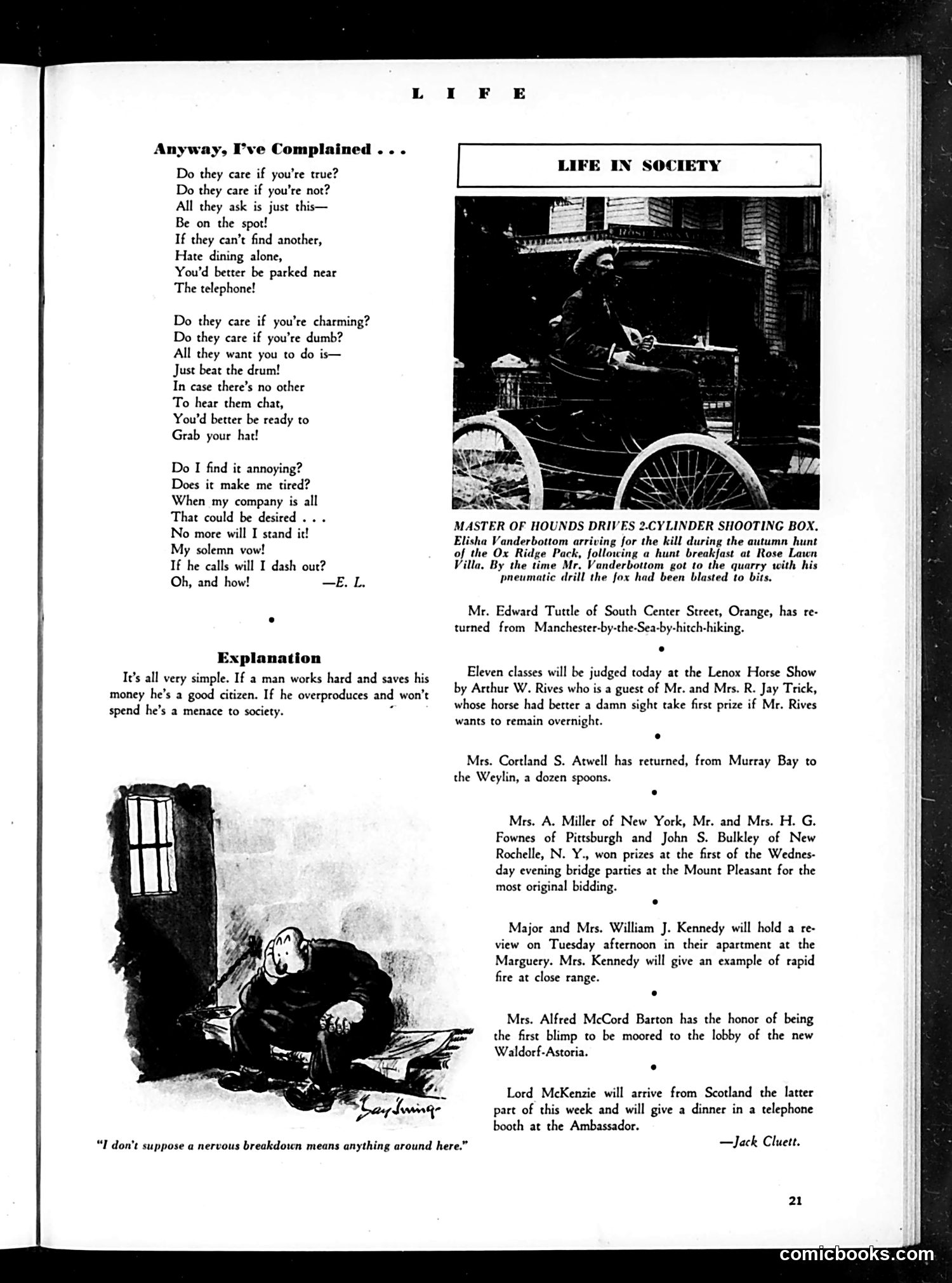
# Life Magazine Satire Page Analysis This page contains a sketch and several brief satirical news items typical of Life magazine's humor format. **The Cartoon:** Shows a formal gathering where a man is gesturing animatedly while others (including women) are present. The caption "Sir! You forgot yourself—there are ladies present!" suggests he's made an improper remark or displayed crude behavior in mixed company—satirizing violations of early 20th-century social etiquette standards. **The News Items** mock various contemporary issues: - Prohibition advocacy (drinking beer) - Economic inflation (dollar value declining) - Weather forecasting unreliability - School teacher labor disputes - Marine recruitment needs - Crime and burglary - Boxing entertainment choices These brief quips exemplify Life's satirical approach to current events and social commentary.
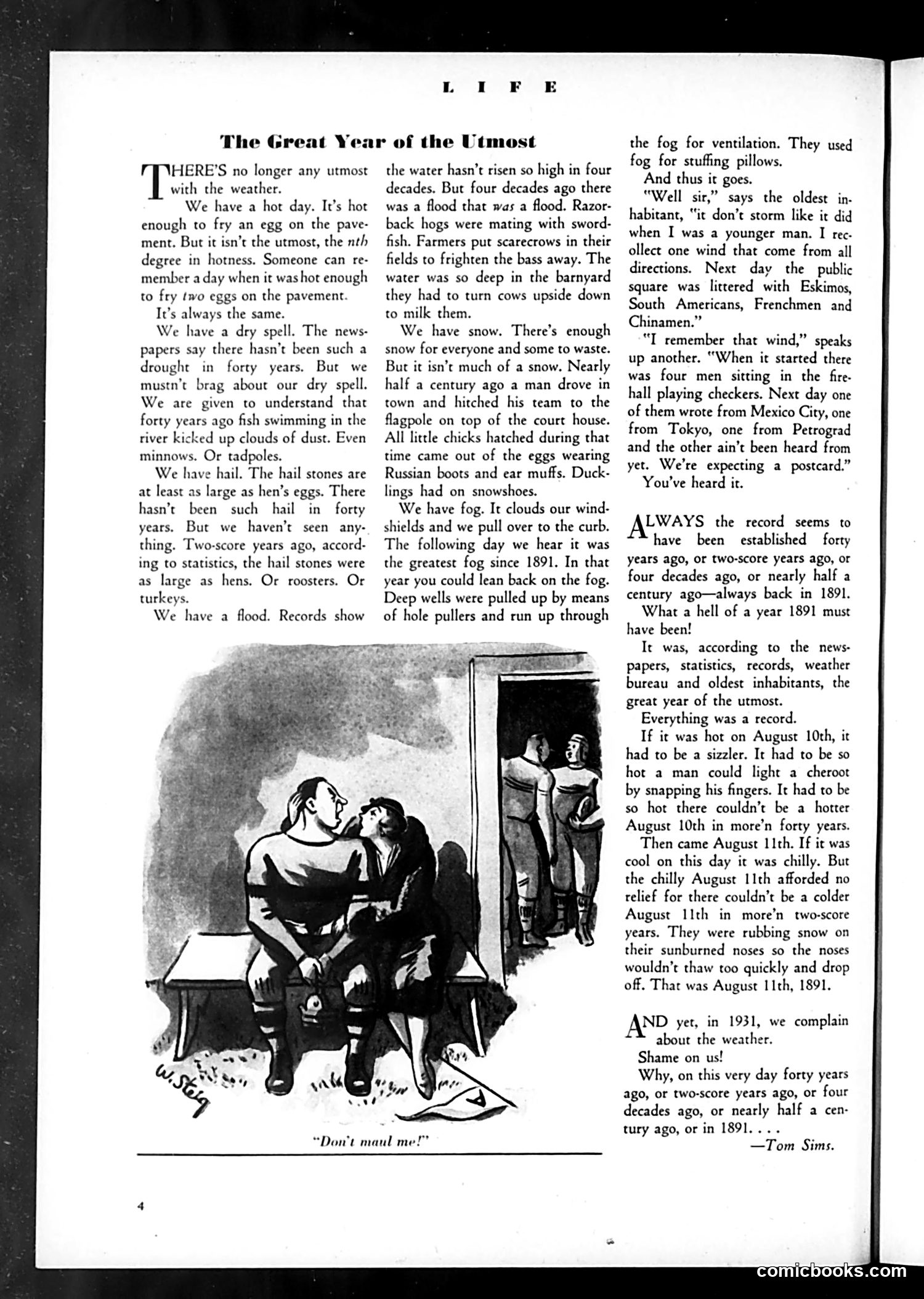
# "The Great Year of the Utmost" - Life Magazine Satire This article by Tom Sims satirizes extreme weather claims and record-breaking obsession in 1931. The piece mocks how every weather event gets called "the worst in forty years"—a recurring exaggeration. The cartoon shows two people indoors during oppressive heat, with one saying "Don't maul me!" The illustration contrasts indoor discomfort with the article's theme: people complaining about weather despite living through relatively ordinary conditions. Sims argues that Americans shamefully grumble about 1931's weather while referencing the supposedly unprecedented "Great Year of the Utmost" from 1891—implying modern complaints pale compared to historical extremes, or that record-chasing narratives are inherently unreliable. The satire targets both media sensationalism and public amnesia about actual past hardships.
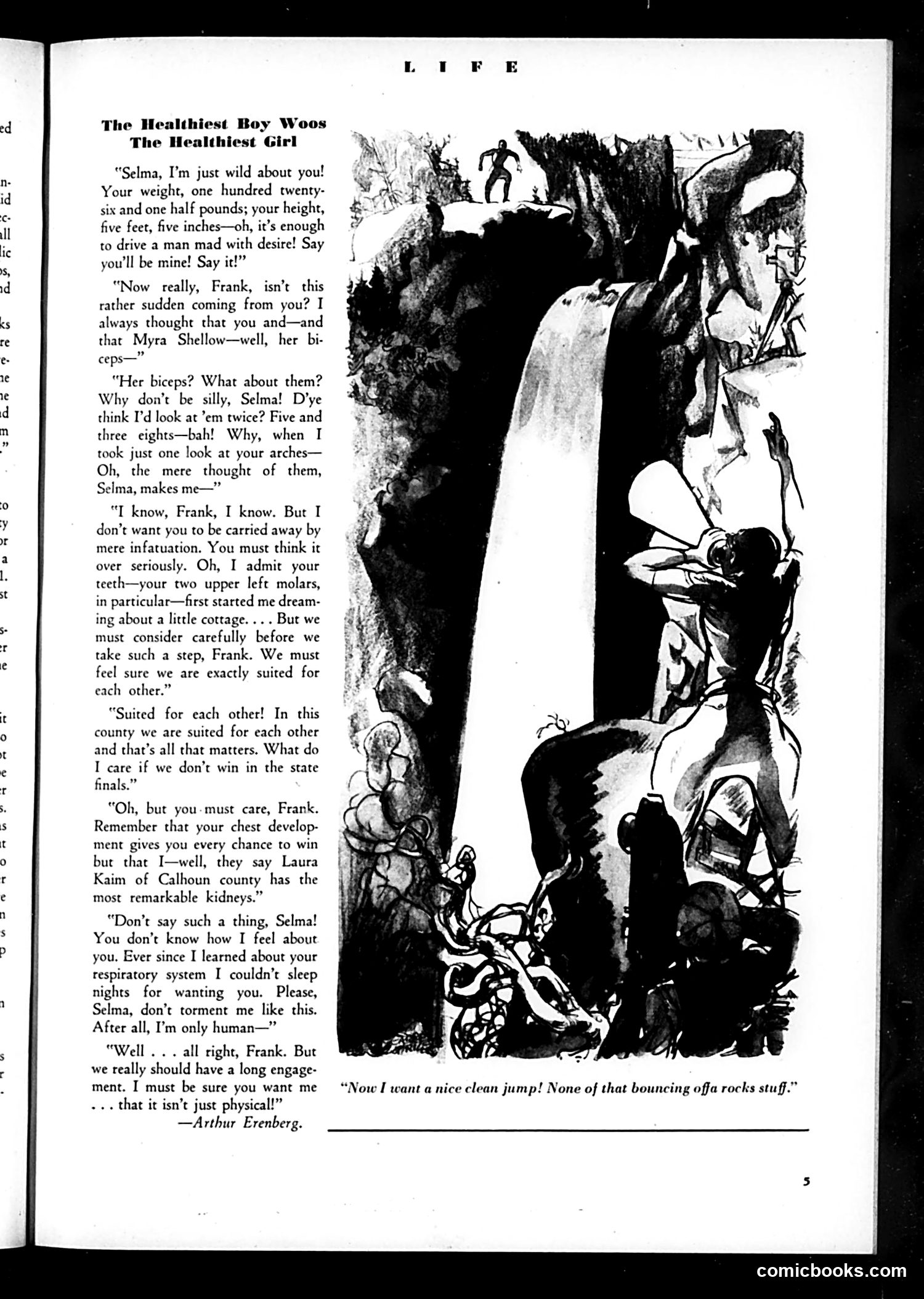
# "The Healthiest Boy Woos The Healthiest Girl" This appears to be a satirical romantic dialogue between two young people obsessed with physical fitness and health metrics. Frank boasts about his measurements (126.5 pounds, 5'5", muscular development), while Selma counters with her own physical attributes—her biceps and notably her kidneys, which she claims are "the most remarkable" in Calhoun county. The satire targets early 20th-century health-obsession culture, where physical fitness and organ function became romantic selling points. The couple's discussion of kidneys, respiratory systems, and chest development as desirable traits mocks the era's pseudo-scientific health movements and the reduction of human attraction to measurable bodily attributes. The illustration shows them hiking, reinforcing the "healthy lifestyle" theme.
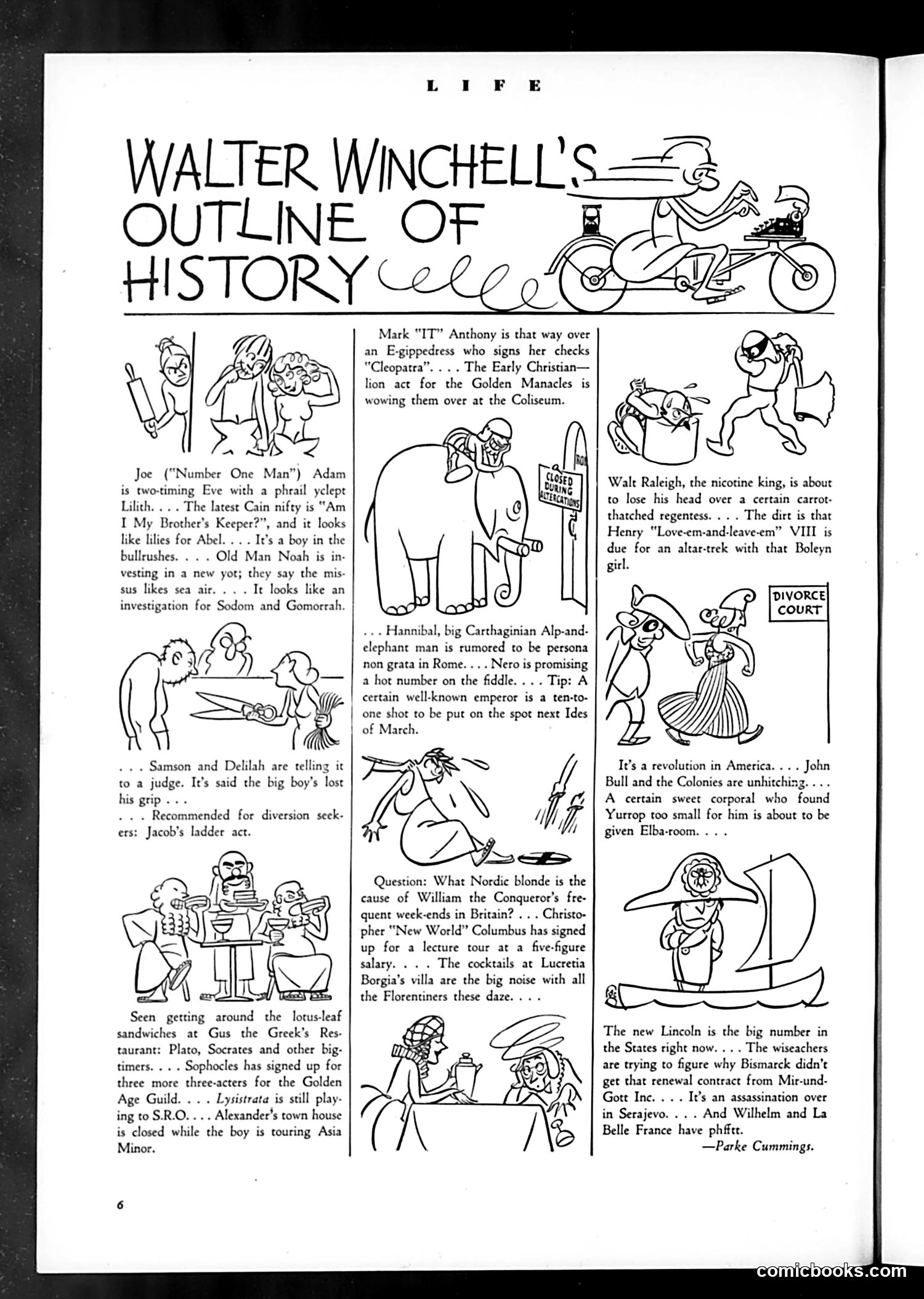
# Walter Winchell's Outline of History This is a humorous satirical column by Parker Cummings that uses cartoons to mock historical figures and contemporary celebrities through absurdist comparisons. The format pairs famous historical moments with modern (1920s-30s) gossip and scandals. For example, it compares Adam and Eve to contemporary figures, references Mark Anthony and Cleopatra alongside modern celebrities, and mocks historical figures like Hannibal, William the Conqueror, and Christopher Columbus. The column concludes with topical references to American politics (John Bull and the Colonies), and contemporary entertainment/scandal involving figures like Lincoln (likely a film), Bismarck, and others. The satire suggests history simply repeats through different scandals and human foibles—both ancient and modern tragedies boil down to similar moral failures and gossip.
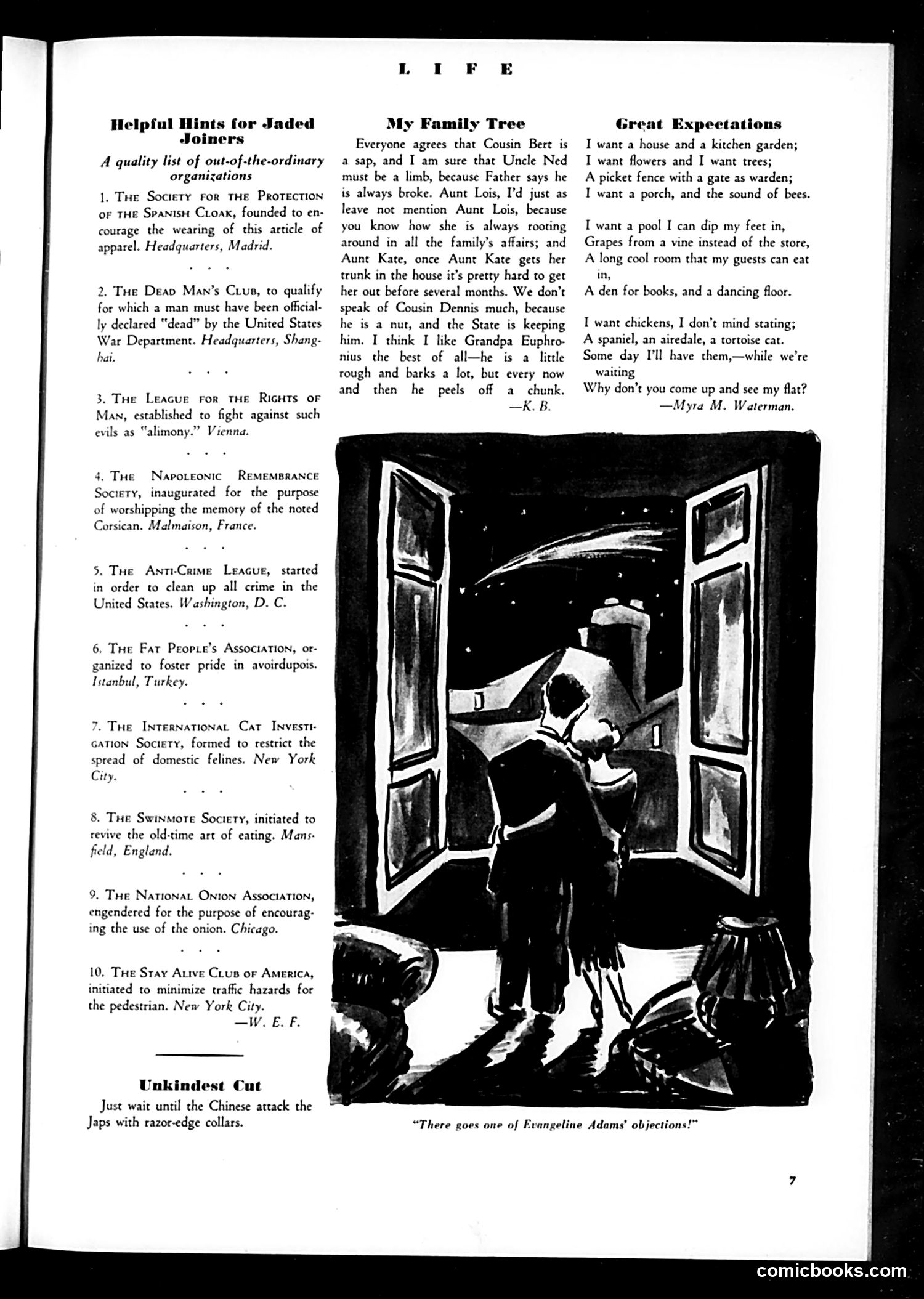
# Analysis of Life Magazine Page 7 The main illustration shows a figure looking out a window at night, with the caption "There goes one of Evangeline Adams' objections!" This references **Evangeline Adams**, a famous early 20th-century astrologer whose predictions were widely publicized and often mocked. The left column contains satirical "helpful hints" listing absurdist fictional organizations (the Society for Protection of Spinsters, Dead Man's Club, etc.)—pure satire poking fun at America's proliferation of niche clubs and organizations. The poem "Great Expectations" and "My Family Tree" offer gentle domestic humor about wanting a home, garden, and various pets, with comedic family member descriptions. The cartoon likely jokes that something Adams predicted (possibly about fate or destiny) has now ironically come to pass, mocking both astrology and celebrity prediction culture.
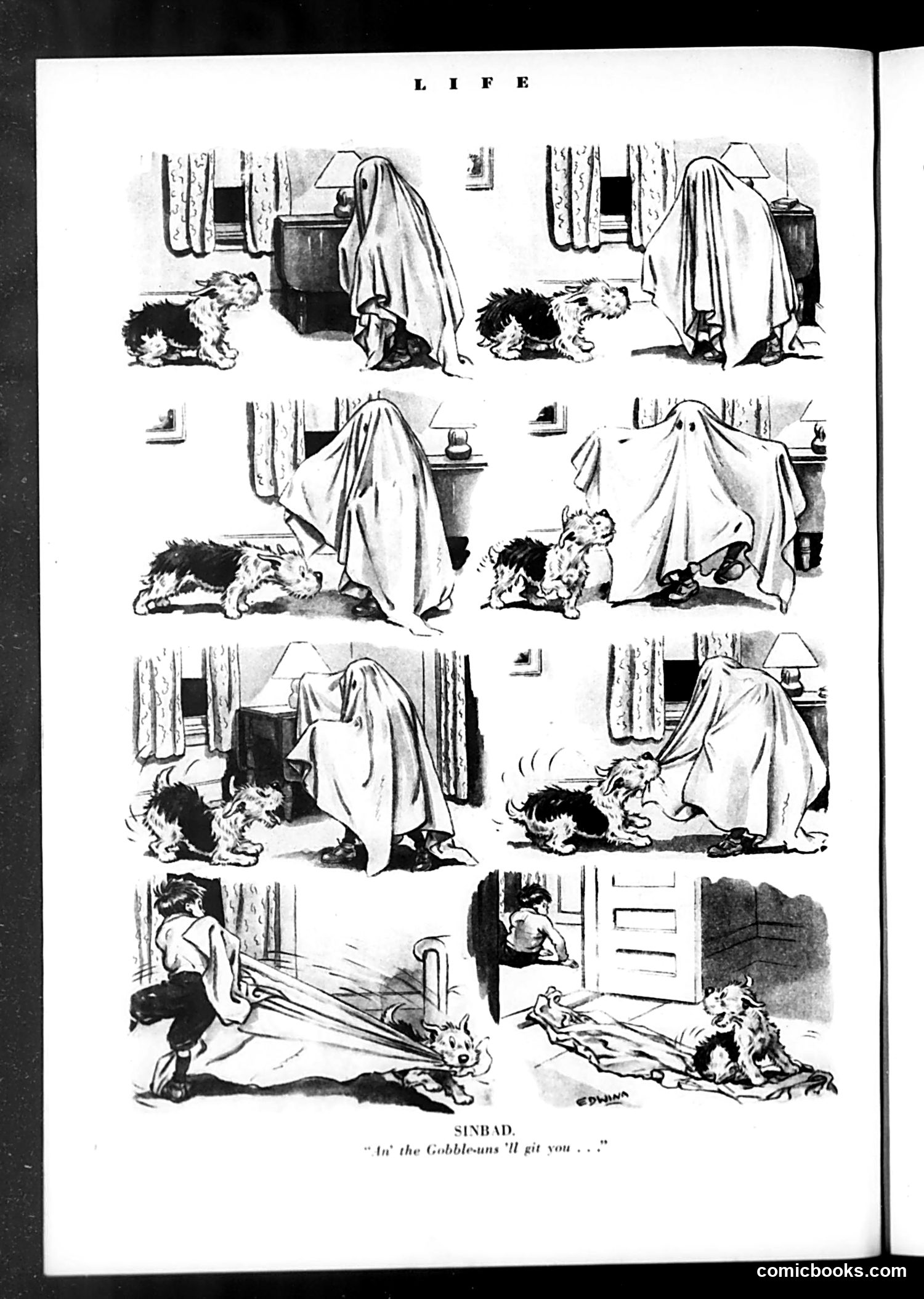
# "Sinbad" Comic Strip Analysis This appears to be a humorous multi-panel strip titled "Sinbad" with the caption "In the Goblin's I'll git you..." The narrative shows a cloaked figure (the "Goblin") pursuing a small character through a domestic interior, progressing from bedroom scenes through hallways and finally outdoors. The strip plays on the familiar trope of a threatening supernatural pursuer chasing an increasingly panicked victim. The humor derives from the contrast between the goblin's menacing intent and the domestic, mundane setting—a bedroom with curtains and lamps. The escalating chaos and the victim's visible fear create slapstick comedy. The reference to "Sinbad" (the legendary sailor) appears ironic, as this is domestic comedy rather than exotic adventure. This represents typical early 20th-century American satirical comic humor blending supernatural folklore with everyday domestic life.
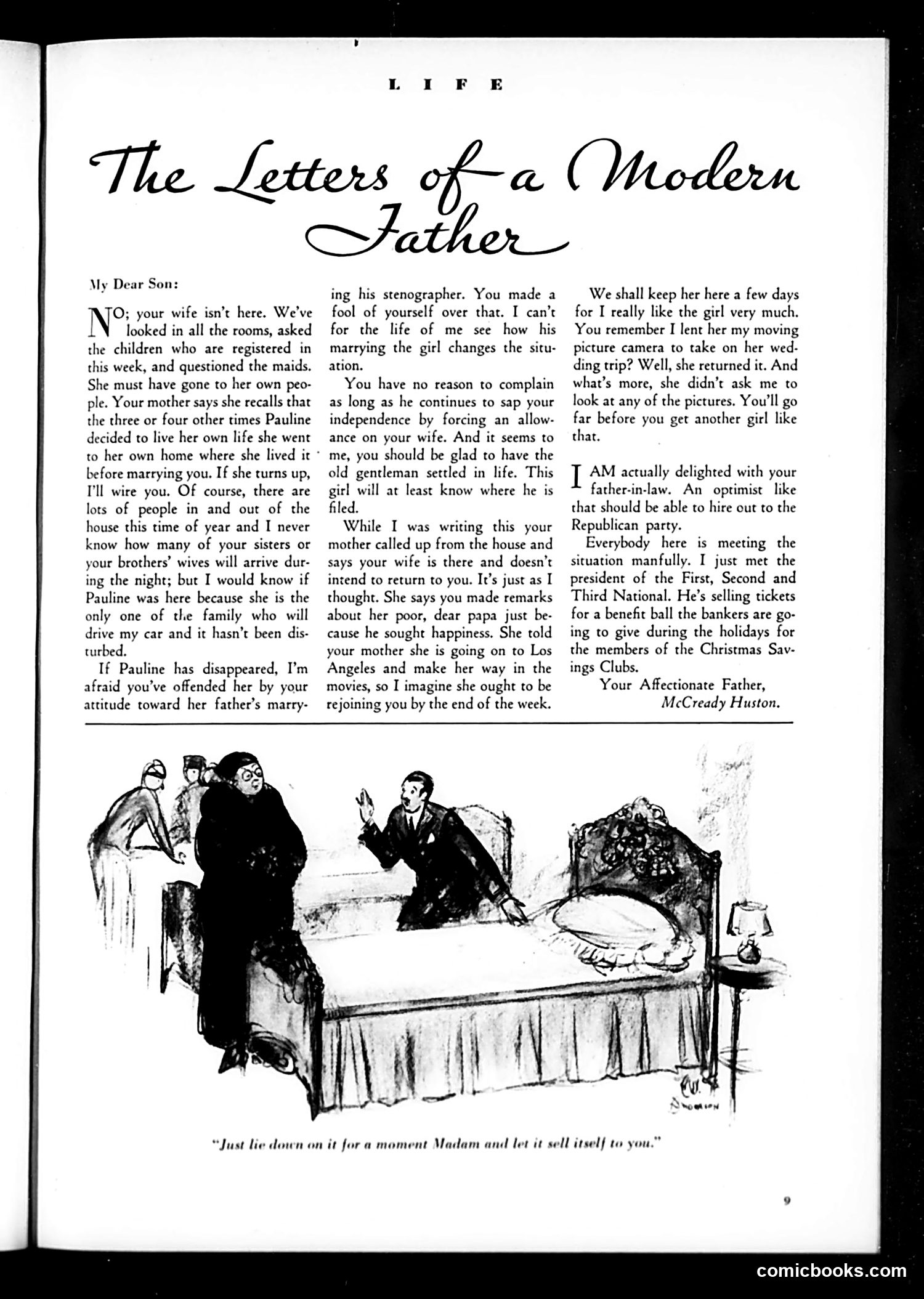
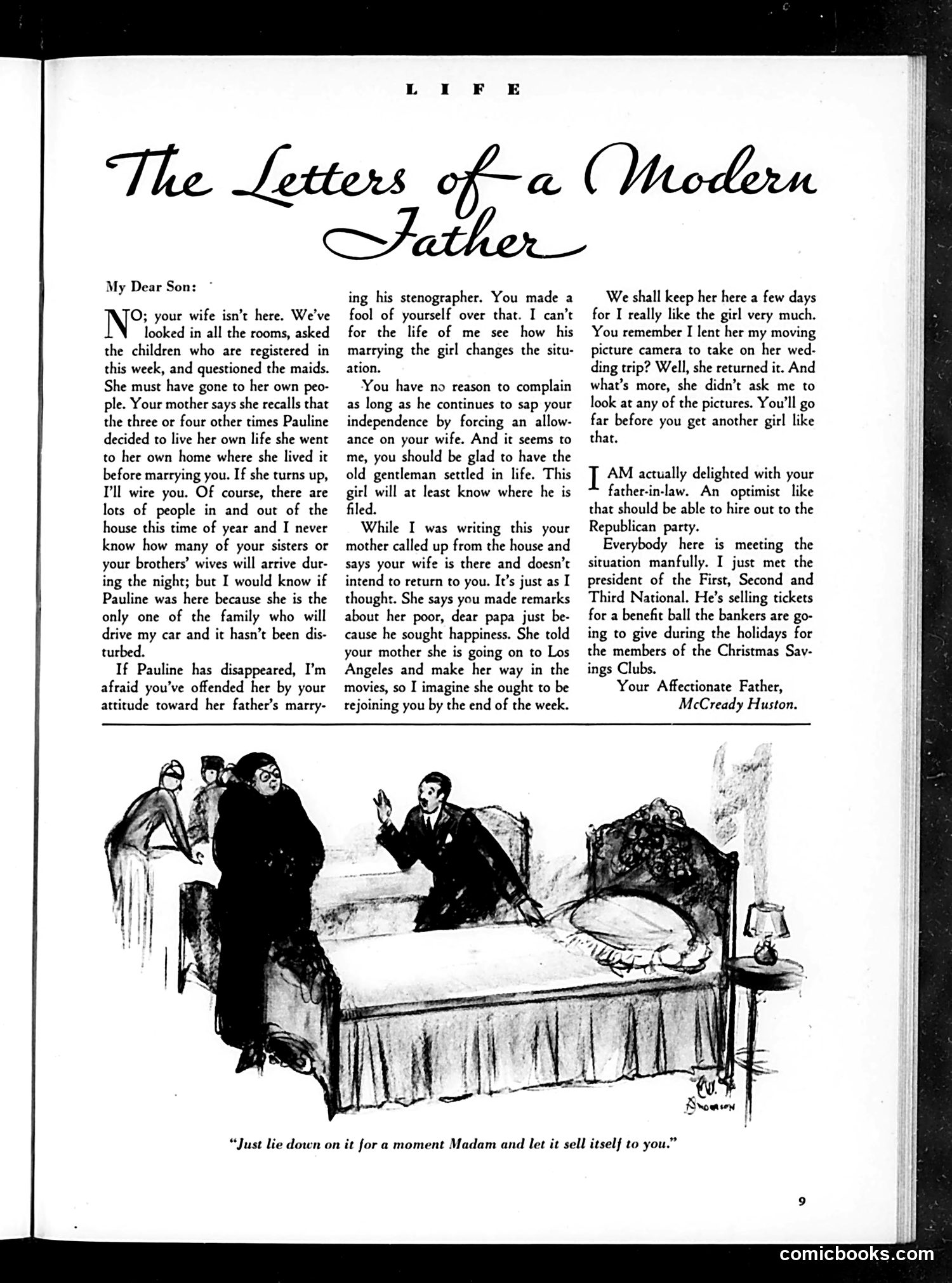
# "The Letters of a Modern Father" This satirical piece mocks upper-class family dysfunction. A father writes to his absent son about his wife's disappearance—she's apparently left him, possibly to pursue a film career in Los Angeles. The satire targets the son's marriage to a girl the father-in-law dislikes, and the wife's discontent with her restricted domestic role. The cartoon illustrates the chaos: a woman lies in bed while men gather around, suggesting marital or health crisis. The caption, "Just lie down on it for a moment Madam and let it sell itself to you," appears to reference furniture sales or advertising. The piece critiques modern marriage instability, women's dissatisfaction with traditional roles, and wealthy families' social pretensions—common themes in Life's social satire.
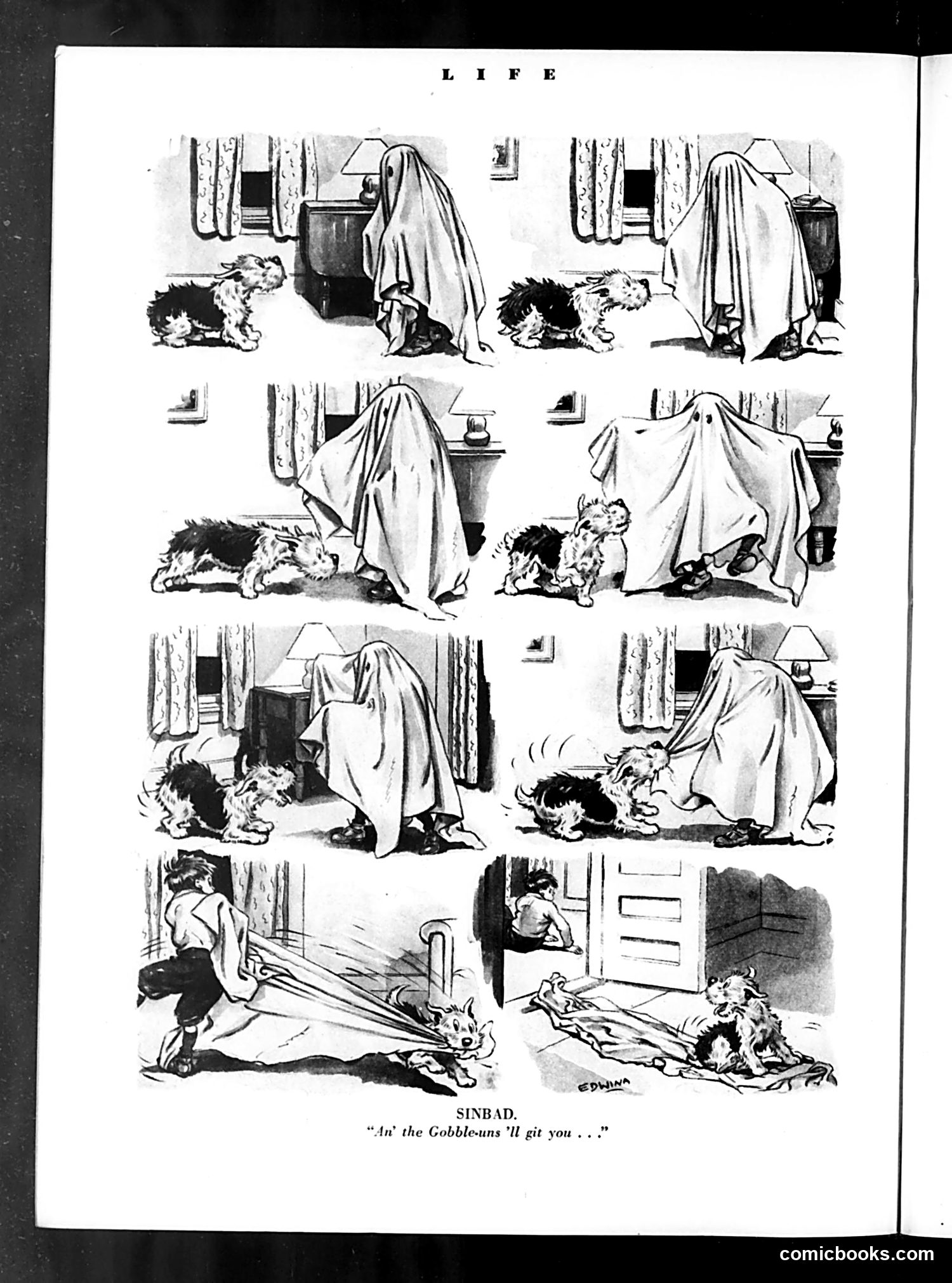
# Analysis of "Sinbad" Cartoon This is a humorous comic strip sequence titled "Sinbad" with the caption "An' the Gobbleuns 'll git you..." The strip depicts a woman (likely a mother or caregiver) using a classic parenting threat to frighten small children into obedience. In each panel, she dramatically drapes fabric over herself while children cower in fear, apparently believing she's a monster or supernatural creature. The final panels show the children fleeing in terror. The humor derives from the relatable domestic scenario: using scary tales and theatrical threats to discipline misbehaving children—a common parenting tactic of the era. The reference to "Gobbleuns" (likely from James Whitcomb Riley's poem "Little Orphant Annie") reinforces the folk-tale, bedtime-story quality of the threat. The satire gently mocks both parental discipline methods and children's gullibility.