A complete issue · 36 pages · 1931
Life — July 24, 1931
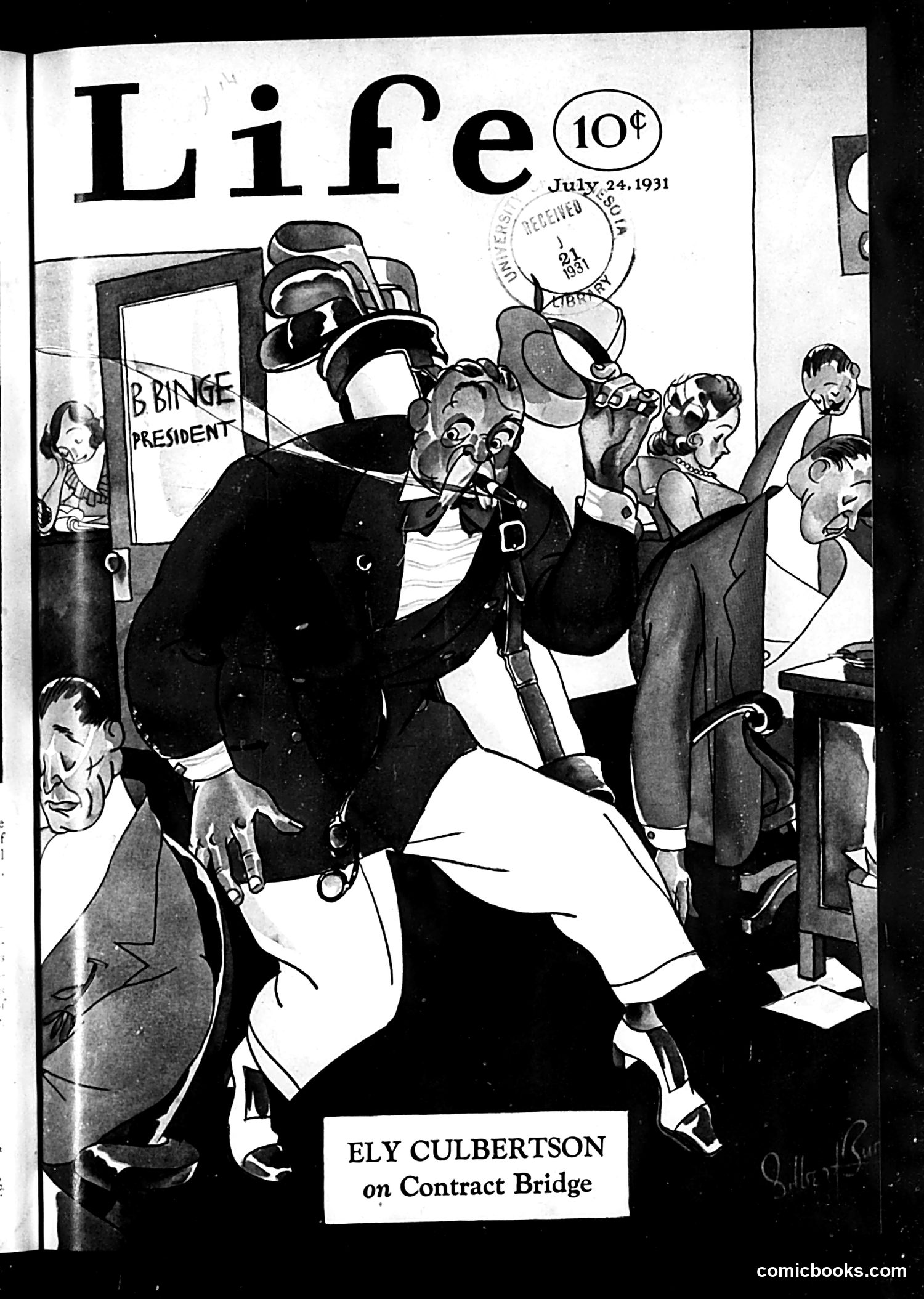
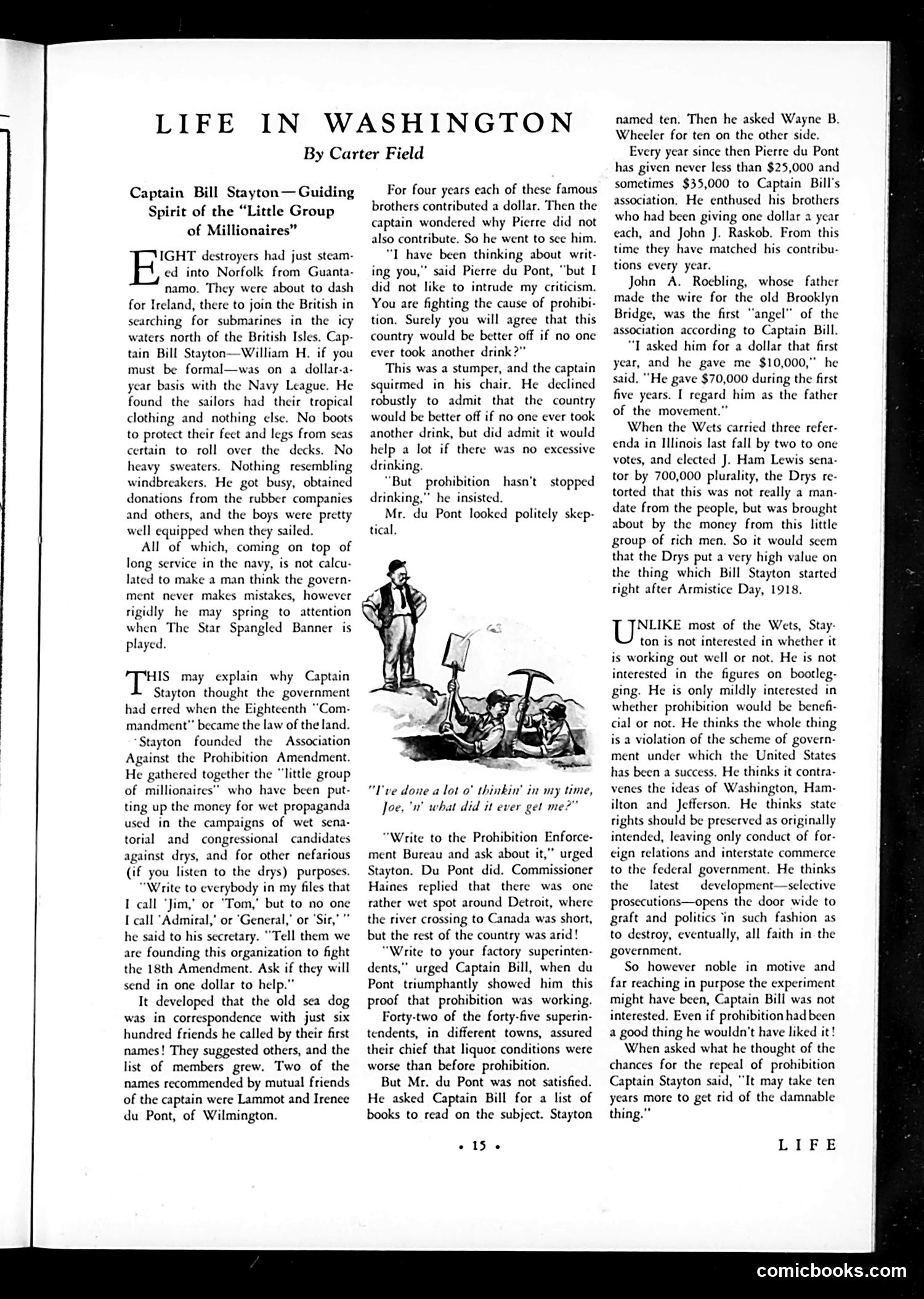
# Life Magazine Cover Analysis - July 24, 1931 This **Life** cover satirizes **Ely Culbertson** and the craze surrounding **Contract Bridge**, a newly popular card game variant in the 1930s. The illustration depicts Culbertson as a large, dominating figure bursting into what appears to be a presidential office (marked "BINGE PRESIDENT"), physically overwhelming the occupants. The exaggerated, almost violent entrance suggests how obsessively Americans were adopting Contract Bridge—the game had become such a cultural phenomenon that it was metaphorically "crashing" into even the highest levels of society. Culbertson, a famous bridge player and promoter, is caricatured as the driving force behind this social mania. The satire mocks both the game's popularity and Culbertson's role in making bridge-playing a national obsession during the Depression era.
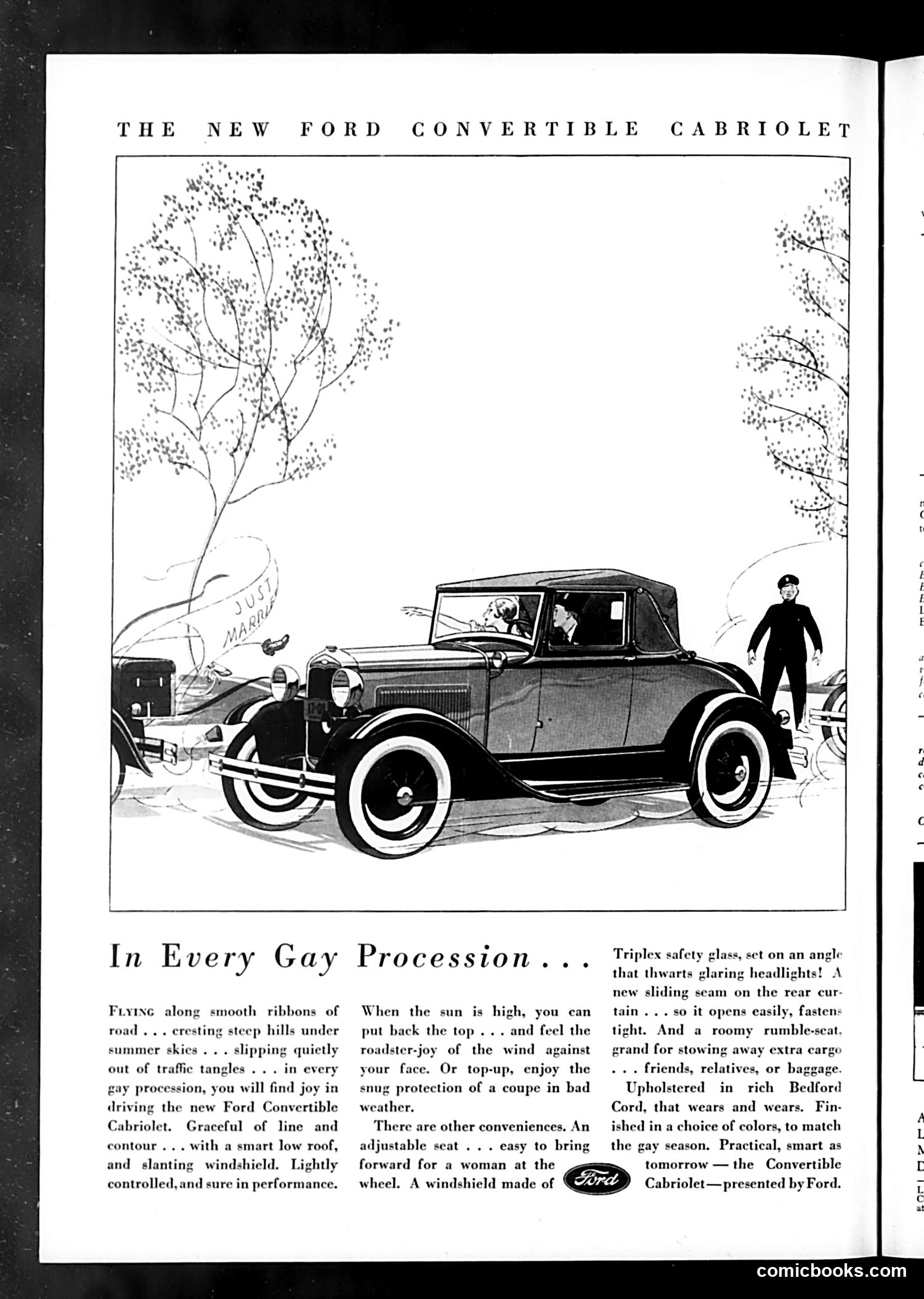
# Analysis This is an **advertisement** for the Ford Convertible Cabriolet, not political satire or a cartoon. The page presents an idealized sketch of the vehicle in a leisure scene—a convertible parked near a tree with well-dressed figures nearby, suggesting recreational driving. The ad text emphasizes the car's appeal to modern, affluent consumers: smooth highways, open-air comfort ("roofless-joy"), practical features (adjustable seat, windshield, cargo space), and aesthetic design ("choice of colors"). The headline "In Every Gay Procession..." uses "gay" in its original sense meaning cheerful and lighthearted, reflecting 1920s-1930s advertising language. The overall message positions the Ford Cabriolet as a stylish, dependable choice for leisure driving—targeting middle-to-upper-class buyers seeking both practicality and social status.
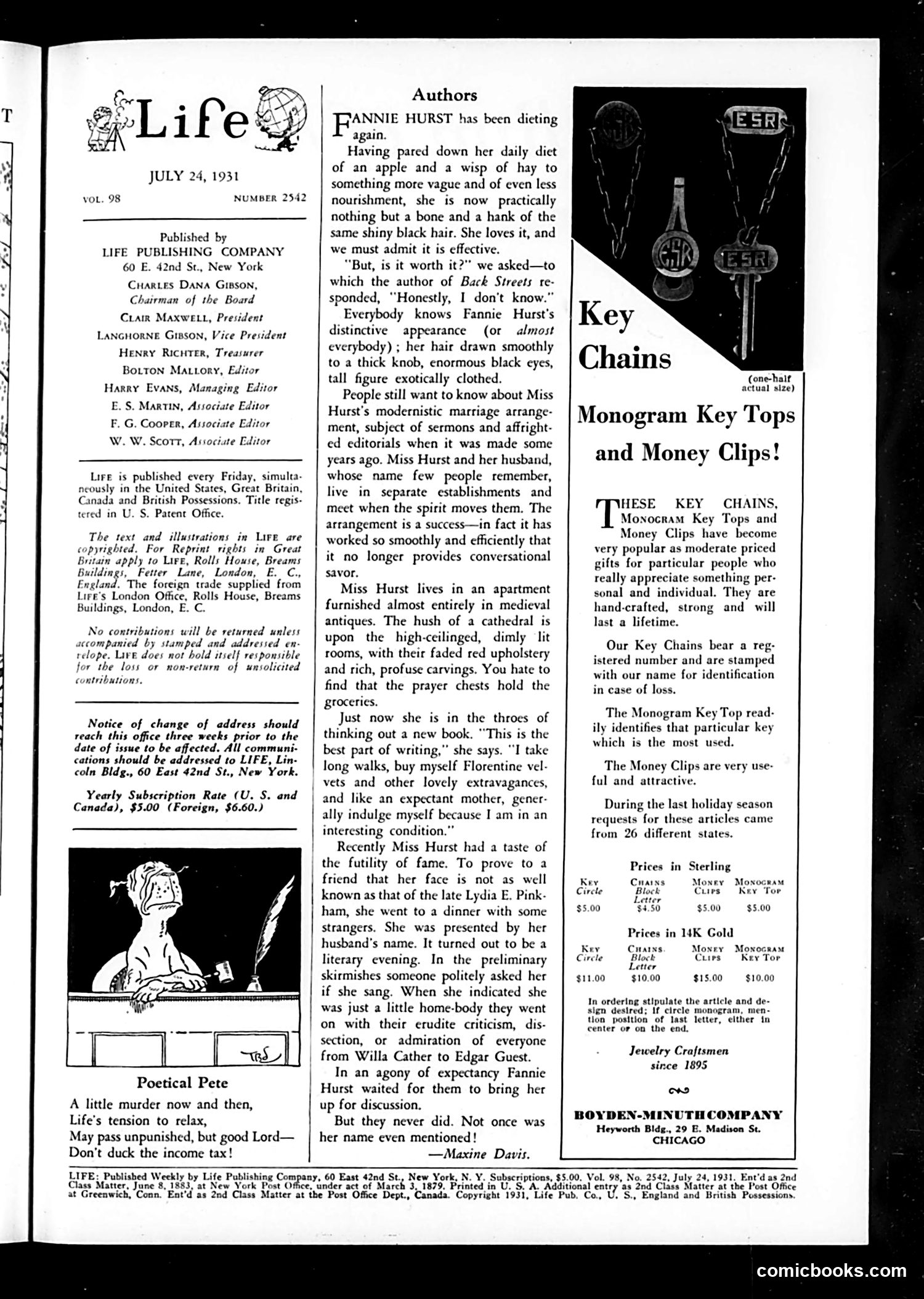
# Analysis of Life Magazine, July 24, 1931 This page is primarily **advertising and editorial content** rather than political satire. The main feature is an "Authors" section profiling **Fannie Hurst**, a novelist known for *Back Street*. The text describes her distinctive appearance (dark hair, black eyes) and her unconventional marriage arrangement—she and her husband maintained separate residences and only met "when the spirit moves them." The right side advertises **"Key Chains, Monogram Key Tops and Money Clips"** from the Boyden-Mesthcowpany in Chicago—luxury items marketed as gifts for people of refinement. At bottom left is a brief humorous poem titled **"Poetical Pete,"** making a light joke about murder and income taxes—typical of Life's satirical style, though unrelated to the main content. This reflects 1931 consumer culture and literary society rather than political commentary.
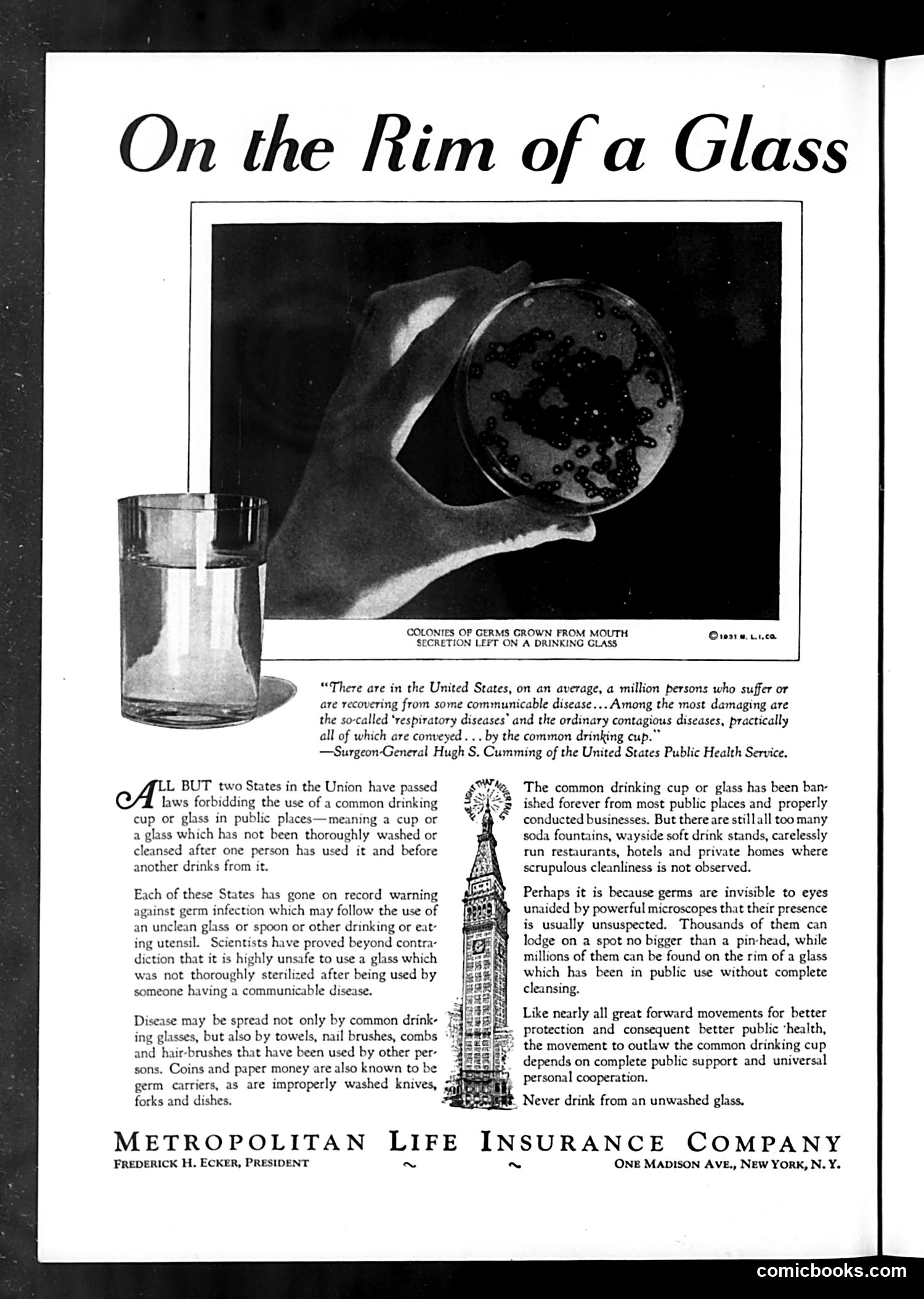
# On the Rim of a Glass This is a public health advertisement by Metropolitan Life Insurance Company warning against sharing drinking glasses. The dramatic photograph shows a hand holding a glass with visible bacterial colonies grown from mouth secretion—a scientific visualization meant to shock viewers. The text cites Surgeon General Hugh S. Cumming regarding communicable diseases spread through common drinking cups. The ad notes that only two U.S. states had banned public drinking glasses, though many establishments still used them unsafely. The message was straightforward health advocacy: germs are invisible but deadly, and shared drinking glasses spread diseases like respiratory infections and contagious illnesses. The appeal to "complete public support and universal personal cooperation" urged readers to reject the common drinking cup entirely—a practical public health campaign presented through dramatic visual evidence.
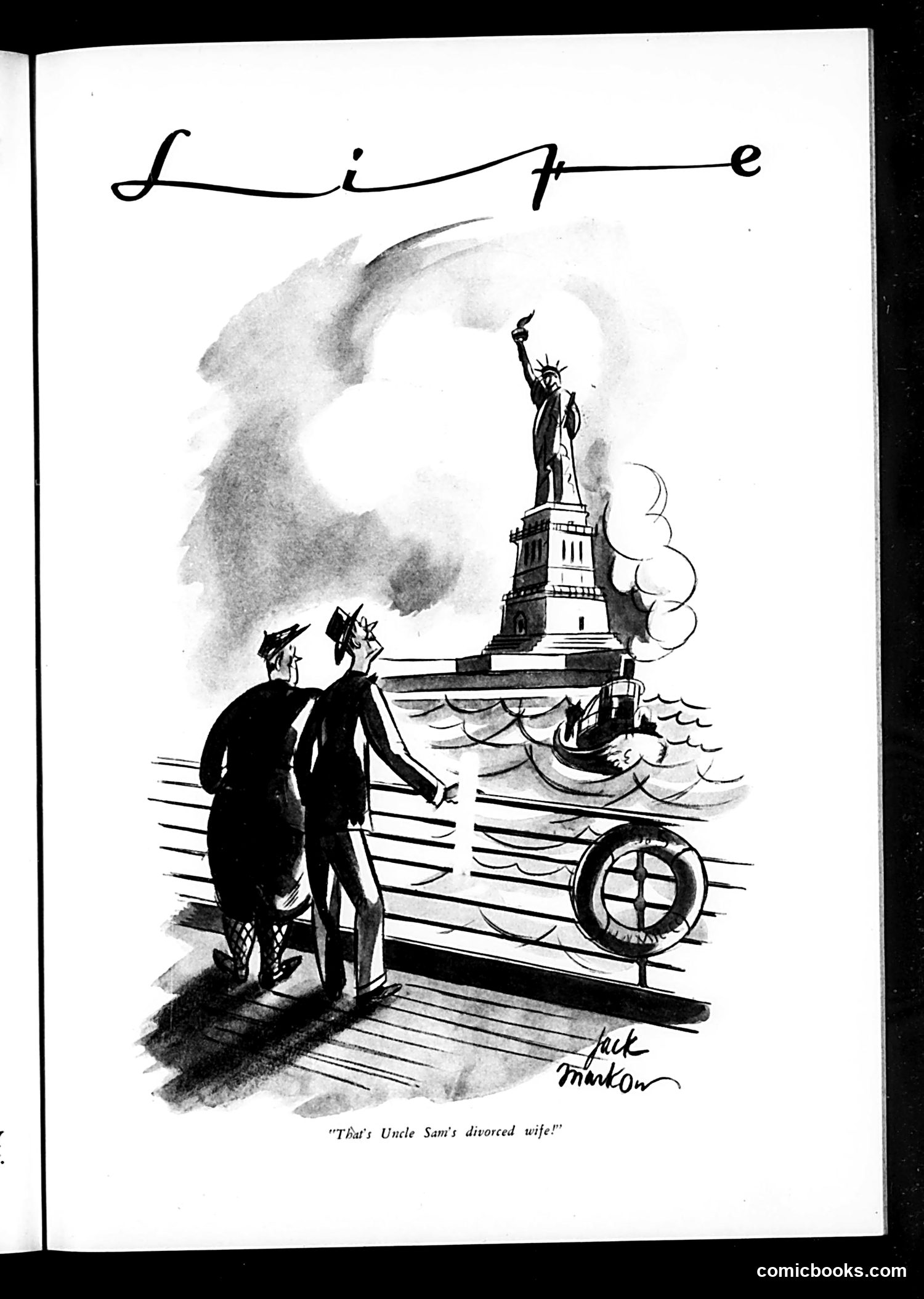
# Analysis This political cartoon by Jack Markow depicts two men in formal attire standing on a ship's deck, viewing the Statue of Liberty. The caption reads: "That's Uncle Sam's divorced wife!" The joke relies on personifying the United States government as "Uncle Sam" and Lady Liberty as his spouse. The cartoon appears to satirize a perceived disconnect between American ideals (represented by the Statue of Liberty's promise of freedom and welcome) and the actual policies or actions of the U.S. government at the time. By calling Liberty "Uncle Sam's divorced wife," the cartoonist suggests these ideals have been abandoned or rejected by the government itself—a commentary on hypocrisy between American founding principles and contemporary political practice. Without a specific date visible, the exact historical context remains unclear.
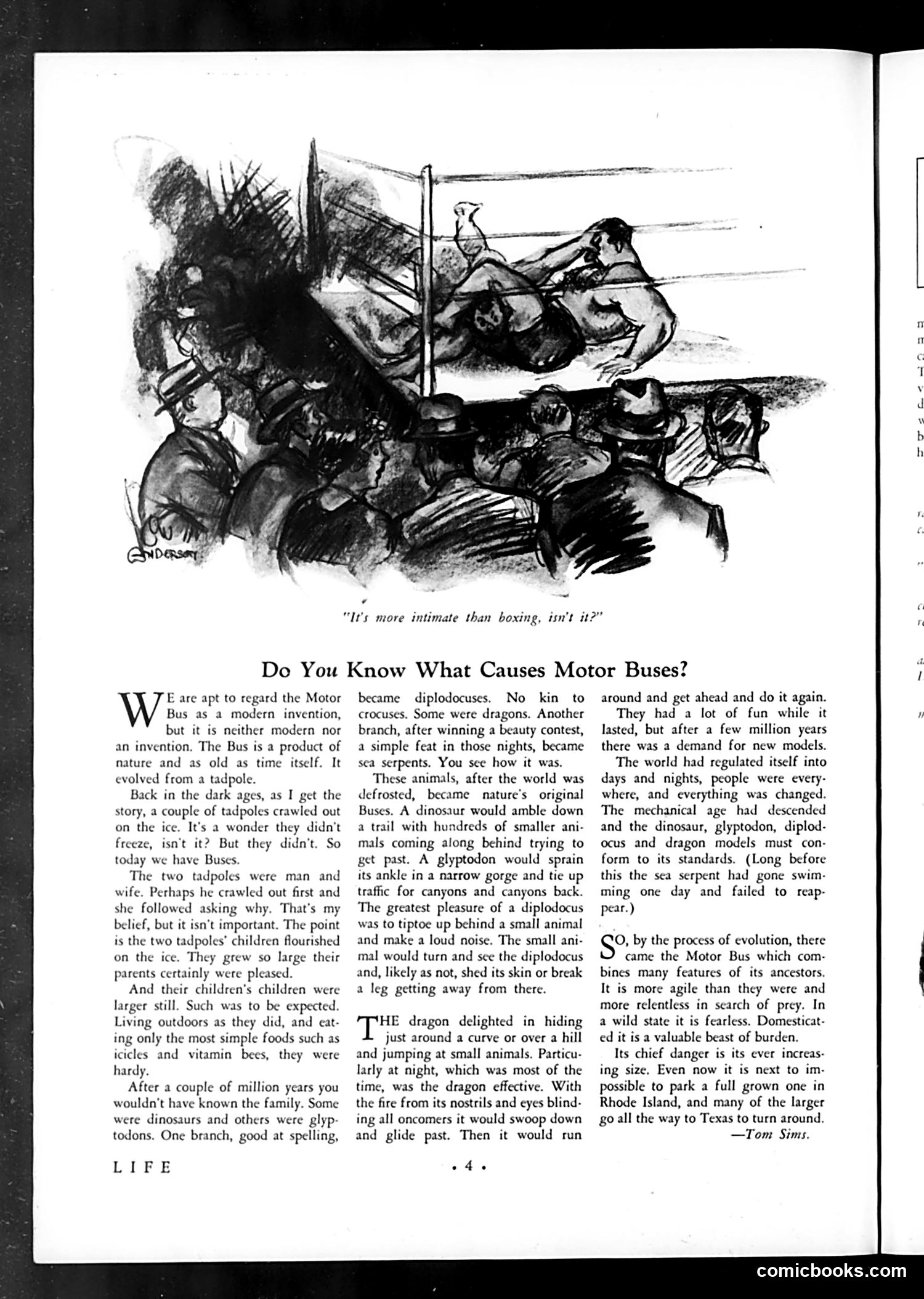
# "Do You Know What Causes Motor Buses?" — Life Magazine Satire This is a humorous satirical article using evolutionary theory as social commentary. The piece uses a fanciful origin story: motor buses allegedly descended from prehistoric creatures (diplodocuses, glyptodons, dragons) through evolutionary processes. The satire appears to mock the growing prevalence of motor buses in early 20th-century urban life—their size, power, and dangerous behavior toward pedestrians and smaller vehicles. By playfully attributing them to evolutionary descent from extinct monsters, the author satirizes how these new machines have become part of the urban landscape, viewing them as modern "beasts of burden" that are "fearless" and dangerous. The cartoon shows pedestrians and smaller vehicles encountering these large buses, capturing public anxiety about motorized transportation's rapid expansion.
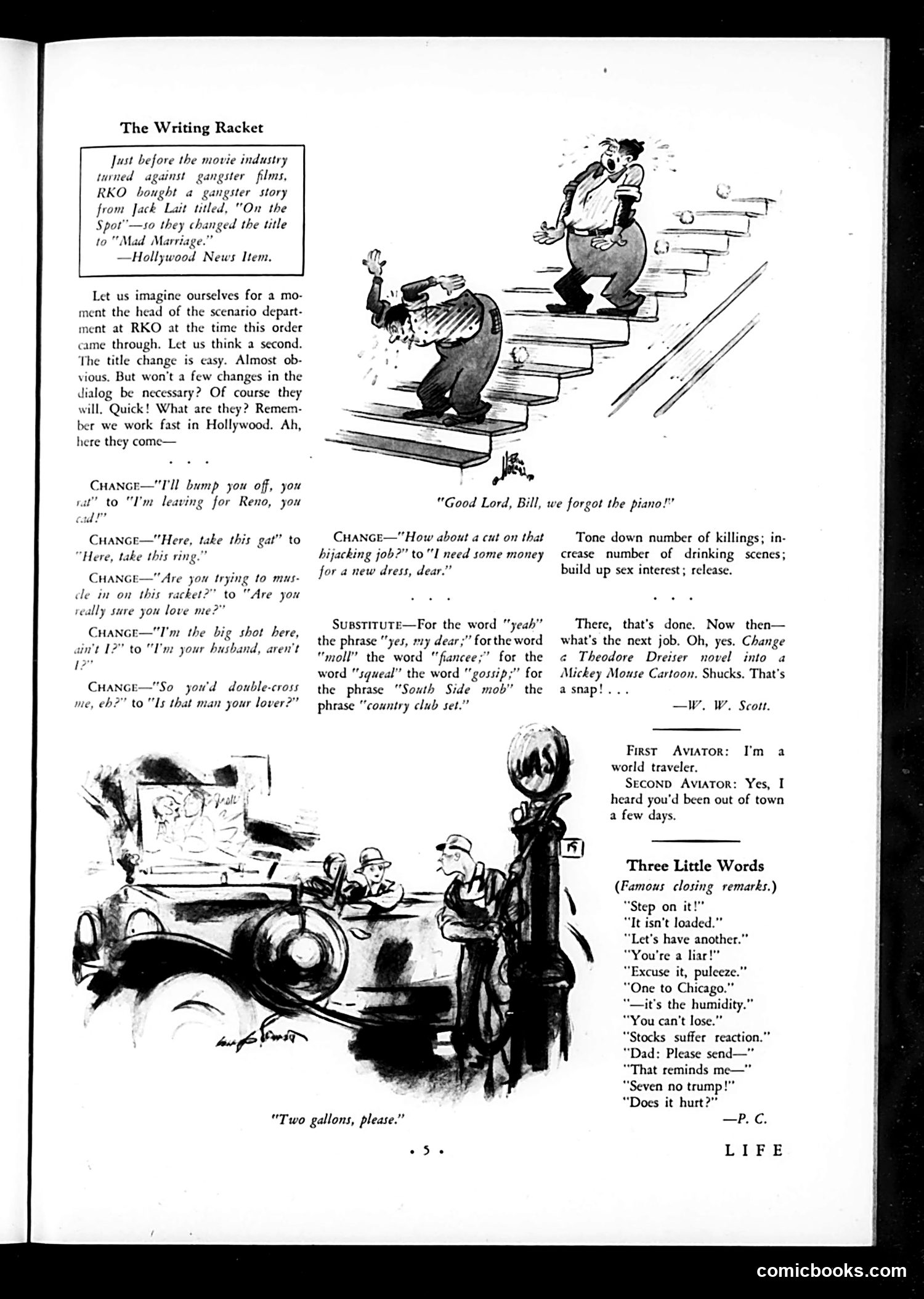
# Explanation for Modern Readers This page satirizes Hollywood's screenwriting process during the early studio era. The top section, titled "The Writing Racket," mocks how quickly studios rewrote scripts when censors objected—a real anecdote mentions RKO changing a title from "On the Spot" to "Mad Marriage" due to gangster-film restrictions. The dialogue examples show absurd substitutions editors forced writers to make: replacing "yeah" with "yes," sanitizing language, and toning down sexual content and violence to appease censors and moral watchdog groups. The cartoon illustrations humorously depict this process—writers literally climbing stairs while losing content, and a scene captioned "Two gallons, please" (unclear reference, possibly about studios' voracious script consumption). The page critiques how studio interference degraded creative work through arbitrary censorship demands.
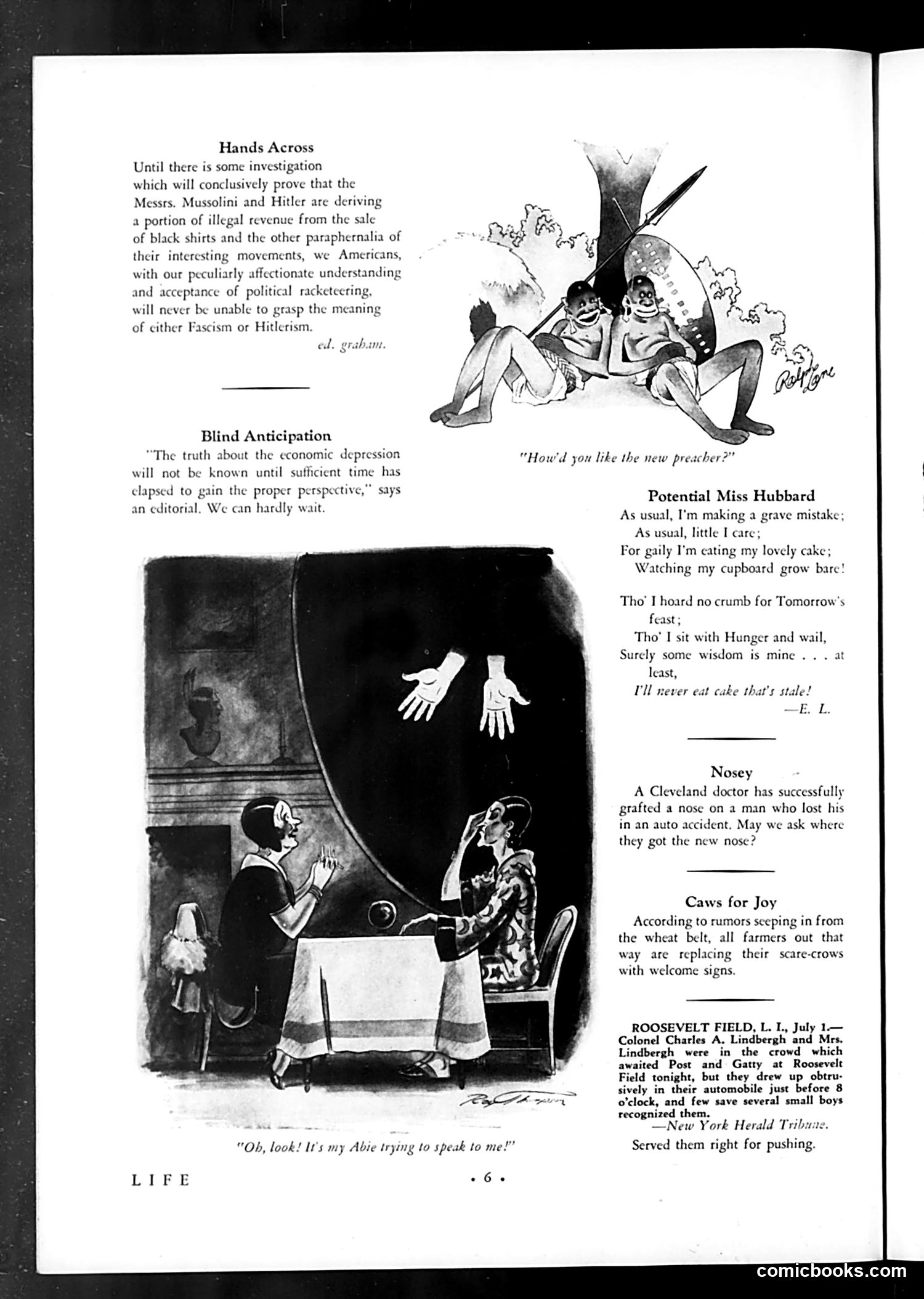
# Analysis of Life Magazine Page **Top Cartoon ("Hands Across")**: Two figures wearing what appear to be military/fascist regalia sit together, with one asking the other "How'd you like the new preacher?" This satirizes Mussolini and Hitler (as explicitly named in the accompanying text), suggesting they're profiting from illegal revenue through black shirts and other paraphernalia. The cartoon criticizes American indifference to understanding fascism and Hitlerism. **Bottom Cartoon ("Oh, look! It's my Abie trying to speak to me!")**: Shows a séance scene where a living person attempts to communicate with ghostly hands. This appears to be a supernatural/spiritualism joke, though the specific reference is unclear from the visible text. The page demonstrates Life's anti-fascist political stance during the pre-WWII era.
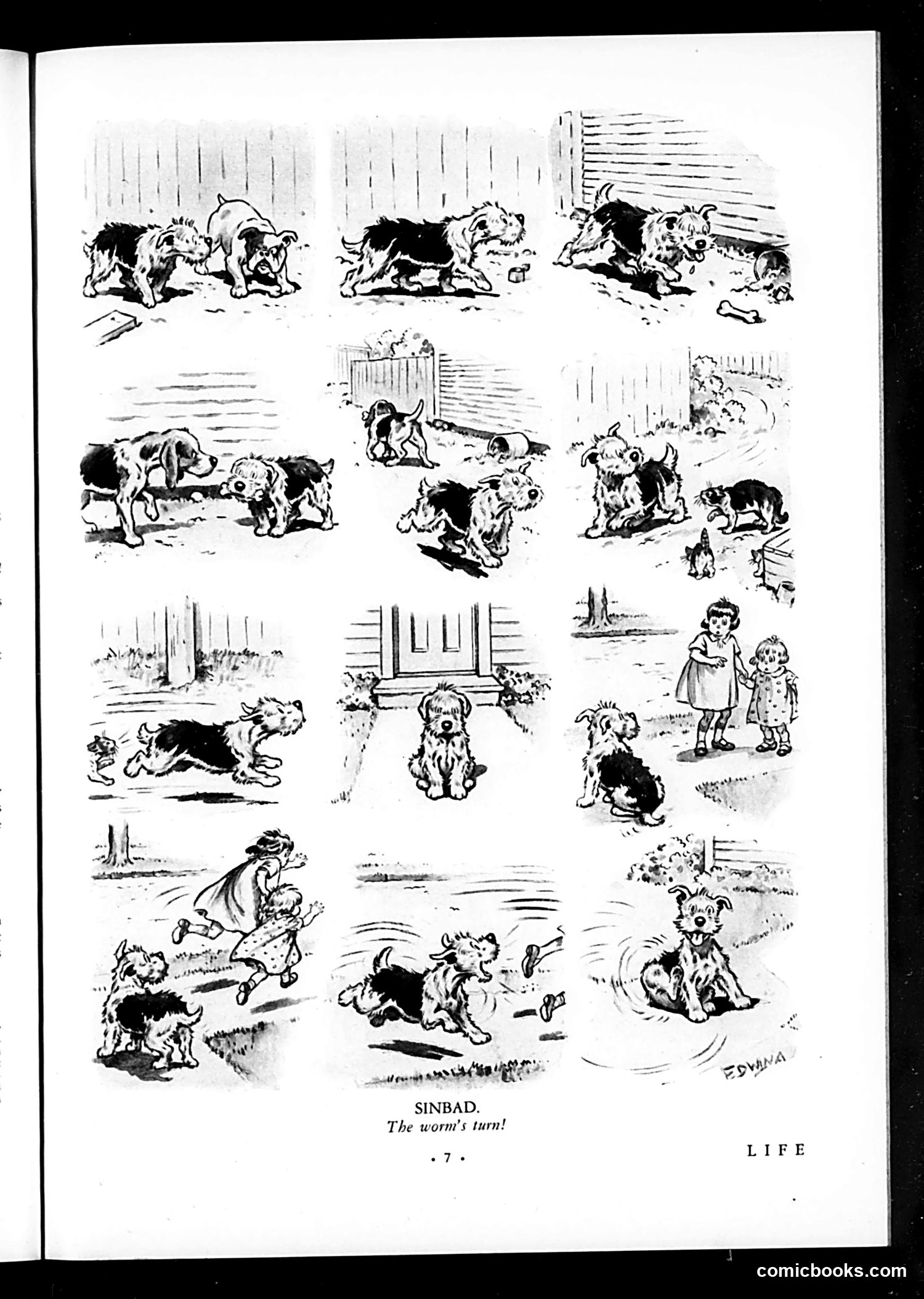
# "Sinbad: The Worm's Turn!" This is a humorous comic strip sequence showing dogs repeatedly chasing and tormenting what appears to be a small creature or "worm." The title "The Worm's Turn" suggests an ironic reversal—implying the worm will finally get revenge on its tormentors. The strip depicts various scenarios of dogs pursuing the small animal through different settings (yards, near houses, in water). The final panels appear to show the creature turning the tables, with the dogs now fleeing or reacting in alarm. This is likely satirical commentary using animal behavior as metaphor for underdog revenge or social reversal—the weak finally standing up to their oppressors. The specific political or social reference remains unclear without additional context about Life magazine's 1920s-era concerns.
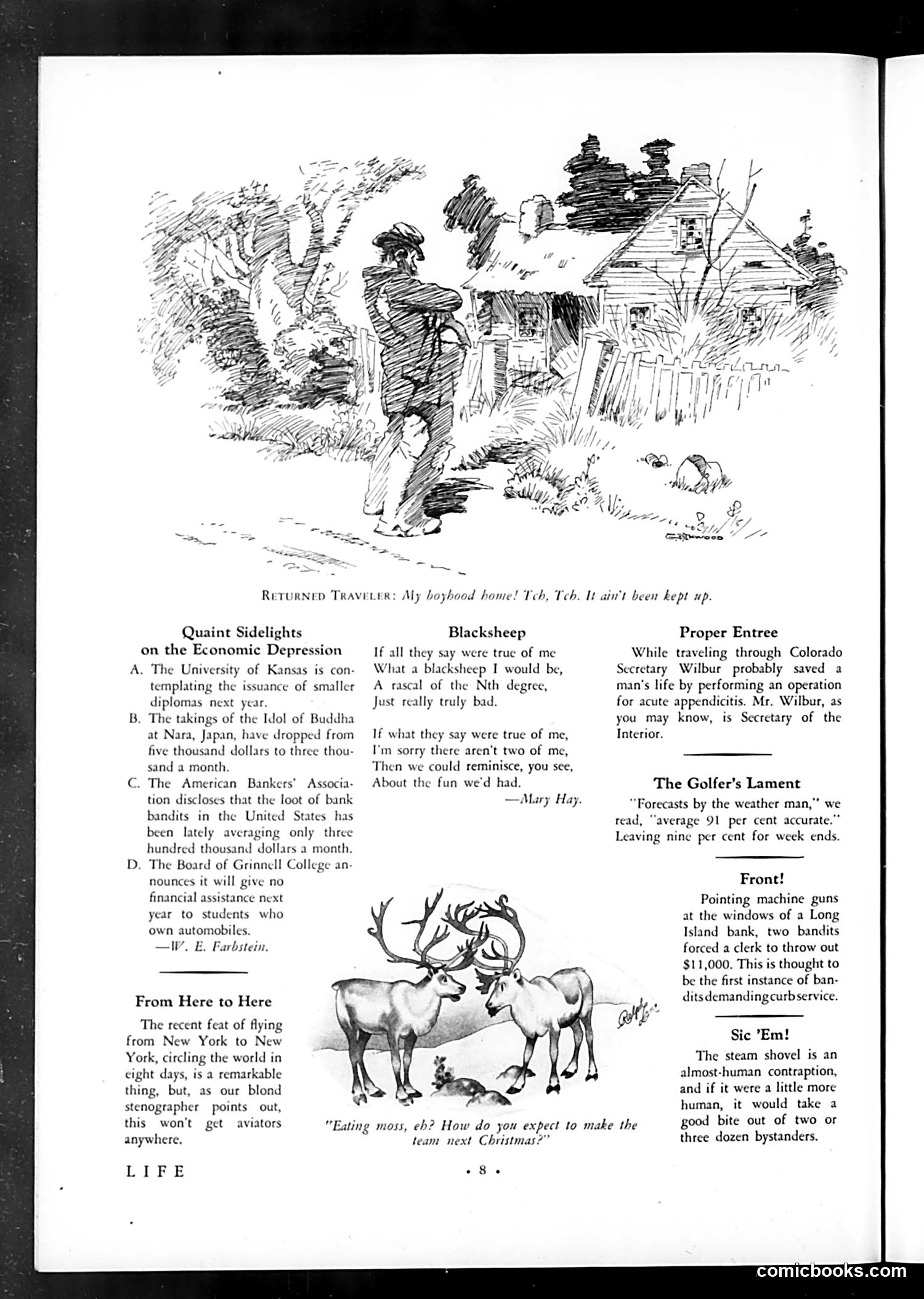
# Explanation for Modern Readers This Life magazine page contains satirical commentary on 1930s Depression-era economics and conditions. The main cartoon shows two deer, with one asking the other about making "the team next Christmas?"—a dark joke about eating grass ("moss") during food scarcity. The "Quaint Sidelights on the Economic Depression" section mocks institutional responses: universities cutting diploma costs, Japanese temples losing donations, American banks hemorrhaging money, and colleges refusing to help students with car payments—all absurd economies reflecting widespread financial collapse. "Blacksheep" appears to be a poem about reputation damage. Other brief items satirize weather forecasting accuracy and a bank robbery attempt. The overall tone is sardonic commentary on how institutions and individuals struggled during the Great Depression.
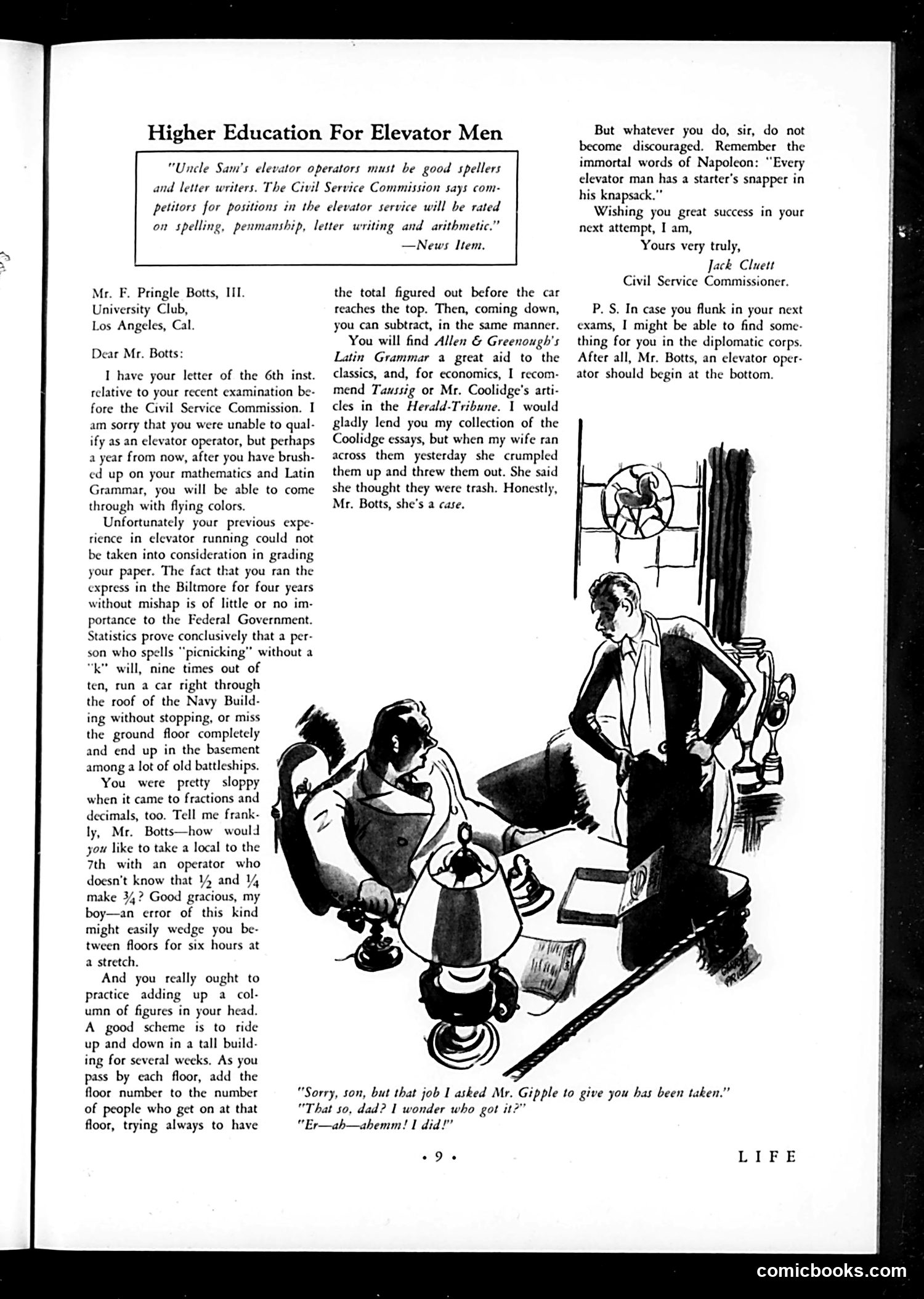
# "Higher Education For Elevator Men" This satirical piece mocks a failed civil service examination candidate who aspired to become an elevator operator. The letter from Civil Service Commissioner Jack Cluett humorously suggests the applicant study grammar, Latin, and arithmetic to improve for his next attempt—treating a menial job as if it required scholarly credentials. The cartoon illustrates the absurdity: an elevator operator struggling with complex mathematical calculations and academic materials while managing the mechanical equipment. The joke critiques both the bureaucratic rigidity of civil service testing and the pretension of requiring "higher education" for unskilled labor. The applicant's poor spelling, math errors, and general incompetence are presented as obstacles comically overblown by the examination system itself.
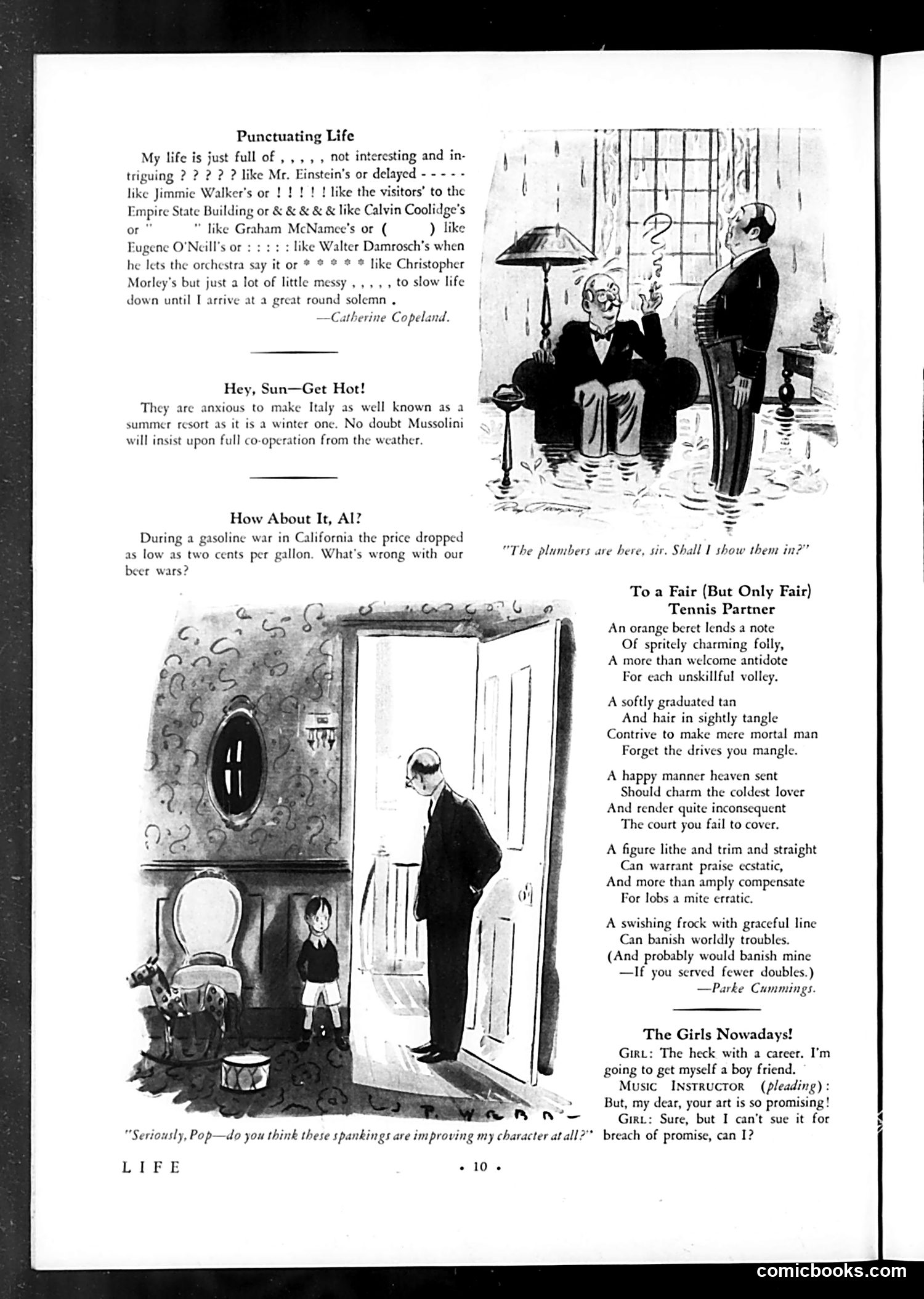
# Analysis of Life Magazine Page This page contains humor pieces and cartoons typical of 1920s American satire. The top piece "Punctuating Life" by Catherine Copeland uses punctuation marks as metaphors for people's personalities—referencing public figures like Einstein and Calvin Coolidge to describe different life rhythms. The two main cartoons satirize domestic frustrations: one depicts a homeowner with plumbers (mocking the inconvenience and cost of repair services), and another shows a man at a bathroom door, humorously asking if the plumbers should be shown in. The poetry section "To a Fair (But Only Fair) Tennis Partner" by Parker Cummings gently mocks poor tennis opponents with backhanded compliments about their appearance and skill. "The Girls Nowadays!" depicts generational conflict between a young woman pursuing romance and an older music instructor valuing artistic dedication—reflecting 1920s debates about changing youth values.