A complete issue · 37 pages · 1931
Life — July 10, 1931
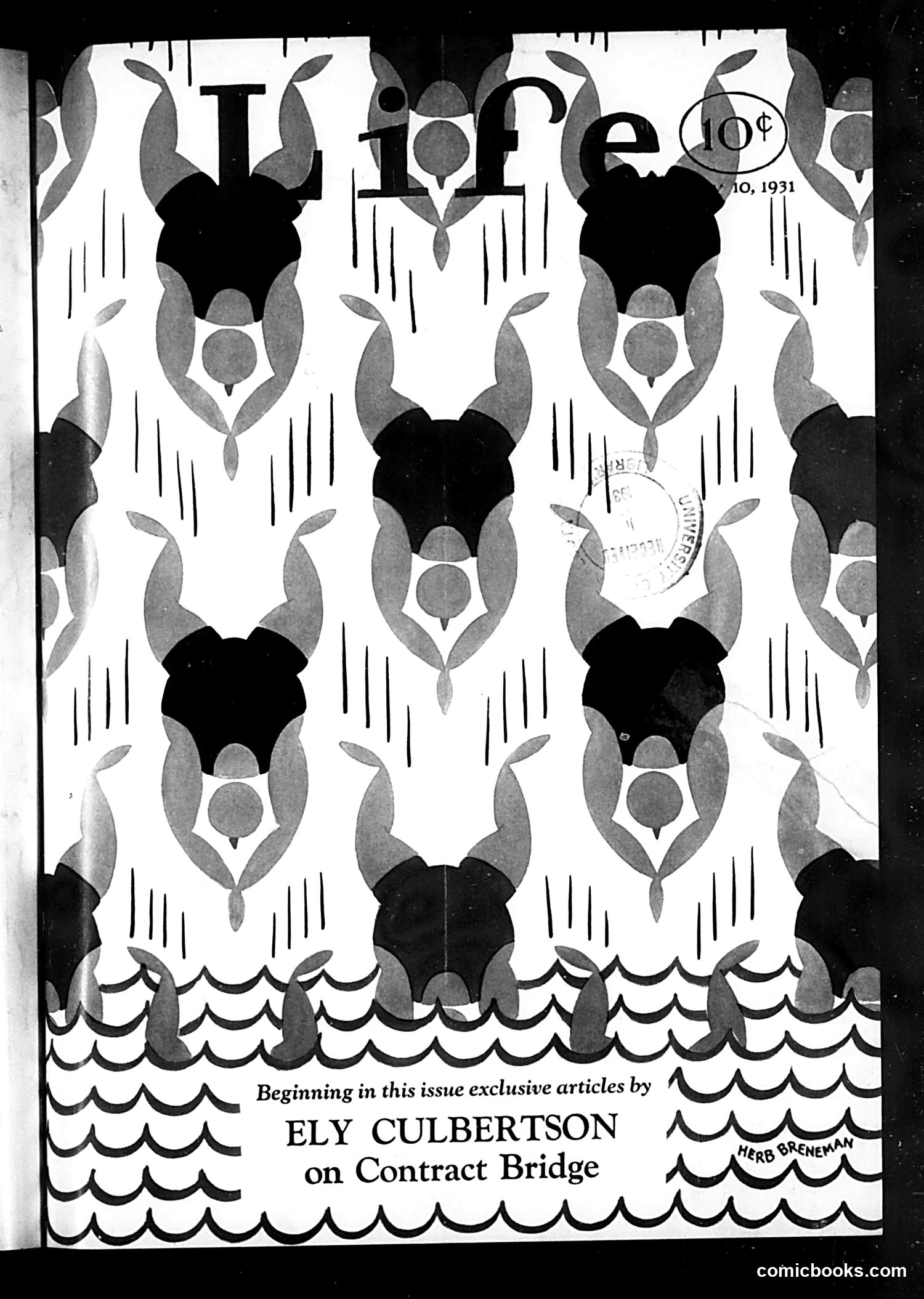
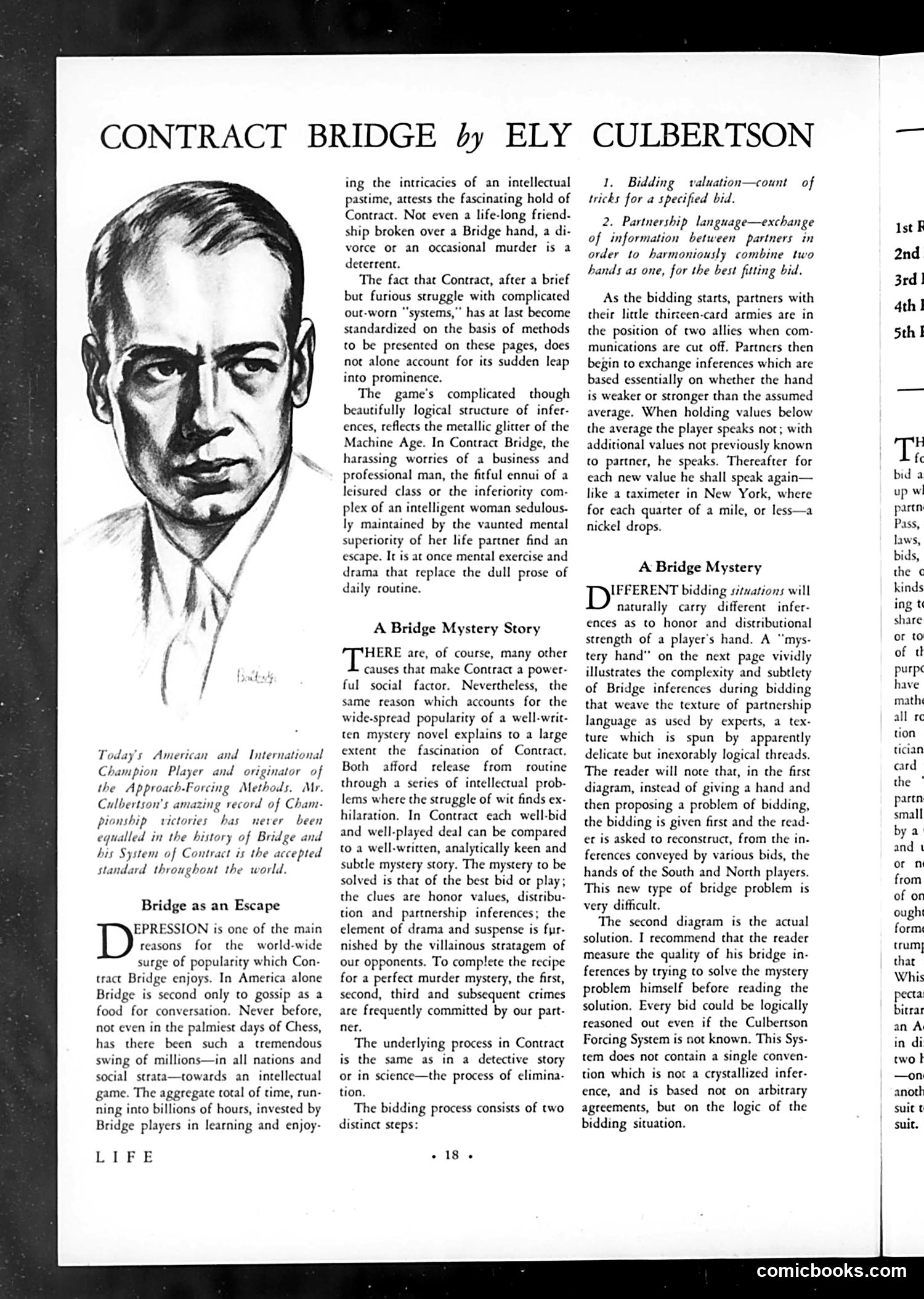
# Life Magazine Cover Analysis (1931) This appears to be a **Life magazine cover from 1931** advertising exclusive bridge articles by **Ely Culbertson**, a famous contract bridge expert of that era. The design features a **repeating pattern of stylized bull or ox heads** (shown in black silhouette) alternating with decorative botanical elements in gray. The horned animal motif likely plays on the bridge-related content—possibly a visual pun or decorative theme popular in 1931 Art Deco design. The scalloped wave pattern at the bottom adds a nautical or formal border typical of the period's graphic design aesthetic. This is primarily a **title/cover page** announcing content rather than presenting political satire or commentary. The focus is promotional, highlighting Culbertson's bridge instruction as a major draw for this issue.
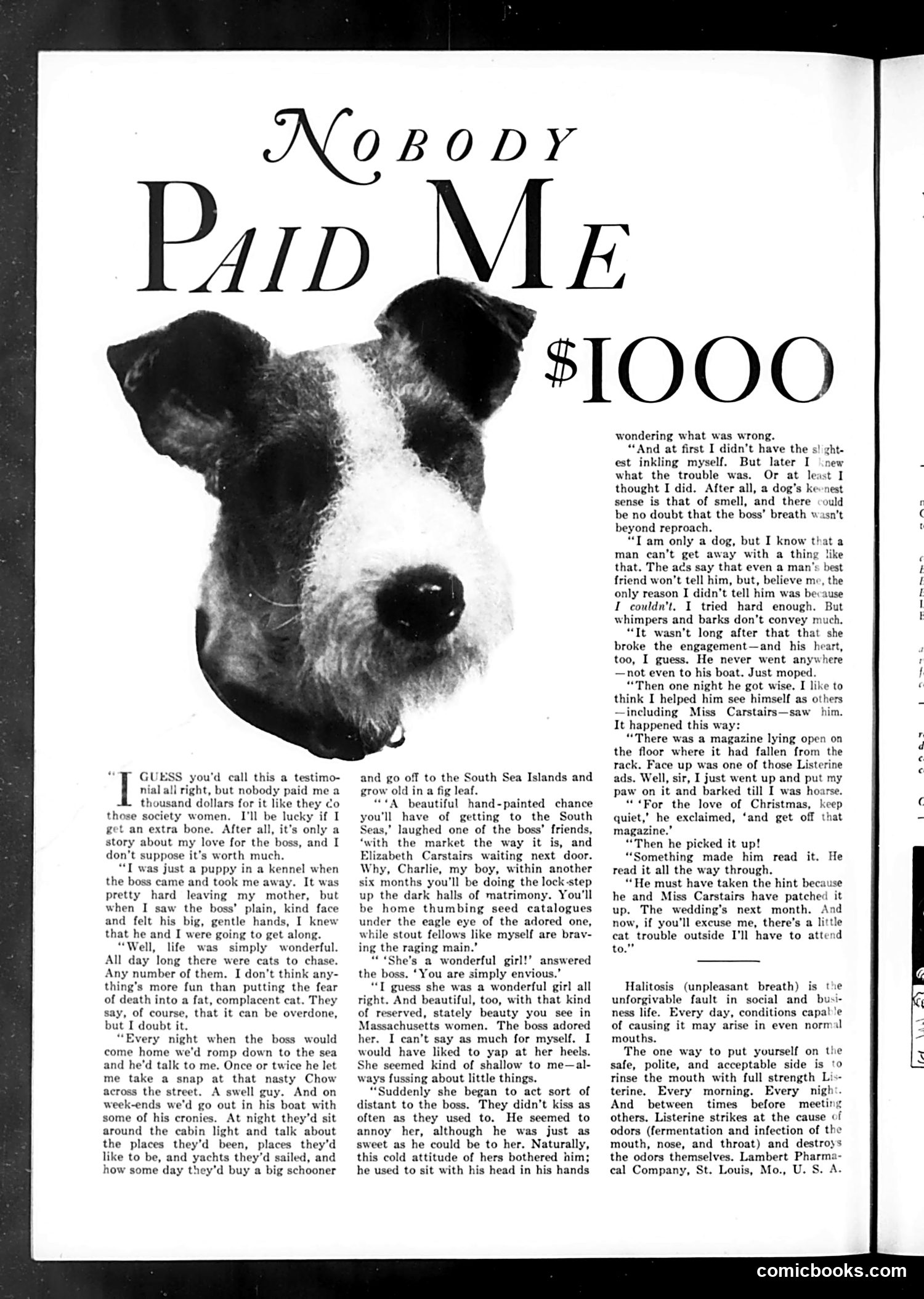
# "Nobody Paid Me $1000" This appears to be a humorous story illustrated with a close-up photograph of a dog's face. The narrative, told from the dog's perspective, describes a dog who remained silent about discovering his owner's infidelity with a woman named Miss Carstairs, apparently costing the man a valuable engagement or relationship worth significant money. The satire plays on the common saying that "a dog is man's best friend"—suggesting the dog's loyalty prevented him from exposing damaging secrets, unlike humans who might betray confidences for profit. The $1000 figure appears to reference either money the man lost or might have paid to keep the scandal quiet. The piece is primarily satirical commentary on human morality, loyalty, and friendship rather than political satire.
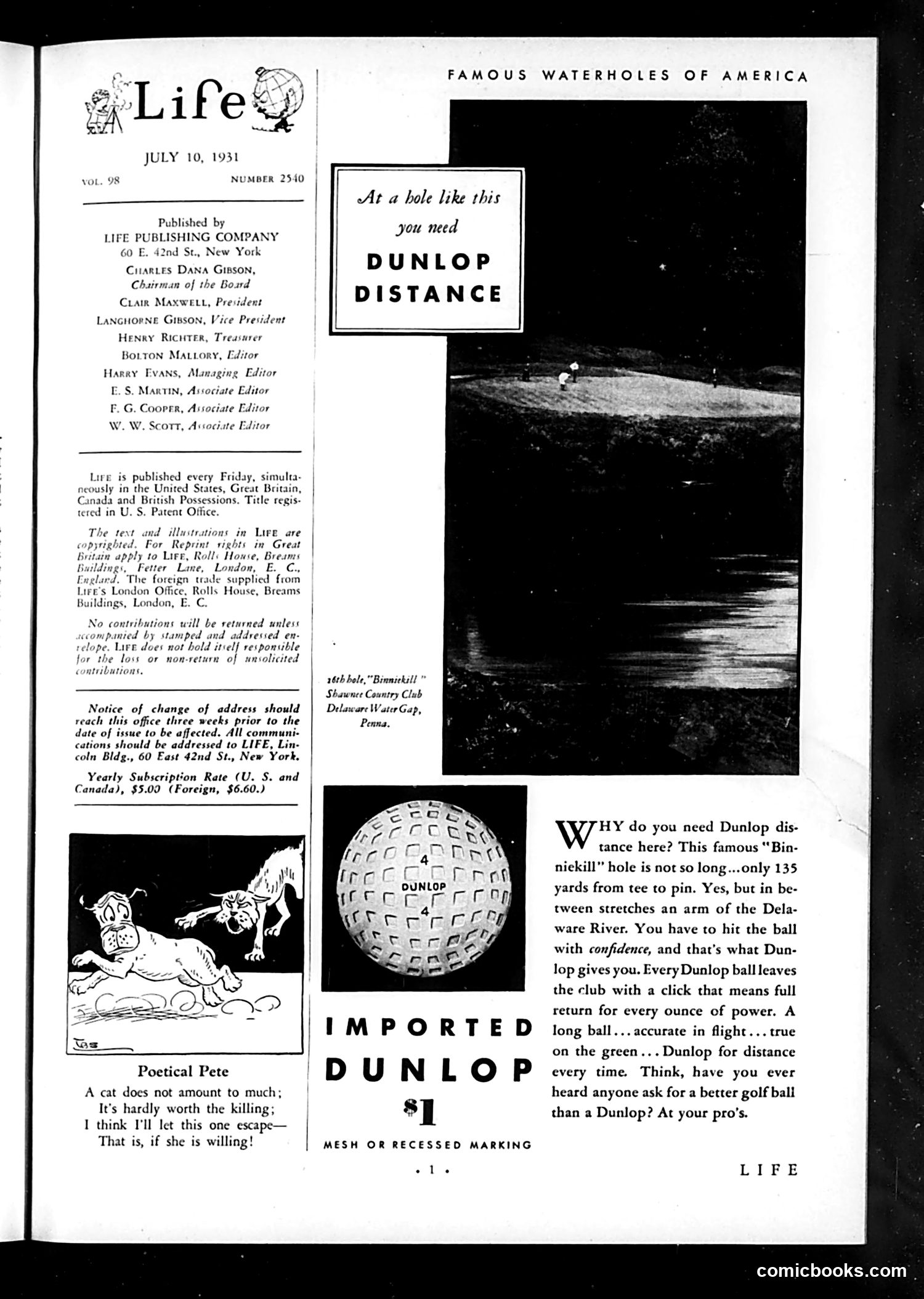
# "Poetical Pete" Cartoon Analysis This page is primarily an **advertisement for Dunlop golf balls**, with a small cartoon titled "Poetical Pete" in the lower left corner. The cartoon depicts a cat that has apparently killed a bird or mouse. The accompanying verse suggests Pete is contemplating letting the cat escape, reasoning that killing prey is simply what cats do naturally—"it's hardly worth the killing." The joke is a dark commentary on moral responsibility: Pete rationalizes overlooking the cat's predatory behavior by accepting it as instinctive rather than condemnable. This is satirical commentary on how people excuse or rationalize undesirable behavior when they attribute it to nature or circumstance rather than choice. The Dunlop advertisement dominates the page, featuring a golf ball and promoting its reliability for distance on the "Binniekill" hole near the Delaware River.
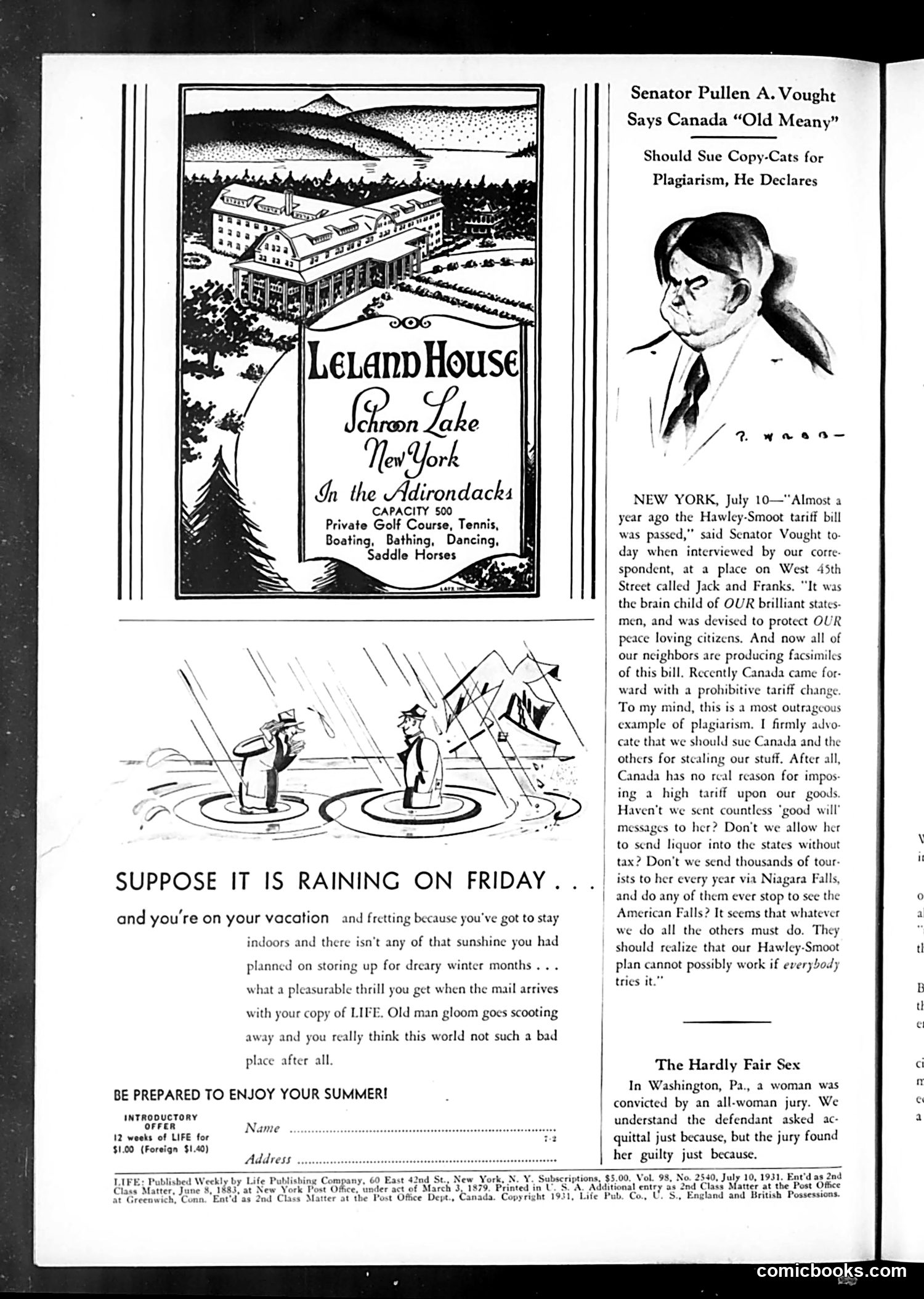
# Analysis This page contains a **Senator Pullen A. Vought portrait and quote** (right column) alongside a **Leland House resort advertisement** (top left) and an **unrelated cartoon about rainy vacations** (bottom left). **The political content:** Senator Vought accuses Canada of "plagiarism" regarding the Hawley-Smoot tariff bill, claiming Canada copied American protectionist trade policy. He sarcastically argues Canada should be sued for intellectual theft rather than allowed to impose competing tariffs. The piece mocks Canada as an imitator while criticizing protectionist trade wars as economically damaging to both nations. **The cartoons** are unrelated advertisements—one promoting a vacation resort, another joking about rainy weather ruining holiday plans. The page satirizes nationalist trade rhetoric of this era.
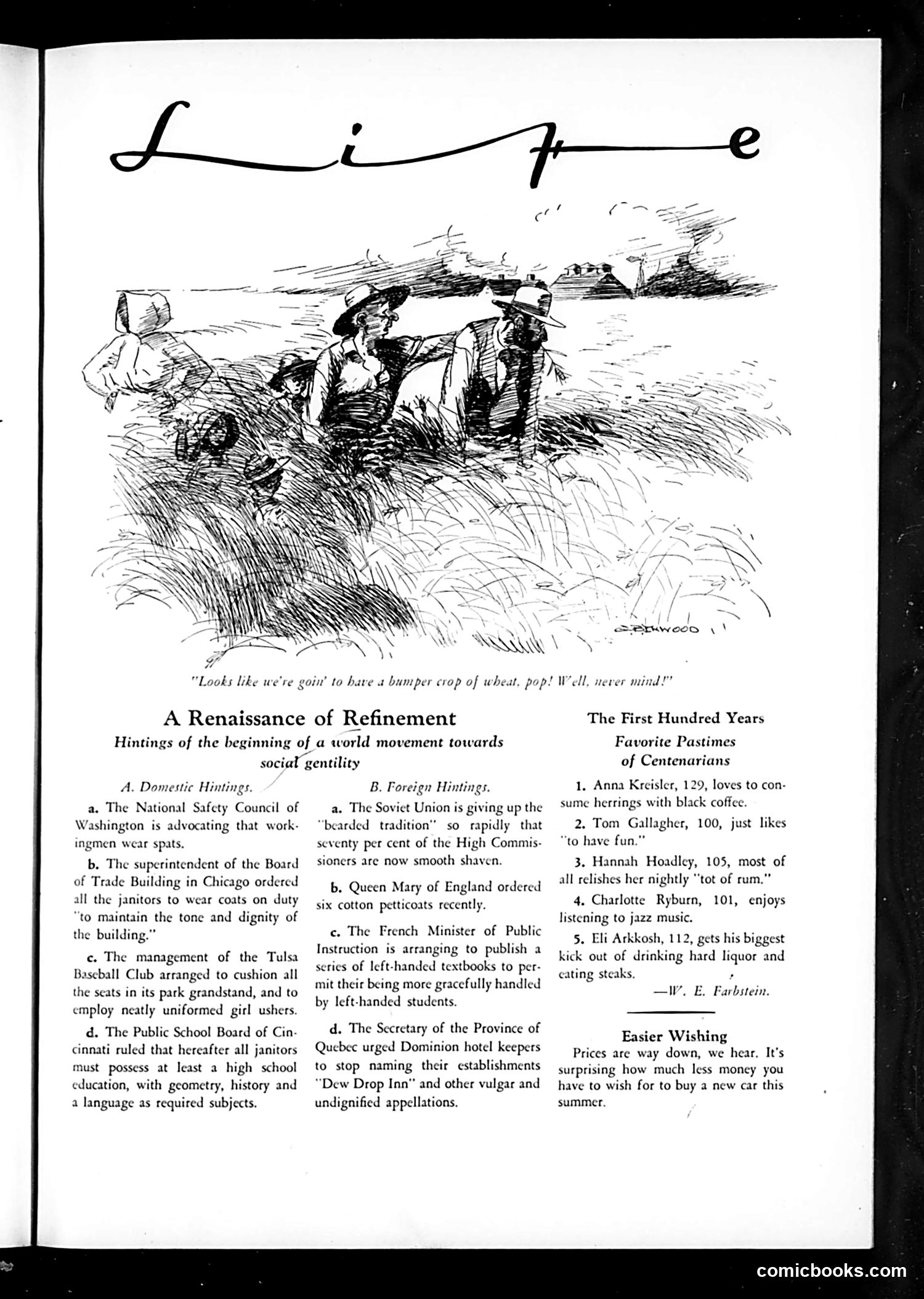
# "Life" Page Analysis: Social Refinement The main cartoon depicts rural farmers in a wheat field, with the caption: "Looks like we're goin' to have a bumper crop of wheat, pop! We'll, never mind!" This satirizes agricultural prosperity—the farmers seem indifferent to their success, suggesting a critique of rural attitudes or acceptance of hardship. The page's title, "A Renaissance of Refinement," sarcastically frames the accompanying text about various institutions promoting "social gentility." Examples include the National Safety Council requiring workmen to wear spotless clothing and the Tulsa Baseball Club hiring uniformed ushers—mock-serious accounts of superficial civility measures. The satire mocks how organizations conflate minor etiquette reforms with genuine social progress, lampooning early 20th-century obsession with outward refinement over substance.
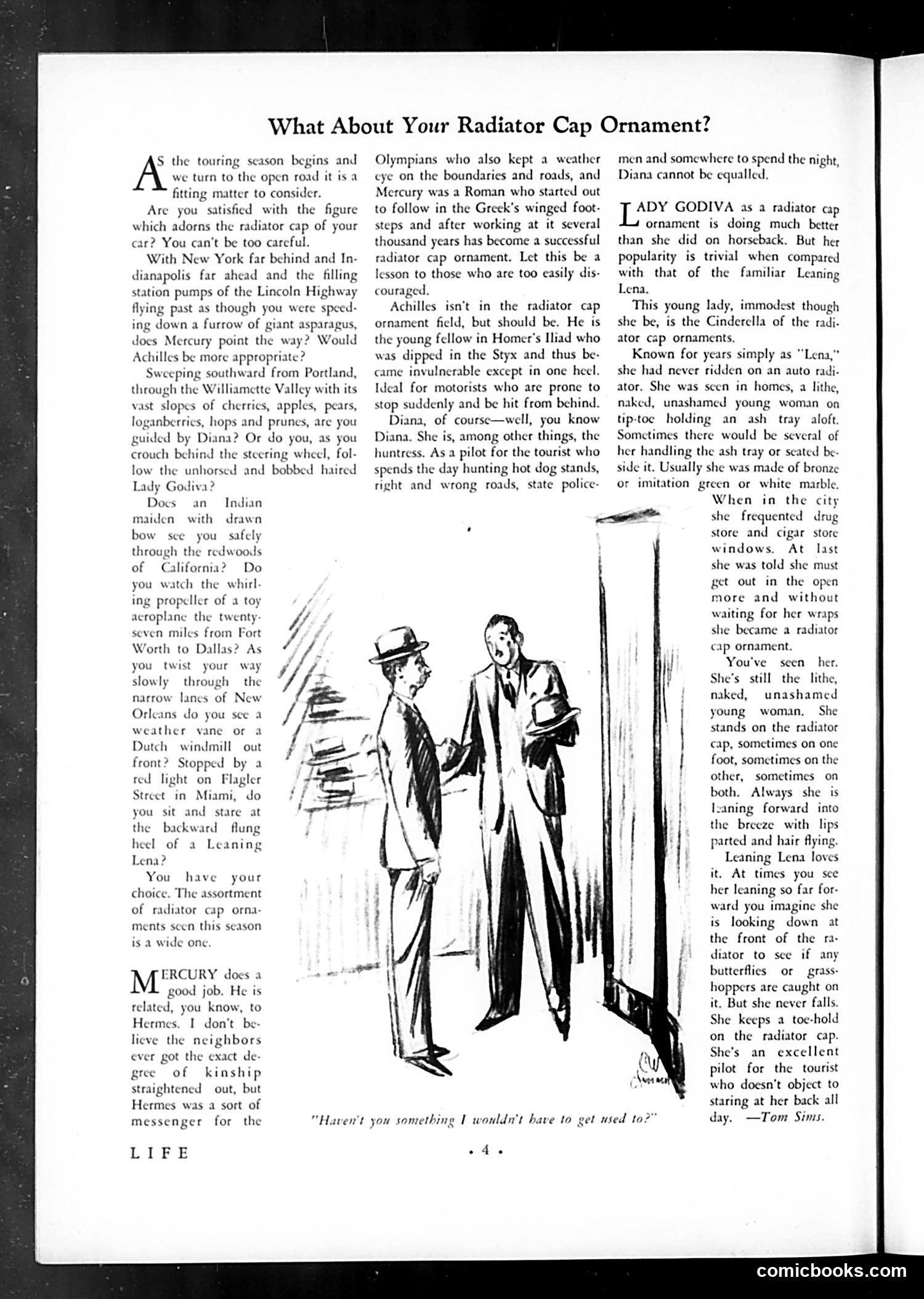
# Radiator Cap Ornaments Satire This humorous article mocks the fashion of decorative radiator cap ornaments on 1920s automobiles. The text poses absurd questions: would Mercury point the way? Should Achilles be there? Does an Indian maiden guide you through forests? The satirical point is that these ornaments—often expensive, ornate figurines—were status symbols that served no practical purpose on cars. The article gently ridicules both the ornaments themselves and drivers' vanity in displaying them. The accompanying sketch shows two men in conversation, with one asking "Haven't you something I wouldn't have to get mud on?"—mocking both the impracticality of keeping such decorations clean and the snobbish desire to own exclusive items. The profile of "Lady Godiva" is discussed as a particularly absurd choice for a radiator ornament.
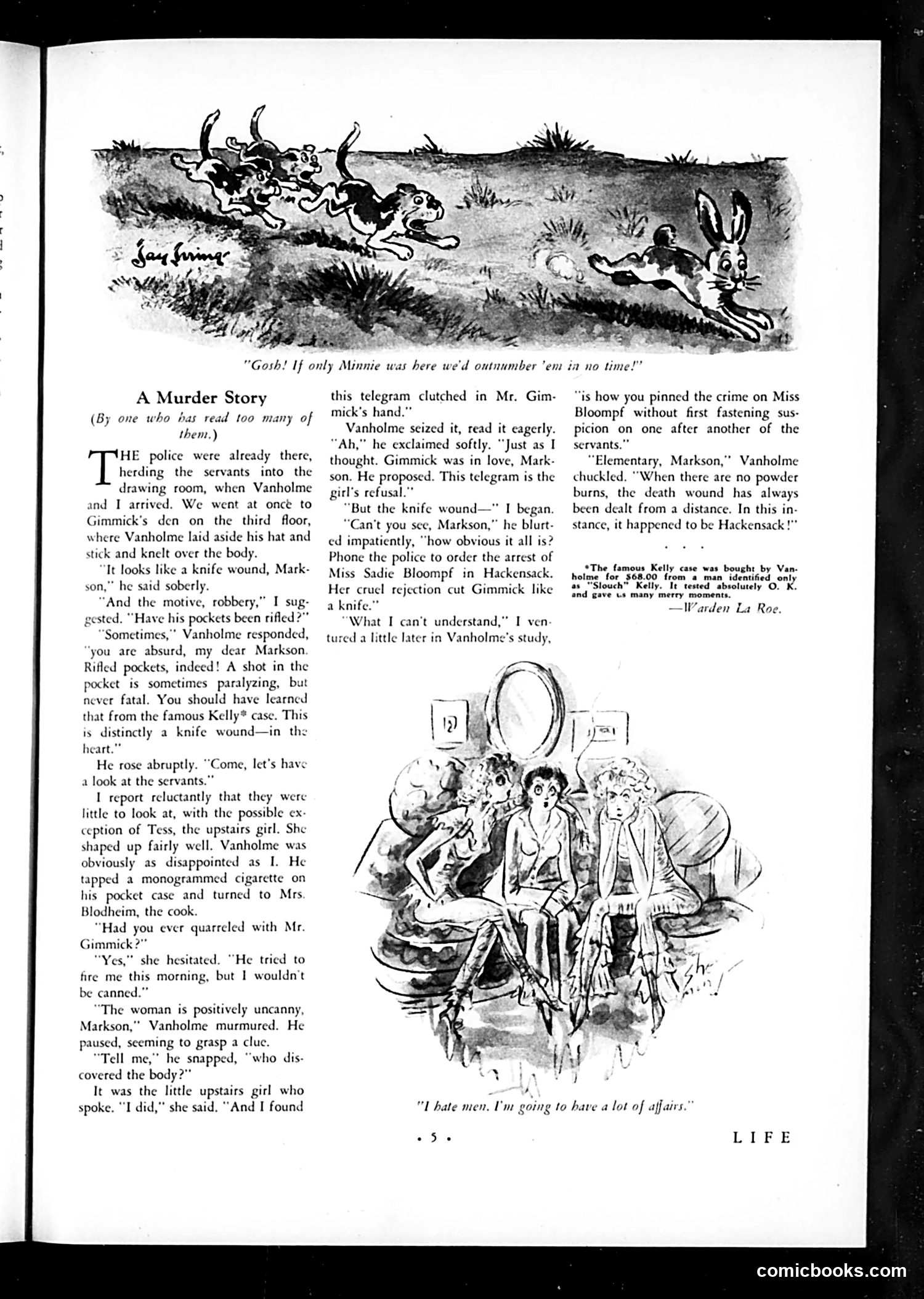
# "A Murder Story" - Life Magazine Page This page presents a murder mystery short story titled "A Murder Story (By one who has read too many of them)" — the parenthetical subtitle indicates this is satire *about* detective fiction itself, not a serious crime narrative. The story involves characters named Markson, Vanholme, and Gimmick investigating a knife wound. The satire mocks common detective-story tropes: the police arriving first, suspects with suspicious pockets, the learned detective explaining obscure wound analysis, and dramatic revelations by minor characters. The illustration shows a magnifying glass scene with multiple figures gathered around — a visual cliché of mystery fiction investigations. The page satirizes how formulaic and predictable murder mysteries had become in popular literature by the early 20th century.
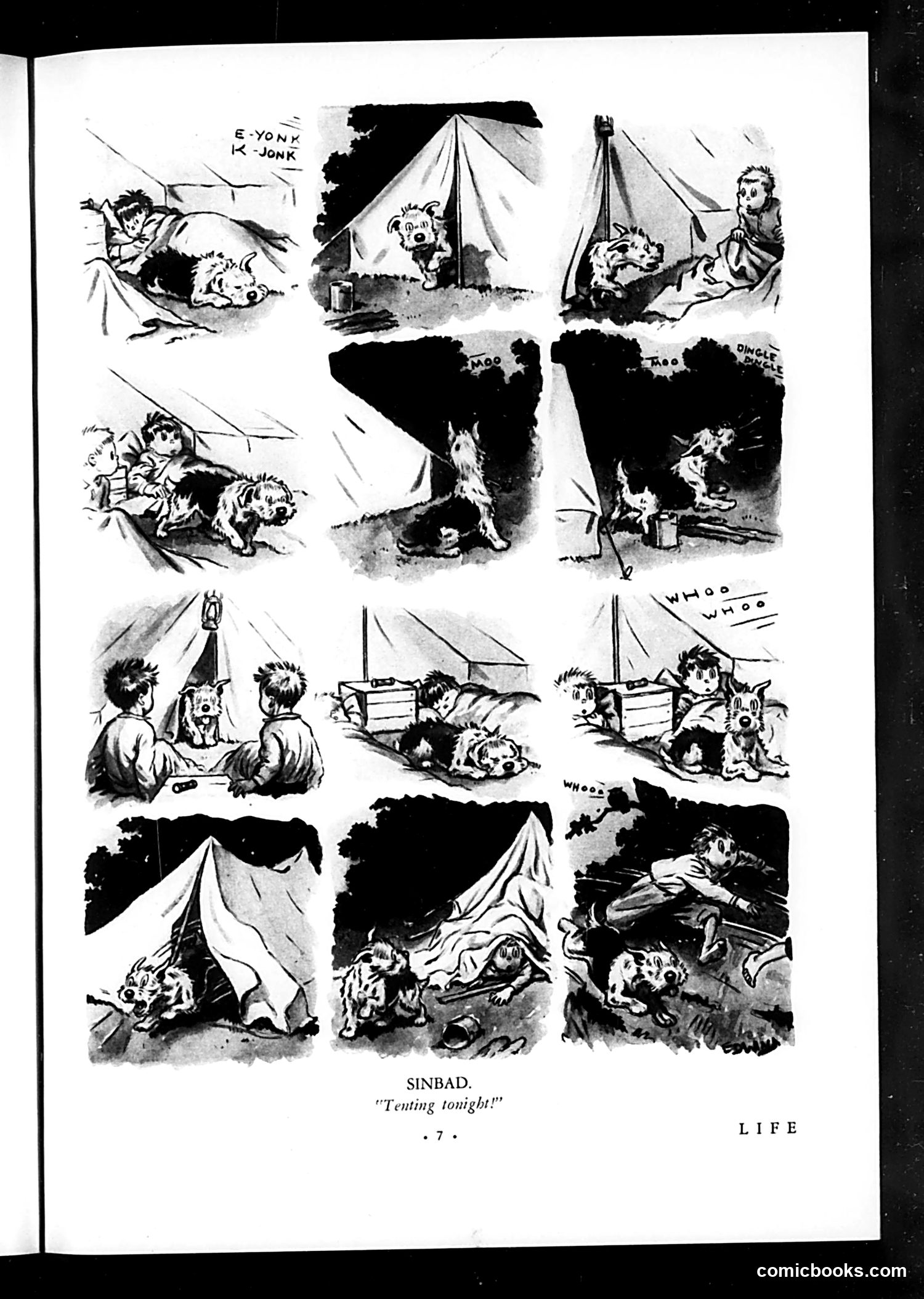
# SINBAD: "Tenting Tonight!" This comic strip appears to be a humorous sequence about camping or outdoor tent life. The title "Tenting tonight!" suggests the narrative focus. The strip shows what appear to be children or young people engaged in various camping activities—sleeping in tents, gathering around fires, and dealing with typical camping situations. The characters appear somewhat disheveled or comically exaggerated in typical early-20th-century cartoon style. Without additional context about the "Sinbad" character or strip's ongoing narrative, the specific satire is unclear. However, the comedic approach seems to mock the romantic ideal of outdoor camping by showing its messy, uncomfortable, or chaotic reality—a common satirical target of the era. The page is from *Life* magazine, a major American humor publication of this period.
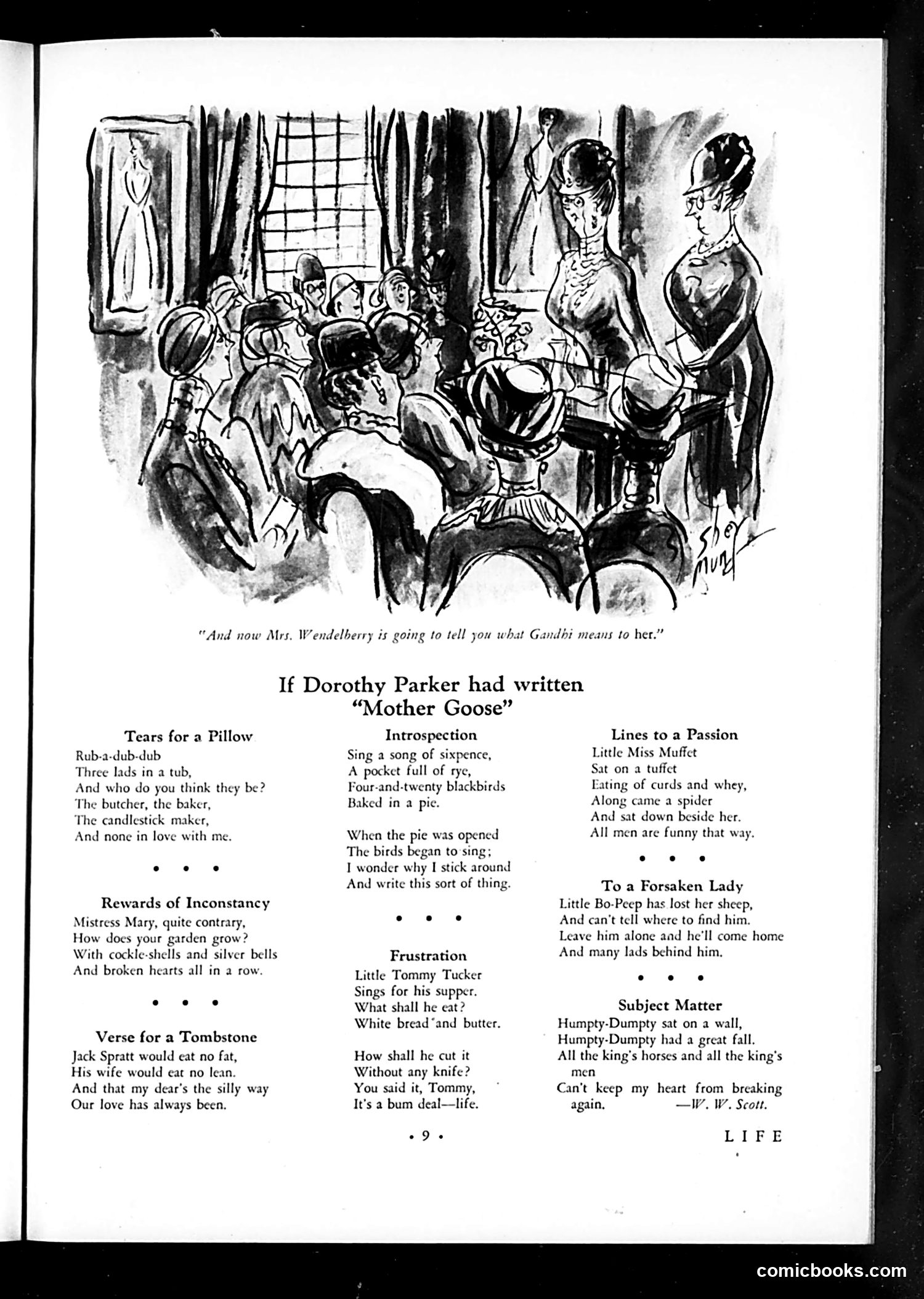
# Analysis The cartoon depicts a social gathering where a woman announces she will explain what "Gandhi" means to the assembled guests. This is a satirical take on Gandhi's growing prominence in American cultural consciousness, likely from the 1920s-30s when Indian independence activism gained international attention. The satire targets upper-class social pretension—the idea that educated society women would discuss Gandhi at cocktail parties as a fashionable intellectual topic, whether or not they genuinely understood his philosophy or political significance. The cartoon mocks this superficial engagement with serious political matters. The accompanying parodies of nursery rhymes ("Mother Goose") below continue the satire through absurdist humor, a common Life magazine approach to social commentary on contemporary figures and trends.
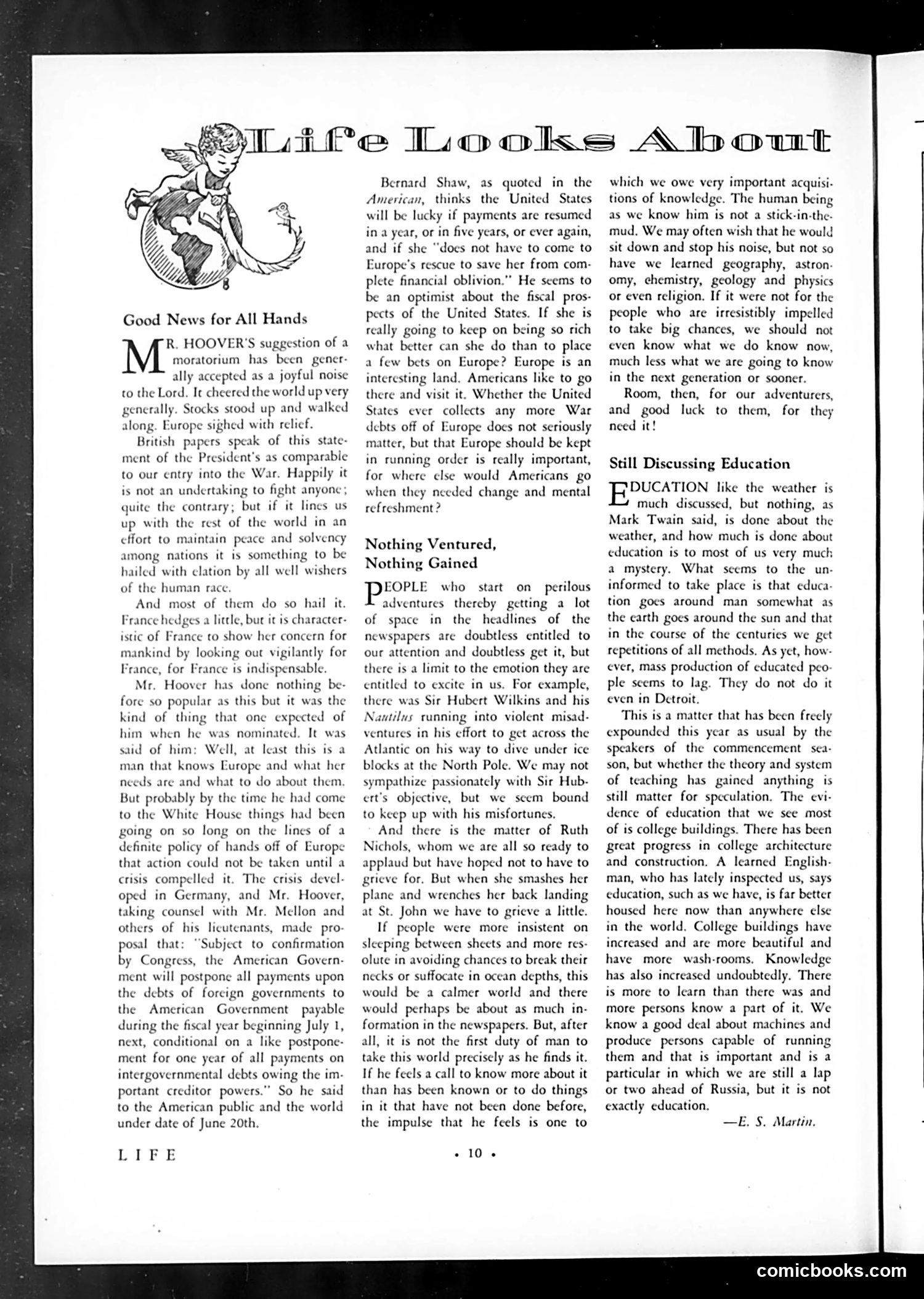
# Analysis of "Life Looks About" Page This page contains three opinion pieces rather than cartoons. The header illustration shows a cherub-like figure, Life magazine's mascot. **"Good News for All Hands"** discusses President Hoover's moratorium on war debts—a proposal to postpone payments owed to the U.S. by European governments. The author praises this as promoting peace among nations and suggests it prevents Europe from financial collapse, which would harm American interests. **"Nothing Ventured, Nothing Gained"** criticizes newspaper coverage of explorers like Sir Hubert Wilkins attempting dangerous polar expeditions. The author argues such sensational headlines don't justify the risks. **"Still Discussing Education"** critiques American education's ineffectiveness, comparing it unfavorably to college buildings. The author, E.S. Martin, argues education theory hasn't improved actual learning outcomes.