A complete issue · 37 pages · 1931
Life — June 26, 1931
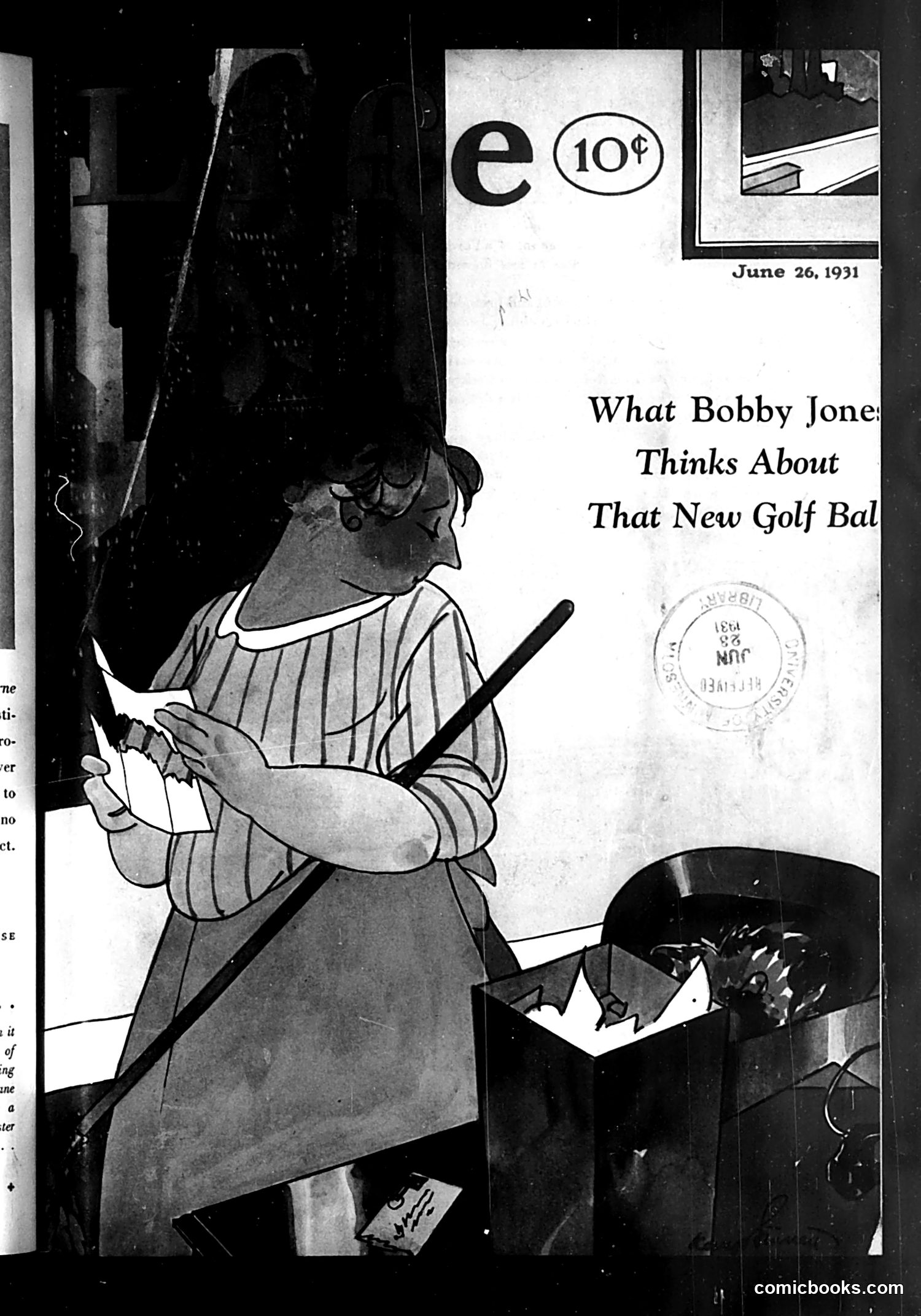
# Analysis This is the cover of Life magazine from June 26, 1931. The main illustration depicts a figure in a baseball uniform (pinstriped shirt) examining or holding a golf ball. The headline reads "What Bobby Jones Thinks About That New Golf Ball." Bobby Jones was a legendary amateur golfer of the era. The satire appears to reference contemporary debate about new golf ball technology—likely regulations or specifications being debated in golf at the time. By presenting a baseball player examining a golf ball, the artist may be making a humorous point about the absurdity of technical golf debates, or possibly commenting on Jones's involvement in golf equipment discussions. The 10-cent price and library stamp indicate this is an archival copy.
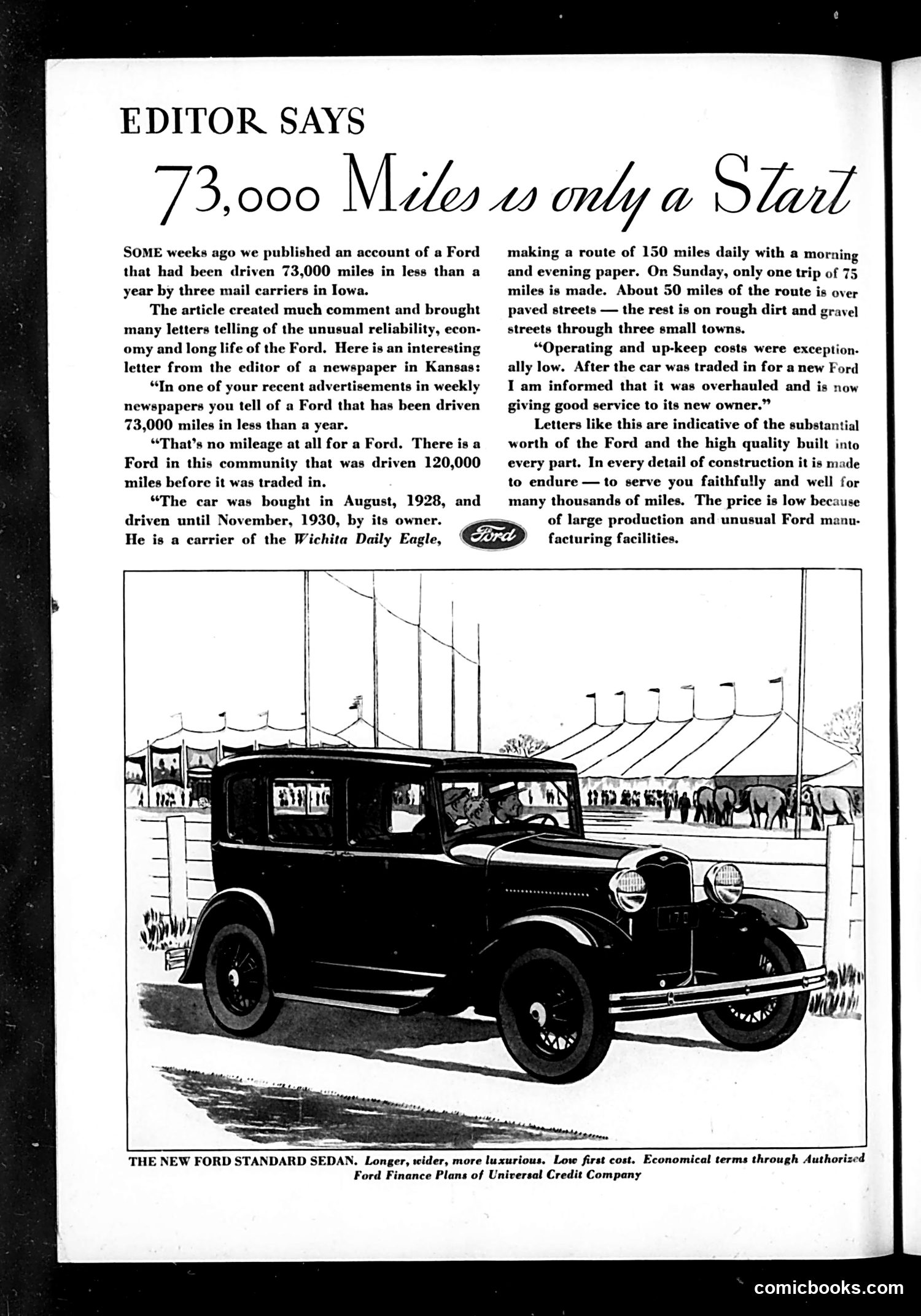
# Analysis This is primarily **advertising content**, not satire or political commentary. The "Editor Says" section presents a Ford Motor Company advertisement disguised as editorial endorsement. The piece highlights a Ford that traveled 73,000 miles in less than a year—a mail carrier's vehicle in Iowa—to demonstrate the car's **reliability and durability**. The editor emphasizes Ford's low operating costs and quality construction as reasons for the vehicle's longevity. The accompanying illustration shows a 1920s-era Ford Standard Sedan at what appears to be a fair or exhibition grounds, emphasizing the vehicle's practical design. This represents early 20th-century **advertorial content**, where companies paid for editorial-style articles promoting their products. The message targets practical consumers concerned with economy and dependability rather than luxury.
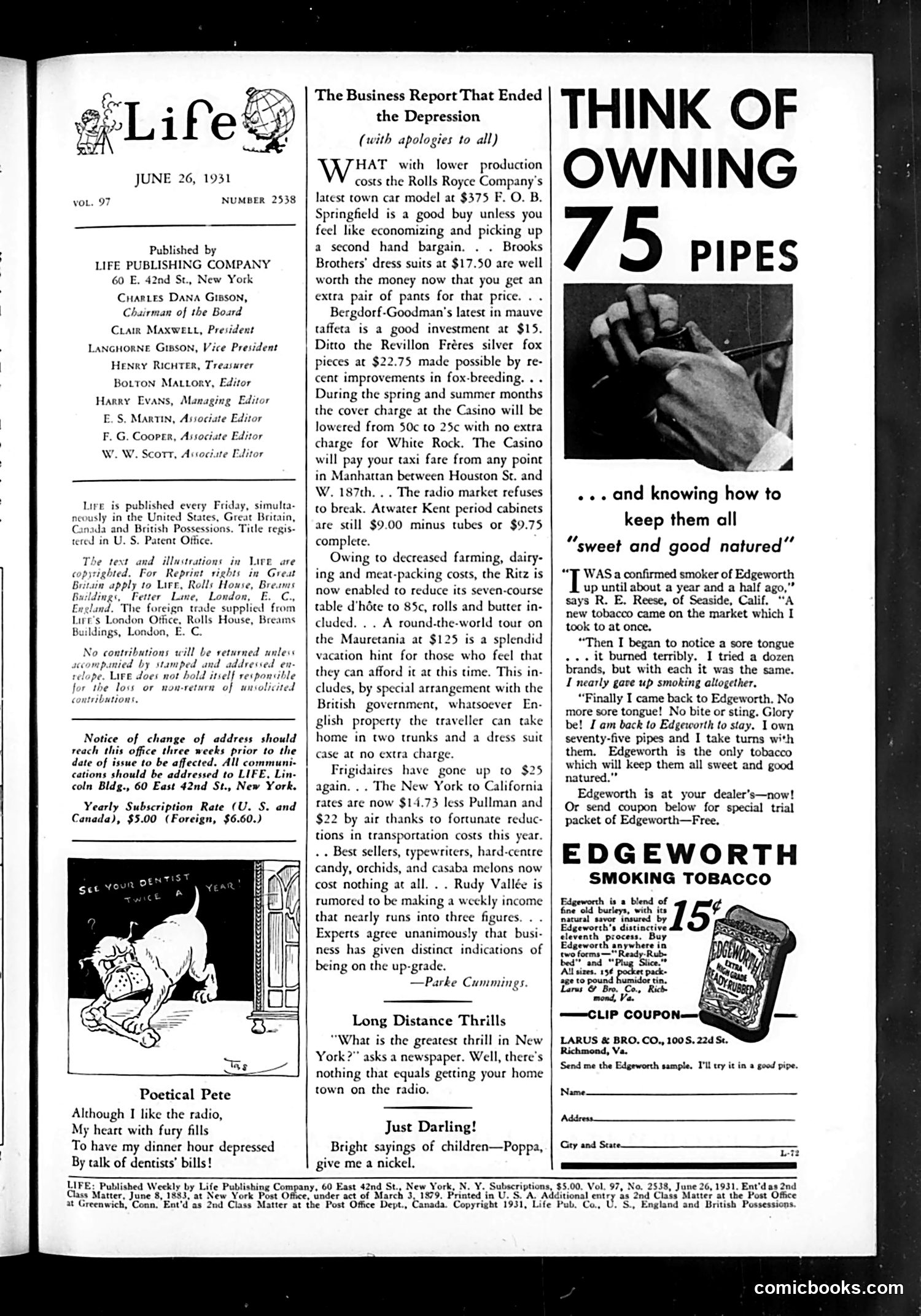
# Analysis This page is primarily advertising and editorial content from Life magazine (June 26, 1931), during the Great Depression. The small cartoon at bottom-left, titled "Poetical Pete," shows a figure at a dentist's office. The accompanying verse jokes that Pete prefers listening to the radio during dinner rather than hearing about dentists' bills—a Depression-era quip about avoiding unpleasant financial realities. The main advertisement promotes Edgeworth Smoking Tobacco, featuring a testimonial about pipe-smoking's pleasures. The "75 pipes" headline appeals to collectors during economically difficult times. The page's editorial content discusses Depression bargains (cheap clothing, reduced prices) with dark humor about "economizing"—reflecting 1931's economic desperation when consumers sought any cost savings, even secondhand goods.
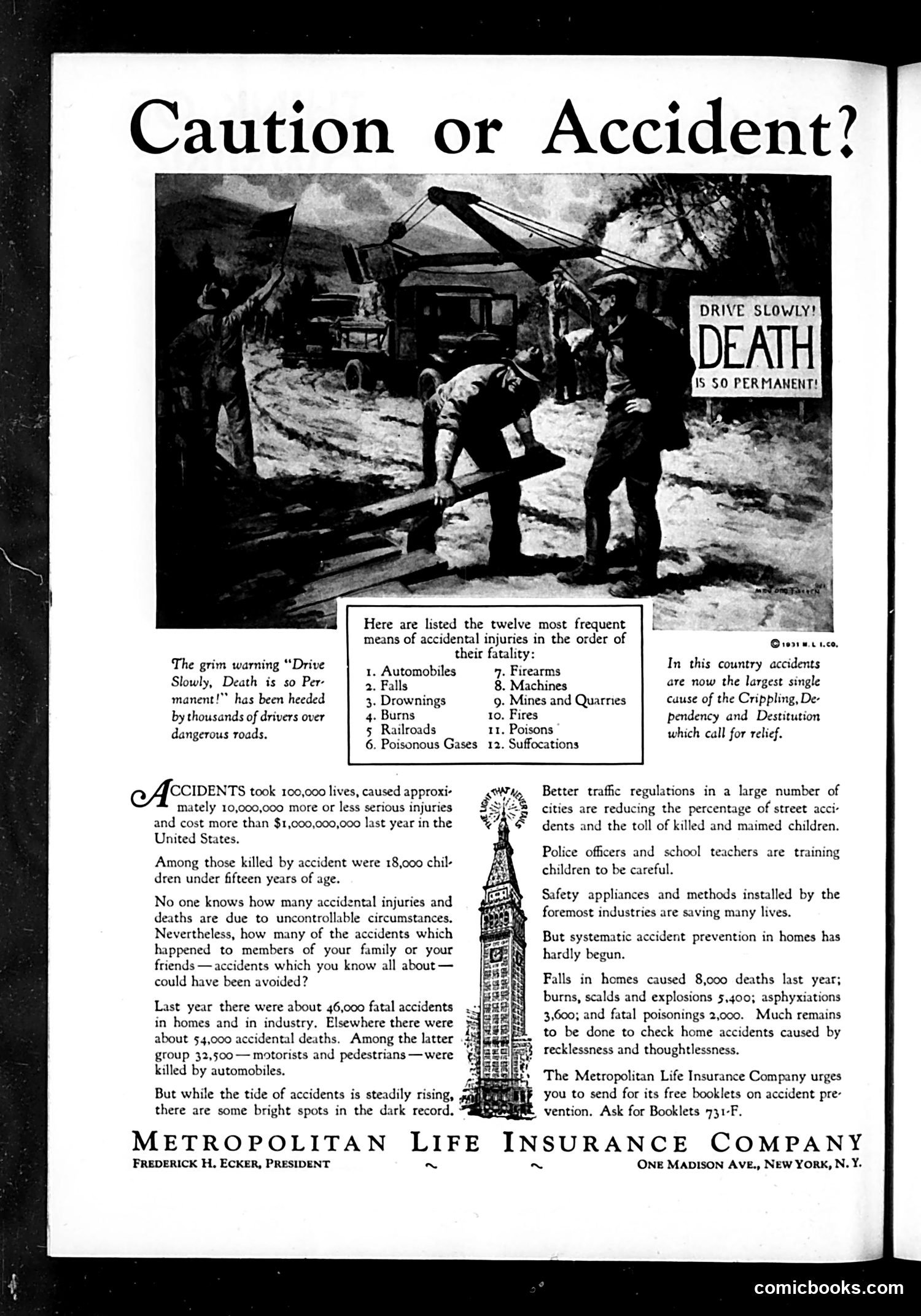
# "Caution or Accident?" - Safety Public Service Advertisement This is a public health advertisement by the Metropolitan Life Insurance Company addressing America's accident crisis. The stark black-and-white photograph shows wreckage from a vehicle collision, with workers surveying the damage. The headline poses a moral question: were accidents truly unavoidable, or preventable through caution? The advertisement lists the twelve deadliest accident categories, with automobiles ranked first. The text reveals startling statistics: 100,000 annual deaths and $1 billion in costs. The company argues that while industrial safety improved, home accidents remain largely unaddressed. The final message urges readers to request safety pamphlets, positioning insurance companies as accident-prevention advocates rather than mere claim-payers. This represents early 20th-century corporate safety messaging merged with insurance industry marketing.
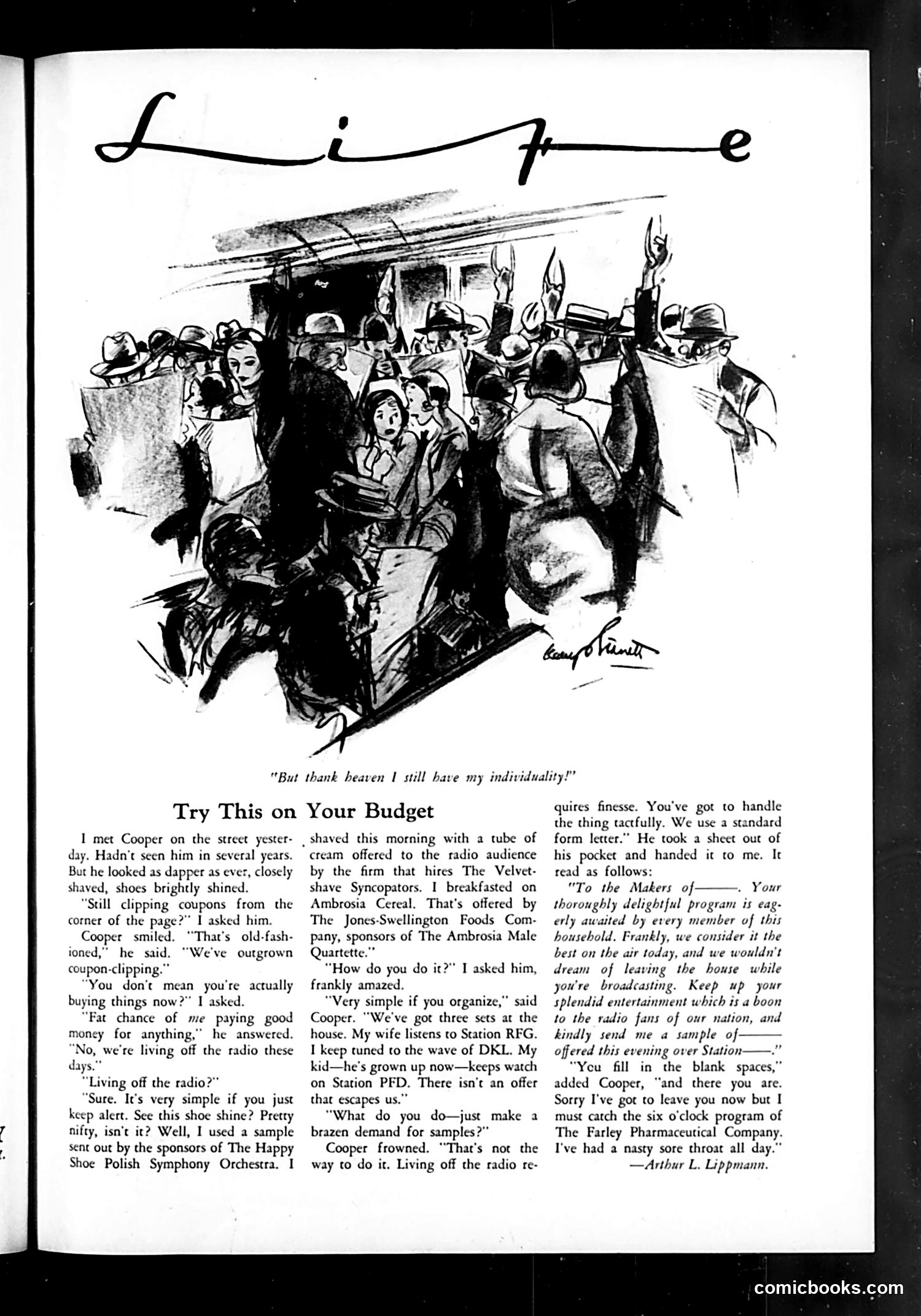
# "Try This on Your Budget" - Life Magazine Satire This article satirizes 1920s-30s radio sponsorship culture. The cartoon depicts a crowded radio station scene with the caption "But thank heaven I still have my individuality!" The piece mocks how ordinary people were being manipulated by radio sponsors offering free samples and premiums. The protagonist "Cooper" describes receiving cereal samples, shoe polish, and other products in exchange for listening to sponsored programs. He's pressured to write testimonial letters praising these products to keep receiving freebies. The satire's central joke: listeners believed they were exercising "individuality" by choosing which radio programs to hear, while actually becoming unwitting advertisements for commercial sponsors. The irony is that accepting free samples and writing scripts for companies actually *removes* rather than preserves genuine individuality.
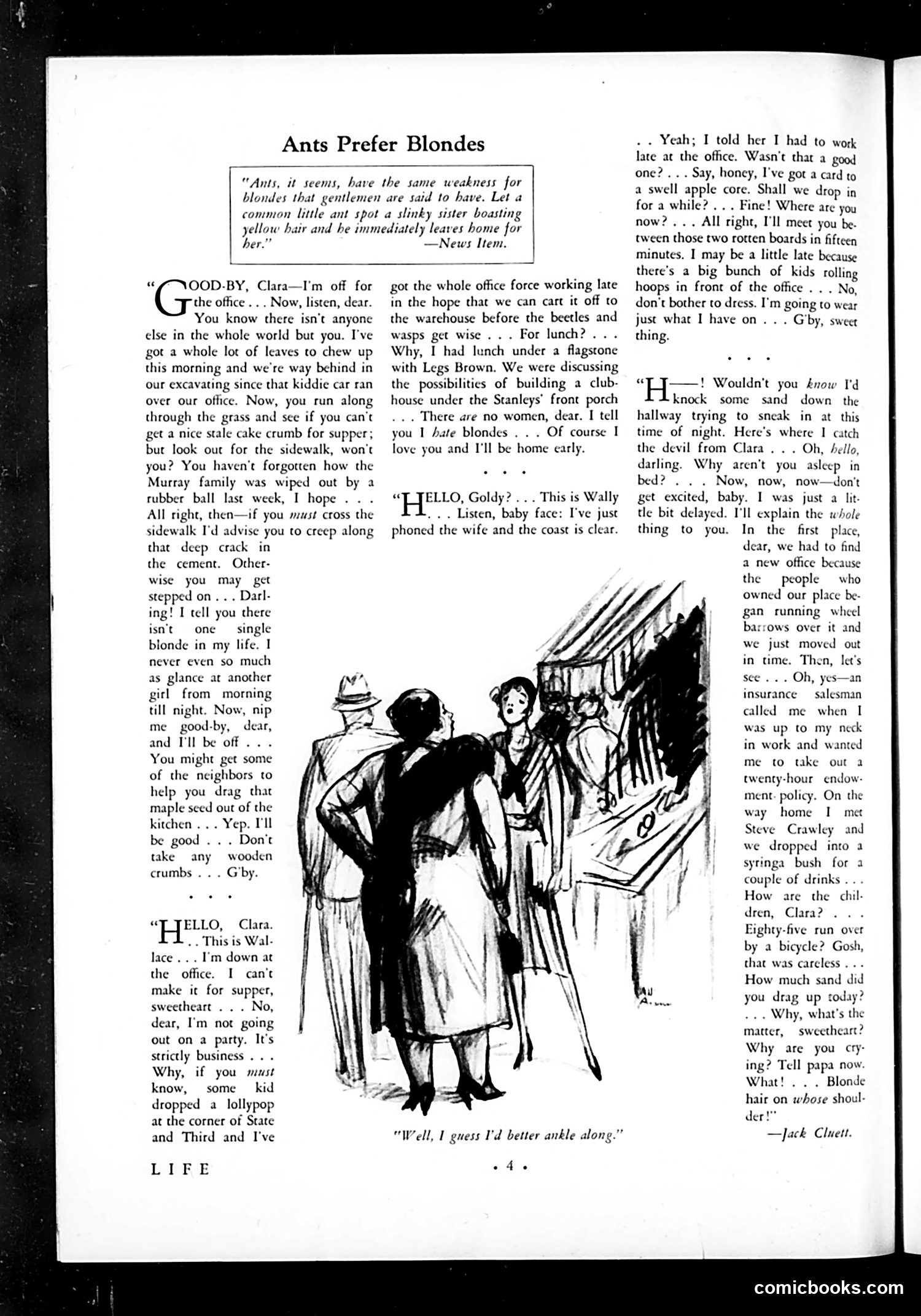
# "Ants Prefer Blondes" This page presents a humorous domestic narrative about office and home life. The story depicts a husband (Goldy/Wally) making excuses to his wife Clara about working late at the office. He invents elaborate reasons—moving to a new office, meeting with an insurance salesman, stopping for drinks—to explain his delayed arrival home. The title's reference to "blondes" suggests the satirical point: the husband is likely pursuing romantic interests rather than genuinely working late. The illustration shows figures in what appears to be a street or social setting, supporting this subtext. The humor targets common male excuses and infidelity, presenting familiar domestic conflict through exaggerated workplace justifications. It's vintage social satire about marital deception and gender relations in early-to-mid twentieth century American life.
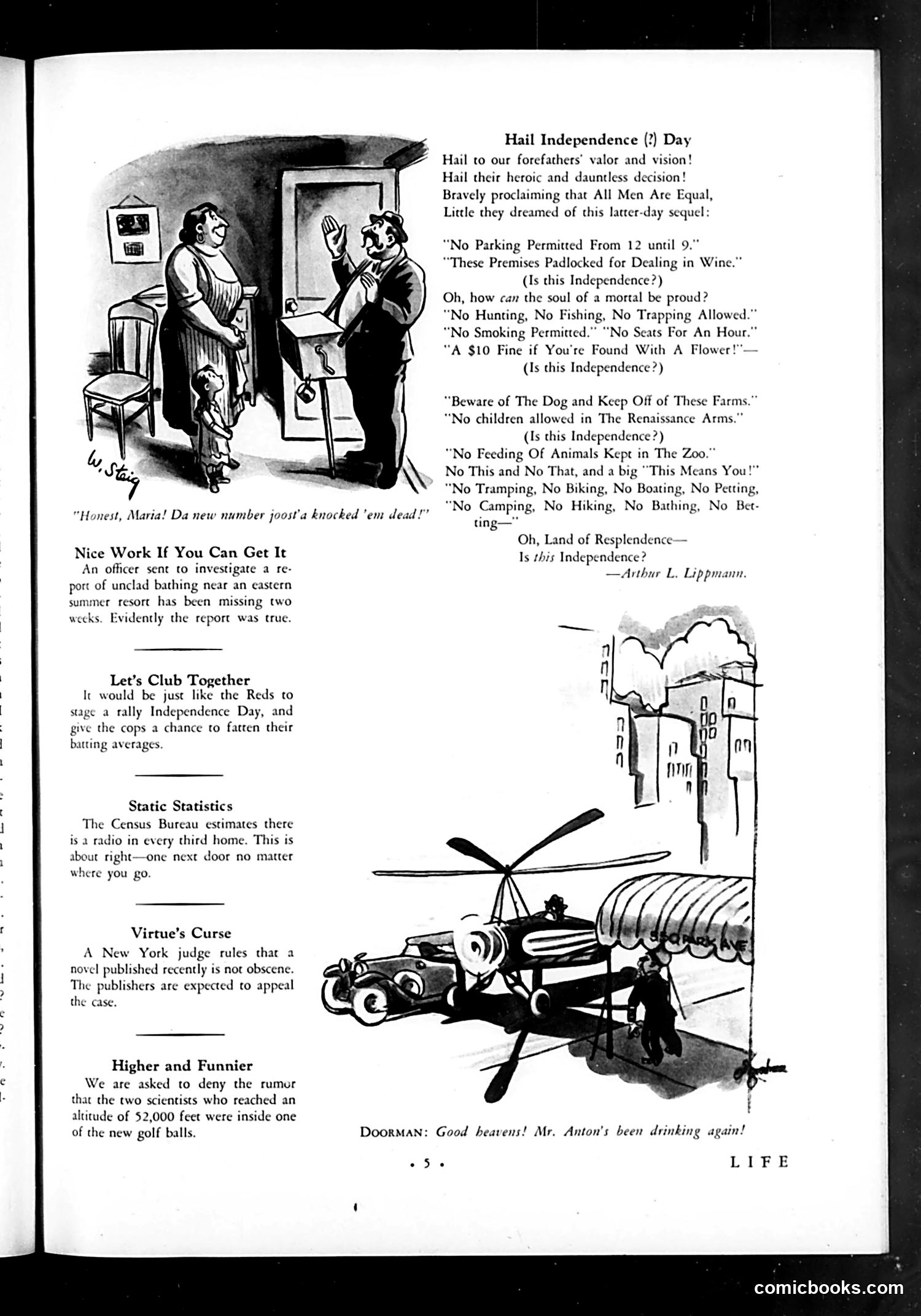
# Analysis of Life Magazine Page This page satirizes American Independence Day hypocrisy. The main cartoon shows two men in a doorway with a sign about a bathroom—the caption reads "Honest, Maria! Da new number joost'a knocked 'em dead!" The poem "Hail Independence (?) Day" by Arthur L. Lippmann is the central satire. It mockingly lists numerous restrictions and prohibitions ("No Parking," "No Hunting," "No Smoking," "No children allowed") that contradict the founders' promise of freedom and equality. Each restriction is followed by "(Is this Independence?)" to emphasize the irony. The satire critiques how Americans celebrate independence while living under endless rules and restrictions that limit personal liberty. The accompanying cartoon of people near an airplane comments on modern constraints on freedom.
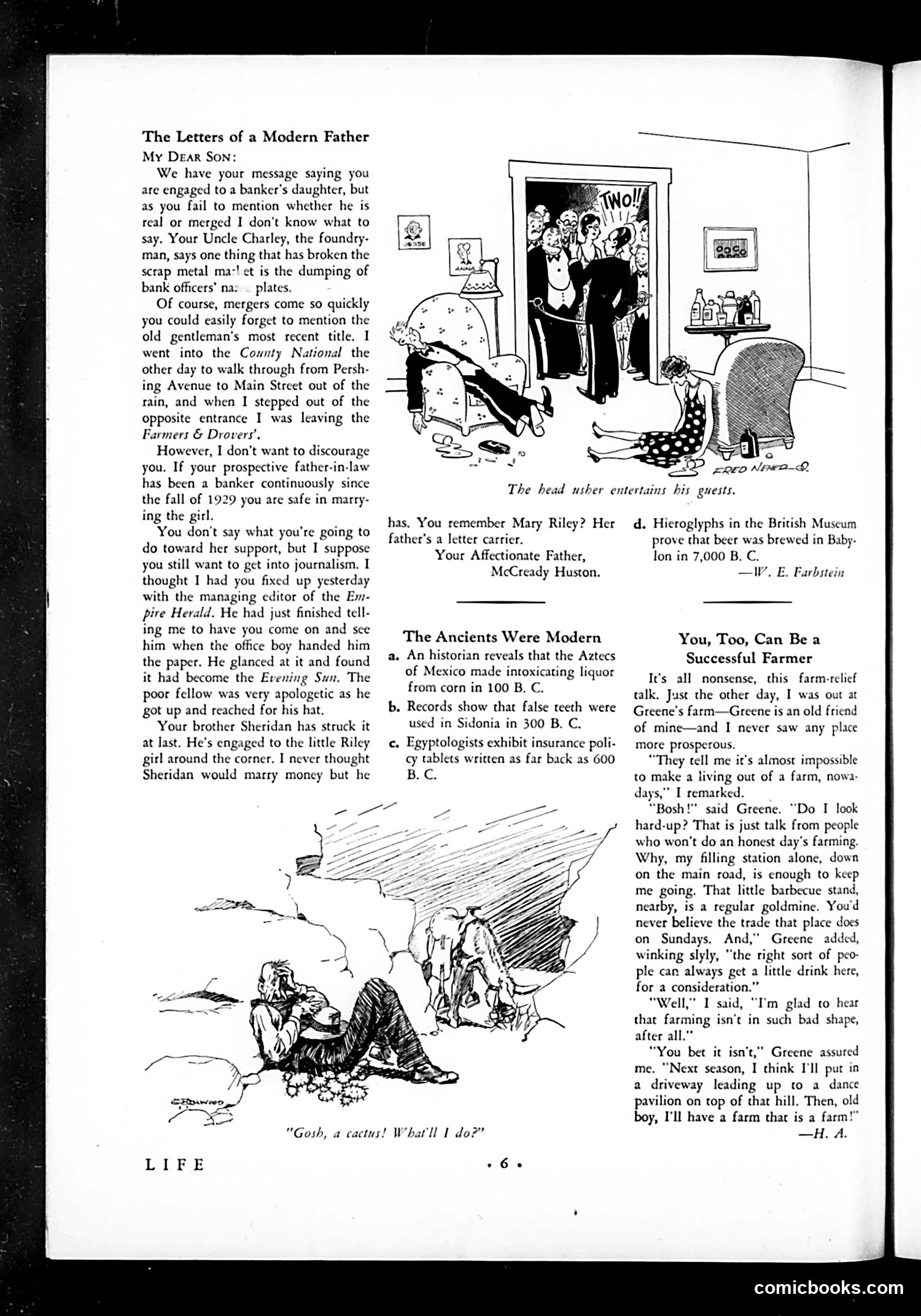
# Explanation of Content This page contains three satirical pieces from *Life* magazine: 1. **"The Letters of a Modern Father"** (left): A humorous letter from a father to his son regarding the son's engagement to a banker's daughter. The father mentions Uncle Charley (a foundry man) and references to the *County National* bank and the *Evening Sun* newspaper. The satire targets the father's snobbish concern about the prospective in-law's social status and occupation. 2. **"The head usher entertains his guests"** (top right): A cartoon depicting a domestic scene where a head usher hosts visitors. The satire likely mocks pretentious social climbing and the awkwardness of working-class people attempting upper-class hospitality. 3. **"You, Too, Can Be a Successful Farmer"** (right): A dialogue between the narrator and "Greene" about farming profitability, suggesting that modern farming can succeed through unconventional means (a filling station and barbecue stand on the property).
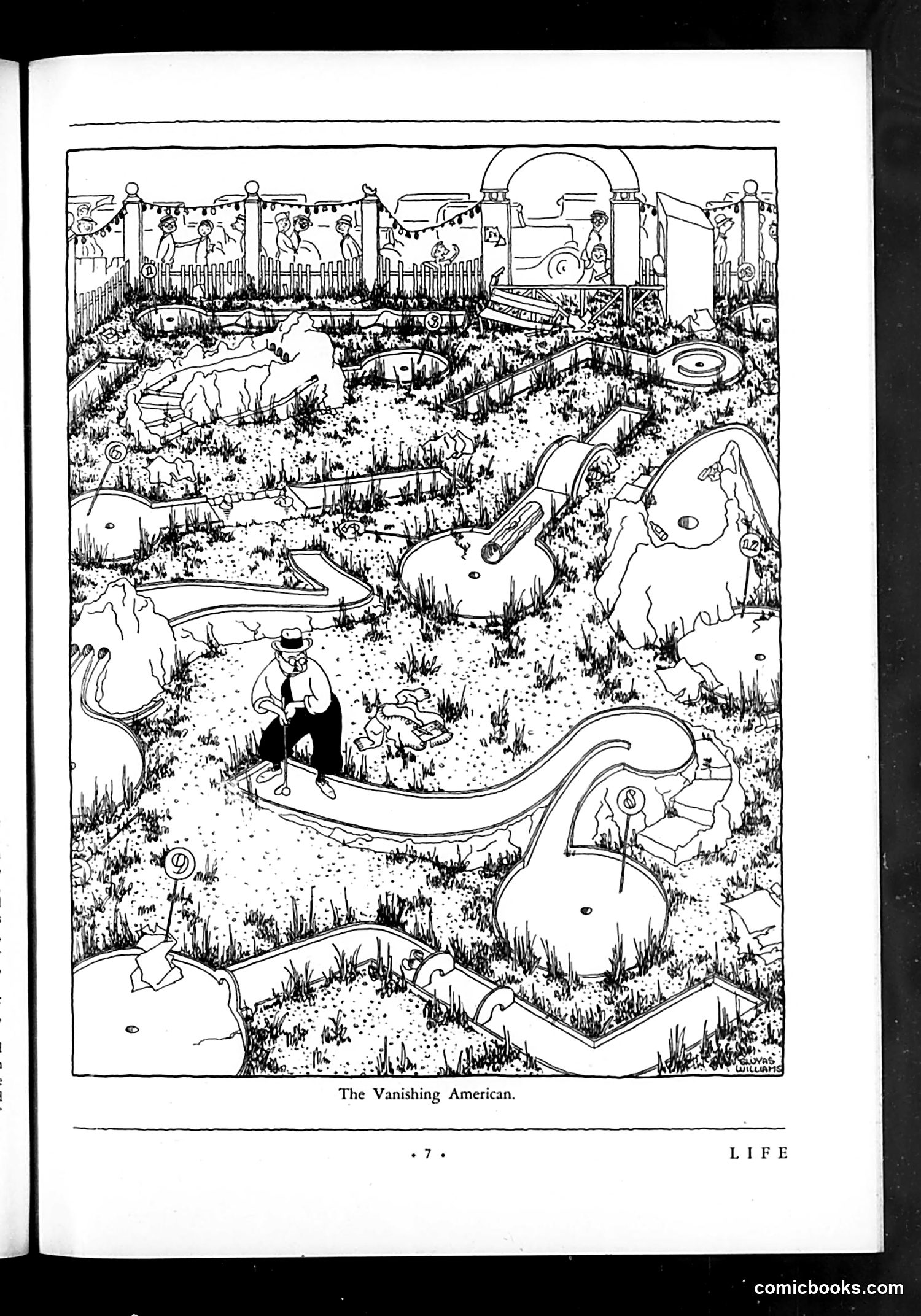
# "The Vanishing American" This cartoon depicts Native Americans as literally disappearing into the ground beneath a bustling amusement park or fair. Spectators watch from decorated viewing stands above while the landscape shows Indigenous peoples being consumed or absorbed into the earth itself—represented by dome-shaped mounds and figures sinking downward. The title and imagery express a dark satirical commentary on the displacement and destruction of Native American populations during American expansion. The stark contrast between the cheerful crowd above and the vanishing people below emphasizes how American society ignored or celebrated Indigenous erasure as entertainment. This reflects late 19th/early 20th-century anxieties about Native American populations being viewed as obsolete relics of a "vanishing" past.
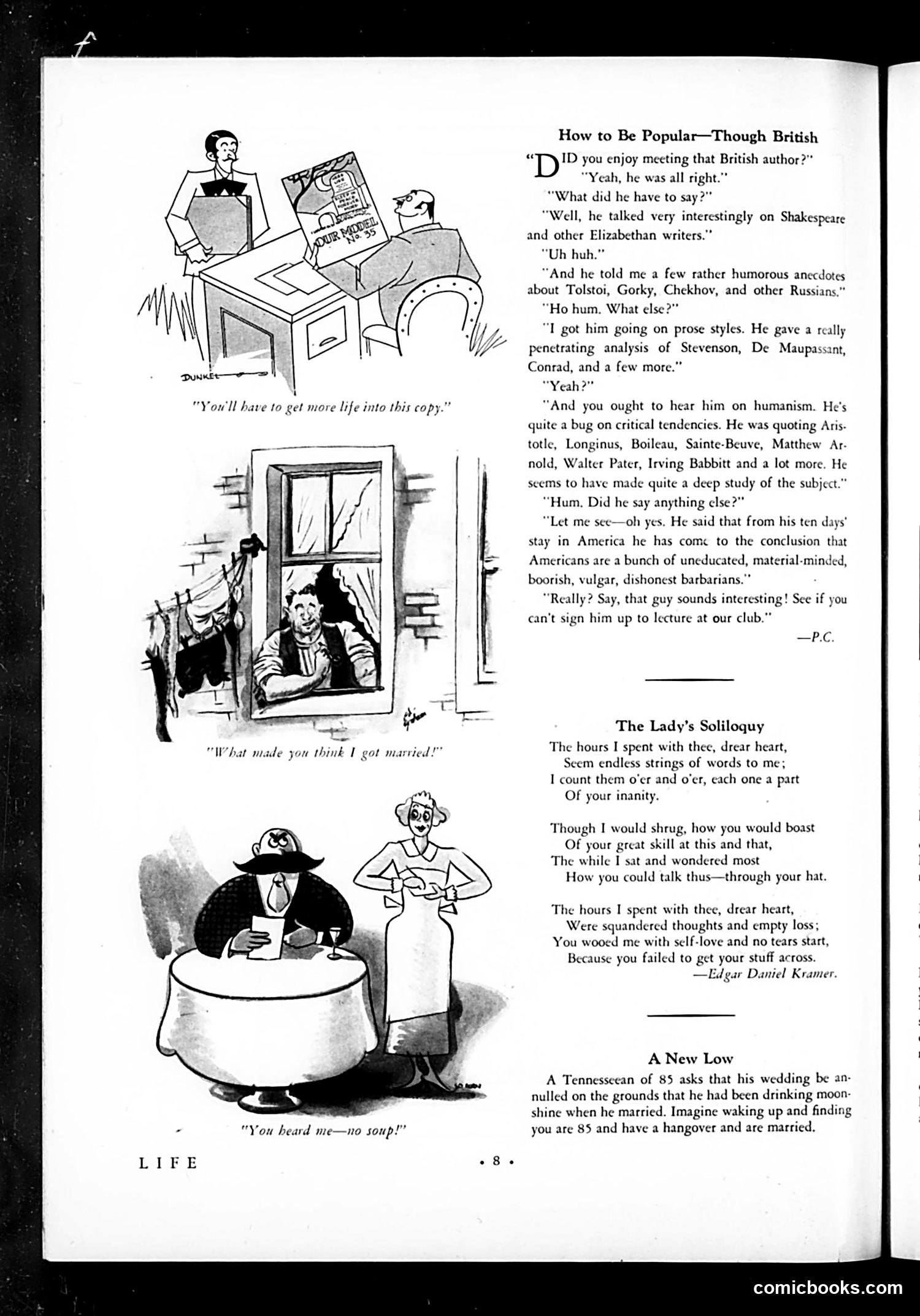
# Page Analysis: Life Magazine Satire This page contains three separate humorous pieces: **Top cartoon**: A man at a desk tells an editor, "You'll have to get more life into this copy"—satirizing editorial demands for livelier writing. **Middle cartoon**: Shows a couple at a window with the caption "What made you think I got married!"—joke about disillusionment in marriage. **Bottom cartoon**: Depicts a portly man at dinner with a standing woman, captioned "You heard me—no soup!"—apparently about marital conflict or domestic power dynamics. The **right column** contains a conversational piece about meeting a British author who discussed Shakespeare, Russian writers, and prose styles, then expressed disdain for Americans as "uneducated, material-minded, boorish" barbarians—satirizing intellectual pretension and anti-American snobbery. Below are a poem ("The Lady's Soliloquy") and a brief anecdote about an 83-year-old Tennessean seeking to annul his marriage due to a hangover.
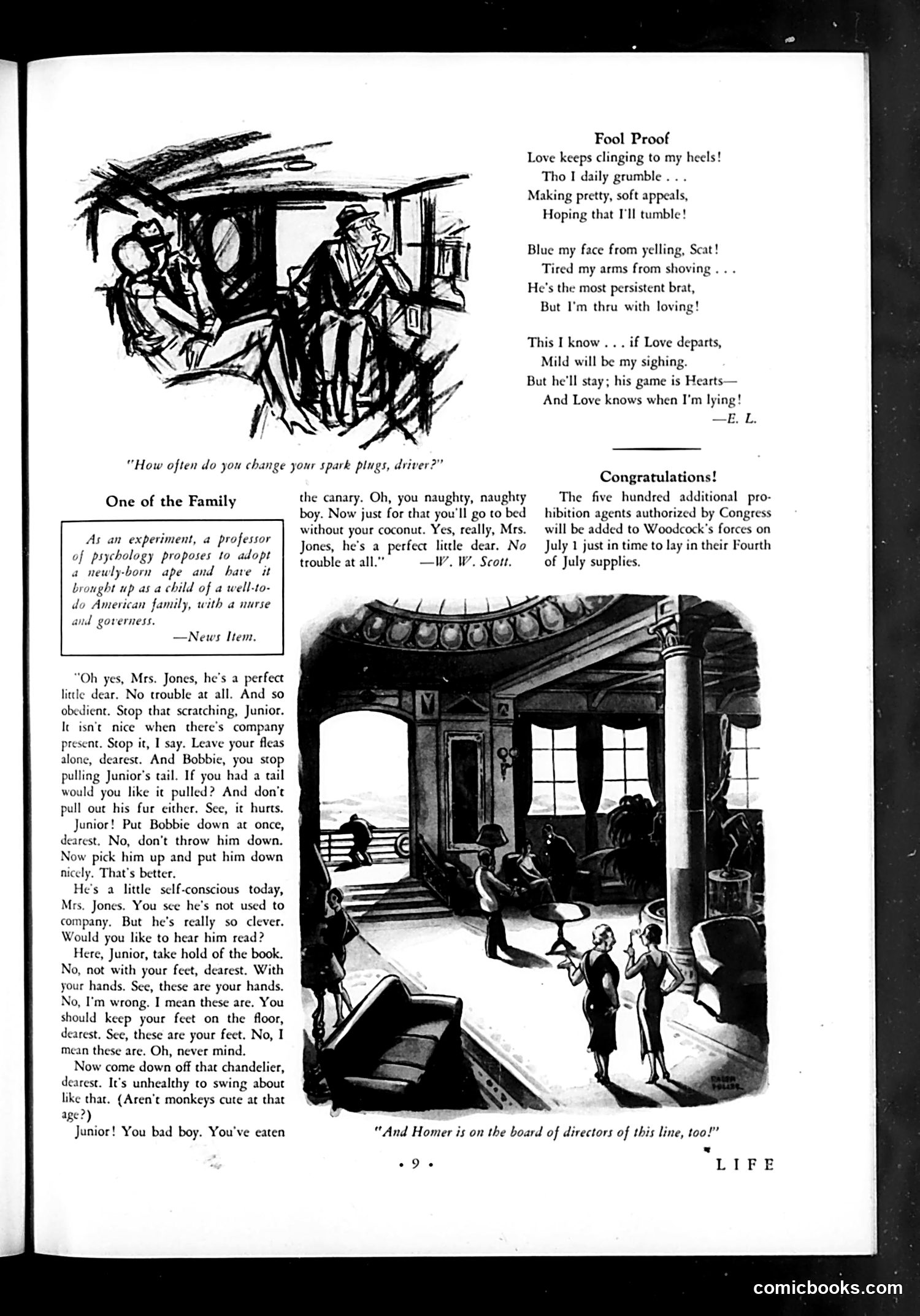
# Analysis This page contains three distinct pieces: 1. **"Fool Proof" (poem)**: A sentimental poem about romantic persistence despite rejection, signed "E.L." 2. **"One of the Family" (story)**: A domestic humor piece about a psychology professor who brings home an ape as an experiment. The setup satirizes early-20th-century scientific hubris—the idea that animal behavior can be studied through family integration. Mrs. Jones's lengthy monologue about the ape's good manners is absurdist humor, treating the creature as an unruly houseguest. 3. **"Congratulations!" (cartoon)**: Shows what appears to be a ship's interior with text referencing Homer on a "board of directors." This seems to be nautical/maritime humor, likely satirizing corporate boards or wartime administration. The page represents Life magazine's mixed-format approach: poetry, domestic comedy, and visual satire targeting early-20th-century social pretension and scientific overreach.
# "Life Looks About" - Political Commentary Page This page contains three opinion pieces on post-WWI policy issues: 1. **"Our Ailing World: Doctors Called In"** discusses German reparations payments and Allied debt collection, suggesting the debtor nations need economic relief to restore prosperity. 2. **"Get a Better Law"** critiques education policy, specifically referencing Mr. Wickersham's Eighteenth Amendment address at Syracuse. The author argues that education—particularly habitual association with temperate people—matters more than prohibition laws in preventing alcoholism. 3. **"Sighting Another World"** celebrates Sir Oliver Lodge's 80th birthday and his scientific theories about invisible worlds and intelligence beyond human understanding. The decorative header illustration shows a cherub or angel figure. The content reflects 1920s concerns: war debt, Prohibition enforcement, and emerging spiritualist/scientific interests.