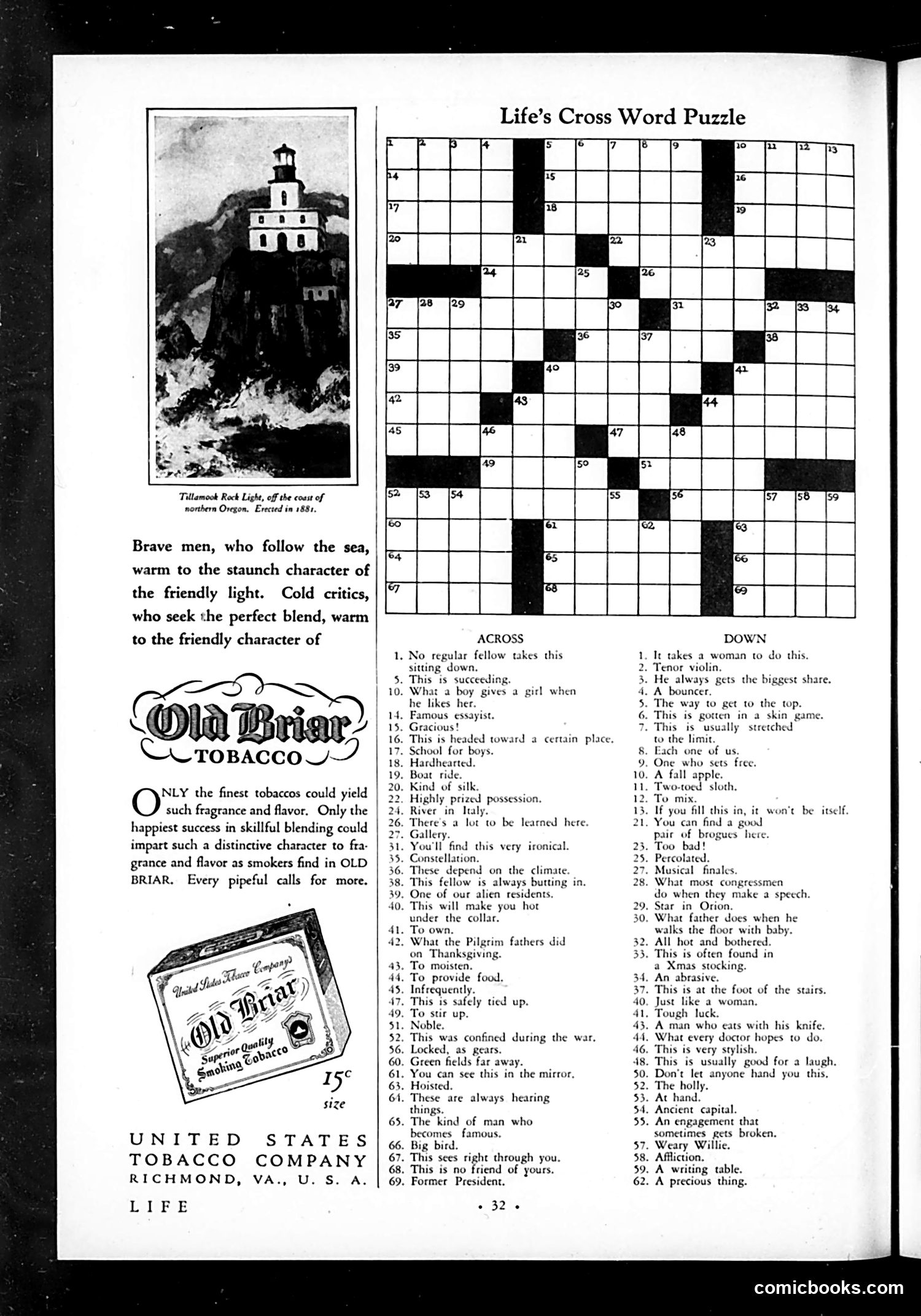
A complete issue · 36 pages · 1931
Life — June 19, 1931
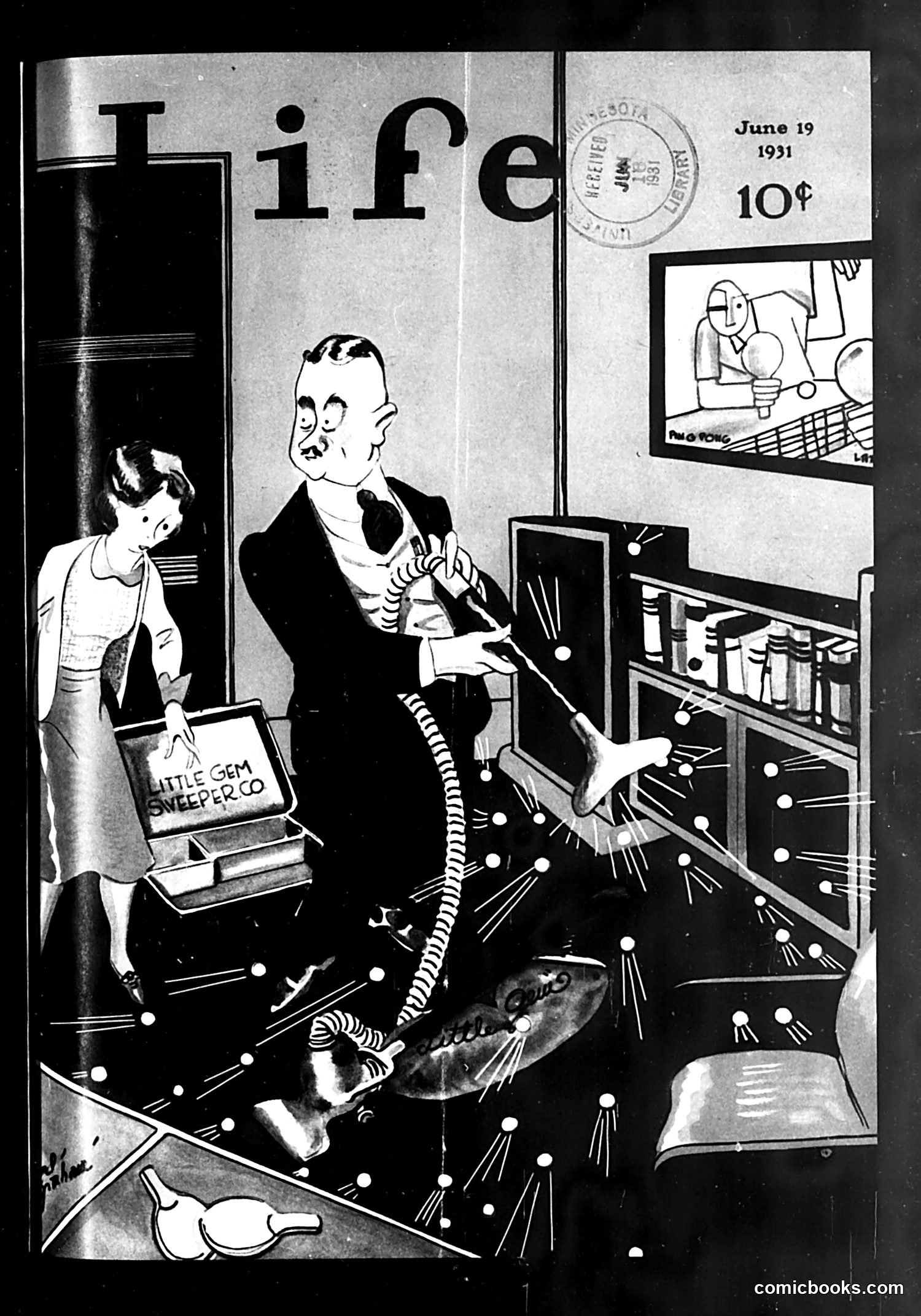
# Life Magazine, June 19, 1931 This cartoon satirizes a man in formal attire using electrical equipment—apparently a laboratory or scientific apparatus with visible electrical coils and wiring. He appears to be conducting some kind of experiment, while a woman on the left holds a box labeled "LITTLE GEM SHIPPER CO." The cartoon seems to mock either pseudoscientific claims or an inventor/entrepreneur promoting dubious electrical products. The chaotic electrical imagery and the man's exaggerated facial expression suggest incompetence or fraud. The "Little Gem Shipper Co." box likely represents a commercial venture or mail-order business. Without clearer textual context identifying the specific figure or product being satirized, the general target appears to be 1930s-era snake-oil salesmen or fraudulent inventors making false claims about electrical devices and their miraculous properties.
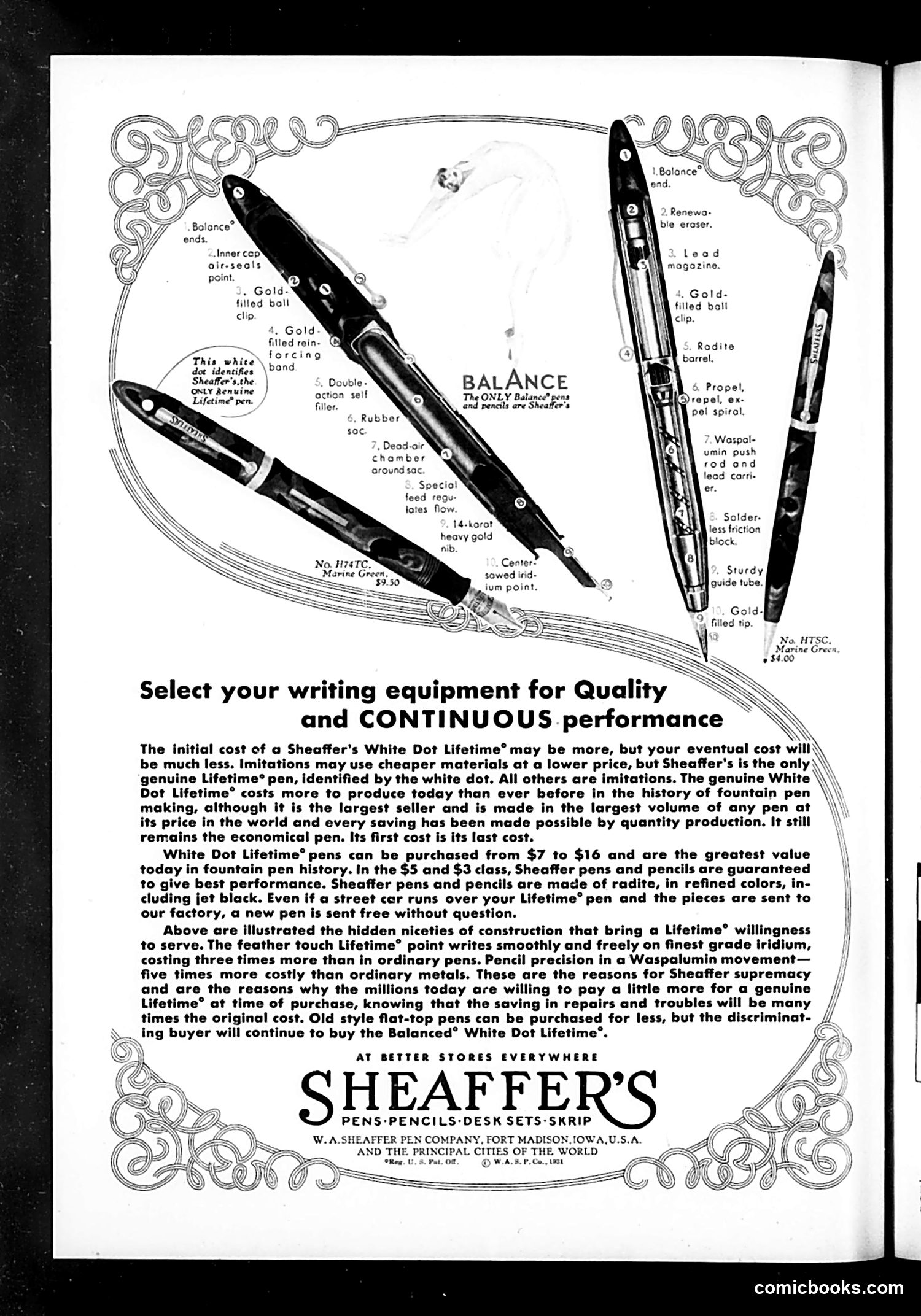
# Content Analysis This page is primarily a **Sheaffer's fountain pen advertisement**, not political satire or comics. The image shows detailed technical diagrams of the "Balance" fountain pen model with labeled components (balance ends, gold-filled clips, feed mechanisms, etc.). The advertisement emphasizes quality construction and durability as justification for the higher price point ($7-$16). The marketing copy argues that Sheaffer's "White Dot Lifetime" pens, though initially more expensive than imitations, offer better long-term value through superior materials and craftsmanship. It claims competitors use "cheaper materials" while Sheaffer's remains "the economical pen." The ornamental Art Deco border reflects the design aesthetic of the publication's era. This is straightforward product advertising with no political or satirical content.
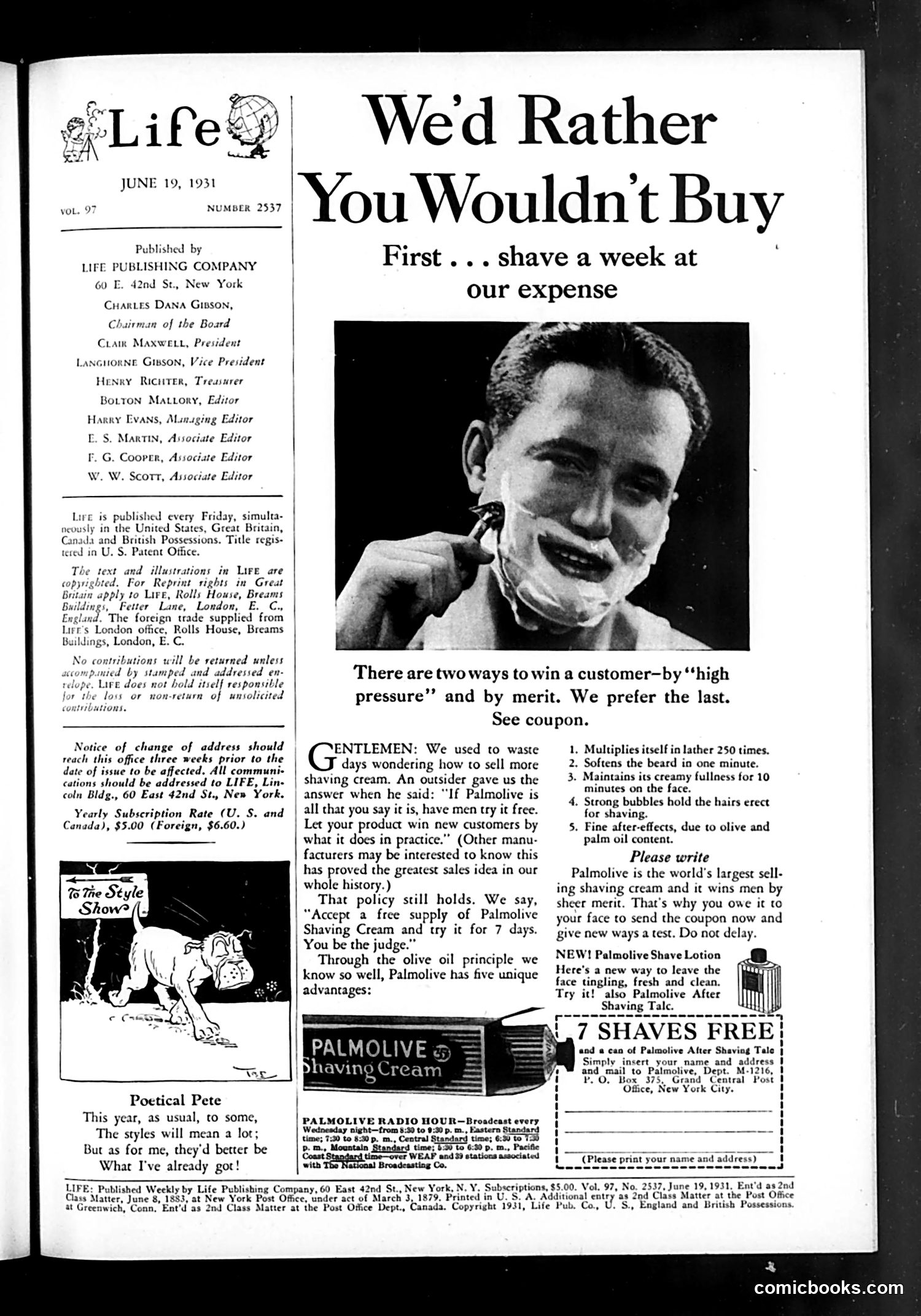
# Analysis This page is primarily a **Palmolive shaving cream advertisement** disguised as editorial content, dated June 19, 1931. The main image shows a man's face demonstrating shaving results. The advertisement's central claim references an "outsider" (likely a competitor or skeptic) who challenged Palmolive to prove its product works by offering free trials. The satirical framing—"We'd Rather You Wouldn't Buy First...shave a week at our expense"—uses reverse psychology, a marketing technique positioning confidence in product merit over aggressive sales tactics. The accompanying text lists five claimed benefits of Palmolive, emphasizing olive oil content. A coupon offers "7 SHAVES FREE" to encourage trial. The small cartoon titled "Poetical Pete" appears unrelated to the advertisement, likely filler content. This represents 1930s advertising strategy: wrapping product promotion in magazine editorial format to seem more credible to readers.

# Analysis This is a **cigarette advertisement**, not political satire. It promotes Spud menthol-cooled cigarettes by The Axton-Fisher Tobacco Company of Louisville, Kentucky. The ad features a formally-dressed man at what appears to be a social gathering, with the tagline "The 'Occasion' Smoker Said" about clean taste. The copy claims that casual smokers prefer Spuds because they maintain a "moist-cool" quality and "clean taste" regardless of consumption volume. The advertisement targets mid-century consumers by positioning the product as enabling social smoking without the typical drawbacks (dry mouth, stale taste). The phrase "grand new freedom in old-fashioned tobacco enjoyment" suggests menthol as a modern innovation. This represents typical 1940s-50s cigarette marketing before health warnings—normalizing smoking as sophisticated social behavior.
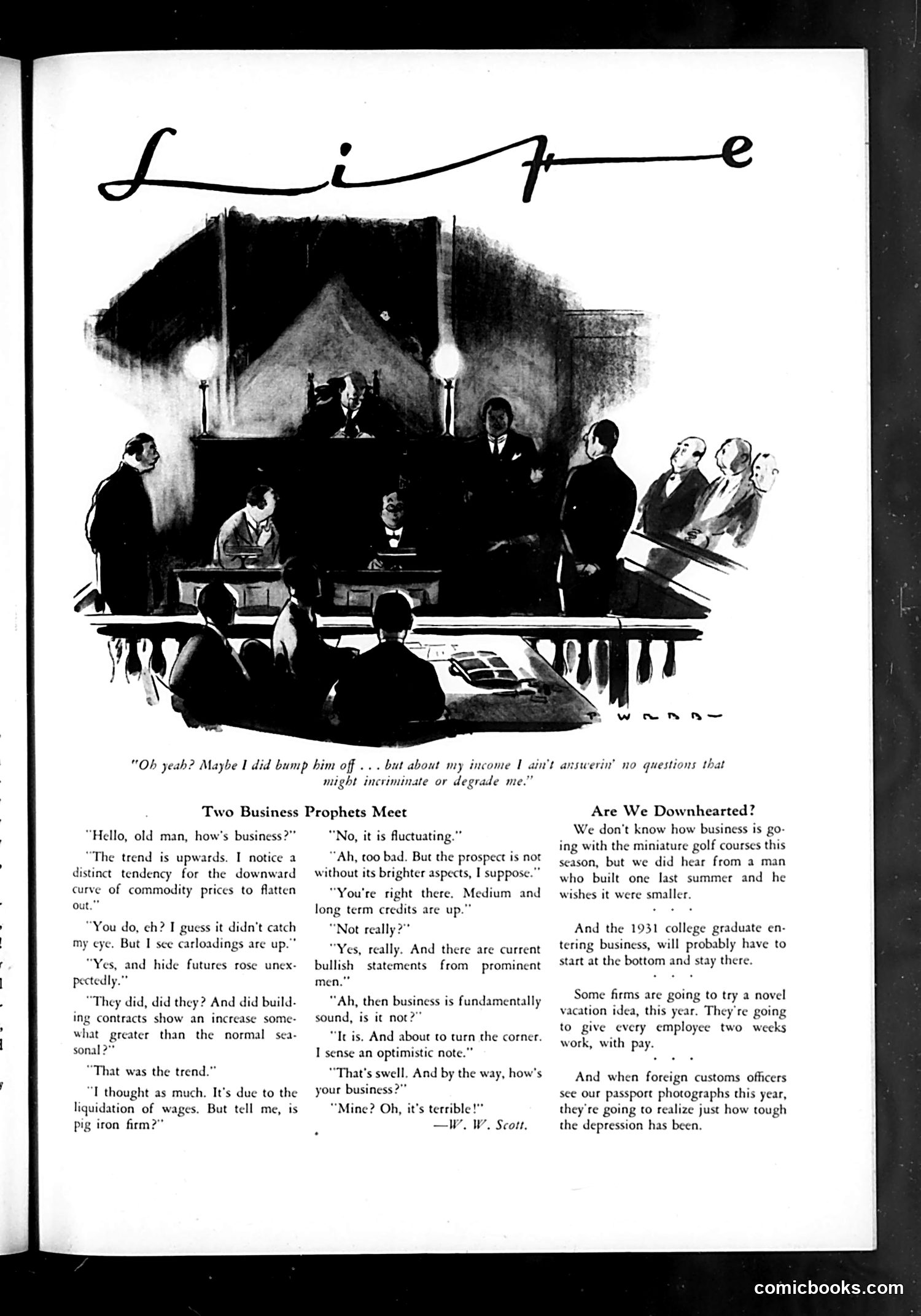
# Analysis This page features a courtroom satire titled "Two Business Prophets Meet." The illustration depicts a trial scene where one businessman testifies about dumping another's body, dismissing it casually while claiming his own income remains unaffected. The dialogue satirizes Depression-era business cynicism. Two executives discuss commodity price deflation, wage liquidation, and building contracts showing "greater than normal" growth despite economic crisis. One notes "the trend is upward" while acknowledging widespread hardship. The right-hand column, "Are We Downhearted?", offers grim economic predictions: new college graduates will start at the bottom and stay there; companies are offering two-week unpaid vacations; customs officials now scrutinize passport photos to assess citizens' hardship. The satire targets callous business rhetoric masking Depression suffering—executives congratulating themselves on "fundamentally sound" practices while ordinary people struggle.
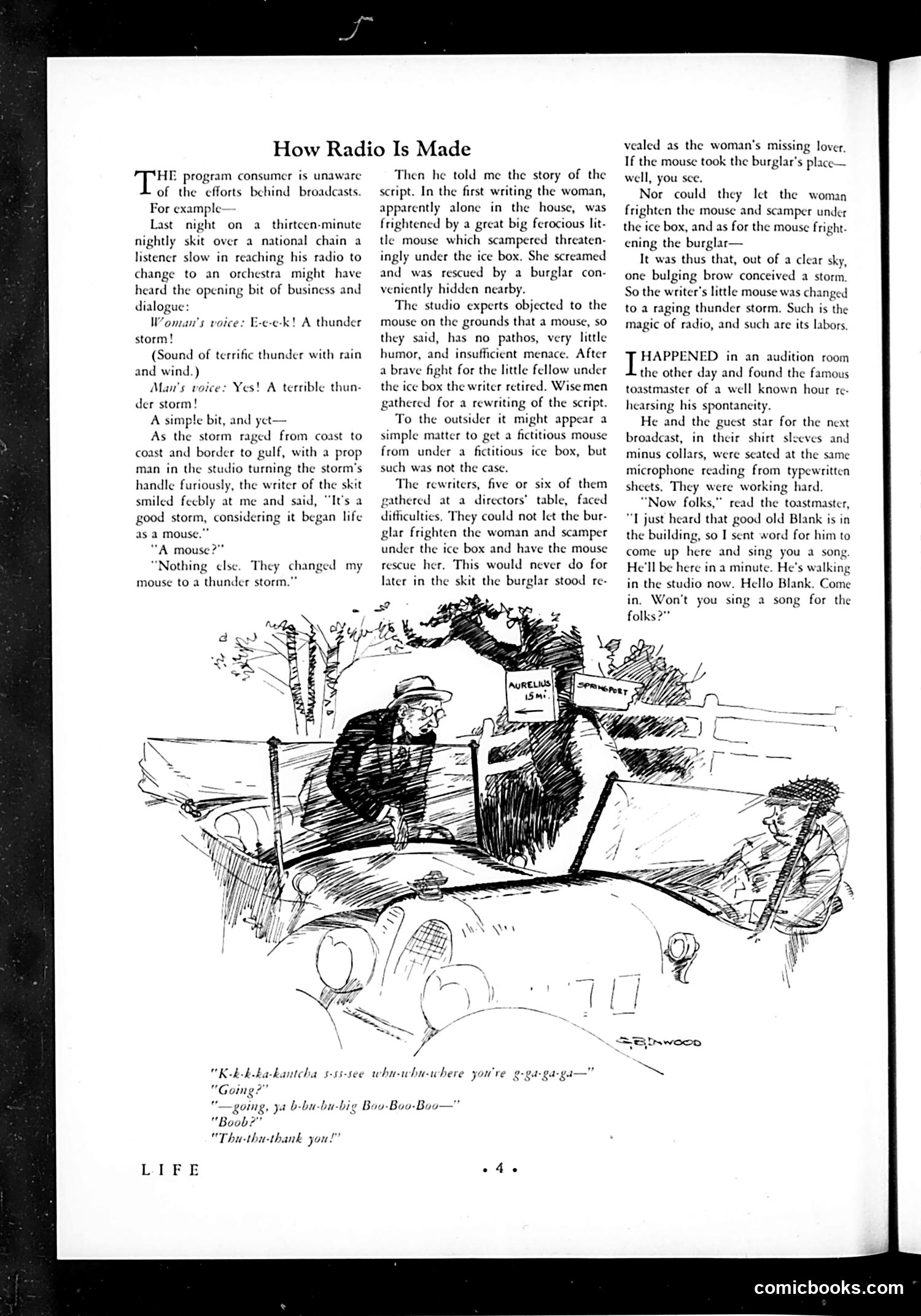
# "How Radio Is Made" This article explains radio broadcasting production through a humorous anecdote. A writer describes how a simple 13-minute radio drama—featuring sound effects like thunder—requires extensive studio coordination. The joke centers on the gap between what listeners hear and the mechanical reality: a small mouse caused the "thunder" effect, which then had to be rewritten into the script as a plot element (the mouse becomes part of the story itself). The cartoon illustrates the behind-the-scenes chaos: a sound-effects technician manipulates props and devices while actors perform at microphones, showing the invisible labor that creates seamless radio broadcasts. The satire mocks how radio presents polished entertainment while hiding the improvisation and absurdity required to produce it.
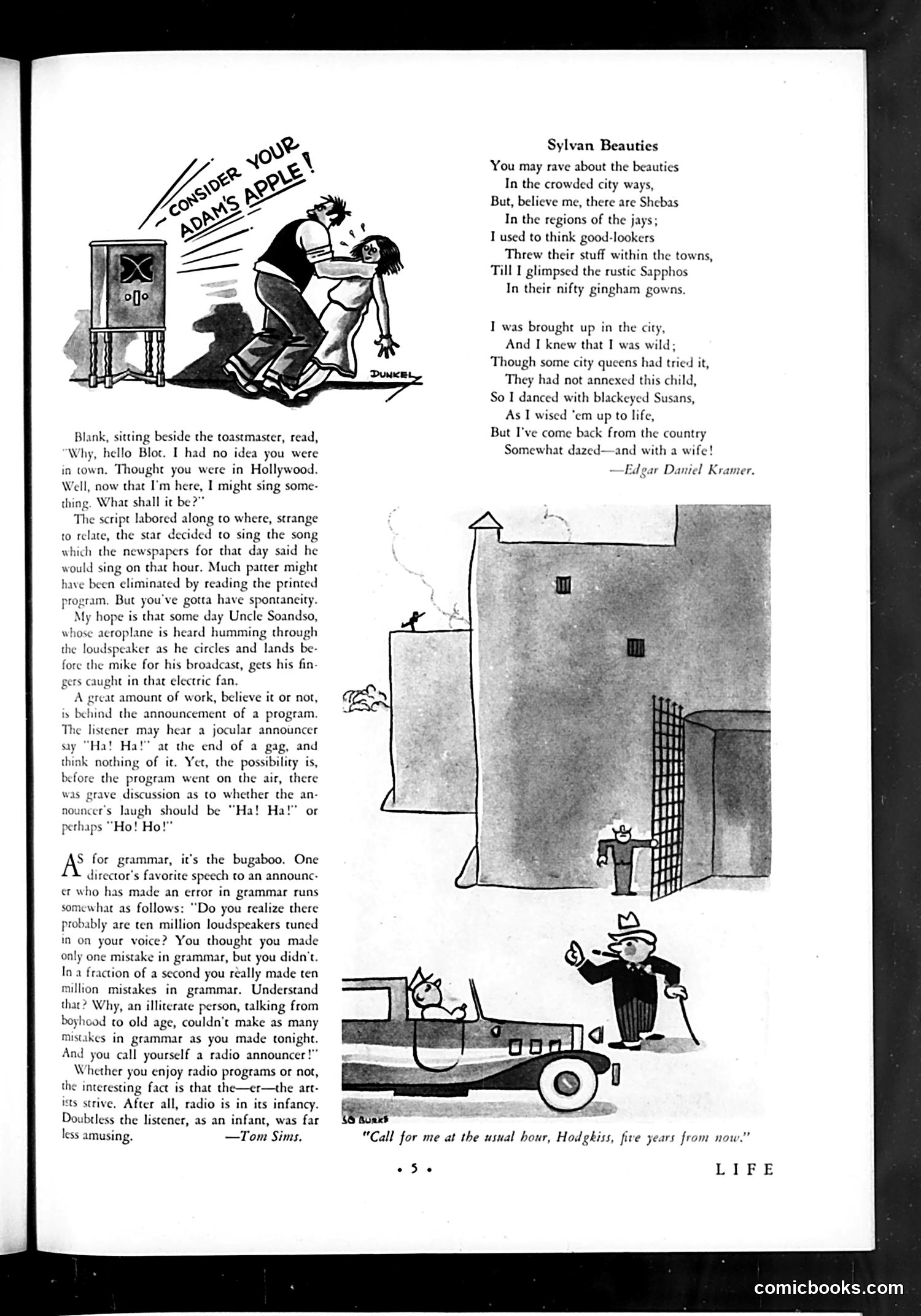
# Analysis of Life Magazine Page **Top Cartoon**: Shows a man being forcibly fed an apple by another figure. The caption reads "CONSIDER YOUR ADAM'S APPLE!" This appears to be a health or dietary satire, likely referencing early 20th-century wellness trends or dietary advice. **Main Content**: The page features "Sylvan Beauties," a poem by Edgar Daniel Kramer contrasting rural and urban beauty. A man boasts of conquering city women until finding a country wife, suggesting a satirical commentary on rural versus urban values—a common theme in period literature. **Bottom Illustration**: Shows a radio broadcaster and someone in a car, with caption "Call for me at the usual hour, Hodgkiss, five years from now." This jokes about radio program scheduling or romantic arrangements via broadcast. The page reflects 1920s-30s American culture: radio's novelty, health crazes, and rural-urban social tensions.
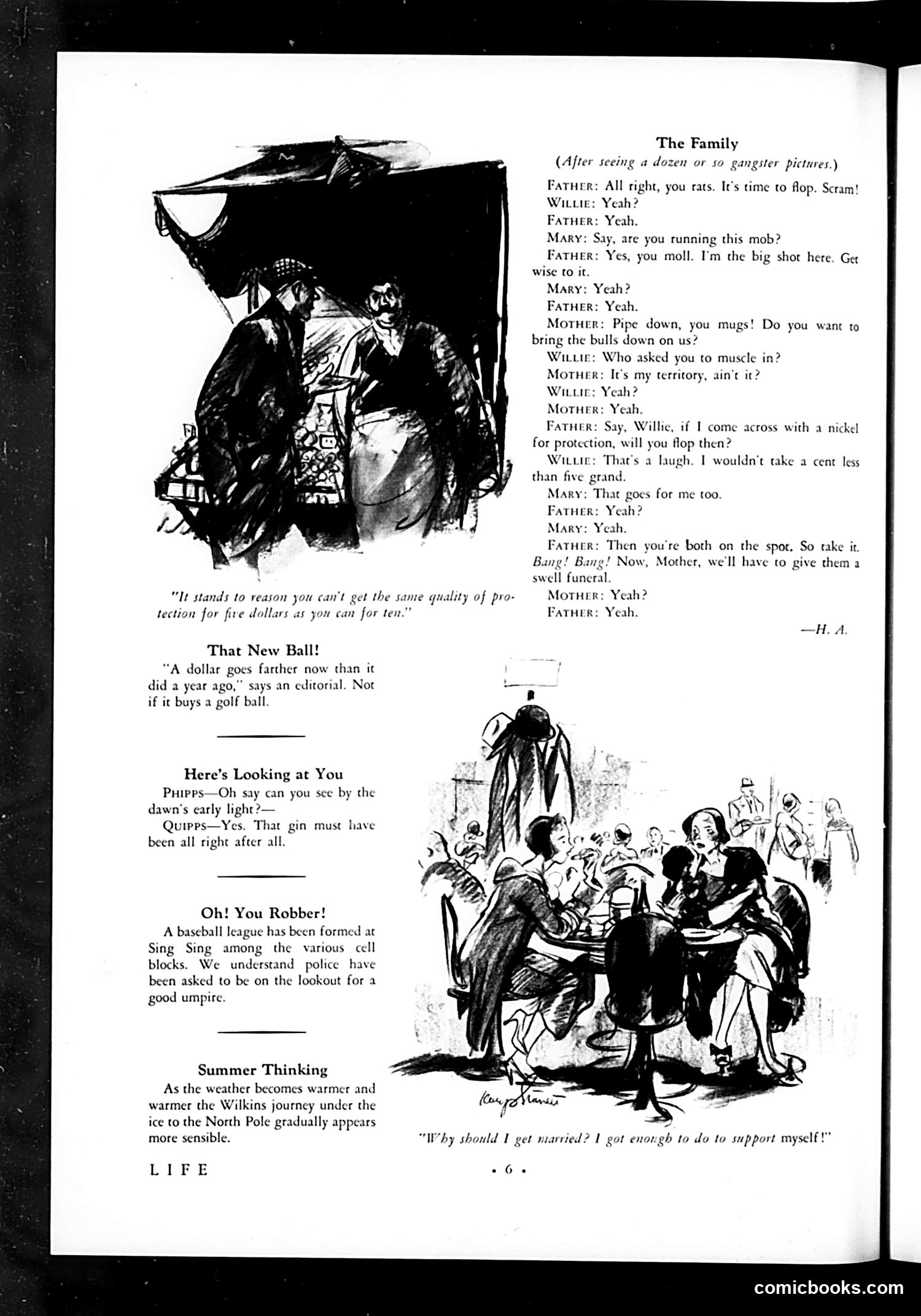
# "The Family" and Related Sketches - Life Magazine Satire The main sketch depicts a mobster ("the big shot") with his family discussing criminal protection rackets. The father boasts about running organized crime operations while his wife and children respond with casual acceptance—the satire mocks how gangster families normalized illegal activity as routine business. The bottom cartoon shows a woman at an altar saying "Why should I get married? I got enough to do to support myself!"—satirizing women's economic independence and reluctance toward marriage, reflecting 1920s social anxieties about changing gender roles. Other brief items mock inflation (a dollar's reduced purchasing power), early morning activities, and forming a baseball league. The overall theme critiques American social issues: organized crime's normalization, women's economic autonomy, and economic hardship—typical Life magazine satirical commentary.
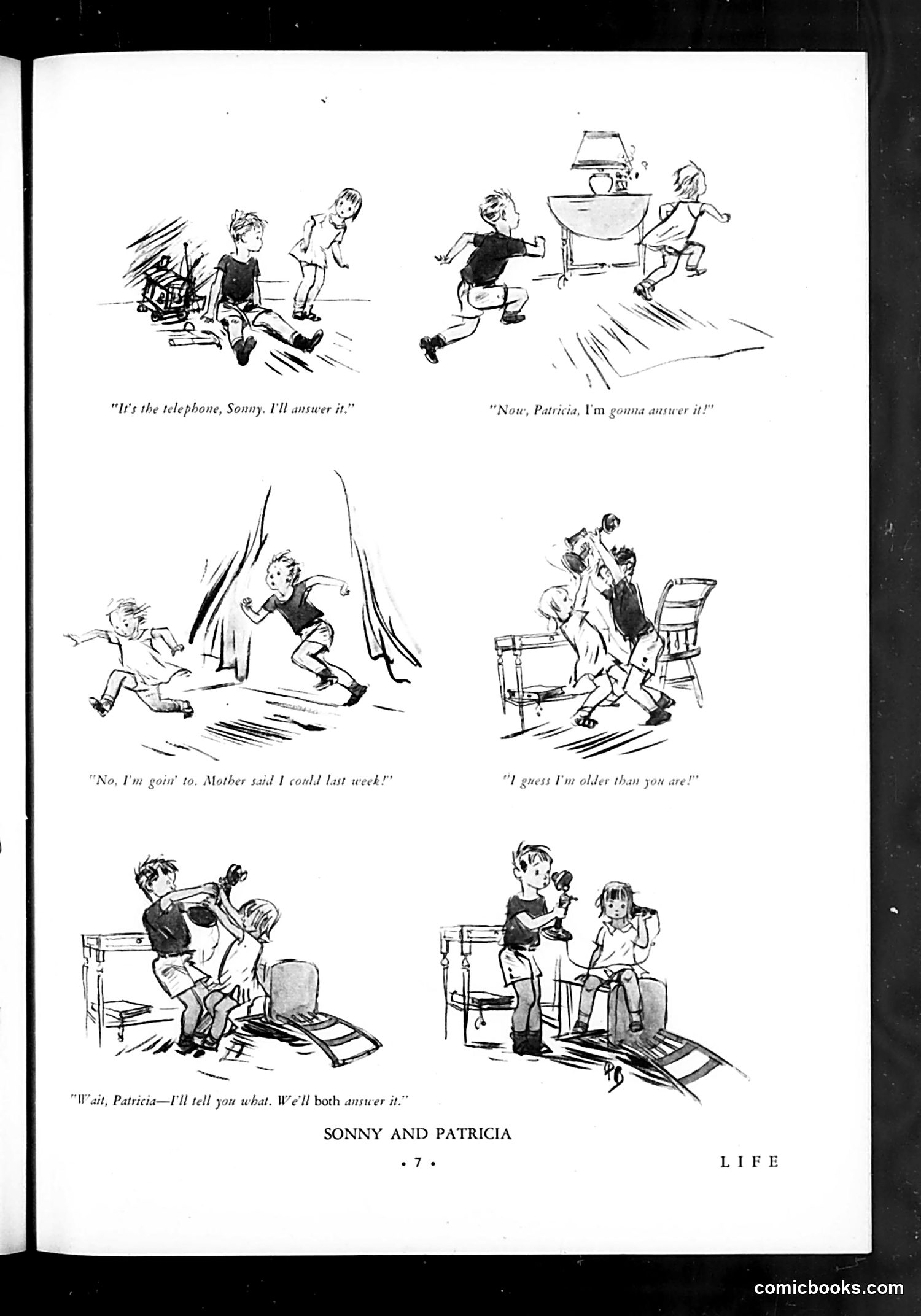
# "Sonny and Patricia" - Life Magazine Comic Strip This is a humorous domestic comic strip featuring two children navigating everyday situations. The sequence shows: 1. **The telephone scene**: Sonny answers a ringing phone while Patricia watches 2. **The competing answer**: Patricia runs to answer instead, saying she'll get it 3. **The excuse-making**: A child claims they can't leave because "Mother said I could last week" 4. **The age assertion**: Children argue about who is older 5. **The collaboration**: They decide to answer together The humor relies on typical childhood behavior—competition over trivial tasks, exaggerated claims about parental permission, and sibling dynamics. This appears to be gentle domestic satire about children's social interactions rather than political commentary. It's typical of Life magazine's lighter entertainment content from the early-to-mid 20th century.
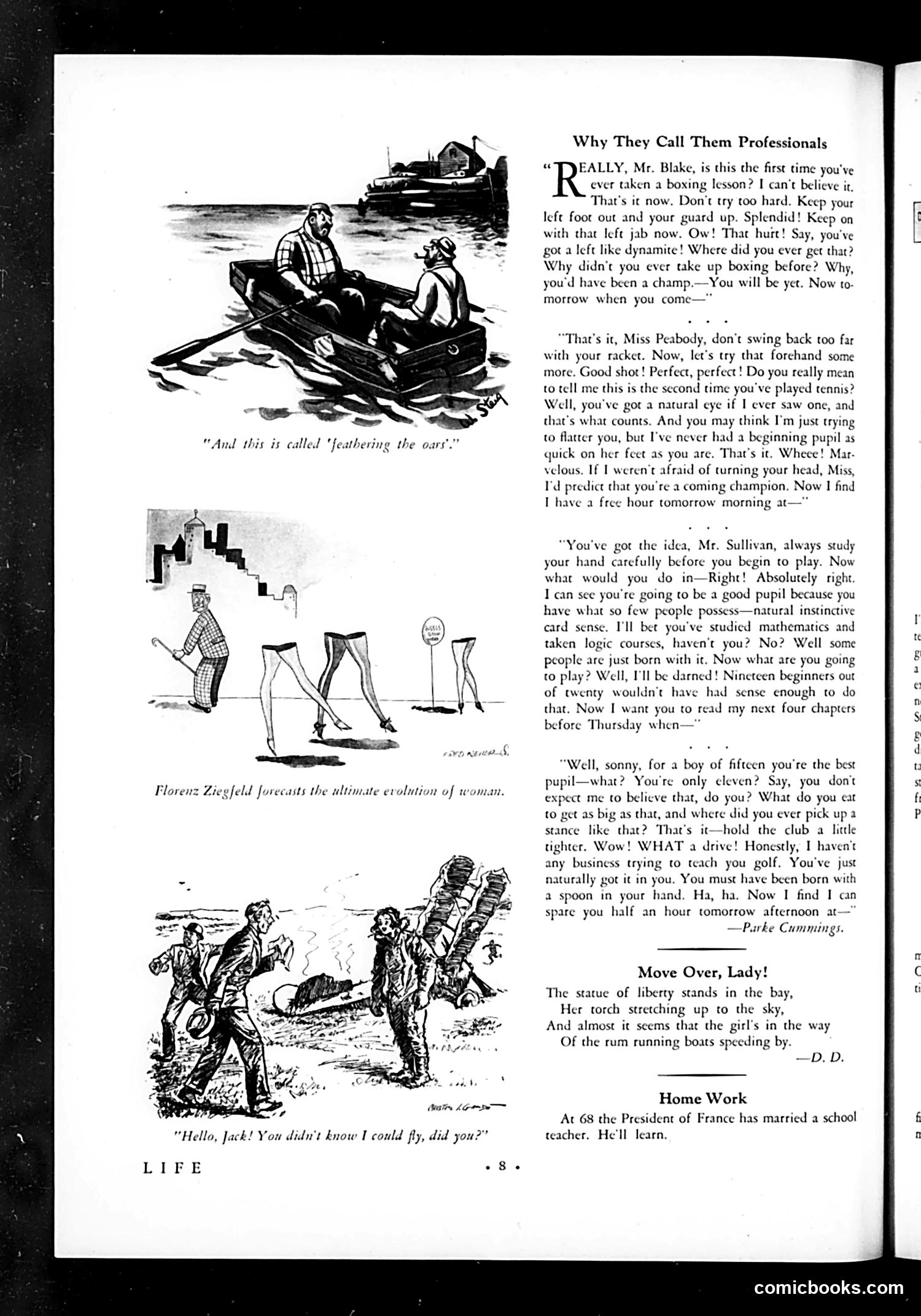
# Analysis of Life Magazine Page This page satirizes sports instruction and amateur athletes. The top illustration shows rowing instruction with the caption "And this is called 'feathering the oar'"—mocking overly technical coaching jargon. The middle illustration labeled "Florenz Ziegfeld forecasts the ultimate evolution of woman" depicts women in exaggerated golf poses, satirizing both the famous impresario's theatrical designs and the era's concern about women entering sports. The bottom cartoon shows someone exclaiming "Hello, Jack! You didn't know I could fly, did you?"—likely referencing contemporary aviation novelty or boasting about athletic prowess. The text passages ("Why They Call Them Professionals," "Move Over, Lady!") humorously critique amateur sports enthusiasts who adopt professional mannerisms and women's increasing athletic participation—both controversial social shifts of the era.
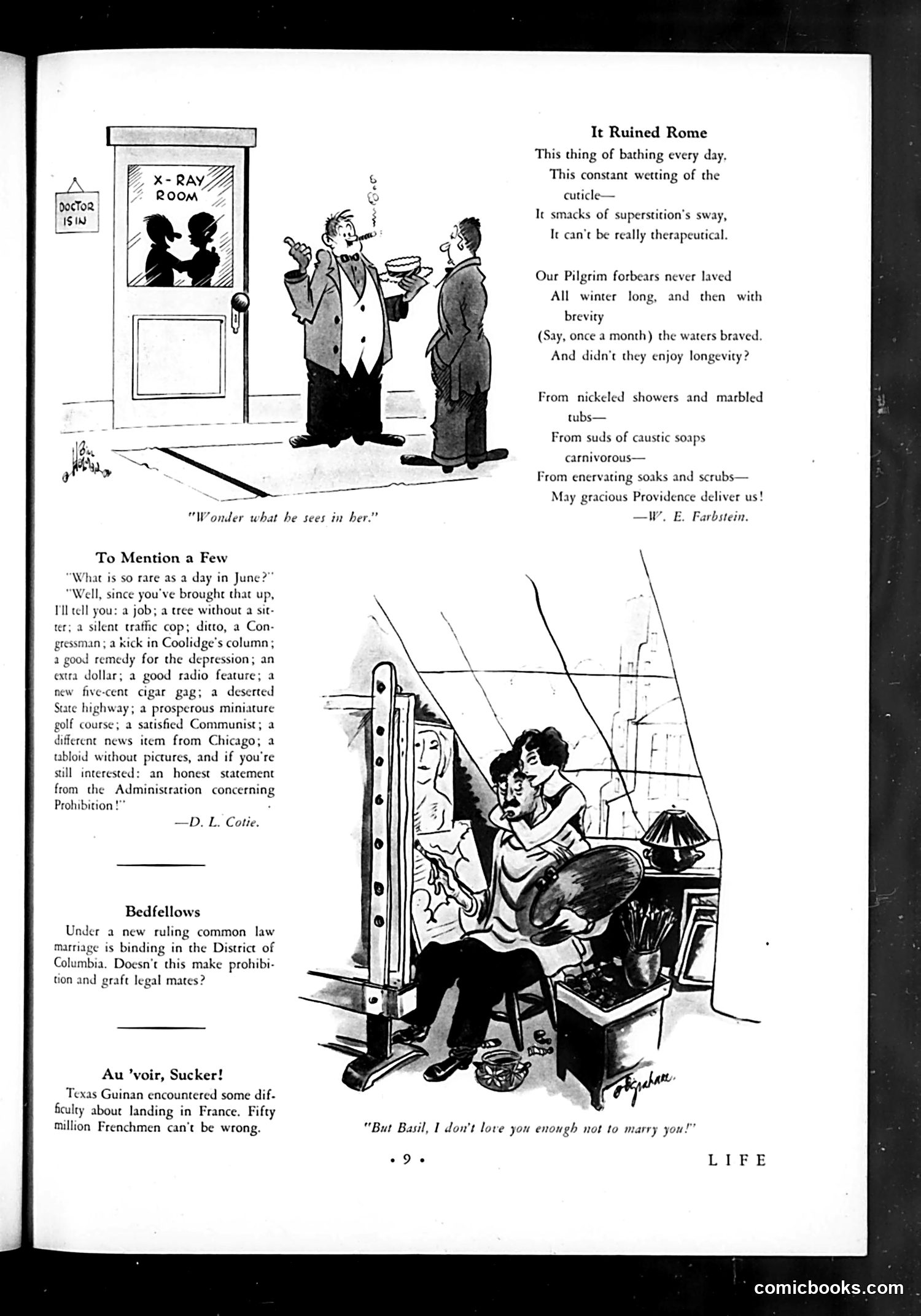
# Analysis of Life Magazine Page **Top Cartoon ("It Ruined Rome"):** Shows a doctor's office where a patient complains about daily bathing. The accompanying poem by W.E. Farberstein satirizes excessive bathing as superstitious and harmful—ironically arguing that Roman pilgrims rarely bathed and lived long lives. This is humorous social commentary criticizing the era's growing hygiene obsession, suggesting constant washing is therapeutically unfounded. **Bottom Cartoon:** Depicts a couple in bed with the caption "But Basil, I don't love you enough not to marry you!" This inverts typical romantic logic—she's saying she doesn't love him *enough* to *avoid* marrying him, implying mercenary or pragmatic motivations rather than genuine affection. **Other Items:** Brief satirical pieces about rare occurrences, prohibition law absurdities, and French military landing difficulties.
# "Life Looks About" This page contains three opinion pieces rather than political cartoons. The main articles address: 1. **"A Ruction in Italy"** — discusses power struggles between the Pope and Mussolini over control in Italy, examining which institution will ultimately influence Italian affairs. 2. **"Our Mr. Morrow!"** — speculates on what will happen to Mr. Morrow (appears to be a political figure) within a year, questioning whether he'll become president and discussing his potential as a political solution. 3. **"Joan of Arc's 500th!"** — celebrates a May 31st anniversary of Joan of Arc's death in Rouen, noting that despite modern circumstances (Mooney still in jail, citizenship denied to Professor MacIntosh), Joan remains an admirable historical figure. The small illustration shows Cupid with what appears to be a swan or bird, likely decorative rather than satirical.