A complete issue · 36 pages · 1931
Life — June 5, 1931
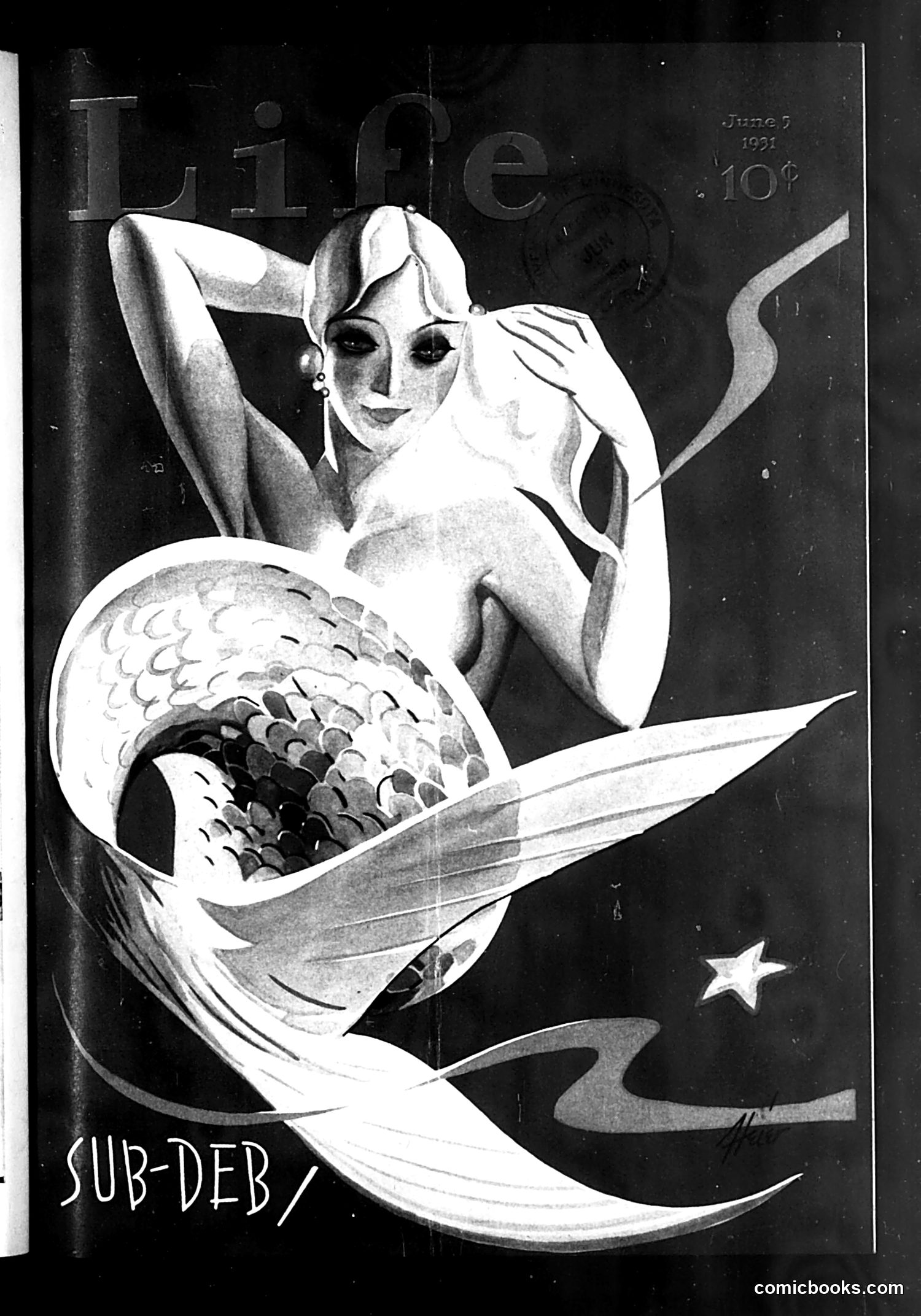
# Life Magazine Cover Analysis - June 7, 1931 This is a Life magazine cover from June 1931 featuring an Art Deco-style illustration signed "SUB-DEB." The image depicts a stylized female figure in an elegant, theatrical pose with a large shell or fan-like form. The artistic style and composition suggest this is satirizing fashionable society women or "debutantes" of the era—hence the "SUB-DEB" (sub-debutante) reference, a social category for young women entering high society. The ornate, somewhat exaggerated styling appears to mock the pretensions and vanity of upper-class women's fashion and social conventions during the Jazz Age. The cover price of 10 cents and the date place this squarely in the Great Depression era, when satirizing wealthy elites held particular resonance.
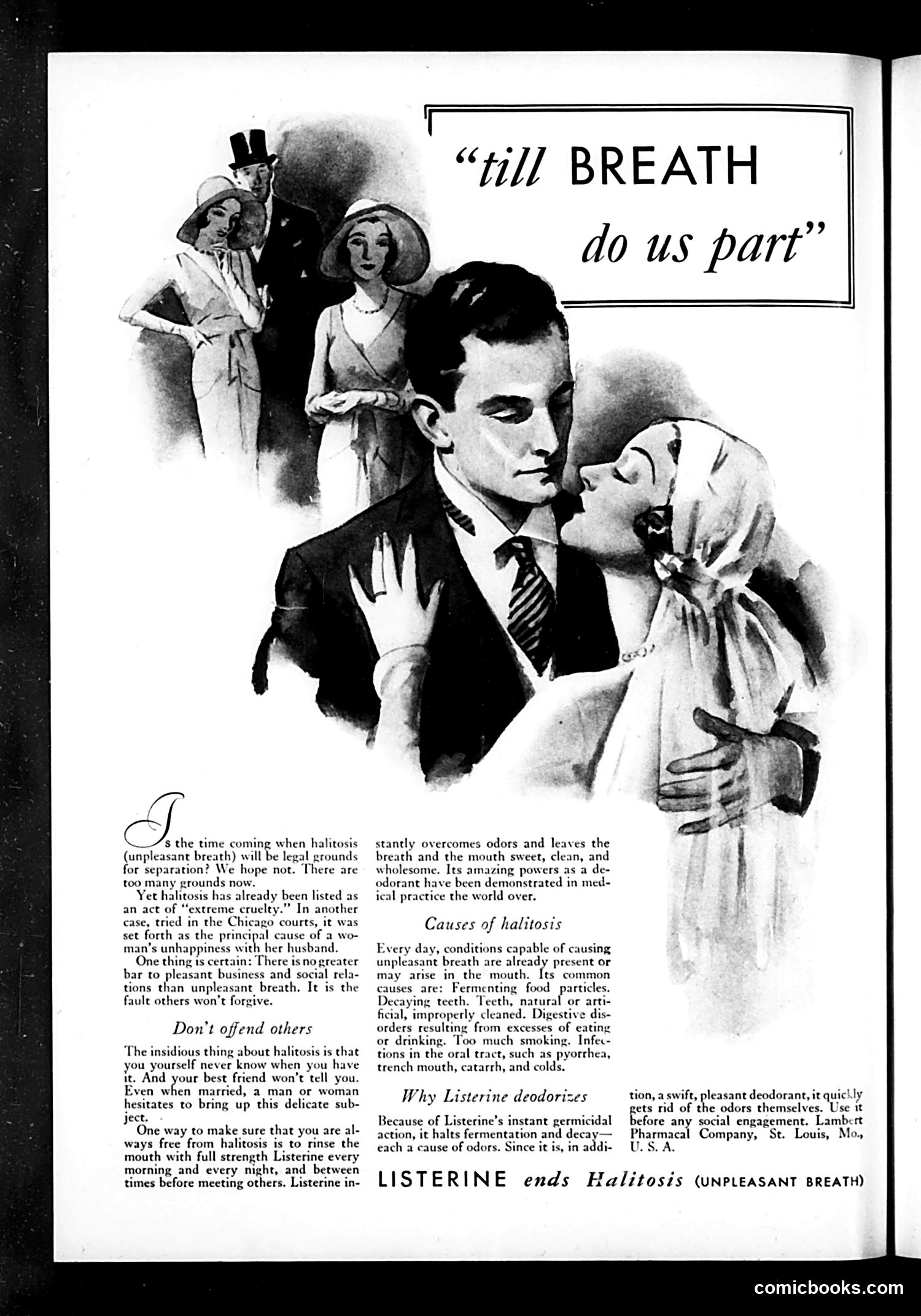
# Listerine Advertisement Analysis This is a **Listerine mouthwash advertisement**, not political satire. The illustration depicts a social scenario where a man appears rejected or avoided by others due to halitosis (bad breath). The headline quotes "'till BREATH do us part," suggesting that unpleasant breath threatens relationships and social standing. The ad argues that halitosis causes social embarrassment and damaged business/personal relations. It lists causes: fermenting food, decaying teeth, digestive disorders, smoking, and infections. The solution presented is Listerine, which the ad claims uses "instant germicidal action" to halt fermentation and decay. This reflects early 20th-century marketing that exploited social anxiety about hygiene to sell commercial products—a common advertising strategy of the era.
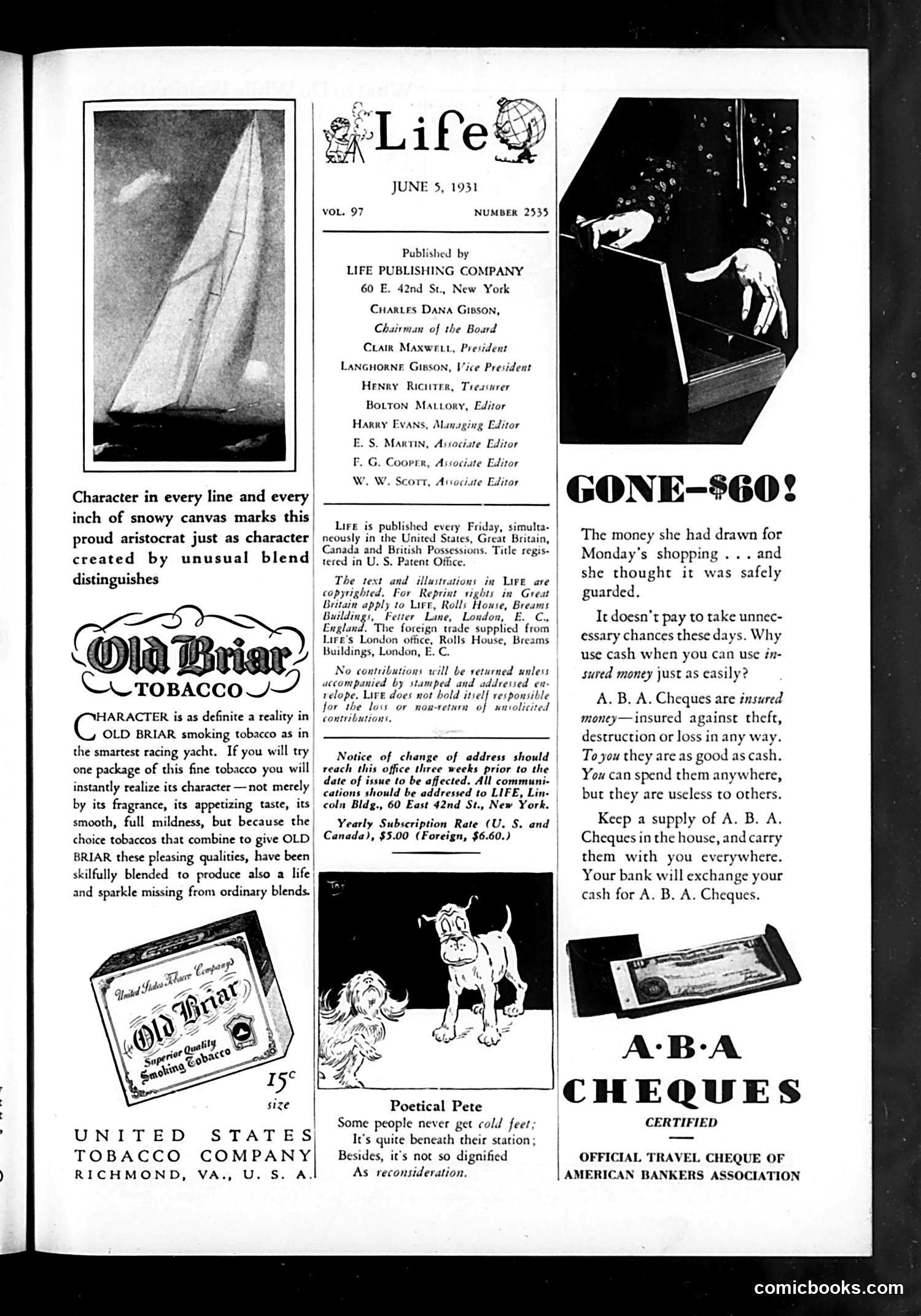
# Content Analysis This page is primarily **advertising and masthead information** for Life magazine (June 5, 1931, Vol. 97). The main editorial content is minimal: a small cartoon titled "Poetical Pete" showing a dog and small figure, with a brief humorous verse about someone not getting "cold feet" despite being beneath a station. The page is dominated by three advertisements: 1. **Old Briar Tobacco** — emphasizing character and quality blending 2. **A.B.A. Cheques** — promoting traveler's checks as safer than carrying cash (a financial safety message during the Great Depression era) The sailboat photograph at top left appears decorative rather than satirical. There is **no significant political cartoon or social satire** on this page—it functions primarily as a title/advertising page rather than editorial content.
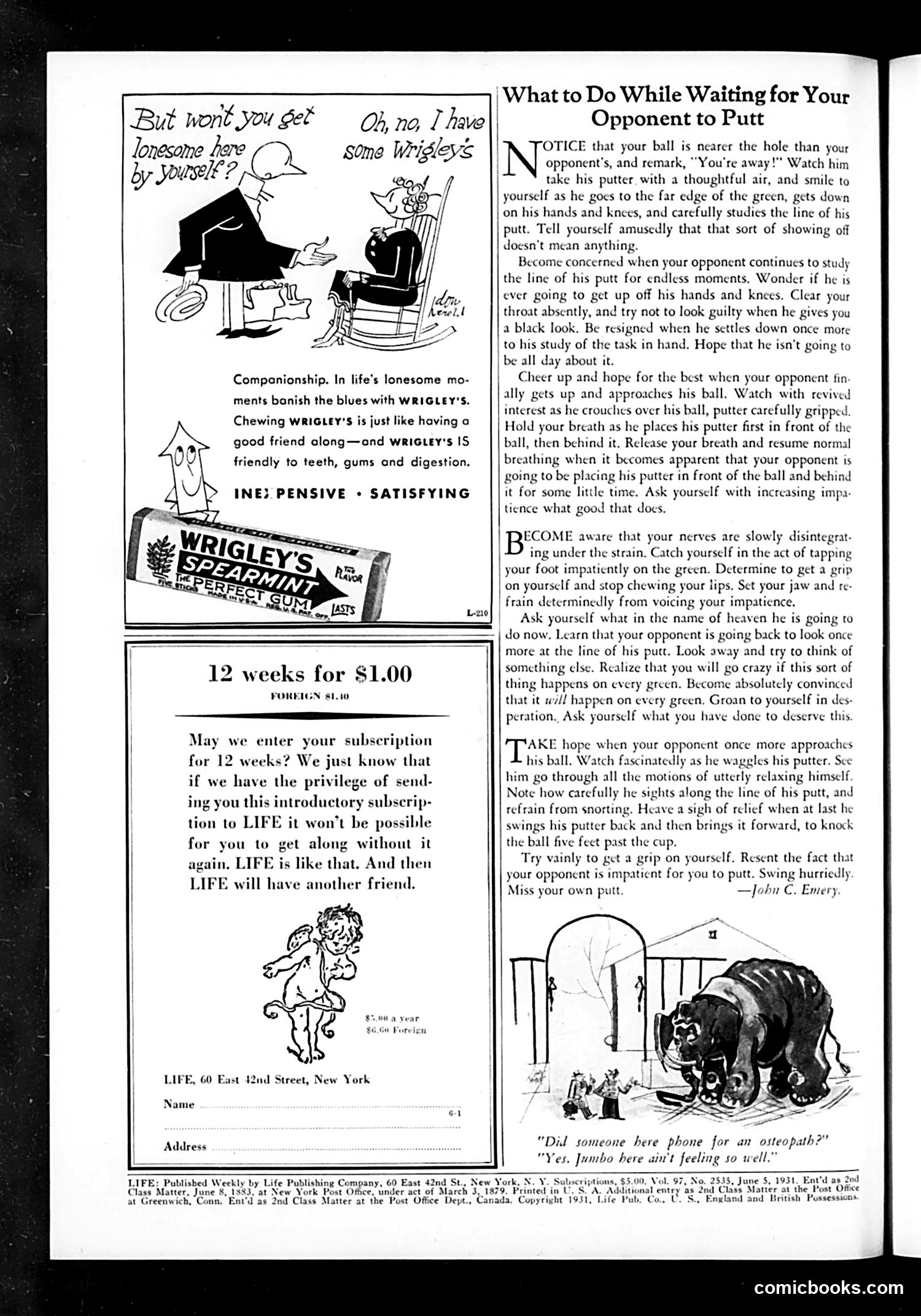
# Page Analysis: Life Magazine, June 5, 1931 This page combines **advertising and humor content** typical of 1930s Life magazine. The top cartoon depicts two golfers—one asking his lonely companion if he's gotten "lonesome here by yourself," while the other sits alone with Wrigley's gum. This advertises Wrigley's as a companion to pass time during solitary moments. The main article, "What to Do While Waiting for Your Opponent to Putt," humorously catalogs the psychological torments of golf: nervousness, impatience, distraction, and self-doubt. It's satirizing golfers' competitive anxiety and the mind games inherent in the sport. The bottom cartoon shows an ailing dog with the caption "Did someone here phone for an osteopath? Yes, Jumbo here ain't feeling so well"—a gentle joke about the dog's size and health. These are lighthearted, non-political pieces reflecting 1930s leisure-class humor.
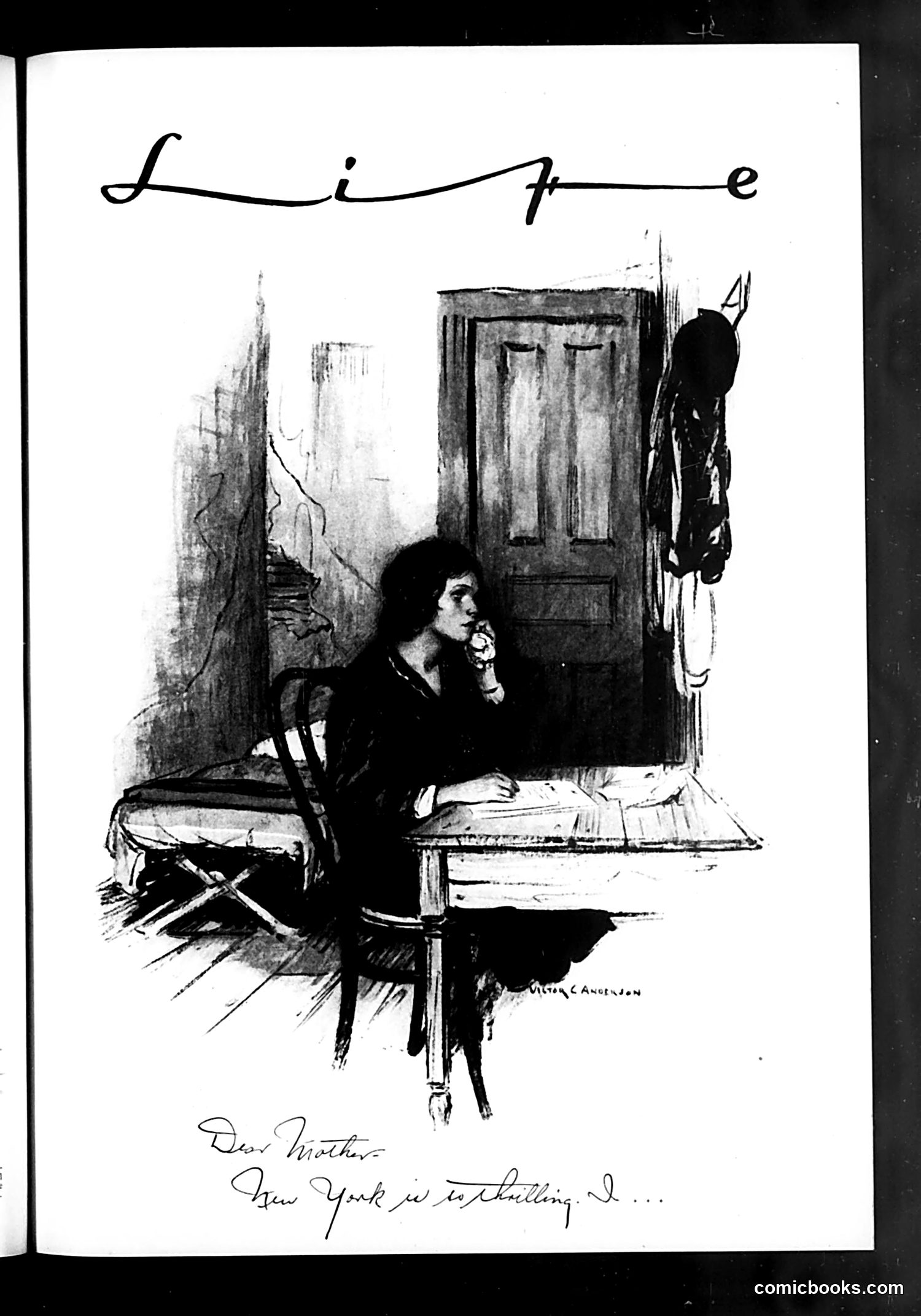
# Analysis of "Life" Magazine Page This appears to be an illustration titled "Life" showing a contemplative figure sitting at a desk by a window in what looks like a sparse, modest room. The figure is posed in a thinking position, gazing outward. Below the illustration is handwritten text reading "Dear Brother, New York is bewildering I..." The sketch employs dramatic chiaroscuro (light and shadow) typical of early-to-mid 20th century satirical illustration. The signature appears to read "Mead C. Anderson" or similar. Without additional context about the specific issue date or full text, the exact satirical target remains unclear. However, the contemplative pose and reference to New York's bewildering nature suggests commentary on urban life, perhaps immigrant or newcomer experiences in the city. The artistic style and handwritten correspondence format were common devices in Life magazine for social commentary.
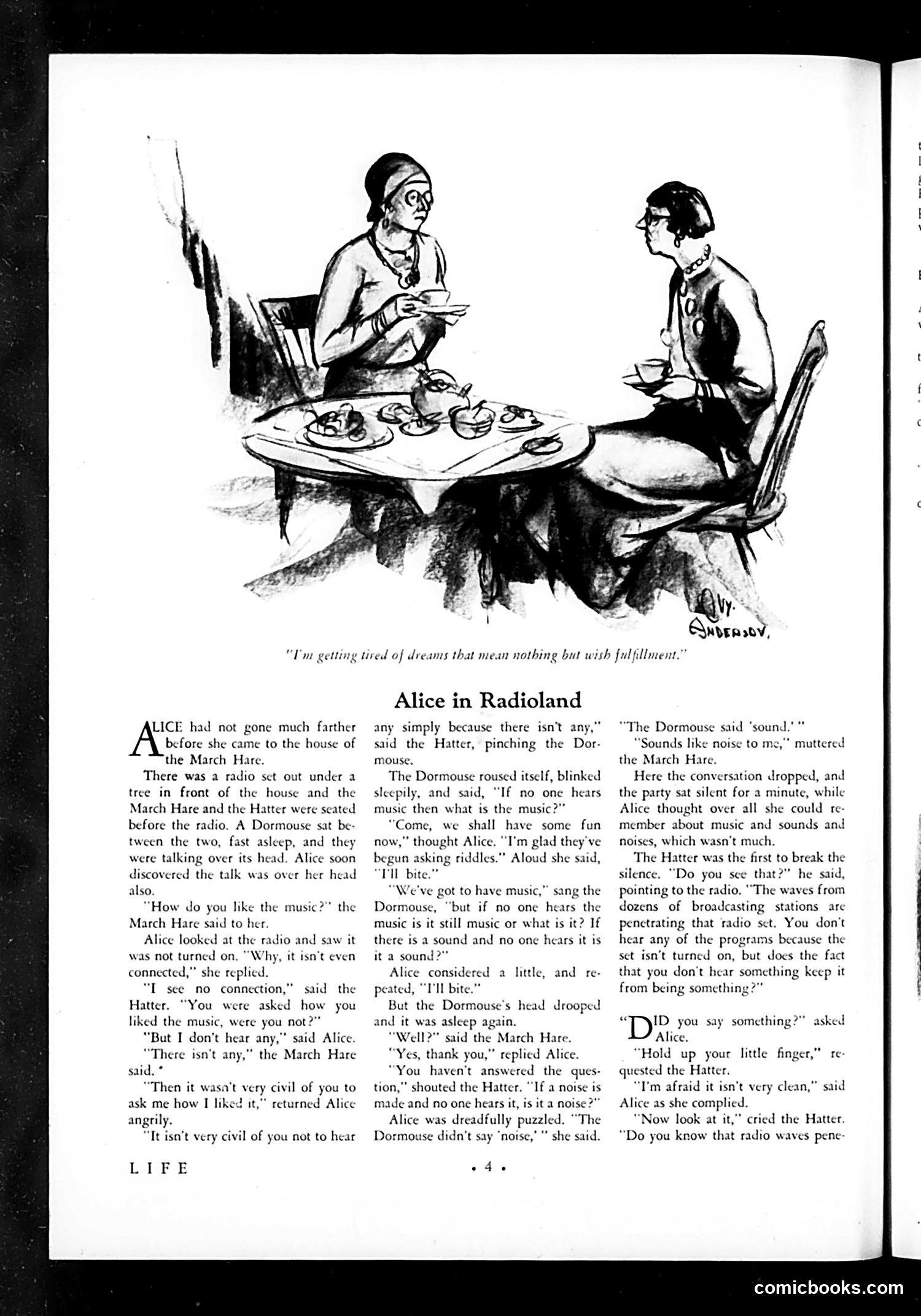
# "Alice in Radioland" This is a parody of Lewis Carroll's *Alice in Wonderland*, reimagined for the radio age. The illustration shows Alice at a tea party with the March Hare and the Dormouse (characters from the original story), but now they're discussing radio broadcasts. The satire mocks both radio technology and abstract philosophical debates. The characters engage in circular logic about whether unheard radio waves constitute "music" or "sound"—a jest at radio's invisible nature and listeners' credulity about programming they cannot verify. The joke targets early radio enthusiasm: audiences accepted radio content on faith, unable to verify what they heard. Alice's pragmatic objections to nonsensical arguments mirror readers' potential skepticism about this new medium's claims. This reflects 1920s-30s cultural anxieties about mass media's intangible yet persuasive power.
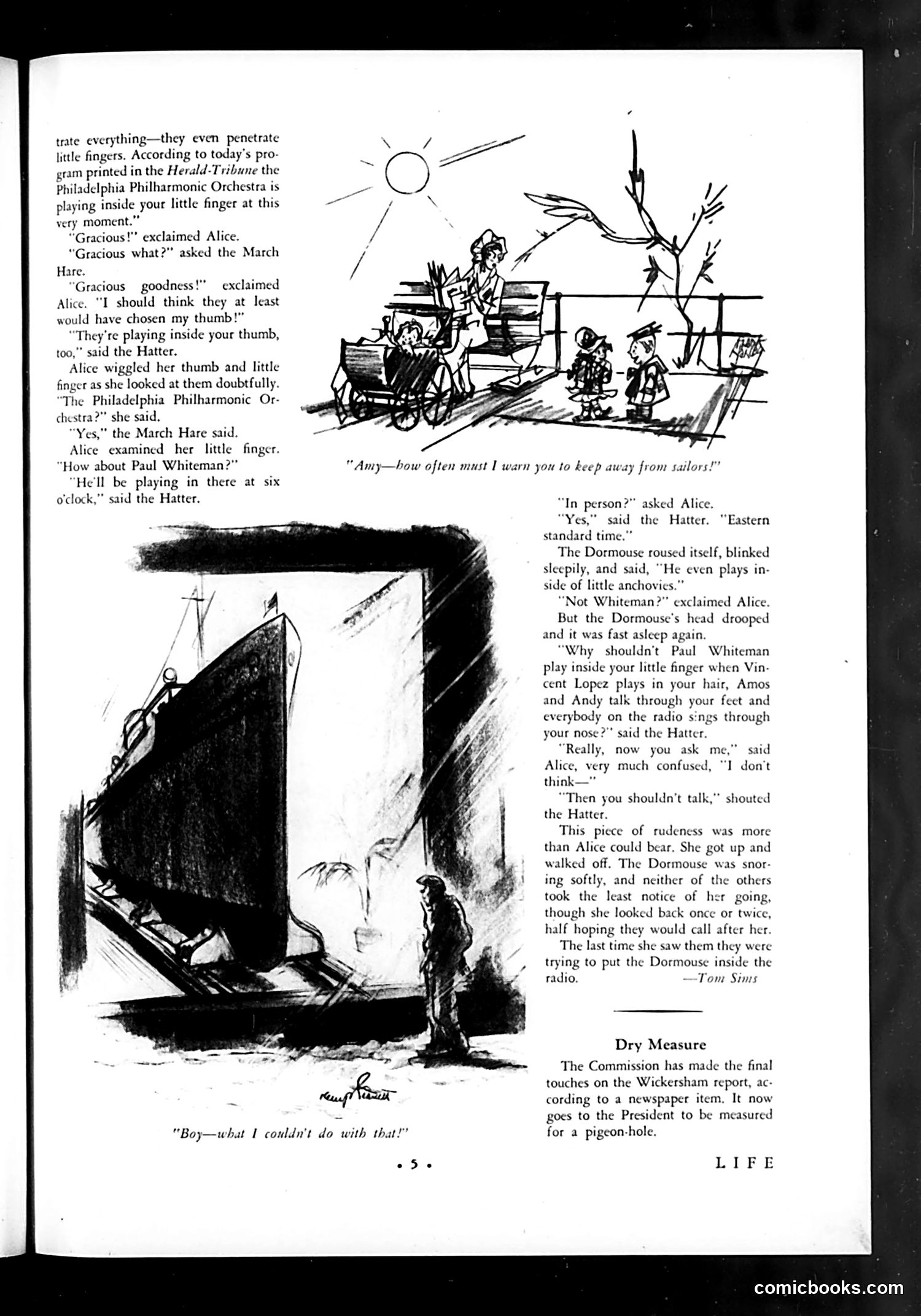
# Analysis This page is a literary parody of *Alice in Wonderland*, reimagining Alice's encounters with radio broadcasts and musicians instead of fictional characters. The conversation references Paul Whiteman (a famous 1920s jazz bandleader), Vincent Lopez, and radio performers, treating them as absurdly "inside" Alice's body—playing in her thumb, hair, and feet. The satire mocks the radio craze of the early 20th century, when Americans became obsessed with radio technology and celebrity musicians. The joke is that radio penetrates so completely into everyday life that these famous performers seem literally embedded in one's body. The bottom cartoon shows someone struggling with radio equipment, captioned "Boy—what I couldn't do with that!"—satirizing people's frustration with and fascination for new radio technology.
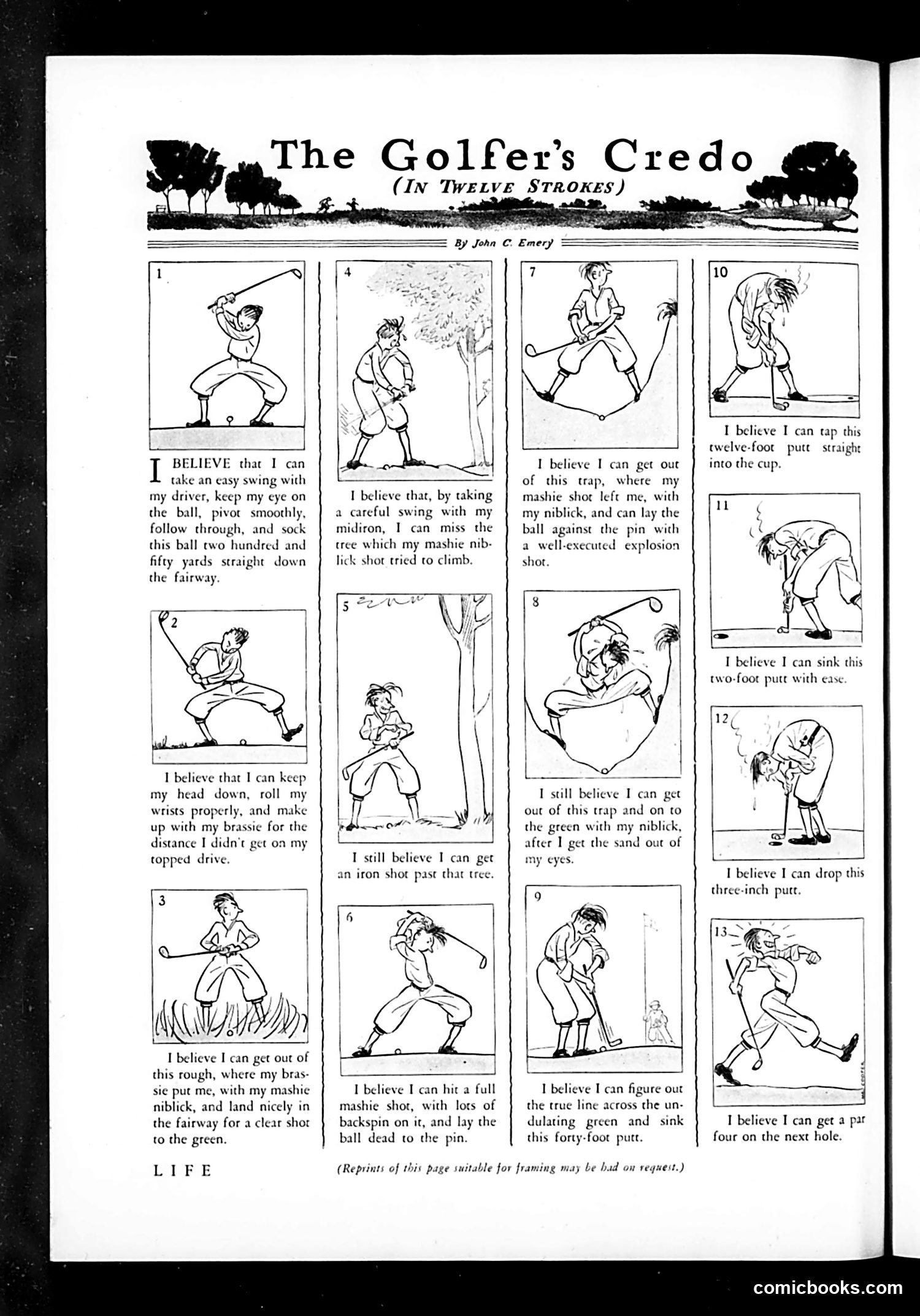
# "The Golfer's Credo (In Twelve Strokes)" by John C. Emery This is a humorous comic strip satirizing golfers' persistent optimism and self-delusion. The unnamed golfer repeatedly insists "I believe I can..." despite clearly demonstrating incompetence throughout the sequence—hitting into rough, sand traps, and trees; making poor shots; struggling with basic techniques. The satire targets the universal golfer's mindset: unwavering confidence despite mounting evidence of failure. Each panel shows the golfer in progressively worse situations, yet his internal monologue remains stubbornly positive. The "credo" joke is that golfers maintain faith in their abilities regardless of actual performance. This reflects early 20th-century golf's popularity among middle and upper-class Americans, mocking both the sport's frustrations and the optimistic personality type it attracted.
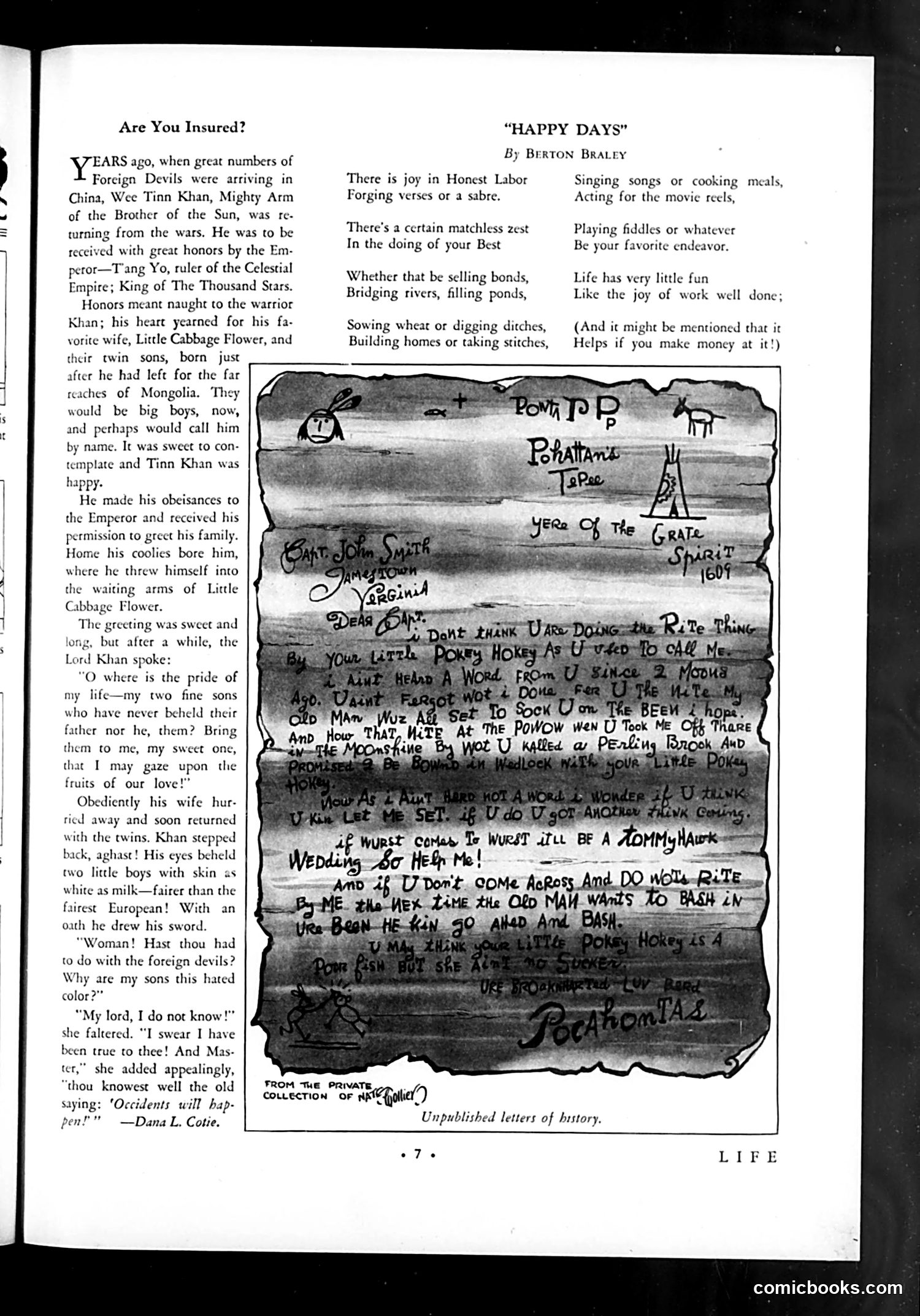
# Explanation for Modern Readers This page contains two separate pieces: **Left column ("Are You Insured?"):** A satirical story about Wee Tinn Khan, a Chinese warlord who returns home after wars. The humor hinges on early-20th-century Western stereotypes about China and exotic foreign rulers, treating his homecoming as comedic material. **Right side ("Happy Days" by Berton Brealey):** A poem celebrating honest labor—singing, cooking, acting, playing music, building, farming. The accompanying image appears to be a handwritten historical letter with humorous annotations overlaid, captioned as "unpublished letters of history." The satirical point seems to be contrasting the poem's celebration of simple work with presumably absurd or contradictory content in the historical document shown. Without reading the letter clearly, the exact joke remains unclear, though it relies on period assumptions about labor and historical authenticity.
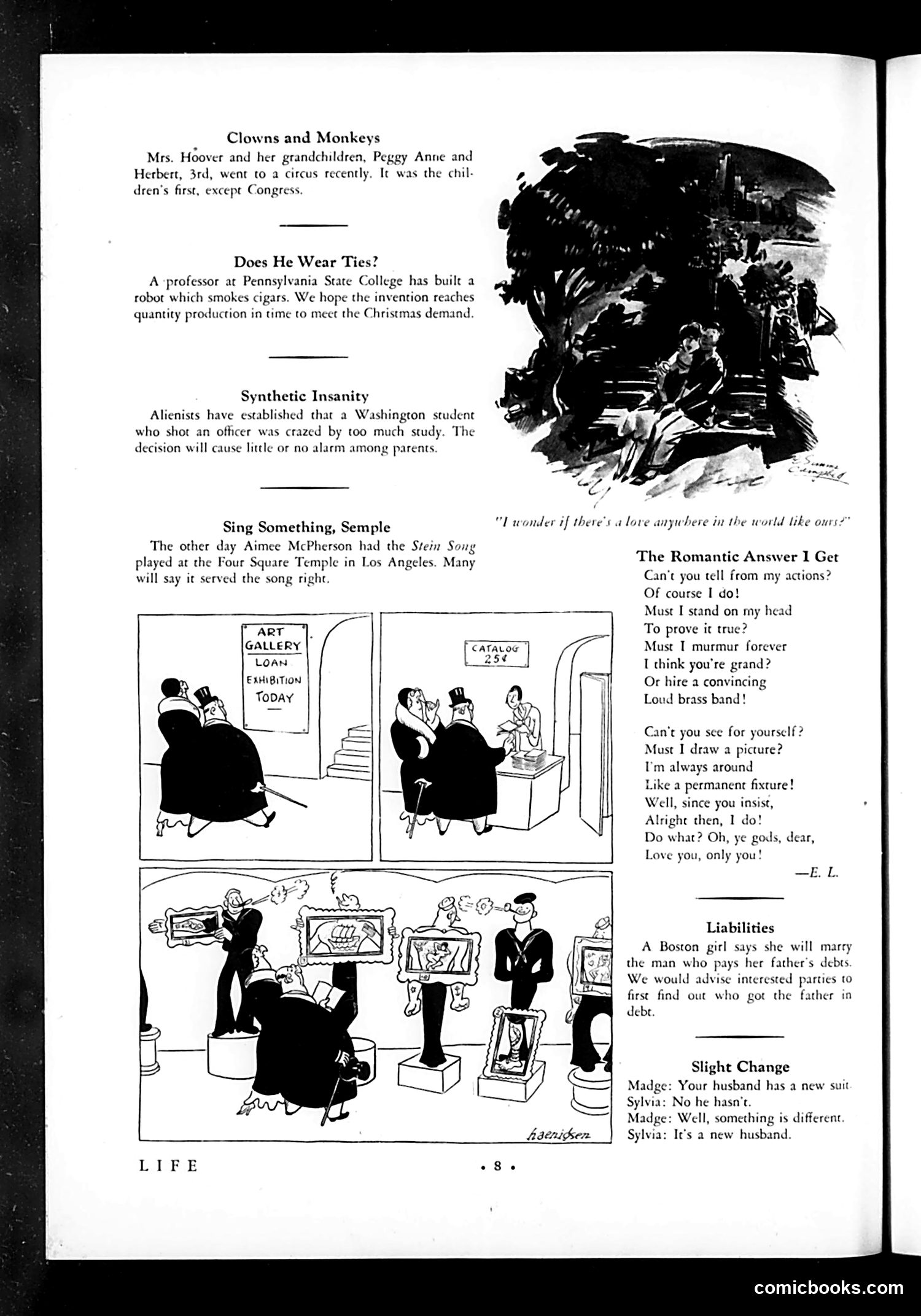
# Life Magazine Page Analysis This page contains brief humorous social commentary and a three-panel comic strip about an art gallery exhibition. **The Comic Strip:** Shows visitors touring an art gallery where patrons view and purchase artwork. The humor appears to mock pretentious gallery culture—visitors studying paintings seriously while dealers conduct business. The final panel reveals the gallery as a bustling marketplace, satirizing how art appreciation can be commodified. **The Text Items:** Include brief, witty observations about contemporary life: a robot that smokes cigars, a student driven to extremes by academic pressure, and romantic poetry. The "Slight Change" dialogue jokes about a husband's infidelity through understatement. **Overall Tone:** Typical of *Life* magazine's lighthearted social satire targeting urban middle-class pretensions, academic excess, and relationship dynamics. No specific political figures are targeted.
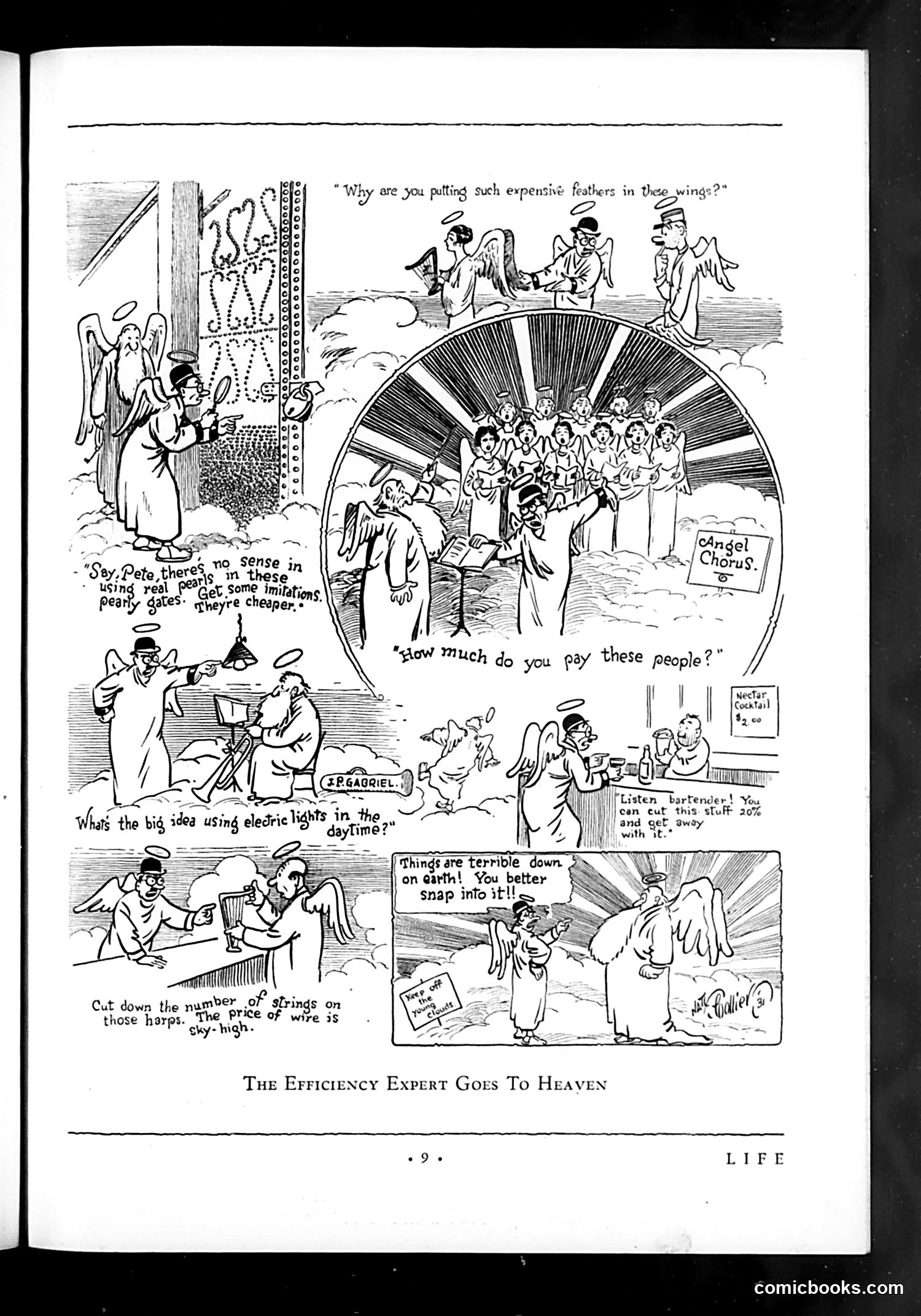
# "The Efficiency Expert Goes To Heaven" This satirical cartoon mocks the early 20th-century "efficiency expert" craze—consultants who applied industrial management principles to optimize costs and productivity everywhere. The joke: an efficiency expert arrives in Heaven and immediately begins offering cost-cutting suggestions to angels and saints. He proposes eliminating expensive feather wings, replacing harp strings with cheaper wire, using electric lights instead of halos, and negotiating lower wages for the "angel chorus." The satire targets how efficiency-obsessed business consultants of the era applied ruthless cost-cutting logic to inappropriate domains—suggesting that even sacred, spiritual realms couldn't escape their intrusive "rationalization." The expert's inability to recognize Heaven's incompatibility with penny-pinching reflects contemporary anxiety about unrestrained commercialism and mechanization corrupting all aspects of life.
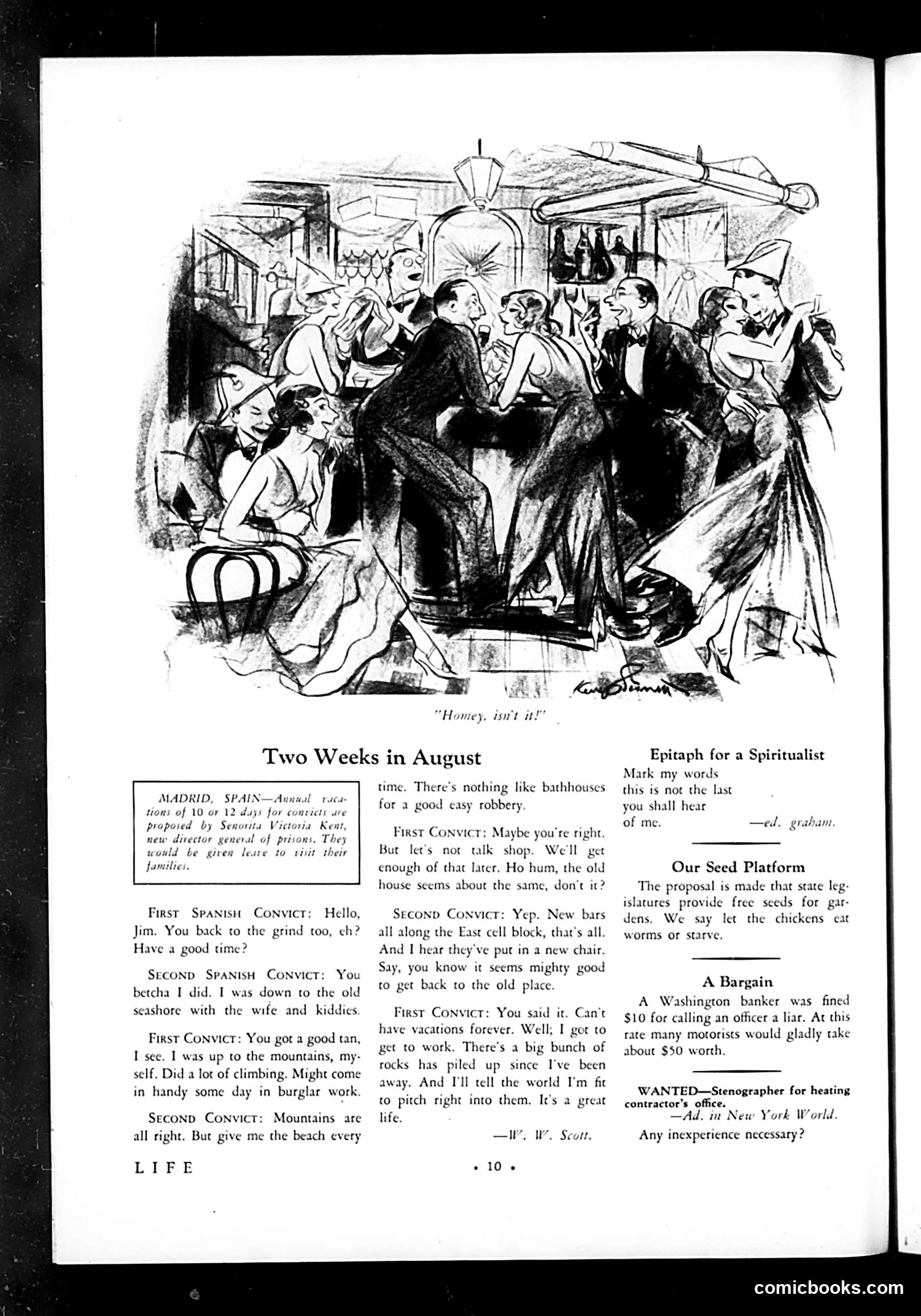
# "Two Weeks in August" - Analysis This page contains a satirical cartoon and accompanying humorous dialogue about convicts on vacation from prison in Madrid, Spain. The cartoon depicts well-dressed people at what appears to be a social gathering or nightclub, with the caption "Honey, isn't it?" The joke satirizes the contrast between respectable society and criminality: two Spanish convicts discuss their prison leave as a vacation opportunity, with one boasting about planning future burglaries while on holiday. The humor derives from treating serious crime casually and the absurdity of prisoners receiving vacation time. The page also includes unrelated brief jokes and advertisements typical of *Life* magazine's format. The satirical point targets both the apparent leniency of the Spanish penal system and the criminals' shameless attitudes toward their crimes.