A complete issue · 36 pages · 1931
Life — May 29, 1931
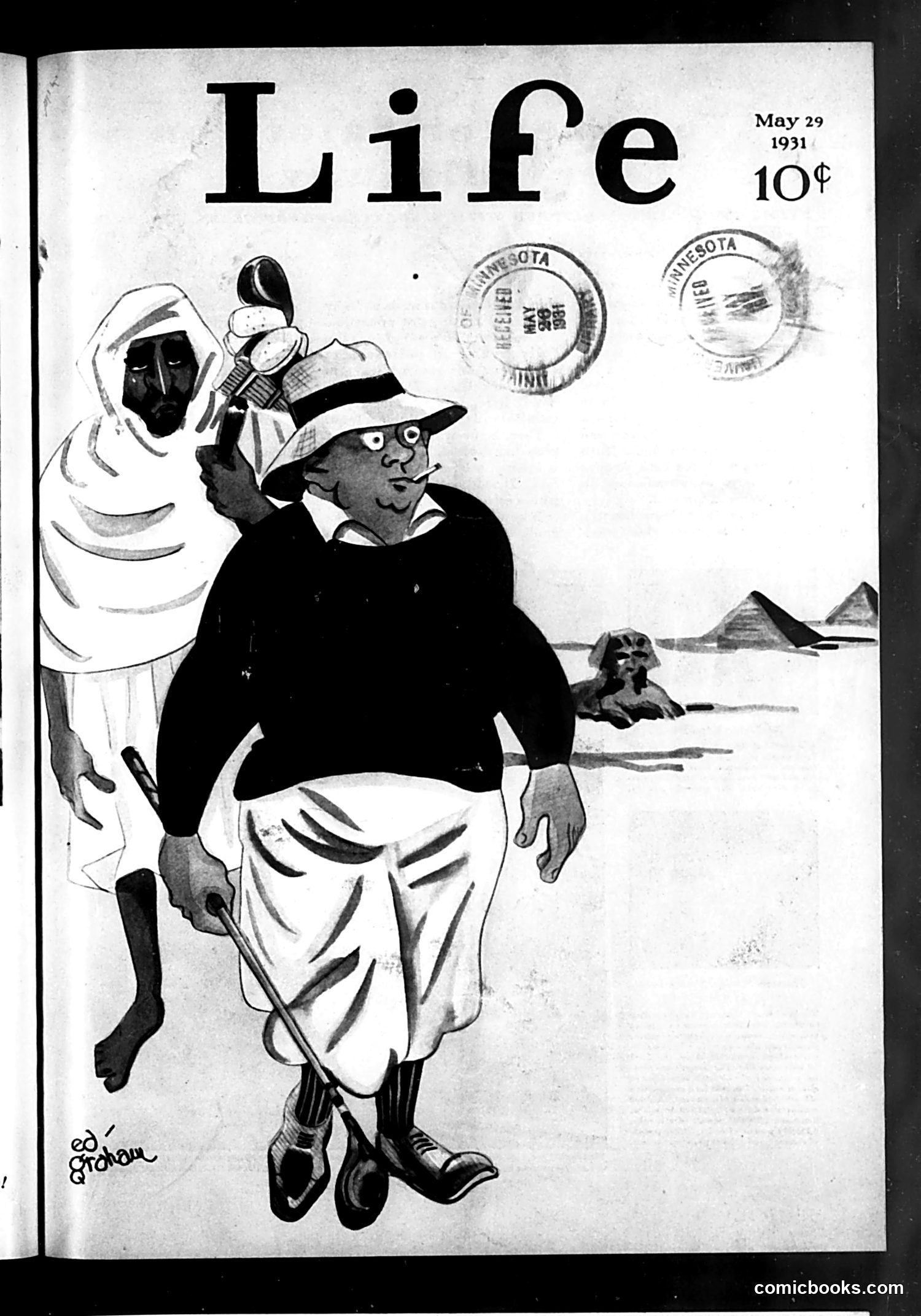
# Life Magazine Cover Analysis (May 29, 1931) This cover depicts a rotund man in winter clothing carrying what appears to be Arctic or polar expedition gear, with Indigenous figures visible in the background and pyramids in the distance. The cartoonist (signed "Goldberg," likely Rube Goldberg) appears to satirize an explorer or adventurer preparing for an expedition. Given the 1931 date and visual elements, this likely mocks contemporary polar exploration efforts or a specific explorer's ambitious claims. The juxtaposition of Arctic clothing with Egyptian pyramids in the background creates comedic absurdity, suggesting either confused geography or grandiose pretensions about multiple expeditions. The exaggerated physique contrasts humorously with the demanding physical requirements of polar exploration, emphasizing the satirical point about the figure's fitness or credibility for such ventures.
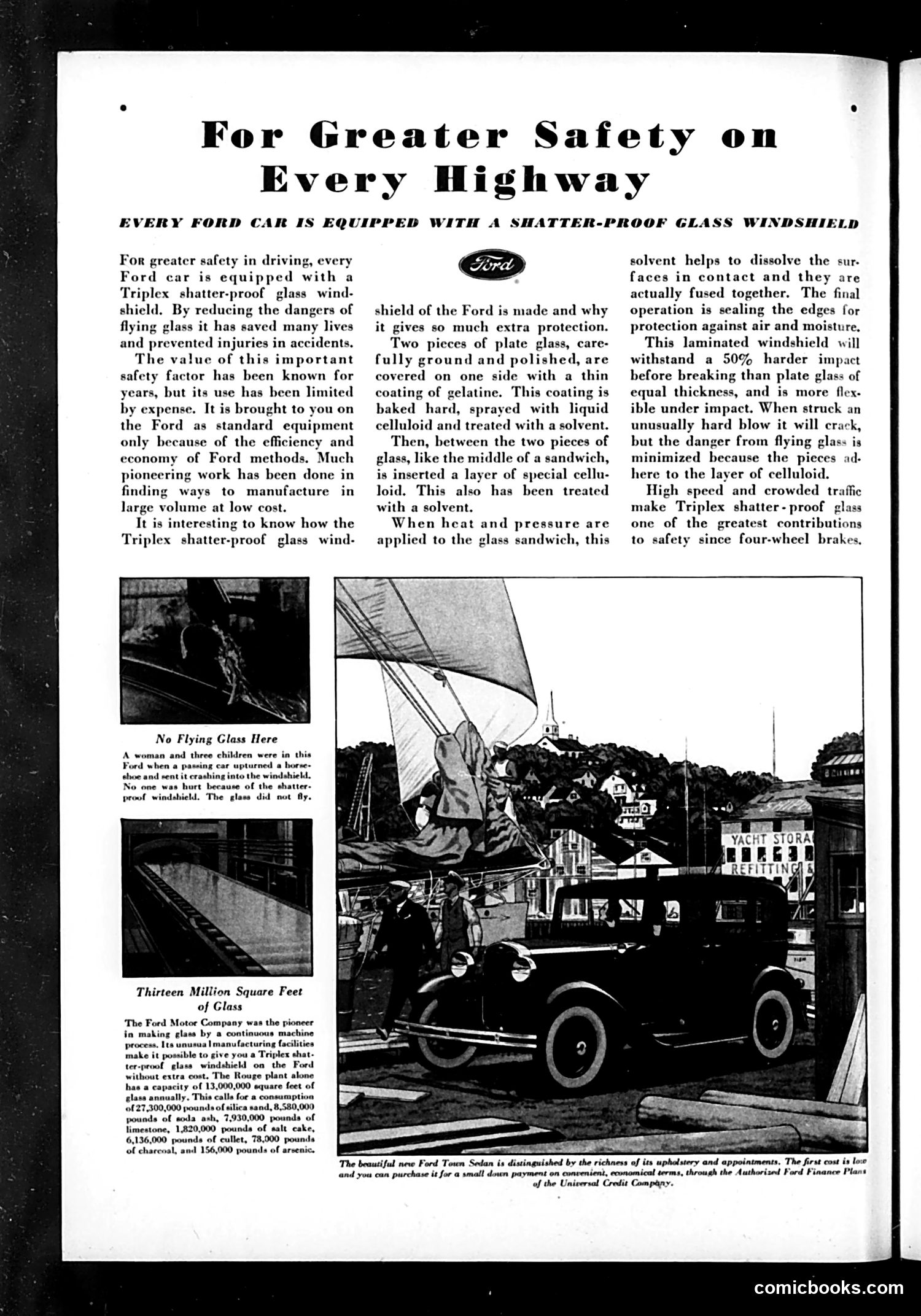
# Analysis This is primarily a **Ford Motor Company advertisement**, not satire or a political cartoon. It promotes Ford's "Triplex shatter-proof glass windshield" as a safety feature for automobiles. The page contains: 1. **Technical explanation** of how the laminated glass works (two plates with cellulose layer) 2. **Two small photographs** showing the windshield's durability—one labeled "No Flying Glass Here" demonstrating a crash test 3. **A large photograph** of a Ford Tudor Sedan at what appears to be a yacht club or waterfront venue, showcasing the car's modern design The advertisement emphasizes the **safety innovation** as a competitive advantage, noting Ford's manufacturing efficiency allows them to offer this feature as standard equipment without extra cost. This reflects early-1930s automotive marketing emphasizing technological advancement and consumer safety.
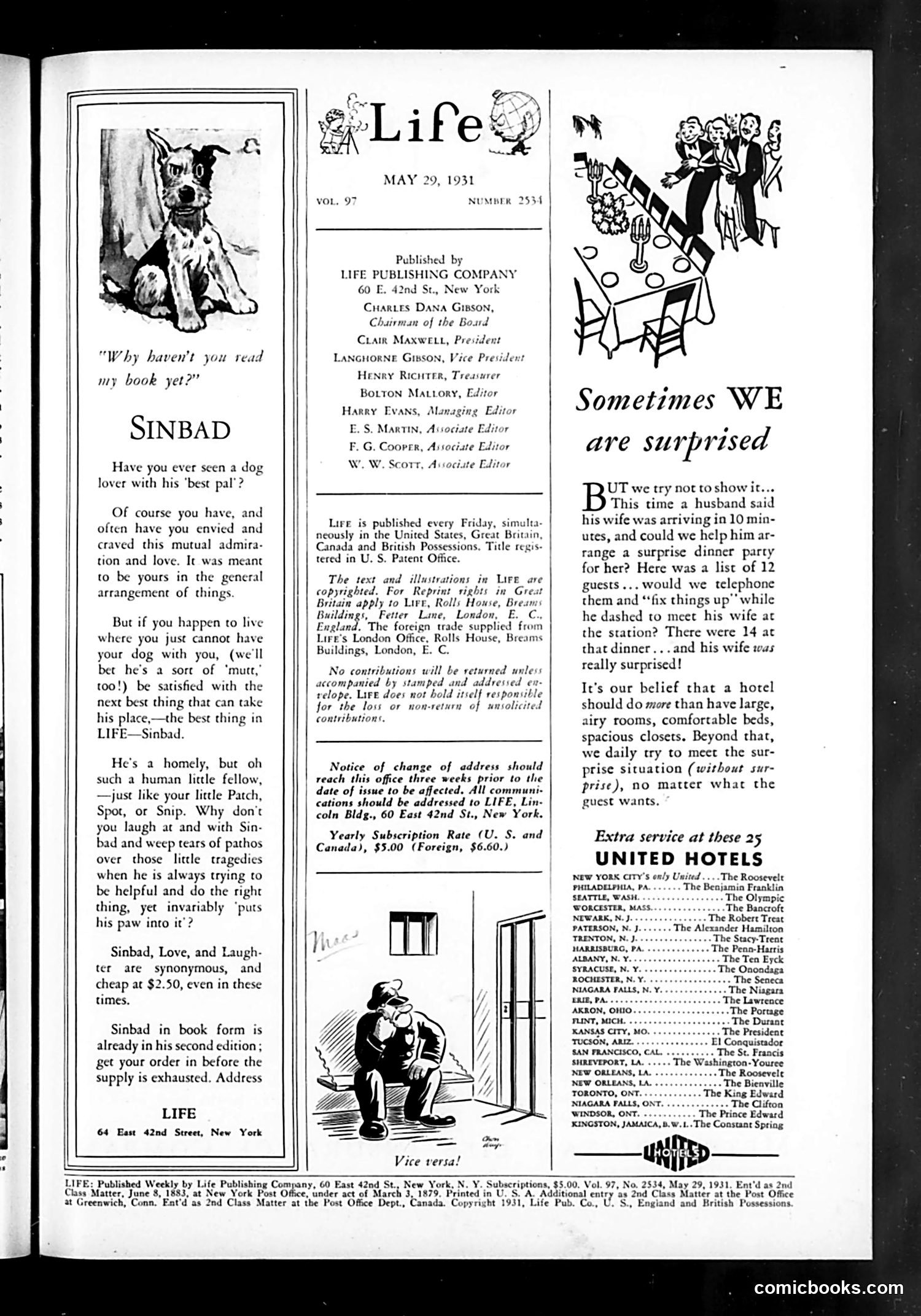
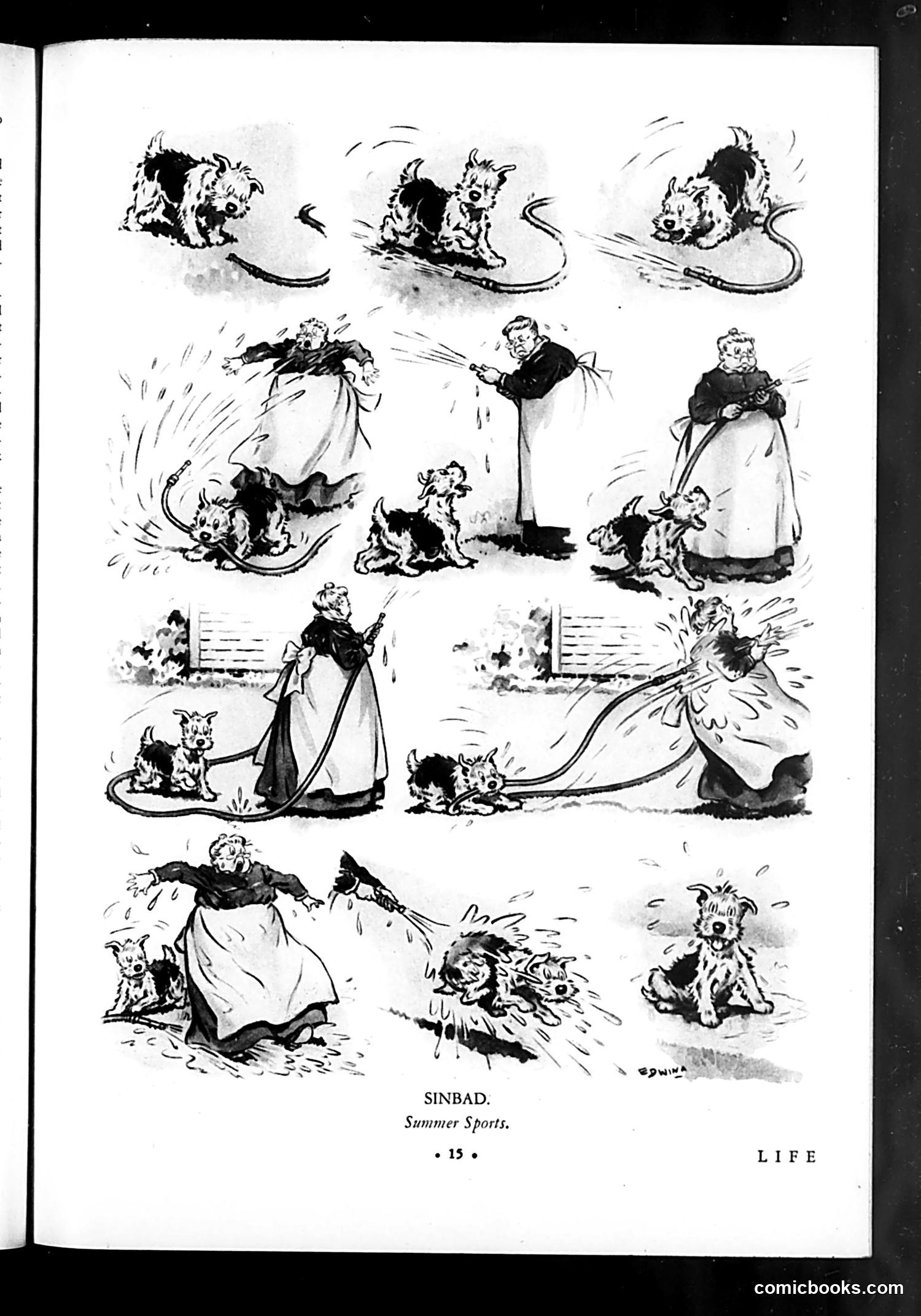
# Life Magazine, May 29, 1931 - Page Analysis This page is primarily a title/masthead page and advertising rather than political satire. The left column features "Sinbad," a dog-themed comic or book series, with accompanying advertisement. The caption "Why haven't you read my book yet?" presents a talking dog—a common device in early 20th-century American humor. The center-right shows a cartoon titled "Sometimes WE are surprised," depicting a domestic scene where a husband arranges a surprise dinner party for his wife. The humor derives from the husband's anxiety about her reaction, reflecting 1930s gender expectations and domestic comedy conventions. The bottom-right "Vice versa!" cartoon appears to reverse this scenario, though details are unclear. The bulk of the page consists of United Hotels advertising, listing affiliated properties nationwide—standard magazine filler for this era.
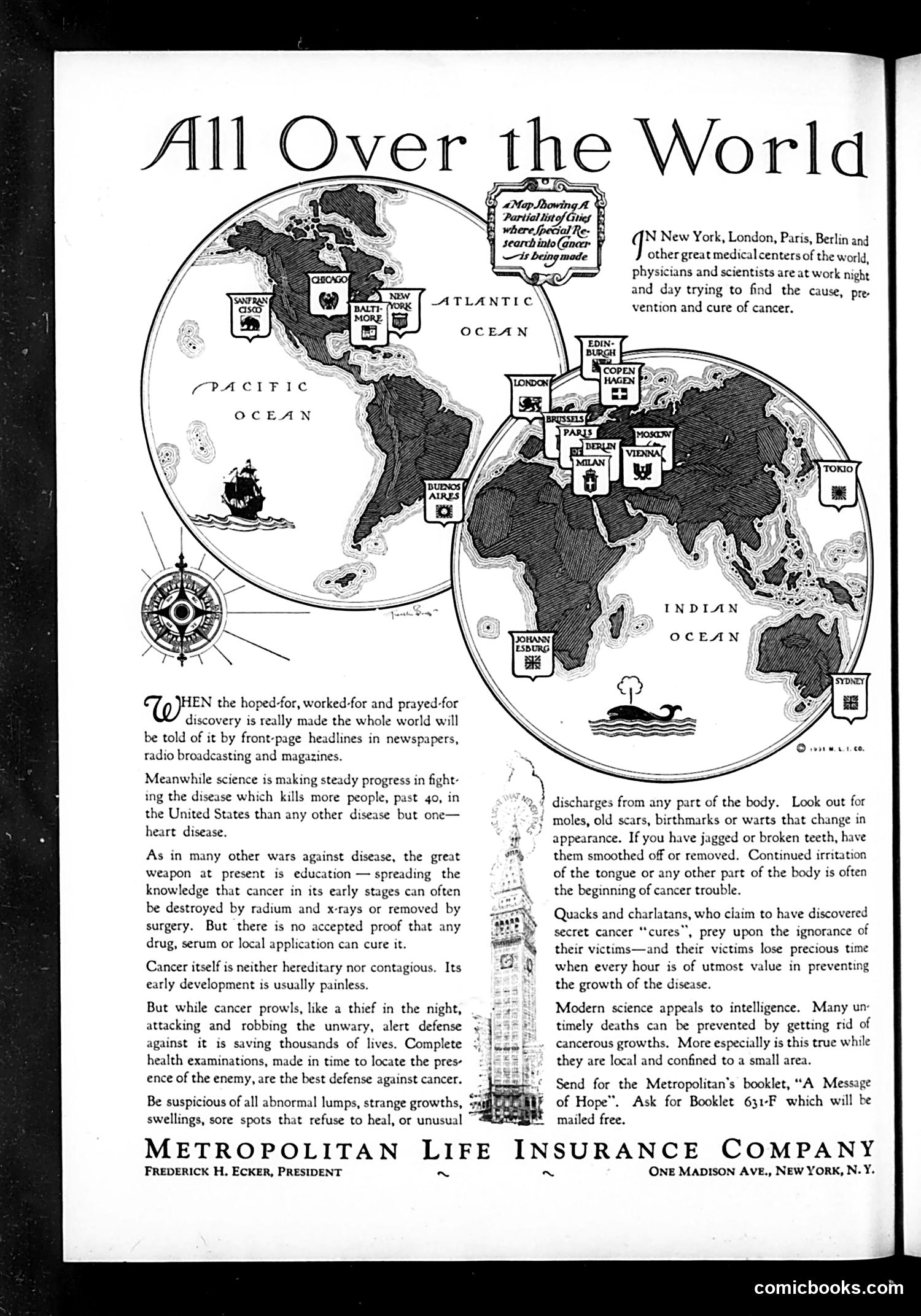
# Analysis This is primarily an **advertisement by Metropolitan Life Insurance Company**, not satire or political commentary. The page features a world map showing medical research centers (New York, London, Paris, Berlin, Edinburgh, Copenhagen, Milan, Vienna, Tokyo, Johannesburg, and Sydney) where scientists search for cancer causes and cures. The text discusses cancer as a major killer in America and emphasizes early detection through health examinations and awareness of warning signs (lumps, growths, sores). It warns against quacks selling fake "cures" and promotes education as the best defense. The accompanying illustration of a tall building (likely Metropolitan Life's New York headquarters) reinforces the company's authority and legitimacy in promoting public health awareness—a common insurance industry practice of that era.
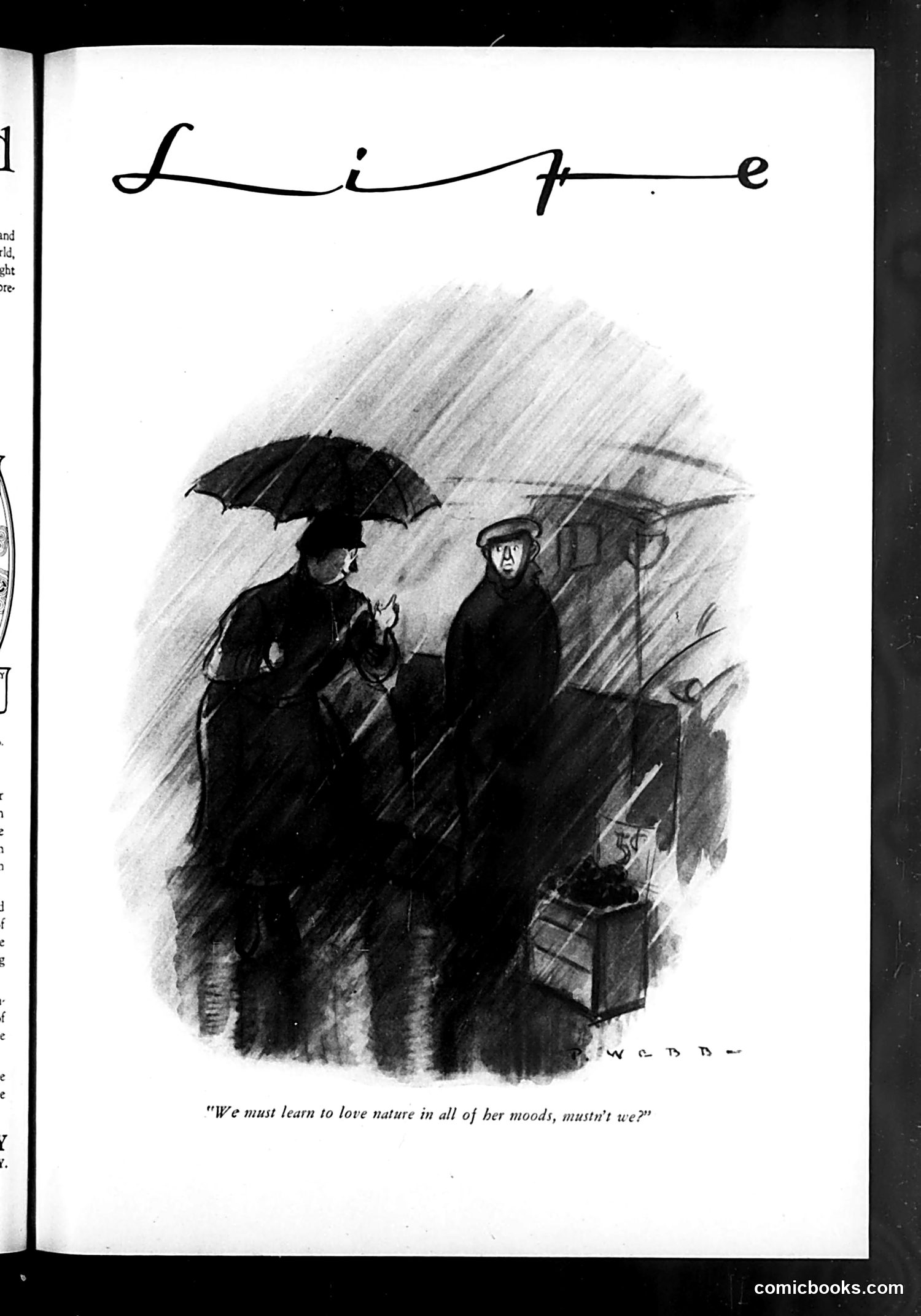
# Analysis This cartoon depicts two figures standing in heavy rain with an umbrella, with the caption: "We must learn to love nature in all of her moods, mustn't we?" The joke appears to be a satirical commentary on romantic or philosophical idealism about nature. One figure (likely representing an enthusiast or idealist) makes an earnest statement about appreciating nature's full range of conditions, while the other figure's facial expression suggests skepticism or discomfort—they're getting soaked in a downpour, making the idealistic sentiment impractical and absurd. The cartoonist (signed "Webbs") is mocking the gap between philosophical posturing about nature and actual human experience. It's a gentle satire on people who express lofty sentiments while ignoring practical misery—a common theme in Life magazine's satirical humor about pretentious attitudes.
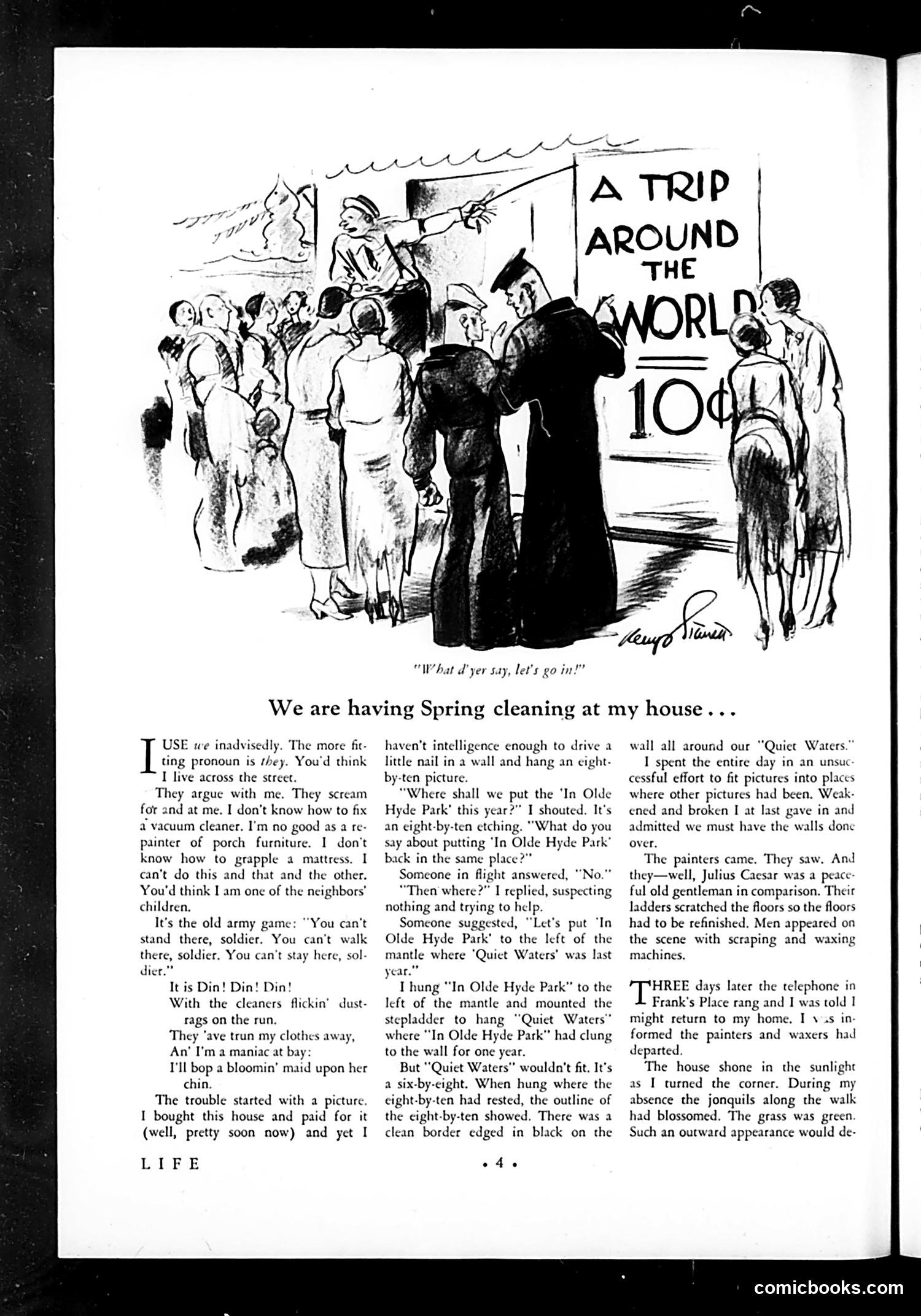
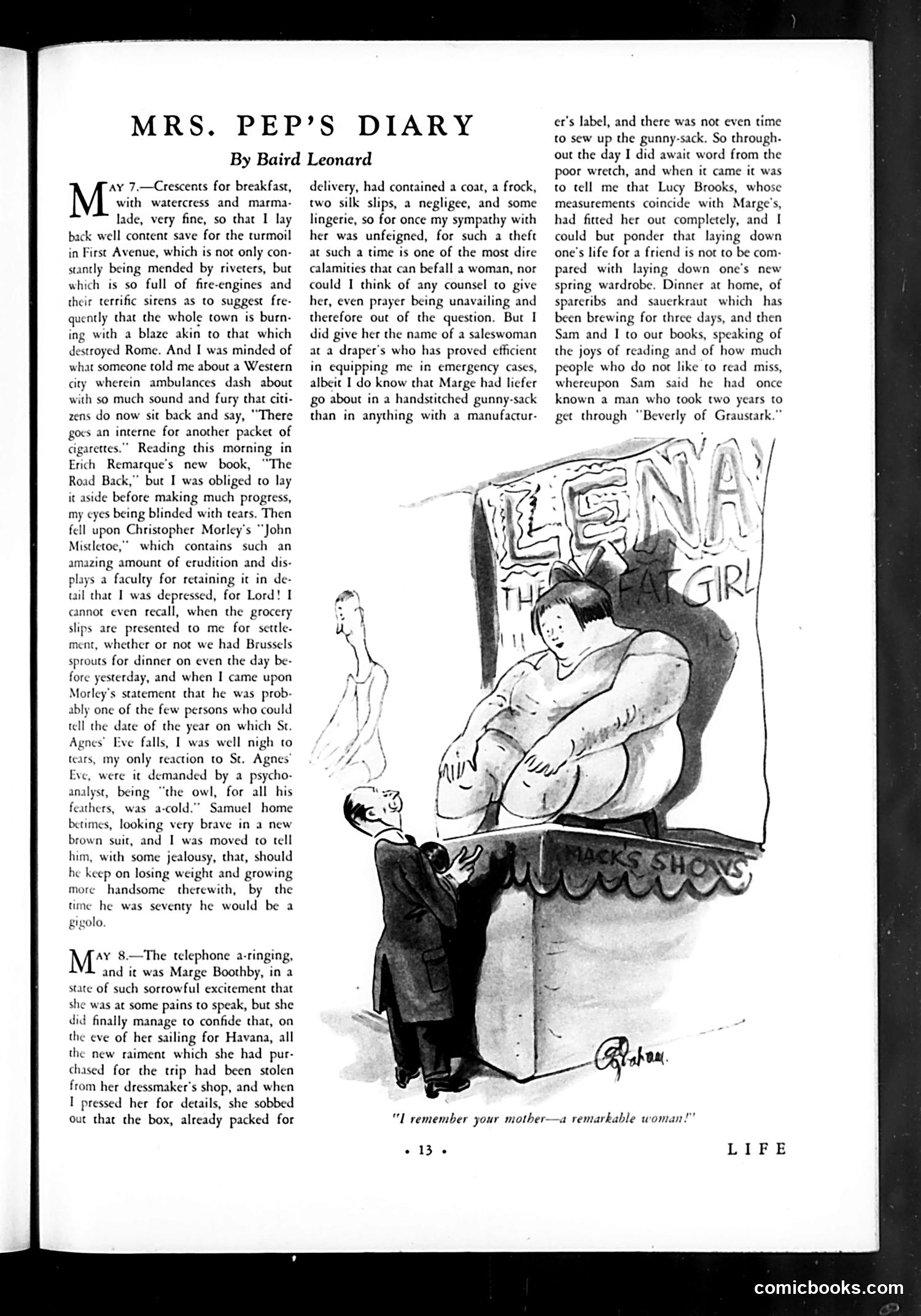
# Analysis This is a humorous domestic essay about spring cleaning, accompanied by a cartoon illustration. The cartoon shows a barker at a booth advertising "A Trip Around the World - 10¢" to a crowd of people, with the caption "What d'yer say, let's go in?" The satire is straightforward: the essay describes the chaos and disruption of spring cleaning in the author's home—furniture moved, walls repainted, workers tracking dirt everywhere. The cartoon's "trip around the world" booth appears as visual commentary suggesting that spring cleaning is such a disruptive ordeal that escaping to an actual world tour would be preferable to enduring it at home. The piece uses relatable domestic humor typical of Life magazine's satirical approach, poking fun at the spring-cleaning tradition and its impacts on household peace and order.
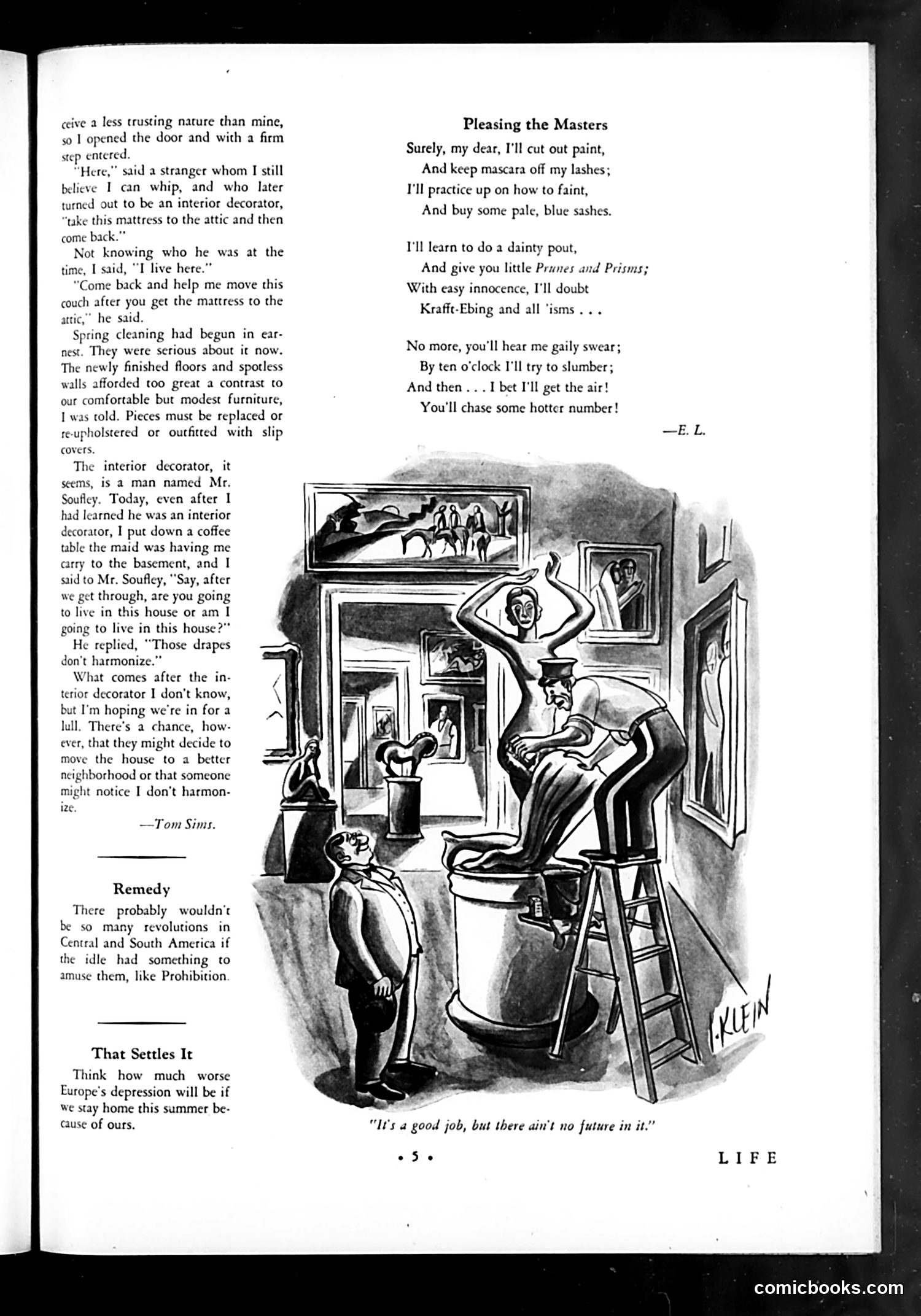
# Analysis: "Pleasing the Masters" and Related Content The main cartoon depicts an interior decorator working in a home while a woman (likely the homeowner) watches with exaggerated facial expressions. The caption reads, "It's a good job, but there ain't no future in it." The satire targets the precarious status of service workers—here, an interior decorator—who lack job security despite performing skilled labor. The woman's dramatic pose suggests anxiety about the work's quality or cost. The accompanying poem "Pleasing the Masters" (credited to E.L.) satirizes women attempting to adopt artistic sophistication by abandoning makeup and adopting intellectual pretenses—referencing "Kraff-Ebing and all 'isms"—to impress educated men ("masters"). The shorter pieces below address unrelated topics: American revolutions in Central/South America and European economic depression, typical satirical fare for Life magazine's commentary on contemporary affairs.
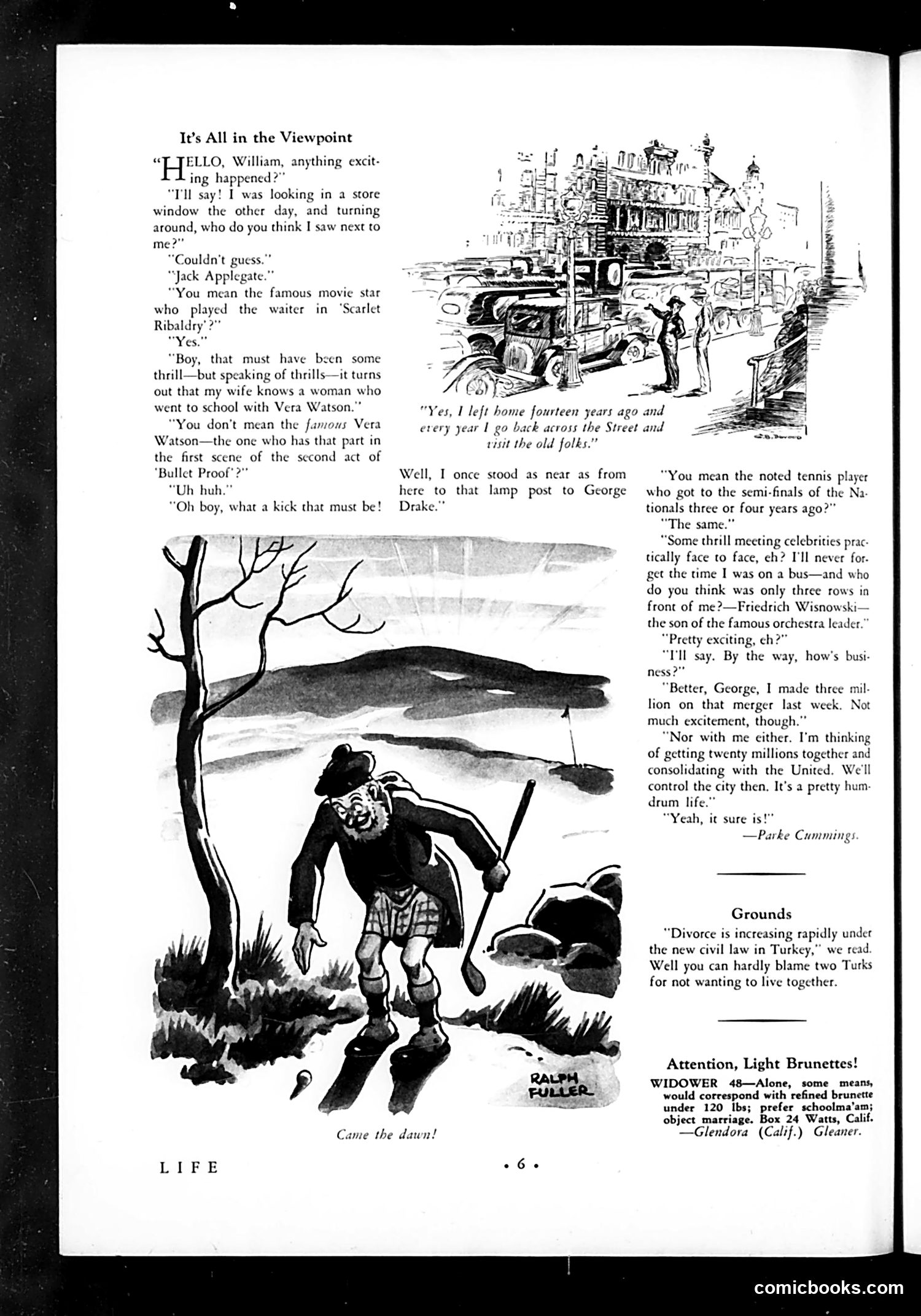
# Analysis of "It's All in the Viewpoint" This is a humorous dialogue piece satirizing celebrity encounters and wealth. A man brags about seeing famous people—Vera Watson (an actress in "Scarlet Ribbons" and "Bullet Proof"), and a noted tennis player at the Nationals semifinals. His friend responds that he too has met celebrities, casually mentioning Friedrich Wisnowski (son of a famous orchestra leader) on a bus. The satire targets social climbing and name-dropping: both men claim exciting celebrity meetings, but the second speaker deflates the first's enthusiasm by revealing his own "celebrity" encounter was utterly mundane—just sitting near someone on public transit. The lower cartoon by Ralph Fuller shows a golfer in poor weather ("Came the dawn!"), illustrating life's disappointments.
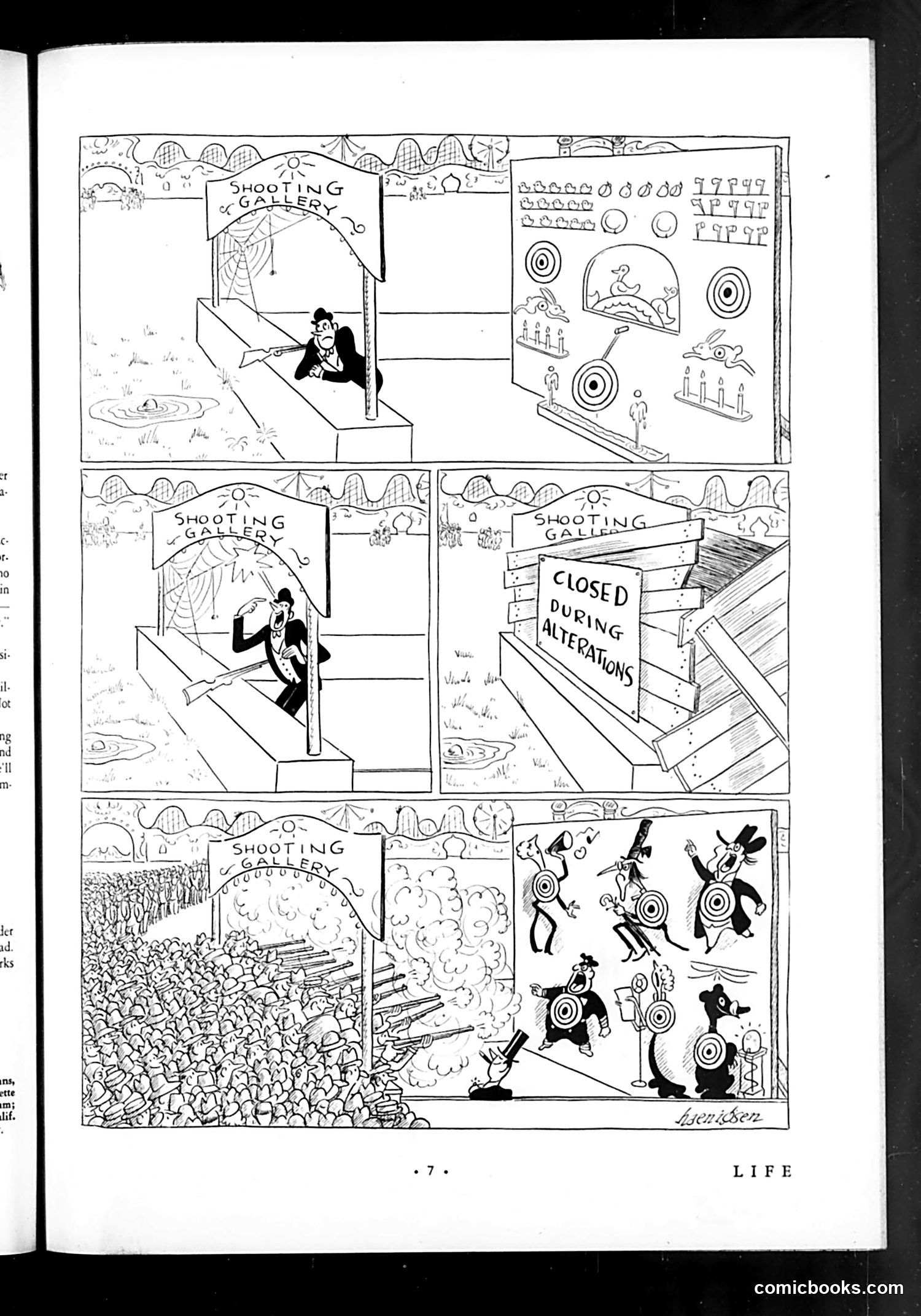
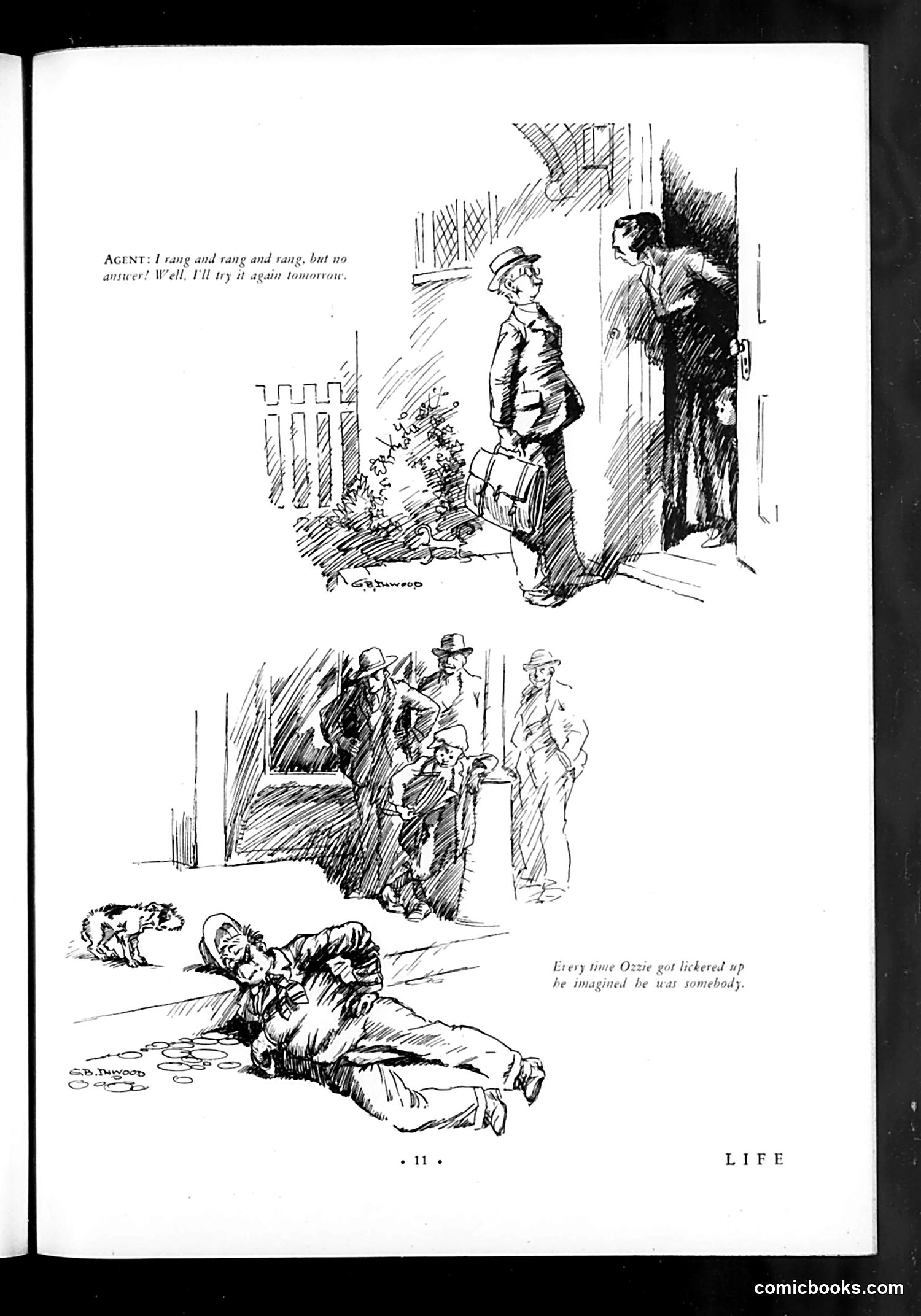
# Analysis of Life Magazine Cartoon This is a satirical comic strip about a shooting gallery—an amusement park attraction. The humor works through escalating absurdity: **Panel 1-2:** A man enters an ordinary shooting gallery with target practice setup. **Panel 3:** A sign reads "CLOSED DURING ALTERATIONS," suggesting temporary renovation. **Panel 4:** When the gallery reopens, it has been transformed into an actual war zone with real soldiers, explosions, and casualties replacing the paper targets. Figures flee in panic. The satire critiques militarization or perhaps the American fascination with war as entertainment—suggesting that if shooting galleries kept "improving," they'd become indistinguishable from actual combat. The joke relies on the absurd juxtaposition of innocent amusement with genuine warfare, implying commentary on desensitization or the blurred lines between entertainment and violence.
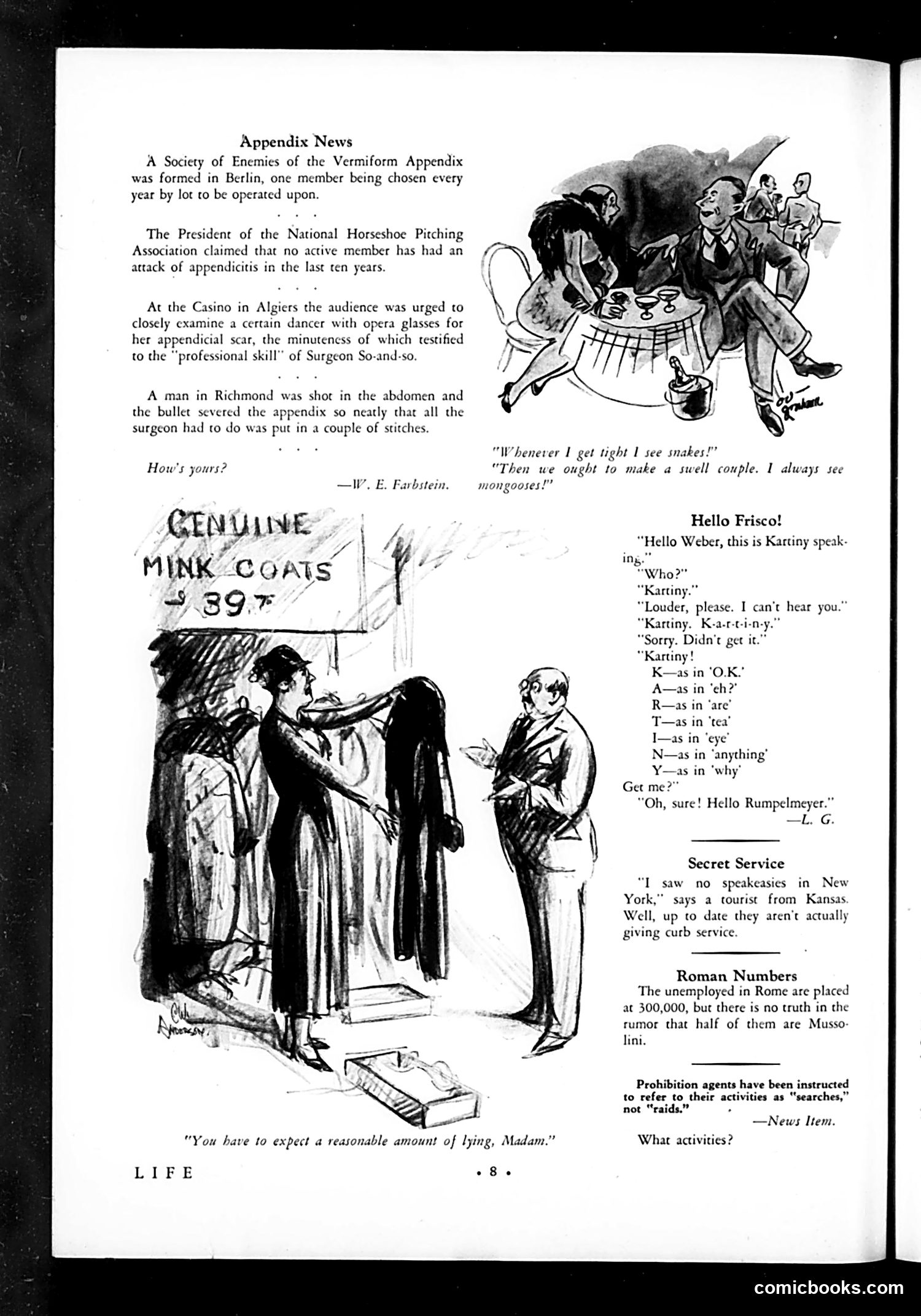
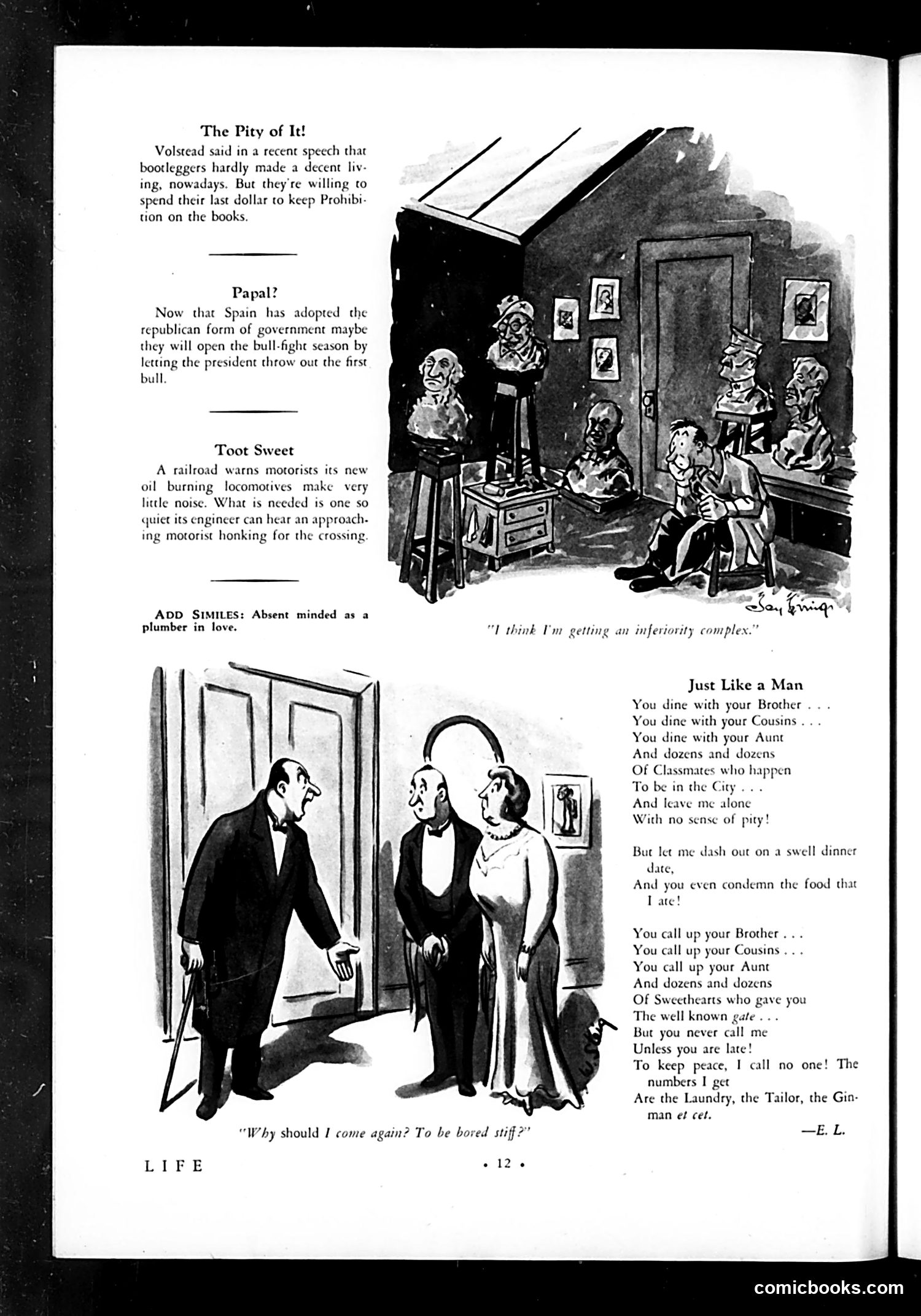
# Analysis of Life Magazine Page This page contains several satirical items typical of early 20th-century humor magazines: **Main Cartoon**: Shows a woman examining mink coats priced at $39.75, with a salesman claiming they're "genuine." The joke satirizes both deceptive retail practices and women's gullibility regarding luxury goods—a common theme in period satire about consumer culture and gender. **"Hello Frisco!" Bit**: A humorous phone conversation demonstrating regional accent differences, poking fun at pronunciation variations between speakers. **Other Items**: Brief satirical news snippets about appendicitis societies, horseshoe pitching, and prohibition agents euphemistically calling their activities "searches" instead of "raids." The page reflects 1920s American concerns: consumer fraud, regionalism, medical fads, and prohibition enforcement—all presented through gentle mockery rather than harsh criticism.
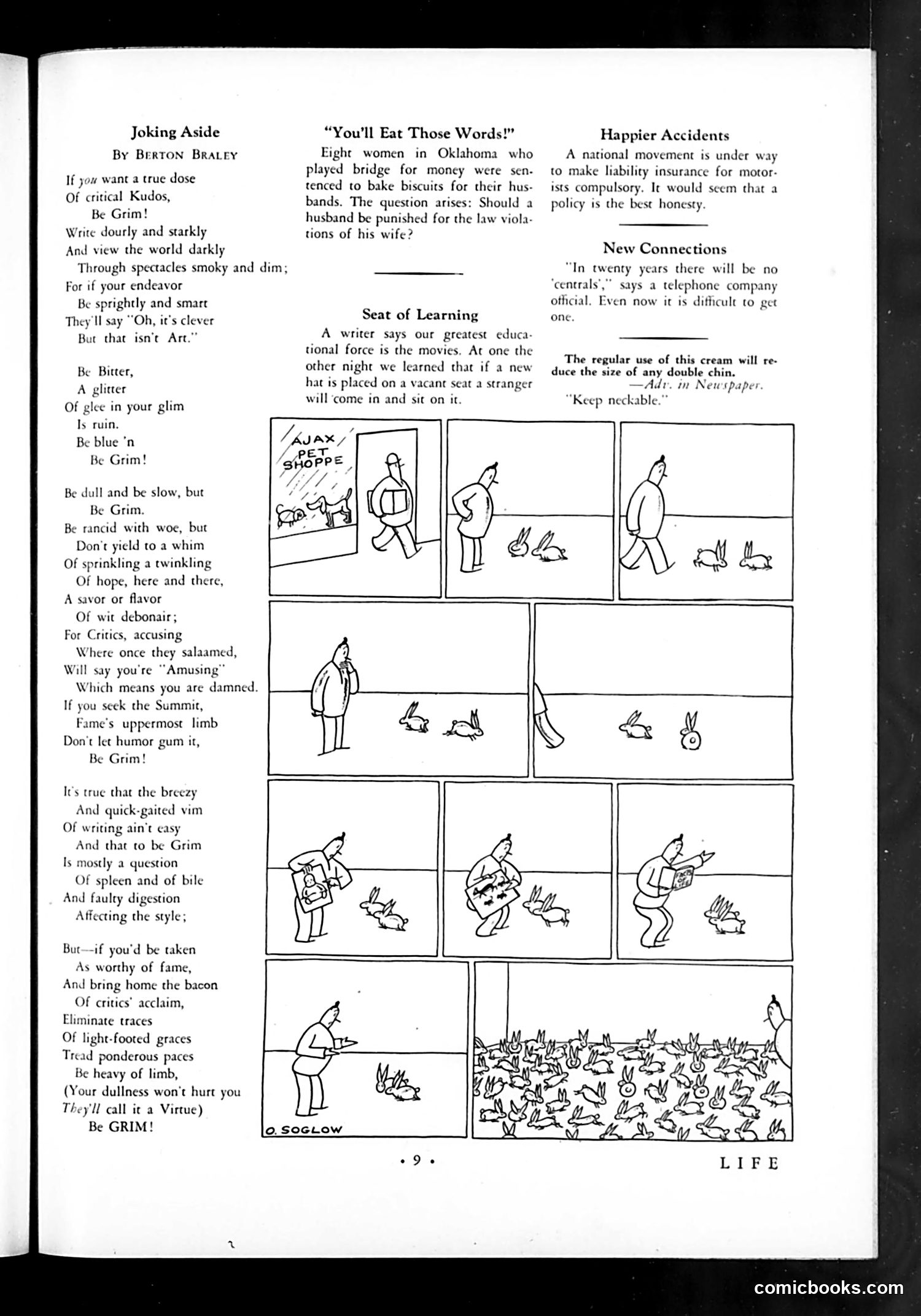
# Analysis of Life Magazine Page This page contains three distinct pieces: 1. **"Joking Aside"** (poem by Brerton Braley): A humorous guide advising writers to "Be Grim"—rejecting cleverness and wit in favor of dark, serious tone to gain critical respect. 2. **"You'll Eat Those Words!"**: A brief anecdote about eight Oklahoma women sentenced to bake biscuits after playing bridge for money—satirizing inconsistent legal punishment and questioning whether wives should be punished for husbands' violations. 3. **Comic strip by O. Soglow**: Shows a figure at an "Ajax People Shoppe" acquiring what appear to be rabbits, which multiply exponentially across successive panels, ultimately overwhelming him in a chaotic final scene—a visual gag about uncontrolled proliferation or consumer excess. The magazine mixes social commentary with absurdist humor typical of 1920s-30s satire.
# "Life Looks About" - Analysis This page discusses three notable descendants: Mrs. Reid, Mr. George F. Baker, and Mr. Robert De Forest—described as valuable people blessed with "abundant means backed by sound minds and admirable energies." The article praises their character development and social contributions, mentioning Mr. Baker's railroad rescue work and Mrs. Reid's political interests and newspaper ownership. The satirical point appears subtle: the piece celebrates wealthy American citizens who use their resources for public good rather than mere accumulation. However, the closing argument by E.S. Martin advocates *against* Federal Prohibition, suggesting individual states decide on alcohol bans themselves—a pre-Prohibition stance that would soon become dated. The cartoon's cherub head (top left) adds whimsical visual interest but its specific meaning remains unclear from this excerpt alone.