A complete issue · 36 pages · 1931
Life — April 3, 1931
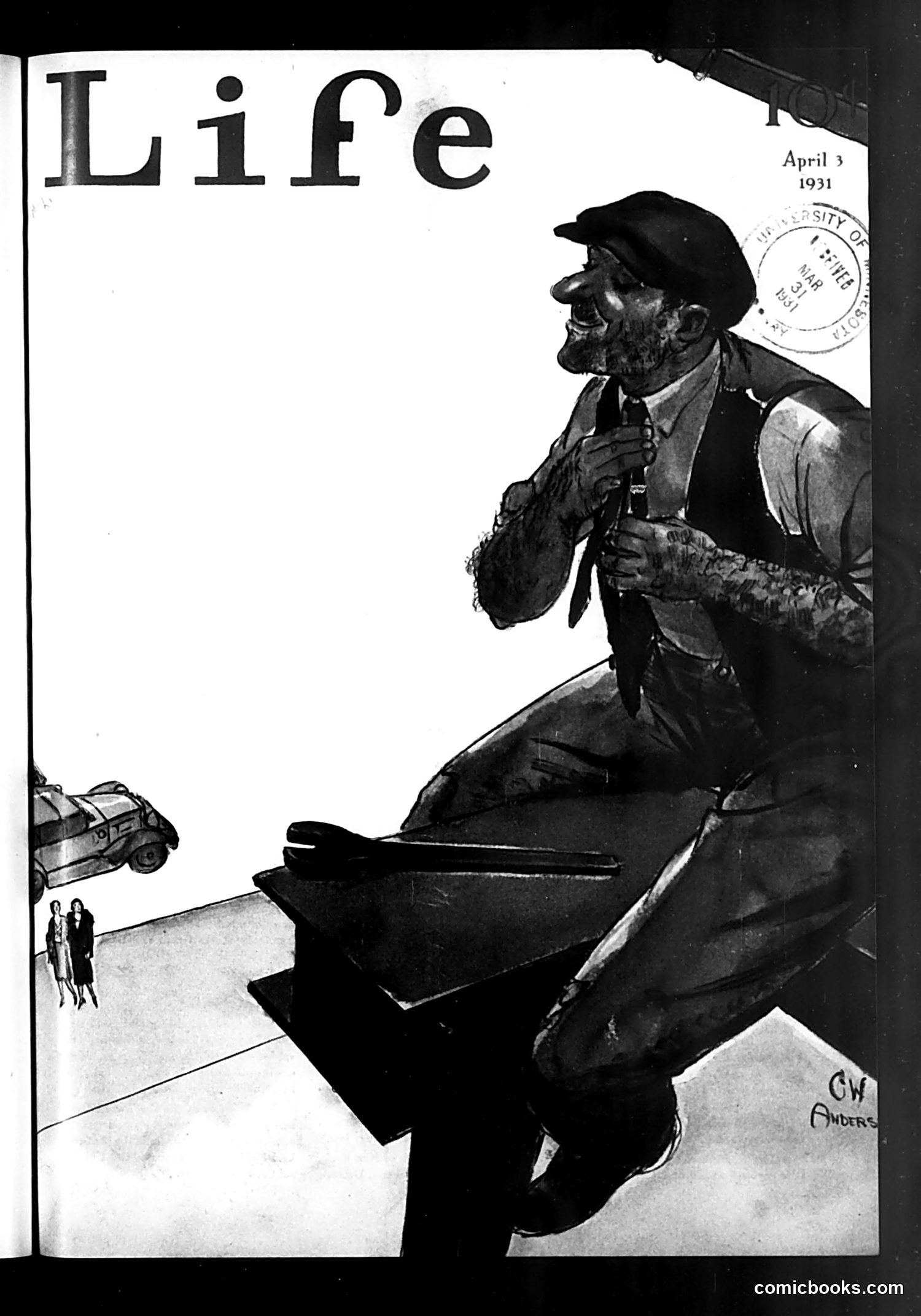
# Life Magazine Cover Analysis (April 3, 1931) This cover depicts a disheveled, bearded man in worn clothing sitting in an oversized shoe, appearing distressed or contemplative. The shoe functions as a makeshift shelter or dwelling. The small vignette in the lower left shows a couple and an automobile, suggesting contrasting wealth and mobility. The cartoon satirizes homelessness and poverty during the Great Depression (which began in 1929). The "old woman who lived in a shoe" nursery rhyme reference becomes darkly ironic—here, a man literally inhabits a shoe as his only shelter. This juxtaposes Depression-era destitution against the car-owning middle class, highlighting economic inequality and the desperation of those made homeless by the economic collapse. The work critiques both poverty conditions and the indifference of the more fortunate.
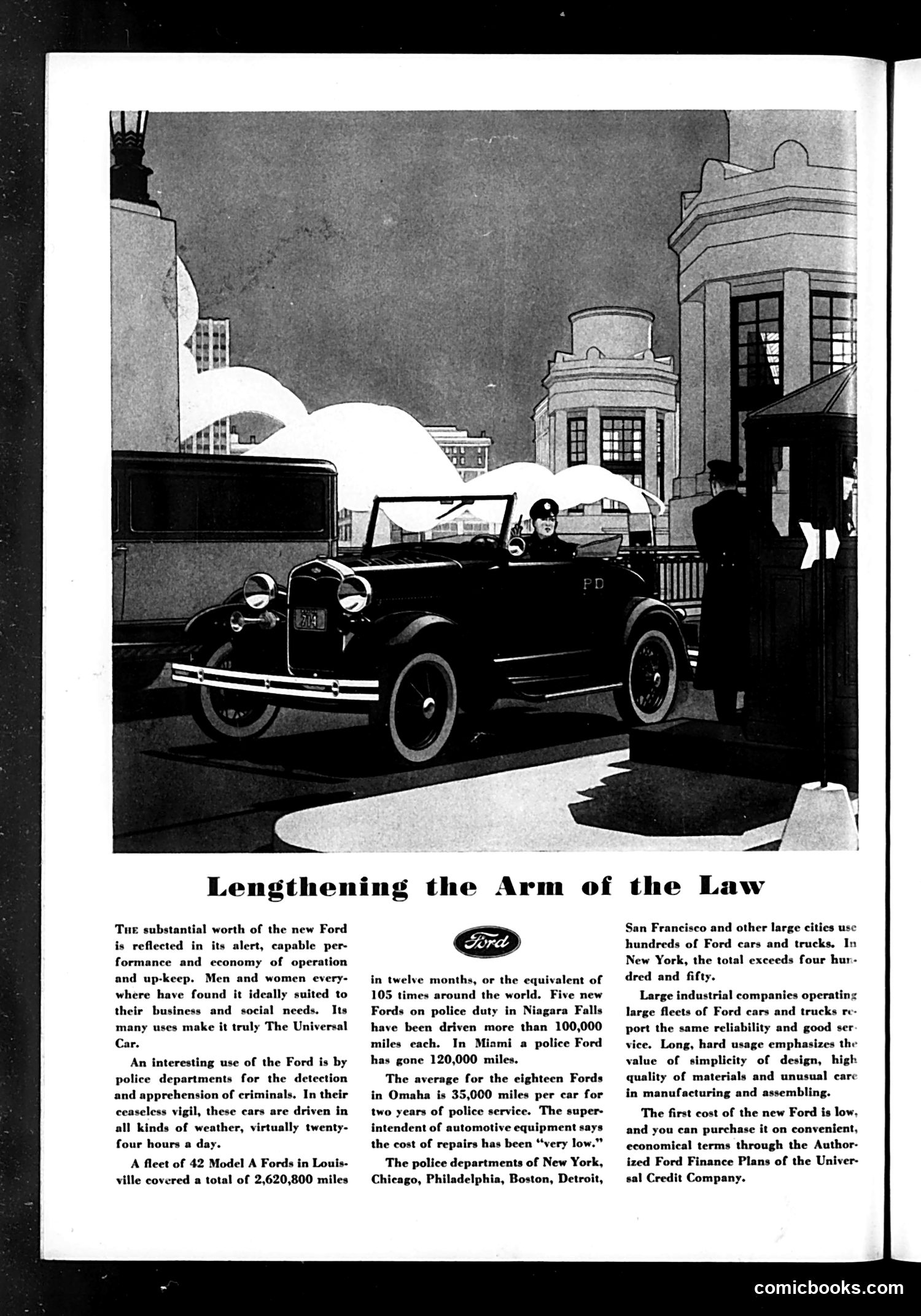
# Analysis This is primarily a **Ford automobile advertisement**, not satire or political commentary. The headline "Lengthening the Arm of the Law" uses figurative language to promote Ford vehicles' use by police departments. The image shows a Model A Ford police car in an urban setting. The accompanying text highlights Ford's reliability for law enforcement: police fleets in major cities (New York, Chicago, Philadelphia, Boston, Detroit, San Francisco) use Ford vehicles extensively. Specific statistics mention a Louisville fleet covering 2,620,800 miles and Miami police accumulating 120,000 miles. The "arm of the law" metaphor simply means Ford cars extend police reach and effectiveness. The advertisement emphasizes durability, low operating costs, and convenient financing through Ford's finance plans—standard marketing appeals of the era aimed at institutional buyers.
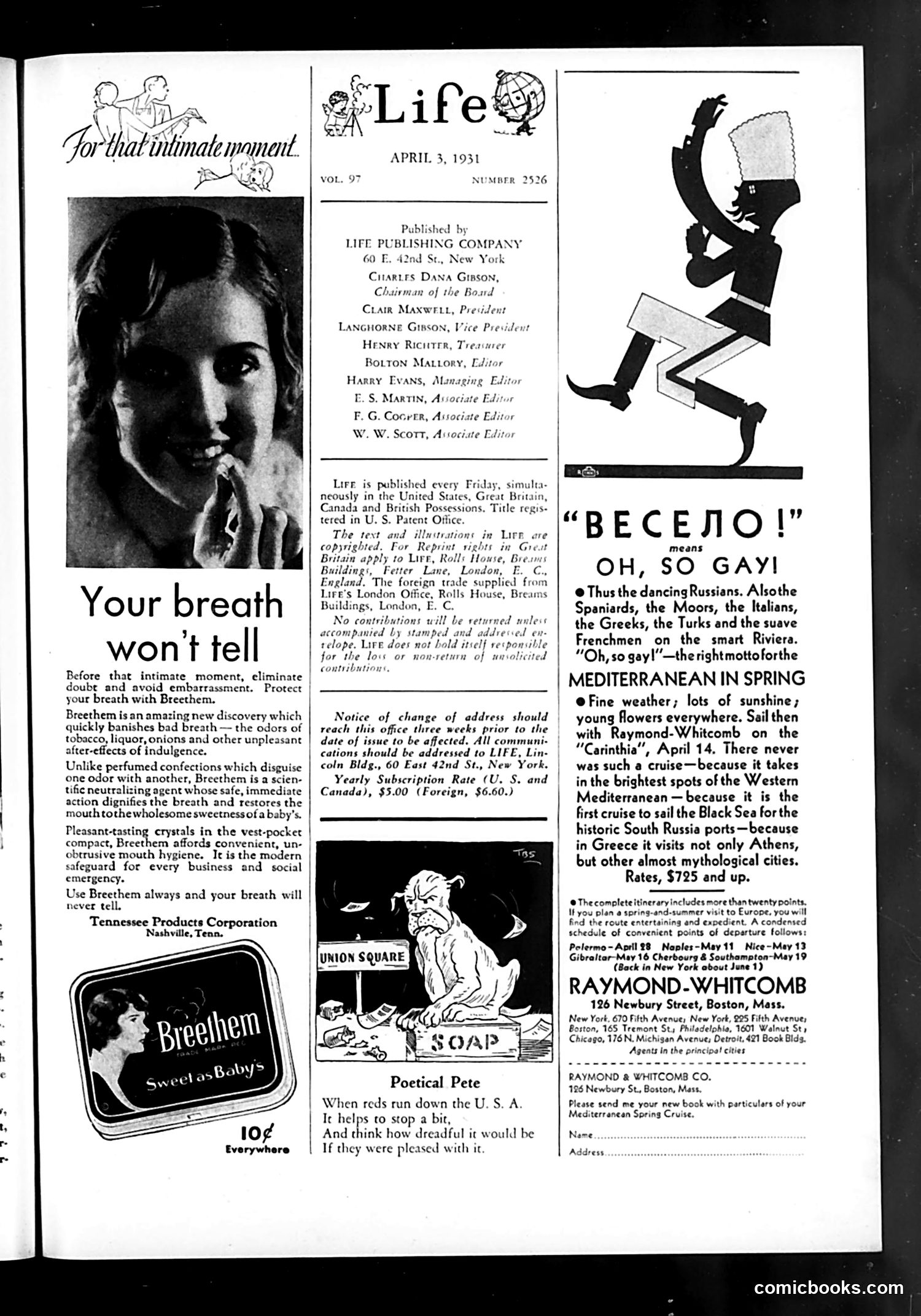
# Content Analysis: Life Magazine, April 3, 1931 This is primarily a **title/contents page** with advertisements rather than satirical cartoons. The main visual content includes: 1. **"Your Breath Won't Tell"** - A Breethem breath mint advertisement emphasizing discretion about alcohol consumption, reflecting Prohibition-era concerns (Prohibition ended December 1933, so this is still relevant). 2. **"Poetical Pete"** - A brief cartoon/poem about stopping red ants, with minimal satirical value. 3. **"Beseдo!" Advertisement** - A Raymond-Whitcomb cruise line ad featuring a stylized dancing Russian figure (referencing the exoticized "Russian" cultural fascination of the 1930s), promoting Mediterranean spring cruises. The page is dominated by **commercial content** rather than political or social satire. The Breethem ad's alcohol reference is the only material with contemporary social commentary.
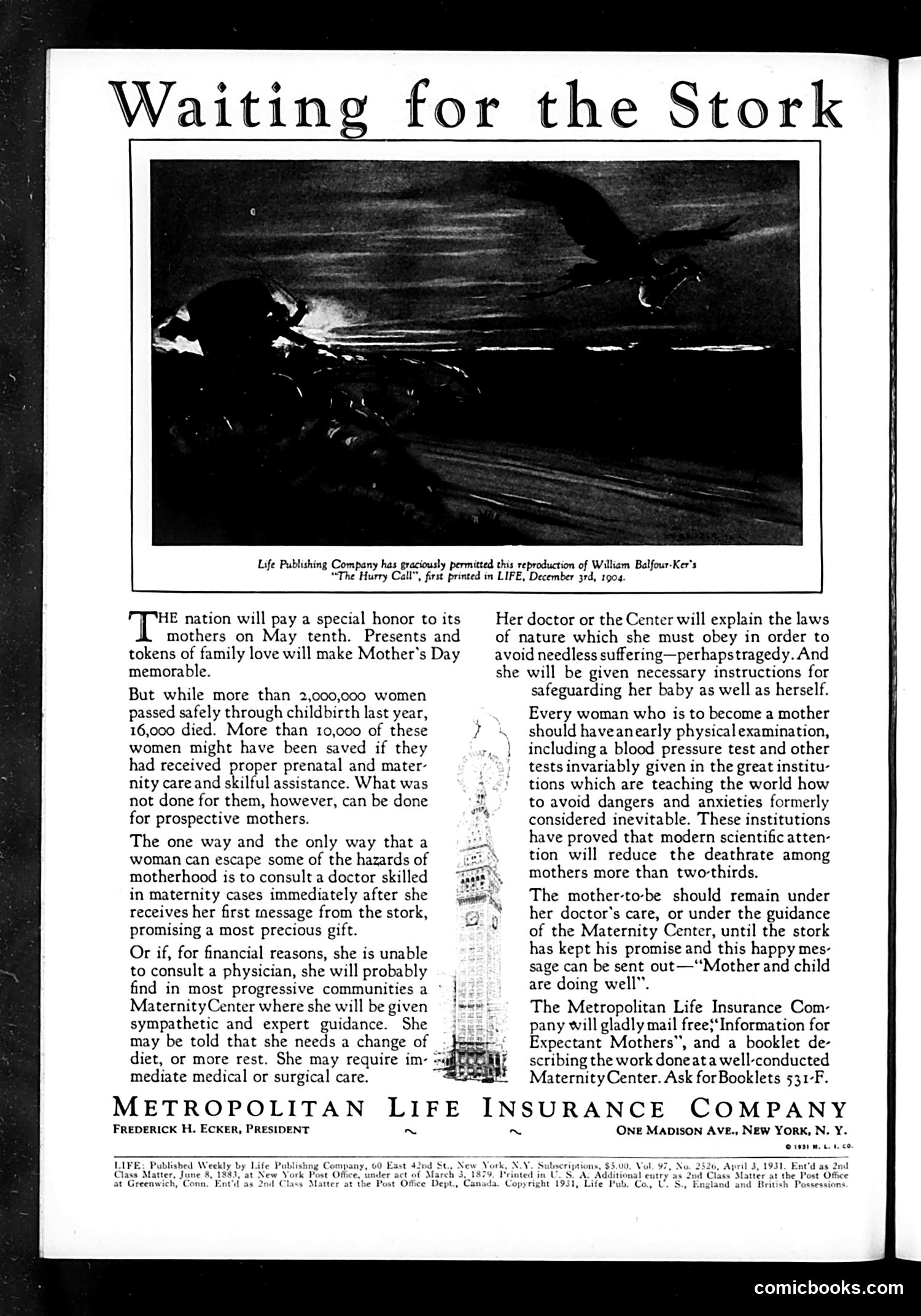
# "Waiting for the Stork" - Analysis This page combines a dramatic illustration with a public health advocacy article. The silhouetted image appears to show an anxious figure awaiting childbirth, likely representing expectant parents or mothers. The text addresses maternal mortality—a significant public health crisis of the era. It notes that over 16,000 women died in childbirth the previous year, many preventable through proper prenatal care. The article advocates for medical consultation, physical examinations, and institutional maternity centers, positioning modern medical science as a solution to "hazards of motherhood." The remainder is a Metropolitan Life Insurance Company advertisement offering free maternal health information to "Expectant Mothers," framing insurance and medical care as interconnected services. This reflects early 20th-century corporate involvement in public health messaging.
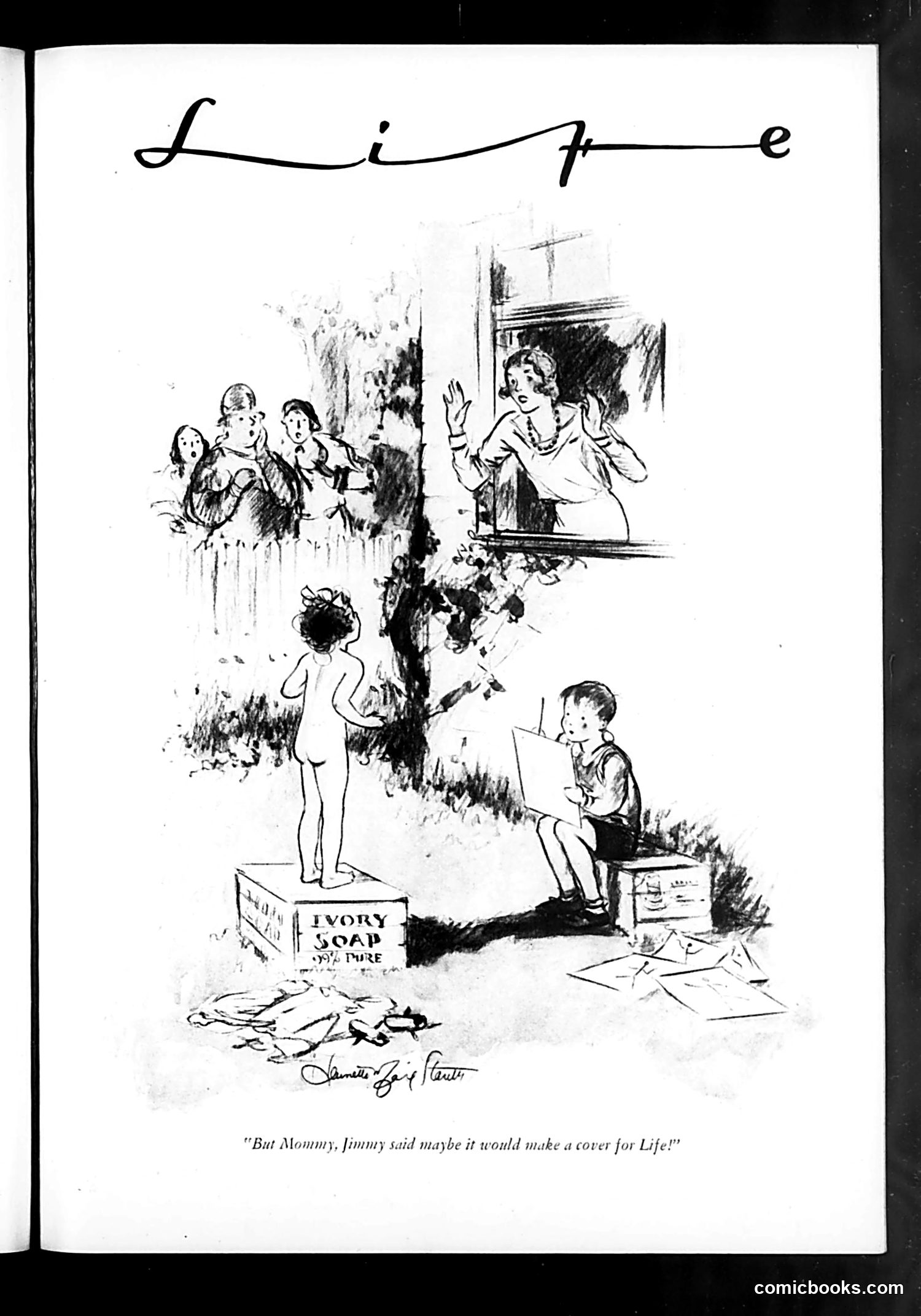
# Analysis of "Life" Magazine Cartoon This is an advertisement for Ivory Soap disguised as humor. Two children stand on soap boxes labeled "Ivory Soap - 99⁴⁄₁₀₀ Pure," appearing to perform or give speeches to an audience visible through a window. The caption reads: "But Mommy, Jimmy said maybe it would make a cover for Life!" The joke plays on double meaning: the children are using soap boxes (literal platforms) while also making a pun on "cover"—both a magazine cover and the soap's cleaning/covering properties. It's gentle satire of advertising's use of children and of Life magazine itself, while promoting Ivory's famous "99.44% pure" purity claim. The cartoon suggests even children recognize advertising's pretensions.
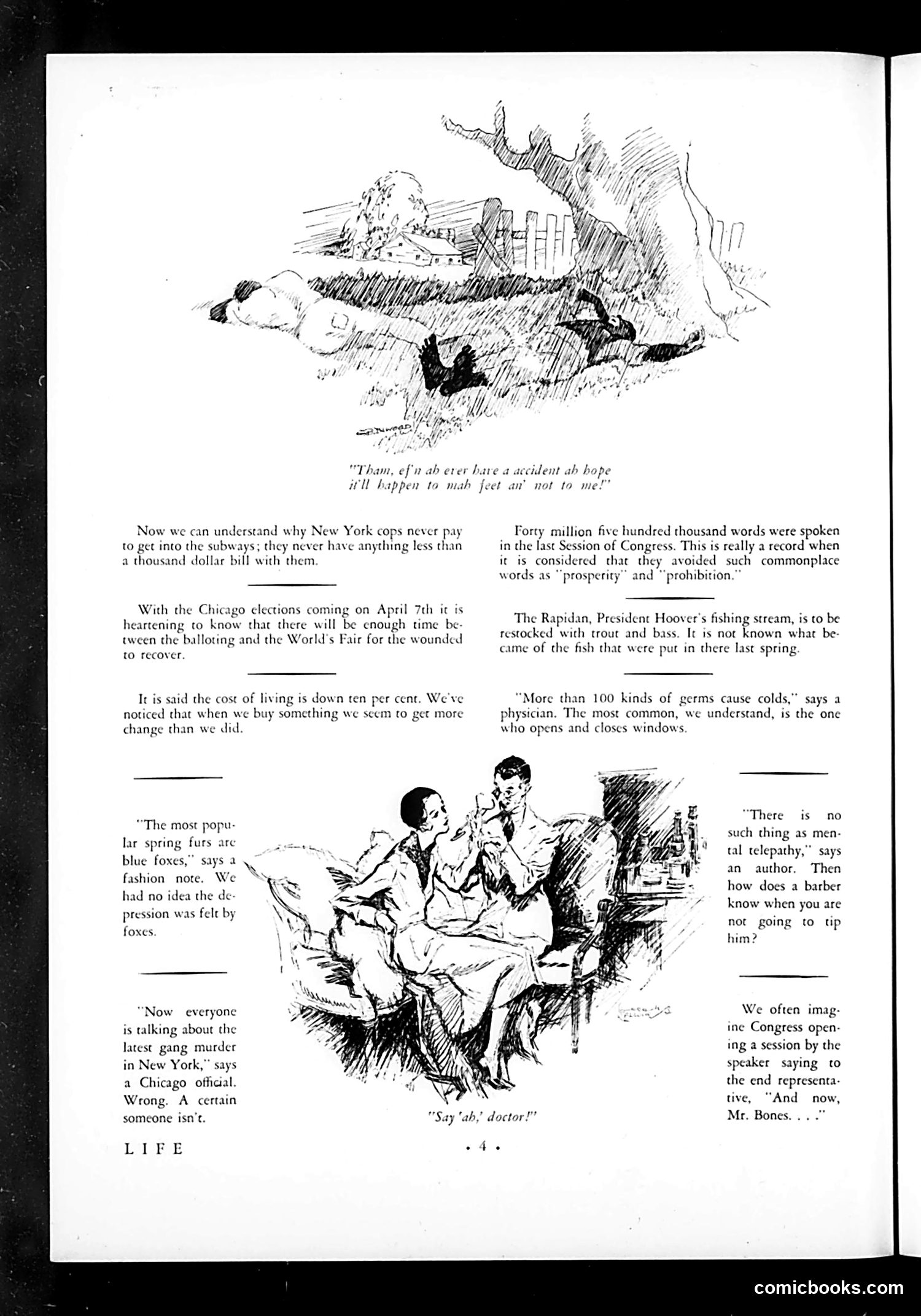
# Analysis of Life Magazine Page This satirical page contains several distinct items: **Top Cartoon**: A rural scene with the quote "Tham, ef u eb eber hae a accident ah hope it'll happen to mah feet an' not to me." The dialect suggests rural/working-class commentary, likely mocking folk wisdom about accidents. **Central Cartoon** ("Say 'ah,' doctor!"): Shows two men—apparently a doctor and patient in consultation. The satire likely concerns medical practice or diagnosis, though the specific reference is unclear. **Text Sections**: Brief satirical commentary on contemporary issues including New York police corruption, Chicago elections, cost of living, spring fashions (blue foxes), Congress proceedings, the Rapidan (Hoover's fishing stream), cold transmission, and tipping etiquette for barbers. The page exemplifies *Life*'s typical format: mixing visual and textual humor targeting current events and social pretensions.
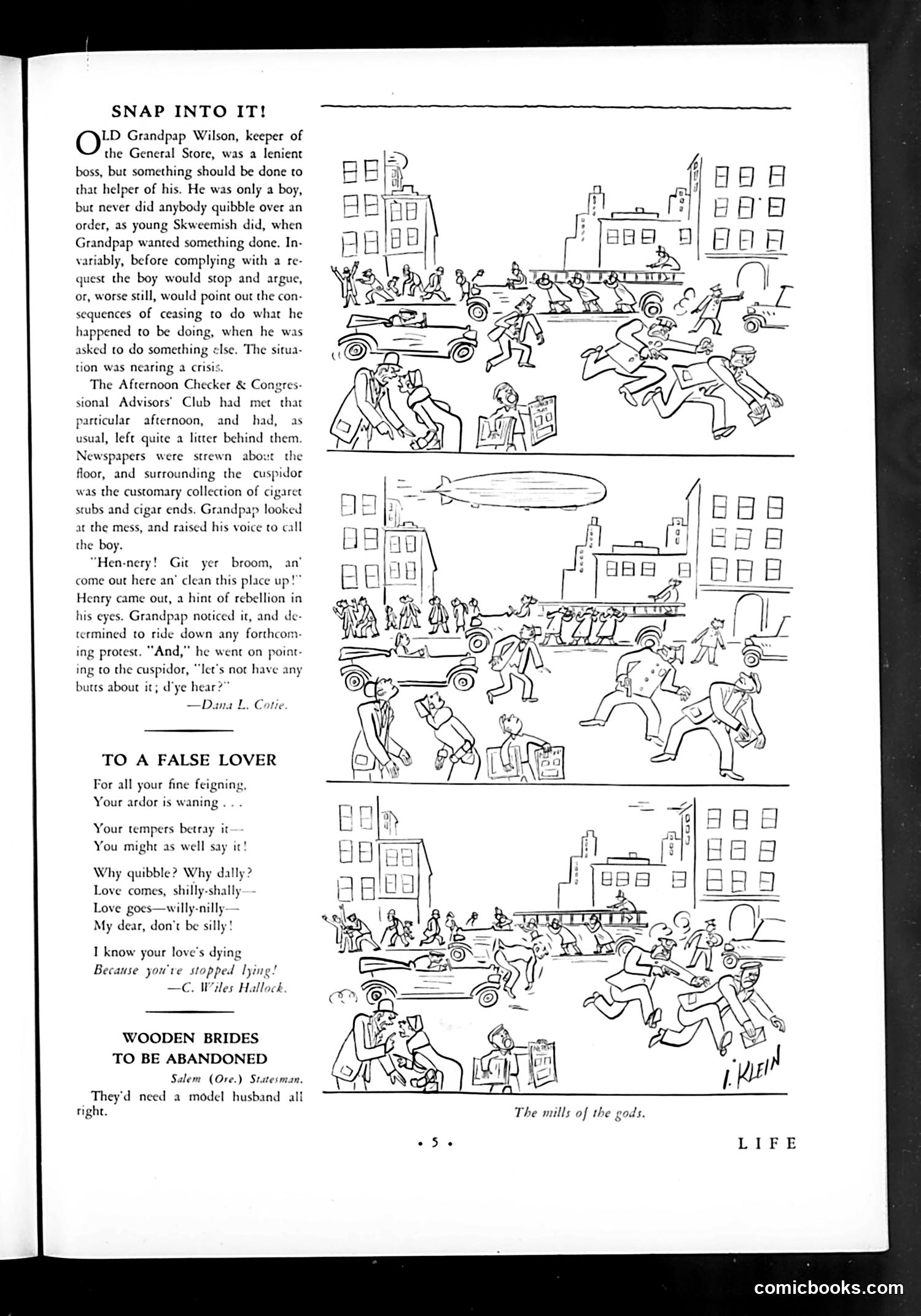
# "Snap Into It!" - Satire of Store Management This comic strip by Riffin satirizes Old Grandpap Wilson, the lenient manager of a General Store, and his conflicts with a boy named Skeweemish (or similar). The story describes how Grandpap never quibbles over orders but also never complies quickly, causing frustration. The narrative mentions an "Afternoon Checker & Congressional Advisers' Club" meeting where newspapers cover the store floor alongside cigar stubs—suggesting both administrative chaos and slovenly conditions. Grandpap orders the boy to clean up ("Git yer broom"), but the boy protests. Grandpap threatens to "rule down any forthcoming protest," determined to impose discipline. The strip humorously depicts the clash between relaxed management and the need for actual workplace standards—a common workplace complaint regardless of era.
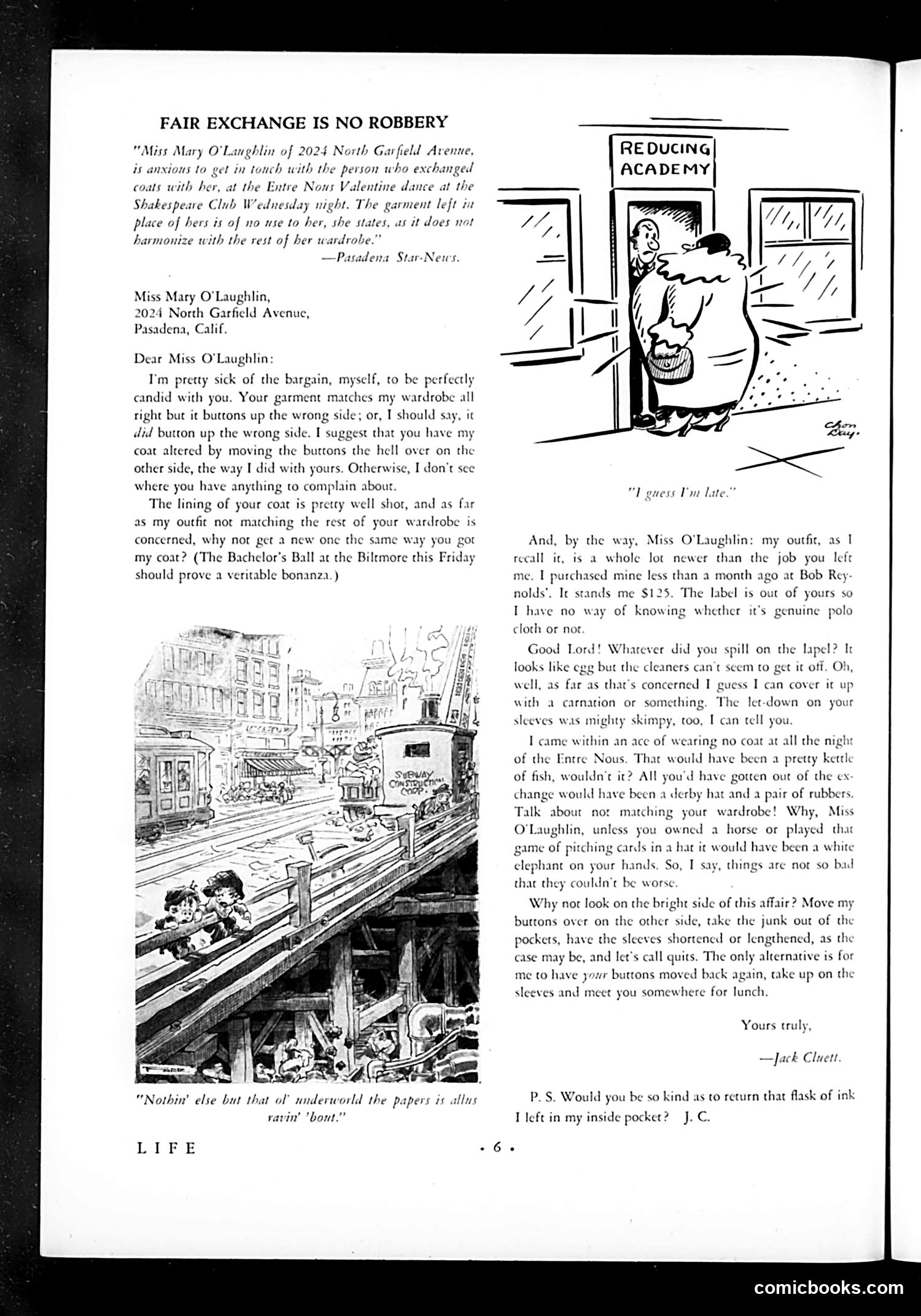
# Analysis This page contains a humorous letter exchange about a clothing swap gone wrong. Miss Mary O'Laughlin of Pasadena exchanged a garment at an "Entre Nous Valentine dance" at the Shakespeare Club, but it didn't match her wardrobe—the buttons were on the wrong side and the lining didn't suit her outfit. Jack Cluett's response is tongue-in-cheek: he suggests she simply move the buttons rather than complain, jokes about worse fashion mishaps (stains, mismatched wardrobes), and proposes they meet for lunch to resolve things. The cartoons illustrate the mild social embarrassment of the mix-up. The satire gently mocks both the fussiness of fashion-conscious socialites and the casual dismissiveness of someone unbothered by wardrobe coordination—typical of Life magazine's mild social commentary on upper-class etiquette.
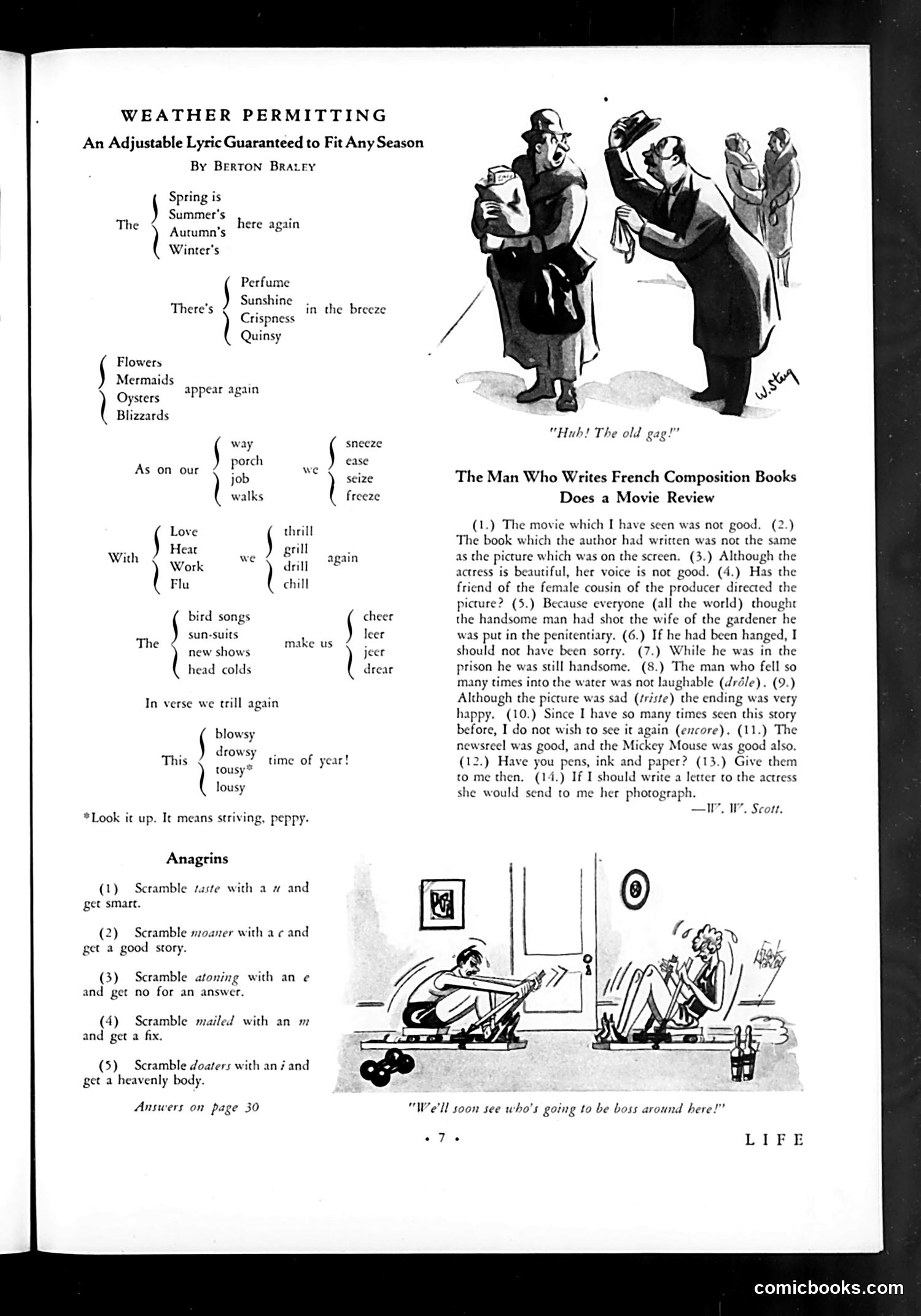
# Analysis of Life Magazine Page 7 This page contains three humor pieces: 1. **"Weather Permitting"** by Berton Braley is a comic poem using fill-in-the-blank structure, allowing readers to insert seasonal words (Spring/Summer/Autumn/Winter) to make the verse adaptable year-round—a clever meta-joke about adjustable humor. 2. **"The Man Who Writes French Composition Books Does a Movie Review"** satirizes awkwardly literal translations. It lists numbered observations (like "Hah! The old gag!") that mimic stilted, grammar-textbook phrasing, mocking how foreign language instructional books produce unnatural English. 3. **"Anagrins"** presents word-scramble wordplay exercises. The bottom cartoon shows someone using exercise equipment while another figure arrives, captioned "We'll soon see who's going to be boss around here!"—suggesting domestic hierarchy concerns through fitness activity.
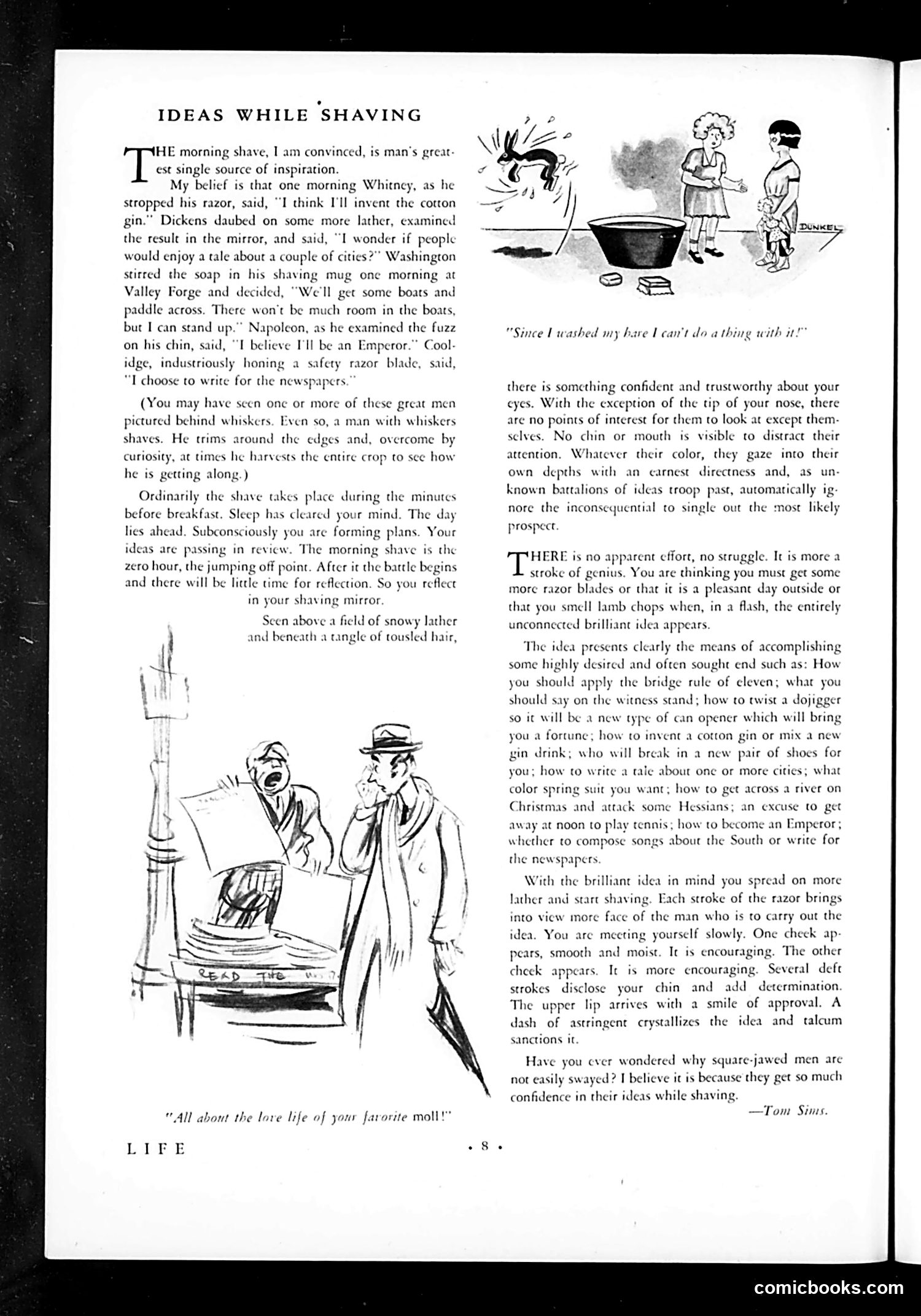
# Analysis of "Ideas While Shaving" This is a humorous essay by Tom Sints about the creative inspiration men experience during their morning shave. The text references historical figures—Eli Whitney (cotton gin inventor), Dickens, Washington, Napoleon, and Coolidge—as examples of great men who had important ideas while shaving. The accompanying cartoons illustrate the theme: one shows a woman saying "Since I washed my hair I can't do a thing with it," while another depicts two men discussing "All about the love life of your favorite moll!" The piece humorously suggests that shaving provides men psychological clarity for creative thinking, contrasting their "confident" demeanor during this ritual with everyday uncertainty. It's a lighthearted commentary on masculine grooming habits and self-confidence.
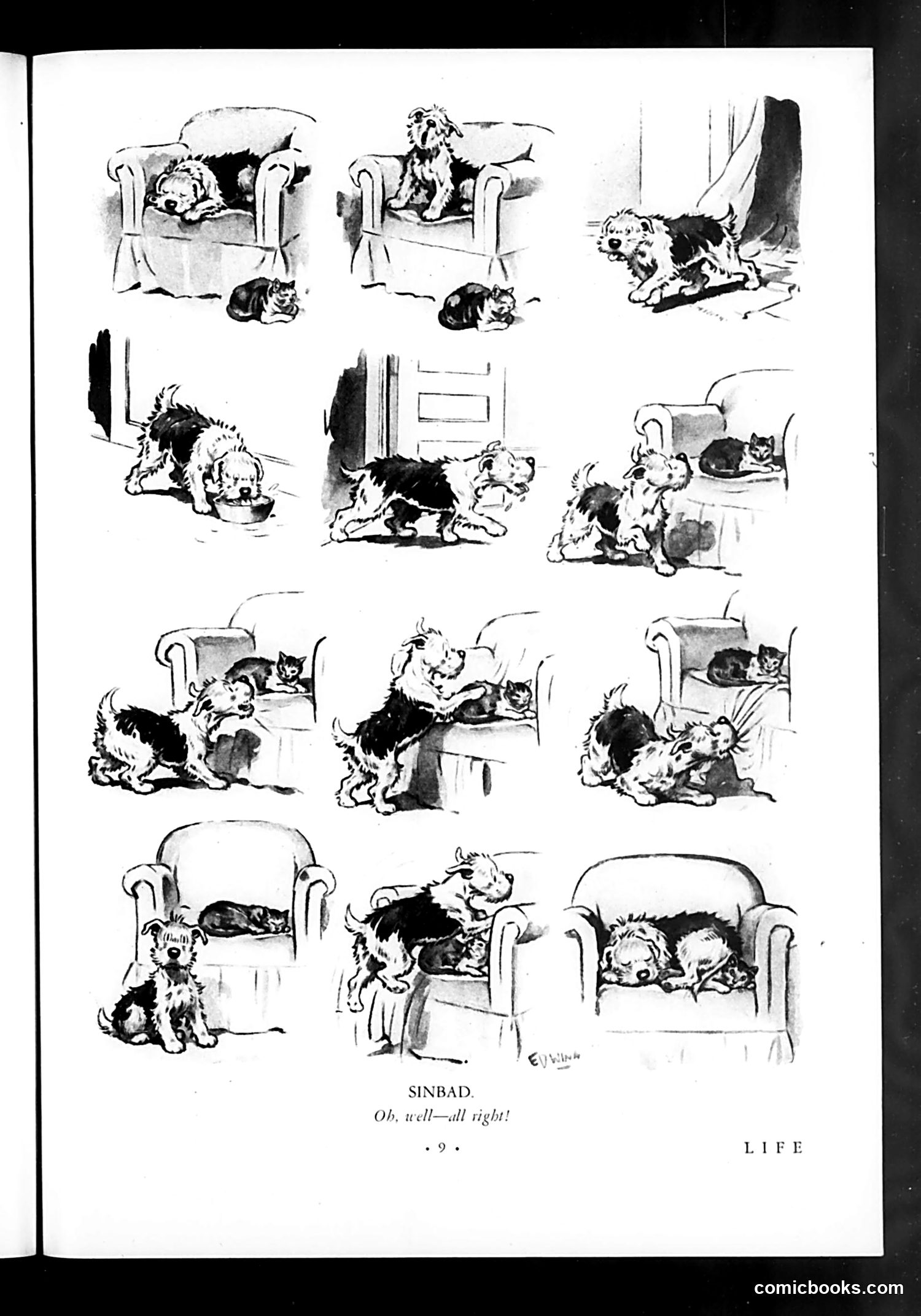
# "Sinbad: Oh, well—all right!" This is a humorous comic strip showing a dog named Sinbad interacting with a cat across twelve panels. The narrative appears to depict a domestic dispute or negotiation between the two pets, culminating in apparent reconciliation on furniture. The title "Oh, well—all right!" suggests Sinbad (the dog) reluctantly agrees to something—likely cohabitation or peaceful coexistence with the cat. The comic plays on the common trope of dogs and cats as natural enemies, here shown learning to share living space and furniture. This appears to be gentle domestic humor rather than political satire, typical of Life magazine's lighter content. It celebrates the animals' eventual tolerance of one another, a relatable scenario for pet-owning readers of the era.
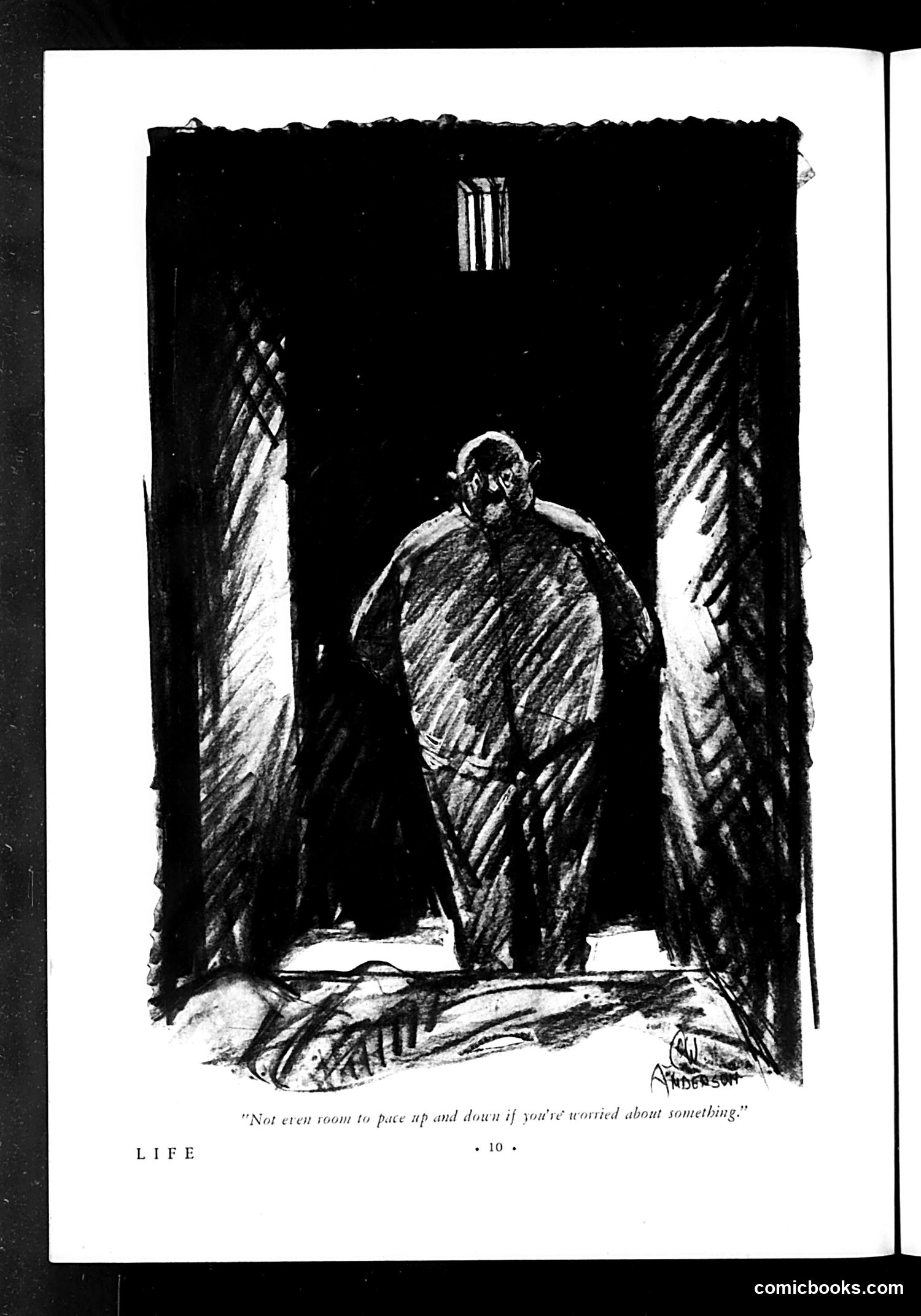
# Analysis This is a single-panel cartoon signed by Anderson, appearing in *Life* magazine (page 10). It depicts a figure standing in a narrow, prison-like corridor or hallway with high walls and barred window, looking troubled or distressed. The caption reads: "Not even room to pace up and down if you're worried about something." The satire appears to be about **confinement and anxiety**—suggesting that worry itself requires physical space and freedom of movement. The cartoon satirizes either literal imprisonment or metaphorical constraint (possibly job stress, financial hardship, or domestic suffocation given the era). The joke's dark humor lies in the grim irony that the worried person is so confined they cannot even perform the nervous habit of pacing. The specific social or political context remains unclear without additional dating or historical markers.